
BT Group’s Cloud Contact Global Edition matters because it packages cloud contact-center software, global voice networking, managed operations, and Microsoft-adjacent workflow integration into a service aimed at large enterprises rather than small support desks. Its importance is not that BT has invented a new category, but that it is trying to make one of the least glamorous pieces of enterprise IT less fragile. For big customer teams, the contact center is where brand promises collide with queue times, outages, compliance rules, and agent churn. BT’s pitch is that the plumbing should become less visible — and that is exactly why it deserves attention.
The old contact center was a place. It had desks, phones, wallboards, supervisors pacing the floor, and a server room whose failure could turn a Monday morning into a public apology. The modern contact center is less a room than a distributed operating system for customer interaction, spanning remote agents, outsourced teams, CRM records, chat channels, call recording, analytics, and routing logic.
That shift changes what buyers should care about. A dashboard matters, but not as much as whether calls arrive, recordings are retained, identity is handled properly, and supervisors can still route work when demand spikes. For a bank, airline, utility, insurer, or public-sector agency, the contact center is no longer a departmental tool. It is operational infrastructure.
BT’s Cloud Contact Global Edition sits in that less glamorous but more consequential layer. It is not trying to win attention with a consumer-style gadget launch. It is aimed at organizations where customer service runs across countries, languages, regulatory regimes, and multiple back-office systems, and where a bad migration can be measured in abandoned calls and newspaper headlines.
That is why “quietly matters” is the right framing. The product is interesting not because every WindowsForum reader will buy it, but because it reflects where enterprise communications is heading: away from isolated PBX-era estates and toward cloud platforms wrapped in connectivity, security, compliance, and managed service contracts.
That is where BT has an advantage over younger, pure-play contact-center vendors. The company already sells network services, managed connectivity, voice infrastructure, security, collaboration, and enterprise support. For a multinational customer, the appeal is not merely “we can host your contact center.” It is “we can take responsibility for the path from customer call to agent desktop.”
This matters because contact-center failure is rarely one clean failure. A call-quality problem may be a carrier issue, a WAN issue, a Teams policy issue, a headset issue, a routing issue, or a CRM integration issue. In a fragmented environment, each vendor can plausibly point at another vendor. BT is trying to make that finger-pointing less attractive by bundling more of the stack under one commercial and operational umbrella.
That bundling is also why the product will not suit everyone. A 40-agent support desk looking for fast deployment and month-to-month SaaS flexibility may find BT’s enterprise machinery too heavy. But a 4,000-agent global operation may see the same machinery as the point.
That makes integration a procurement issue, not just a feature. If agents can work closer to Teams and Dynamics 365, training friction drops. If identity and collaboration fit into existing Microsoft administration patterns, IT has fewer exceptions to govern. If customer interaction history is closer to the CRM record, supervisors and agents spend less time reconciling what happened across disconnected screens.
But the word integration does a lot of work in enterprise sales material. There is a difference between a polished embedded experience, a connector, a certified integration, and a professional-services project that technically makes two systems talk. Buyers should press BT and its partners on exactly what is native, what is configurable, what is custom, and what breaks during upgrades.
For Windows and Microsoft admins, this is the familiar lesson from every “works with Microsoft” promise. The architecture matters. Authentication flows matter. Teams voice policies matter. Data residency matters. Recording and retention matter. Licensing boundaries matter. A contact center that appears inside a Microsoft workflow can still be a separate operational universe behind the scenes.
The upside is real, though. The contact center has historically been one of the places where Microsoft-standard enterprises had to tolerate parallel tooling. BT’s positioning reflects a market assumption that the collaboration suite and the customer-service stack are converging. The agent is not just taking calls; the agent is searching knowledge bases, escalating into Teams, updating CRM records, triggering workflows, and generating post-call summaries.
This is where BT’s network heritage is relevant. The company’s cloud contact-center material emphasizes global voice and data services, cloud contact-center capabilities, multimedia channels, and integration with CRM and legacy platforms. It also points to scale: BT has long positioned its inbound and cloud contact services around very large customer environments and high call volumes.
The practical promise is that a business can move away from aging on-premises contact-center hardware without giving up the operational discipline expected from a carrier-grade environment. That is the part that matters to conservative enterprises. They do not want innovation if it arrives as a downgrade in reliability.
The strongest candidates are organizations where customer contact cannot simply be “best effort.” Airlines during disruption, healthcare providers during demand spikes, banks during fraud events, and government agencies during service deadlines all live or die by capacity and routing. In those environments, a contact center is closer to emergency infrastructure than office software.
BT’s challenge is to make that resilience feel real in procurement and in operations. Service-level agreements are useful, but they do not answer every question. Customers need to understand failover patterns, regional dependencies, incident processes, administrative controls, escalation paths, and how cloud upgrades are staged. The cloud does not eliminate operational risk; it moves it into a different contract.
BT’s cloud contact-center portfolio talks in the language the market now expects: multimedia interaction, omnichannel routing, CRM integration, analytics, and intelligent handling. That is table stakes in 2026. If a contact-center product cannot present agents with a unified view of customer interaction, it is not modern; it is merely hosted.
The difficulty is that “omnichannel” often collapses under the weight of real-world process. A customer may start in a chatbot, move to live chat, be asked to call, repeat the issue to an agent, receive an email, and then reopen the case through a portal. If each channel has its own queue logic and reporting model, the enterprise has not built an omnichannel contact center. It has built a prettier maze.
BT’s value proposition depends on reducing that maze. The service is meant to give agents and supervisors a more coherent environment, with routing based on skill, priority, customer identity, or business rules. Done well, that is not just a customer-experience improvement. It is a labor-efficiency improvement, because agents spend less time hunting context and supervisors spend less time manually compensating for bad flow design.
The annoyance is that many large organizations bring their own complexity. They have inherited CRMs, regional ticketing systems, bespoke IVRs, outsourced service partners, legacy reporting, and politically sensitive departmental workflows. A cloud service can simplify the platform, but it cannot magically simplify the organization.
Intelligent routing can send a customer to the agent most likely to resolve the issue. Speech analytics can reveal which complaints are rising before they become public problems. Agent-assist features can surface knowledge articles during a call. Summarization can reduce after-call work. Supervisors can use analytics to understand not just how long calls take, but why they happen.
Those are useful capabilities, but they are not a substitute for process maturity. AI that summarizes a bad process only produces a neat record of dysfunction. AI that routes customers using poor-quality data can automate unfairness or inefficiency. AI that flags sentiment without context can become another noisy metric supervisors learn to ignore.
For regulated sectors, the governance questions are just as important as the feature list. Where are transcripts stored? Who can search them? Are recordings used for model training? How are redactions handled? Can the business explain automated routing decisions? How does the system deal with protected characteristics, vulnerable customers, or legally sensitive conversations?
BT’s opportunity is to position AI as part of a managed, controlled environment rather than a loose collection of features. That could be compelling for enterprises that want productivity gains but cannot tolerate consumer-grade experimentation in customer service. The winners in this space will not be the vendors with the loudest AI demos. They will be the vendors whose AI survives audit, procurement, and daily supervisor use.
Legacy systems also contain hidden business logic. A routing rule created eight years ago may exist because one regional office had a staffing problem. A custom report may feed a finance process nobody has documented. A call-flow exception may exist because a regulator once complained. Moving to the cloud forces those decisions into daylight.
That is healthy in the long run, but painful in the short run. Enterprises may discover that some bespoke features are too expensive to recreate, not worth recreating, or incompatible with a standardized cloud model. The phrase “digital transformation” sounds cleaner than the actual work of deciding which old habits deserve to die.
BT can reduce that pain with managed services, experience, and network control. It cannot remove the need for customer-side ownership. A contact-center migration without strong business sponsors becomes an IT project that accidentally redesigns customer service. That is how organizations end up with technically successful deployments that agents quietly hate.
The agent experience matters more than many executives admit. If the new desktop adds clicks, hides context, or makes common tasks slower, agents will find workarounds. If supervisors cannot trust reporting during the transition, they will rebuild shadow spreadsheets. If training is rushed, the customer hears the confusion first.
For large organizations, this can be an advantage. Predictable contracts, service commitments, consolidated billing, and a single accountable provider are valuable when the contact center is mission-critical. Procurement teams can negotiate terms, security teams can assess the full stack, and operations teams can define escalation processes.
For smaller or fast-changing teams, the same model can feel rigid. If headcount fluctuates wildly, if the business wants to experiment quickly with a new channel, or if the contact center is still evolving, a heavyweight managed-service contract may feel like buying a train when you need a van. The product’s strengths and weaknesses come from the same enterprise DNA.
This is an important distinction in a market full of misleading comparisons. A lightweight cloud contact-center tool may look cheaper and faster in a demo. It may also leave the customer responsible for carrier relationships, network quality, security integration, compliance mapping, and support coordination. BT’s offer is not merely software; it is software plus operational wrapping.
The buying decision should therefore start with operating model, not feature checklists. If the enterprise wants control, speed, and direct configuration, it may prefer a more modular CCaaS platform. If it wants a managed global service tied into networking and Microsoft-heavy workflows, BT becomes more interesting.
That boundary affects daily operations. Who changes call-routing policies? Who manages Teams voice integration? Who owns identity and conditional access? Who troubleshoots poor call quality from a remote agent on a home broadband line? Who handles retention policy conflicts between CRM records, call recordings, and collaboration data?
In a well-designed deployment, those boundaries are explicit. BT manages the platform and network components it is contracted to manage, while the customer retains governance over identity, data, business rules, and compliance decisions. In a poor deployment, every incident becomes a meeting.
This is especially important because Microsoft’s own contact-center story has become stronger. Dynamics 365 Contact Center, Teams Phone, Copilot-related features, and the wider Power Platform ecosystem give Microsoft-centric enterprises more native options than they had a few years ago. BT has to show why its managed global approach adds value beyond simply buying more Microsoft licenses.
There is a credible answer: Microsoft provides a platform; BT can provide integration, voice reach, operational management, and enterprise support. But that answer must be proven in architecture diagrams, runbooks, and incident response, not just sales language.
BT’s play is different. It is not trying to be the trendiest CCaaS brand. It is trying to be the safe pair of hands for organizations that already treat communications as critical infrastructure. That is a narrower story, but not a small one.
The danger for BT is that “safe” can become a euphemism for slow. Enterprises want reliability, but they also want faster channel deployment, better analytics, AI assistance, and easier integration with modern customer-data platforms. If BT’s service feels too dependent on bespoke implementation cycles, it risks looking like old telecom wearing cloud clothes.
The opportunity is that many enterprises are tired of fragmented SaaS sprawl. They have bought best-of-breed tools for years and are now dealing with integration debt, overlapping analytics, inconsistent identity controls, and unclear accountability. A managed contact-center service tied to global networking and Microsoft workflows can look newly attractive in that environment.
BT does not need to win every contact-center buyer. It needs to win the ones whose problems are global, regulated, voice-heavy, Microsoft-adjacent, and operationally unforgiving. That is a defensible niche — and in enterprise technology, defensible niches can be very large.
The service will shine if BT can deliver consistent voice quality, coherent omnichannel routing, useful analytics, strong Microsoft integration, and clear operational accountability across regions. It will annoy if customers encounter opaque pricing, slow change processes, unclear admin boundaries, or integrations that require more professional services than expected.
The most concrete lessons for buyers are straightforward:
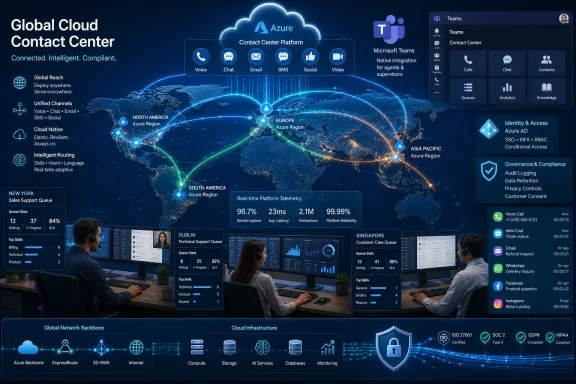 The Contact Center Has Become Infrastructure, Not Just Software
The old contact center was a place. It had desks, phones, wallboards, supervisors pacing the floor, and a server room whose failure could turn a Monday morning into a public apology. The modern contact center is less a room than a distributed operating system for customer interaction, spanning remote agents, outsourced teams, CRM records, chat channels, call recording, analytics, and routing logic.That shift changes what buyers should care about. A dashboard matters, but not as much as whether calls arrive, recordings are retained, identity is handled properly, and supervisors can still route work when demand spikes. For a bank, airline, utility, insurer, or public-sector agency, the contact center is no longer a departmental tool. It is operational infrastructure.
BT’s Cloud Contact Global Edition sits in that less glamorous but more consequential layer. It is not trying to win attention with a consumer-style gadget launch. It is aimed at organizations where customer service runs across countries, languages, regulatory regimes, and multiple back-office systems, and where a bad migration can be measured in abandoned calls and newspaper headlines.
That is why “quietly matters” is the right framing. The product is interesting not because every WindowsForum reader will buy it, but because it reflects where enterprise communications is heading: away from isolated PBX-era estates and toward cloud platforms wrapped in connectivity, security, compliance, and managed service contracts.
BT Is Selling Fewer Boxes and More Accountability
BT’s strongest argument is not that cloud contact-center software exists. Everyone in the market can say that. The bigger argument is that large enterprises often do not want another standalone SaaS console to manage; they want someone to own the messy middle between voice networks, cloud apps, Microsoft collaboration tools, security policy, and service levels.That is where BT has an advantage over younger, pure-play contact-center vendors. The company already sells network services, managed connectivity, voice infrastructure, security, collaboration, and enterprise support. For a multinational customer, the appeal is not merely “we can host your contact center.” It is “we can take responsibility for the path from customer call to agent desktop.”
This matters because contact-center failure is rarely one clean failure. A call-quality problem may be a carrier issue, a WAN issue, a Teams policy issue, a headset issue, a routing issue, or a CRM integration issue. In a fragmented environment, each vendor can plausibly point at another vendor. BT is trying to make that finger-pointing less attractive by bundling more of the stack under one commercial and operational umbrella.
That bundling is also why the product will not suit everyone. A 40-agent support desk looking for fast deployment and month-to-month SaaS flexibility may find BT’s enterprise machinery too heavy. But a 4,000-agent global operation may see the same machinery as the point.
Microsoft Integration Is the Practical Hook, Not the Whole Story
The Microsoft angle is easy to overstate and too important to ignore. Enterprises have spent years standardizing around Microsoft 365, Teams, Entra ID, and Dynamics 365. For many organizations, the agent desktop is already a Microsoft-heavy environment before a contact-center project even begins.That makes integration a procurement issue, not just a feature. If agents can work closer to Teams and Dynamics 365, training friction drops. If identity and collaboration fit into existing Microsoft administration patterns, IT has fewer exceptions to govern. If customer interaction history is closer to the CRM record, supervisors and agents spend less time reconciling what happened across disconnected screens.
But the word integration does a lot of work in enterprise sales material. There is a difference between a polished embedded experience, a connector, a certified integration, and a professional-services project that technically makes two systems talk. Buyers should press BT and its partners on exactly what is native, what is configurable, what is custom, and what breaks during upgrades.
For Windows and Microsoft admins, this is the familiar lesson from every “works with Microsoft” promise. The architecture matters. Authentication flows matter. Teams voice policies matter. Data residency matters. Recording and retention matter. Licensing boundaries matter. A contact center that appears inside a Microsoft workflow can still be a separate operational universe behind the scenes.
The upside is real, though. The contact center has historically been one of the places where Microsoft-standard enterprises had to tolerate parallel tooling. BT’s positioning reflects a market assumption that the collaboration suite and the customer-service stack are converging. The agent is not just taking calls; the agent is searching knowledge bases, escalating into Teams, updating CRM records, triggering workflows, and generating post-call summaries.
Global Reach Is Where the Boring Stuff Becomes Strategic
The “Global Edition” framing is important because contact centers become harder as they become more distributed. A single-country deployment can be complicated enough. A multinational deployment adds regional telecom rules, language routing, local numbers, data-protection requirements, latency concerns, recording consent rules, and support coverage across time zones.This is where BT’s network heritage is relevant. The company’s cloud contact-center material emphasizes global voice and data services, cloud contact-center capabilities, multimedia channels, and integration with CRM and legacy platforms. It also points to scale: BT has long positioned its inbound and cloud contact services around very large customer environments and high call volumes.
The practical promise is that a business can move away from aging on-premises contact-center hardware without giving up the operational discipline expected from a carrier-grade environment. That is the part that matters to conservative enterprises. They do not want innovation if it arrives as a downgrade in reliability.
The strongest candidates are organizations where customer contact cannot simply be “best effort.” Airlines during disruption, healthcare providers during demand spikes, banks during fraud events, and government agencies during service deadlines all live or die by capacity and routing. In those environments, a contact center is closer to emergency infrastructure than office software.
BT’s challenge is to make that resilience feel real in procurement and in operations. Service-level agreements are useful, but they do not answer every question. Customers need to understand failover patterns, regional dependencies, incident processes, administrative controls, escalation paths, and how cloud upgrades are staged. The cloud does not eliminate operational risk; it moves it into a different contract.
Omnichannel Is Now the Entry Fee
Voice is still central to many high-stakes customer interactions, but it is no longer enough. Customers expect to move among phone, web chat, email, messaging, SMS, and sometimes social channels without starting over every time. That expectation is easy to describe and hard to deliver.BT’s cloud contact-center portfolio talks in the language the market now expects: multimedia interaction, omnichannel routing, CRM integration, analytics, and intelligent handling. That is table stakes in 2026. If a contact-center product cannot present agents with a unified view of customer interaction, it is not modern; it is merely hosted.
The difficulty is that “omnichannel” often collapses under the weight of real-world process. A customer may start in a chatbot, move to live chat, be asked to call, repeat the issue to an agent, receive an email, and then reopen the case through a portal. If each channel has its own queue logic and reporting model, the enterprise has not built an omnichannel contact center. It has built a prettier maze.
BT’s value proposition depends on reducing that maze. The service is meant to give agents and supervisors a more coherent environment, with routing based on skill, priority, customer identity, or business rules. Done well, that is not just a customer-experience improvement. It is a labor-efficiency improvement, because agents spend less time hunting context and supervisors spend less time manually compensating for bad flow design.
The annoyance is that many large organizations bring their own complexity. They have inherited CRMs, regional ticketing systems, bespoke IVRs, outsourced service partners, legacy reporting, and politically sensitive departmental workflows. A cloud service can simplify the platform, but it cannot magically simplify the organization.
AI Helps Most When It Stops Pretending to Be Magic
No enterprise communications product can avoid AI now. Contact centers are especially tempting because they generate huge volumes of structured and semi-structured interaction data: calls, transcripts, chats, dispositions, sentiment markers, case notes, and resolution codes. The use cases are obvious.Intelligent routing can send a customer to the agent most likely to resolve the issue. Speech analytics can reveal which complaints are rising before they become public problems. Agent-assist features can surface knowledge articles during a call. Summarization can reduce after-call work. Supervisors can use analytics to understand not just how long calls take, but why they happen.
Those are useful capabilities, but they are not a substitute for process maturity. AI that summarizes a bad process only produces a neat record of dysfunction. AI that routes customers using poor-quality data can automate unfairness or inefficiency. AI that flags sentiment without context can become another noisy metric supervisors learn to ignore.
For regulated sectors, the governance questions are just as important as the feature list. Where are transcripts stored? Who can search them? Are recordings used for model training? How are redactions handled? Can the business explain automated routing decisions? How does the system deal with protected characteristics, vulnerable customers, or legally sensitive conversations?
BT’s opportunity is to position AI as part of a managed, controlled environment rather than a loose collection of features. That could be compelling for enterprises that want productivity gains but cannot tolerate consumer-grade experimentation in customer service. The winners in this space will not be the vendors with the loudest AI demos. They will be the vendors whose AI survives audit, procurement, and daily supervisor use.
The Migration Pain Is Real, and BT Cannot Wish It Away
The biggest frustration with Cloud Contact Global Edition is likely to appear before the service proves its value. Migration from an old contact-center estate is rarely clean. It involves telephony, numbers, routing trees, IVR scripts, workforce management, CRM integration, reporting, call recording, quality management, training, disaster recovery, and sometimes union or works-council considerations.Legacy systems also contain hidden business logic. A routing rule created eight years ago may exist because one regional office had a staffing problem. A custom report may feed a finance process nobody has documented. A call-flow exception may exist because a regulator once complained. Moving to the cloud forces those decisions into daylight.
That is healthy in the long run, but painful in the short run. Enterprises may discover that some bespoke features are too expensive to recreate, not worth recreating, or incompatible with a standardized cloud model. The phrase “digital transformation” sounds cleaner than the actual work of deciding which old habits deserve to die.
BT can reduce that pain with managed services, experience, and network control. It cannot remove the need for customer-side ownership. A contact-center migration without strong business sponsors becomes an IT project that accidentally redesigns customer service. That is how organizations end up with technically successful deployments that agents quietly hate.
The agent experience matters more than many executives admit. If the new desktop adds clicks, hides context, or makes common tasks slower, agents will find workarounds. If supervisors cannot trust reporting during the transition, they will rebuild shadow spreadsheets. If training is rushed, the customer hears the confusion first.
The Pricing Model Favors Stability Over Experimentation
BT does not behave like a self-service SaaS vendor, and buyers should not expect it to. Cloud Contact Global Edition is an enterprise service, typically sold through negotiated contracts rather than transparent online pricing. That model can include per-agent, per-channel, per-interaction, managed service, connectivity, and support elements depending on the deal.For large organizations, this can be an advantage. Predictable contracts, service commitments, consolidated billing, and a single accountable provider are valuable when the contact center is mission-critical. Procurement teams can negotiate terms, security teams can assess the full stack, and operations teams can define escalation processes.
For smaller or fast-changing teams, the same model can feel rigid. If headcount fluctuates wildly, if the business wants to experiment quickly with a new channel, or if the contact center is still evolving, a heavyweight managed-service contract may feel like buying a train when you need a van. The product’s strengths and weaknesses come from the same enterprise DNA.
This is an important distinction in a market full of misleading comparisons. A lightweight cloud contact-center tool may look cheaper and faster in a demo. It may also leave the customer responsible for carrier relationships, network quality, security integration, compliance mapping, and support coordination. BT’s offer is not merely software; it is software plus operational wrapping.
The buying decision should therefore start with operating model, not feature checklists. If the enterprise wants control, speed, and direct configuration, it may prefer a more modular CCaaS platform. If it wants a managed global service tied into networking and Microsoft-heavy workflows, BT becomes more interesting.
Windows Shops Should Watch the Admin Boundary
WindowsForum readers will naturally view this through the Microsoft estate. The relevant question is not whether BT can integrate with Microsoft tools in a broad sense. It is where the administrative boundary lands between BT-managed services and the customer’s Microsoft tenant.That boundary affects daily operations. Who changes call-routing policies? Who manages Teams voice integration? Who owns identity and conditional access? Who troubleshoots poor call quality from a remote agent on a home broadband line? Who handles retention policy conflicts between CRM records, call recordings, and collaboration data?
In a well-designed deployment, those boundaries are explicit. BT manages the platform and network components it is contracted to manage, while the customer retains governance over identity, data, business rules, and compliance decisions. In a poor deployment, every incident becomes a meeting.
This is especially important because Microsoft’s own contact-center story has become stronger. Dynamics 365 Contact Center, Teams Phone, Copilot-related features, and the wider Power Platform ecosystem give Microsoft-centric enterprises more native options than they had a few years ago. BT has to show why its managed global approach adds value beyond simply buying more Microsoft licenses.
There is a credible answer: Microsoft provides a platform; BT can provide integration, voice reach, operational management, and enterprise support. But that answer must be proven in architecture diagrams, runbooks, and incident response, not just sales language.
The Competitive Field Is Crowded, but BT Is Playing a Different Game
The cloud contact-center market is crowded with vendors that specialize in customer experience, workforce engagement, AI automation, and CRM-native service. Some move faster than telecom incumbents. Some have slicker interfaces. Some appeal more naturally to digital-first companies that do not want a managed carrier relationship.BT’s play is different. It is not trying to be the trendiest CCaaS brand. It is trying to be the safe pair of hands for organizations that already treat communications as critical infrastructure. That is a narrower story, but not a small one.
The danger for BT is that “safe” can become a euphemism for slow. Enterprises want reliability, but they also want faster channel deployment, better analytics, AI assistance, and easier integration with modern customer-data platforms. If BT’s service feels too dependent on bespoke implementation cycles, it risks looking like old telecom wearing cloud clothes.
The opportunity is that many enterprises are tired of fragmented SaaS sprawl. They have bought best-of-breed tools for years and are now dealing with integration debt, overlapping analytics, inconsistent identity controls, and unclear accountability. A managed contact-center service tied to global networking and Microsoft workflows can look newly attractive in that environment.
BT does not need to win every contact-center buyer. It needs to win the ones whose problems are global, regulated, voice-heavy, Microsoft-adjacent, and operationally unforgiving. That is a defensible niche — and in enterprise technology, defensible niches can be very large.
The Real Test Comes After the Demo
The demo version of any cloud contact center is tidy. Calls arrive, agents click buttons, dashboards update, AI summarizes the interaction, and the customer journey looks almost humane. Production is where the truth appears.The service will shine if BT can deliver consistent voice quality, coherent omnichannel routing, useful analytics, strong Microsoft integration, and clear operational accountability across regions. It will annoy if customers encounter opaque pricing, slow change processes, unclear admin boundaries, or integrations that require more professional services than expected.
The most concrete lessons for buyers are straightforward:
- Large enterprises should evaluate Cloud Contact Global Edition as an operating model, not just as contact-center software.
- Microsoft integration should be tested against real agent workflows, identity policies, CRM records, and Teams voice requirements before contract signature.
- Migration planning should include legacy call flows, reporting dependencies, recording rules, workforce processes, and agent training rather than treating them as late-stage details.
- AI features should be judged by governance, auditability, and supervisor usefulness, not by demo-friendly summarization alone.
- Smaller teams should compare the service against lighter CCaaS tools because BT’s managed global model may be more structure than they need.
- Regulated and multinational organizations should press hardest on data residency, failover design, incident ownership, and contractual service commitments.
References
- Primary source: AD HOC NEWS
Published: 2026-06-20T04:06:08.353483
Why BT Group’s Cloud Contact Global Edition quietly matters for big customer teams
BT Group’s Cloud Contact Global Edition is not a flashy gadget, but a cloud contact center service built for large, distributed customer teams that need reliability, global reach, and tight Microsoft integration. Where does it shine - and where can it still annoy?www.ad-hoc-news.de - Related coverage: globalservices.bt.com
Cloud contact center | BT
Whether you want to control cost or flexibility, we help you meet your customers’ expectations of excellent customer service globally.www.globalservices.bt.com
- Official source: microsoft.com
Contact Center Pricing | Microsoft Dynamics 365
Discover affordable, scalable Microsoft Dynamics 365 Contact Center pricing with AI and omnichannel capabilities—pricing plans for every business need.www.microsoft.com
- Official source: learn.microsoft.com
Use Microsoft Teams phone in Dynamics 365 Contact Center | Microsoft Learn
Integrate your existing Teams Phone system with Dynamics 365 Contact Center to simplify the voice call configuration.learn.microsoft.com - Related coverage: randgroup.com
Microsoft Dynamics 365 Contact Center implementation guide | Rand Group
Read our Dynamics 365 Contact Center implementation guide to explore costs, timelines, licensing, and best practices. www.randgroup.com
- Related coverage: cisco.com
Contact Center Solutions, Customer Service Platform
Improve customer service, empower agents, and deliver personalized customer experiences with Cisco Contact Center and cloud contact center solutions.www.cisco.com
- Official source: marketplace.microsoft.com
Webex Contact Center for Microsoft Teams
Webex Contact Center integration for Microsoft Teamsmarketplace.microsoft.com
- Related coverage: business.bt.com
Webex for Cloud Voice | BT Business
Learn about the BT Cloud Voice service with Cisco Webex. Make and receive audio and video calls.business.bt.com
