

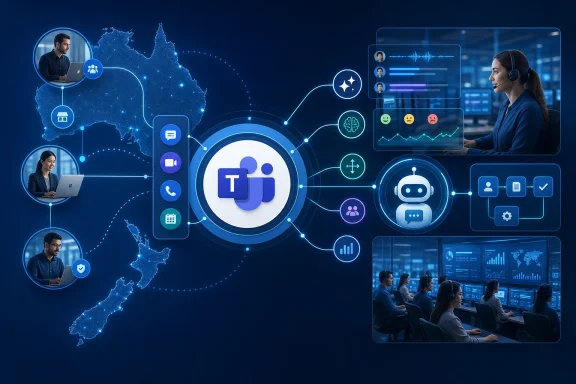
Tech Data, a TD SYNNEX company, announced on June 9, 2026, that it has formed a strategic partnership with AnywhereNow to distribute Microsoft Teams-native customer experience software to channel partners across Australia and New Zealand. The deal is not a consumer-facing Windows story, but it lands squarely in the Microsoft ecosystem that WindowsForum readers live in every day. It shows how Teams is being stretched from meeting app into customer-service infrastructure, and how distributors are turning Microsoft familiarity into a sales argument for AI-era contact centers.
The most important part of this agreement is not that Tech Data has added another vendor to its ANZ portfolio. Distributors do that constantly. The more interesting point is the pitch: businesses can modernize customer service without ripping out the Microsoft estate they already bought, deployed, secured, and trained users to live inside.
That is a powerful argument in 2026. Many organizations standardized on Microsoft 365, Azure, and Teams during the cloud migration and hybrid-work surge of the past several years. Now those same organizations are being asked to fund AI, improve customer experience, reduce costs, and keep cyber risk contained, often with teams that are already stretched thin.
AnywhereNow’s proposition is that contact center and customer engagement functions can be layered onto Teams rather than launched as a separate universe. Its portfolio includes Dialogue Cloud, Deepdesk, and Tendfor, with features spanning omnichannel interaction management, virtual agents, AI-derived insight, contact center operations, and reception workflows. In plain English, the company wants Teams to become the operating surface for customer conversations, not just internal collaboration.
For resellers and managed service providers, that turns a difficult transformation sale into a lower-friction extension sale. Instead of asking customers to adopt a new communications stack, partners can argue that they are improving the one already embedded in daily work.
That matters because ANZ is a geography where partner reach can determine whether a specialist software vendor becomes visible or remains niche. Australia and New Zealand have sophisticated enterprise IT markets, but they also have distributed customer bases, uneven skills availability, and a heavy reliance on partner-led implementation. A vendor with a good Teams integration still needs local commercial and technical muscle to turn that integration into deployments.
The agreement gives AnywhereNow access to Tech Data’s Microsoft-oriented partner ecosystem. In return, Tech Data gets a more complete customer-experience story to sell into organizations that already see Microsoft as strategic infrastructure. This is the basic logic of modern distribution: the distributor is not just moving licenses, it is packaging complexity into something the channel can repeat.
Robbie Upcroft, Tech Data ANZ’s country general manager, framed the deal around skills shortages, rising customer expectations, and the need to maximize existing technology investments. That wording is familiar, but it is not empty. It describes exactly the situation in which Microsoft-native add-ons become attractive: when budgets are constrained, operational expectations are rising, and IT leaders are wary of big-bang replacement projects.
The common thread is that customer interaction is being pulled toward collaboration infrastructure. In many organizations, agents, subject-matter experts, supervisors, and back-office workers already coordinate through Teams. A customer-service platform that can use that same presence, calling, routing, and workflow environment has an obvious operational appeal.
That does not automatically make Teams the best possible foundation for every contact center. Dedicated CCaaS platforms have years of specialized features around workforce optimization, analytics, routing, compliance, and large-scale service operations. But the market does not always reward the most specialized platform; it often rewards the platform that is already approved by procurement, already known by users, and already integrated with identity and security policies.
AnywhereNow’s bet is that enough organizations now see Microsoft Teams as enterprise plumbing. Once that is true, the sales motion changes. The question becomes less “Should we buy a new customer-experience platform?” and more “How much more can we safely run through Microsoft?”
But the more immediate buying concern is not whether AI can summarize conversations or surface recommended actions. The concern is whether the deployment will disrupt existing service operations. Contact centers are not experimental playgrounds; they are live operational systems where dropped calls, failed routing, and bad reporting become customer-visible problems very quickly.
That is why the Microsoft-native angle is doing so much work here. If a partner can show that the solution fits into Teams, Azure, Microsoft identity, and existing communications patterns, the project feels less like an infrastructure gamble. It becomes a controlled extension of the environment administrators already manage.
This is also where Tech Data’s Tech Centre of Excellence becomes strategically relevant. A distributor that can provide technical resources, procurement support, and licensing guidance reduces the burden on smaller partners trying to enter a more complex customer-experience market. The partnership is not just about software availability; it is about making the offer sellable and deployable through the channel.
The opportunity is obvious. Microsoft has made Teams a standard workplace interface, and third-party vendors can build specialized capabilities on top of that foundation. Contact center vendors can use Microsoft’s reach without having to persuade customers to abandon Microsoft.
The tension is that customers must still evaluate where Microsoft’s platform ends and the partner’s product begins. Support boundaries, data handling, call routing behavior, reporting quality, compliance obligations, and licensing dependencies all matter. A Teams-native contact center may reduce integration friction, but it does not eliminate architecture decisions.
For WindowsForum’s IT-pro audience, that distinction is critical. The phrase “built for Teams” should start a technical review, not end one. Administrators still need to understand identity integration, telephony dependencies, audit trails, retention policies, disaster recovery behavior, and how the product behaves when Teams itself has a service issue.
That is good for partners because it creates a broader account strategy. A managed service provider that already supports Microsoft 365 can talk about contact center modernization. A systems integrator with Teams Phone experience can extend into reception, routing, and customer interaction management. A reseller with cloud licensing relationships can add higher-value services around deployment and optimization.
The risk is that the channel oversells simplicity. “It works with Teams” is not the same as “it is simple.” Contact centers involve business rules, staffing models, reporting expectations, customer channels, escalation paths, and compliance obligations. The technology may fit into Microsoft’s environment, but the operational design still has to be done properly.
That is where the better partners will separate themselves. The weaker sales motion will treat Teams-native CX as an add-on SKU. The stronger one will treat it as a business-process modernization project that happens to avoid a platform replacement.
Teams is especially useful in this fight because it sits at the messy intersection of communications and workflow. Calls, meetings, chat, files, apps, identity, and business-system integrations already pass through it. That gives customer-experience vendors a tempting foundation: instead of forcing agents to jump between systems, bring more service work into the collaboration layer.
The appeal is strongest where organizations already feel platform fatigue. Many enterprises have accumulated separate systems for telephony, chat, CRM, knowledge management, analytics, workforce management, and internal collaboration. Every separate platform brings its own licensing, administration, security review, user training, and integration burden.
AnywhereNow and Tech Data are essentially offering a consolidation story. Not total consolidation, and certainly not magic consolidation, but enough consolidation to sound credible: keep Teams at the center and extend customer-service capability around it.
AI-based interaction insight can help managers understand why customers are contacting the business, where agents are struggling, and which processes are failing. Virtual agents can absorb repetitive requests. Summaries can reduce after-call work. Routing suggestions can help customers reach the right specialist faster.
But these systems also raise familiar concerns. What data is being analyzed? Where is it stored? How are prompts, summaries, and recommendations governed? Can an organization explain how an AI-derived decision influenced a customer interaction? Do agents know when to trust the system and when to override it?
Those questions are not unique to AnywhereNow. They apply to the entire AI customer-experience market. The significance of the Tech Data partnership is that these questions will now arrive through more ANZ channel partners, often attached to Microsoft modernization projects that may already be underway.
That is especially true in Microsoft ecosystems. Many organizations do not scan the entire global contact-center market from first principles. They ask their existing Microsoft partner what will work with their environment, what can be supported locally, and what will not create unnecessary risk. If Tech Data makes AnywhereNow easier for those partners to sell, the product becomes more visible at exactly the moment customers are asking about AI and service modernization.
This is why the deal matters beyond its immediate commercial terms. It reflects how enterprise software increasingly reaches customers: not through standalone product evangelism, but through ecosystem adjacency. If a tool fits the dominant platform and the channel can deliver it, it has a fighting chance.
For AnywhereNow, that is the expansion strategy. For Tech Data, it is portfolio enrichment. For customers, it is another reminder that the Microsoft environment they already run is becoming the anchor point for more business functions.
Administrators should ask how the product handles Teams Phone, Operator Connect, Direct Routing, call queues, presence, recording, compliance, reporting, and failover. They should understand whether the solution introduces separate administrative portals, separate data stores, or separate permission models. They should also test what happens during degraded Microsoft 365 service conditions, because a contact center that depends heavily on Teams inherits at least some of Teams’ operational realities.
Security teams will want clarity on data residency, AI processing, retention, transcript handling, and access control. Customer-service leaders will care about queue visibility, routing logic, supervisor features, analytics, and integration with CRM or ticketing systems. Finance teams will care about licensing assumptions, especially when Microsoft, telephony, and third-party software entitlements intersect.
None of this invalidates the pitch. It simply turns it into a serious enterprise evaluation rather than a slogan. A Teams-native contact center can be the right answer, but it still has to survive the same scrutiny as any other system that touches customers directly.
But reduced fragmentation does not mean fewer decisions. It often means decisions move up the stack. Instead of debating whether to replace a telephony system, organizations debate how deeply to embed customer workflows into Teams. Instead of asking whether to adopt AI, they ask which interactions should be analyzed, summarized, or automated.
That shift favors partners that can speak both Microsoft and customer operations. A pure licensing conversation will not be enough. Customers need help mapping service journeys, governance requirements, reporting needs, and user adoption plans onto the technology.
This is where Tech Data’s channel machinery could matter most. If it helps partners build repeatable deployment practices rather than merely resell software, the agreement could have more durable impact in the ANZ market.
 The Teams Contact Center Pitch Is Really a Migration-Avoidance Pitch
The most important part of this agreement is not that Tech Data has added another vendor to its ANZ portfolio. Distributors do that constantly. The more interesting point is the pitch: businesses can modernize customer service without ripping out the Microsoft estate they already bought, deployed, secured, and trained users to live inside.That is a powerful argument in 2026. Many organizations standardized on Microsoft 365, Azure, and Teams during the cloud migration and hybrid-work surge of the past several years. Now those same organizations are being asked to fund AI, improve customer experience, reduce costs, and keep cyber risk contained, often with teams that are already stretched thin.
AnywhereNow’s proposition is that contact center and customer engagement functions can be layered onto Teams rather than launched as a separate universe. Its portfolio includes Dialogue Cloud, Deepdesk, and Tendfor, with features spanning omnichannel interaction management, virtual agents, AI-derived insight, contact center operations, and reception workflows. In plain English, the company wants Teams to become the operating surface for customer conversations, not just internal collaboration.
For resellers and managed service providers, that turns a difficult transformation sale into a lower-friction extension sale. Instead of asking customers to adopt a new communications stack, partners can argue that they are improving the one already embedded in daily work.
Tech Data Sells the Channel What Microsoft Already Made Familiar
Tech Data’s role is not merely to list AnywhereNow software in a catalog. The company is being positioned as the route to market, the licensing guide, the technical enabler, and the confidence layer for partners that may not have deep contact-center implementation expertise of their own.That matters because ANZ is a geography where partner reach can determine whether a specialist software vendor becomes visible or remains niche. Australia and New Zealand have sophisticated enterprise IT markets, but they also have distributed customer bases, uneven skills availability, and a heavy reliance on partner-led implementation. A vendor with a good Teams integration still needs local commercial and technical muscle to turn that integration into deployments.
The agreement gives AnywhereNow access to Tech Data’s Microsoft-oriented partner ecosystem. In return, Tech Data gets a more complete customer-experience story to sell into organizations that already see Microsoft as strategic infrastructure. This is the basic logic of modern distribution: the distributor is not just moving licenses, it is packaging complexity into something the channel can repeat.
Robbie Upcroft, Tech Data ANZ’s country general manager, framed the deal around skills shortages, rising customer expectations, and the need to maximize existing technology investments. That wording is familiar, but it is not empty. It describes exactly the situation in which Microsoft-native add-ons become attractive: when budgets are constrained, operational expectations are rising, and IT leaders are wary of big-bang replacement projects.
AnywhereNow Is Betting That Teams Has Become Enterprise Plumbing
AnywhereNow’s software portfolio makes sense only if Teams is treated as more than a chat and meeting tool. The company’s Dialogue Cloud is aimed at omnichannel communications and dialogue management. Deepdesk focuses on AI-based insight from interactions. Tendfor targets contact center and attendant-console scenarios inside Teams.The common thread is that customer interaction is being pulled toward collaboration infrastructure. In many organizations, agents, subject-matter experts, supervisors, and back-office workers already coordinate through Teams. A customer-service platform that can use that same presence, calling, routing, and workflow environment has an obvious operational appeal.
That does not automatically make Teams the best possible foundation for every contact center. Dedicated CCaaS platforms have years of specialized features around workforce optimization, analytics, routing, compliance, and large-scale service operations. But the market does not always reward the most specialized platform; it often rewards the platform that is already approved by procurement, already known by users, and already integrated with identity and security policies.
AnywhereNow’s bet is that enough organizations now see Microsoft Teams as enterprise plumbing. Once that is true, the sales motion changes. The question becomes less “Should we buy a new customer-experience platform?” and more “How much more can we safely run through Microsoft?”
AI Is the Hook, But Deployment Risk Is the Real Objection
The announcement leans into AI-powered customer experience, and that is expected. No enterprise software partnership in 2026 arrives without an AI ribbon tied around it. Deepdesk’s AI-based interaction insights and the broader push toward virtual agents give partners a story about productivity, service quality, and better use of customer data.But the more immediate buying concern is not whether AI can summarize conversations or surface recommended actions. The concern is whether the deployment will disrupt existing service operations. Contact centers are not experimental playgrounds; they are live operational systems where dropped calls, failed routing, and bad reporting become customer-visible problems very quickly.
That is why the Microsoft-native angle is doing so much work here. If a partner can show that the solution fits into Teams, Azure, Microsoft identity, and existing communications patterns, the project feels less like an infrastructure gamble. It becomes a controlled extension of the environment administrators already manage.
This is also where Tech Data’s Tech Centre of Excellence becomes strategically relevant. A distributor that can provide technical resources, procurement support, and licensing guidance reduces the burden on smaller partners trying to enter a more complex customer-experience market. The partnership is not just about software availability; it is about making the offer sellable and deployable through the channel.
Microsoft-Native Does Not Mean Microsoft-Free
There is a subtle but important distinction in this market: Microsoft-native does not mean Microsoft-built. AnywhereNow is operating in the ecosystem around Microsoft Teams, not replacing Microsoft’s own stack wholesale. That creates both opportunity and tension.The opportunity is obvious. Microsoft has made Teams a standard workplace interface, and third-party vendors can build specialized capabilities on top of that foundation. Contact center vendors can use Microsoft’s reach without having to persuade customers to abandon Microsoft.
The tension is that customers must still evaluate where Microsoft’s platform ends and the partner’s product begins. Support boundaries, data handling, call routing behavior, reporting quality, compliance obligations, and licensing dependencies all matter. A Teams-native contact center may reduce integration friction, but it does not eliminate architecture decisions.
For WindowsForum’s IT-pro audience, that distinction is critical. The phrase “built for Teams” should start a technical review, not end one. Administrators still need to understand identity integration, telephony dependencies, audit trails, retention policies, disaster recovery behavior, and how the product behaves when Teams itself has a service issue.
The ANZ Channel Gets Another Microsoft-Aligned Wedge
For partners in Australia and New Zealand, the practical value of the deal is a new wedge into existing Microsoft accounts. Customer experience budgets do not always sit with the same people who own endpoint management, Teams administration, or Microsoft 365 licensing. But when the proposed solution is built around Teams, the conversation naturally pulls IT, communications, and service leaders into the same room.That is good for partners because it creates a broader account strategy. A managed service provider that already supports Microsoft 365 can talk about contact center modernization. A systems integrator with Teams Phone experience can extend into reception, routing, and customer interaction management. A reseller with cloud licensing relationships can add higher-value services around deployment and optimization.
The risk is that the channel oversells simplicity. “It works with Teams” is not the same as “it is simple.” Contact centers involve business rules, staffing models, reporting expectations, customer channels, escalation paths, and compliance obligations. The technology may fit into Microsoft’s environment, but the operational design still has to be done properly.
That is where the better partners will separate themselves. The weaker sales motion will treat Teams-native CX as an add-on SKU. The stronger one will treat it as a business-process modernization project that happens to avoid a platform replacement.
Customer Experience Has Become Another Front in the Microsoft Stack War
The broader market context is that customer experience software is increasingly being pulled into the gravitational field of large productivity and cloud platforms. Microsoft is not alone here. Every major enterprise platform wants to be the place where work, data, automation, and AI assistance converge.Teams is especially useful in this fight because it sits at the messy intersection of communications and workflow. Calls, meetings, chat, files, apps, identity, and business-system integrations already pass through it. That gives customer-experience vendors a tempting foundation: instead of forcing agents to jump between systems, bring more service work into the collaboration layer.
The appeal is strongest where organizations already feel platform fatigue. Many enterprises have accumulated separate systems for telephony, chat, CRM, knowledge management, analytics, workforce management, and internal collaboration. Every separate platform brings its own licensing, administration, security review, user training, and integration burden.
AnywhereNow and Tech Data are essentially offering a consolidation story. Not total consolidation, and certainly not magic consolidation, but enough consolidation to sound credible: keep Teams at the center and extend customer-service capability around it.
The Contact Center Is Becoming an AI Test Bed With Consequences
Customer service is one of the most obvious places to apply AI because the work produces huge volumes of text, voice, intent, sentiment, and resolution data. It is also one of the riskiest places to apply AI because errors can immediately affect customers, regulators, and brand trust.AI-based interaction insight can help managers understand why customers are contacting the business, where agents are struggling, and which processes are failing. Virtual agents can absorb repetitive requests. Summaries can reduce after-call work. Routing suggestions can help customers reach the right specialist faster.
But these systems also raise familiar concerns. What data is being analyzed? Where is it stored? How are prompts, summaries, and recommendations governed? Can an organization explain how an AI-derived decision influenced a customer interaction? Do agents know when to trust the system and when to override it?
Those questions are not unique to AnywhereNow. They apply to the entire AI customer-experience market. The significance of the Tech Data partnership is that these questions will now arrive through more ANZ channel partners, often attached to Microsoft modernization projects that may already be underway.
Distribution Deals Are Boring Until They Change the Default Option
On paper, this is a distribution agreement. In practice, distribution agreements can change what smaller and mid-market customers perceive as the default option. A product that was previously known mainly to specialists can become part of the standard partner conversation once a major distributor adds enablement, procurement pathways, and local support.That is especially true in Microsoft ecosystems. Many organizations do not scan the entire global contact-center market from first principles. They ask their existing Microsoft partner what will work with their environment, what can be supported locally, and what will not create unnecessary risk. If Tech Data makes AnywhereNow easier for those partners to sell, the product becomes more visible at exactly the moment customers are asking about AI and service modernization.
This is why the deal matters beyond its immediate commercial terms. It reflects how enterprise software increasingly reaches customers: not through standalone product evangelism, but through ecosystem adjacency. If a tool fits the dominant platform and the channel can deliver it, it has a fighting chance.
For AnywhereNow, that is the expansion strategy. For Tech Data, it is portfolio enrichment. For customers, it is another reminder that the Microsoft environment they already run is becoming the anchor point for more business functions.
Admins Should Read “Native” as a Promise to Verify
The word native is doing a lot of marketing work in Teams-based contact center products. It suggests smooth integration, familiar interfaces, and reduced operational friction. Those may be real advantages, but they should still be validated in the context of each organization’s environment.Administrators should ask how the product handles Teams Phone, Operator Connect, Direct Routing, call queues, presence, recording, compliance, reporting, and failover. They should understand whether the solution introduces separate administrative portals, separate data stores, or separate permission models. They should also test what happens during degraded Microsoft 365 service conditions, because a contact center that depends heavily on Teams inherits at least some of Teams’ operational realities.
Security teams will want clarity on data residency, AI processing, retention, transcript handling, and access control. Customer-service leaders will care about queue visibility, routing logic, supervisor features, analytics, and integration with CRM or ticketing systems. Finance teams will care about licensing assumptions, especially when Microsoft, telephony, and third-party software entitlements intersect.
None of this invalidates the pitch. It simply turns it into a serious enterprise evaluation rather than a slogan. A Teams-native contact center can be the right answer, but it still has to survive the same scrutiny as any other system that touches customers directly.
The Best Case Is Less Fragmentation, Not Fewer Decisions
The strongest argument for the Tech Data-AnywhereNow partnership is that it gives ANZ partners a way to reduce fragmentation for customers already invested in Microsoft. If agents can work inside familiar collaboration tools, if administrators can align the solution with existing identity and security models, and if partners can deploy with local support, the value proposition is real.But reduced fragmentation does not mean fewer decisions. It often means decisions move up the stack. Instead of debating whether to replace a telephony system, organizations debate how deeply to embed customer workflows into Teams. Instead of asking whether to adopt AI, they ask which interactions should be analyzed, summarized, or automated.
That shift favors partners that can speak both Microsoft and customer operations. A pure licensing conversation will not be enough. Customers need help mapping service journeys, governance requirements, reporting needs, and user adoption plans onto the technology.
This is where Tech Data’s channel machinery could matter most. If it helps partners build repeatable deployment practices rather than merely resell software, the agreement could have more durable impact in the ANZ market.
The Concrete Wins and Watchpoints for ANZ Microsoft Shops
The partnership is best understood as a channel acceleration play around Teams-based customer experience, not as a sudden reinvention of the contact-center market. For IT leaders and partners, the immediate implications are practical.- Tech Data will give ANZ partners a new route to sell AnywhereNow’s Microsoft Teams-native customer experience software.
- AnywhereNow gains broader regional reach through a distributor with established Microsoft channel relationships.
- The product pitch is strongest for organizations that want to modernize contact center and reception workflows without replacing their Microsoft-centric environment.
- AI features such as interaction insights and virtual-agent capabilities will attract attention, but governance, data handling, and operational reliability still need close review.
- Partners that combine Microsoft technical depth with customer-service process expertise will be better positioned than those treating the offer as a simple licensing add-on.
- Customers should test the meaning of “native” against their own telephony, compliance, reporting, identity, and resilience requirements before committing.
References
- Primary source: IT Brief Australia
Published: Thu, 11 Jun 2026 13:31:00 GMT
Tech Data & AnywhereNow team up for ANZ Microsoft Teams
Channel partners in Australia and New Zealand gain Microsoft Teams-based customer service tools, as Tech Data adds AnywhereNow to its portfolio. itbrief.com.au
- Official source: learn.microsoft.com
- Official source: appsource.microsoft.com
AnywhereNow Dialogue Cloud Contact Center for Teams
Microsoft Teams–native Omnichannel Contact Center with Built‑in AI and Automationappsource.microsoft.com
- Related coverage: news.tdsynnex.com
- Related coverage: itbrief.co.nz
Wesfarmers, Microsoft deepen AI & cloud retail pact
Wesfarmers is deepening its AI and cloud pact with Microsoft to roll out Copilot tools, agents and data platforms across its retail brands. itbrief.co.nz
- Related coverage: info.enghouseinteractive.com
Managed_Services_Image
EN-GL-EX-Datasheet_Cloud-CC-for-Teams-2024 Enghouse Interactive's Privately Hosted Contact Centre Solution for Microsoft Teams powered by Enghouse Communications Centerinfo.enghouseinteractive.com
- Related coverage: ftalliance.com.au
</rdf:Alt> </dc:title> <dc:description> <rdf:Alt> <rdf:li xml:lang="x-default"/> </rdf:Alt> </dc:description> <dc:creator> <rdf:Seq> <rdf:li>Carolin
</rdf:Alt> </dc:description> <dc:creator> <rdf:Seq> <rdf:li>Carolinewww.ftalliance.com.au
