

California State University San Marcos said on June 12, 2026, that it has modernized student support in California by implementing Microsoft Dynamics 365 Contact Center with Dynamics 365 Customer Service, Copilot Studio, and Customer Insights to unify conversations across voice, chat, email, text, and web. The move is not just another campus software upgrade; it is a bet that student success now depends on whether institutions can make their own bureaucracies legible. Microsoft gets a tidy customer story for its AI-first contact center push, but CSUSM gets something more consequential: a test case for whether generative AI can reduce administrative friction without turning student support into a surveillance-flavored workflow engine.
The old model of university support assumed that students knew where to go. Financial aid had its systems, advising had its systems, enrollment had its systems, and students were expected to stitch the experience together by phone, email, web forms, and sheer persistence. That model was always inconvenient, but in a campus serving many first-generation learners, inconvenience becomes policy by other means.
CSUSM CIO Tony Chung puts the issue more sharply than most vendor case studies do: fragmentation creates “invisible inequity.” That phrase matters because it shifts the conversation away from generic digital transformation and toward institutional responsibility. If a student has to explain the same problem repeatedly to different offices, the university has effectively outsourced process integration to the person least equipped to perform it.
The university’s implementation of Dynamics 365 Contact Center is therefore best understood as part of the retention stack. It is not just about answering calls faster, although Microsoft says email response times have been cut by roughly half and hold times have decreased. It is about preserving context so that a student’s prior interaction does not vanish the moment a case crosses a departmental boundary.
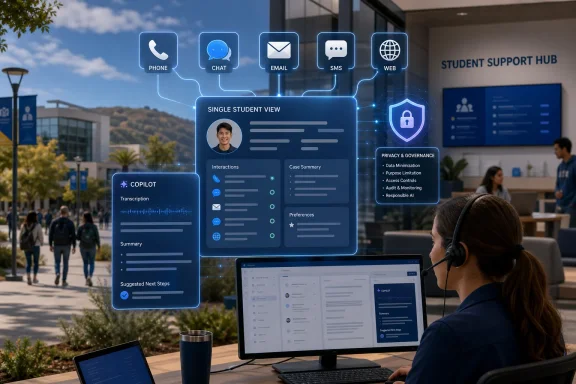
That is why the architecture matters. CSUSM is using Dynamics 365 Contact Center alongside Dynamics 365 Customer Service, Copilot Studio, and Dynamics 365 Customer Insights. In Microsoft’s framing, the pieces create a unified engagement platform; in campus terms, they try to turn scattered contacts into a single student-support narrative.
Dr. Tasos Lazarides, CSUSM’s Director of Digital Transformation, describes the familiar administrative problem: multiple versions of the same student across systems, but no single complete view. That is the core data problem behind most student-support failures. The issue is not that staff lack empathy; it is that the operating model often withholds the relevant context until after a student has already been bounced around.
Dynamics 365 Contact Center tries to solve that problem by treating each interaction as part of an ongoing record rather than an isolated ticket. Voice, chat, SMS, email, and web contacts can be routed and summarized within a shared service environment. Copilot then becomes less of a chatbot novelty and more of a context machine, surfacing prior interactions, drafting replies, and summarizing conversations so staff can pick up the thread.
The practical impact is obvious in Angelica Garcia’s description of the previous process as going through “loopholes” to find the correct information. That is the voice of someone living inside a fragmented support model. When a student assistant has to hunt across systems before answering a student, the institution is not merely inefficient; it is making its front-line workers compensate for architectural debt.
Higher education is a particularly receptive target for that argument. Universities are sprawling service organizations with decentralized authority, legacy systems, high-volume seasonal demand, and users who expect consumer-grade responsiveness. A campus support environment can look less like a call center and more like a federation of help desks that all speak different dialects.
That makes the CSUSM story useful for Microsoft. The university is not selling widgets or handling airline rebookings; it is trying to improve student persistence and reduce friction for people navigating admissions, enrollment, financial aid, advising, and other services. If Microsoft can show that Dynamics 365 Contact Center works in this environment, it strengthens the claim that AI-first contact centers are not just cost-cutting tools but coordination layers.
Still, the vendor story should not be swallowed whole. Microsoft benefits when institutions centralize engagement data inside its cloud, use Copilot Studio for agents and IVR flows, and adopt Customer Insights for proactive outreach. The same integration that reduces friction for staff also deepens platform dependency. For a public university, that trade-off is not disqualifying, but it deserves to be named.
Garcia’s comment about Copilot transcription is telling. If she can read a transcript instead of asking a student to repeat the story, the technology has removed one of the most irritating parts of institutional support. The student is spared the emotional tax of repetition; the staff member is spared the time cost of reconstruction.
That is the sane end of generative AI in service work. The model is not being asked to decide a student’s eligibility, interpret policy in a vacuum, or invent an answer to a high-stakes question. It is being asked to preserve, summarize, and retrieve context for a human worker. In other words, it operates closest to a memory aid.
The risk is that small automations gradually become invisible infrastructure. Once summaries become the default record of what happened, accuracy and auditability matter. If an AI-generated summary leaves out a crucial caveat, misstates a student’s intent, or compresses ambiguity into false certainty, staff may unknowingly inherit the error.
That means universities need governance around summarization just as much as enthusiasm for it. They need policies for review, correction, retention, and escalation. They need to decide when transcripts are records, who can see them, and how long they persist. In student support, the data is often mundane until it is not.
That is why Chung’s comment that first-generation students should not have to “decode the system to succeed” lands with force. The hidden curriculum of college is not only how to study or talk to professors. It is also how to locate the right office, ask the right question, and know when an answer is incomplete.
A unified contact center cannot fix every structural inequity in higher education. It will not make tuition affordable, expand course availability, or solve housing insecurity. But it can remove a class of preventable friction: dead-end calls, repeated explanations, inconsistent answers, and the sense that every office sees only a fragment of the student.
For administrators, the uncomfortable implication is that student-support technology is now part of equity strategy. That does not mean every AI deployment is equitable by definition. It means fragmented service delivery can no longer be dismissed as back-office inconvenience. The interface is part of the institution.
This is the post-Windows Microsoft at its most consequential. Windows still matters on desktops and devices, especially in higher education labs, offices, and managed endpoint fleets. But the center of gravity has shifted toward identity, data, workflow, and AI services that follow users across devices.
A campus like CSUSM is exactly where that shift becomes visible. Student assistants may sit at Windows PCs, use Microsoft 365, authenticate through Microsoft identity services, collaborate in Teams, and now work through a Dynamics-powered support console. The operating system is no longer just what boots the machine; it is the combined environment through which institutional work happens.
That creates opportunities for IT departments. A more integrated Microsoft estate can simplify endpoint management, identity policy, compliance review, and user training. It can also create a cleaner path for automation than a patchwork of niche tools connected by brittle exports and heroic spreadsheet work.
It also creates concentration risk. When service operations, communications, identity, analytics, and AI assistance are bundled into one vendor ecosystem, outages and licensing changes carry broader consequences. Higher education IT leaders have lived through enough platform shifts to know that today’s strategic alignment can become tomorrow’s budget surprise.
But the more meaningful measure may be handoff quality. Garcia notes that when an issue escalates, the higher-level staff member already has the information, so she does not have to re-explain the whole case. That is where a unified service platform changes the texture of work.
In many institutions, escalation is a euphemism for starting over. The student repeats the story, the staff member reopens the file, and everyone burns time reconstructing context that should have followed the case. A better handoff is not just faster; it is more humane.
For support workers, this can reduce cognitive load. The most draining part of front-line service is often not the call itself but the constant context switching, searching, documenting, and apologizing for systems that do not talk to each other. If AI summaries and shared records cut that burden, they may improve both student experience and staff retention.
The question is whether these gains persist after the pilot glow fades. Contact center systems often look best when newly configured, closely watched, and attached to a transformation narrative. The durable test is whether departments keep their data clean, maintain workflows, update knowledge sources, and resist rebuilding old silos inside new software.
The promise is not that every student interaction should be automated. The promise is that routine interactions should be resolved quickly enough that human staff have more time for complex cases. That distinction matters, because students can usually tell when an institution is using automation to help them and when it is using automation to avoid them.
For CSUSM, the better version of this future is a tiered support model where AI handles navigation, summarizes history, and prepares staff with context. The worse version is a maze of bots that deflect students away from human help. The technology can support either outcome; institutional priorities decide which one emerges.
Microsoft’s language around “scaling care” is revealing. Care is not normally a scalable commodity, which is why the phrase can sound like marketing varnish. But if scaling care means reducing needless repetition, preserving context, and helping staff intervene earlier, then the phrase has operational content.
Still, universities should be cautious about letting automation redefine service quality downward. A resolved interaction is not the same as a satisfied student. A deflected call is not the same as a solved problem. A generated response is not the same as institutional accountability.
That capability is powerful because many student-support failures are timing failures. A student misses a deadline, fails to complete a form, does not understand a hold, or disengages quietly until re-enrollment becomes difficult. Proactive outreach can catch some of those moments earlier.
But proactive engagement raises governance questions more quickly than reactive support does. What data is used to infer need? Which offices can trigger messages? How does the university avoid over-messaging students who already receive a flood of institutional communications? How are sensitive indicators protected from misuse or casual exposure?
These are not arguments against Customer Insights. They are arguments for treating it as student-success infrastructure rather than marketing software with a campus paint job. The ethical burden rises when the system moves from answering students to predicting what they might need.
The best deployments will combine data-driven outreach with transparent policy. Students should understand why they are receiving certain communications and how to get human help. Staff should know what the system is inferring and what it is not. Administrators should measure whether outreach improves outcomes without creating new forms of profiling or administrative noise.
The phrase “single student profile” sounds clean. In practice, it involves identity matching, role-based access, consent considerations, records retention, departmental ownership, and a lot of meetings about fields that once seemed trivial. Universities are especially complex because students can be applicants, employees, residents, advisees, athletes, veterans, parents, alumni, and more.
That makes data governance the unglamorous center of the project. If the wrong people see sensitive information, trust erodes. If the system hides too much, staff lose the context that made the platform useful. If records are inconsistent, Copilot can summarize confusion faster than humans can create it.
Security teams will also care about the attack surface. Contact centers collect rich interaction data, including voice transcripts and personal circumstances. AI tools increase the need for clear access controls, logging, retention policies, and review processes. The more useful the data becomes, the more carefully it has to be protected.
For Windows and Microsoft administrators, this is where the project moves from brochure to runbook. Licensing, identity, conditional access, endpoint security, data-loss prevention, retention labels, audit logs, and admin roles all become part of the student-experience story. The service desk is no longer just a department; it is a regulated data environment.
That absence is not scandalous, but it is important. Public-sector technology modernization is rarely a straight line from fragmented systems to unified bliss. It involves procurement constraints, legacy applications, unionized workflows in some environments, departmental autonomy, data cleanup, and the politics of deciding whose process becomes the default.
The reported outcomes are encouraging, especially the faster email response times and decreased hold times. But they are early operational indicators, not a full evaluation of student success. The more ambitious claim—that connected support improves access and retention—will require longer-term evidence.
CSUSM may well be on the right track. The logic is strong: reduce fragmentation, improve context, respond faster, and students should experience less friction. But universities should resist the temptation to treat software adoption as proof of transformation. The proof comes when students who previously struggled to navigate the system actually get help sooner and stay on track.
That is the difference between modernization and digitized bureaucracy. A modern platform can still reproduce old habits if departments use it defensively, hoard information, or optimize for closure metrics over student outcomes. Technology can make a better operating model possible; it cannot force one into existence.
That shift reflects changing student expectations. Students live in a world of persistent digital context, where banks, retailers, delivery services, and healthcare portals increasingly remember prior interactions. Universities do not have to mimic consumer platforms uncritically, but they cannot ignore the baseline expectation that a large institution should know what it already knows.
For IT leaders, that means student support belongs in enterprise architecture conversations. It touches CRM, identity, analytics, AI governance, records management, accessibility, security, and business continuity. It is not a departmental tool to be bought and forgotten.
For staff, the shift could be empowering if implemented carefully. Better context can reduce repetitive work and make escalations smoother. AI can draft, summarize, and retrieve, leaving humans to interpret, reassure, and decide. But if management uses the same data primarily to squeeze more throughput from fewer workers, the project will feel very different on the ground.
For students, the measure is simpler. They should not have to know which system failed to sync, which office owns a field, or which queue their email entered. They should experience the university as one institution, not as a scavenger hunt.
Dynamics 365 Contact Center is designed for that world. It combines omnichannel routing, live transcription, conversation summaries, sentiment and analytics capabilities, self-service agents, and integration with CRM systems. The strategic move is to place Copilot in the middle of routine operational work, not at the edge as a novelty panel.
That is why higher education is such a useful proof point. A university contact center is emotionally and administratively complex. The “customer” may be anxious, confused, financially constrained, or facing a deadline. The answer may require policy interpretation, empathy, and coordination across offices. If AI-assisted service can help there without flattening the human element, it has a stronger claim elsewhere.
Microsoft will almost certainly use more stories like this to argue that AI adoption is moving from experimentation to production. The company wants Copilot to be measured not by how clever it sounds in a demo but by whether it cuts response times, reduces hold times, and improves service consistency. CSUSM gives it a clean example.
The caution for readers is to separate capability from outcome. The platform can summarize conversations; that does not guarantee better advising. It can unify records; that does not guarantee just policy. It can automate outreach; that does not guarantee students feel seen rather than processed.
 CSUSM Turns the Help Desk Into a Student-Retention System
The old model of university support assumed that students knew where to go. Financial aid had its systems, advising had its systems, enrollment had its systems, and students were expected to stitch the experience together by phone, email, web forms, and sheer persistence. That model was always inconvenient, but in a campus serving many first-generation learners, inconvenience becomes policy by other means.CSUSM CIO Tony Chung puts the issue more sharply than most vendor case studies do: fragmentation creates “invisible inequity.” That phrase matters because it shifts the conversation away from generic digital transformation and toward institutional responsibility. If a student has to explain the same problem repeatedly to different offices, the university has effectively outsourced process integration to the person least equipped to perform it.
The university’s implementation of Dynamics 365 Contact Center is therefore best understood as part of the retention stack. It is not just about answering calls faster, although Microsoft says email response times have been cut by roughly half and hold times have decreased. It is about preserving context so that a student’s prior interaction does not vanish the moment a case crosses a departmental boundary.
That is why the architecture matters. CSUSM is using Dynamics 365 Contact Center alongside Dynamics 365 Customer Service, Copilot Studio, and Dynamics 365 Customer Insights. In Microsoft’s framing, the pieces create a unified engagement platform; in campus terms, they try to turn scattered contacts into a single student-support narrative.
The Single Student View Is the Product, Not the Dashboard
Every enterprise software pitch eventually arrives at the phrase single view of the customer. In higher education, the phrase becomes more delicate. Students are not customers in the retail sense, but they do move through a lifecycle filled with transactions, deadlines, interventions, exceptions, and moments where a missed message can change an academic outcome.Dr. Tasos Lazarides, CSUSM’s Director of Digital Transformation, describes the familiar administrative problem: multiple versions of the same student across systems, but no single complete view. That is the core data problem behind most student-support failures. The issue is not that staff lack empathy; it is that the operating model often withholds the relevant context until after a student has already been bounced around.
Dynamics 365 Contact Center tries to solve that problem by treating each interaction as part of an ongoing record rather than an isolated ticket. Voice, chat, SMS, email, and web contacts can be routed and summarized within a shared service environment. Copilot then becomes less of a chatbot novelty and more of a context machine, surfacing prior interactions, drafting replies, and summarizing conversations so staff can pick up the thread.
The practical impact is obvious in Angelica Garcia’s description of the previous process as going through “loopholes” to find the correct information. That is the voice of someone living inside a fragmented support model. When a student assistant has to hunt across systems before answering a student, the institution is not merely inefficient; it is making its front-line workers compensate for architectural debt.
Microsoft’s Contact Center Pitch Finds a Natural Campus Market
Microsoft launched Dynamics 365 Contact Center as a Copilot-first, cloud-based product meant to bring AI, automation, routing, analytics, and omnichannel engagement to service operations. The product sits in a market long dominated by specialized contact center vendors, but Microsoft’s advantage is not merely telephony. Its pitch is that customer service, CRM data, productivity apps, identity, analytics, and AI assistants can live on the same platform.Higher education is a particularly receptive target for that argument. Universities are sprawling service organizations with decentralized authority, legacy systems, high-volume seasonal demand, and users who expect consumer-grade responsiveness. A campus support environment can look less like a call center and more like a federation of help desks that all speak different dialects.
That makes the CSUSM story useful for Microsoft. The university is not selling widgets or handling airline rebookings; it is trying to improve student persistence and reduce friction for people navigating admissions, enrollment, financial aid, advising, and other services. If Microsoft can show that Dynamics 365 Contact Center works in this environment, it strengthens the claim that AI-first contact centers are not just cost-cutting tools but coordination layers.
Still, the vendor story should not be swallowed whole. Microsoft benefits when institutions centralize engagement data inside its cloud, use Copilot Studio for agents and IVR flows, and adopt Customer Insights for proactive outreach. The same integration that reduces friction for staff also deepens platform dependency. For a public university, that trade-off is not disqualifying, but it deserves to be named.
AI Summaries Are Small Until They Become the Operating Model
The flashiest part of the CSUSM deployment is not a humanoid agent replacing staff. It is transcription, summarization, and context carryover. That sounds modest, but it is precisely where generative AI is becoming operationally important.Garcia’s comment about Copilot transcription is telling. If she can read a transcript instead of asking a student to repeat the story, the technology has removed one of the most irritating parts of institutional support. The student is spared the emotional tax of repetition; the staff member is spared the time cost of reconstruction.
That is the sane end of generative AI in service work. The model is not being asked to decide a student’s eligibility, interpret policy in a vacuum, or invent an answer to a high-stakes question. It is being asked to preserve, summarize, and retrieve context for a human worker. In other words, it operates closest to a memory aid.
The risk is that small automations gradually become invisible infrastructure. Once summaries become the default record of what happened, accuracy and auditability matter. If an AI-generated summary leaves out a crucial caveat, misstates a student’s intent, or compresses ambiguity into false certainty, staff may unknowingly inherit the error.
That means universities need governance around summarization just as much as enthusiasm for it. They need policies for review, correction, retention, and escalation. They need to decide when transcripts are records, who can see them, and how long they persist. In student support, the data is often mundane until it is not.
First-Generation Students Expose the Cost of Administrative Design
CSUSM’s framing around first-generation students is not incidental. First-generation learners often encounter college as both an academic and bureaucratic system, with fewer inherited scripts for how to navigate offices, deadlines, appeals, holds, and jargon. A process that feels merely annoying to a continuing-generation student may become a barrier to persistence for someone still decoding the institution.That is why Chung’s comment that first-generation students should not have to “decode the system to succeed” lands with force. The hidden curriculum of college is not only how to study or talk to professors. It is also how to locate the right office, ask the right question, and know when an answer is incomplete.
A unified contact center cannot fix every structural inequity in higher education. It will not make tuition affordable, expand course availability, or solve housing insecurity. But it can remove a class of preventable friction: dead-end calls, repeated explanations, inconsistent answers, and the sense that every office sees only a fragment of the student.
For administrators, the uncomfortable implication is that student-support technology is now part of equity strategy. That does not mean every AI deployment is equitable by definition. It means fragmented service delivery can no longer be dismissed as back-office inconvenience. The interface is part of the institution.
The Windows Angle Is the Microsoft Stack Becoming Campus Plumbing
For WindowsForum readers, the interesting part is not that a university bought a Microsoft cloud product. It is that the Microsoft stack continues to move from productivity layer to operational substrate. Dynamics, Power Platform, Teams, Copilot Studio, Customer Insights, Entra identity, and Microsoft 365 are increasingly presented not as separate tools but as a programmable administrative environment.This is the post-Windows Microsoft at its most consequential. Windows still matters on desktops and devices, especially in higher education labs, offices, and managed endpoint fleets. But the center of gravity has shifted toward identity, data, workflow, and AI services that follow users across devices.
A campus like CSUSM is exactly where that shift becomes visible. Student assistants may sit at Windows PCs, use Microsoft 365, authenticate through Microsoft identity services, collaborate in Teams, and now work through a Dynamics-powered support console. The operating system is no longer just what boots the machine; it is the combined environment through which institutional work happens.
That creates opportunities for IT departments. A more integrated Microsoft estate can simplify endpoint management, identity policy, compliance review, and user training. It can also create a cleaner path for automation than a patchwork of niche tools connected by brittle exports and heroic spreadsheet work.
It also creates concentration risk. When service operations, communications, identity, analytics, and AI assistance are bundled into one vendor ecosystem, outages and licensing changes carry broader consequences. Higher education IT leaders have lived through enough platform shifts to know that today’s strategic alignment can become tomorrow’s budget surprise.
Faster Email Is the Easy Metric; Better Handoffs Are the Harder Win
Microsoft’s customer story highlights a concrete improvement: emails that previously took about 48 hours can now take about 24 hours. That is the sort of metric procurement teams like because it is simple, legible, and defensible. Students certainly notice response time, especially around deadlines.But the more meaningful measure may be handoff quality. Garcia notes that when an issue escalates, the higher-level staff member already has the information, so she does not have to re-explain the whole case. That is where a unified service platform changes the texture of work.
In many institutions, escalation is a euphemism for starting over. The student repeats the story, the staff member reopens the file, and everyone burns time reconstructing context that should have followed the case. A better handoff is not just faster; it is more humane.
For support workers, this can reduce cognitive load. The most draining part of front-line service is often not the call itself but the constant context switching, searching, documenting, and apologizing for systems that do not talk to each other. If AI summaries and shared records cut that burden, they may improve both student experience and staff retention.
The question is whether these gains persist after the pilot glow fades. Contact center systems often look best when newly configured, closely watched, and attached to a transformation narrative. The durable test is whether departments keep their data clean, maintain workflows, update knowledge sources, and resist rebuilding old silos inside new software.
Copilot Studio Moves the Bot From Side Project to Service Layer
Copilot Studio is important in this deployment because it represents Microsoft’s attempt to make conversational agents part of standard enterprise plumbing. In contact center scenarios, these agents can support self-service, interactive voice response, escalation, and proactive engagement. That is a natural fit for repetitive campus questions: deadlines, forms, office hours, status checks, and routing.The promise is not that every student interaction should be automated. The promise is that routine interactions should be resolved quickly enough that human staff have more time for complex cases. That distinction matters, because students can usually tell when an institution is using automation to help them and when it is using automation to avoid them.
For CSUSM, the better version of this future is a tiered support model where AI handles navigation, summarizes history, and prepares staff with context. The worse version is a maze of bots that deflect students away from human help. The technology can support either outcome; institutional priorities decide which one emerges.
Microsoft’s language around “scaling care” is revealing. Care is not normally a scalable commodity, which is why the phrase can sound like marketing varnish. But if scaling care means reducing needless repetition, preserving context, and helping staff intervene earlier, then the phrase has operational content.
Still, universities should be cautious about letting automation redefine service quality downward. A resolved interaction is not the same as a satisfied student. A deflected call is not the same as a solved problem. A generated response is not the same as institutional accountability.
Customer Insights Brings Proactive Outreach—and Harder Governance
Dynamics 365 Customer Insights adds another dimension to the CSUSM deployment: outreach and engagement. In a commercial setting, that might mean targeting customers with timely offers or lifecycle messaging. In higher education, it can mean identifying students who need reminders, nudges, or support before a problem becomes a crisis.That capability is powerful because many student-support failures are timing failures. A student misses a deadline, fails to complete a form, does not understand a hold, or disengages quietly until re-enrollment becomes difficult. Proactive outreach can catch some of those moments earlier.
But proactive engagement raises governance questions more quickly than reactive support does. What data is used to infer need? Which offices can trigger messages? How does the university avoid over-messaging students who already receive a flood of institutional communications? How are sensitive indicators protected from misuse or casual exposure?
These are not arguments against Customer Insights. They are arguments for treating it as student-success infrastructure rather than marketing software with a campus paint job. The ethical burden rises when the system moves from answering students to predicting what they might need.
The best deployments will combine data-driven outreach with transparent policy. Students should understand why they are receiving certain communications and how to get human help. Staff should know what the system is inferring and what it is not. Administrators should measure whether outreach improves outcomes without creating new forms of profiling or administrative noise.
Public Universities Cannot Buy Their Way Out of Data Stewardship
The CSUSM case also highlights a truth every IT pro knows: integration is not a one-time implementation but a discipline. A contact center platform can centralize interactions, but it cannot magically reconcile every definition, permission boundary, business process, and data-quality problem across a university.The phrase “single student profile” sounds clean. In practice, it involves identity matching, role-based access, consent considerations, records retention, departmental ownership, and a lot of meetings about fields that once seemed trivial. Universities are especially complex because students can be applicants, employees, residents, advisees, athletes, veterans, parents, alumni, and more.
That makes data governance the unglamorous center of the project. If the wrong people see sensitive information, trust erodes. If the system hides too much, staff lose the context that made the platform useful. If records are inconsistent, Copilot can summarize confusion faster than humans can create it.
Security teams will also care about the attack surface. Contact centers collect rich interaction data, including voice transcripts and personal circumstances. AI tools increase the need for clear access controls, logging, retention policies, and review processes. The more useful the data becomes, the more carefully it has to be protected.
For Windows and Microsoft administrators, this is where the project moves from brochure to runbook. Licensing, identity, conditional access, endpoint security, data-loss prevention, retention labels, audit logs, and admin roles all become part of the student-experience story. The service desk is no longer just a department; it is a regulated data environment.
The Vendor Case Study Leaves Out the Messy Middle
Microsoft’s customer story is polished, as customer stories are supposed to be. It gives the institution’s rationale, names the products, quotes the leaders, and offers early indicators of improvement. What it does not provide is the messy middle: migration timelines, integration challenges, licensing costs, training demands, user resistance, accessibility testing, or failure modes.That absence is not scandalous, but it is important. Public-sector technology modernization is rarely a straight line from fragmented systems to unified bliss. It involves procurement constraints, legacy applications, unionized workflows in some environments, departmental autonomy, data cleanup, and the politics of deciding whose process becomes the default.
The reported outcomes are encouraging, especially the faster email response times and decreased hold times. But they are early operational indicators, not a full evaluation of student success. The more ambitious claim—that connected support improves access and retention—will require longer-term evidence.
CSUSM may well be on the right track. The logic is strong: reduce fragmentation, improve context, respond faster, and students should experience less friction. But universities should resist the temptation to treat software adoption as proof of transformation. The proof comes when students who previously struggled to navigate the system actually get help sooner and stay on track.
That is the difference between modernization and digitized bureaucracy. A modern platform can still reproduce old habits if departments use it defensively, hoard information, or optimize for closure metrics over student outcomes. Technology can make a better operating model possible; it cannot force one into existence.
The Campus Contact Center Becomes a Strategic System
The most interesting implication of CSUSM’s move is that the contact center is becoming strategic infrastructure in higher education. For years, contact centers were associated with call queues, scripts, and cost control. Now they are becoming the front door to institutional intelligence.That shift reflects changing student expectations. Students live in a world of persistent digital context, where banks, retailers, delivery services, and healthcare portals increasingly remember prior interactions. Universities do not have to mimic consumer platforms uncritically, but they cannot ignore the baseline expectation that a large institution should know what it already knows.
For IT leaders, that means student support belongs in enterprise architecture conversations. It touches CRM, identity, analytics, AI governance, records management, accessibility, security, and business continuity. It is not a departmental tool to be bought and forgotten.
For staff, the shift could be empowering if implemented carefully. Better context can reduce repetitive work and make escalations smoother. AI can draft, summarize, and retrieve, leaving humans to interpret, reassure, and decide. But if management uses the same data primarily to squeeze more throughput from fewer workers, the project will feel very different on the ground.
For students, the measure is simpler. They should not have to know which system failed to sync, which office owns a field, or which queue their email entered. They should experience the university as one institution, not as a scavenger hunt.
The CSUSM Deployment Shows Where Microsoft Wants AI to Live
The CSUSM story is a small campus modernization story with a larger Microsoft strategy inside it. The company is not merely selling chatbots; it is embedding generative AI into workflow systems where decisions, records, and customer interactions already live. That is a more durable business than standalone AI assistants.Dynamics 365 Contact Center is designed for that world. It combines omnichannel routing, live transcription, conversation summaries, sentiment and analytics capabilities, self-service agents, and integration with CRM systems. The strategic move is to place Copilot in the middle of routine operational work, not at the edge as a novelty panel.
That is why higher education is such a useful proof point. A university contact center is emotionally and administratively complex. The “customer” may be anxious, confused, financially constrained, or facing a deadline. The answer may require policy interpretation, empathy, and coordination across offices. If AI-assisted service can help there without flattening the human element, it has a stronger claim elsewhere.
Microsoft will almost certainly use more stories like this to argue that AI adoption is moving from experimentation to production. The company wants Copilot to be measured not by how clever it sounds in a demo but by whether it cuts response times, reduces hold times, and improves service consistency. CSUSM gives it a clean example.
The caution for readers is to separate capability from outcome. The platform can summarize conversations; that does not guarantee better advising. It can unify records; that does not guarantee just policy. It can automate outreach; that does not guarantee students feel seen rather than processed.
The Cougar Blueprint Is Promising Because It Starts With Friction
The concrete lesson from CSUSM is not that every university should buy the same bundle. It is that the best AI projects begin with a real institutional pain point, not with a mandate to “use AI.” CSUSM started from fragmentation, repeated explanations, inconsistent context, and slow response loops. Those are problems worth solving.- CSUSM implemented Dynamics 365 Contact Center with Dynamics 365 Customer Service, Copilot Studio, and Customer Insights to unify student engagement across multiple channels.
- Microsoft says the university has seen email response times improve from roughly 48 hours to about 24 hours, while call hold times have decreased.
- The most practical AI use case in the deployment is not autonomous decision-making but transcription, summarization, and context carryover for human support staff.
- The project’s equity argument rests on reducing the burden placed on students, especially first-generation learners, to navigate fragmented offices and systems.
- The long-term risks sit in data governance, privacy, platform dependency, and whether operational metrics are tied to genuine student outcomes rather than faster ticket closure.
- The deployment shows Microsoft positioning Dynamics 365 Contact Center as a strategic AI service layer for institutions that already depend on its cloud, productivity, and identity stack.
References
- Primary source: Microsoft
Published: 2026-06-12T17:52:07.308354
CSUSM modernizes student support with Dynamics 365 Contact Center | Microsoft Customer Stories
CSUSM delivers more consistent, connected student support with Dynamics 365 Contact Center.www.microsoft.com
