
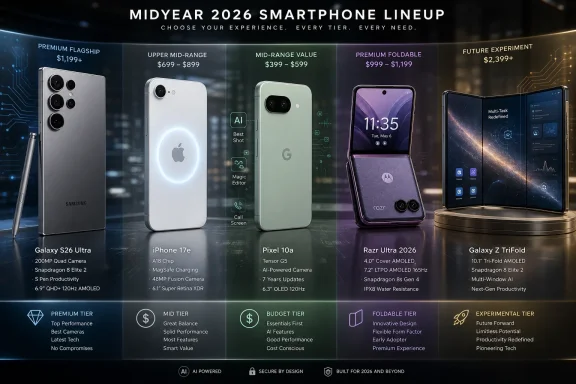
Mashable’s midyear 2026 smartphone list names Samsung’s Galaxy S26 Ultra, Apple’s iPhone 17e, Google’s Pixel 10a, Motorola’s Razr Ultra, and Samsung’s short-lived Galaxy Z TriFold as the standout phones so far, reflecting a market where excellence increasingly arrives with a premium price tag. The selection is less interesting as a shopping guide than as a snapshot of where the handset business has landed. The best phones are now either expensive flagships, carefully constrained budget models, or experimental foldables that behave more like concept cars than mainstream consumer electronics. The smartphone has not run out of ideas, but in 2026 those ideas are being metered out through pricing tiers with almost ruthless precision.
The quiet theme running through Mashable’s list is that every good deal now comes with a visible seam. The iPhone 17e is presented as Apple’s practical choice, but its compromises are not hidden: one rear camera and a 60Hz display in a world where smoother screens have filtered far below the flagship tier. Google’s Pixel 10a keeps the A-series value argument alive, but the story is no longer that a $499 phone is almost indistinguishable from the expensive one.
That matters because the midrange used to be where smartphone progress felt most democratic. A buyer could wait a year, skip the launch-day hype, and get last year’s miracle in this year’s cheaper plastic shell. In 2026, that bargain still exists, but the distance between “good enough” and “best” is being made more legible by design.
The cited culprit, RAMageddon, is a useful shorthand for a broader squeeze. Memory pricing, AI workloads, storage expectations, and supply-chain discipline have all made it harder for vendors to throw premium components into cheaper devices without consequence. The result is a market that still offers affordable phones, but no longer lets buyers forget exactly what they gave up.
This is why the list feels both optimistic and faintly grim. The phones are impressive. The economics around them are less forgiving.
Yet default should not be confused with lazy. The 6.9-inch 120Hz display, 5,000mAh battery, S Pen, and camera stack are not just bullet points for spec-sheet loyalists. They reinforce Samsung’s basic pitch that a phone can be the most important computer most people own, especially for users who write, annotate, shoot video, edit photos, manage work chats, and navigate life from a single slab of glass.
That pitch is strongest among WindowsForum’s natural audience: power users, IT admins, and people who notice when a device reduces friction across workflows. The S Pen is no longer a novelty for doodlers; it is a differentiator in a market where most premium phones are variations on the same rectangle. Samsung’s decision to keep it alive inside the Ultra line gives the device a productivity identity competitors struggle to match.
The AI features are the more complicated part. Samsung, like Apple and Google, is selling AI as a reason to upgrade, but the practical value remains uneven. Some features save time; some feel like demos waiting for a workflow. The risk for Samsung is that “AI phone” becomes the 2020s equivalent of “3D TV”: technically impressive, heavily marketed, and not always central to why people buy.
Still, the Ultra succeeds because it does not need AI to justify itself. It is a maximalist phone in a market where maximalism has become a luxury tier. The expensive Android flagship is alive and well; it just no longer bothers apologizing for being expensive.
MagSafe support is the headline repair. Wireless accessories, car mounts, battery packs, wallets, and charging stands have become part of the iPhone ecosystem, and leaving that ecosystem out of the lower-cost model always felt less like cost discipline than product segmentation with a smirk. Bringing MagSafe to the 17e makes the phone feel less isolated from the rest of Apple’s lineup.
The A19 chip and 256GB starting storage are equally important. Apple’s long software support window means entry-level iPhones often stay in circulation for years, handed down through families or deployed as reliable work devices. A stronger chip and more storage are not luxuries in that context; they are what keep the phone from becoming a complaint generator in 2028.
But Apple’s old instincts are still visible. The 60Hz display is the kind of omission that keeps the product ladder intact. The single-camera setup does the same. Apple gives the 17e enough to feel modern, but not enough to let buyers forget that the “real” iPhones are elsewhere.
That is classic Apple segmentation: remove pain, preserve envy. For many buyers, the 17e may be the most rational iPhone of the year precisely because it avoids the four-figure flagship trap. But it also shows how Apple defines value not as generosity, but as controlled access to the ecosystem.
Mashable’s summary makes the trade-off plain. The Pixel 10a reportedly misses some higher-end AI capabilities and does not bring the kind of processor leap enthusiasts crave. That is not fatal, but it changes the emotional pitch. This is no longer the phone that embarrasses the flagship; it is the phone that reassures the buyer they made a sensible decision.
There is value in that. A flat back that does not wobble on a desk sounds trivial until you live with a giant camera island for two years. A brighter display matters more than a benchmark score when you are using navigation in sunlight. Better charging options are not glamorous, but they affect the daily experience more than another staged AI demo.
Google’s advantage remains computational photography. The company has spent years teaching consumers that Pixel cameras are less about optics than outcomes. If the 10a continues that pattern, it can justify its place even without leading-edge hardware.
The larger question is whether Google can keep the A-series from becoming too derivative. A budget phone can survive reused components if the price is right and the software story is strong. But if AI becomes the new dividing line between premium and affordable Android, Google risks turning its most trusted midrange brand into a waiting room for features users can see advertised elsewhere.
That matters because foldables have spent years trying to escape the demo-table problem. Everyone understands why they are cool within ten seconds of holding one. Far fewer people have been convinced they are durable, affordable, or necessary enough to buy.
The Razr Ultra’s clamshell design is the strongest case for foldables as lifestyle devices rather than tiny tablets. A phone that folds smaller has an obvious appeal: it fits in pockets, bags, and hands differently. The external display can handle quick interactions without opening the device, while the internal AMOLED screen restores the familiar smartphone canvas when needed.
The Snapdragon 8 Elite chip and strong battery life suggest Motorola is no longer treating the Razr as fashion hardware with adequate internals. That was always the danger with nostalgia. A Razr name can get people to look, but only performance and reliability can keep them from regretting the purchase.
For WindowsForum readers, foldables also raise an enterprise question that consumer reviews tend to underplay. These devices are harder to case, harder to repair, and harder to standardize across a fleet. They may be excellent personal devices, but IT departments still have reasons to hesitate before blessing them for broad deployment.
The answer, for now, appears to be: technically yes, commercially not yet. Reports around its limited availability and discontinuation suggest a device that was never meant to be a mass-market pillar. It was a showcase, a stress test, and perhaps a message to competitors that Samsung’s display engineering still has room to escalate.
Mashable is right to treat it as “ambitious” rather than broadly recommendable. A device that most people cannot buy, and that may have existed in tiny quantities, cannot be judged by the same criteria as an iPhone or Pixel. Its importance is symbolic.
But symbols matter in mature markets. The TriFold says that the smartphone’s physical form is not finished. It also says that the next wave of innovation may be expensive, fragile, and intermittent before it becomes ordinary.
That is how many categories evolve. The first useful folding phones were compromised. The first ultra-premium camera phones were niche. The first large-screen phones were mocked before they became the default. The TriFold may disappear as a SKU, but the idea it represents is unlikely to disappear with it.
That creates a new kind of fragmentation. In the past, a cheaper phone might have a worse camera, dimmer display, or slower processor. Now it may also lack the newest software experiences, even if those experiences are the ones vendors spend the most money advertising.
For consumers, that can feel like bait and switch. A brand campaign presents AI as the future of the platform, but the affordable model gets a subset. The phone still works, of course, but it may not feel like a full participant in the ecosystem’s next chapter.
For IT departments, the problem is different. AI features introduce data-handling questions, administrative controls, compliance concerns, and support ambiguity. If one user’s device summarizes messages locally while another sends requests to a cloud service, the difference is not cosmetic. It may affect policy.
This is where Microsoft’s world intersects with the smartphone market even when Windows itself is not the operating system in your pocket. Mobile devices are endpoints. They authenticate users, access corporate data, scan documents, join Teams calls, and receive passkeys. The more AI features they carry, the more they belong in the same governance conversation as PCs.
Foldables intensify that calculation. A cracked conventional display is bad enough; a damaged folding panel can feel financially catastrophic. The more exotic the device, the more important warranty terms and repair availability become.
This is why the affordable phones on Mashable’s list may matter more than the spectacular ones. The iPhone 17e and Pixel 10a are not the most exciting devices, but they are the ones that keep the market from becoming entirely detached from normal budgets. They are the pressure valves.
Even so, the psychological baseline has shifted. A $499 Android phone is now treated as budget. A $599 iPhone is a modest option. A $1,199 flagship is normal premium. A $1,499 foldable is expensive but understandable. A nearly $3,000 experimental tri-fold becomes absurd, yet not unimaginable.
That is the real inflation in smartphones: not just component prices, but consumer acclimation. The industry has trained buyers to think in laptop prices for pocket devices, and in some cases the comparison is justified. But it should still make us pause.
That is especially true for users already carrying a recent flagship. A Galaxy S24 Ultra, iPhone 15 Pro, Pixel 9 Pro, or recent foldable is not suddenly obsolete because 2026 models have better AI hooks or brighter displays. The useful life of premium hardware has expanded, even as vendors work harder to make annual improvements feel urgent.
Budget and midrange buyers face a different calculus. If storage, battery health, camera quality, or software support are becoming problems, the iPhone 17e and Pixel 10a look like rational replacements. They are not aspirational devices, but they may be the smartest purchases precisely because they avoid the bleeding edge.
Foldable buyers should be more deliberate. The Razr Ultra may be excellent, but buying a foldable still means accepting a different risk profile. The hinge, display crease, repair cost, and accessory ecosystem are part of the product, not footnotes.
The TriFold, meanwhile, is a reminder not to confuse availability with maturity. The industry can build astonishing devices before it can build them affordably, durably, and at scale. Enthusiasts may love being first, but first is often another word for unpaid field testing.
That map is more revealing than any single winner. The market is not stagnant; it is stratified. Innovation is happening, but it is increasingly sorted by price, risk tolerance, and ecosystem loyalty.
 The Smartphone Market Has Stopped Pretending Cheap Can Mean Complete
The quiet theme running through Mashable’s list is that every good deal now comes with a visible seam. The iPhone 17e is presented as Apple’s practical choice, but its compromises are not hidden: one rear camera and a 60Hz display in a world where smoother screens have filtered far below the flagship tier. Google’s Pixel 10a keeps the A-series value argument alive, but the story is no longer that a $499 phone is almost indistinguishable from the expensive one.That matters because the midrange used to be where smartphone progress felt most democratic. A buyer could wait a year, skip the launch-day hype, and get last year’s miracle in this year’s cheaper plastic shell. In 2026, that bargain still exists, but the distance between “good enough” and “best” is being made more legible by design.
The cited culprit, RAMageddon, is a useful shorthand for a broader squeeze. Memory pricing, AI workloads, storage expectations, and supply-chain discipline have all made it harder for vendors to throw premium components into cheaper devices without consequence. The result is a market that still offers affordable phones, but no longer lets buyers forget exactly what they gave up.
This is why the list feels both optimistic and faintly grim. The phones are impressive. The economics around them are less forgiving.
Samsung’s Ultra Strategy Turns Excess Into a Product Category
The Galaxy S26 Ultra’s place at the top of the Android heap is unsurprising, but that is precisely the point. Samsung has turned the Ultra line into a dependable ritual: large screen, top-tier silicon, huge battery, elaborate camera array, stylus support, and a price that dares buyers to call it unreasonable. The formula is so established that the phone can win the “best flagship” slot almost by structural default.Yet default should not be confused with lazy. The 6.9-inch 120Hz display, 5,000mAh battery, S Pen, and camera stack are not just bullet points for spec-sheet loyalists. They reinforce Samsung’s basic pitch that a phone can be the most important computer most people own, especially for users who write, annotate, shoot video, edit photos, manage work chats, and navigate life from a single slab of glass.
That pitch is strongest among WindowsForum’s natural audience: power users, IT admins, and people who notice when a device reduces friction across workflows. The S Pen is no longer a novelty for doodlers; it is a differentiator in a market where most premium phones are variations on the same rectangle. Samsung’s decision to keep it alive inside the Ultra line gives the device a productivity identity competitors struggle to match.
The AI features are the more complicated part. Samsung, like Apple and Google, is selling AI as a reason to upgrade, but the practical value remains uneven. Some features save time; some feel like demos waiting for a workflow. The risk for Samsung is that “AI phone” becomes the 2020s equivalent of “3D TV”: technically impressive, heavily marketed, and not always central to why people buy.
Still, the Ultra succeeds because it does not need AI to justify itself. It is a maximalist phone in a market where maximalism has become a luxury tier. The expensive Android flagship is alive and well; it just no longer bothers apologizing for being expensive.
Apple’s Cheapest New iPhone Is Also a Pricing Lesson
The iPhone 17e is the most strategically revealing device on Mashable’s list. At $599, it is not cheap in the old sense, but it is cheap by Apple’s current standards. More importantly, Apple appears to have corrected some of the obvious omissions that made earlier budget positioning feel punitive.MagSafe support is the headline repair. Wireless accessories, car mounts, battery packs, wallets, and charging stands have become part of the iPhone ecosystem, and leaving that ecosystem out of the lower-cost model always felt less like cost discipline than product segmentation with a smirk. Bringing MagSafe to the 17e makes the phone feel less isolated from the rest of Apple’s lineup.
The A19 chip and 256GB starting storage are equally important. Apple’s long software support window means entry-level iPhones often stay in circulation for years, handed down through families or deployed as reliable work devices. A stronger chip and more storage are not luxuries in that context; they are what keep the phone from becoming a complaint generator in 2028.
But Apple’s old instincts are still visible. The 60Hz display is the kind of omission that keeps the product ladder intact. The single-camera setup does the same. Apple gives the 17e enough to feel modern, but not enough to let buyers forget that the “real” iPhones are elsewhere.
That is classic Apple segmentation: remove pain, preserve envy. For many buyers, the 17e may be the most rational iPhone of the year precisely because it avoids the four-figure flagship trap. But it also shows how Apple defines value not as generosity, but as controlled access to the ecosystem.
Google’s Pixel 10a Shows the Midrange Is Now About Trust, Not Thrill
The Pixel 10a lands differently. Google’s A-series phones have long been the Android world’s great rebuttal to flagship excess: excellent photos, clean software, and enough performance for normal people at a sane price. In 2026, that argument still works, but it has become more conservative.Mashable’s summary makes the trade-off plain. The Pixel 10a reportedly misses some higher-end AI capabilities and does not bring the kind of processor leap enthusiasts crave. That is not fatal, but it changes the emotional pitch. This is no longer the phone that embarrasses the flagship; it is the phone that reassures the buyer they made a sensible decision.
There is value in that. A flat back that does not wobble on a desk sounds trivial until you live with a giant camera island for two years. A brighter display matters more than a benchmark score when you are using navigation in sunlight. Better charging options are not glamorous, but they affect the daily experience more than another staged AI demo.
Google’s advantage remains computational photography. The company has spent years teaching consumers that Pixel cameras are less about optics than outcomes. If the 10a continues that pattern, it can justify its place even without leading-edge hardware.
The larger question is whether Google can keep the A-series from becoming too derivative. A budget phone can survive reused components if the price is right and the software story is strong. But if AI becomes the new dividing line between premium and affordable Android, Google risks turning its most trusted midrange brand into a waiting room for features users can see advertised elsewhere.
Motorola’s Razr Ultra Proves Foldables Are Finally Desirable, If Not Sensible
The Motorola Razr Ultra is the emotional counterweight to the sensible Pixel. It is expensive, nostalgic, technically ambitious, and slightly impractical in the way good gadgets often are. At $1,499, it asks buyers to pay flagship money not just for performance, but for form.That matters because foldables have spent years trying to escape the demo-table problem. Everyone understands why they are cool within ten seconds of holding one. Far fewer people have been convinced they are durable, affordable, or necessary enough to buy.
The Razr Ultra’s clamshell design is the strongest case for foldables as lifestyle devices rather than tiny tablets. A phone that folds smaller has an obvious appeal: it fits in pockets, bags, and hands differently. The external display can handle quick interactions without opening the device, while the internal AMOLED screen restores the familiar smartphone canvas when needed.
The Snapdragon 8 Elite chip and strong battery life suggest Motorola is no longer treating the Razr as fashion hardware with adequate internals. That was always the danger with nostalgia. A Razr name can get people to look, but only performance and reliability can keep them from regretting the purchase.
For WindowsForum readers, foldables also raise an enterprise question that consumer reviews tend to underplay. These devices are harder to case, harder to repair, and harder to standardize across a fleet. They may be excellent personal devices, but IT departments still have reasons to hesitate before blessing them for broad deployment.
The TriFold Was a Prototype That Briefly Escaped the Lab
Samsung’s Galaxy Z TriFold is the most fascinating device on the list because it barely behaves like a product. A dual-hinge phone with a massive internal display is not simply another foldable. It is a public experiment in whether phone, tablet, and portable productivity machine can collapse into one object.The answer, for now, appears to be: technically yes, commercially not yet. Reports around its limited availability and discontinuation suggest a device that was never meant to be a mass-market pillar. It was a showcase, a stress test, and perhaps a message to competitors that Samsung’s display engineering still has room to escalate.
Mashable is right to treat it as “ambitious” rather than broadly recommendable. A device that most people cannot buy, and that may have existed in tiny quantities, cannot be judged by the same criteria as an iPhone or Pixel. Its importance is symbolic.
But symbols matter in mature markets. The TriFold says that the smartphone’s physical form is not finished. It also says that the next wave of innovation may be expensive, fragile, and intermittent before it becomes ordinary.
That is how many categories evolve. The first useful folding phones were compromised. The first ultra-premium camera phones were niche. The first large-screen phones were mocked before they became the default. The TriFold may disappear as a SKU, but the idea it represents is unlikely to disappear with it.
AI Is Becoming the New Upsell, Whether Users Asked for It or Not
The 2026 smartphone story cannot be separated from AI. Samsung, Apple, and Google are all building product narratives around on-device intelligence, cloud-assisted features, smarter editing, better search, and automation that promises to make the phone feel less like an app launcher and more like an assistant. The problem is that the hardware ladder and the AI ladder are becoming the same ladder.That creates a new kind of fragmentation. In the past, a cheaper phone might have a worse camera, dimmer display, or slower processor. Now it may also lack the newest software experiences, even if those experiences are the ones vendors spend the most money advertising.
For consumers, that can feel like bait and switch. A brand campaign presents AI as the future of the platform, but the affordable model gets a subset. The phone still works, of course, but it may not feel like a full participant in the ecosystem’s next chapter.
For IT departments, the problem is different. AI features introduce data-handling questions, administrative controls, compliance concerns, and support ambiguity. If one user’s device summarizes messages locally while another sends requests to a cloud service, the difference is not cosmetic. It may affect policy.
This is where Microsoft’s world intersects with the smartphone market even when Windows itself is not the operating system in your pocket. Mobile devices are endpoints. They authenticate users, access corporate data, scan documents, join Teams calls, and receive passkeys. The more AI features they carry, the more they belong in the same governance conversation as PCs.
The Price of Premium Is No Longer Just the Sticker
A $1,199 or $1,499 phone is not merely expensive at checkout. It changes the ownership equation. Cases, insurance, repairs, subscriptions, cloud storage, chargers, and trade-in timing all become part of the real cost.Foldables intensify that calculation. A cracked conventional display is bad enough; a damaged folding panel can feel financially catastrophic. The more exotic the device, the more important warranty terms and repair availability become.
This is why the affordable phones on Mashable’s list may matter more than the spectacular ones. The iPhone 17e and Pixel 10a are not the most exciting devices, but they are the ones that keep the market from becoming entirely detached from normal budgets. They are the pressure valves.
Even so, the psychological baseline has shifted. A $499 Android phone is now treated as budget. A $599 iPhone is a modest option. A $1,199 flagship is normal premium. A $1,499 foldable is expensive but understandable. A nearly $3,000 experimental tri-fold becomes absurd, yet not unimaginable.
That is the real inflation in smartphones: not just component prices, but consumer acclimation. The industry has trained buyers to think in laptop prices for pocket devices, and in some cases the comparison is justified. But it should still make us pause.
The Upgrade Cycle Is Being Rewritten Around Patience
The best response to the 2026 smartphone market may be restraint. Not refusal, not nostalgia, but patience. Phones are now good enough for long enough that the upgrade decision should be triggered by need, not launch cadence.That is especially true for users already carrying a recent flagship. A Galaxy S24 Ultra, iPhone 15 Pro, Pixel 9 Pro, or recent foldable is not suddenly obsolete because 2026 models have better AI hooks or brighter displays. The useful life of premium hardware has expanded, even as vendors work harder to make annual improvements feel urgent.
Budget and midrange buyers face a different calculus. If storage, battery health, camera quality, or software support are becoming problems, the iPhone 17e and Pixel 10a look like rational replacements. They are not aspirational devices, but they may be the smartest purchases precisely because they avoid the bleeding edge.
Foldable buyers should be more deliberate. The Razr Ultra may be excellent, but buying a foldable still means accepting a different risk profile. The hinge, display crease, repair cost, and accessory ecosystem are part of the product, not footnotes.
The TriFold, meanwhile, is a reminder not to confuse availability with maturity. The industry can build astonishing devices before it can build them affordably, durably, and at scale. Enthusiasts may love being first, but first is often another word for unpaid field testing.
The 2026 Shortlist Says More About the Market Than the Winners
Mashable’s five picks form a useful map of the current smartphone battlefield. The expensive flagship remains the safest “best” phone. The affordable iPhone is finally less compromised. The Pixel midranger continues to defend practical Android value. The Razr Ultra makes foldables feel desirable. The TriFold points to a future that is thrilling and economically ridiculous.That map is more revealing than any single winner. The market is not stagnant; it is stratified. Innovation is happening, but it is increasingly sorted by price, risk tolerance, and ecosystem loyalty.
- The Galaxy S26 Ultra is the phone for buyers who want the most complete Android hardware package and are willing to pay flagship money for it.
- The iPhone 17e is the clearest sign that Apple understands its cheaper phones must feel like real members of the iPhone family.
- The Pixel 10a remains the practical Android recommendation, but its appeal depends on software trust more than hardware excitement.
- The Motorola Razr Ultra shows that foldables are moving from novelty toward desirability, even if their pricing still limits mainstream adoption.
- The Galaxy Z TriFold is less a normal consumer product than a preview of where display engineering may go once cost and durability catch up.
References
- Primary source: Mashable
Published: Fri, 19 Jun 2026 22:00:00 GMT
The best smartphones of 2026 are elite — and expensive | Mashable
Samsung, Motorola, Google, and others have brought us some great handsets to start 2026.mashable.com - Related coverage: androidcentral.com
Best Motorola phones | Android Central
Here are the best Motorola phones you should consider if you're planning to buy a new phone. From budget options to foldables, there are many choices.www.androidcentral.com - Related coverage: tomsguide.com
The best gaming phone 2026 — I tested them all to crown a winner | Tom's Guide
Of all the phones I've tried, these are the ones I'd recommend for keen mobile gamerswww.tomsguide.com - Related coverage: techradar.com
The best phone 2026: top smartphones in the US right now | TechRadar
We've tested the best phones around, in every price range, to bring you this definitive ranking of the best smartphone to buy.www.techradar.com - Related coverage: digitalcameraworld.com
New iPhone 17e announced today: Apple's cheapest gets significant upgrade | Digital Camera World
Apple's big week started early with iPhone and iPad announcements – and the iPhone 17e looks a good deal...www.digitalcameraworld.com - Related coverage: abit.ee
Samsung Galaxy Z TriFold discontinued: the experiment is over
Samsung has discontinued the $2,899 Galaxy Z TriFold tri-fold smartphone after less than five months on sale. A successor model with a thinner hinge may follow in 2027.abit.ee
- Related coverage: ubos.tech
Samsung Galaxy Z TriFold Discontinued After Three Months – What It Means for Foldable Phones - UBOS
Samsung has officially discontinued the Galaxy Z TriFold, ending production just three months after its launch. Why the Galaxy Z TriFold’s Exit Matters Early adopters and foldable‑phone enthusiasts were stunned when Samsung announced that the premium $2,899 Galaxy Z TriFold would vanish from...ubos.tech - Related coverage: t3.com
Samsung Galaxy TriFold has been discontinued already – will there ever be a TriFold 2? | T3
Is innovation about to stagnate at Samsung?www.t3.com
