
Microsoft’s rumored “Xbox Reset,” described in a June 2026 report as a 100-day push to stabilize the business after falling hardware revenue, rising component costs, and a weakened console pitch, frames Xbox less as a troubled box under the TV than as a platform looking for a new center of gravity. The most important part of the story is not whether every leaked or reported figure survives scrutiny. It is that the old Xbox bargain — buy our console, subscribe to our service, play our games here first — has been stretched until it no longer explains Microsoft’s actual strategy. Xbox is not dying so much as being forced to admit what it has already become.
For most of its life, Xbox had a simple argument. It was the machine for Halo, for Xbox Live, for the friends list that made online console gaming feel less like a novelty and more like the default. Even when Microsoft stumbled, the pitch was legible: buy the hardware because the ecosystem was strongest there.
That clarity has been fading for years. Cross-play weakened the social lock-in. PC releases weakened the hardware lock-in. Game Pass weakened the purchase model. Microsoft’s expanding PlayStation support weakened the exclusivity argument. Each move made sense in isolation, but together they left the Xbox console with an increasingly awkward job: justifying itself inside a business that no longer behaves like a console-first business.
That is why the “reset” language lands with such force. It names a problem that Xbox fans have been debating in less corporate terms since the Series X|S era began. If Xbox games are on PC, cloud, handhelds, and now rival consoles, the question is no longer whether the Xbox console is good hardware. The question is what unique role it plays.
The answer cannot simply be “Game Pass.” Game Pass is a distribution strategy, a retention tool, and a content budget wrapped into a subscription. It is not, by itself, a reason to buy one dedicated box if the same account, library, and social graph can travel elsewhere.
The reported reset should be read against that contradiction. Microsoft spent the last decade buying content and expanding distribution. It wanted Xbox to be everywhere, and in many ways it succeeded. But “everywhere” is a dangerous victory for a console brand, because the console business depends on scarcity, habit, and identity.
Nintendo understands this instinctively. Sony, despite its PC ambitions, still understands it commercially. Microsoft has tried to have it both ways: sell the console as a premium home for Xbox while telling players that Xbox is a service, a library, a launcher, a cloud endpoint, and increasingly a publisher on other platforms.
That may be strategically rational. It may even be inevitable. But it is not emotionally tidy, and console buying is still partly emotional. Players do not spend hundreds of dollars on a platform because a corporate flywheel diagram makes sense. They buy because they believe the box will be the best place to play the things they care about.
The Series X|S generation has not followed the comforting old curve. Instead of smooth price cuts, buyers have seen stubborn prices and, in some markets, increases. The Xbox Series S once gave Microsoft a sharp value argument: a cheaper next-gen entry point paired with a subscription library. But as prices rose and storage demands increased, that argument became harder to sustain.
A $299 Series S could be pitched as a gateway drug for modern gaming. A much more expensive Series S has to compete not only with PlayStation, but with used hardware, PC handhelds, financing plans, and the simple option of waiting. The Series X has a different problem: it is powerful and well-designed, but power alone is a weak differentiator when the most important games increasingly appear across platforms.
If component costs are rising because AI infrastructure is swallowing memory supply, Xbox is caught in an especially Microsoft-shaped bind. The parent company’s most important growth story may be making the gaming division’s hardware economics harder. That does not mean Microsoft is sabotaging Xbox. It means Xbox now lives inside a corporation whose capital priorities are much larger than games.
Microsoft has already been moving toward the last three answers. Xbox mode in Windows, the ROG Xbox Ally push, Play Anywhere growth, and a more unified console-PC development story all point toward a platform that is less dependent on one box. That could be powerful if Microsoft executes well. It could also be confusing if the company cannot explain why a customer should choose the official Xbox device over a handheld, a gaming PC, or a PlayStation plus a Game Pass-compatible secondary screen.
A premium Project Helix machine would satisfy enthusiasts who want Microsoft to compete head-on with Sony. But if the price climbs toward boutique PC territory, the audience narrows. A cheaper box would preserve the mass-market console idea, but rising memory and storage costs make that difficult. A family of third-party Xbox devices would give Microsoft reach, but it risks making the first-party console feel like just another certified endpoint.
This is the tightrope. Xbox needs hardware to remain credible as a platform. But the more Xbox becomes a platform independent of hardware, the harder it is to make hardware feel indispensable.
But rational does not mean costless. Exclusivity is inefficient in the short term and powerful in the long term. It concentrates attention. It gives hardware a story. It tells players that if they want the full cultural experience of a platform, they need to be inside that platform.
By sending more games elsewhere, Microsoft has expanded the Xbox audience while diluting the Xbox console’s claim on that audience. A PlayStation owner who can play Forza, Halo, Fable, or other Xbox-published titles without buying an Xbox has learned a useful lesson: Microsoft may want their money more than their platform loyalty.
That does not make the strategy wrong. In fact, for a company of Microsoft’s scale, software revenue may matter more than console purity. But it does change what Xbox is selling. The console is no longer the locked gate to Microsoft’s best games. It has to become the most convenient, best-value, most coherent expression of the Xbox ecosystem.
At the moment, that case is uneven. Game Pass remains compelling, backward compatibility remains a strength, and Xbox’s account infrastructure is mature. But the emotional center has weakened. A console can survive without every exclusive. It cannot thrive if customers believe exclusives will eventually arrive somewhere else and the hardware will only get more expensive.
The strain is now visible. Subscription economics are brutal when development budgets keep rising and growth slows. The more expensive the content pipeline becomes, the more Game Pass has to either raise prices, add advertising, segment tiers, reduce generosity, or find new forms of monetization. None of those options are as clean as the original promise.
This is where Satya Nadella’s reported comments about monetization matter. If Xbox games generate enormous attention outside Microsoft’s own payment rails, then the company sees leakage. Players may watch, stream, discuss, and socialize around Xbox content without spending enough inside Microsoft’s ecosystem. That is a familiar internet problem, but it is a newer console problem.
The temptation will be to monetize more aggressively. That could mean bundles, financing, ads, perks, cloud upsells, storefront integration, or a revived Xbox All Access-style model. Some of that may be reasonable. But Xbox has to be careful not to make its value proposition feel like a spreadsheet wearing a gamer hoodie.
Players can tolerate price increases when the product feels abundant and confident. They are less forgiving when prices rise while the platform’s identity is being renegotiated in public.
That is a real opportunity. PC gaming is powerful but messy. Driver updates, launchers, storefront fragmentation, shader compilation, controller support, anti-cheat quirks, and handheld compatibility all create friction. A polished Xbox mode for Windows could make PC gaming feel more console-like without closing the platform.
For WindowsForum readers, this is where the story becomes bigger than Xbox. A successful Xbox reset could shape how Microsoft treats Windows as an entertainment OS. It could influence handheld design, living-room PCs, Store policy, Game Bar, cloud saves, input handling, and the long-running effort to make Windows feel less hostile on controller-first devices.
But the danger is equally obvious. Microsoft has a long history of almost solving Windows gaming and then getting distracted. Games for Windows Live remains the cautionary ghost. The Microsoft Store has improved, but it has not replaced Steam as the center of PC gaming gravity. Xbox on Windows must be more than a full-screen skin if it wants to matter.
The prize is not merely selling another console. The prize is making Xbox the default identity layer for play across Windows devices. That would give Microsoft a future even if traditional console hardware becomes a smaller business. It would also demand consistency, patience, and restraint — three qualities Xbox strategy has not always displayed.
That matters because the platform’s future depends on creative credibility. Gears E-Day, Clockwork Revolution, Fable, Halo, Forza, Avowed, The Outer Worlds, Doom, Call of Duty, Fallout, Elder Scrolls, and countless smaller projects are not interchangeable “content units.” They are the reason people care about the ecosystem at all.
If Xbox responds to margin pressure by cutting too deeply, it risks weakening the very asset base that justifies the reset. If it spends without discipline, it repeats the bloat problem that made the reset necessary. The company needs a publishing strategy that is narrower, clearer, and more accountable without becoming creatively timid.
This is a hard balance. Microsoft has enough studios to release major games regularly, but that scale only helps if the schedule, quality bar, and platform strategy align. The next 100 days, if the reported framing is accurate, cannot fix a development culture overnight. It can, however, signal whether Xbox intends to become a disciplined publisher or a nervous conglomerate managing decline.
But Sony’s model is not immune to the same pressures. Development costs are rising across the industry. PC ports are now part of PlayStation’s economics. Live-service bets have been uneven. Hardware price cuts are less automatic than they once were. The traditional console business is not collapsing, but it is no longer the simple growth engine it was in earlier cycles.
The difference is that Sony still has a cleaner answer to the buyer’s question: why buy a PlayStation? Microsoft’s answer is more ambitious and less concise. It wants Xbox to mean console, PC, cloud, subscription, publishing label, handheld experience, backward-compatible archive, and social identity. That may be the future. It is also a branding problem.
A reset can help only if Microsoft chooses which meanings matter most. If Xbox tries to be everything at once, it will keep sounding evasive. If it picks a hierarchy — games first, Windows integration second, hardware as the premium home of the ecosystem — the whole strategy becomes easier to understand.
Each statement can be defended. Together, they create fatigue. A platform holder does not need to reveal every business plan, but it does need to make customers feel that their purchases remain safe, valued, and strategically central.
Backward compatibility has been one of Xbox’s strongest trust-building moves because it respected libraries across generations. Play Anywhere does something similar across PC and console. Cross-save, cross-buy, and controller continuity are not glamorous, but they are the kind of infrastructure that makes users believe an ecosystem will not strand them.
That should be the heart of the reset. Not a slogan. Not a nostalgia montage. Not another claim that Xbox is “for everyone.” The heart should be a practical promise: buy into Xbox, and your library, saves, identity, and access will follow you across devices better than anywhere else.
If Microsoft can make that promise real, the console becomes part of a larger value proposition rather than the lone object expected to carry the brand.
Right now, Microsoft has partial answers. The library is strong. The service is familiar. The Windows opportunity is real. The hardware commitment exists, at least publicly, through Project Helix. The weak point is coherence.
The reported “Xbox Plus Game Pass” idea, financing partnerships, and potential free multiplayer discussion all suggest Microsoft knows the purchase model needs simplification. A console bundled with a service can make sense if it feels like a phone plan: predictable, accessible, and useful. But if the bundle is merely a way to disguise rising costs, players will notice.
Free multiplayer would be one of the clearest signals Microsoft could send. Xbox Live Gold helped define paid console online play, but the PC market has long made that fee look increasingly strange. Dropping the paywall would not solve Xbox’s hardware problem by itself, but it would align the brand with its Windows future and remove one psychological tax from the console pitch.
The company also needs to be honest about exclusives. A case-by-case model may be financially rational, but it should not be dressed up as a grand doctrine if the real answer is timing, contract terms, and expected return. Players can handle nuance better than corporate fog.
The financial logic says Microsoft should sell software and services wherever customers are. It should use Windows, cloud, PlayStation, Nintendo, handhelds, and subscriptions to maximize reach. It should reduce dependence on subsidized hardware if that hardware no longer produces enough platform lock-in.
The fan logic says a console platform needs pride of place. It needs games that feel native to it, features that feel designed for it, and a future that makes the purchase feel wise. It needs identity, not merely access.
The reset will succeed only if Microsoft stops treating those logics as enemies. The console does not have to be the entire Xbox business. But it does have to be the best Xbox experience for a meaningful audience. If Microsoft cannot say that with conviction, customers will not say it for them.
That promise should not be “Xbox everywhere” in the abstract. It should be “your Xbox library everywhere, with the best living-room and Windows experience on Xbox hardware.” That distinction matters. The first phrase makes the console optional. The second gives it a role.
Near-term, Microsoft’s reported reset should be judged by concrete moves rather than rhetoric:
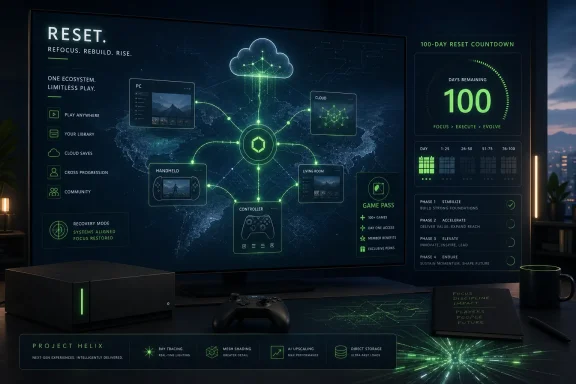 The Console War Ended Before Xbox Found Its Victory Speech
For most of its life, Xbox had a simple argument. It was the machine for Halo, for Xbox Live, for the friends list that made online console gaming feel less like a novelty and more like the default. Even when Microsoft stumbled, the pitch was legible: buy the hardware because the ecosystem was strongest there.That clarity has been fading for years. Cross-play weakened the social lock-in. PC releases weakened the hardware lock-in. Game Pass weakened the purchase model. Microsoft’s expanding PlayStation support weakened the exclusivity argument. Each move made sense in isolation, but together they left the Xbox console with an increasingly awkward job: justifying itself inside a business that no longer behaves like a console-first business.
That is why the “reset” language lands with such force. It names a problem that Xbox fans have been debating in less corporate terms since the Series X|S era began. If Xbox games are on PC, cloud, handhelds, and now rival consoles, the question is no longer whether the Xbox console is good hardware. The question is what unique role it plays.
The answer cannot simply be “Game Pass.” Game Pass is a distribution strategy, a retention tool, and a content budget wrapped into a subscription. It is not, by itself, a reason to buy one dedicated box if the same account, library, and social graph can travel elsewhere.
Microsoft Built a Bigger Xbox and Made the Box Smaller
The paradox of modern Xbox is that Microsoft’s gaming footprint is larger than ever while the Xbox console feels less essential than ever. Activision Blizzard, Bethesda, Mojang, Xbox Game Studios, PC storefronts, cloud gaming, and Game Pass together make Microsoft one of the most consequential companies in games. Yet that scale has not translated into a clean hardware win.The reported reset should be read against that contradiction. Microsoft spent the last decade buying content and expanding distribution. It wanted Xbox to be everywhere, and in many ways it succeeded. But “everywhere” is a dangerous victory for a console brand, because the console business depends on scarcity, habit, and identity.
Nintendo understands this instinctively. Sony, despite its PC ambitions, still understands it commercially. Microsoft has tried to have it both ways: sell the console as a premium home for Xbox while telling players that Xbox is a service, a library, a launcher, a cloud endpoint, and increasingly a publisher on other platforms.
That may be strategically rational. It may even be inevitable. But it is not emotionally tidy, and console buying is still partly emotional. Players do not spend hundreds of dollars on a platform because a corporate flywheel diagram makes sense. They buy because they believe the box will be the best place to play the things they care about.
The Hardware Subsidy Model Is Losing Its Cover
The reported pressure from memory and storage prices matters because it attacks one of the console industry’s quiet assumptions. Consoles have traditionally been sold at thin margins or losses early in a cycle, with the platform holder expecting to recover money through software, services, accessories, and licensing. That model works when hardware costs fall over time and the installed base grows into a profitable software market.The Series X|S generation has not followed the comforting old curve. Instead of smooth price cuts, buyers have seen stubborn prices and, in some markets, increases. The Xbox Series S once gave Microsoft a sharp value argument: a cheaper next-gen entry point paired with a subscription library. But as prices rose and storage demands increased, that argument became harder to sustain.
A $299 Series S could be pitched as a gateway drug for modern gaming. A much more expensive Series S has to compete not only with PlayStation, but with used hardware, PC handhelds, financing plans, and the simple option of waiting. The Series X has a different problem: it is powerful and well-designed, but power alone is a weak differentiator when the most important games increasingly appear across platforms.
If component costs are rising because AI infrastructure is swallowing memory supply, Xbox is caught in an especially Microsoft-shaped bind. The parent company’s most important growth story may be making the gaming division’s hardware economics harder. That does not mean Microsoft is sabotaging Xbox. It means Xbox now lives inside a corporation whose capital priorities are much larger than games.
Project Helix Has to Be More Than a Faster Console
Project Helix, Microsoft’s next-generation Xbox hardware effort, is therefore carrying more weight than a normal console transition. A faster GPU, better ray tracing, and tighter Windows integration are expected. They are not enough. The next Xbox has to answer a strategic question the Series consoles never fully resolved: is this a console, a PC-adjacent appliance, a living-room Windows machine, or a reference design for other manufacturers?Microsoft has already been moving toward the last three answers. Xbox mode in Windows, the ROG Xbox Ally push, Play Anywhere growth, and a more unified console-PC development story all point toward a platform that is less dependent on one box. That could be powerful if Microsoft executes well. It could also be confusing if the company cannot explain why a customer should choose the official Xbox device over a handheld, a gaming PC, or a PlayStation plus a Game Pass-compatible secondary screen.
A premium Project Helix machine would satisfy enthusiasts who want Microsoft to compete head-on with Sony. But if the price climbs toward boutique PC territory, the audience narrows. A cheaper box would preserve the mass-market console idea, but rising memory and storage costs make that difficult. A family of third-party Xbox devices would give Microsoft reach, but it risks making the first-party console feel like just another certified endpoint.
This is the tightrope. Xbox needs hardware to remain credible as a platform. But the more Xbox becomes a platform independent of hardware, the harder it is to make hardware feel indispensable.
The Exclusivity Retreat Was Rational, but It Was Not Free
Microsoft’s multiplatform pivot is often discussed as betrayal or enlightenment, depending on the fan forum. In business terms, it is simpler. If Xbox-owned games can sell millions more copies on PlayStation and PC, leaving that money on the table becomes harder to defend, especially after multibillion-dollar acquisitions and sluggish console sales.But rational does not mean costless. Exclusivity is inefficient in the short term and powerful in the long term. It concentrates attention. It gives hardware a story. It tells players that if they want the full cultural experience of a platform, they need to be inside that platform.
By sending more games elsewhere, Microsoft has expanded the Xbox audience while diluting the Xbox console’s claim on that audience. A PlayStation owner who can play Forza, Halo, Fable, or other Xbox-published titles without buying an Xbox has learned a useful lesson: Microsoft may want their money more than their platform loyalty.
That does not make the strategy wrong. In fact, for a company of Microsoft’s scale, software revenue may matter more than console purity. But it does change what Xbox is selling. The console is no longer the locked gate to Microsoft’s best games. It has to become the most convenient, best-value, most coherent expression of the Xbox ecosystem.
At the moment, that case is uneven. Game Pass remains compelling, backward compatibility remains a strength, and Xbox’s account infrastructure is mature. But the emotional center has weakened. A console can survive without every exclusive. It cannot thrive if customers believe exclusives will eventually arrive somewhere else and the hardware will only get more expensive.
Game Pass Is Still the Crown Jewel, but It No Longer Solves Every Problem
Game Pass changed the industry because it gave Xbox a narrative Sony could not easily copy: day-one first-party releases, a rotating library, and a subscription that made experimentation feel cheap. For players who sampled widely, it was and remains one of the strongest values in gaming. For Microsoft, it promised recurring revenue and a way to turn content scale into platform stickiness.The strain is now visible. Subscription economics are brutal when development budgets keep rising and growth slows. The more expensive the content pipeline becomes, the more Game Pass has to either raise prices, add advertising, segment tiers, reduce generosity, or find new forms of monetization. None of those options are as clean as the original promise.
This is where Satya Nadella’s reported comments about monetization matter. If Xbox games generate enormous attention outside Microsoft’s own payment rails, then the company sees leakage. Players may watch, stream, discuss, and socialize around Xbox content without spending enough inside Microsoft’s ecosystem. That is a familiar internet problem, but it is a newer console problem.
The temptation will be to monetize more aggressively. That could mean bundles, financing, ads, perks, cloud upsells, storefront integration, or a revived Xbox All Access-style model. Some of that may be reasonable. But Xbox has to be careful not to make its value proposition feel like a spreadsheet wearing a gamer hoodie.
Players can tolerate price increases when the product feels abundant and confident. They are less forgiving when prices rise while the platform’s identity is being renegotiated in public.
The Windows Connection Is Xbox’s Best Escape Route and Its Biggest Risk
The most promising version of Xbox’s future may not be a console war comeback. It may be a Windows gaming reset. Microsoft owns the dominant PC operating system, a major gaming subscription, a deep publishing bench, DirectX, cloud infrastructure, and a console interface that many players already understand. If those pieces finally come together, Xbox could become the consumer-friendly gaming layer Windows has always lacked.That is a real opportunity. PC gaming is powerful but messy. Driver updates, launchers, storefront fragmentation, shader compilation, controller support, anti-cheat quirks, and handheld compatibility all create friction. A polished Xbox mode for Windows could make PC gaming feel more console-like without closing the platform.
For WindowsForum readers, this is where the story becomes bigger than Xbox. A successful Xbox reset could shape how Microsoft treats Windows as an entertainment OS. It could influence handheld design, living-room PCs, Store policy, Game Bar, cloud saves, input handling, and the long-running effort to make Windows feel less hostile on controller-first devices.
But the danger is equally obvious. Microsoft has a long history of almost solving Windows gaming and then getting distracted. Games for Windows Live remains the cautionary ghost. The Microsoft Store has improved, but it has not replaced Steam as the center of PC gaming gravity. Xbox on Windows must be more than a full-screen skin if it wants to matter.
The prize is not merely selling another console. The prize is making Xbox the default identity layer for play across Windows devices. That would give Microsoft a future even if traditional console hardware becomes a smaller business. It would also demand consistency, patience, and restraint — three qualities Xbox strategy has not always displayed.
The Studio Question Is Where Strategy Meets Morale
A reset that focuses only on hardware pricing and platform architecture misses the human problem. Xbox’s strength is software, and software comes from studios. After years of acquisitions, reorganizations, cancellations, layoffs, and shifting priorities, Microsoft has to convince developers that Xbox is not just a financial instrument for extracting IP value.That matters because the platform’s future depends on creative credibility. Gears E-Day, Clockwork Revolution, Fable, Halo, Forza, Avowed, The Outer Worlds, Doom, Call of Duty, Fallout, Elder Scrolls, and countless smaller projects are not interchangeable “content units.” They are the reason people care about the ecosystem at all.
If Xbox responds to margin pressure by cutting too deeply, it risks weakening the very asset base that justifies the reset. If it spends without discipline, it repeats the bloat problem that made the reset necessary. The company needs a publishing strategy that is narrower, clearer, and more accountable without becoming creatively timid.
This is a hard balance. Microsoft has enough studios to release major games regularly, but that scale only helps if the schedule, quality bar, and platform strategy align. The next 100 days, if the reported framing is accurate, cannot fix a development culture overnight. It can, however, signal whether Xbox intends to become a disciplined publisher or a nervous conglomerate managing decline.
The PlayStation Comparison Is Useful but Incomplete
It is tempting to reduce Xbox’s predicament to a PlayStation victory lap. Sony has outsold Microsoft in hardware, preserved a stronger console identity, and maintained a clearer premium first-party brand. On those measures, Xbox has plainly lost ground.But Sony’s model is not immune to the same pressures. Development costs are rising across the industry. PC ports are now part of PlayStation’s economics. Live-service bets have been uneven. Hardware price cuts are less automatic than they once were. The traditional console business is not collapsing, but it is no longer the simple growth engine it was in earlier cycles.
The difference is that Sony still has a cleaner answer to the buyer’s question: why buy a PlayStation? Microsoft’s answer is more ambitious and less concise. It wants Xbox to mean console, PC, cloud, subscription, publishing label, handheld experience, backward-compatible archive, and social identity. That may be the future. It is also a branding problem.
A reset can help only if Microsoft chooses which meanings matter most. If Xbox tries to be everything at once, it will keep sounding evasive. If it picks a hierarchy — games first, Windows integration second, hardware as the premium home of the ecosystem — the whole strategy becomes easier to understand.
The Brand Reset Is Really a Trust Reset
Xbox fans are not angry because they dislike change. They are angry because the direction has often felt provisional. One year the message is cloud. Another year it is Game Pass. Then it is “when everyone plays, we all win.” Then it is premium hardware. Then it is multiplatform publishing. Then it is a renewed promise of signature exclusives.Each statement can be defended. Together, they create fatigue. A platform holder does not need to reveal every business plan, but it does need to make customers feel that their purchases remain safe, valued, and strategically central.
Backward compatibility has been one of Xbox’s strongest trust-building moves because it respected libraries across generations. Play Anywhere does something similar across PC and console. Cross-save, cross-buy, and controller continuity are not glamorous, but they are the kind of infrastructure that makes users believe an ecosystem will not strand them.
That should be the heart of the reset. Not a slogan. Not a nostalgia montage. Not another claim that Xbox is “for everyone.” The heart should be a practical promise: buy into Xbox, and your library, saves, identity, and access will follow you across devices better than anywhere else.
If Microsoft can make that promise real, the console becomes part of a larger value proposition rather than the lone object expected to carry the brand.
The Next Xbox Pitch Must Survive the Checkout Page
The next Xbox cannot be sold on specs alone. It has to survive a buyer standing in front of a price, a shelf, a subscription chart, and a competing device. That buyer will ask whether the games are there, whether friends are there, whether the subscription is worth it, whether the library travels, and whether the platform holder still seems committed.Right now, Microsoft has partial answers. The library is strong. The service is familiar. The Windows opportunity is real. The hardware commitment exists, at least publicly, through Project Helix. The weak point is coherence.
The reported “Xbox Plus Game Pass” idea, financing partnerships, and potential free multiplayer discussion all suggest Microsoft knows the purchase model needs simplification. A console bundled with a service can make sense if it feels like a phone plan: predictable, accessible, and useful. But if the bundle is merely a way to disguise rising costs, players will notice.
Free multiplayer would be one of the clearest signals Microsoft could send. Xbox Live Gold helped define paid console online play, but the PC market has long made that fee look increasingly strange. Dropping the paywall would not solve Xbox’s hardware problem by itself, but it would align the brand with its Windows future and remove one psychological tax from the console pitch.
The company also needs to be honest about exclusives. A case-by-case model may be financially rational, but it should not be dressed up as a grand doctrine if the real answer is timing, contract terms, and expected return. Players can handle nuance better than corporate fog.
The Hard Numbers Point to a Softer Identity Crisis
Hardware revenue declines, reported margin pressure, and component inflation are serious. But the deeper issue is not a single bad quarter. It is that Xbox’s strongest financial logic and strongest fan logic now point in different directions.The financial logic says Microsoft should sell software and services wherever customers are. It should use Windows, cloud, PlayStation, Nintendo, handhelds, and subscriptions to maximize reach. It should reduce dependence on subsidized hardware if that hardware no longer produces enough platform lock-in.
The fan logic says a console platform needs pride of place. It needs games that feel native to it, features that feel designed for it, and a future that makes the purchase feel wise. It needs identity, not merely access.
The reset will succeed only if Microsoft stops treating those logics as enemies. The console does not have to be the entire Xbox business. But it does have to be the best Xbox experience for a meaningful audience. If Microsoft cannot say that with conviction, customers will not say it for them.
The Reset Gives Xbox One Last Chance to Make Its Sprawl Feel Intentional
The shape of a credible recovery is visible, even if the execution is not guaranteed. Microsoft has the content. It has the operating system. It has the cloud. It has a subscription brand that, despite pressure, remains widely recognized. It has hardware teams still building the next generation. What it lacks is a simple promise that ties those assets together.That promise should not be “Xbox everywhere” in the abstract. It should be “your Xbox library everywhere, with the best living-room and Windows experience on Xbox hardware.” That distinction matters. The first phrase makes the console optional. The second gives it a role.
Near-term, Microsoft’s reported reset should be judged by concrete moves rather than rhetoric:
- Microsoft needs to clarify which first-party games remain exclusive, which are timed, and which are fully multiplatform.
- Project Helix needs a price and performance story that does not collapse under comparison with PCs and handhelds.
- Game Pass needs a sustainable model that preserves its value instead of slowly teaching users to expect less for more.
- Xbox on Windows needs to become a polished gaming environment, not another half-finished shell over the desktop.
- The company needs to protect studio output because software is the only asset strong enough to make the broader ecosystem matter.
- The next hardware pitch must explain why buying an Xbox is better than merely playing Xbox games somewhere else.
References
- Primary source: NoobFeed
Published: 2026-06-20T17:50:20.553667
XBOX Reset Could Change the Future of Gaming | NoobFeed
As pressures on the company increase due to rising costs, declining revenue, and shifting strategies, XBOX is under pressure to rethink its place in the gamingwww.noobfeed.com - Related coverage: windowscentral.com
"The rumors are false": No, Microsoft isn't already looking to 'reverse course' on Xbox exclusives — but it's not hard to understand why these rumors spread | Windows Central
Rumors picked up over the weekend spread by anonymous forum posters that Microsoft wasn't truly committed to exclusive games. Microsoft has denied them.www.windowscentral.com - Related coverage: gamesradar.com
Microsoft CEO admits "there's more monetization of Xbox games happening on YouTube" than the company as it tries to "turn this into a sustainable business" | GamesRadar+
He says this amid an "Xbox reset"www.gamesradar.com - Related coverage: pcgamer.com
As Xbox eyes layoffs, Microsoft's CEO says its videogames aren't monetised enough—so it's not the cancelled games or $68.7 billion deals or AI overspending, then | PC Gamer
Watch that line go up, up up up up up.www.pcgamer.com - Related coverage: gamespot.com
Xbox Gaming Revenue Declines As Console Sales Continue To Slump - GameSpot
Microsoft's gaming division continues to struggle while the company's cloud and business services thrive.www.gamespot.com - Related coverage: gematsu.com
Forza Horizon 6 announced for PS5, Xbox Series, and PC - Gematsu
Publisher Xbox Game Studios and developer Playground Games have announced open-world racing game Forza Horizon 6. It will launch first for Xbox Series and PC…www.gematsu.com
- Related coverage: tbreak.com
Microsoft Q3 2026: Xbox Revenue Falls 33%, Game Pass Down 5%
Microsoft Q3 2026 earnings: Xbox hardware revenue fell 33% year-on-year and Game Pass dropped 5%, raising questions about the console division's direction. tbreak.com
- Related coverage: techtimes.com
Xbox Warns Storage Costs Hit 5x by 2027: AI Chip Demand Breaks Console Subsidy Model
Xbox Project Helix price faces a storage cost crisis confirmed in Xbox CEO Asha Sharma’s June 10 Reset memo: component costs have quadrupled since Fall 2025 and will exceed 5x by the 2027 holidaywww.techtimes.com - Related coverage: tech.sportskeeda.com
Xbox hardware revenue down by 32% in Q2 FY26, is Xbox in trouble?
Microsoft posted its earnings report for Q2 FY26, which reflected overall growth for the company. However, the Xbox revenue is down by 32% this time, which is not a good look, but that's not all.tech.sportskeeda.com - Related coverage: xboxera.com
Xbox Down Year over Year in Both Hardware and Services for Q2 FY26 | DayOne
Xbox is down in both their Services & Content and Hardware revenue per Microsoft's freshly released FY26 Q2 statement.xboxera.com - Related coverage: talkesport.com
Xbox Revenue Down Again in Q3 FY2026: Hardware Drops 33%, Gaming Falls 7%
Xbox hardware revenue fell 33% and gaming dropped 7% in Microsoft's Q3 FY2026 earnings. Total gaming revenue was $5.34 billion as Azure hit 40% growth. Full breakdown here.www.talkesport.com - Related coverage: purexbox.com
- Related coverage: news.xbox.com
From GDC: Building the Next Generation of Xbox - XBOX Wire
Xbox is deep in development on the next generation Xbox console, Project Helix. Find out more from our keynote at the 2026 Game Developer Conference.news.xbox.com - Related coverage: tomshardware.com
Microsoft's gaming division flounders while the firm makes more money than ever — Xbox consoles sales drop 32% | Tom's Hardware
Xbox gamers have seen their share of struggles lately.www.tomshardware.com - Related coverage: tweaktown.com
Xbox hardware revenue drops to record low of Gen9 Xbox Series generation
Xbox's Q3FY26 represent the lowest quarter of Xbox console revenues ever recorded since Microsoft launched the gen 9 Xbox Series console generation. www.tweaktown.com
- Related coverage: ashgabattimes.com
