
ServiceNow is being cast as an underappreciated artificial-intelligence winner because, as of June 2026, its workflow platform sits between enterprise employees, business systems, and emerging AI agents that still need governance, permissions, approvals, audit trails, and operational handoffs to do useful work. That is the important distinction buried beneath the stock-market shorthand. AI does not simply remove work from companies; in many cases, it creates a new class of work that must be supervised, routed, measured, and secured.
The Motley Fool’s argument is not that ServiceNow is suddenly more glamorous than Nvidia, OpenAI, Microsoft, or Anthropic. It is that the less theatrical part of the AI economy may turn out to be more durable: the operating layer that decides which automated action is allowed, who approved it, where it was logged, and what happens when it fails. For WindowsForum readers, that should sound familiar. The enterprise rarely dies from lack of clever demos; it dies from uncontrolled sprawl.
The first wave of agentic AI hype invited a clean but misleading story: if software can write workflows, execute tasks, and talk to business systems, traditional workflow platforms become less necessary. Why pay for a large software suite when an AI agent can stitch together processes on demand? That question helped pressure software valuations earlier in the AI cycle, particularly for companies whose products looked like middleware between employees and enterprise data.
But that framing treats the enterprise like a blank canvas. Real companies are not blank canvases. They are accumulations of procurement rules, identity systems, ticket queues, compliance obligations, security controls, exception paths, change-management boards, and employees who know exactly which “simple approval” can bring a process to a halt.
ServiceNow’s business has always lived inside that mess. Its pitch is not that work is elegant. Its pitch is that work is messy enough to need a system of record and a system of action. AI agents may automate more tasks, but they do not remove the need to know what happened, why it happened, who authorized it, and whether the action violated policy.
That is why the bear case against ServiceNow can be directionally right and practically incomplete at the same time. Yes, AI will compress some software tasks. Yes, natural-language interfaces will make some forms and dashboards feel antiquated. But the deeper question is not whether an agent can generate a purchase request, reset a password, triage a support ticket, or draft a remediation plan. The question is whether the enterprise will let it do those things without a control plane.
A large organization may have thousands of ServiceNow workflows that encode how the business actually functions. A new hire request triggers hardware provisioning, identity setup, manager approvals, facilities access, training assignments, and compliance acknowledgments. A security incident triggers investigation, escalation, containment, reporting, and post-incident review. A customer-service problem may cross product teams, engineering queues, legal constraints, and account-management obligations.
That layer is hard to replace because it is not just software. It is organizational memory. Once a company has wired its procedures into ServiceNow, the platform becomes a map of dependencies that are expensive to reconstruct elsewhere. The switching cost is not simply a license fee; it is the risk of breaking processes that people only notice when they stop working.
This is why workflow platforms have often looked less exciting than they are. They do not produce the same emotional reaction as a new chatbot or image model. They do not benchmark cleanly on a leaderboard. But they sit close to the transaction layer of the company, where mundane actions accumulate into business continuity.
AI raises the value of that map rather than rendering it obsolete. An agent without context is a clever intern with admin rights. An agent with context, permissions, workflow state, and auditability starts to look like a useful enterprise tool. ServiceNow wants to be where that conversion happens.
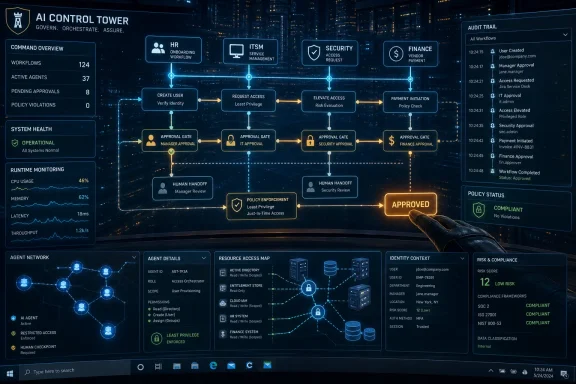
That is the wedge ServiceNow is pushing. Its AI Control Tower is positioned as a centralized place to observe AI agents, manage their access, connect them to workflows, and measure their effect. The company has expanded that pitch through partnerships with major AI and cloud vendors, including Microsoft, AWS, Google Cloud, NVIDIA, Anthropic, and others. The strategic message is obvious: ServiceNow does not need to own every model if it can govern what those models are allowed to do inside the enterprise.
This is a classic enterprise-software move. When a new technology wave creates fragmentation, the platform vendor offers consolidation. When departments buy point tools, the platform vendor offers governance. When executives worry that adoption is happening faster than oversight, the platform vendor offers a dashboard, policy layer, and audit trail.
The critical test is whether customers see this as genuine control or just another management console. Enterprises are already drowning in consoles. Security teams have dashboards for identity, endpoint telemetry, cloud posture, vulnerability management, SIEM, SOAR, data loss prevention, and more. A successful AI control layer must do more than visualize agent activity. It must connect AI action to existing business workflows in a way that reduces risk and friction.
That is where ServiceNow’s installed base gives it a credible story. If the company can make AI agents operate through workflows enterprises already trust, it can sell AI governance as an extension of operational discipline rather than as a new island.
AI agents are the next version of that problem. They can act across systems, make decisions with incomplete information, invoke tools, summarize logs, open tickets, close tickets, update records, and potentially trigger real-world consequences. That makes them useful. It also makes them dangerous in ways that are familiar to anyone who has ever cleaned up an overprivileged service account.
The enterprise does not need every agent to be brilliant. It needs every agent to be bounded. It needs to know which identity the agent used, what data it accessed, what action it took, whether a human approved the step, and whether the result can be rolled back. Those are not philosophical concerns. They are operational requirements.
This is why the ServiceNow story intersects with WindowsForum’s world more than a typical stock-market article might suggest. The same organizations managing Windows fleets, Microsoft 365 tenants, Azure subscriptions, endpoint security, and identity policies are the organizations being asked to let AI act inside production workflows. They will not evaluate that request like consumers trying a chatbot. They will evaluate it like administrators inheriting another privileged actor on the network.
That creates an opening for ServiceNow. The company can tell CIOs and CISOs that agentic AI should not become another unmanaged layer. It should be folded into the same workflow, approval, risk, and audit structures that already govern human work.
Still, investors and IT buyers should avoid confusing early traction with inevitability. Enterprise AI budgets are real, but they are also experimental. Many companies are still sorting out which AI features create measurable productivity gains and which merely produce executive enthusiasm. The next several years will separate sticky AI workflow products from expensive add-ons that looked good in a demo.
ServiceNow’s advantage is that it can attach AI to existing contracts and existing processes. That gives it a distribution channel that AI-native startups envy. A startup may have a clever agent for procurement, incident response, or HR onboarding, but ServiceNow may already be the place where those workflows live. In enterprise software, proximity to the budget and proximity to the process often matter as much as technical novelty.
The risk is that customers may resist paying premium prices for AI features that become commoditized. If model capabilities improve rapidly and integration frameworks standardize, some buyers may ask why they need an expensive proprietary layer. ServiceNow’s answer must be that the value is not the model itself. The value is the governed execution of work across a large organization.
That answer is plausible. It is not guaranteed. The company’s AI story will be judged by renewal rates, expansion deals, real productivity metrics, and whether customers continue to treat ServiceNow as strategic infrastructure rather than as a costly system they inherited.
This competitive landscape cuts both ways. On one hand, it validates the market. Everyone wants to own the layer where AI moves from answer generation to business action. On the other hand, it means ServiceNow must prove that a cross-enterprise workflow platform is more compelling than native AI controls bundled into existing productivity, cloud, or business-application suites.
Microsoft is the most obvious pressure point for many WindowsForum readers. If an organization already lives in Microsoft 365, Entra ID, Teams, Purview, Defender, Azure, and Copilot Studio, Microsoft can argue that AI governance should be built into that estate. That argument will resonate with customers looking to reduce vendor complexity.
ServiceNow’s counterargument is neutrality and workflow depth. It can present itself as the layer that governs work across Microsoft, AWS, Google Cloud, NVIDIA-powered infrastructure, third-party models, custom agents, and business systems. That is a strong pitch for heterogeneous enterprises, which is to say most large enterprises.
But neutrality is only valuable if it works. If AI Control Tower becomes another integration promise that requires months of professional services, customers will be skeptical. If it genuinely discovers, governs, and routes agentic work across systems without forcing every department into a single vendor’s worldview, ServiceNow may have something more durable than a feature cycle.
This is not a theoretical concern. Enterprise AI security discussions have already moved beyond prompt injection jokes and into questions of privilege escalation, tool misuse, data leakage, agent impersonation, and unapproved autonomous action. When an AI system can do more than generate text, traditional application-security assumptions start to look thin.
ServiceNow’s pitch is that governance, role-scoped permissions, auditability, and workflow controls can make agentic AI safe enough for production. That is exactly the right problem to solve. It is also a problem that will invite scrutiny every time a vulnerability, misconfiguration, or unexpected agent behavior appears.
For IT pros, the practical question is not whether ServiceNow’s AI controls sound sensible in a keynote. It is whether they fit into existing security operations. Can agent actions be logged in a way security teams trust? Can access be scoped cleanly to enterprise identity? Can approval steps be enforced rather than suggested? Can risky behavior be halted automatically? Can auditors reconstruct the chain of events after something goes wrong?
If the answer is yes, ServiceNow becomes more than a workflow vendor with AI branding. It becomes part of the enterprise safety layer for autonomous work. If the answer is no, AI Control Tower risks becoming a grand name for a partial dashboard.
That handoff is where enterprises will spend much of the next decade. Full autonomy will be attractive in narrow domains, but most organizations will move through stages. First, AI summarizes and recommends. Then it drafts and queues. Then it executes low-risk tasks. Then it handles more complex work under policy. At every stage, someone needs to define the boundary between advice and action.
ServiceNow is trying to make that boundary programmable. That is a bigger idea than adding a chatbot to a ticketing system. It suggests a future in which workflows are not simply sequences of human tasks, but mixed systems of human workers, AI agents, business rules, approvals, and machine-generated evidence.
This vision has obvious appeal to executives. Labor is expensive. Processes are slow. Employees hate internal bureaucracy. Customers hate waiting. If AI agents can eliminate delays without creating chaos, the productivity argument becomes strong.
But the same vision will create tension inside organizations. Employees may worry about surveillance and job displacement. Administrators may worry about opaque automation. Developers may worry about platform lock-in. Security teams may worry about granting agency to systems they cannot fully predict. ServiceNow’s success will depend on whether it can make AI feel like controlled acceleration rather than uncontrolled delegation.
That is why ServiceNow deserves attention even from people who do not care about its stock. The company is a useful indicator of where AI is moving inside large organizations. The conversation is shifting from “Can the model answer?” to “Can the system act safely?” That shift favors vendors with workflow context, identity integration, governance features, and existing enterprise trust.
There is a parallel here with the cloud era. Early cloud excitement focused on raw infrastructure and developer velocity. Over time, the spending expanded into security, compliance, observability, cost management, identity, data governance, and automation. The first-order platform created second-order control problems. Entire product categories grew out of those problems.
Agentic AI appears to be following the same pattern at higher speed. The more agents companies deploy, the more they need registries, policies, logs, permission models, evaluation frameworks, fallback paths, and business-process integration. That is not an argument that ServiceNow wins automatically. It is an argument that ServiceNow is competing in the right layer.
For Windows-heavy enterprises, this also means AI adoption will not be confined to a single assistant embedded in Office or a single model hosted in Azure. It will spill into help desks, device management, security operations, HR workflows, procurement systems, customer support, and application development. The operational question becomes who coordinates all of that. ServiceNow wants the answer to be ServiceNow.
That is particularly true if ServiceNow succeeds in becoming a broker for AI agents across multiple systems. A misconfigured workflow is one thing. A misconfigured autonomous workflow with access to identity, procurement, customer records, or security tools is another. The platform’s promise of centralized control means customers will expect centralized accountability.
This is where enterprise buyers should push past the branding. They should ask how ServiceNow handles agent identity, least privilege, runtime monitoring, approval enforcement, rollback, data retention, model evaluation, third-party integrations, and incident response. They should ask what happens when an agent makes a plausible but wrong decision. They should ask how the platform distinguishes between a legitimate autonomous action and an agent operating outside its intended scope.
These are not reasons to reject ServiceNow’s AI strategy. They are reasons to take it seriously. A trivial AI add-on does not require this level of diligence. A platform that may govern autonomous work across the enterprise absolutely does.
The irony is that ServiceNow’s strongest selling point may also slow adoption. The more important the platform becomes, the more carefully enterprises will deploy it. That is healthy. AI governance should not be bought like a browser extension.
That can be a very good business. Plumbing is sticky. Governance is sticky. Workflow history is sticky. The more departments depend on a platform, the harder it becomes to remove. If ServiceNow can attach AI governance and agent orchestration to that foundation, it can turn a perceived disruption into an expansion cycle.
But “winner” is still a premature word. The AI platform market is moving quickly, and many customers are still in pilot mode. Microsoft, Salesforce, Workday, Atlassian, cloud providers, security vendors, and AI-native startups will all fight for pieces of the same control layer. ServiceNow’s advantage is real, but it is not destiny.
The better formulation is this: ServiceNow is one of the most credible candidates to benefit from the enterprise phase of AI, where the bottleneck is no longer model access but operational trust. That is a less flashy story than chips or chatbots. It may also be the story that matters most once the demos end.
The Motley Fool’s argument is not that ServiceNow is suddenly more glamorous than Nvidia, OpenAI, Microsoft, or Anthropic. It is that the less theatrical part of the AI economy may turn out to be more durable: the operating layer that decides which automated action is allowed, who approved it, where it was logged, and what happens when it fails. For WindowsForum readers, that should sound familiar. The enterprise rarely dies from lack of clever demos; it dies from uncontrolled sprawl.
 The AI Threat Was Always Too Simple
The first wave of agentic AI hype invited a clean but misleading story: if software can write workflows, execute tasks, and talk to business systems, traditional workflow platforms become less necessary. Why pay for a large software suite when an AI agent can stitch together processes on demand? That question helped pressure software valuations earlier in the AI cycle, particularly for companies whose products looked like middleware between employees and enterprise data.But that framing treats the enterprise like a blank canvas. Real companies are not blank canvases. They are accumulations of procurement rules, identity systems, ticket queues, compliance obligations, security controls, exception paths, change-management boards, and employees who know exactly which “simple approval” can bring a process to a halt.
ServiceNow’s business has always lived inside that mess. Its pitch is not that work is elegant. Its pitch is that work is messy enough to need a system of record and a system of action. AI agents may automate more tasks, but they do not remove the need to know what happened, why it happened, who authorized it, and whether the action violated policy.
That is why the bear case against ServiceNow can be directionally right and practically incomplete at the same time. Yes, AI will compress some software tasks. Yes, natural-language interfaces will make some forms and dashboards feel antiquated. But the deeper question is not whether an agent can generate a purchase request, reset a password, triage a support ticket, or draft a remediation plan. The question is whether the enterprise will let it do those things without a control plane.
Workflow Software Looks Boring Until It Becomes the Map of the Company
ServiceNow’s strength is that it is already embedded where companies route work. IT service management remains the historical center of gravity, but the company’s platform has expanded into HR, customer service, security operations, risk, finance-adjacent workflows, asset management, and industry-specific processes. That matters because the value is not merely in the form a user fills out. The value is in the institutional graph behind it.A large organization may have thousands of ServiceNow workflows that encode how the business actually functions. A new hire request triggers hardware provisioning, identity setup, manager approvals, facilities access, training assignments, and compliance acknowledgments. A security incident triggers investigation, escalation, containment, reporting, and post-incident review. A customer-service problem may cross product teams, engineering queues, legal constraints, and account-management obligations.
That layer is hard to replace because it is not just software. It is organizational memory. Once a company has wired its procedures into ServiceNow, the platform becomes a map of dependencies that are expensive to reconstruct elsewhere. The switching cost is not simply a license fee; it is the risk of breaking processes that people only notice when they stop working.
This is why workflow platforms have often looked less exciting than they are. They do not produce the same emotional reaction as a new chatbot or image model. They do not benchmark cleanly on a leaderboard. But they sit close to the transaction layer of the company, where mundane actions accumulate into business continuity.
AI raises the value of that map rather than rendering it obsolete. An agent without context is a clever intern with admin rights. An agent with context, permissions, workflow state, and auditability starts to look like a useful enterprise tool. ServiceNow wants to be where that conversion happens.
ServiceNow Is Selling Control, Not Just Automation
The phrase “AI Control Tower” sounds like marketing, because it is. But the underlying idea is not frivolous. As companies deploy models, copilots, departmental bots, AI assistants, and increasingly autonomous agents, they need a way to discover and govern those systems across different clouds, vendors, and business units.That is the wedge ServiceNow is pushing. Its AI Control Tower is positioned as a centralized place to observe AI agents, manage their access, connect them to workflows, and measure their effect. The company has expanded that pitch through partnerships with major AI and cloud vendors, including Microsoft, AWS, Google Cloud, NVIDIA, Anthropic, and others. The strategic message is obvious: ServiceNow does not need to own every model if it can govern what those models are allowed to do inside the enterprise.
This is a classic enterprise-software move. When a new technology wave creates fragmentation, the platform vendor offers consolidation. When departments buy point tools, the platform vendor offers governance. When executives worry that adoption is happening faster than oversight, the platform vendor offers a dashboard, policy layer, and audit trail.
The critical test is whether customers see this as genuine control or just another management console. Enterprises are already drowning in consoles. Security teams have dashboards for identity, endpoint telemetry, cloud posture, vulnerability management, SIEM, SOAR, data loss prevention, and more. A successful AI control layer must do more than visualize agent activity. It must connect AI action to existing business workflows in a way that reduces risk and friction.
That is where ServiceNow’s installed base gives it a credible story. If the company can make AI agents operate through workflows enterprises already trust, it can sell AI governance as an extension of operational discipline rather than as a new island.
The Windows Admin Lesson Is That Autonomy Always Needs a Boundary
Windows administrators have seen this movie before, just with different branding. PowerShell increased automation, but it also forced organizations to think harder about execution policy, logging, remoting, secrets, least privilege, and script provenance. Group Policy simplified fleet control, but it also created its own governance challenges. Microsoft Intune, Defender, Entra ID, and the broader endpoint-management stack all reflect the same truth: automation without policy becomes drift.AI agents are the next version of that problem. They can act across systems, make decisions with incomplete information, invoke tools, summarize logs, open tickets, close tickets, update records, and potentially trigger real-world consequences. That makes them useful. It also makes them dangerous in ways that are familiar to anyone who has ever cleaned up an overprivileged service account.
The enterprise does not need every agent to be brilliant. It needs every agent to be bounded. It needs to know which identity the agent used, what data it accessed, what action it took, whether a human approved the step, and whether the result can be rolled back. Those are not philosophical concerns. They are operational requirements.
This is why the ServiceNow story intersects with WindowsForum’s world more than a typical stock-market article might suggest. The same organizations managing Windows fleets, Microsoft 365 tenants, Azure subscriptions, endpoint security, and identity policies are the organizations being asked to let AI act inside production workflows. They will not evaluate that request like consumers trying a chatbot. They will evaluate it like administrators inheriting another privileged actor on the network.
That creates an opening for ServiceNow. The company can tell CIOs and CISOs that agentic AI should not become another unmanaged layer. It should be folded into the same workflow, approval, risk, and audit structures that already govern human work.
The Financial Signal Is Strong, but Not Yet Definitive
The Motley Fool highlights two numbers that matter: ServiceNow reported strong 2025 revenue growth, and Now Assist net new annual contract value more than doubled year over year in the fourth quarter of 2025. Those are meaningful signals because they suggest customers are not merely attending AI keynotes; they are buying AI-related capabilities from a workflow vendor.Still, investors and IT buyers should avoid confusing early traction with inevitability. Enterprise AI budgets are real, but they are also experimental. Many companies are still sorting out which AI features create measurable productivity gains and which merely produce executive enthusiasm. The next several years will separate sticky AI workflow products from expensive add-ons that looked good in a demo.
ServiceNow’s advantage is that it can attach AI to existing contracts and existing processes. That gives it a distribution channel that AI-native startups envy. A startup may have a clever agent for procurement, incident response, or HR onboarding, but ServiceNow may already be the place where those workflows live. In enterprise software, proximity to the budget and proximity to the process often matter as much as technical novelty.
The risk is that customers may resist paying premium prices for AI features that become commoditized. If model capabilities improve rapidly and integration frameworks standardize, some buyers may ask why they need an expensive proprietary layer. ServiceNow’s answer must be that the value is not the model itself. The value is the governed execution of work across a large organization.
That answer is plausible. It is not guaranteed. The company’s AI story will be judged by renewal rates, expansion deals, real productivity metrics, and whether customers continue to treat ServiceNow as strategic infrastructure rather than as a costly system they inherited.
The Competition Will Not Wait Politely
ServiceNow is not the only company that understands the control-plane opportunity. Microsoft is deeply positioned through Microsoft 365, Teams, Copilot, Azure, Entra ID, Intune, Defender, Power Platform, and Dynamics. Salesforce is pushing agentic AI into customer workflows. Atlassian has deep roots in software teams and IT service management. Workday owns major HR and finance workflows. Cloud providers want agent orchestration to live near their compute, data, and model platforms.This competitive landscape cuts both ways. On one hand, it validates the market. Everyone wants to own the layer where AI moves from answer generation to business action. On the other hand, it means ServiceNow must prove that a cross-enterprise workflow platform is more compelling than native AI controls bundled into existing productivity, cloud, or business-application suites.
Microsoft is the most obvious pressure point for many WindowsForum readers. If an organization already lives in Microsoft 365, Entra ID, Teams, Purview, Defender, Azure, and Copilot Studio, Microsoft can argue that AI governance should be built into that estate. That argument will resonate with customers looking to reduce vendor complexity.
ServiceNow’s counterargument is neutrality and workflow depth. It can present itself as the layer that governs work across Microsoft, AWS, Google Cloud, NVIDIA-powered infrastructure, third-party models, custom agents, and business systems. That is a strong pitch for heterogeneous enterprises, which is to say most large enterprises.
But neutrality is only valuable if it works. If AI Control Tower becomes another integration promise that requires months of professional services, customers will be skeptical. If it genuinely discovers, governs, and routes agentic work across systems without forcing every department into a single vendor’s worldview, ServiceNow may have something more durable than a feature cycle.
The Security Story Is Both the Opportunity and the Warning
The most compelling argument for ServiceNow as an AI winner is also the reason buyers should be cautious. Giving AI agents access to workflows, identities, approvals, and operational systems creates a powerful new attack surface. The more useful an agent becomes, the more damage it can do if misconfigured, manipulated, or compromised.This is not a theoretical concern. Enterprise AI security discussions have already moved beyond prompt injection jokes and into questions of privilege escalation, tool misuse, data leakage, agent impersonation, and unapproved autonomous action. When an AI system can do more than generate text, traditional application-security assumptions start to look thin.
ServiceNow’s pitch is that governance, role-scoped permissions, auditability, and workflow controls can make agentic AI safe enough for production. That is exactly the right problem to solve. It is also a problem that will invite scrutiny every time a vulnerability, misconfiguration, or unexpected agent behavior appears.
For IT pros, the practical question is not whether ServiceNow’s AI controls sound sensible in a keynote. It is whether they fit into existing security operations. Can agent actions be logged in a way security teams trust? Can access be scoped cleanly to enterprise identity? Can approval steps be enforced rather than suggested? Can risky behavior be halted automatically? Can auditors reconstruct the chain of events after something goes wrong?
If the answer is yes, ServiceNow becomes more than a workflow vendor with AI branding. It becomes part of the enterprise safety layer for autonomous work. If the answer is no, AI Control Tower risks becoming a grand name for a partial dashboard.
The Real Prize Is Owning the Handoff Between Humans and Machines
The most interesting part of ServiceNow’s AI strategy is not the assistant. Assistants are everywhere. The more important layer is the handoff: where AI-generated recommendations become approved actions, where machine triage becomes human escalation, where autonomous execution pauses for policy, and where outcomes are recorded.That handoff is where enterprises will spend much of the next decade. Full autonomy will be attractive in narrow domains, but most organizations will move through stages. First, AI summarizes and recommends. Then it drafts and queues. Then it executes low-risk tasks. Then it handles more complex work under policy. At every stage, someone needs to define the boundary between advice and action.
ServiceNow is trying to make that boundary programmable. That is a bigger idea than adding a chatbot to a ticketing system. It suggests a future in which workflows are not simply sequences of human tasks, but mixed systems of human workers, AI agents, business rules, approvals, and machine-generated evidence.
This vision has obvious appeal to executives. Labor is expensive. Processes are slow. Employees hate internal bureaucracy. Customers hate waiting. If AI agents can eliminate delays without creating chaos, the productivity argument becomes strong.
But the same vision will create tension inside organizations. Employees may worry about surveillance and job displacement. Administrators may worry about opaque automation. Developers may worry about platform lock-in. Security teams may worry about granting agency to systems they cannot fully predict. ServiceNow’s success will depend on whether it can make AI feel like controlled acceleration rather than uncontrolled delegation.
The Stock-Market Narrative Is Catching Up to the Admin Reality
Investors often chase the visible layers of a technology shift first. In AI, that meant chips, cloud capacity, foundation models, and consumer-facing chatbots. Those are real markets, and some of them are enormous. But enterprise adoption tends to reward companies that solve the less glamorous deployment problems.That is why ServiceNow deserves attention even from people who do not care about its stock. The company is a useful indicator of where AI is moving inside large organizations. The conversation is shifting from “Can the model answer?” to “Can the system act safely?” That shift favors vendors with workflow context, identity integration, governance features, and existing enterprise trust.
There is a parallel here with the cloud era. Early cloud excitement focused on raw infrastructure and developer velocity. Over time, the spending expanded into security, compliance, observability, cost management, identity, data governance, and automation. The first-order platform created second-order control problems. Entire product categories grew out of those problems.
Agentic AI appears to be following the same pattern at higher speed. The more agents companies deploy, the more they need registries, policies, logs, permission models, evaluation frameworks, fallback paths, and business-process integration. That is not an argument that ServiceNow wins automatically. It is an argument that ServiceNow is competing in the right layer.
For Windows-heavy enterprises, this also means AI adoption will not be confined to a single assistant embedded in Office or a single model hosted in Azure. It will spill into help desks, device management, security operations, HR workflows, procurement systems, customer support, and application development. The operational question becomes who coordinates all of that. ServiceNow wants the answer to be ServiceNow.
The Catch Is That Platforms Become Targets
ServiceNow’s installed base is its moat, but it is also its burden. A platform that becomes central to AI governance will attract more scrutiny from attackers, regulators, competitors, and customers. The bigger the control plane, the higher the consequence of failure.That is particularly true if ServiceNow succeeds in becoming a broker for AI agents across multiple systems. A misconfigured workflow is one thing. A misconfigured autonomous workflow with access to identity, procurement, customer records, or security tools is another. The platform’s promise of centralized control means customers will expect centralized accountability.
This is where enterprise buyers should push past the branding. They should ask how ServiceNow handles agent identity, least privilege, runtime monitoring, approval enforcement, rollback, data retention, model evaluation, third-party integrations, and incident response. They should ask what happens when an agent makes a plausible but wrong decision. They should ask how the platform distinguishes between a legitimate autonomous action and an agent operating outside its intended scope.
These are not reasons to reject ServiceNow’s AI strategy. They are reasons to take it seriously. A trivial AI add-on does not require this level of diligence. A platform that may govern autonomous work across the enterprise absolutely does.
The irony is that ServiceNow’s strongest selling point may also slow adoption. The more important the platform becomes, the more carefully enterprises will deploy it. That is healthy. AI governance should not be bought like a browser extension.
The Quiet AI Winner Still Has to Earn the Word “Winner”
ServiceNow may be under-discussed in mainstream AI conversation because it does not fit the popular image of the AI boom. It is not selling GPUs. It is not training frontier models. It is not a consumer chatbot with cultural heat. It is selling the plumbing that may determine whether AI can operate safely in the corporate world.That can be a very good business. Plumbing is sticky. Governance is sticky. Workflow history is sticky. The more departments depend on a platform, the harder it becomes to remove. If ServiceNow can attach AI governance and agent orchestration to that foundation, it can turn a perceived disruption into an expansion cycle.
But “winner” is still a premature word. The AI platform market is moving quickly, and many customers are still in pilot mode. Microsoft, Salesforce, Workday, Atlassian, cloud providers, security vendors, and AI-native startups will all fight for pieces of the same control layer. ServiceNow’s advantage is real, but it is not destiny.
The better formulation is this: ServiceNow is one of the most credible candidates to benefit from the enterprise phase of AI, where the bottleneck is no longer model access but operational trust. That is a less flashy story than chips or chatbots. It may also be the story that matters most once the demos end.
ServiceNow’s AI Bet Comes Down to Five Enterprise Realities
ServiceNow’s case as an AI winner rests on the idea that agentic AI increases the need for workflow control rather than eliminating it. That thesis is persuasive, but only if the company turns its platform position into measurable customer outcomes.- ServiceNow already owns critical workflow territory inside many large organizations, which gives it a strong starting point for AI orchestration and governance.
- AI agents do not remove the need for approvals, permissions, audit trails, escalation paths, and accountability inside regulated enterprises.
- The company’s AI Control Tower strategy is best understood as a bid to govern AI activity across vendors, clouds, models, and business systems.
- Microsoft and other platform vendors will challenge ServiceNow by embedding AI governance into ecosystems customers already use.
- Security will decide whether agentic AI becomes trusted infrastructure or another uncontrolled layer of enterprise risk.
- The investment case depends less on AI hype than on whether customers keep expanding ServiceNow contracts because the platform makes autonomous work safer and more productive.
References
- Primary source: The Motley Fool
Published: Sun, 21 Jun 2026 13:10:43 GMT
Loading…
www.fool.com - Related coverage: newsroom.servicenow.com
Loading…
newsroom.servicenow.com - Related coverage: investor.servicenow.com
Loading…
investor.servicenow.com - Related coverage: servicenow.com
Loading…
www.servicenow.com - Related coverage: rediff.com
ServiceNow AI Control Tower: Enhanced Governance For AI Systems - Rediff.com Business
ServiceNow has announced an expansion of its AI Control Tower offering with new capabilities that give enterprises control over every AI system, agent, and workflow, regardless of where it runs.www.rediff.com
- Related coverage: erp.today
ServiceNow Repositions Around AI Security and Governance at Knowledge 2026 | ERP Today
ServiceNow used Knowledge 2026 to reposition as the AI security and governance layer for enterprises, launching Autonomous Security and Risk, expanding AI Control Tower, and opening Action Fabric to external agents.erp.today
- Related coverage: nasdaq.com
ServiceNow hits $1 billion in AWS Marketplace transactions as enterprises rapidly adopt AI at scale | Nasdaq
Knowledge 2026— May 6, 2026— ServiceNow, the AI control tower for business reinvention, and Amazon Web Services today announced a platform expansion as companies rapidly deploy and scale agentic AI across the enterprise, which follows a significant milestone of ServiceNow AWS Marketplace...www.nasdaq.com - Related coverage: s205.q4cdn.com
- Related coverage: axios.com
Anthropic will use Claude AI to power ServiceNow agents
Claude will power ServiceNow's Build Agent, the company's AI tool for building applications and workflows.www.axios.com
- Related coverage: itpro.com
'Advisory AI has run its course': ServiceNow wants agents working in every corner of your business | IT Pro
ServiceNow is targeting mass integration of agents across an array of business functions with a major expansion of its Autonomous Workforce service.www.itpro.com - Related coverage: techradar.com
ServiceNow patches critical security flaw which could allow user impersonation | TechRadar
It is the most severe AI-driven vulnerability ever found, researchers saywww.techradar.com - Related coverage: kiplinger.com
Best AI Stocks to Buy: Smart Artificial Intelligence Investments | Kiplinger
Artificial intelligence is the catalyst for what many observers recognize as a fourth industrial revolution. Here are the best AI stocks to buy right now.www.kiplinger.com