
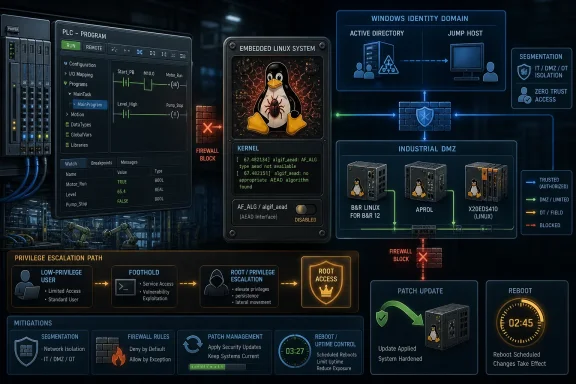
B&R Industrial Automation’s June 2026 advisory says multiple Linux kernel vulnerabilities affect Linux for B&R 12 and earlier, APROL releases before APROL-AutoYaST-DVD V4.4-010.10.260602, and all X20EDS410 devices, enabling local privilege escalation on exposed systems. The headline is not that a PLC-adjacent Linux stack has bugs; the headline is that industrial products are now inheriting the tempo of general-purpose Linux security. For WindowsForum readers, the lesson reaches beyond Linux shops: mixed Windows, Linux, and OT networks increasingly fail or survive as one estate. The old habit of treating industrial appliances as static boxes is becoming untenable.
B&R’s advisory is narrow in one sense and broad in another. The vulnerabilities require local access with low-privileged credentials, so this is not a classic unauthenticated internet worm scenario. But in industrial environments, “local access” often arrives through maintenance accounts, remote support tunnels, engineering workstations, jump hosts, or vendor service paths that were never designed with modern post-exploitation tactics in mind.
The affected product list matters because it spans more than one layer of the automation stack. Linux for B&R is the platform foundation, APROL is B&R’s process control and automation system, and X20EDS410 sits in the edge-device category. That means the issue is not limited to a single application package; it touches the embedded operating system layer that many operators rarely patch with the same urgency as a Windows domain controller or public-facing VPN.
The vulnerabilities carry high CVSS scores, mostly 7.8, with one listed at 7.1. That is the security industry’s numerical way of saying what administrators already understand intuitively: if an attacker can get a foothold, these flaws may turn a restricted account into root. In the OT world, root is not merely an administrative prize. It can mean persistence, tampering, log suppression, service manipulation, and a much uglier incident response exercise.
B&R says it had no evidence of exploitation targeting its products at the time of publication. That is reassuring only up to a point. The advisory also acknowledges public proof-of-concept exploits, and at least one of the covered vulnerabilities, CVE-2026-31431, has been widely discussed as an actively exploited Linux kernel privilege-escalation issue in the broader ecosystem. In other words, attackers do not need to care about B&R specifically for B&R users to become exposed.
The most prominent vulnerability in the bundle is CVE-2026-31431, commonly discussed under the “Copy Fail” nickname. It involves the Linux kernel’s AF_ALG cryptographic interface and the algif_aead module, allowing a local attacker to abuse kernel behavior in a way that can lead to privilege escalation. The precise mechanics live deep in the kernel’s handling of authenticated encryption and memory movement, but the operational meaning is simpler: an ordinary user can potentially become root on vulnerable systems.
That would be concerning on any server. On industrial Linux appliances, it is more complicated because many systems are deployed as products, not as general-purpose servers. The customer may not think of the device as a Debian-based Linux host. The operator may not have a normal package-management process. The maintenance team may have been told for years not to touch the underlying OS unless the vendor says so.
That vendor-mediated patch model creates friction. Linux distributions can push fixed kernels through repositories quickly, but industrial products often require qualification, packaging, and validation. B&R’s advisory reflects that reality: APROL has a named fixed version, while affected products are directed to install updates when available and conduct risk assessments where they are not.
There is a quiet but important message in that wording. The industrial software supply chain is downstream of the open-source kernel, but its update process does not move at upstream speed. Attackers can read upstream commits, proof-of-concept code, and public advisories immediately. Asset owners may wait for vendor validation, maintenance windows, and plant approval boards.
The B&R advisory says successful exploitation requires local access with low-privileged user credentials. That should shift the conversation from “not remotely exploitable” to “how many low-privileged paths exist into our industrial Linux systems?” For many organizations, the answer is uncomfortable. Engineering laptops, contractor VPNs, shared maintenance accounts, SSH access, web consoles, and temporary troubleshooting users all create paths that can turn a local bug into an operational risk.
This is especially relevant for Windows-heavy enterprises. Many OT incidents begin or are managed from Windows systems: Active Directory, jump servers, remote desktop gateways, engineering stations, backup consoles, and SIEM tooling. If a Windows identity compromise gives an attacker access to a Linux-based automation node, the Linux privilege-escalation bug becomes part of the Windows incident.
That is why this advisory belongs on WindowsForum. The Windows/Linux divide is mostly an administrative fiction inside real networks. Attackers do not respect platform boundaries. They follow credentials, trust relationships, remote management paths, and the weakest patch window.
CVE-2026-43284 and CVE-2026-46300 are tied to networking paths involving shared socket buffers and ESP processing. The advisory text points to scenarios where data may be decrypted or modified in place when the kernel should first ensure it owns a private copy. That may sound like a small bookkeeping mistake, but in kernel code, ownership mistakes are often security boundaries by another name.
CVE-2026-46333 concerns ptrace and dumpability logic. Ptrace is the debugging and inspection mechanism that has always sat uncomfortably close to security policy. When the kernel decides who may inspect or manipulate another process, subtle assumptions about credentials, capabilities, and process memory can decide whether “least privilege” actually means anything.
CVE-2026-43494 involves RDS zerocopy page handling and a cleanup path that can release resources incorrectly. Double-free and resource-release flaws have a long history in exploitation because they turn error handling into an attack surface. In production systems, obscure kernel features sometimes remain enabled not because anyone needs them, but because nobody has had the mandate to strip them down.
The advisory’s CWE labels tell the same story in standards language: incorrect resource transfer, write-what-where, improper privilege management, out-of-bounds write, and multiple releases of the same resource or handle. Different components, same class of operational headache. The kernel is a dense mesh of performance optimizations, compatibility promises, and edge-case handling; privilege escalation bugs emerge when those layers disagree about ownership and trust.
In industrial environments, rebooting is rarely a clerical act. A kernel update may require scheduled downtime, application validation, vendor acceptance, and rollback planning. If the system participates in process control, the question is not simply “can we patch?” but “when can we patch without creating a safety, availability, or production incident?”
This is where IT and OT cultures often collide. IT security teams see public proof-of-concept exploits and think in hours or days. Plant operations teams see a stable control system and think in production cycles. Both sides have a point, but the attacker benefits from the gap between them.
The right framing is not “patch immediately at any cost” versus “wait for the next annual shutdown.” It is risk-managed acceleration. If an affected B&R system has interactive users, remote maintenance access, reachable SSH, shared credentials, or a history of contractor access, it belongs higher in the patch queue. If it is deeply isolated, tightly controlled, and not granting shell access to routine users, compensating controls may buy time, but they do not erase the exposure.
B&R’s own warning around workarounds deserves attention. The company says customers must test because it does not have visibility into customer-specific applications running on the underlying Linux system. That is not legal boilerplate pretending to be security advice; it is the core operational problem. Industrial Linux boxes often run vendor software, customer scripts, monitoring agents, backup tools, and site-specific integrations that no external advisory can fully model.
The advisory says disabling algif_aead should not affect common components such as dm-crypt/LUKS, kTLS, IPsec/XFRM, OpenSSL, GnuTLS, NSS, or SSH. That is helpful, but it is not a universal guarantee. Applications explicitly using the AF_ALG engine or binding directly to kernel crypto sockets may be affected, and the suggested exposure check using lsof is a rare example of mitigation guidance that administrators can actually operationalize.
Still, workarounds should not become permanent architecture. A disabled module can be re-enabled by later changes, missed in golden images, forgotten during incident response, or invalidated by a different exploit path. The workaround is a bridge to a fixed kernel, not a substitute for one.
That distinction matters, but it can be misread. Product-specific exploitation is often hard to observe, especially in OT networks with limited endpoint telemetry. A Linux kernel privilege escalation on an industrial appliance may not generate the same signals as commodity malware on a Windows workstation. Absence of known targeting is not the same as absence of risk.
The advisory also arrives through CISA as a republication of an ABB PSIRT advisory in CSAF form. B&R is part of ABB’s automation portfolio, and CISA’s republication increases visibility but explicitly does not turn the document into an independently edited government analysis. For defenders, that means the advisory is useful but should not be treated as the final operational truth for every site.
The better approach is to treat it as a trigger for asset-specific investigation. Which B&R products do we run? Which software versions? Which kernel versions? Which accounts can log in? Which remote paths reach them? Which systems can be rebooted in the next maintenance window? The value of an advisory is not that it answers all of those questions; it forces them onto the agenda before an attacker does.
If Active Directory credentials are used to reach engineering workstations, and those workstations can reach B&R systems, then a Linux local privilege-escalation bug is part of the Windows risk model. If remote vendors authenticate through a Windows-managed VPN before accessing Linux-based automation nodes, then the privilege boundary is cross-platform. If backups or monitoring agents run with elevated access across both estates, the blast radius ignores OS branding.
This is also a reminder that vulnerability management cannot stop at Windows Update, WSUS, Intune, or Configuration Manager. Those tools are essential, but they do not cover the embedded and industrial Linux layer where critical processes increasingly live. The same asset inventory discipline that Windows teams apply to laptops and servers must extend to automation devices, appliances, and Linux-based control components.
The practical implication is organizational. IT and OT teams need shared inventories, shared exception registers, and shared escalation paths. A vulnerability in B&R’s Linux base should not live in a PDF on one engineer’s desktop while the SOC remains unaware. Conversely, the SOC should not demand a blind reboot of production control infrastructure without understanding the operational consequences.
A root escalation bug cannot be triggered by a user who cannot log in, cannot execute code, cannot reach a shell, and cannot place files on the target. That does not make patching optional, but it changes the immediate risk calculation. The fewer interactive users and service paths exist on an affected system, the fewer chances an attacker has to convert initial access into full control.
This is where industrial environments often carry legacy baggage. Shared maintenance accounts, stale vendor users, reused passwords, broad sudo rules, and permissive SSH access are common because they make support easier. They also turn local privilege-escalation vulnerabilities into predictable attack chains. A low-privileged account should be treated as a potential launchpad, not as a harmless convenience.
Administrators should also review whether affected systems need interactive login at all. Some appliances require shell access only during commissioning or deep support. If routine operation does not require it, access can be restricted, monitored, or placed behind just-in-time workflows. The best workaround for a local exploit is often to make “local” much harder to obtain.
For this advisory, segmentation has a specific purpose. It reduces the chance that compromise of a corporate Windows endpoint becomes shell access on a B&R Linux host. It limits where an attacker can stage tools. It gives defenders a narrower set of paths to monitor. It buys time when patching requires a maintenance window.
VPN guidance deserves a modern reading too. A VPN is not magic; it is an extension cord for trust. If a contractor’s laptop, stolen credential, or unpatched remote access appliance becomes the entry point, the VPN may faithfully deliver the attacker into the environment. Remote access should be patched, strongly authenticated, logged, limited by role, and separated from broad flat access to industrial networks.
Detection also needs attention. If organizations cannot tell who logged into affected B&R systems, when kernel modules were loaded or unloaded, whether new users appeared, or whether binaries changed unexpectedly, then they are mostly relying on hope. Industrial security monitoring does not need to mirror enterprise EDR in every detail, but it must produce enough evidence to distinguish “not targeted” from “not seen.”
 A Local Bug Becomes an Industrial Problem
B&R’s advisory is narrow in one sense and broad in another. The vulnerabilities require local access with low-privileged credentials, so this is not a classic unauthenticated internet worm scenario. But in industrial environments, “local access” often arrives through maintenance accounts, remote support tunnels, engineering workstations, jump hosts, or vendor service paths that were never designed with modern post-exploitation tactics in mind.The affected product list matters because it spans more than one layer of the automation stack. Linux for B&R is the platform foundation, APROL is B&R’s process control and automation system, and X20EDS410 sits in the edge-device category. That means the issue is not limited to a single application package; it touches the embedded operating system layer that many operators rarely patch with the same urgency as a Windows domain controller or public-facing VPN.
The vulnerabilities carry high CVSS scores, mostly 7.8, with one listed at 7.1. That is the security industry’s numerical way of saying what administrators already understand intuitively: if an attacker can get a foothold, these flaws may turn a restricted account into root. In the OT world, root is not merely an administrative prize. It can mean persistence, tampering, log suppression, service manipulation, and a much uglier incident response exercise.
B&R says it had no evidence of exploitation targeting its products at the time of publication. That is reassuring only up to a point. The advisory also acknowledges public proof-of-concept exploits, and at least one of the covered vulnerabilities, CVE-2026-31431, has been widely discussed as an actively exploited Linux kernel privilege-escalation issue in the broader ecosystem. In other words, attackers do not need to care about B&R specifically for B&R users to become exposed.
The Kernel Is Now Part of the Control System Attack Surface
For years, industrial security conversations have focused on protocols, segmentation, firmware, default passwords, and remote access. Those still matter. But this advisory is a reminder that the Linux kernel itself has become a first-class OT attack surface.The most prominent vulnerability in the bundle is CVE-2026-31431, commonly discussed under the “Copy Fail” nickname. It involves the Linux kernel’s AF_ALG cryptographic interface and the algif_aead module, allowing a local attacker to abuse kernel behavior in a way that can lead to privilege escalation. The precise mechanics live deep in the kernel’s handling of authenticated encryption and memory movement, but the operational meaning is simpler: an ordinary user can potentially become root on vulnerable systems.
That would be concerning on any server. On industrial Linux appliances, it is more complicated because many systems are deployed as products, not as general-purpose servers. The customer may not think of the device as a Debian-based Linux host. The operator may not have a normal package-management process. The maintenance team may have been told for years not to touch the underlying OS unless the vendor says so.
That vendor-mediated patch model creates friction. Linux distributions can push fixed kernels through repositories quickly, but industrial products often require qualification, packaging, and validation. B&R’s advisory reflects that reality: APROL has a named fixed version, while affected products are directed to install updates when available and conduct risk assessments where they are not.
There is a quiet but important message in that wording. The industrial software supply chain is downstream of the open-source kernel, but its update process does not move at upstream speed. Attackers can read upstream commits, proof-of-concept code, and public advisories immediately. Asset owners may wait for vendor validation, maintenance windows, and plant approval boards.
“Local Access Required” Is Not the Comfort It Used to Be
Security teams often triage local privilege-escalation bugs below remote code execution. That instinct is understandable, but it can be dangerous in environments where perimeter compromise is no longer the only plausible entry point. Modern intrusions often unfold in stages: steal credentials, land on a workstation, pivot through remote access, find a service account, then elevate on whatever system matters.The B&R advisory says successful exploitation requires local access with low-privileged user credentials. That should shift the conversation from “not remotely exploitable” to “how many low-privileged paths exist into our industrial Linux systems?” For many organizations, the answer is uncomfortable. Engineering laptops, contractor VPNs, shared maintenance accounts, SSH access, web consoles, and temporary troubleshooting users all create paths that can turn a local bug into an operational risk.
This is especially relevant for Windows-heavy enterprises. Many OT incidents begin or are managed from Windows systems: Active Directory, jump servers, remote desktop gateways, engineering stations, backup consoles, and SIEM tooling. If a Windows identity compromise gives an attacker access to a Linux-based automation node, the Linux privilege-escalation bug becomes part of the Windows incident.
That is why this advisory belongs on WindowsForum. The Windows/Linux divide is mostly an administrative fiction inside real networks. Attackers do not respect platform boundaries. They follow credentials, trust relationships, remote management paths, and the weakest patch window.
Five CVEs, One Larger Pattern
The advisory lists five kernel vulnerabilities: CVE-2026-31431, CVE-2026-43284, CVE-2026-46333, CVE-2026-46300, and CVE-2026-43494. They are not identical bugs, but they rhyme. Several involve the kernel mishandling memory ownership, shared fragments, crypto paths, or resource cleanup in ways that can become privilege boundaries collapsing under pressure.CVE-2026-43284 and CVE-2026-46300 are tied to networking paths involving shared socket buffers and ESP processing. The advisory text points to scenarios where data may be decrypted or modified in place when the kernel should first ensure it owns a private copy. That may sound like a small bookkeeping mistake, but in kernel code, ownership mistakes are often security boundaries by another name.
CVE-2026-46333 concerns ptrace and dumpability logic. Ptrace is the debugging and inspection mechanism that has always sat uncomfortably close to security policy. When the kernel decides who may inspect or manipulate another process, subtle assumptions about credentials, capabilities, and process memory can decide whether “least privilege” actually means anything.
CVE-2026-43494 involves RDS zerocopy page handling and a cleanup path that can release resources incorrectly. Double-free and resource-release flaws have a long history in exploitation because they turn error handling into an attack surface. In production systems, obscure kernel features sometimes remain enabled not because anyone needs them, but because nobody has had the mandate to strip them down.
The advisory’s CWE labels tell the same story in standards language: incorrect resource transfer, write-what-where, improper privilege management, out-of-bounds write, and multiple releases of the same resource or handle. Different components, same class of operational headache. The kernel is a dense mesh of performance optimizations, compatibility promises, and edge-case handling; privilege escalation bugs emerge when those layers disagree about ownership and trust.
The Patch Is Straightforward Only on Paper
B&R’s fixed APROL version is APROL-AutoYaST-DVD V4.4-010.10.260602. For Debian-based systems still inside an active support lifecycle, the advisory points customers toward the familiar package update path: update package metadata, upgrade installed packages, and reboot into the fixed kernel. That is sensible advice, but it is not the whole job.In industrial environments, rebooting is rarely a clerical act. A kernel update may require scheduled downtime, application validation, vendor acceptance, and rollback planning. If the system participates in process control, the question is not simply “can we patch?” but “when can we patch without creating a safety, availability, or production incident?”
This is where IT and OT cultures often collide. IT security teams see public proof-of-concept exploits and think in hours or days. Plant operations teams see a stable control system and think in production cycles. Both sides have a point, but the attacker benefits from the gap between them.
The right framing is not “patch immediately at any cost” versus “wait for the next annual shutdown.” It is risk-managed acceleration. If an affected B&R system has interactive users, remote maintenance access, reachable SSH, shared credentials, or a history of contractor access, it belongs higher in the patch queue. If it is deeply isolated, tightly controlled, and not granting shell access to routine users, compensating controls may buy time, but they do not erase the exposure.
Workarounds Are Useful, but They Are Not a Security Program
The advisory offers a temporary mitigation for CVE-2026-31431: disable the algif_aead module persistently and unload it if present. That workaround is meaningful because it targets a known exploitation path through the AF_ALG interface. It also reflects a pragmatic truth of industrial security: sometimes the best available answer before a maintenance window is to remove an exposed mechanism rather than fully replace the kernel.B&R’s own warning around workarounds deserves attention. The company says customers must test because it does not have visibility into customer-specific applications running on the underlying Linux system. That is not legal boilerplate pretending to be security advice; it is the core operational problem. Industrial Linux boxes often run vendor software, customer scripts, monitoring agents, backup tools, and site-specific integrations that no external advisory can fully model.
The advisory says disabling algif_aead should not affect common components such as dm-crypt/LUKS, kTLS, IPsec/XFRM, OpenSSL, GnuTLS, NSS, or SSH. That is helpful, but it is not a universal guarantee. Applications explicitly using the AF_ALG engine or binding directly to kernel crypto sockets may be affected, and the suggested exposure check using lsof is a rare example of mitigation guidance that administrators can actually operationalize.
Still, workarounds should not become permanent architecture. A disabled module can be re-enabled by later changes, missed in golden images, forgotten during incident response, or invalidated by a different exploit path. The workaround is a bridge to a fixed kernel, not a substitute for one.
The Advisory’s Contradictions Are Themselves a Warning
There is an odd tension in the text. B&R says it had no evidence of active exploitation targeting B&R products at publication time. Later FAQ-style language says B&R is aware of reports indicating the vulnerabilities had been exploited when the advisory was originally issued, while again saying no exploitation was observed in B&R products. The most charitable reading is that exploitation exists in the broader Linux ecosystem, not specifically against B&R deployments.That distinction matters, but it can be misread. Product-specific exploitation is often hard to observe, especially in OT networks with limited endpoint telemetry. A Linux kernel privilege escalation on an industrial appliance may not generate the same signals as commodity malware on a Windows workstation. Absence of known targeting is not the same as absence of risk.
The advisory also arrives through CISA as a republication of an ABB PSIRT advisory in CSAF form. B&R is part of ABB’s automation portfolio, and CISA’s republication increases visibility but explicitly does not turn the document into an independently edited government analysis. For defenders, that means the advisory is useful but should not be treated as the final operational truth for every site.
The better approach is to treat it as a trigger for asset-specific investigation. Which B&R products do we run? Which software versions? Which kernel versions? Which accounts can log in? Which remote paths reach them? Which systems can be rebooted in the next maintenance window? The value of an advisory is not that it answers all of those questions; it forces them onto the agenda before an attacker does.
Windows Administrators Are in This Story Whether They Like It or Not
It is tempting for Windows administrators to see a Linux kernel advisory and move on. That would be a mistake. In many organizations, the Windows team owns the identity infrastructure, remote access stack, patch governance process, endpoint monitoring platform, vulnerability scanner, ticketing workflow, and backup environment that surround OT systems.If Active Directory credentials are used to reach engineering workstations, and those workstations can reach B&R systems, then a Linux local privilege-escalation bug is part of the Windows risk model. If remote vendors authenticate through a Windows-managed VPN before accessing Linux-based automation nodes, then the privilege boundary is cross-platform. If backups or monitoring agents run with elevated access across both estates, the blast radius ignores OS branding.
This is also a reminder that vulnerability management cannot stop at Windows Update, WSUS, Intune, or Configuration Manager. Those tools are essential, but they do not cover the embedded and industrial Linux layer where critical processes increasingly live. The same asset inventory discipline that Windows teams apply to laptops and servers must extend to automation devices, appliances, and Linux-based control components.
The practical implication is organizational. IT and OT teams need shared inventories, shared exception registers, and shared escalation paths. A vulnerability in B&R’s Linux base should not live in a PDF on one engineer’s desktop while the SOC remains unaware. Conversely, the SOC should not demand a blind reboot of production control infrastructure without understanding the operational consequences.
The Real Mitigation Is Account Discipline
B&R’s mitigation language emphasizes strict access control, trusted personnel, hardened permissions, and disabled unused accounts. That may sound generic, but for local privilege escalation, account hygiene is not secondary. It is the front door to the exploit.A root escalation bug cannot be triggered by a user who cannot log in, cannot execute code, cannot reach a shell, and cannot place files on the target. That does not make patching optional, but it changes the immediate risk calculation. The fewer interactive users and service paths exist on an affected system, the fewer chances an attacker has to convert initial access into full control.
This is where industrial environments often carry legacy baggage. Shared maintenance accounts, stale vendor users, reused passwords, broad sudo rules, and permissive SSH access are common because they make support easier. They also turn local privilege-escalation vulnerabilities into predictable attack chains. A low-privileged account should be treated as a potential launchpad, not as a harmless convenience.
Administrators should also review whether affected systems need interactive login at all. Some appliances require shell access only during commissioning or deep support. If routine operation does not require it, access can be restricted, monitored, or placed behind just-in-time workflows. The best workaround for a local exploit is often to make “local” much harder to obtain.
CISA’s Standard ICS Advice Still Applies, but It Needs Sharper Teeth
CISA’s recommended practices are familiar: minimize network exposure, avoid direct internet access, place control systems behind firewalls, isolate them from business networks, and use secure remote access when necessary. None of that is new. The problem is that many organizations have treated those statements as aspirations rather than enforceable design requirements.For this advisory, segmentation has a specific purpose. It reduces the chance that compromise of a corporate Windows endpoint becomes shell access on a B&R Linux host. It limits where an attacker can stage tools. It gives defenders a narrower set of paths to monitor. It buys time when patching requires a maintenance window.
VPN guidance deserves a modern reading too. A VPN is not magic; it is an extension cord for trust. If a contractor’s laptop, stolen credential, or unpatched remote access appliance becomes the entry point, the VPN may faithfully deliver the attacker into the environment. Remote access should be patched, strongly authenticated, logged, limited by role, and separated from broad flat access to industrial networks.
Detection also needs attention. If organizations cannot tell who logged into affected B&R systems, when kernel modules were loaded or unloaded, whether new users appeared, or whether binaries changed unexpectedly, then they are mostly relying on hope. Industrial security monitoring does not need to mirror enterprise EDR in every detail, but it must produce enough evidence to distinguish “not targeted” from “not seen.”
The B&R Advisory Compresses the Action Plan
The practical path through this advisory is not mysterious, but it is easy to postpone. The affected systems should be identified, exposure should be ranked, APROL should be brought to the fixed release where applicable, supported Debian-based systems should receive kernel updates, and temporary mitigations should be tested only where patching cannot happen quickly. The hard part is not knowing what to do; it is aligning ownership before the exploit chain aligns itself.- Organizations running Linux for B&R 12 or earlier, APROL before APROL-AutoYaST-DVD V4.4-010.10.260602, or X20EDS410 devices should treat those systems as affected until proven otherwise.
- The most urgent risk is privilege escalation after an attacker obtains low-privileged local access, so account review and remote-access restriction are immediate controls rather than paperwork.
- APROL environments should be prioritized for the vendor-fixed release, with reboot and validation planning handled as a production change rather than an ordinary package update.
- Debian-based affected systems that remain within active support should receive available kernel updates and then be rebooted so the fixed kernel actually runs.
- Disabling algif_aead may reduce exposure to CVE-2026-31431 where patching is delayed, but it should be tested and tracked as a temporary workaround.
- Windows and identity administrators should be part of the response because compromised enterprise credentials and remote access paths can create the “local” access these Linux flaws require.
References
- Primary source: CISA
Published: 2026-06-23T12:00:00+00:00
- Related coverage: threatprotect.qualys.com
- Related coverage: ociso.ucla.edu
Linux Kernel Local Privilege Escalation Vulnerability (Copy Fail)
A new Linux kernel vulnerability, "Copy Fail" (CVE-2026-31431), allows local users to gain root access by writing four bytes into the page cache of readable files.Impact: Local Privilege Escalation (LPE) to root.Scope: Affects Linux kernels 4.14 and later (since 2017).Distributions...ociso.ucla.edu
- Related coverage: access.redhat.com
RHSB-2026-002 Cryptographic Subsystem Privilege Escalation - Linux Kernel (CVE-2026-31431) - Copy Fail | Red Hat Customer Portal
Access Red Hat’s knowledge, guidance, and support through your subscription.access.redhat.com
- Related coverage: community.rsa.com

RSA Community
community.rsa.com
- Related coverage: mitel.com
Mitel Product Security Advisory MISA-2026-0003
 www.mitel.com


- Related coverage: techradar.com
'An hour of scan time is all it took': "Copy Fail" flaw impacts all Linux kernels released since 2017, so patch now or face the consequences | TechRadar
All Linux kernels since 2017 are vulnerablewww.techradar.com - Related coverage: tomshardware.com
CISA flags actively exploited ‘Copy Fail’ Linux kernel flaw enabling root takeover across major distros — unpatched systems may remain vulnerable to attack | Tom's Hardware
Researchers released a working exploit before patches were ready.www.tomshardware.com - Related coverage: labs.cloudsecurityalliance.org
CSA research note linux copy fail CVE 2026 31431 20260503 csa styled
PDF documentlabs.cloudsecurityalliance.org
- Related coverage: cert.europa.eu
