

CISA on June 4, 2026 republished ABB’s advisory for CVE-2025-11482, a high-severity denial-of-service vulnerability in the OPC-UA server used by B&R PPT30 Operating System versions before 1.8.0 and in version 1.8.0 as an affected baseline now fixed by update guidance. The bug is not a Windows flaw, but it lands squarely in the world WindowsForum readers increasingly administer: mixed IT and operational technology networks where Windows workstations, engineering laptops, HMIs, historians, and industrial controllers all coexist. Its lesson is blunt. In industrial environments, “just a denial of service” can still mean loss of visibility, loss of control, and a long night for the people expected to prove production is safe.
The advisory is narrow on paper. B&R says the vulnerability sits in the optional OPC-UA server used by the PPT30 Operating System, the firmware layer required for B&R PPT30 hardware products. An unauthenticated attacker with network access can exhaust or mishandle server resources badly enough that legitimate users can no longer interact with the OPC-UA service.
That is why the assigned weakness matters. CWE-770, “Allocation of Resources Without Limits or Throttling,” is not glamorous in the way remote code execution is glamorous. It is the old engineering sin of accepting too much, limiting too little, and assuming the surrounding environment will behave.
In enterprise IT, resource exhaustion is often translated into downtime, failover events, or noisy monitoring dashboards. In industrial control systems, the blast radius is less abstract. A dead or wedged OPC-UA service may interrupt telemetry, supervisory control, alarming, data collection, or integration paths that operators and maintenance teams rely on to understand what a device or process is doing.
The vulnerability’s CVSS 3.1 score of 7.5 reflects that shape. There is no confidentiality impact and no integrity impact in the published vector. The entire severity sits in availability, with network attack, low complexity, no privileges, and no user interaction. For ordinary office software, that might sound contained. For an industrial interface whose job is to answer when polled, availability is the product.
The advisory says the OPC-UA server on PPT30 is not activated by default. That is an important mitigating factor, but not a reason for complacency. Optional services in industrial environments often become permanent once a plant, building, utility, or integrator discovers that another system depends on them.
The danger is not merely that an attacker could knock over one server. The danger is that many organizations do not have a crisp inventory of which industrial devices expose OPC-UA, which clients talk to them, which firewall rules permit that traffic, and which Windows boxes act as engineering workstations or jump hosts into the same network segment.
That gap is where IT and OT risk now lives. Windows administrators may not own the controller, but they frequently own the domain accounts, VPN infrastructure, patching policy, endpoint security, and remote-access paths that decide whether an attacker ever reaches the controller network. A vulnerability like CVE-2025-11482 is therefore not “some plant-floor thing.” It is a reminder that the Windows estate is often the bridge into the plant-floor thing.
That distinction should shape every response. If the service is exposed only to a tightly controlled industrial segment, the risk is materially different from a service reachable from a flat corporate network, a contractor VPN pool, or a misconfigured remote-access appliance. The vulnerability does not magically cross network boundaries. Bad architecture does.
B&R’s own FAQ-style explanation says exploitation could involve sending messages to an affected system node. It also describes the usual routes into that position: direct network connection, wrongly configured or penetrated firewall, malicious software on a system node, or broader infection of the network. That is not exotic threat modeling. It is the standard failure chain behind many real-world industrial incidents.
This is why “not internet-facing” is a useful answer only if somebody has proven it. Asset discovery, firewall review, switch configuration, and remote-access auditing are the work. A sentence in a policy document is not segmentation.
That simplicity can be deceptive. Firmware updates in industrial environments are not like updating a browser. A plant may need a maintenance window, vendor coordination, backup images, rollback planning, and operational sign-off before touching hardware that supports a live process.
Still, the first step is mundane and urgent: determine whether any PPT30 products are present, whether they run an affected operating system version, and whether the OPC-UA server is enabled. Many organizations will discover that the hardest part of this advisory is not patching. It is answering those three questions without sending a dozen emails to people who are not sure what is installed.
The advisory also lists PPT30 Operating System versions before 1.8.0 and references 1.8.0 in the affected product language while saying the problem is corrected in 1.8.0. That is a nuance administrators should treat carefully. In practice, teams should follow the vendor’s current remediation guidance, verify the exact build or package available from B&R, and document what was installed rather than relying on a shorthand version string copied into a ticket.
That distinction matters. CISA republications can look like fresh federal analysis, but in this case the substance comes from ABB and B&R. CISA’s role is amplification: putting an industrial advisory in front of the broader community of defenders who track ICS risk through CISA channels rather than through every individual vendor portal.
For WindowsForum readers, that is useful precisely because industrial estates are heterogeneous. A single environment may contain Windows Server systems, domain-joined engineering laptops, virtualized SCADA components, Linux appliances, embedded controllers, and vendor-specific firmware that never appears in a traditional endpoint dashboard. CISA advisories help security teams notice the non-Windows pieces that Windows-centric tooling may not fully enumerate.
But amplification is not validation that exploitation is occurring. The advisory says B&R had not received reports of exploitation when the advisory was originally issued and that the vulnerability had not been publicly disclosed at that time. That should lower panic, not priority. Unexploited industrial flaws have a way of becoming exploited only after defenders have spent months treating them as paperwork.
That is the correct vocabulary for industrial security. It is also the vocabulary that breaks when IT and OT teams do not share ownership. The firewall that matters may be maintained by an automation vendor. The VPN that grants access may be owned by corporate IT. The workstation that can reach the control network may be used by a contractor twice a month and patched whenever someone remembers.
A denial-of-service bug in an optional service therefore becomes a test of organizational boundaries. Can the security team identify trusted IPs? Can operations say which clients genuinely need OPC-UA access? Can network administrators enforce the answer without interrupting production? Can physical access to network drops and cabinets be limited in a way that survives real maintenance work?
The safest answer is rarely “turn it all off” in a live industrial environment. The safer answer is to make services boringly specific: required only where required, reachable only from known clients, monitored for unusual connection behavior, and documented well enough that the next incident responder does not have to reconstruct the architecture under pressure.
Yet the likely route to the vulnerable service may run through Windows systems. Engineering workstations are often Windows machines. Remote support sessions often terminate on Windows jump boxes. HMIs and supervisory software frequently run on Windows. Active Directory often governs at least part of the access model, even when the controller layer itself is not domain joined.
That means a ransomware intrusion, credential theft campaign, or compromised VPN account can turn into industrial exposure without the attacker needing an industrial zero-day. Once inside, the attacker looks for reachable services. A resource-exhaustion condition in OPC-UA is then not the opening move; it is one more lever available after the enterprise perimeter has already failed.
This is the uncomfortable convergence story. OT vulnerabilities increasingly depend on IT hygiene for practical exploitability, while IT incidents increasingly carry OT consequences when networks are poorly separated. Windows administrators may not patch the PPT30 Operating System themselves, but they may control the access paths that determine whether CVE-2025-11482 is reachable.
Industrial environments invert that instinct. Availability is not a convenience feature; it is part of operational safety, continuity, and confidence. When a service becomes inaccessible, the impact is not limited to the service owner. It can ripple into dashboards, alerts, trend data, maintenance workflows, and the human decisions built on top of those signals.
The advisory language is careful: exploitation could permanently prevent legitimate users from interacting with the OPC-UA service. “Permanently” here should not be read as device destruction unless the vendor says so, but it does suggest a failure state that does not simply clear after a bad packet passes. That kind of stuck condition is operationally expensive even if it requires a restart or service recovery rather than hardware replacement.
For defenders, the right question is not whether the vulnerability lets an attacker take over a device. The right question is whether losing the OPC-UA service at the wrong time would matter. If the answer is yes, the vulnerability deserves the same disciplined response as a flashier bug.
Commercial facilities, critical manufacturing, energy, transportation systems, and water and wastewater operations all depend on boring interfaces functioning predictably. A protocol server that becomes unavailable under unauthenticated network pressure is not automatically a national emergency. But it is the kind of weakness that can become significant when paired with poor segmentation, remote access sprawl, and thin staffing.
The “worldwide” deployment note also complicates response. A multinational organization may have B&R equipment in one plant but not another, managed by different integrators, documented in different languages, and maintained under different support contracts. A central security team may receive the advisory before the local operations team has even mapped it to an asset.
That gap is why industrial vulnerability management needs a process beyond forwarding advisories. Someone has to translate product names into installed equipment, equipment into physical locations, locations into operational owners, and owners into action. Otherwise, the advisory becomes another PDF in a ticketing system, technically acknowledged and practically unresolved.
A serious response should begin by searching asset inventories, engineering project files, procurement records, network scans, switch port descriptions, and vendor maintenance documentation for B&R PPT30 hardware. If the organization has a passive OT monitoring platform, this is where it should earn its keep. If it does not, the exercise may reveal just how much tribal knowledge still substitutes for asset management.
Once devices are identified, administrators need to determine the installed operating system version and whether OPC-UA is enabled. The advisory makes clear that the service is optional and disabled by default, which means the exposed population may be smaller than the installed population. That is good news, but only if the organization can prove it.
The final step is deciding between patching, disabling, and restricting. In many cases, the answer should be all three over time: disable OPC-UA where it is not needed, restrict it where it is needed, and update affected firmware under a controlled change process. The worst answer is leaving an unnecessary service enabled because nobody wants to ask whether anything still uses it.
Trusted IPs are often harder to define than security diagrams imply. A historian may need access. An HMI may need access. An engineering workstation may need occasional access. A vendor support laptop may need temporary access during commissioning or troubleshooting. Over time, temporary access has a way of becoming permanent.
Good firewall policy should express operational reality without surrendering to it. If a system needs continuous access, document it and monitor it. If a workstation needs occasional access, use a controlled path rather than broad standing reachability. If a vendor needs access, make the access time-bound, logged, and mediated by a jump host or remote-access platform that can be audited.
The point is not to make the network beautiful. The point is to make exploitation inconvenient. CVE-2025-11482 requires network reachability; every unnecessary route removed is a meaningful reduction in risk.
A malicious or careless connection inside a cabinet, control room, maintenance area, or contractor work zone can bypass assumptions made at the enterprise perimeter. If an attacker or infected laptop can join the relevant network segment, “not internet-facing” becomes irrelevant. The attacker is already where the vulnerable service listens.
This is one reason OT security cannot be reduced to firewall screenshots. Port security, cabinet locks, access control, visitor procedures, contractor management, and clear rules for portable media and laptops all matter. They are not glamorous controls, but they close the gap between a tidy logical diagram and the messy places where Ethernet cables actually live.
For Windows administrators, the same principle applies to engineering laptops. A laptop that roams between office networks, home networks, vendor networks, and control networks is an attack path with a keyboard. Its patch state, local admin policy, endpoint protection, and network access rights may matter as much as the firmware version on the industrial device.
Many industrial vulnerabilities are discovered through vendor analysis or coordinated disclosure before attackers use them publicly. That is the best time to fix them. Once proof-of-concept details, scanner checks, or opportunistic exploitation appear, defenders have already lost the advantage of calm planning.
There is also a detection problem. If an attacker causes an OPC-UA service to become inaccessible, will the organization recognize that as malicious activity? Or will it be treated as a flaky device, a bad cable, a transient network issue, or another mystery reboot? Absence of evidence is especially weak in environments where evidence is not consistently collected.
The smart posture is measured urgency. Do not shut down production in a panic. Do not wait for exploitation reports either. Identify exposure, reduce reachability, schedule updates, and improve monitoring so the next availability anomaly has context.
The organizations that already maintain an OT asset inventory, enforce segmentation, restrict industrial protocols, and coordinate IT/OT change windows will treat CVE-2025-11482 as a contained maintenance item. They will find the devices, validate the service state, patch or disable what is necessary, and close the loop with documentation.
The organizations that rely on memory, vendor invoices, flat networks, and emergency heroics will experience the advisory very differently. They may not know whether they own affected hardware. They may not know who can approve firmware changes. They may not know whether the OPC-UA server is used by a production dashboard until that dashboard stops working.
That is the uncomfortable but useful value of vulnerability advisories. They do not merely describe software defects. They expose process defects. A resource-exhaustion bug in one optional server can reveal whether an organization understands its industrial estate at all.
A high-severity availability bug in an optional OPC-UA server will not dominate the security news cycle, and it probably will not produce the drama of a mass-exploited edge-device zero-day. But for the sites that depend on PPT30 devices and their data paths, CVE-2025-11482 is exactly the kind of vulnerability that rewards preparation and punishes ambiguity. The future of Windows administration increasingly includes responsibility for the networks that touch operational technology, and the safest shops will be the ones that treat these small industrial advisories not as someone else’s firmware footnote, but as early warnings about the architecture they already own.
 A Small Advisory With a Big Industrial Shadow
The advisory is narrow on paper. B&R says the vulnerability sits in the optional OPC-UA server used by the PPT30 Operating System, the firmware layer required for B&R PPT30 hardware products. An unauthenticated attacker with network access can exhaust or mishandle server resources badly enough that legitimate users can no longer interact with the OPC-UA service.That is why the assigned weakness matters. CWE-770, “Allocation of Resources Without Limits or Throttling,” is not glamorous in the way remote code execution is glamorous. It is the old engineering sin of accepting too much, limiting too little, and assuming the surrounding environment will behave.
In enterprise IT, resource exhaustion is often translated into downtime, failover events, or noisy monitoring dashboards. In industrial control systems, the blast radius is less abstract. A dead or wedged OPC-UA service may interrupt telemetry, supervisory control, alarming, data collection, or integration paths that operators and maintenance teams rely on to understand what a device or process is doing.
The vulnerability’s CVSS 3.1 score of 7.5 reflects that shape. There is no confidentiality impact and no integrity impact in the published vector. The entire severity sits in availability, with network attack, low complexity, no privileges, and no user interaction. For ordinary office software, that might sound contained. For an industrial interface whose job is to answer when polled, availability is the product.
OPC-UA Is the Plumbing Nobody Notices Until It Stops Flowing
OPC-UA has become one of the industrial world’s essential interoperability layers. It is designed to let systems exchange structured data across equipment, applications, and vendors. That makes it useful, and useful protocols have a habit of ending up in places far more exposed than their designers intended.The advisory says the OPC-UA server on PPT30 is not activated by default. That is an important mitigating factor, but not a reason for complacency. Optional services in industrial environments often become permanent once a plant, building, utility, or integrator discovers that another system depends on them.
The danger is not merely that an attacker could knock over one server. The danger is that many organizations do not have a crisp inventory of which industrial devices expose OPC-UA, which clients talk to them, which firewall rules permit that traffic, and which Windows boxes act as engineering workstations or jump hosts into the same network segment.
That gap is where IT and OT risk now lives. Windows administrators may not own the controller, but they frequently own the domain accounts, VPN infrastructure, patching policy, endpoint security, and remote-access paths that decide whether an attacker ever reaches the controller network. A vulnerability like CVE-2025-11482 is therefore not “some plant-floor thing.” It is a reminder that the Windows estate is often the bridge into the plant-floor thing.
The Word “Unauthenticated” Does the Heavy Lifting
The advisory’s most important word is unauthenticated. An attacker does not need credentials to trigger the failure condition. They need network access to a system node where the vulnerable OPC-UA server is reachable.That distinction should shape every response. If the service is exposed only to a tightly controlled industrial segment, the risk is materially different from a service reachable from a flat corporate network, a contractor VPN pool, or a misconfigured remote-access appliance. The vulnerability does not magically cross network boundaries. Bad architecture does.
B&R’s own FAQ-style explanation says exploitation could involve sending messages to an affected system node. It also describes the usual routes into that position: direct network connection, wrongly configured or penetrated firewall, malicious software on a system node, or broader infection of the network. That is not exotic threat modeling. It is the standard failure chain behind many real-world industrial incidents.
This is why “not internet-facing” is a useful answer only if somebody has proven it. Asset discovery, firewall review, switch configuration, and remote-access auditing are the work. A sentence in a policy document is not segmentation.
Version 1.8.0 Is the Line Administrators Must Verify
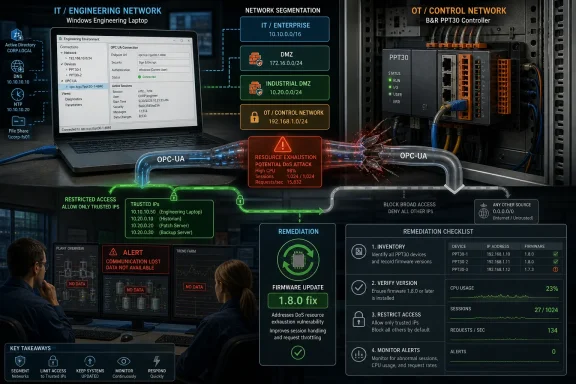
The vendor fix is straightforward: the problem is corrected in PPT30 Operating System 1.8.0. B&R recommends customers who have enabled the OPC-UA server install the update at the earliest opportunity, and says the user manual describes both the update process and how to identify the installed product version.That simplicity can be deceptive. Firmware updates in industrial environments are not like updating a browser. A plant may need a maintenance window, vendor coordination, backup images, rollback planning, and operational sign-off before touching hardware that supports a live process.
Still, the first step is mundane and urgent: determine whether any PPT30 products are present, whether they run an affected operating system version, and whether the OPC-UA server is enabled. Many organizations will discover that the hardest part of this advisory is not patching. It is answering those three questions without sending a dozen emails to people who are not sure what is installed.
The advisory also lists PPT30 Operating System versions before 1.8.0 and references 1.8.0 in the affected product language while saying the problem is corrected in 1.8.0. That is a nuance administrators should treat carefully. In practice, teams should follow the vendor’s current remediation guidance, verify the exact build or package available from B&R, and document what was installed rather than relying on a shorthand version string copied into a ticket.
CISA’s Republication Is a Signal, Not a Rewrite
CISA’s notice is a republication of ABB PSIRT advisory SA25P006 through the Common Security Advisory Framework pipeline. CISA explicitly says the advisory is provided as-is for visibility and that the vendor remains the source for technical and editorial accuracy.That distinction matters. CISA republications can look like fresh federal analysis, but in this case the substance comes from ABB and B&R. CISA’s role is amplification: putting an industrial advisory in front of the broader community of defenders who track ICS risk through CISA channels rather than through every individual vendor portal.
For WindowsForum readers, that is useful precisely because industrial estates are heterogeneous. A single environment may contain Windows Server systems, domain-joined engineering laptops, virtualized SCADA components, Linux appliances, embedded controllers, and vendor-specific firmware that never appears in a traditional endpoint dashboard. CISA advisories help security teams notice the non-Windows pieces that Windows-centric tooling may not fully enumerate.
But amplification is not validation that exploitation is occurring. The advisory says B&R had not received reports of exploitation when the advisory was originally issued and that the vulnerability had not been publicly disclosed at that time. That should lower panic, not priority. Unexploited industrial flaws have a way of becoming exploited only after defenders have spent months treating them as paperwork.
The Real Control Is Segmentation, Not Hope
B&R’s mitigation guidance leans heavily on architecture. The optional OPC-UA server should only be activated if required. Access should be restricted to trusted IP addresses using the South Firewall and/or the Control Network Firewall. The network where the PPT30 operates should be properly segmented, and physical interfaces associated with the same logical network should be accessible only to authorized personnel.That is the correct vocabulary for industrial security. It is also the vocabulary that breaks when IT and OT teams do not share ownership. The firewall that matters may be maintained by an automation vendor. The VPN that grants access may be owned by corporate IT. The workstation that can reach the control network may be used by a contractor twice a month and patched whenever someone remembers.
A denial-of-service bug in an optional service therefore becomes a test of organizational boundaries. Can the security team identify trusted IPs? Can operations say which clients genuinely need OPC-UA access? Can network administrators enforce the answer without interrupting production? Can physical access to network drops and cabinets be limited in a way that survives real maintenance work?
The safest answer is rarely “turn it all off” in a live industrial environment. The safer answer is to make services boringly specific: required only where required, reachable only from known clients, monitored for unusual connection behavior, and documented well enough that the next incident responder does not have to reconstruct the architecture under pressure.
Windows Shops Should Care Because the Attack Path Often Starts With Windows
It would be easy for a Windows-focused audience to dismiss this advisory as outside the lane. The product is B&R firmware. The protocol is industrial. The sectors listed include critical manufacturing, energy, transportation systems, water and wastewater, and commercial facilities. None of that sounds like a Windows Update problem.Yet the likely route to the vulnerable service may run through Windows systems. Engineering workstations are often Windows machines. Remote support sessions often terminate on Windows jump boxes. HMIs and supervisory software frequently run on Windows. Active Directory often governs at least part of the access model, even when the controller layer itself is not domain joined.
That means a ransomware intrusion, credential theft campaign, or compromised VPN account can turn into industrial exposure without the attacker needing an industrial zero-day. Once inside, the attacker looks for reachable services. A resource-exhaustion condition in OPC-UA is then not the opening move; it is one more lever available after the enterprise perimeter has already failed.
This is the uncomfortable convergence story. OT vulnerabilities increasingly depend on IT hygiene for practical exploitability, while IT incidents increasingly carry OT consequences when networks are poorly separated. Windows administrators may not patch the PPT30 Operating System themselves, but they may control the access paths that determine whether CVE-2025-11482 is reachable.
Availability Bugs Are Underrated Until Operators Lose Visibility
The security industry still tends to rank vulnerabilities emotionally. Remote code execution gets attention. Authentication bypass gets attention. Data theft gets attention. Denial of service often gets filed under “annoying unless exploited at scale.”Industrial environments invert that instinct. Availability is not a convenience feature; it is part of operational safety, continuity, and confidence. When a service becomes inaccessible, the impact is not limited to the service owner. It can ripple into dashboards, alerts, trend data, maintenance workflows, and the human decisions built on top of those signals.
The advisory language is careful: exploitation could permanently prevent legitimate users from interacting with the OPC-UA service. “Permanently” here should not be read as device destruction unless the vendor says so, but it does suggest a failure state that does not simply clear after a bad packet passes. That kind of stuck condition is operationally expensive even if it requires a restart or service recovery rather than hardware replacement.
For defenders, the right question is not whether the vulnerability lets an attacker take over a device. The right question is whether losing the OPC-UA service at the wrong time would matter. If the answer is yes, the vulnerability deserves the same disciplined response as a flashier bug.
The Critical Infrastructure Label Should Not Become Background Noise
The advisory lists deployment across multiple critical infrastructure sectors and worldwide use. Those labels appear so often in ICS advisories that they risk becoming wallpaper. They should not.Commercial facilities, critical manufacturing, energy, transportation systems, and water and wastewater operations all depend on boring interfaces functioning predictably. A protocol server that becomes unavailable under unauthenticated network pressure is not automatically a national emergency. But it is the kind of weakness that can become significant when paired with poor segmentation, remote access sprawl, and thin staffing.
The “worldwide” deployment note also complicates response. A multinational organization may have B&R equipment in one plant but not another, managed by different integrators, documented in different languages, and maintained under different support contracts. A central security team may receive the advisory before the local operations team has even mapped it to an asset.
That gap is why industrial vulnerability management needs a process beyond forwarding advisories. Someone has to translate product names into installed equipment, equipment into physical locations, locations into operational owners, and owners into action. Otherwise, the advisory becomes another PDF in a ticketing system, technically acknowledged and practically unresolved.
The Fix Is Firmware, but the Defense Is Inventory
The clean remediation is to update affected PPT30 Operating System installations to the fixed release and confirm the OPC-UA server configuration. But the deeper defense is inventory, because every subsequent decision depends on knowing what exists.A serious response should begin by searching asset inventories, engineering project files, procurement records, network scans, switch port descriptions, and vendor maintenance documentation for B&R PPT30 hardware. If the organization has a passive OT monitoring platform, this is where it should earn its keep. If it does not, the exercise may reveal just how much tribal knowledge still substitutes for asset management.
Once devices are identified, administrators need to determine the installed operating system version and whether OPC-UA is enabled. The advisory makes clear that the service is optional and disabled by default, which means the exposed population may be smaller than the installed population. That is good news, but only if the organization can prove it.
The final step is deciding between patching, disabling, and restricting. In many cases, the answer should be all three over time: disable OPC-UA where it is not needed, restrict it where it is needed, and update affected firmware under a controlled change process. The worst answer is leaving an unnecessary service enabled because nobody wants to ask whether anything still uses it.
Firewalls Need to Express Operational Reality
B&R specifically recommends restricting access to the OPC-UA server to trusted IP addresses using the relevant firewalls and segmenting the network where the PPT30 operates. This sounds simple until it meets a real plant.Trusted IPs are often harder to define than security diagrams imply. A historian may need access. An HMI may need access. An engineering workstation may need occasional access. A vendor support laptop may need temporary access during commissioning or troubleshooting. Over time, temporary access has a way of becoming permanent.
Good firewall policy should express operational reality without surrendering to it. If a system needs continuous access, document it and monitor it. If a workstation needs occasional access, use a controlled path rather than broad standing reachability. If a vendor needs access, make the access time-bound, logged, and mediated by a jump host or remote-access platform that can be audited.
The point is not to make the network beautiful. The point is to make exploitation inconvenient. CVE-2025-11482 requires network reachability; every unnecessary route removed is a meaningful reduction in risk.
Physical Access Still Matters in a Supposedly Remote Bug
The advisory also calls out physical access to network interfaces assigned to the same logical network as the PPT30. That may seem odd for a network-exploitable vulnerability, but it reflects a hard truth of industrial environments: remote and physical boundaries overlap.A malicious or careless connection inside a cabinet, control room, maintenance area, or contractor work zone can bypass assumptions made at the enterprise perimeter. If an attacker or infected laptop can join the relevant network segment, “not internet-facing” becomes irrelevant. The attacker is already where the vulnerable service listens.
This is one reason OT security cannot be reduced to firewall screenshots. Port security, cabinet locks, access control, visitor procedures, contractor management, and clear rules for portable media and laptops all matter. They are not glamorous controls, but they close the gap between a tidy logical diagram and the messy places where Ethernet cables actually live.
For Windows administrators, the same principle applies to engineering laptops. A laptop that roams between office networks, home networks, vendor networks, and control networks is an attack path with a keyboard. Its patch state, local admin policy, endpoint protection, and network access rights may matter as much as the firmware version on the industrial device.
No Public Exploitation Is Not the Same as No Risk
B&R said it had not received information indicating exploitation when the advisory was originally issued. That is reassuring, but it should not become the excuse for deferral.Many industrial vulnerabilities are discovered through vendor analysis or coordinated disclosure before attackers use them publicly. That is the best time to fix them. Once proof-of-concept details, scanner checks, or opportunistic exploitation appear, defenders have already lost the advantage of calm planning.
There is also a detection problem. If an attacker causes an OPC-UA service to become inaccessible, will the organization recognize that as malicious activity? Or will it be treated as a flaky device, a bad cable, a transient network issue, or another mystery reboot? Absence of evidence is especially weak in environments where evidence is not consistently collected.
The smart posture is measured urgency. Do not shut down production in a panic. Do not wait for exploitation reports either. Identify exposure, reduce reachability, schedule updates, and improve monitoring so the next availability anomaly has context.
The PPT30 Advisory Rewards the Shops That Already Did the Boring Work
This is one of those advisories that separates mature environments from lucky ones. The vulnerability is specific, the fix is available, and the service is optional. On paper, that should make response manageable.The organizations that already maintain an OT asset inventory, enforce segmentation, restrict industrial protocols, and coordinate IT/OT change windows will treat CVE-2025-11482 as a contained maintenance item. They will find the devices, validate the service state, patch or disable what is necessary, and close the loop with documentation.
The organizations that rely on memory, vendor invoices, flat networks, and emergency heroics will experience the advisory very differently. They may not know whether they own affected hardware. They may not know who can approve firmware changes. They may not know whether the OPC-UA server is used by a production dashboard until that dashboard stops working.
That is the uncomfortable but useful value of vulnerability advisories. They do not merely describe software defects. They expose process defects. A resource-exhaustion bug in one optional server can reveal whether an organization understands its industrial estate at all.
The Patch Note That Should Change the Meeting Agenda
Before this advisory disappears into the weekly vulnerability queue, it deserves a short, practical conversation between security, network, and operations teams. The goal is not to turn every Windows admin into an automation engineer. The goal is to make sure the access paths Windows teams manage do not quietly undermine the controls OT teams assume exist.- Organizations should identify any B&R PPT30 hardware and verify the installed PPT30 Operating System version rather than assuming the advisory is irrelevant.
- Teams should confirm whether the optional OPC-UA server is enabled, because systems with the service disabled have a materially different exposure profile.
- Affected deployments using OPC-UA should be updated to the fixed vendor release through a controlled maintenance process.
- Network access to the OPC-UA server should be limited to known, trusted clients instead of broad plant, corporate, VPN, or contractor subnets.
- Windows engineering workstations, jump hosts, and remote-access systems should be reviewed as possible paths into the same control network.
- Loss of OPC-UA availability should be treated as an operational security signal worth logging, investigating, and correlating with network activity.
A high-severity availability bug in an optional OPC-UA server will not dominate the security news cycle, and it probably will not produce the drama of a mass-exploited edge-device zero-day. But for the sites that depend on PPT30 devices and their data paths, CVE-2025-11482 is exactly the kind of vulnerability that rewards preparation and punishes ambiguity. The future of Windows administration increasingly includes responsibility for the networks that touch operational technology, and the safest shops will be the ones that treat these small industrial advisories not as someone else’s firmware footnote, but as early warnings about the architecture they already own.
References
- Primary source: CISA
Published: 2026-06-04T12:00:00+00:00

B&R PPT30 Operating System | CISA
www.cisa.gov
- Related coverage: feed.craftedsignal.io

ABB PPT30 Operating System Vulnerability (CVE-2025-11482) – CraftedSignal Threat Feed
A vulnerability, CVE-2025-11482, exists in ABB's PPT30 Operating System related to handling concurrent connections in the PPT30 OPC-UA Server, affecting versions prior to 1.8.0.
feed.craftedsignal.io
- Related coverage: cyber.gc.ca
[Control systems] ABB security advisory (AV26-510) - Canadian Centre for Cyber Security
[Control systems] ABB security advisory (AV26-510)www.cyber.gc.ca
