

A One-Bit Accounting Error Becomes a Root Problem
The kernel’s socket buffer, usually called an skb, is one of those data structures that makes modern networking possible while remaining nearly invisible to everyone outside kernel development. It carries packet data, metadata, fragments, offload state, checksums, and enough ownership information to decide whether the kernel may safely modify the underlying memory in place.
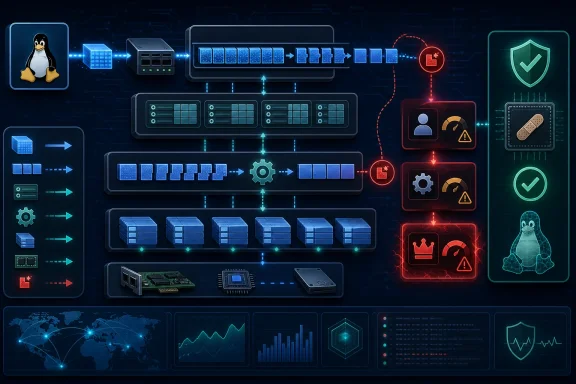
CVE-2026-46300 sits in that ownership accounting. When skb_try_coalesce() attaches paged fragments from one buffer to another, the destination buffer can inherit fragments backed by external memory or page-cache pages. If the source buffer was marked with SKBFL_SHARED_FRAG, the destination needed to carry that marker too.
The bug was that the marker could be lost. The data moved, but the warning label did not.
That distinction matters because later code paths rely on skb_has_shared_frag() to decide whether in-place writes are safe. ESP input handling, used in IPsec processing, is one such path. If a packet buffer contains shared page-backed fragments but no longer says so, the kernel can decide that copy-on-write is unnecessary and decrypt directly into memory it should have treated as shared.
In plain English, the kernel could be fooled into writing into cached file pages that were supposed to be read-only from the attacker’s perspective. That is why a networking metadata bug is being tracked as a high-severity local privilege escalation rather than a harmless packet-processing oddity.
The Vulnerability Is Local, but “Local” Is Not Comforting Anymore
NVD assigned CVE-2026-46300 a CVSS 3.1 score of 7.8, with local attack vector, low complexity, low privileges required, no user interaction, unchanged scope, and high impact to confidentiality, integrity, and availability. That scoring tells the right broad story: an attacker needs some local foothold, but once there, the potential outcome is severe.
The industry has spent years teaching itself not to dismiss local privilege escalation. A compromised web application, a stolen developer token, a malicious package in a CI runner, an untrusted shell account, or a container escape chain all become much worse when the next step is a reliable move to root. On modern systems, “local” is often just the second stage of an attack.
That is especially true for Linux hosts that do real work in shared environments. Build servers, Kubernetes nodes, virtualization hosts, jump boxes, and developer workstations all run code from multiple trust zones. The kernel is supposed to be the hard line between those zones.
The user-provided NVD record describes the weakness as CWE-787, an out-of-bounds write, but the more revealing story is about ownership confusion. This is not a classic “copy too many bytes into a too-small buffer” tale. It is a case where the kernel’s model of who owns a fragment diverges from reality, and security decisions downstream inherit the lie.
Fragnesia Extends the Dirty Frag Story Rather Than Replacing It
Security researchers and distribution advisories have been calling CVE-2026-46300 “Fragnesia,” and the name is useful because it places the bug in a broader cluster of recent Linux page-cache and fragment-handling issues. It appeared in the wake of “Dirty Frag,” another high-profile set of Linux kernel flaws involving page-cache writes and privilege escalation.
The important point is not the branding. It is the recurring pattern.
Linux has spent years optimizing data movement. Zero-copy paths, page-backed fragments, generic receive offload, TCP coalescing, IPsec transforms, and packet segmentation all exist because copying bytes is expensive. The performance win comes from passing references to pages instead of duplicating payloads wherever possible.
That design is not inherently unsafe. But it demands that the kernel never lose track of whether data is private, shared, externally backed, or safe to mutate. CVE-2026-46300 shows how fragile that invariant can be when multiple subsystems meet.
A bug in an accounting flag does not look dramatic in a patch title. Yet the security boundary it supports is dramatic: do not write attacker-controlled decrypted bytes into the page cache of protected files. If that boundary collapses, root-owned binaries and read-only files can become attack surfaces without their on-disk contents changing.
Why Page-Cache Corruption Is So Unsettling
The page cache is one of Linux’s great performance engines. Frequently used file contents live in memory so the kernel does not have to keep hitting storage. Most administrators think about it as a speed feature, not as a security-sensitive object.
But if an attacker can alter the cached copy of a protected file, the system can behave as if the file changed even when the disk says it did not. A root-owned binary can be executed from modified cached pages. Integrity checks that read the file from storage may miss the transient corruption, depending on timing and cache behavior.
That is what makes this class of vulnerability so uncomfortable. It attacks the gap between what the filesystem promises and what the kernel is actually executing or reading in memory. The operating system’s own optimization layer becomes part of the exploit surface.
This also explains why security tools can struggle to explain these bugs cleanly. File integrity monitoring is built around durable changes. Package verification is built around installed bytes. A page-cache write primitive lives in a more ambiguous space: not persistent in the normal sense, but potent enough to change execution.
For defenders, that means patch status matters more than after-the-fact detection. Once an attacker has a reliable local primitive that can mutate cached privileged files, you are no longer in a comfortable logging-and-alerting problem. You are in kernel-trust territory.
The Patch Is Small Because the Invariant Is Big
The core fix described in the CVE is conceptually simple: propagate SKBFL_SHARED_FRAG when skb_try_coalesce() transfers paged fragments. If the destination buffer now contains fragments that came from a shared or externally backed source, it must carry the marker.
The CVE text also notes that the tailroom copy path does not need the marker because it copies bytes into the destination’s linear data rather than transferring fragment descriptors. That distinction is exactly the kind of detail that separates a correct kernel fix from a cosmetic one. The marker is needed when ownership of fragment descriptors moves, not when bytes are copied into private storage.
This is why administrators should resist the temptation to judge severity by patch size. Many of the most consequential kernel fixes are a handful of lines that restore a broken invariant. The code diff may be small; the security property it reinstates is not.
The change history in the supplied NVD record is also revealing. The CVE description appears to have evolved from a broader discussion of shared-fragment propagation through several frag-transfer helpers into the narrower final description around skb_try_coalesce() and coalescing. That kind of churn is common when kernel maintainers, CVE authorities, and downstream databases are trying to map a live technical fix into vulnerability records quickly.
It also means defenders should track vendor kernel updates rather than trying to reverse-engineer safety from one public description. Distribution kernels often carry backports, and the version string alone can be misleading without the vendor’s changelog or advisory.
The Affected-Version List Is Wide Enough to Demand Inventory
The NVD configuration data supplied by the user lists Linux kernel 7.1 release candidates and several long version ranges stretching back to 3.9, with fixed thresholds across stable branches. Those ranges should get attention, but not blind panic.
Kernel vulnerability versioning is messy because upstream version numbers, stable backports, enterprise distribution kernels, vendor appliance kernels, and cloud-provider kernels do not line up neatly. A Red Hat, Ubuntu, Debian, SUSE, AlmaLinux, or appliance kernel may carry a fix while still presenting a base version that looks old. Conversely, a custom or self-built kernel can remain exposed even if its major branch sounds modern.
The practical response is to ask a more useful question: has your vendor shipped the relevant skbuff shared-fragment fix for your kernel line, and have you rebooted into it? On Linux, applying the package is only half the story. The vulnerable kernel remains in control until the system actually boots the patched image, unless live patching is in use and confirmed for this specific fix.
That matters for Windows-heavy shops too. Linux often enters those environments through side doors: WSL images, Hyper-V guests, container hosts, security appliances, backup servers, developer workstations, and CI/CD runners. The host inventory may be Windows-first, but the risk register is not.
WSL deserves a careful note. Not every Linux kernel CVE maps cleanly to WSL exposure because Microsoft ships and services its own WSL kernel, and available kernel features differ from a general-purpose distribution install. But administrators should not assume immunity without checking the WSL kernel version and Microsoft’s servicing status. If developers can run untrusted code locally, local kernel bugs are never academic.
Containers Make Kernel Bugs Everybody’s Problem
Containers are often described as lightweight isolation, but they share the host kernel. That single fact turns Linux kernel privilege-escalation bugs into infrastructure events. A containerized workload that gains root inside its namespace is supposed to remain constrained by kernel isolation; a kernel bug can turn that promise into wishful thinking.
CVE-2026-46300 is not automatically a one-command container escape in every configuration. Exploitability depends on reachable kernel features, namespace permissions, capabilities, distribution hardening, and whether unprivileged user namespaces or network namespaces are available. But the class of bug is exactly the sort that container operators cannot dismiss.
The reporting around Fragnesia has emphasized scenarios using local privileges and networking features to reach the vulnerable path. In hardened production clusters, some of those primitives may be restricted. In developer clusters, CI runners, research systems, and lab hosts, they often are not.
That is why mitigations like disabling unprivileged user namespaces, restricting network namespace creation, limiting CAP_NET_ADMIN, and reviewing IPsec-related exposure may reduce risk in some environments. They are not substitutes for patching, but they can narrow the path from “untrusted code execution” to “kernel write primitive.”
For Kubernetes operators, the actionable inventory is not just node kernel version. It is also workload privilege, pod security posture, allowed capabilities, host networking use, and whether tenants can run arbitrary images. Kernel patching remains the fix; cluster policy determines how easy it is to reach the bug before the fix lands.
The CVSS Score Understates the Operational Urgency for Some Fleets
A 7.8 high score is serious, but CVSS can flatten context. A single-user desktop, a tightly managed appliance, and a multi-tenant build host may all share the same base vulnerability record while carrying very different operational risk.
For a personal Linux desktop, the attack likely requires that malicious code already runs locally. That is still bad, but it is closer to the familiar malware escalation story. For a shared shell server or CI runner, the same vulnerability can threaten every other workload and credential on the box.
For a cloud VM that only runs one trusted service, the immediate concern may be post-exploitation hardening. If an attacker compromises the service account, can they use this CVE to become root? That is exactly the sort of question incident responders ask after initial access.
For an enterprise Linux estate, the challenge is less philosophical and more logistical. Which kernels are exposed? Which are vendor-patched? Which hosts have reboot windows? Which appliances depend on vendor firmware? Which container hosts are running kernels older than the distribution image suggests?
That operational layer is where many organizations lose time. The exploit may be local, but patch deployment is distributed, stateful, and full of exceptions.
Windows Administrators Should Read This as a Platform Boundary Story
It may seem odd to foreground a Linux kernel CVE on a Windows community site, but modern Windows environments are rarely Windows-only. Microsoft’s own platform strategy normalized Linux as a first-class citizen through WSL, Azure Linux workloads, Linux containers, AKS, cross-platform developer tooling, and hybrid identity systems.
The result is that Windows administrators increasingly own Linux risk even when their job titles have not caught up. A developer laptop with Windows 11 and WSL is a mixed environment. A Hyper-V host running Linux guests is a mixed environment. An Azure subscription with Windows Server domain controllers and Linux app servers is a mixed environment.
CVE-2026-46300 is a reminder that “not Windows” does not mean “not my problem.” If Linux provides the runtime for your build pipeline, your VPN gateway, your container host, or your developer tooling, Linux kernel bugs sit inside your Windows operational blast radius.
The Windows comparison is also useful technically. Both Windows and Linux have spent decades optimizing I/O by sharing buffers, mapping pages, and avoiding copies. Both kernels rely on metadata to decide when memory can be modified safely. The names differ; the security pattern is universal.
When that metadata becomes wrong, the system’s performance shortcuts can become security shortcuts. That is the lesson here, and it crosses operating-system tribal lines.
The Real Fix Is Patch Discipline, Not Clever Detection
Security teams naturally want indicators of compromise, exploit signatures, and detection logic. Those are useful, but they are not where the center of gravity sits for CVE-2026-46300. A local kernel privilege escalation that can manipulate memory-backed file contents is exactly the kind of bug where prevention beats investigation.
Network IDS is unlikely to save you from a local exploit path driven on the host. File integrity monitoring may not observe durable disk modification. Endpoint telemetry may catch suspicious privilege transitions or exploit tooling, but that depends on visibility at the right moment and a rule that understands a fast-moving kernel exploit.
Patch discipline is less glamorous and more reliable. Install the vendor kernel containing the fix. Reboot into it. Confirm the running kernel, not merely the installed package. For fleets, verify at scale.
Live patching may help in some enterprise environments, but only if the vendor explicitly covers this CVE and the relevant code path. Administrators should not assume a live-patching subscription magically applies to every networking-stack flaw. Kernel live patches are technical artifacts with scope, prerequisites, and limitations.
The reboot problem remains one of Linux’s least romantic security issues. Systems can sit for months with patched packages installed and vulnerable kernels still running. CVE-2026-46300 is another argument for treating kernel reboot compliance as a measurable security control, not an optional maintenance nicety.
Mitigation Is a Narrow Bridge, Not a Destination
There are environments where immediate patching is not possible. Appliances may depend on vendor firmware. Production clusters may require maintenance windows. High-availability systems may need staged failover. In those cases, administrators can reduce exposure while preparing the real fix.
The most obvious mitigations involve reducing untrusted local code execution and constraining the kernel features commonly used to reach these paths. Disable or restrict unprivileged user namespaces where feasible. Limit network namespace creation. Avoid granting CAP_NET_ADMIN to containers unless it is truly required. Review IPsec and ESP-in-TCP exposure on systems where local users are not fully trusted.
But these mitigations have trade-offs. Developer tooling may depend on user namespaces. Container platforms may rely on namespace creation. VPN or overlay networking products may legitimately use capabilities that look risky in the abstract.
That is why mitigation guidance must be environment-specific. A hardened server can disable features that a developer workstation needs. A single-tenant appliance has different exposure from a public CI runner. A Kubernetes node has different assumptions from a laptop running WSL.
The wrong lesson would be to rip out useful kernel functionality because one bug appeared. The right lesson is to stop granting powerful namespace and networking features casually, especially to workloads whose trust level is unclear.
The NVD Record Shows the Limits of Vulnerability Databases
The NVD entry is useful: it gives the CVE, publication date, severity, vector, weakness mapping, affected-version ranges, and references to upstream patches and mailing-list discussion. For triage, that is enough to trigger action.
But vulnerability databases are not a substitute for engineering judgment. The same record can list wide kernel ranges, release candidates, and branch-specific thresholds while leaving administrators to map those ranges onto distribution kernels. It can call the weakness an out-of-bounds write while the exploit narrative is really about shared-fragment metadata and page-cache writes.
That mismatch is not necessarily an error. CVE and CWE systems compress complicated failures into standardized fields. Compression is useful for automation but lossy for humans.
This is why serious vulnerability management reads NVD as the starting point, not the conclusion. The authoritative operational question is whether your kernel vendor has shipped the fix for your exact kernel build. The authoritative security question is whether untrusted local actors can reach the affected paths on your systems.
There is also a timing issue. The supplied record shows multiple changes between May 23 and May 26, including description changes, references, and NVD enrichment. In the first days of a kernel CVE, the public record is often still settling. Acting early is good; treating the first record as perfect is not.
The Kernel’s Performance Debt Keeps Coming Due
CVE-2026-46300 belongs to a broader category of bugs produced by the tension between speed and ownership. Modern kernels are full of code designed to avoid copying data. That choice is rational. Copying is expensive, and networking stacks are under constant pressure to do more work with fewer cycles.
The cost is conceptual complexity. A packet may be linear or nonlinear. Its payload may be split across fragments. Those fragments may point to pages with special ownership rules. Offload paths may defer work. Coalescing may merge buffers. Segmentation may split them again.
Security invariants have to survive all of that. If one helper moves fragment descriptors without moving the corresponding marker, downstream code can make a locally reasonable but globally unsafe decision. That is the story of CVE-2026-46300 in miniature.
This is also why fuzzing, formal reasoning, and targeted code audits keep finding bugs in old kernel subsystems. The code is not necessarily sloppy. It is just operating at the edge of what humans can comfortably reason about when performance, compatibility, and security meet.
The lesson for operating-system vendors is sobering. The more the kernel relies on metadata to avoid copying, the more every metadata propagation path becomes security-critical. A missing flag is no longer just a correctness bug; it is a boundary failure.
The Practical Reading for Admins Is Shorter Than the Exploit Chain
For all the kernel detail, the operational response is straightforward. Treat CVE-2026-46300 as a high-priority local privilege-escalation issue on Linux systems that run untrusted or semi-trusted local code, especially multi-user hosts, container nodes, CI runners, developer workstations, and VPN or networking-heavy systems.
Do not rely on the upstream kernel version alone. Distribution backports change the picture. Vendor advisories, package changelogs, and the running kernel build are the facts that matter.
Do not assume that a patched package means a patched host. Kernel updates generally require a reboot. In a fleet, the difference between “installed” and “running” is where vulnerabilities persist.
Do not overfit the risk to one exploit demonstration. The CVE description focuses on ESP input and TCP receive coalescing, but the deeper issue is metadata preservation across fragment transfer. Once a bug class is public and patches are available, exploit adaptation tends to move faster than maintenance calendars.
The Skbuff Bug Leaves Five Jobs for Defenders
The near-term work is not mysterious, but it does require discipline. CVE-2026-46300 should move from “interesting kernel bug” to a concrete checklist owned by whoever manages Linux runtime risk in the organization.
- Identify every Linux kernel you operate, including WSL kernels, container hosts, hypervisor guests, appliances, CI runners, and developer workstations that may not appear in the primary server inventory.
- Confirm whether each vendor kernel includes the stable fix that preserves the shared-fragment marker during skbuff coalescing and related affected paths.
- Reboot systems after installing fixed kernels, then verify the running kernel rather than trusting package installation status.
- Reduce exposure on systems awaiting patches by limiting untrusted local code, unnecessary
CAP_NET_ADMIN, permissive namespace creation, and avoidable IPsec-related attack surface. - Prioritize multi-tenant and semi-trusted environments first, because local privilege escalation is most damaging where many users or workloads share one kernel.
- Treat file-integrity monitoring as insufficient on its own, because page-cache corruption can affect execution without leaving the sort of persistent on-disk modification those tools are designed to catch.
The uncomfortable truth in CVE-2026-46300 is that the kernel did not forget how to enforce permissions; it briefly forgot what kind of memory it was handling, and the rest of the stack trusted that memory label. That is a modern operating-system failure mode in its purest form: not a spectacular crash, but a quiet metadata drift with root at the end of it. The fix is already moving through stable kernels, and the organizations that come out best will be the ones that treat Linux kernel patching as part of their core platform hygiene rather than a specialist chore waiting at the edge of a Windows estate.
References
- CVE-2026-46300 net: skbuff: preserve shared-frag marker during coalescing NVD / Linux Kernel · 2026-05-27T01:01:32-07:00