

CVE-2026-46324, published by NVD on June 9, 2026, is a newly recorded Linux kernel netfilter/nf_tables vulnerability fixed by changing hook removal paths to use
The most important fact about this CVE is not that it has a dramatic public exploit or a polished severity rating. It is that it sits inside nf_tables, the kernel machinery behind nftables, at the intersection of firewall configuration, netlink control messages, and concurrent readers. That is exactly the kind of place where boring synchronization bugs become the expensive kind of boring.
The kernel description is terse, as these records often are:
nf_tables is not an ornamental kernel feature. It is the replacement-era packet filtering framework underneath nftables, and it is widely used directly or indirectly by Linux firewalls, container hosts, routers, appliances, and security tooling. Even administrators who think they are “just using iptables” may be interacting with nftables compatibility layers on modern distributions.
The “netlink hooks” part matters because netlink is one of the kernel’s main channels for structured communication with userspace. Firewall rules, tables, chains, sets, hooks, and flowtables are not simply static objects compiled into the kernel; they are created, listed, modified, and destroyed while the system is running. That control plane has to coexist with packet-processing paths and with administrative dump operations that enumerate current state.
The fix described in CVE-2026-46324 is about removal discipline. When an object is potentially visible to readers using Read-Copy-Update, or RCU, deletion must be staged in a way that lets current readers finish safely.
A missing CVSS score usually means the vulnerability record is still being processed, not that the flaw has been proven harmless. The CVE text was received from kernel.org, and the references point to stable kernel commits, which indicates the upstream and stable-maintenance machinery already considered the issue concrete enough to fix and backport. In the Linux kernel ecosystem, that sequence often precedes downstream distribution advisories rather than follows them.
This is especially true for nf_tables bugs. The subsystem has accumulated a long record of vulnerability fixes because it manages complex, user-configurable kernel data structures under concurrency. The history does not mean every new nf_tables CVE is automatically catastrophic, but it does mean administrators should resist the comforting fiction that packet-filtering bugs are exotic edge cases.
The correct posture is not panic. It is triage without waiting for a marketing-friendly number. If a server exposes untrusted local users, runs container workloads, permits unprivileged user namespaces, or delegates network namespace management to orchestration tooling, a netfilter race in the kernel deserves prompt attention.
That is why CVE-2026-46324’s fix wording is so specific. The vulnerable paths were unregistering netdev and flowtable hooks in nf_tables while concurrent netlink dumpers could still be walking the relevant list. If the deletion path used the wrong primitive, a reader could observe an object in a state the writer assumed was already gone.
The CVE text does not spell out a full exploit chain, and it should not be inflated beyond the evidence. But the class of failure is recognizable. Kernel list misuse under concurrent traversal can produce stale pointers, inconsistent state, crashes, or, in more dangerous cases, memory-safety conditions that attackers can shape into privilege escalation.
The key phrase is “can be walked by concurrent dumpers.” A dumper is not a packet traversing the firewall fast path; it is a userspace-triggered enumeration of kernel state. That distinction narrows the immediate mental model, but it does not make the bug irrelevant. Control-plane operations are often available to privileged or namespace-confined actors, and Linux’s namespace model has repeatedly turned “requires network administration capability” into a more nuanced security boundary than many enterprise teams would like.
A contemporary Linux host may rely on nf_tables for local firewall policy, Kubernetes networking, container isolation, NAT, transparent proxying, VPN routing, service meshes, or appliance-like traffic handling. Many of those use cases are dynamic. Rules are not installed once at boot and left alone; they are churned by daemons reacting to containers, interfaces, tunnels, policy updates, and service discovery.
That dynamism is where concurrency bugs live. An administrator dumping a ruleset, a daemon removing hooks for a disappearing interface, and another process adjusting flowtable state may all be legitimate operations. The kernel must allow them to overlap without exposing freed or half-removed objects.
CVE-2026-46324 is therefore less interesting as an isolated typo and more interesting as a symptom of the load placed on the packet-filtering core. nf_tables is not merely filtering packets. It is mediating a live, programmable networking database shared between userspace and kernel paths.
WSL is the first place many Windows users will wonder about. WSL 2 uses a real Linux kernel provided and serviced through Microsoft’s update channels, but its exposure model is not identical to a general-purpose Linux server. Most home and developer WSL installations are not acting as multi-user network appliances with nftables management delegated across namespaces. Still, the right answer for WSL users is simple: keep the WSL kernel current rather than trying to hand-assess every upstream kernel CVE.
The more urgent Windows-adjacent audience is enterprise IT running Linux workloads on Windows-managed infrastructure. A Windows-heavy organization may still operate Linux firewall appliances, Kubernetes nodes, CI runners, VPN gateways, or edge boxes. Those systems often sit in the path of important traffic, and their administrators may not be the same team staring at Microsoft Patch Tuesday dashboards.
There is also the container angle. Linux kernel vulnerabilities are host vulnerabilities, even when the trigger comes from inside a container. Containers share the host kernel by design. If a flaw is reachable from a container with sufficient namespace or capability conditions, the line between “application workload issue” and “host compromise risk” gets thinner.
That distinction matters for prioritization. A remotely reachable packet parser bug on an exposed firewall is one thing; a race involving netlink operations during hook removal is another. The latter typically requires a local actor able to manipulate nftables objects or network namespace state, or at least able to cause relevant administrative operations to happen while also triggering dumps.
But “local” does not mean “low risk” in Linux kernel security. Cloud, container, hosting, university, and CI environments routinely run untrusted or semi-trusted code on shared kernels. If unprivileged user namespaces are enabled, a process may be able to acquire capabilities inside a namespace that change what kernel paths it can reach. Whether that is enough for this specific CVE depends on kernel version, configuration, distribution patches, nftables exposure, and the final analysis that distribution vendors publish.
For now, the defensible reading is conservative: treat CVE-2026-46324 as a kernel concurrency flaw in a historically sensitive subsystem, likely most relevant to local or namespace-confined attackers and to systems with dynamic nftables use. Do not treat it as a confirmed remote internet worm. Do not ignore it because it lacks a score.
For administrators, the operational task is not to cherry-pick those commits from git.kernel.org unless they build their own kernels. Most organizations should wait for their distribution’s kernel packages and advisory metadata. Red Hat, Ubuntu, Debian, SUSE, Oracle, Amazon Linux, Microsoft’s Linux kernel channels, and appliance vendors all perform their own backporting and version labeling.
That backporting can confuse scanner output. A distribution may ship a kernel with an older upstream version number but include the fix. Conversely, a raw upstream version comparison can falsely claim safety or exposure depending on how the vendor maintains its tree. The only reliable answer is the vendor’s fixed package version or a direct check against the patched source used by that vendor.
This is where IT teams should be careful with automation. Vulnerability scanners that key only on upstream version strings are notorious for kernel false positives and false negatives. CVE-2026-46324 will likely be no different until distro OVAL feeds, security trackers, and package metadata catch up.
nf_tables was designed for this more programmable world. Sets, maps, flowtables, and netdev hooks are powerful because they can express complex policy cleanly and update it efficiently. But power means there are more object lifetimes to manage and more paths where readers and writers can collide.
CVE-2026-46324 specifically points at unregister paths. That is important because teardown is where many concurrency bugs hide. Creation paths are tested heavily because nothing works if they fail; deletion paths are often exercised under less predictable timing, especially when interfaces disappear, namespaces are destroyed, or ruleset management daemons reload.
The bug also involves dumpers, which are part of observability. The act of listing kernel firewall state should be safe at any time, including while another process is changing it. If observability itself can race with teardown, then monitoring and troubleshooting commands become part of the concurrency environment administrators must consider.
But the opposite reaction—burying it until a scanner paints it red—is also wrong. Kernel netfilter bugs have a way of becoming more interesting after researchers analyze reachable paths across namespaces, containers, and distribution defaults. A newly published kernel CVE from kernel.org in nf_tables is exactly the kind of item that should move from “seen” to “tracked” quickly.
The right operational response is boring in the best sense. Identify Linux systems that use nftables, netfilter flowtables, container networking, or dynamic firewall orchestration. Watch distribution advisories. Stage kernel updates. Reboot where required. Validate that critical packet-filtering behavior still works after patching.
For high-density multi-tenant systems, be more aggressive. Shared Kubernetes nodes, developer build farms, container hosting platforms, and systems allowing untrusted shell access have less room for leisurely kernel patch cycles. Even if a bug requires local capability, those environments are where local capability boundaries matter most.
nf_tables has repeatedly sat at the center of that ambiguity. Some operations require
CVE-2026-46324 does not, by itself, prove a namespace escape. The public description is too narrow for that conclusion. But defenders should include namespace configuration in their exposure review because it changes the meaning of “attacker must be able to perform netlink/nftables operations.”
If your organization disables unprivileged user namespaces, restricts container capabilities, and avoids granting network administration privileges to workloads, the reachable attack surface may be substantially smaller. If your environment allows broad container capabilities or runs privileged network tooling in tenant-controlled contexts, the calculus changes.
For those devices, administrators may not see “CVE-2026-46324” in an advisory immediately. Vendors may roll the fix into a firmware release under a broader security update, or they may decide their kernel branch is not affected because the relevant code path differs. Either outcome requires vendor confirmation rather than assumption.
The risk is not merely theoretical. Network appliances are attractive targets because they sit in privileged positions and often have long uptimes. A local-trigger requirement may reduce exposure on a sealed appliance, but management planes, plugin systems, VPN users, and containerized add-ons can complicate that picture.
Enterprises should ask vendors direct questions in the language of the CVE: does the product include nf_tables code with
For conventional Linux servers, update through the distribution and reboot into the fixed kernel. For immutable or image-based systems, rebuild the base image once the vendor package lands and roll nodes in a controlled way. For Kubernetes and container hosts, remember that updating container images does nothing for a host kernel flaw.
For WSL users, the practical answer is to update WSL and Windows through normal channels, then verify the WSL kernel version after the update. WSL is not the same exposure profile as a production Linux firewall, but it should not be left indefinitely stale. Developers who run privileged containers or complex local networking stacks inside WSL should be especially disciplined.
For security teams, create a temporary tracking item even if your vulnerability platform shows “N/A” severity. The risk decision should be based on affected kernel lineage, nftables exposure, namespace policy, and vendor fix status. CVSS can help later; it should not be the first and only signal.
list_del_rcu() when netlink dumpers may still be walking the same lists. The bug is not yet scored by NVD, which means defenders do not have the usual CVSS shorthand to lean on. But the affected subsystem, the concurrency pattern, and the kernel’s own wording all point to a familiar lesson: in modern packet filtering, tiny list-handling mistakes can become operationally serious.The most important fact about this CVE is not that it has a dramatic public exploit or a polished severity rating. It is that it sits inside nf_tables, the kernel machinery behind nftables, at the intersection of firewall configuration, netlink control messages, and concurrent readers. That is exactly the kind of place where boring synchronization bugs become the expensive kind of boring.
 A Small Patch Lands in One of Linux’s Most Sensitive Neighborhoods
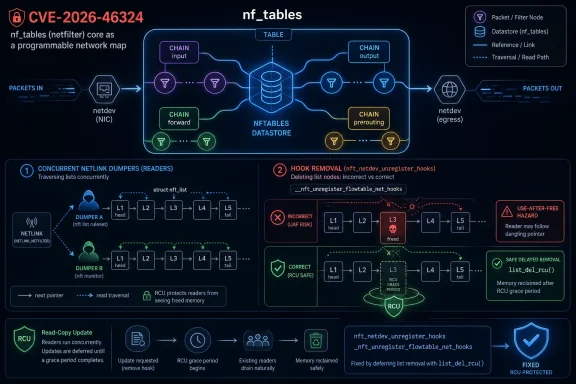
The kernel description is terse, as these records often are: nft_netdev_unregister_hooks and __nft_unregister_flowtable_net_hooks need to use list_del_rcu() because the list can be walked by concurrent dumpers. A helper was added so the pattern is used consistently. That is the entire public story in the CVE text, but it says more than it first appears to.nf_tables is not an ornamental kernel feature. It is the replacement-era packet filtering framework underneath nftables, and it is widely used directly or indirectly by Linux firewalls, container hosts, routers, appliances, and security tooling. Even administrators who think they are “just using iptables” may be interacting with nftables compatibility layers on modern distributions.
The “netlink hooks” part matters because netlink is one of the kernel’s main channels for structured communication with userspace. Firewall rules, tables, chains, sets, hooks, and flowtables are not simply static objects compiled into the kernel; they are created, listed, modified, and destroyed while the system is running. That control plane has to coexist with packet-processing paths and with administrative dump operations that enumerate current state.
The fix described in CVE-2026-46324 is about removal discipline. When an object is potentially visible to readers using Read-Copy-Update, or RCU, deletion must be staged in a way that lets current readers finish safely.
list_del_rcu() is not just a prettier spelling of list_del(). It is the kernel’s way of saying: this list node may still be observed by readers that are protected by RCU, so do not tear it out in a way that violates their assumptions.The Absence of a Score Is Not the Absence of Risk
NVD’s entry currently has no CVSS 4.0, 3.x, or 2.0 score from NIST. That will tempt some scanners and dashboards to treat CVE-2026-46324 as a lower-priority item until enrichment catches up. That is a mistake, or at least a lazy bet.A missing CVSS score usually means the vulnerability record is still being processed, not that the flaw has been proven harmless. The CVE text was received from kernel.org, and the references point to stable kernel commits, which indicates the upstream and stable-maintenance machinery already considered the issue concrete enough to fix and backport. In the Linux kernel ecosystem, that sequence often precedes downstream distribution advisories rather than follows them.
This is especially true for nf_tables bugs. The subsystem has accumulated a long record of vulnerability fixes because it manages complex, user-configurable kernel data structures under concurrency. The history does not mean every new nf_tables CVE is automatically catastrophic, but it does mean administrators should resist the comforting fiction that packet-filtering bugs are exotic edge cases.
The correct posture is not panic. It is triage without waiting for a marketing-friendly number. If a server exposes untrusted local users, runs container workloads, permits unprivileged user namespaces, or delegates network namespace management to orchestration tooling, a netfilter race in the kernel deserves prompt attention.
RCU Bugs Are Where “Just a List Operation” Stops Being Simple
RCU is one of the great performance compromises in the Linux kernel. It lets readers traverse shared structures cheaply while writers update or remove objects with special rules. The bargain is elegant but unforgiving: readers move fast because writers promise not to invalidate the ground beneath them too soon.That is why CVE-2026-46324’s fix wording is so specific. The vulnerable paths were unregistering netdev and flowtable hooks in nf_tables while concurrent netlink dumpers could still be walking the relevant list. If the deletion path used the wrong primitive, a reader could observe an object in a state the writer assumed was already gone.
The CVE text does not spell out a full exploit chain, and it should not be inflated beyond the evidence. But the class of failure is recognizable. Kernel list misuse under concurrent traversal can produce stale pointers, inconsistent state, crashes, or, in more dangerous cases, memory-safety conditions that attackers can shape into privilege escalation.
The key phrase is “can be walked by concurrent dumpers.” A dumper is not a packet traversing the firewall fast path; it is a userspace-triggered enumeration of kernel state. That distinction narrows the immediate mental model, but it does not make the bug irrelevant. Control-plane operations are often available to privileged or namespace-confined actors, and Linux’s namespace model has repeatedly turned “requires network administration capability” into a more nuanced security boundary than many enterprise teams would like.
Netfilter’s Attack Surface Keeps Expanding Because Linux Keeps Consolidating Around It
The nftables transition was supposed to rationalize Linux packet filtering. In many ways, it did. It replaced decades of iptables layering with a more expressive framework, better abstractions, and a cleaner path for modern firewall features. The price of that consolidation is that nf_tables became more important and more attractive as a target.A contemporary Linux host may rely on nf_tables for local firewall policy, Kubernetes networking, container isolation, NAT, transparent proxying, VPN routing, service meshes, or appliance-like traffic handling. Many of those use cases are dynamic. Rules are not installed once at boot and left alone; they are churned by daemons reacting to containers, interfaces, tunnels, policy updates, and service discovery.
That dynamism is where concurrency bugs live. An administrator dumping a ruleset, a daemon removing hooks for a disappearing interface, and another process adjusting flowtable state may all be legitimate operations. The kernel must allow them to overlap without exposing freed or half-removed objects.
CVE-2026-46324 is therefore less interesting as an isolated typo and more interesting as a symptom of the load placed on the packet-filtering core. nf_tables is not merely filtering packets. It is mediating a live, programmable networking database shared between userspace and kernel paths.
Windows Shops Should Still Care About a Linux Kernel CVE
At first glance, this looks like a Linux-only story, and technically it is. The vulnerability is in the Linux kernel, not Windows. But the WindowsForum audience lives in a mixed world: Hyper-V hosts run Linux guests, Windows developers run WSL, enterprises deploy Linux containers from Windows workstations, and Microsoft’s cloud and developer ecosystem assumes Linux is part of the daily estate.WSL is the first place many Windows users will wonder about. WSL 2 uses a real Linux kernel provided and serviced through Microsoft’s update channels, but its exposure model is not identical to a general-purpose Linux server. Most home and developer WSL installations are not acting as multi-user network appliances with nftables management delegated across namespaces. Still, the right answer for WSL users is simple: keep the WSL kernel current rather than trying to hand-assess every upstream kernel CVE.
The more urgent Windows-adjacent audience is enterprise IT running Linux workloads on Windows-managed infrastructure. A Windows-heavy organization may still operate Linux firewall appliances, Kubernetes nodes, CI runners, VPN gateways, or edge boxes. Those systems often sit in the path of important traffic, and their administrators may not be the same team staring at Microsoft Patch Tuesday dashboards.
There is also the container angle. Linux kernel vulnerabilities are host vulnerabilities, even when the trigger comes from inside a container. Containers share the host kernel by design. If a flaw is reachable from a container with sufficient namespace or capability conditions, the line between “application workload issue” and “host compromise risk” gets thinner.
The Real Severity Depends on Reachability, Not the CVE Headline
The practical question is who can trigger the vulnerable path. The functions named in the CVE are tied to unregistering nftables netdev hooks and flowtable net hooks. That suggests the bug is in configuration teardown paths, not in passive receipt of arbitrary packets from the network.That distinction matters for prioritization. A remotely reachable packet parser bug on an exposed firewall is one thing; a race involving netlink operations during hook removal is another. The latter typically requires a local actor able to manipulate nftables objects or network namespace state, or at least able to cause relevant administrative operations to happen while also triggering dumps.
But “local” does not mean “low risk” in Linux kernel security. Cloud, container, hosting, university, and CI environments routinely run untrusted or semi-trusted code on shared kernels. If unprivileged user namespaces are enabled, a process may be able to acquire capabilities inside a namespace that change what kernel paths it can reach. Whether that is enough for this specific CVE depends on kernel version, configuration, distribution patches, nftables exposure, and the final analysis that distribution vendors publish.
For now, the defensible reading is conservative: treat CVE-2026-46324 as a kernel concurrency flaw in a historically sensitive subsystem, likely most relevant to local or namespace-confined attackers and to systems with dynamic nftables use. Do not treat it as a confirmed remote internet worm. Do not ignore it because it lacks a score.
The Stable Commits Tell Admins Where the Story Is Going
The NVD entry lists three stable kernel references, which is a useful signal even before distribution advisories are complete. Kernel stable commits are the route by which fixes move into maintained release lines. The presence of multiple references usually means the patch has been applied across more than one stable branch or related code line.For administrators, the operational task is not to cherry-pick those commits from git.kernel.org unless they build their own kernels. Most organizations should wait for their distribution’s kernel packages and advisory metadata. Red Hat, Ubuntu, Debian, SUSE, Oracle, Amazon Linux, Microsoft’s Linux kernel channels, and appliance vendors all perform their own backporting and version labeling.
That backporting can confuse scanner output. A distribution may ship a kernel with an older upstream version number but include the fix. Conversely, a raw upstream version comparison can falsely claim safety or exposure depending on how the vendor maintains its tree. The only reliable answer is the vendor’s fixed package version or a direct check against the patched source used by that vendor.
This is where IT teams should be careful with automation. Vulnerability scanners that key only on upstream version strings are notorious for kernel false positives and false negatives. CVE-2026-46324 will likely be no different until distro OVAL feeds, security trackers, and package metadata catch up.
The nftables Era Has Made Firewall State More Programmable—and More Fragile
The old mental model of a firewall as a static ruleset is increasingly obsolete. On modern Linux, firewall state is often generated rather than hand-authored. Container engines inject rules, orchestration platforms reconcile policies, VPN clients install marks and routes, and network managers react to interface churn.nf_tables was designed for this more programmable world. Sets, maps, flowtables, and netdev hooks are powerful because they can express complex policy cleanly and update it efficiently. But power means there are more object lifetimes to manage and more paths where readers and writers can collide.
CVE-2026-46324 specifically points at unregister paths. That is important because teardown is where many concurrency bugs hide. Creation paths are tested heavily because nothing works if they fail; deletion paths are often exercised under less predictable timing, especially when interfaces disappear, namespaces are destroyed, or ruleset management daemons reload.
The bug also involves dumpers, which are part of observability. The act of listing kernel firewall state should be safe at any time, including while another process is changing it. If observability itself can race with teardown, then monitoring and troubleshooting commands become part of the concurrency environment administrators must consider.
Security Teams Should Avoid Both Theater and Complacency
There is no public CVSS score from NVD yet, no vendor-neutral exploitability statement in the CVE text, and no claim in the record that unauthenticated remote attackers can exploit the flaw. That should restrain the language. Calling this an internet-scale emergency would be irresponsible based on the currently published data.But the opposite reaction—burying it until a scanner paints it red—is also wrong. Kernel netfilter bugs have a way of becoming more interesting after researchers analyze reachable paths across namespaces, containers, and distribution defaults. A newly published kernel CVE from kernel.org in nf_tables is exactly the kind of item that should move from “seen” to “tracked” quickly.
The right operational response is boring in the best sense. Identify Linux systems that use nftables, netfilter flowtables, container networking, or dynamic firewall orchestration. Watch distribution advisories. Stage kernel updates. Reboot where required. Validate that critical packet-filtering behavior still works after patching.
For high-density multi-tenant systems, be more aggressive. Shared Kubernetes nodes, developer build farms, container hosting platforms, and systems allowing untrusted shell access have less room for leisurely kernel patch cycles. Even if a bug requires local capability, those environments are where local capability boundaries matter most.
The Patch Is a Reminder That Namespaces Are Not a Security Magic Trick
Linux namespaces are an engineering triumph, but they complicate vulnerability analysis. A process can be “unprivileged” in the initial host namespace while holding meaningful capabilities inside a user-created or container-created namespace. Kernel code still has to defend itself when those namespace-local operations reach shared subsystems.nf_tables has repeatedly sat at the center of that ambiguity. Some operations require
CAP_NET_ADMIN, which sounds reassuring until one remembers that CAP_NET_ADMIN inside a network namespace is not the same policy boundary as root on the host. Whether a given flaw is reachable from that position becomes a case-by-case analysis.CVE-2026-46324 does not, by itself, prove a namespace escape. The public description is too narrow for that conclusion. But defenders should include namespace configuration in their exposure review because it changes the meaning of “attacker must be able to perform netlink/nftables operations.”
If your organization disables unprivileged user namespaces, restricts container capabilities, and avoids granting network administration privileges to workloads, the reachable attack surface may be substantially smaller. If your environment allows broad container capabilities or runs privileged network tooling in tenant-controlled contexts, the calculus changes.
Appliances and Embedded Linux May Lag Behind the Mainstream Distros
The systems most likely to depend heavily on netfilter are not always the easiest to patch. Routers, firewalls, NAS boxes, industrial gateways, SD-WAN appliances, and vendor-managed security products often run Linux kernels with extensive backports and opaque update cadences. Many of them use netfilter as core plumbing.For those devices, administrators may not see “CVE-2026-46324” in an advisory immediately. Vendors may roll the fix into a firmware release under a broader security update, or they may decide their kernel branch is not affected because the relevant code path differs. Either outcome requires vendor confirmation rather than assumption.
The risk is not merely theoretical. Network appliances are attractive targets because they sit in privileged positions and often have long uptimes. A local-trigger requirement may reduce exposure on a sealed appliance, but management planes, plugin systems, VPN users, and containerized add-ons can complicate that picture.
Enterprises should ask vendors direct questions in the language of the CVE: does the product include nf_tables code with
nft_netdev_unregister_hooks or __nft_unregister_flowtable_net_hooks, and has the list_del_rcu() fix been applied where needed? That is more useful than asking whether a product runs “Linux 6.x,” because vendor kernels rarely map cleanly to upstream releases.The WindowsForum Reader’s Patch Plan Is Straightforward
This is not a case where administrators need a heroic mitigation invented overnight. The kernel fix exists. The work is to track it into the kernels actually running on your systems and to avoid being misled by incomplete scoring.For conventional Linux servers, update through the distribution and reboot into the fixed kernel. For immutable or image-based systems, rebuild the base image once the vendor package lands and roll nodes in a controlled way. For Kubernetes and container hosts, remember that updating container images does nothing for a host kernel flaw.
For WSL users, the practical answer is to update WSL and Windows through normal channels, then verify the WSL kernel version after the update. WSL is not the same exposure profile as a production Linux firewall, but it should not be left indefinitely stale. Developers who run privileged containers or complex local networking stacks inside WSL should be especially disciplined.
For security teams, create a temporary tracking item even if your vulnerability platform shows “N/A” severity. The risk decision should be based on affected kernel lineage, nftables exposure, namespace policy, and vendor fix status. CVSS can help later; it should not be the first and only signal.
The Concrete Work Hiding Behind a Three-Line CVE
CVE-2026-46324 is a small record with outsized context, and that makes the defender’s job less about drama and more about disciplined inventory.- Administrators should treat the June 9, 2026 NVD publication as the start of downstream triage, not as a complete severity assessment.
- Linux systems using nftables, flowtables, dynamic firewall tooling, container networking, or network namespaces deserve priority review.
- The absence of an NVD CVSS score does not mean the vulnerability is harmless or unreachable.
- Distribution and appliance vendor advisories matter more than raw upstream kernel version comparisons because kernel fixes are often backported.
- Container hosts must be patched at the host-kernel level; rebuilding application containers will not remediate this class of flaw.
- Windows users running WSL should keep the WSL kernel updated, while enterprise Windows shops should also account for Linux systems attached to their Windows-managed estate.
References
- Primary source: NVD / Linux Kernel
Published: 2026-06-10T01:06:09-07:00
NVD - CVE-2026-46324
 nvd.nist.gov
- Security advisory: MSRC
Published: 2026-06-10T01:06:09-07:00
Original feed URL
Security Update Guide - Microsoft Security Response Center
 msrc.microsoft.com
- Related coverage: cve.imfht.com
CVE-2026-23231: netfilter: nf_tables: fix use-after-free in nf_tables_addchain() - Vulnerability Platform
[HIGH 7.8] Overview The Linux kernel's function contains a use-after-free vulnerability when chain registration fails. This issue arises because after calling to cve.imfht.com
- Related coverage: systemshardening.com
Linux netfilter and nf_tables Security Hardening
Harden Linux netfilter and nf_tables against CVE-2026-31414-class connection tracking bugs, privilege escalation via nf_tables, and the recurring pattern of silent kernel netfilter fixes.www.systemshardening.com - Related coverage: windowsforum.com
CVE-2026-23231: Linux nf_tables UAF Fix with synchronize_rcu | Windows Forum
The Linux kernel's netfilter subsystem has a new, high-consequence memory-corruption fix that any Linux systems team running nftables must treat as urgent...windowsforum.com - Related coverage: workshop.netfilter.org
