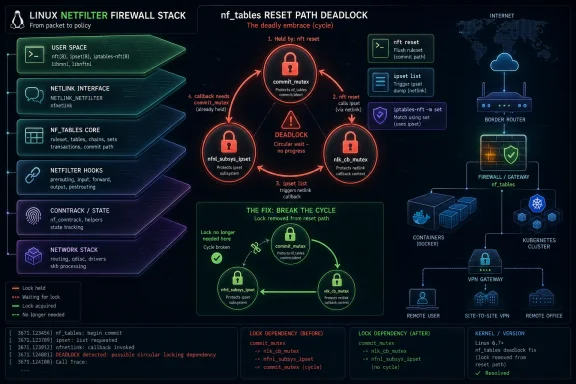
Linux kernel CVE-2026-45901 was published by NVD on May 27, 2026, after kernel.org assigned a security record to a netfilter nf_tables fix that removes
The first thing to say about CVE-2026-45901 is that it does not currently look like a classic memory-corruption Linux kernel bug. There is no published NVD CVSS score yet, no weakness classification from NIST at the time of the record, and no public indication in the record that this is a privilege-escalation primitive or remote code execution flaw. The description points instead to a circular lock dependency: three pieces of kernel and netfilter state can wait on each other in the wrong order when certain firewall-management operations occur at the same time.
That distinction matters, but it should not make the issue invisible. A kernel deadlock in packet-filtering code can still become a security problem because availability is part of security. If firewall tooling can wedge kernel paths, stall administrative operations, or freeze a networking component under realistic concurrency, the bug belongs in the patch-management queue rather than the trivia drawer.
The relevant operations are also not exotic in the way kernel mailing-list bugs often are.
That is what makes the CVE interesting for WindowsForum’s audience, even though it lives in the Linux kernel. Most Windows shops now run more Linux than they think: WSL instances, Linux-based security appliances, Kubernetes nodes, cloud firewalls, VPN concentrators, NAS boxes, edge routers, and CI runners. A bug in netfilter is rarely confined to the sort of person who compiles kernels for sport.
That is the uncomfortable rhythm of kernel engineering. A lock can be a seatbelt in one release and a tripwire in the next. The commit message says earlier patches made it safe to run reset handlers concurrently, which means the
The specific lock names are easy to skip over, but they tell the story.
That is why the affected command mix is revealing.
But infrastructure does not migrate like a marketing slide. It accretes. A server might have nftables installed, an application might still ship iptables commands, a container runtime might program rules automatically, a security agent might query sets, and a distribution might route old iptables invocations through the
CVE-2026-45901 lives in that in-between state. The bug description explicitly includes
That should sound familiar to anyone who has run Windows estates through major security architecture changes. Compatibility modes are always sold as a bridge, but bridges become permanent when vendors, scripts, appliances, and third-party agents keep walking across them. The risk is not merely that old commands survive. The risk is that old commands are now mapped onto newer internals with enough translation to work almost all the time.
The most interesting phrase in the CVE description is “Previous patches made it safe.” It implies a sequence: first, lock aggressively; then, harden the concurrent handlers; then, remove the broader lock because it has become counterproductive. That is good engineering, but it is also a reminder that secure concurrency is rarely achieved in one clean patch. It is negotiated over time through reports, tests, regressions, and reverts.
For this one, the lack of a score should prevent overclaiming. There is no basis, from the public record alone, to describe CVE-2026-45901 as a confirmed remote compromise vulnerability. There is also no basis to dismiss it as harmless. A concurrency bug in the kernel’s firewall control plane is the kind of issue that may be low drama on a single workstation and operationally ugly on a busy gateway, container host, or automated test fleet.
Security teams should treat the CVE as a kernel availability and reliability fix until better evidence says otherwise. That means prioritizing systems where nftables, ipset, and iptables compatibility tooling are all in use, especially if rulesets are manipulated automatically. Firewalls that rarely change state are less likely to hit the race condition than systems where orchestration, monitoring, and policy updates happen in parallel.
The most realistic near-term failure mode is not a hacker typing the three magic commands by hand across the Internet. It is a local or privileged management context where concurrent operations happen naturally: scripts, agents, container networking components, service restarts, or security tooling that queries and rewrites firewall state. If an attacker already has the ability to trigger those administrative operations, the bug may become one piece of a denial-of-service chain, but the public record does not justify claiming more than that.
That nuance matters because Linux kernel CVEs now arrive in industrial quantities. The kernel project’s CVE process has made many resolved bugs visible as CVE records, including issues whose exploitability is subtle, local, or largely theoretical. The right response is not to ignore them all, nor to treat each as a five-alarm breach. The right response is to map the bug to the systems and workflows that could plausibly exercise it.
Humans are bad at finding lock cycles by inspection in a system as complicated as the Linux networking stack. Automated fuzzers are very good at making subsystems collide in weird orders. They do not care whether a command combination is aesthetically pleasing or likely in a tutorial. They care that the kernel exposes enough interfaces for one operation to overlap another, and then they keep trying until the lock validator complains.
That is one reason CVE-2026-45901 should be read as a success story as well as a bug report. The issue was found, reduced, patched, and propagated into stable kernel work. The fix removes an unnecessary lock rather than adding another layer of defensive complexity. In a subsystem where too much locking can be as dangerous as too little, that is the kind of repair administrators should want.
It also complicates the way organizations think about vulnerability severity. Automated bug discovery produces reports that may not map cleanly to attacker behavior. Some are catastrophic. Some are regressions. Some are theoretical. Some are availability bugs under odd concurrency. All of them, however, feed a hardening pipeline that eventually becomes the kernel your distribution ships.
The irony is that the better Linux gets at finding and labeling bugs, the noisier vulnerability management becomes for everyone downstream. Windows administrators know this feeling from Patch Tuesday: a list of fixes is not the same as a ranked operational plan. Linux shops now face a similar challenge with kernel CVEs that can be precise in code terms and ambiguous in business risk terms.
A desktop Linux machine that never uses advanced firewall tooling may technically carry the code but have little practical exposure. A cloud host running container networking, host firewalls, dynamic policy agents, and compatibility iptables commands is a different story. A router distribution, load balancer, VPN endpoint, or Kubernetes node is different again. The bug is about a particular subsystem under particular concurrent control-plane operations, not a passive packet arriving at port 443.
For Windows-heavy environments, the most likely exposure is indirect. WSL users who do serious Linux networking work, lab machines running local firewalls, Hyper-V hosts with Linux guests, and corporate networks with Linux appliances can all bring netfilter into the estate. Even if the vulnerability is not a Windows vulnerability, it can affect the security boundary that Windows clients depend on.
Container platforms deserve special attention because they are concurrency factories. Rules are created, queried, replaced, and torn down as workloads start and stop. Many environments still depend on iptables-compatible behavior even when the underlying backend is nftables. That does not mean every Kubernetes node is affected in a meaningful way; it means this is the class of system where administrators should look first rather than last.
The same is true for security products that manage Linux firewall state. Endpoint agents, intrusion-prevention systems, VPN clients, and network-control daemons often touch netfilter without making much noise. An administrator may not personally run
This is especially important for long-term support distributions. Enterprise Linux vendors often backport security fixes without changing the apparent major kernel version. A system may still report an older kernel line while containing the relevant netfilter patch. Conversely, a custom or appliance kernel may look modern but lag on stable networking fixes if the vendor has not pulled them in.
Administrators should resist version-number theater. The presence of a vulnerable-looking version string is not always proof of exposure, and the presence of a newish version string is not always proof of safety. Vendor advisories, changelogs, package metadata, and commit references matter more than a superficial
This is where CVE-2026-45901 becomes a patch-governance test. A high-CVSS remote code execution bug forces action because everyone understands the headline. A not-yet-scored kernel deadlock requires a more mature process: identify whether netfilter nf_tables is in use, determine whether compatibility tooling is present, check vendor kernel status, then schedule updates according to operational role.
The good news is that the fix is conceptually small. It removes a lock from reset paths where prior hardening made it unnecessary. That does not guarantee the backport is trivial across every vendor kernel, but it is not a sprawling redesign. In many environments, the hard part will be reboot coordination, not code risk.
That assumption is usually fair. The kernel exists to provide safe shared abstractions, and userspace should not need to know every lock order behind nftables and ipset. But CVE-2026-45901 shows the boundary between safe abstraction and emergent behavior. When nftables reset paths, ipset operations, and iptables compatibility invocations overlap, internal locking becomes the product.
This is one reason firewall automation should be treated like database automation. You would not allow six independent tools to rewrite database schema at the same time without ownership rules. Yet many Linux hosts end up with distributions, container runtimes, VPN clients, security agents, and human scripts all making firewall changes. The kernel can handle much of that chaos, but the more actors you add, the more you depend on edge cases being correct.
For IT teams, the lesson is not to stop automating. Manual firewall administration is not a security strategy. The lesson is to document which component owns firewall policy on each class of host and to reduce overlapping control planes where possible. If nftables is the standard, then legacy iptables compatibility paths should be there for known reasons, not accidental convenience.
That is particularly relevant for hybrid Windows/Linux shops. Windows Defender Firewall, Group Policy, Intune, and enterprise security agents create one model of policy ownership on Windows. Linux often lacks the same central discipline unless organizations impose it. CVE-2026-45901 is a reminder that Linux firewall state deserves equal governance, not just shell scripts and hope.
That category of operation is common in observability. Monitoring systems do not just read; they sometimes read-and-clear. Security tools do not just inspect; they sometimes reset counters or rotate state. Troubleshooting commands can become write operations in disguise. The more frequently those commands run, the more likely they are to collide with policy changes or compatibility-layer translations.
In packet filtering, counters and sets are not ornamental. They help administrators understand whether rules are matching, whether abuse controls are working, and whether traffic is flowing as expected. A reset path bug can therefore affect the same systems that are trying hardest to observe their security posture. That is an unpleasant inversion: the act of measuring the firewall can help trigger a firewall control-plane problem.
This is not unique to Linux. Every mature operating system accumulates management APIs whose behavior under concurrency becomes as important as their feature set. Windows has its own long history of management layers, compatibility shims, PowerShell providers, WMI classes, and security products all touching shared state. The Linux difference here is that the public kernel process lets us watch the locking argument unfold in commit messages.
The best observability tools are aware of this problem. They avoid unnecessary resets, minimize disruptive queries, and coordinate with the platform’s preferred API. The worst ones poll aggressively, shell out to legacy commands, and assume the kernel will absorb everything. CVE-2026-45901 does not prove a given monitoring tool is dangerous, but it gives administrators a reason to review how often firewall state is being queried and reset.
Start with systems that actively use nftables and ipset together. Then look for hosts where iptables commands are still present but routed through the nft backend. Finally, prioritize systems where firewall rules are touched by multiple automated actors. The more these conditions overlap, the more relevant the CVE becomes.
Administrators should also consider whether untrusted local users can trigger relevant tooling. On many systems, firewall administration requires elevated privileges, which lowers the likelihood of direct exploitation by a normal user. But local privilege boundaries can be messy in appliances, containers, delegated administration models, and CI environments. A “local administrative operation” is not always as controlled as it sounds.
For internet-facing firewalls, the more important issue may be reliability under management load. A remote packet alone is not described as the trigger, but management-plane disruption can still become an availability incident. If an automated policy update or monitoring job can wedge firewall operations at the wrong time, the business impact may be real even without code execution.
The remediation path is conventional. Track vendor advisories, install kernel updates that include the upstream fix or backport, and reboot into the patched kernel where required. If reboot windows are scarce, prioritize systems that combine nftables, ipset, iptables-nft compatibility, and frequent automated firewall changes.
The security dependency graph has changed. A Windows client may depend on a Linux VPN server, a Linux firewall, a Linux container host, or a Linux reverse proxy. A domain-joined workstation may be protected by a network path whose packet filtering is handled by netfilter. A Windows application may be deployed into a Kubernetes cluster whose node firewall behavior is Linux all the way down.
That does not make every Linux CVE a Windows crisis. It does mean Windows administrators need enough Linux literacy to ask the right questions. Does the appliance vendor use nftables? Does the container platform still call iptables? Are ipset-based deny lists or allow lists in use? Is firewall state managed by multiple agents? Those are not Linux hobbyist questions anymore; they are enterprise risk questions.
There is also a WSL angle, though it should be kept in proportion. WSL has its own networking architecture and does not turn every Windows user into a netfilter administrator. But developers using Linux environments on Windows often interact with containers, local firewalls, VPNs, and test networks. The broader point is that the boundary between Windows and Linux operations has become porous.
For mixed estates, the response should be boring and disciplined. Add CVE-2026-45901 to Linux kernel tracking, verify distribution exposure, and patch according to role. Do not wait for a scary score to discover that the systems enforcing policy for Windows workloads are running unreviewed kernels.
That combination is exactly why mature patch programs exist. They are supposed to distinguish between universal emergencies and role-specific risk. They are supposed to notice that a low-drama kernel bug in a firewall subsystem can matter more to a gateway than a headline-grabbing application bug on an isolated lab machine.
The article-length version of the guidance is nuanced, but the administrator version is straightforward:
commit_mutex locking from reset paths to avoid a circular lock dependency triggered by concurrent nft reset, ipset list, and iptables-nft -m set activity. The bug is not the sort of vulnerability that produces instant exploit panic, but it matters because it sits in one of Linux’s most security-sensitive subsystems: the packet-filtering machinery that backs firewalls, containers, routers, appliances, and plenty of Windows-adjacent infrastructure. The story here is less “another terrifying kernel zero-day” than “a small locking correction exposes how fragile modern firewall plumbing can become when old and new netfilter worlds overlap.” For administrators, the practical question is not whether to rip out nftables, but how quickly their distributions will backport a narrowly targeted kernel fix whose severity is still awaiting NVD scoring.
 A Deadlock CVE Is Still a Security Signal
The first thing to say about CVE-2026-45901 is that it does not currently look like a classic memory-corruption Linux kernel bug. There is no published NVD CVSS score yet, no weakness classification from NIST at the time of the record, and no public indication in the record that this is a privilege-escalation primitive or remote code execution flaw. The description points instead to a circular lock dependency: three pieces of kernel and netfilter state can wait on each other in the wrong order when certain firewall-management operations occur at the same time.That distinction matters, but it should not make the issue invisible. A kernel deadlock in packet-filtering code can still become a security problem because availability is part of security. If firewall tooling can wedge kernel paths, stall administrative operations, or freeze a networking component under realistic concurrency, the bug belongs in the patch-management queue rather than the trivia drawer.
The relevant operations are also not exotic in the way kernel mailing-list bugs often are.
nft reset is part of the nftables management model, ipset list belongs to a long-lived ecosystem of IP set management, and iptables-nft is the compatibility bridge many systems still use while pretending they have fully moved on from iptables. The vulnerable choreography appears when those worlds meet under concurrent load.That is what makes the CVE interesting for WindowsForum’s audience, even though it lives in the Linux kernel. Most Windows shops now run more Linux than they think: WSL instances, Linux-based security appliances, Kubernetes nodes, cloud firewalls, VPN concentrators, NAS boxes, edge routers, and CI runners. A bug in netfilter is rarely confined to the sort of person who compiles kernels for sport.
The Patch Reverts a Lock, Not a Feature
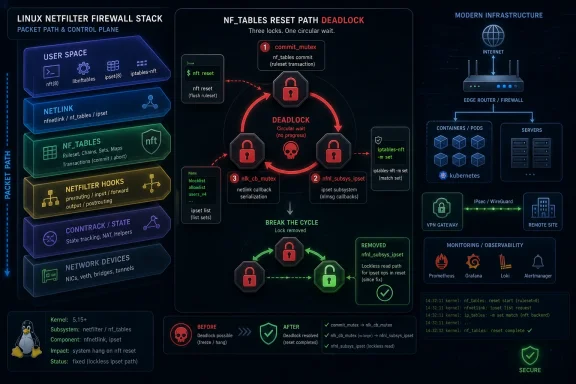
The fix behind CVE-2026-45901 is unusually plain: revert the use ofcommit_mutex in the nf_tables reset path. In kernel terms, that is not a product announcement; it is a course correction. A lock that had been added for safety in one set of circumstances became unnecessary after other patches made individual reset handlers safe to run concurrently.That is the uncomfortable rhythm of kernel engineering. A lock can be a seatbelt in one release and a tripwire in the next. The commit message says earlier patches made it safe to run reset handlers concurrently, which means the
commit_mutex was no longer required to serialize those operations. Once it stayed around beyond its usefulness, it could participate in a lock cycle with nfnl_subsys_ipset and nlk_cb_mutex.The specific lock names are easy to skip over, but they tell the story.
commit_mutex belongs to nftables transaction handling; nfnl_subsys_ipset points toward netfilter’s netlink-facing ipset subsystem; nlk_cb_mutex is part of the netlink callback machinery that helps userspace tools talk to the kernel. A deadlock here is not packet forwarding gone wrong in isolation. It is control-plane plumbing tangling itself while administrators or automation are asking the firewall stack to inspect, reset, or translate state.That is why the affected command mix is revealing.
nft reset, ipset list, and iptables-nft are not all from the same era of Linux firewalling. They represent the messy compatibility layer between nftables, the older iptables user experience, and ipset-style set management that many scripts and security products still rely upon. The kernel fix is narrow, but the ecosystem lesson is broad: migration layers are where old assumptions go to collide.Netfilter’s Compatibility Era Keeps Producing Edge Cases
Netfilter is one of the great pieces of Linux infrastructure precisely because it has survived multiple generations of administration style. The original iptables model trained a generation of sysadmins to think in chains, tables, matches, and targets. nftables changed the underlying architecture, offering a more expressive ruleset engine, native sets and maps, atomic updates, and a cleaner long-term direction.But infrastructure does not migrate like a marketing slide. It accretes. A server might have nftables installed, an application might still ship iptables commands, a container runtime might program rules automatically, a security agent might query sets, and a distribution might route old iptables invocations through the
iptables-nft backend. Everybody thinks they are operating the firewall; the kernel has to make all of them right enough at the same time.CVE-2026-45901 lives in that in-between state. The bug description explicitly includes
iptables-nft with a -m set rule, which is exactly the sort of compatibility path that exists because userspace cannot be swapped out overnight. It also includes ipset list, a read-style operation that administrators may not mentally associate with risk. The problem is not that listing a set is dangerous by itself, but that the lock ordering across simultaneous operations can become dangerous.That should sound familiar to anyone who has run Windows estates through major security architecture changes. Compatibility modes are always sold as a bridge, but bridges become permanent when vendors, scripts, appliances, and third-party agents keep walking across them. The risk is not merely that old commands survive. The risk is that old commands are now mapped onto newer internals with enough translation to work almost all the time.
The most interesting phrase in the CVE description is “Previous patches made it safe.” It implies a sequence: first, lock aggressively; then, harden the concurrent handlers; then, remove the broader lock because it has become counterproductive. That is good engineering, but it is also a reminder that secure concurrency is rarely achieved in one clean patch. It is negotiated over time through reports, tests, regressions, and reverts.
The Absence of a CVSS Score Should Slow Panic, Not Patching
NVD’s record for CVE-2026-45901 was still marked as awaiting enrichment when the CVE landed, with no NIST CVSS 4.0, 3.x, or 2.0 base score provided. That absence is important because the security industry tends to automate attention around numbers. A CVE with a 9.8 gets dashboards glowing red; a CVE with “N/A” can sink into the backlog even when it affects core kernel code.For this one, the lack of a score should prevent overclaiming. There is no basis, from the public record alone, to describe CVE-2026-45901 as a confirmed remote compromise vulnerability. There is also no basis to dismiss it as harmless. A concurrency bug in the kernel’s firewall control plane is the kind of issue that may be low drama on a single workstation and operationally ugly on a busy gateway, container host, or automated test fleet.
Security teams should treat the CVE as a kernel availability and reliability fix until better evidence says otherwise. That means prioritizing systems where nftables, ipset, and iptables compatibility tooling are all in use, especially if rulesets are manipulated automatically. Firewalls that rarely change state are less likely to hit the race condition than systems where orchestration, monitoring, and policy updates happen in parallel.
The most realistic near-term failure mode is not a hacker typing the three magic commands by hand across the Internet. It is a local or privileged management context where concurrent operations happen naturally: scripts, agents, container networking components, service restarts, or security tooling that queries and rewrites firewall state. If an attacker already has the ability to trigger those administrative operations, the bug may become one piece of a denial-of-service chain, but the public record does not justify claiming more than that.
That nuance matters because Linux kernel CVEs now arrive in industrial quantities. The kernel project’s CVE process has made many resolved bugs visible as CVE records, including issues whose exploitability is subtle, local, or largely theoretical. The right response is not to ignore them all, nor to treat each as a five-alarm breach. The right response is to map the bug to the systems and workflows that could plausibly exercise it.
Syzbot’s Fingerprints Are All Over the Modern Kernel Security Pipeline
The patch history around this issue points to syzbot, the automated kernel bug-finding system built around syzkaller. That detail is more than inside baseball. It shows how much modern kernel security work is driven by machines that relentlessly explore impossible-looking interleavings until the impossible becomes a reproducer.Humans are bad at finding lock cycles by inspection in a system as complicated as the Linux networking stack. Automated fuzzers are very good at making subsystems collide in weird orders. They do not care whether a command combination is aesthetically pleasing or likely in a tutorial. They care that the kernel exposes enough interfaces for one operation to overlap another, and then they keep trying until the lock validator complains.
That is one reason CVE-2026-45901 should be read as a success story as well as a bug report. The issue was found, reduced, patched, and propagated into stable kernel work. The fix removes an unnecessary lock rather than adding another layer of defensive complexity. In a subsystem where too much locking can be as dangerous as too little, that is the kind of repair administrators should want.
It also complicates the way organizations think about vulnerability severity. Automated bug discovery produces reports that may not map cleanly to attacker behavior. Some are catastrophic. Some are regressions. Some are theoretical. Some are availability bugs under odd concurrency. All of them, however, feed a hardening pipeline that eventually becomes the kernel your distribution ships.
The irony is that the better Linux gets at finding and labeling bugs, the noisier vulnerability management becomes for everyone downstream. Windows administrators know this feeling from Patch Tuesday: a list of fixes is not the same as a ranked operational plan. Linux shops now face a similar challenge with kernel CVEs that can be precise in code terms and ambiguous in business risk terms.
The Affected Surface Is Smaller Than “Linux,” but Larger Than “Some Lab Box”
It would be tempting to say this affects “Linux” and leave it at that. That would be technically broad and operationally useless. The vulnerable code sits in the kernel’s netfilter nf_tables area, and the trigger described requires concurrent use of nftables reset functionality, ipset listing, and an iptables-nft set match path.A desktop Linux machine that never uses advanced firewall tooling may technically carry the code but have little practical exposure. A cloud host running container networking, host firewalls, dynamic policy agents, and compatibility iptables commands is a different story. A router distribution, load balancer, VPN endpoint, or Kubernetes node is different again. The bug is about a particular subsystem under particular concurrent control-plane operations, not a passive packet arriving at port 443.
For Windows-heavy environments, the most likely exposure is indirect. WSL users who do serious Linux networking work, lab machines running local firewalls, Hyper-V hosts with Linux guests, and corporate networks with Linux appliances can all bring netfilter into the estate. Even if the vulnerability is not a Windows vulnerability, it can affect the security boundary that Windows clients depend on.
Container platforms deserve special attention because they are concurrency factories. Rules are created, queried, replaced, and torn down as workloads start and stop. Many environments still depend on iptables-compatible behavior even when the underlying backend is nftables. That does not mean every Kubernetes node is affected in a meaningful way; it means this is the class of system where administrators should look first rather than last.
The same is true for security products that manage Linux firewall state. Endpoint agents, intrusion-prevention systems, VPN clients, and network-control daemons often touch netfilter without making much noise. An administrator may not personally run
iptables-nft -m set, but software on the box might. Asset owners should examine actual tooling, not just human habits.Distribution Backports Will Decide the Real Patch Story
The upstream fix references stable kernel commits, but most production systems do not run vanilla upstream kernels. They run distribution kernels with backports, vendor patches, and support contracts. That means the practical question is not only “Is the upstream kernel fixed?” but “Has my vendor shipped the relevant fix for the kernel I actually boot?”This is especially important for long-term support distributions. Enterprise Linux vendors often backport security fixes without changing the apparent major kernel version. A system may still report an older kernel line while containing the relevant netfilter patch. Conversely, a custom or appliance kernel may look modern but lag on stable networking fixes if the vendor has not pulled them in.
Administrators should resist version-number theater. The presence of a vulnerable-looking version string is not always proof of exposure, and the presence of a newish version string is not always proof of safety. Vendor advisories, changelogs, package metadata, and commit references matter more than a superficial
uname -r comparison.This is where CVE-2026-45901 becomes a patch-governance test. A high-CVSS remote code execution bug forces action because everyone understands the headline. A not-yet-scored kernel deadlock requires a more mature process: identify whether netfilter nf_tables is in use, determine whether compatibility tooling is present, check vendor kernel status, then schedule updates according to operational role.
The good news is that the fix is conceptually small. It removes a lock from reset paths where prior hardening made it unnecessary. That does not guarantee the backport is trivial across every vendor kernel, but it is not a sprawling redesign. In many environments, the hard part will be reboot coordination, not code risk.
The Firewall Stack Is Now a Shared Responsibility Between Kernel and Automation
The operational risk around CVE-2026-45901 is magnified by the way firewall state is now managed. In the old mental model, a sysadmin edited rules, loaded them, and occasionally listed them. In the modern model, multiple pieces of software may manipulate firewall state continuously and independently, each assuming the kernel will serialize reality.That assumption is usually fair. The kernel exists to provide safe shared abstractions, and userspace should not need to know every lock order behind nftables and ipset. But CVE-2026-45901 shows the boundary between safe abstraction and emergent behavior. When nftables reset paths, ipset operations, and iptables compatibility invocations overlap, internal locking becomes the product.
This is one reason firewall automation should be treated like database automation. You would not allow six independent tools to rewrite database schema at the same time without ownership rules. Yet many Linux hosts end up with distributions, container runtimes, VPN clients, security agents, and human scripts all making firewall changes. The kernel can handle much of that chaos, but the more actors you add, the more you depend on edge cases being correct.
For IT teams, the lesson is not to stop automating. Manual firewall administration is not a security strategy. The lesson is to document which component owns firewall policy on each class of host and to reduce overlapping control planes where possible. If nftables is the standard, then legacy iptables compatibility paths should be there for known reasons, not accidental convenience.
That is particularly relevant for hybrid Windows/Linux shops. Windows Defender Firewall, Group Policy, Intune, and enterprise security agents create one model of policy ownership on Windows. Linux often lacks the same central discipline unless organizations impose it. CVE-2026-45901 is a reminder that Linux firewall state deserves equal governance, not just shell scripts and hope.
The Reset Path Tells a Bigger Story About Observability
The word “reset” in this CVE should catch the eye. Reset operations are often administrative conveniences: dump counters and reset them, retrieve state and clear it, inspect an object while changing its accounting. They are not necessarily thought of as high-risk mutations, yet they can touch enough shared state to require careful locking.That category of operation is common in observability. Monitoring systems do not just read; they sometimes read-and-clear. Security tools do not just inspect; they sometimes reset counters or rotate state. Troubleshooting commands can become write operations in disguise. The more frequently those commands run, the more likely they are to collide with policy changes or compatibility-layer translations.
In packet filtering, counters and sets are not ornamental. They help administrators understand whether rules are matching, whether abuse controls are working, and whether traffic is flowing as expected. A reset path bug can therefore affect the same systems that are trying hardest to observe their security posture. That is an unpleasant inversion: the act of measuring the firewall can help trigger a firewall control-plane problem.
This is not unique to Linux. Every mature operating system accumulates management APIs whose behavior under concurrency becomes as important as their feature set. Windows has its own long history of management layers, compatibility shims, PowerShell providers, WMI classes, and security products all touching shared state. The Linux difference here is that the public kernel process lets us watch the locking argument unfold in commit messages.
The best observability tools are aware of this problem. They avoid unnecessary resets, minimize disruptive queries, and coordinate with the platform’s preferred API. The worst ones poll aggressively, shell out to legacy commands, and assume the kernel will absorb everything. CVE-2026-45901 does not prove a given monitoring tool is dangerous, but it gives administrators a reason to review how often firewall state is being queried and reset.
Security Teams Should Rank This by Role, Not by Anxiety
Because NVD had not enriched the CVE with a severity score, organizations need a practical interim triage model. The mistake would be to rank every Linux machine identically. A developer laptop, a container host, a firewall appliance, and a cloud NAT instance have very different relationships to netfilter.Start with systems that actively use nftables and ipset together. Then look for hosts where iptables commands are still present but routed through the nft backend. Finally, prioritize systems where firewall rules are touched by multiple automated actors. The more these conditions overlap, the more relevant the CVE becomes.
Administrators should also consider whether untrusted local users can trigger relevant tooling. On many systems, firewall administration requires elevated privileges, which lowers the likelihood of direct exploitation by a normal user. But local privilege boundaries can be messy in appliances, containers, delegated administration models, and CI environments. A “local administrative operation” is not always as controlled as it sounds.
For internet-facing firewalls, the more important issue may be reliability under management load. A remote packet alone is not described as the trigger, but management-plane disruption can still become an availability incident. If an automated policy update or monitoring job can wedge firewall operations at the wrong time, the business impact may be real even without code execution.
The remediation path is conventional. Track vendor advisories, install kernel updates that include the upstream fix or backport, and reboot into the patched kernel where required. If reboot windows are scarce, prioritize systems that combine nftables, ipset, iptables-nft compatibility, and frequent automated firewall changes.
Microsoft Shops Should Care Because Their Perimeter Is Already Linux
WindowsForum readers could reasonably ask why a Linux netfilter CVE belongs on their radar. The answer is that Microsoft-centric environments are no longer Microsoft-only environments. Azure workloads, AKS clusters, Linux-based network appliances, WSL development, storage devices, and security tools routinely sit alongside Windows endpoints and domain services.The security dependency graph has changed. A Windows client may depend on a Linux VPN server, a Linux firewall, a Linux container host, or a Linux reverse proxy. A domain-joined workstation may be protected by a network path whose packet filtering is handled by netfilter. A Windows application may be deployed into a Kubernetes cluster whose node firewall behavior is Linux all the way down.
That does not make every Linux CVE a Windows crisis. It does mean Windows administrators need enough Linux literacy to ask the right questions. Does the appliance vendor use nftables? Does the container platform still call iptables? Are ipset-based deny lists or allow lists in use? Is firewall state managed by multiple agents? Those are not Linux hobbyist questions anymore; they are enterprise risk questions.
There is also a WSL angle, though it should be kept in proportion. WSL has its own networking architecture and does not turn every Windows user into a netfilter administrator. But developers using Linux environments on Windows often interact with containers, local firewalls, VPNs, and test networks. The broader point is that the boundary between Windows and Linux operations has become porous.
For mixed estates, the response should be boring and disciplined. Add CVE-2026-45901 to Linux kernel tracking, verify distribution exposure, and patch according to role. Do not wait for a scary score to discover that the systems enforcing policy for Windows workloads are running unreviewed kernels.
The Small Revert That Should Change the Patch Conversation
CVE-2026-45901 offers a useful corrective to the way vulnerability news is usually consumed. The fix is a revert of a locking choice, not a dramatic new mitigation. The impact is likely availability and concurrency rather than remote takeover, based on the public record. The affected area is specialized but important. The CVSS score is absent, but the operational context may still make the patch urgent for some systems.That combination is exactly why mature patch programs exist. They are supposed to distinguish between universal emergencies and role-specific risk. They are supposed to notice that a low-drama kernel bug in a firewall subsystem can matter more to a gateway than a headline-grabbing application bug on an isolated lab machine.
The article-length version of the guidance is nuanced, but the administrator version is straightforward:
- Systems that use nftables together with ipset and iptables-nft compatibility deserve the first look.
- The public record describes a circular lock dependency, so availability and reliability should drive triage unless new exploit information emerges.
- The absence of an NVD score on May 27, 2026, should not be treated as proof that the issue is irrelevant.
- Distribution backports matter more than upstream version guessing, especially on enterprise and appliance kernels.
- Firewall automation should be reviewed wherever multiple tools query, reset, or rewrite netfilter state concurrently.
- Windows-centric organizations should include Linux firewalls, container hosts, appliances, and WSL-adjacent developer infrastructure in their exposure review.
References
- Primary source: NVD / Linux Kernel
Published: 2026-05-28T01:03:53-07:00
NVD - CVE-2026-45901
 nvd.nist.gov
- Security advisory: MSRC
Published: 2026-05-28T01:03:53-07:00
Original feed URL
Security Update Guide - Microsoft Security Response Center
 msrc.microsoft.com
- Related coverage: spinics.net
Re: test [PATCH nf-next] netfilter: nf_tables: use dedicated mutex for reset operations — Linux Kernel
Linux Kernel: Re: test [PATCH nf-next] netfilter: nf_tables: use dedicated mutex for reset operations www.spinics.net
- Related coverage: korg.docs.kernel.org
- Related coverage: systemshardening.com
Linux netfilter and nf_tables Security Hardening
Harden Linux netfilter and nf_tables against CVE-2026-31414-class connection tracking bugs, privilege escalation via nf_tables, and the recurring pattern of silent kernel netfilter fixes. www.systemshardening.com
- Related coverage: kernel.org

The Linux Kernel Archives
www.kernel.org
- Related coverage: gitlab.com
- Related coverage: kernel.googlesource.com
- Related coverage: bootlin.com