
Siemens SINEC INS versions before V1.0 SP2 Update 6 are affected by four vulnerabilities disclosed by Siemens ProductCERT on June 9, 2026, and republished by CISA on June 23, with the most serious issues rated 8.8 under CVSS v3.1. The short version is simple: update the industrial network services platform now. The longer version is more uncomfortable, because these flaws sit in precisely the kind of infrastructure software that many organizations treat as background plumbing until it breaks. In industrial environments, background plumbing is often where the real risk accumulates.
The affected product, SINEC INS, is part of Siemens’ industrial networking portfolio, built for environments where network services need to be centrally provided, managed, and kept predictable. That puts it in a different category from an ordinary business application. It is not just another server in the rack; it is part of the administrative fabric around operational technology.
That is why the most important word in the advisory is not “command injection,” even though that is the phrase most likely to get attention. The most important word is “authenticated.” These vulnerabilities are not described as unauthenticated internet drive-bys, but in industrial security that is not the comfort it may appear to be.
An authenticated attacker in an OT-adjacent system is already too close. Credentials can be phished, reused, harvested from poorly protected jump hosts, or inherited from the messy reality of contractor access. Once an attacker has a foothold, flaws that turn a low-privilege account into command execution, file access, or privilege escalation become the bridge between “we had an account problem” and “we have a platform compromise.”
Siemens has released SINEC INS V1.0 SP2 Update 6 and recommends customers move to that release or later. That is the correct answer, but it is also the beginning of the operational conversation rather than the end. Industrial patching is rarely a one-click ritual, and the places most likely to be affected are often the places least able to tolerate unplanned change.
That last detail matters. This is not merely a bad input field that immediately reacts to a malformed request. The advisory describes a path where malicious input can persist and then trigger later, a pattern that complicates both detection and incident reconstruction. In practical terms, the exploit path has the ugly shape of a booby trap: an attacker plants something that looks like data, and the system later treats it as instruction.
The CVSS v3.1 score of 8.8 reflects the seriousness of that chain. Network access, low attack complexity, low privileges required, and no user interaction are the kind of ingredients defenders do not like seeing together. The attacker still needs credentials, but once that hurdle is cleared, the flaw can lead to command execution with the privileges of the affected service user.
For WindowsForum readers who spend their days in Windows Server, Active Directory, and endpoint management, the lesson should feel familiar. The initial vulnerability may live in an industrial product, but the failure mode is universal: a management plane accepts input, stores it, and later executes something the developer did not intend. Whether the target is a PowerShell-heavy Windows estate or a Linux-based industrial appliance, the principle is the same. Administrative software is only safe when its trust boundaries are aggressively boring.
Path traversal is the sort of vulnerability that rarely wins headlines unless it is paired with something louder. Here, it is paired with something louder. On its own, unintended file system access can expose configuration files, operational clues, secrets, logs, or software layout details. In combination with command injection and privilege issues, it becomes part of an attacker’s map.
The endpoint overlap is also notable. Both the command injection and path traversal issues involve SFTP upload file handling. That suggests defenders should pay particular attention not only to the patched version number but to logs, API activity, directory names, and unexpected file paths associated with that subsystem.
The danger is not that every vulnerable installation has already been compromised. The danger is that environments tend to underestimate low- and medium-scored flaws when they appear next to high-scored ones. Attackers do not read advisories as ranked shopping lists; they read them as assembly instructions.
This is not a classic memory corruption bug or a novel cryptographic break. It is a design and configuration problem. A binary has more power than it should, and if an attacker reaches the right position, that power can be abused.
That is exactly the kind of vulnerability industrial software struggles with, because these products often inherit years of operational assumptions. A service is granted broad access because it made deployment easier, fixed a support problem, or avoided a permissions edge case. The product works, customers stop complaining, and the excessive privilege becomes part of the furniture.
The advisory’s impact language is stark because privilege escalation changes the defender’s calculus. Command execution as a service user is bad; a path to root is worse. In industrial network services, root-level compromise can threaten not only the application but the integrity of the host, its stored credentials, its configuration, and potentially the trust relationships around it.
The Windows analogy is obvious. A service account with unnecessary local administrator rights may not be an exploit by itself, but when another flaw gives an attacker code execution in that service context, the decision to overprivilege becomes the accelerant. Least privilege is not a compliance slogan. It is the difference between containment and system ownership.
This vulnerability has a different tempo from the others. It is not necessarily the flaw an attacker uses first in a live intrusion. It is the flaw that makes stolen password material more valuable after the fact.
Static salts are a well-understood anti-pattern. Salts exist to make identical passwords hash differently and to frustrate precomputed attacks. If every installation and every user shares the same hardcoded salt, that protective property collapses. Pair that with too few iterations, and the economics tilt toward the attacker.
The CVSS v3.1 score of 7.5 reflects a more constrained path: local access, high privileges, and high attack complexity. But defenders should resist the temptation to read that as “less important.” In incident response, password material often becomes the hinge between a contained compromise and a broader identity problem. If a product’s password storage weakens that hinge, remediation should include credential hygiene, not just binary replacement.
For administrators, the uncomfortable question is whether updating the product is enough. In many cases, it will be prudent to rotate passwords associated with the affected system, especially if there is any evidence of unauthorized access, suspicious local activity, or file exposure. A patch fixes the implementation going forward; it does not magically unsteal or unlearn credentials that may already have been exposed.
That does not make the CISA notice redundant. For many asset owners, CISA is the operational alarm bell. Vendor advisories can disappear into product portals, mailing lists, or engineering inboxes. A CISA ICS advisory has a different audience: critical infrastructure operators, security teams, government partners, and organizations that may not track every Siemens ProductCERT update directly.
The affected sectors listed in the CISA material are broad: critical manufacturing, transportation systems, energy, healthcare and public health, financial services, and government services and facilities. That breadth is typical for industrial networking products, but it is also the point. Infrastructure software does not map neatly to one industry vertical. It follows the installed base.
The advisory also lists worldwide deployment and Siemens’ headquarters in Germany. Those details are bureaucratic on the surface, but they reinforce the scale problem. A vulnerable industrial network service product can exist in a factory in Ohio, a transport facility in Europe, a hospital-affiliated environment, or a government-linked site. The operational realities differ; the software flaw does not care.
CISA’s standard recommendations are equally familiar: minimize network exposure, keep control systems off the open internet, place control system networks behind firewalls, isolate them from business networks, and use secure remote access methods such as updated VPNs when remote access is required. These are not glamorous recommendations. They are repeated because failures in these areas keep turning product vulnerabilities into incidents.
SINEC INS is not a programmable logic controller, and this advisory does not say attackers can directly manipulate physical processes through these vulnerabilities. That distinction matters. But infrastructure services around industrial networks are valuable because they help define, support, and administer the environment in which those physical systems operate.
Attackers do not need every foothold to be a direct path to machinery. They need footholds that improve visibility, persistence, credential access, and lateral movement. A network services platform can offer all four if it is poorly segmented, overtrusted, or administered from shared workstations.
For sysadmins, the practical lesson is that “OT product” does not mean “someone else’s problem.” Many of the controls that will reduce risk here are IT controls: identity governance, privileged access management, patch management, log retention, firewall policy, jump host hardening, backup validation, and remote access review. Industrial security may have different tolerance for downtime, but it still depends on the fundamentals.
For OT engineers, the lesson cuts the other way. A product that makes industrial networks easier to operate can also become an attractive target precisely because it centralizes function. Convenience and centralization are not bad; unmanaged trust is.
The first challenge is inventory. Teams need to know whether SINEC INS is deployed, which version is running, where it sits, who administers it, and what depends on it. That sounds basic until one remembers how many industrial networks have grown by project, vendor, contractor, and emergency fix rather than by centralized asset management.
The second challenge is testing. Even when the patch is the right answer, responsible operators need to validate it against their environment. Industrial systems are often bound to maintenance windows, validation procedures, vendor support agreements, and change control boards. The result is that advisories with urgent security language meet organizations built for cautious operational change.
The third challenge is compensating control. If a patch cannot be applied immediately, the environment still needs to move. Access to the affected application should be restricted to known administrative networks and hosts. Accounts should be reviewed. Logs should be examined for suspicious use of the affected endpoints. Remote access paths should be checked for unnecessary exposure.
None of this is an argument for delaying the update. It is an argument for treating the update as one part of a defensible response. The worst outcome is to assume that because a patch exists, risk has been handled. The second-worst outcome is to assume that because patching is operationally hard, nothing meaningful can be done until the next outage window.
In contemporary intrusions, valid credentials are not rare trophies. They are routine tools. Phishing, infostealers, password reuse, exposed remote access systems, vendor accounts, unmanaged service accounts, and poorly rotated shared passwords all make authentication a thinner wall than defenders want it to be. Once inside, attackers search for systems where a modest privilege level can be converted into administrative control.
That is why the combination of flaws here matters. A low-privileged authenticated user may be able to trigger command execution. A local attacker may be able to escalate through an overprivileged binary. Password hashing weaknesses may make recovered credential material easier to attack. Path traversal may expose data useful for staging the next move.
Security teams should think in chains, not entries. Each CVE has its own score, vector, and description, but real attackers compose weaknesses. The defensive response should do the same: patch the product, reduce access, rotate sensitive credentials where appropriate, inspect logs, and validate segmentation.
This is also where identity architecture becomes operational security. If SINEC INS administration is tied to broadly used accounts, shared credentials, or unmanaged local users, the blast radius expands. If access is constrained through named accounts, strong authentication, hardened admin workstations, and role separation, the same vulnerability is less likely to become a domain-wide or plant-wide crisis.
That repetition can make the advisories easy to skim past. Siemens, Schneider Electric, Rockwell, Mitsubishi, and others routinely publish security notices; CISA republishes or summarizes many of them; security teams triage the pile. Over time, the format becomes background noise.
But this particular advisory is a useful example of why the format still matters. It gives defenders a specific affected version range, concrete CVEs, severity scores, endpoint details, and a fixed remediation target. That is enough to move from awareness to action if an organization has the internal machinery to do so.
The problem is that many organizations do not. They have vulnerability scanners that see Windows and Linux servers more clearly than industrial appliances. They have endpoint tools that may not run in OT. They have asset databases that know about laptops but not network services boxes installed during a plant modernization project. They have security teams that understand CVSS but lack authority over production maintenance windows.
This gap is where vulnerability management becomes governance. Someone must own the decision to patch, defer, mitigate, monitor, and document. In industrial settings, that cannot be a purely technical decision made by a lone administrator after reading an advisory. It needs operations, engineering, security, and business risk in the same conversation.
A command injection flaw exposed only to a tightly controlled management subnet is still serious. The same flaw reachable from a flat corporate network, a loosely governed VPN pool, or a third-party remote support path is much worse. Exposure changes everything.
The same is true of privilege. If the vulnerable system runs in a well-monitored zone, with limited administrative accounts and strong logging, responders have a fighting chance. If it is treated as a trusted island and excluded from normal monitoring because it is “industrial,” attackers gain one of their favorite advantages: invisibility.
There is also a cultural point here. Industrial vendors often publish guidance that assumes customers will build secure environments around their products. Customers often assume vendors have made products resilient enough to survive imperfect environments. Reality sits in the gap between those assumptions.
The SINEC INS vulnerabilities show why neither side can outsource the whole problem to the other. Siemens needed to fix the product, and it has provided an update. Asset owners need to fix the environment, or at least verify that the environment does not turn a product flaw into an operational incident.
In other words, the boundary between Windows IT and industrial OT is often a workflow, not a wall. A compromised domain account can affect OT access. A poorly secured jump host can expose industrial management tools. A flat network can make an engineering workstation a bridge. A VPN group with too many members can turn “authenticated attacker” into a large population.
Windows administrators therefore have a role even when the vulnerable product is not a Windows application. They can help answer which accounts have access, whether privileged groups are overbroad, whether remote access is logged and constrained, whether admin workstations are hardened, and whether firewall rules match the architecture people believe exists.
They can also help with detection. If SINEC INS access flows through Windows infrastructure, authentication logs, VPN logs, endpoint telemetry, and jump host records may provide clues. The product advisory describes the vulnerable application, but the surrounding Windows estate may hold the evidence of how it was reached.
This is the practical convergence of IT and OT security. Industrial software vulnerabilities increasingly demand enterprise security muscle, while enterprise security teams increasingly need OT context before they act. Neither side has the whole picture alone.
Start with exposure. Confirm that SINEC INS is not reachable from the public internet and is not casually reachable from broad enterprise networks. Check firewall rules, VPN routes, jump host paths, and any vendor remote support mechanisms. If the product is reachable by more people than can justify access, the vulnerability has already done its job as a diagnostic tool.
Then review accounts. Identify local users, administrative accounts, service accounts, shared credentials, and any integrations tied to the platform. Where password hashing weaknesses are involved, credential rotation should be considered, especially if logs are incomplete or if there is any suspicion of prior access.
Finally, look for traces. The command injection vulnerability involves crafted directory names and execution tied to directory listing behavior. That should push teams toward reviewing API activity, SFTP-related paths, unusual directory names, unexpected command execution, modified files, and privilege escalation indicators on the host.
This is not about panic. It is about refusing to let the existence of a patch narrow the response too much. The patch closes known holes; the review determines whether anyone walked through them first.
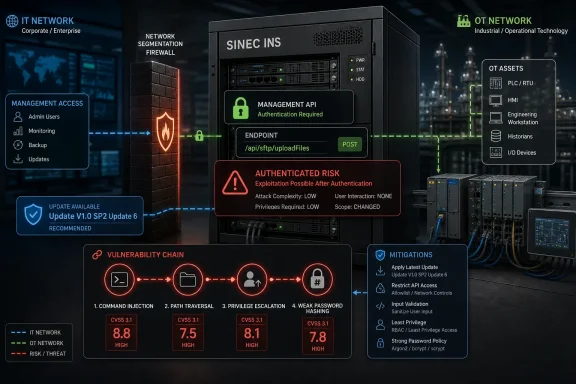 Siemens’ Patch Is Small; the Trust Boundary It Exposes Is Not
The affected product, SINEC INS, is part of Siemens’ industrial networking portfolio, built for environments where network services need to be centrally provided, managed, and kept predictable. That puts it in a different category from an ordinary business application. It is not just another server in the rack; it is part of the administrative fabric around operational technology.That is why the most important word in the advisory is not “command injection,” even though that is the phrase most likely to get attention. The most important word is “authenticated.” These vulnerabilities are not described as unauthenticated internet drive-bys, but in industrial security that is not the comfort it may appear to be.
An authenticated attacker in an OT-adjacent system is already too close. Credentials can be phished, reused, harvested from poorly protected jump hosts, or inherited from the messy reality of contractor access. Once an attacker has a foothold, flaws that turn a low-privilege account into command execution, file access, or privilege escalation become the bridge between “we had an account problem” and “we have a platform compromise.”
Siemens has released SINEC INS V1.0 SP2 Update 6 and recommends customers move to that release or later. That is the correct answer, but it is also the beginning of the operational conversation rather than the end. Industrial patching is rarely a one-click ritual, and the places most likely to be affected are often the places least able to tolerate unplanned change.
The Command Injection Flaw Is the One That Changes the Room
The headline vulnerability is CVE-2026-46746, an OS command injection issue in the/api/sftp/uploadFiles endpoint. Siemens describes a failure to properly sanitize user input, allowing crafted directory names to inject shell command payloads. Those payloads can then be stored and executed when directory listings are retrieved.That last detail matters. This is not merely a bad input field that immediately reacts to a malformed request. The advisory describes a path where malicious input can persist and then trigger later, a pattern that complicates both detection and incident reconstruction. In practical terms, the exploit path has the ugly shape of a booby trap: an attacker plants something that looks like data, and the system later treats it as instruction.
The CVSS v3.1 score of 8.8 reflects the seriousness of that chain. Network access, low attack complexity, low privileges required, and no user interaction are the kind of ingredients defenders do not like seeing together. The attacker still needs credentials, but once that hurdle is cleared, the flaw can lead to command execution with the privileges of the affected service user.
For WindowsForum readers who spend their days in Windows Server, Active Directory, and endpoint management, the lesson should feel familiar. The initial vulnerability may live in an industrial product, but the failure mode is universal: a management plane accepts input, stores it, and later executes something the developer did not intend. Whether the target is a PowerShell-heavy Windows estate or a Linux-based industrial appliance, the principle is the same. Administrative software is only safe when its trust boundaries are aggressively boring.
File Traversal Turns “Just Browsing” Into Reconnaissance
CVE-2026-46747 is lower-severity on paper, with a CVSS v3.1 score of 4.3, but it should not be dismissed as a footnote. Siemens says the affected application does not properly sanitize path input in theGET /api/sftp/uploadFiles endpoint used for directory listing. Crafted input can allow path traversal and access to unintended file system locations.Path traversal is the sort of vulnerability that rarely wins headlines unless it is paired with something louder. Here, it is paired with something louder. On its own, unintended file system access can expose configuration files, operational clues, secrets, logs, or software layout details. In combination with command injection and privilege issues, it becomes part of an attacker’s map.
The endpoint overlap is also notable. Both the command injection and path traversal issues involve SFTP upload file handling. That suggests defenders should pay particular attention not only to the patched version number but to logs, API activity, directory names, and unexpected file paths associated with that subsystem.
The danger is not that every vulnerable installation has already been compromised. The danger is that environments tend to underestimate low- and medium-scored flaws when they appear next to high-scored ones. Attackers do not read advisories as ranked shopping lists; they read them as assembly instructions.
Privilege Design Becomes a Vulnerability When the Assumption Fails
CVE-2026-46748 is the second 8.8-rated issue under CVSS v3.1, and in some ways it is the most revealing. Siemens says the affected system includes a binary configured with thecap_dac_override capability. That Linux capability allows a process to bypass file system permission checks, and Siemens warns it could allow a local attacker to escalate privileges, modify arbitrary files, and gain root privileges.This is not a classic memory corruption bug or a novel cryptographic break. It is a design and configuration problem. A binary has more power than it should, and if an attacker reaches the right position, that power can be abused.
That is exactly the kind of vulnerability industrial software struggles with, because these products often inherit years of operational assumptions. A service is granted broad access because it made deployment easier, fixed a support problem, or avoided a permissions edge case. The product works, customers stop complaining, and the excessive privilege becomes part of the furniture.
The advisory’s impact language is stark because privilege escalation changes the defender’s calculus. Command execution as a service user is bad; a path to root is worse. In industrial network services, root-level compromise can threaten not only the application but the integrity of the host, its stored credentials, its configuration, and potentially the trust relationships around it.
The Windows analogy is obvious. A service account with unnecessary local administrator rights may not be an exploit by itself, but when another flaw gives an attacker code execution in that service context, the decision to overprivilege becomes the accelerant. Least privilege is not a compliance slogan. It is the difference between containment and system ownership.
The Password Hashing Bug Is a Warning From an Older Era
CVE-2026-46749 concerns password hashing. Siemens says the affected application uses a static, hardcoded salt shared across all users and installations, with an insufficient number of iterations. The advisory warns that this could allow efficient password recovery using brute-force or precomputed attacks, potentially leading to unauthorized access.This vulnerability has a different tempo from the others. It is not necessarily the flaw an attacker uses first in a live intrusion. It is the flaw that makes stolen password material more valuable after the fact.
Static salts are a well-understood anti-pattern. Salts exist to make identical passwords hash differently and to frustrate precomputed attacks. If every installation and every user shares the same hardcoded salt, that protective property collapses. Pair that with too few iterations, and the economics tilt toward the attacker.
The CVSS v3.1 score of 7.5 reflects a more constrained path: local access, high privileges, and high attack complexity. But defenders should resist the temptation to read that as “less important.” In incident response, password material often becomes the hinge between a contained compromise and a broader identity problem. If a product’s password storage weakens that hinge, remediation should include credential hygiene, not just binary replacement.
For administrators, the uncomfortable question is whether updating the product is enough. In many cases, it will be prudent to rotate passwords associated with the affected system, especially if there is any evidence of unauthorized access, suspicious local activity, or file exposure. A patch fixes the implementation going forward; it does not magically unsteal or unlearn credentials that may already have been exposed.
CISA’s Republication Is a Signal, Not a Second Discovery
CISA republished the Siemens advisory on June 23, 2026, as ICSA-26-174-04, noting that it was a verbatim republication of Siemens ProductCERT SSA-860189. That distinction matters because it tells us where the technical claims originate. Siemens reported the vulnerabilities, Siemens produced the advisory, and CISA amplified it for the U.S. industrial control systems audience.That does not make the CISA notice redundant. For many asset owners, CISA is the operational alarm bell. Vendor advisories can disappear into product portals, mailing lists, or engineering inboxes. A CISA ICS advisory has a different audience: critical infrastructure operators, security teams, government partners, and organizations that may not track every Siemens ProductCERT update directly.
The affected sectors listed in the CISA material are broad: critical manufacturing, transportation systems, energy, healthcare and public health, financial services, and government services and facilities. That breadth is typical for industrial networking products, but it is also the point. Infrastructure software does not map neatly to one industry vertical. It follows the installed base.
The advisory also lists worldwide deployment and Siemens’ headquarters in Germany. Those details are bureaucratic on the surface, but they reinforce the scale problem. A vulnerable industrial network service product can exist in a factory in Ohio, a transport facility in Europe, a hospital-affiliated environment, or a government-linked site. The operational realities differ; the software flaw does not care.
CISA’s standard recommendations are equally familiar: minimize network exposure, keep control systems off the open internet, place control system networks behind firewalls, isolate them from business networks, and use secure remote access methods such as updated VPNs when remote access is required. These are not glamorous recommendations. They are repeated because failures in these areas keep turning product vulnerabilities into incidents.
The Real Risk Lives Between IT and OT
The SINEC INS advisory lands in the gray zone between traditional IT and operational technology. That is where many modern industrial security problems now live. The plant floor is not air-gapped in the way vendors, auditors, or nostalgic diagrams once implied, and the enterprise network is not as separate from production as everyone wishes during budget season.SINEC INS is not a programmable logic controller, and this advisory does not say attackers can directly manipulate physical processes through these vulnerabilities. That distinction matters. But infrastructure services around industrial networks are valuable because they help define, support, and administer the environment in which those physical systems operate.
Attackers do not need every foothold to be a direct path to machinery. They need footholds that improve visibility, persistence, credential access, and lateral movement. A network services platform can offer all four if it is poorly segmented, overtrusted, or administered from shared workstations.
For sysadmins, the practical lesson is that “OT product” does not mean “someone else’s problem.” Many of the controls that will reduce risk here are IT controls: identity governance, privileged access management, patch management, log retention, firewall policy, jump host hardening, backup validation, and remote access review. Industrial security may have different tolerance for downtime, but it still depends on the fundamentals.
For OT engineers, the lesson cuts the other way. A product that makes industrial networks easier to operate can also become an attractive target precisely because it centralizes function. Convenience and centralization are not bad; unmanaged trust is.
Patch Management Is the Easy Sentence and the Hard Project
“Update to V1.0 SP2 Update 6 or later” is the cleanest sentence in the advisory. In a normal consumer or office software context, that might be the whole story. In industrial environments, it is a project.The first challenge is inventory. Teams need to know whether SINEC INS is deployed, which version is running, where it sits, who administers it, and what depends on it. That sounds basic until one remembers how many industrial networks have grown by project, vendor, contractor, and emergency fix rather than by centralized asset management.
The second challenge is testing. Even when the patch is the right answer, responsible operators need to validate it against their environment. Industrial systems are often bound to maintenance windows, validation procedures, vendor support agreements, and change control boards. The result is that advisories with urgent security language meet organizations built for cautious operational change.
The third challenge is compensating control. If a patch cannot be applied immediately, the environment still needs to move. Access to the affected application should be restricted to known administrative networks and hosts. Accounts should be reviewed. Logs should be examined for suspicious use of the affected endpoints. Remote access paths should be checked for unnecessary exposure.
None of this is an argument for delaying the update. It is an argument for treating the update as one part of a defensible response. The worst outcome is to assume that because a patch exists, risk has been handled. The second-worst outcome is to assume that because patching is operationally hard, nothing meaningful can be done until the next outage window.
Authentication Is Not a Moat When Credentials Are Everywhere
The advisory’s attack paths generally require some level of access or privilege. That will lead some organizations to down-rank urgency. They should be careful.In contemporary intrusions, valid credentials are not rare trophies. They are routine tools. Phishing, infostealers, password reuse, exposed remote access systems, vendor accounts, unmanaged service accounts, and poorly rotated shared passwords all make authentication a thinner wall than defenders want it to be. Once inside, attackers search for systems where a modest privilege level can be converted into administrative control.
That is why the combination of flaws here matters. A low-privileged authenticated user may be able to trigger command execution. A local attacker may be able to escalate through an overprivileged binary. Password hashing weaknesses may make recovered credential material easier to attack. Path traversal may expose data useful for staging the next move.
Security teams should think in chains, not entries. Each CVE has its own score, vector, and description, but real attackers compose weaknesses. The defensive response should do the same: patch the product, reduce access, rotate sensitive credentials where appropriate, inspect logs, and validate segmentation.
This is also where identity architecture becomes operational security. If SINEC INS administration is tied to broadly used accounts, shared credentials, or unmanaged local users, the blast radius expands. If access is constrained through named accounts, strong authentication, hardened admin workstations, and role separation, the same vulnerability is less likely to become a domain-wide or plant-wide crisis.
The ICS Advisory Machine Is Becoming the Industry’s Early-Warning System
There is a reason CISA’s industrial control system advisories often read repetitive. They keep telling organizations to segment networks, minimize exposure, use firewalls, secure remote access, and perform impact analysis because the same architectural weaknesses repeatedly turn software flaws into operational risk.That repetition can make the advisories easy to skim past. Siemens, Schneider Electric, Rockwell, Mitsubishi, and others routinely publish security notices; CISA republishes or summarizes many of them; security teams triage the pile. Over time, the format becomes background noise.
But this particular advisory is a useful example of why the format still matters. It gives defenders a specific affected version range, concrete CVEs, severity scores, endpoint details, and a fixed remediation target. That is enough to move from awareness to action if an organization has the internal machinery to do so.
The problem is that many organizations do not. They have vulnerability scanners that see Windows and Linux servers more clearly than industrial appliances. They have endpoint tools that may not run in OT. They have asset databases that know about laptops but not network services boxes installed during a plant modernization project. They have security teams that understand CVSS but lack authority over production maintenance windows.
This gap is where vulnerability management becomes governance. Someone must own the decision to patch, defer, mitigate, monitor, and document. In industrial settings, that cannot be a purely technical decision made by a lone administrator after reading an advisory. It needs operations, engineering, security, and business risk in the same conversation.
Siemens’ General Guidance Is Boring Because It Is Right
Siemens’ general security recommendations follow the standard industrial line: protect network access with appropriate mechanisms, configure the environment according to operational guidelines for industrial security, and follow product manuals. That language can feel like boilerplate. It is also the foundation on which this kind of vulnerability either remains contained or becomes dangerous.A command injection flaw exposed only to a tightly controlled management subnet is still serious. The same flaw reachable from a flat corporate network, a loosely governed VPN pool, or a third-party remote support path is much worse. Exposure changes everything.
The same is true of privilege. If the vulnerable system runs in a well-monitored zone, with limited administrative accounts and strong logging, responders have a fighting chance. If it is treated as a trusted island and excluded from normal monitoring because it is “industrial,” attackers gain one of their favorite advantages: invisibility.
There is also a cultural point here. Industrial vendors often publish guidance that assumes customers will build secure environments around their products. Customers often assume vendors have made products resilient enough to survive imperfect environments. Reality sits in the gap between those assumptions.
The SINEC INS vulnerabilities show why neither side can outsource the whole problem to the other. Siemens needed to fix the product, and it has provided an update. Asset owners need to fix the environment, or at least verify that the environment does not turn a product flaw into an operational incident.
Windows Shops Should Care Because the Boundary Runs Through Them
At first glance, this may seem like a Siemens-and-OT story rather than a Windows story. That would be a mistake. Many industrial networks are administered from Windows workstations, authenticated through Microsoft identity infrastructure, reached through Windows-based jump servers, monitored by tools running in mixed environments, and supported by vendors who remote in through enterprise-controlled access paths.In other words, the boundary between Windows IT and industrial OT is often a workflow, not a wall. A compromised domain account can affect OT access. A poorly secured jump host can expose industrial management tools. A flat network can make an engineering workstation a bridge. A VPN group with too many members can turn “authenticated attacker” into a large population.
Windows administrators therefore have a role even when the vulnerable product is not a Windows application. They can help answer which accounts have access, whether privileged groups are overbroad, whether remote access is logged and constrained, whether admin workstations are hardened, and whether firewall rules match the architecture people believe exists.
They can also help with detection. If SINEC INS access flows through Windows infrastructure, authentication logs, VPN logs, endpoint telemetry, and jump host records may provide clues. The product advisory describes the vulnerable application, but the surrounding Windows estate may hold the evidence of how it was reached.
This is the practical convergence of IT and OT security. Industrial software vulnerabilities increasingly demand enterprise security muscle, while enterprise security teams increasingly need OT context before they act. Neither side has the whole picture alone.
The SINEC INS Fix Should Trigger a Wider Access Review
The minimum response is to update SINEC INS to V1.0 SP2 Update 6 or later. The better response is to use the advisory as a forcing function for a broader review of how industrial network services are accessed and protected.Start with exposure. Confirm that SINEC INS is not reachable from the public internet and is not casually reachable from broad enterprise networks. Check firewall rules, VPN routes, jump host paths, and any vendor remote support mechanisms. If the product is reachable by more people than can justify access, the vulnerability has already done its job as a diagnostic tool.
Then review accounts. Identify local users, administrative accounts, service accounts, shared credentials, and any integrations tied to the platform. Where password hashing weaknesses are involved, credential rotation should be considered, especially if logs are incomplete or if there is any suspicion of prior access.
Finally, look for traces. The command injection vulnerability involves crafted directory names and execution tied to directory listing behavior. That should push teams toward reviewing API activity, SFTP-related paths, unusual directory names, unexpected command execution, modified files, and privilege escalation indicators on the host.
This is not about panic. It is about refusing to let the existence of a patch narrow the response too much. The patch closes known holes; the review determines whether anyone walked through them first.
The Version Number Is the Floor, Not the Finish Line
The concrete action is straightforward, but the defensive interpretation should be broader. Siemens and CISA have put a clear marker in the sand: versions before V1.0 SP2 Update 6 are affected, and the update is the vendor’s remediation path. Organizations should treat that version number as the floor for acceptable exposure, not as proof that the surrounding environment is healthy.- Organizations running Siemens SINEC INS before V1.0 SP2 Update 6 should plan and apply the Siemens update as the primary remediation.
- Administrators should restrict access to SINEC INS management functions to trusted hosts, trusted networks, and named users with a clear operational need.
- Security teams should review logs and file system activity around the
/api/sftp/uploadFilesfunctionality for suspicious paths, directory names, and unexpected execution behavior. - Environments with any suspicion of compromise should consider rotating credentials associated with SINEC INS, especially local or privileged accounts.
- IT and OT teams should jointly verify that remote access, VPN paths, jump hosts, and firewall rules match the organization’s intended industrial segmentation model.
- Asset owners unable to patch immediately should document compensating controls, monitor aggressively, and set a specific maintenance target rather than allowing “later” to become policy.
References
- Primary source: CISA
Published: 2026-06-23T12:00:00+00:00

Siemens SINEC INS | CISA
www.cisa.gov
- Related coverage: cert-portal.siemens.com
- Related coverage: cyber.gc.ca
[Control systems] Siemens security advisory (AV26-566) - Canadian Centre for Cyber Security
[Control systems] Siemens security advisory (AV26-566)www.cyber.gc.ca - Related coverage: vulnerability.circl.lu
Vulnerability-Lookup
Vulnerability-Lookup - Fast vulnerability lookup correlation from different sources.vulnerability.circl.lu - Related coverage: cache.industry.siemens.com
SINEC INS V1.0 SP2 Upd3
</rdf:Alt> </dc:description> <dc:creator> <rdf:Seq> <rdf:li>Siemens Aktiengesellschaftcache.industry.siemens.com
- Related coverage: support.industry.siemens.com
