
Microsoft Exchange Server administrators received a new reason to prioritize the June 9, 2026 security update after a public proof-of-concept exploit appeared on June 22 for CVE-2026-45502, an authenticated Exchange Web Services SSRF flaw affecting on-premises Exchange 2016, 2019, and Subscription Edition deployments. The bug is not a ProxyShell-scale disaster, and Microsoft rates it only Medium. But the proof-of-concept changes the operational picture: a patched vulnerability has become a copy-paste test case for turning Exchange into a network vantage point. For defenders, the right question is no longer whether this flaw is spectacular; it is whether an internet-facing mail server should ever be allowed to make attacker-directed requests into the quiet parts of the network.
Exchange has always been a strange sort of perimeter system. It is exposed enough to accept traffic from the outside world, privileged enough to talk to domain infrastructure, and trusted enough that defenders often treat its outbound behavior as ordinary background noise. That combination is precisely why even a “medium” flaw in Exchange deserves more attention than a higher-scored bug in a less central application.
CVE-2026-45502 sits in Exchange Web Services, the older but still important API surface used by clients, integrations, mailbox automation, and administrative tooling. The reported vulnerable path involves an authenticated EWS
That makes the vulnerability a server-side request forgery, or SSRF. The attacker does not directly connect to an internal target. Instead, the attacker persuades Exchange to do it on their behalf. If the victim server can reach an internal management panel, a cloud metadata endpoint, a monitoring API, or a service bound to a private address, the attacker may be able to use Exchange as the messenger.
This is why SSRF bugs tend to be underrated until they are chained. By themselves, they often leak only partial information. In the right network, they become a bridge between a low-privileged account and systems never meant to be reachable from the internet.
That distinction matters because on-premises Exchange is exactly where SSRF risk is most consequential. A Microsoft 365-hosted service runs inside Microsoft’s managed environment, where the vendor controls the service fabric and can enforce platform-level network rules. An on-premises Exchange server, by contrast, may live in a flat corporate network, a hybrid identity environment, or a half-modernized datacenter where old assumptions survive because the mail still flows.
The alleged vulnerable condition is stark: if validation only happens when
This is a familiar pattern in mature enterprise software. Cloud code paths receive stronger, newer, more centralized protections, while on-premises code paths carry decades of compatibility sediment. The product keeps working, but the assumptions drift. When attackers find the seam, the seam becomes the vulnerability.
That is a lower bar than many organizations would like to admit. Mailbox credentials are among the most frequently phished, reused, sprayed, and traded credentials in enterprise environments. Multi-factor authentication reduces the blast radius for interactive sign-in, but EWS exposure, legacy client exceptions, app passwords, and service-account habits can complicate the picture.
The public PoC is also useful to defenders, which is the uncomfortable bargain of exploit publication. Administrators can reproduce the behavior in a controlled lab, validate that the patch is effective, and tune detections around the request pattern. But attackers get the same gift. They no longer need to reverse-engineer the June update or infer the vulnerable code path from advisory language.
The saving grace is that this is not a pre-authentication remote code execution chain. It is blind or semi-blind SSRF, and Microsoft’s CVSS 3.1 score of 5.0 reflects limited confidentiality impact without direct integrity or availability impact. Still, CVSS is a poor narrator for infrastructure risk. A medium bug on a server with privileged network placement may be more operationally important than a critical bug trapped behind multiple compensating controls.
That reconnaissance can be valuable even when response bodies are not fully exposed. Attackers can test RFC1918 ranges, probe common service ports through URL schemes and timing, and look for endpoints that behave differently from dead space. Internal topology is intelligence, and Exchange may provide it from a location that bypasses external firewalls.
The cloud metadata example is especially important because SSRF has a long history of becoming serious when servers can reach link-local metadata endpoints. In AWS, the canonical address is
Internal REST APIs and management surfaces are another concern. Many administrative tools assume that requests from inside the network are more trustworthy than requests from the internet. If Exchange can reach those tools, the security model becomes dependent on whether those services authenticate every request properly and reject unexpected methods, headers, and paths.
In many organizations, mailbox access is the easiest foothold to buy, phish, or obtain through password reuse. Once an attacker has that account, a bug like CVE-2026-45502 may let them ask a different question: what can the Exchange server see that the compromised user cannot? That shift from user context to server network context is the entire point of SSRF.
The privilege requirement also raises a monitoring challenge. A malicious EWS request may arrive under a real user account, from an IP address that has already passed whatever access policy allowed the credential to be used. If EWS is broadly available, defenders may need to distinguish ordinary application traffic from unusual
This is where logs matter. Organizations should look for anomalous EWS
That is the right direction. SSRF defenses based on string checks, partial internal-address detection, or deployment-type assumptions tend to age badly. Allowlisting is less convenient, but it matches the narrow business purpose of an app manifest fetch: Exchange does not need to retrieve arbitrary resources from anywhere on the internet or inside the LAN merely because a user supplied a URL.
The reported default allowlist includes Microsoft’s Office client endpoint and administrator-configured entries. That trade-off gives organizations a migration path for legitimate add-in workflows without preserving the open-ended fetch primitive. It also moves the conversation from “which destinations are dangerous?” to “which destinations are actually required?”
The fixed build numbers are concrete and worth checking directly in every Exchange estate. Exchange Server 2016 CU23 is fixed at 15.01.2507.069, Exchange Server 2019 CU14 at 15.02.1544.041, Exchange Server 2019 CU15 at 15.02.1748.046, and Exchange Server Subscription Edition RTM at 15.02.2562.043. If servers are below those levels, they should be treated as vulnerable unless another compensating control demonstrably blocks the exploit path.
This is not merely a paperwork problem. Exchange is often the last large on-premises Microsoft server product that an organization cannot easily turn off. It may support hybrid mail flow, relay devices, compliance journaling, legacy applications, scanners, line-of-business integrations, or administrative workflows that were never redesigned for a cloud-first world.
As a result, some organizations will look at a Medium CVSS score and postpone the update. Others may be unable to patch quickly because of ESU eligibility, change windows, or fragile customizations. That delay is exactly what public PoC releases punish. Once exploit mechanics are known, the exposure window becomes less theoretical.
The lesson is not that every company must instantly abandon on-premises Exchange. The lesson is that on-premises Exchange must be treated as a high-value, high-connectivity security boundary. If it cannot be patched promptly, it needs stricter network egress controls, narrower EWS exposure, better identity enforcement, and more aggressive logging than many deployments historically received.
Exchange servers need outbound access for specific purposes: mail delivery, DNS, certificate validation, update retrieval, hybrid connectivity, monitoring, and approved integrations. They do not usually need arbitrary HTTP access to internal management networks, cloud metadata endpoints, storage appliances, router interfaces, or application admin consoles. If the server can reach those places today, CVE-2026-45502 is a reminder to ask why.
The hard part is that Exchange deployments often grew organically. Firewall rules may have been added during migrations and never removed. Service accounts may have been granted broad access because a business process broke at 2 a.m. Internal tools may trust the mail server because “it’s inside.” SSRF turns those conveniences into attack surface.
A practical response starts with observing outbound traffic from Exchange before cutting too aggressively. Baseline the destinations, identify legitimate dependencies, then deny the rest. In mature environments, this becomes a default-deny egress model for Exchange. In less mature ones, even blocking access to known sensitive internal ranges and metadata endpoints is a meaningful improvement.
For administrators, the question is not simply whether EWS is enabled. It is who can use it, from where, and for what. If every mailbox can reach EWS from broad network locations, the blast radius of any authenticated EWS bug is larger. If EWS access is constrained through client access rules, conditional access equivalents, reverse proxy policy, or network segmentation, the exploit path narrows.
The
This is especially relevant for organizations that have treated Exchange as boring infrastructure after years of emergency patching fatigue. The biggest Exchange bugs of the early 2020s trained defenders to look for web shells and pre-auth chains. CVE-2026-45502 is subtler. It asks whether the boring, authenticated, logged-in parts of Exchange still expose too much power.
Both scores can be true and still incomplete. CVSS is designed to standardize severity, not to model an organization’s internal network topology. It does not know whether an Exchange server sits beside domain controllers, whether internal admin tools lack strong authentication, whether cloud metadata protections are configured, or whether egress filtering exists.
In other words, the vulnerability’s generic severity is medium; its local severity depends on architecture. In a segmented environment with patched Exchange, tight EWS controls, default-deny egress, and modern metadata defenses, exploitation may produce little more than a logged anomaly. In a flat network with broad outbound access and weak internal service assumptions, it may become reconnaissance infrastructure.
That distinction matters for prioritization. Security teams drowning in June 2026 Patch Tuesday work may be tempted to sort strictly by CVSS. For Exchange, that is risky. The product’s placement in the network should raise the priority of bugs that create new ways to pivot, probe, or impersonate trusted internal traffic.
Better detection focuses on behavior. Exchange should not commonly initiate HTTP requests to random hosts immediately after unusual EWS app-install requests. It should not reach link-local metadata addresses. It should not probe private IP ranges or internal management ports in patterns that resemble scanning. It should not suddenly generate outbound web traffic to infrastructure unrelated to mail, hybrid identity, certificate validation, or approved add-ins.
Correlating inbound and outbound events is particularly valuable. If an authenticated EWS request arrives from a user account and the Exchange server then makes an outbound HTTP request to a host embedded in that request, the sequence is more important than either event alone. Proxy, firewall, EDR, IIS, and Exchange logs each hold part of that story.
Organizations should also review failed and noisy attempts. The public test reportedly returned an EWS HTTP 200 with an internal error response while the callback still succeeded. That means defenders cannot assume that application-level errors imply failed exploitation. A request can look broken to the attacker-facing API and still cause the server-side fetch that matters.
After patching, administrators should test deliberately rather than assume success. A controlled reproduction against a lab or maintenance-window system can confirm that arbitrary manifest URLs no longer trigger outbound callbacks. That kind of proof is useful for change records, incident review, and leadership conversations about why Exchange patching remains a recurring emergency.
Then comes constraint. If EWS is exposed broadly, narrow it. If users can install arbitrary add-ins, revisit that policy. If Exchange has broad outbound HTTP access, reduce it. If internal services trust traffic merely because it originates from Exchange, fix the internal services rather than hoping no SSRF bug appears again.
The strategic response is to reduce the number of things an Exchange server can see. That sounds obvious, but it runs against years of enterprise convenience. Mail servers have often been allowed to reach “whatever they need” because nobody wanted to break mail. The problem is that attackers like “whatever they need” too.
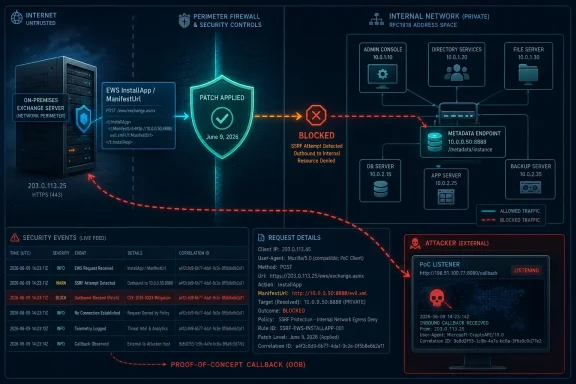 Exchange Once Again Becomes the Best Seat in the Network
Exchange has always been a strange sort of perimeter system. It is exposed enough to accept traffic from the outside world, privileged enough to talk to domain infrastructure, and trusted enough that defenders often treat its outbound behavior as ordinary background noise. That combination is precisely why even a “medium” flaw in Exchange deserves more attention than a higher-scored bug in a less central application.CVE-2026-45502 sits in Exchange Web Services, the older but still important API surface used by clients, integrations, mailbox automation, and administrative tooling. The reported vulnerable path involves an authenticated EWS
InstallApp SOAP request that supplies a ManifestUrl. Exchange then fetches that manifest, and in vulnerable on-premises builds the protection intended to stop unsafe internal fetches can be bypassed.That makes the vulnerability a server-side request forgery, or SSRF. The attacker does not directly connect to an internal target. Instead, the attacker persuades Exchange to do it on their behalf. If the victim server can reach an internal management panel, a cloud metadata endpoint, a monitoring API, or a service bound to a private address, the attacker may be able to use Exchange as the messenger.
This is why SSRF bugs tend to be underrated until they are chained. By themselves, they often leak only partial information. In the right network, they become a bridge between a low-privileged account and systems never meant to be reachable from the internet.
The Design Bug Is More Interesting Than the Score
The most revealing detail in the public write-up is not the HTTP callback itself. It is the conditional logic reportedly guarding the request. According to the proof-of-concept analysis, the intranet URL validation path was gated on anisBposUser flag, a cloud-oriented branch associated with Microsoft 365-hosted users rather than on-premises Exchange users.That distinction matters because on-premises Exchange is exactly where SSRF risk is most consequential. A Microsoft 365-hosted service runs inside Microsoft’s managed environment, where the vendor controls the service fabric and can enforce platform-level network rules. An on-premises Exchange server, by contrast, may live in a flat corporate network, a hybrid identity environment, or a half-modernized datacenter where old assumptions survive because the mail still flows.
The alleged vulnerable condition is stark: if validation only happens when
isBposUser is true, and on-premises deployments set it false, then the check short-circuits before Exchange evaluates whether the URL points somewhere unsafe. That is not merely a missing blocklist entry. It is a policy decision accidentally scoped away from the customers who needed it most.This is a familiar pattern in mature enterprise software. Cloud code paths receive stronger, newer, more centralized protections, while on-premises code paths carry decades of compatibility sediment. The product keeps working, but the assumptions drift. When attackers find the seam, the seam becomes the vulnerability.
A Public PoC Turns a Patched Bug Into a Measurable Exposure
The proof-of-concept published by an Aretiq AI researcher reportedly starts a local HTTP listener, sends a crafted EWSInstallApp request, and waits for the Exchange server to call back. On a vulnerable system, the server makes an HTTP GET request to the attacker-controlled URL and appends a correlation identifier. The exploit does not require administrative control of Exchange; it requires valid mailbox credentials and network access to EWS over HTTPS.That is a lower bar than many organizations would like to admit. Mailbox credentials are among the most frequently phished, reused, sprayed, and traded credentials in enterprise environments. Multi-factor authentication reduces the blast radius for interactive sign-in, but EWS exposure, legacy client exceptions, app passwords, and service-account habits can complicate the picture.
The public PoC is also useful to defenders, which is the uncomfortable bargain of exploit publication. Administrators can reproduce the behavior in a controlled lab, validate that the patch is effective, and tune detections around the request pattern. But attackers get the same gift. They no longer need to reverse-engineer the June update or infer the vulnerable code path from advisory language.
The saving grace is that this is not a pre-authentication remote code execution chain. It is blind or semi-blind SSRF, and Microsoft’s CVSS 3.1 score of 5.0 reflects limited confidentiality impact without direct integrity or availability impact. Still, CVSS is a poor narrator for infrastructure risk. A medium bug on a server with privileged network placement may be more operationally important than a critical bug trapped behind multiple compensating controls.
The Attack Is Not Loud, but the Network May Answer
The public test case confirms exploitation by watching for a callback. In a real environment, an attacker would not stop there. They would use Exchange’s network position to learn what it can reach, how quickly internal addresses respond, and whether sensitive services reveal useful metadata through status codes, timing, redirects, or small differences in error behavior.That reconnaissance can be valuable even when response bodies are not fully exposed. Attackers can test RFC1918 ranges, probe common service ports through URL schemes and timing, and look for endpoints that behave differently from dead space. Internal topology is intelligence, and Exchange may provide it from a location that bypasses external firewalls.
The cloud metadata example is especially important because SSRF has a long history of becoming serious when servers can reach link-local metadata endpoints. In AWS, the canonical address is
169.254.169.254, and other cloud platforms have their own metadata services and protections. Modern metadata services are harder to abuse than older ones, but “harder” is not “impossible,” particularly in hybrid estates with inconsistent instance settings.Internal REST APIs and management surfaces are another concern. Many administrative tools assume that requests from inside the network are more trustworthy than requests from the internet. If Exchange can reach those tools, the security model becomes dependent on whether those services authenticate every request properly and reject unexpected methods, headers, and paths.
Authentication Is a Speed Bump, Not a Wall
Microsoft’s advisory language places the bug in the authenticated-attacker category. That is meaningful, but it should not lull anyone into complacency. Exchange vulnerabilities often become more dangerous because the first step in an intrusion is not exploiting Exchange; it is acquiring a mailbox.In many organizations, mailbox access is the easiest foothold to buy, phish, or obtain through password reuse. Once an attacker has that account, a bug like CVE-2026-45502 may let them ask a different question: what can the Exchange server see that the compromised user cannot? That shift from user context to server network context is the entire point of SSRF.
The privilege requirement also raises a monitoring challenge. A malicious EWS request may arrive under a real user account, from an IP address that has already passed whatever access policy allowed the credential to be used. If EWS is broadly available, defenders may need to distinguish ordinary application traffic from unusual
InstallApp behavior rather than simply block anonymous probes.This is where logs matter. Organizations should look for anomalous EWS
InstallApp requests, suspicious ManifestUrl values, outbound HTTP attempts from Exchange to unexpected internal or external destinations, and callbacks containing correlation parameters associated with manifest retrieval. The investigation should not be limited to the day the PoC was published; Microsoft patched the bug on June 9, and capable attackers often study patches before public exploit code appears.The Patch Says Microsoft Understood the Architectural Mistake
Microsoft addressed CVE-2026-45502 in the June 2026 Exchange security updates. The fix reportedly replaces the single cloud-gated check with a two-tier validation model using new feature flags,ManifestUrlValidation and ManifestUrlCheck, enabled by default. More importantly, the patched behavior enforces a URL allowlist rather than trusting the broad shape of the request.That is the right direction. SSRF defenses based on string checks, partial internal-address detection, or deployment-type assumptions tend to age badly. Allowlisting is less convenient, but it matches the narrow business purpose of an app manifest fetch: Exchange does not need to retrieve arbitrary resources from anywhere on the internet or inside the LAN merely because a user supplied a URL.
The reported default allowlist includes Microsoft’s Office client endpoint and administrator-configured entries. That trade-off gives organizations a migration path for legitimate add-in workflows without preserving the open-ended fetch primitive. It also moves the conversation from “which destinations are dangerous?” to “which destinations are actually required?”
The fixed build numbers are concrete and worth checking directly in every Exchange estate. Exchange Server 2016 CU23 is fixed at 15.01.2507.069, Exchange Server 2019 CU14 at 15.02.1544.041, Exchange Server 2019 CU15 at 15.02.1748.046, and Exchange Server Subscription Edition RTM at 15.02.2562.043. If servers are below those levels, they should be treated as vulnerable unless another compensating control demonstrably blocks the exploit path.
ESU Turns Old Exchange Into a Licensing and Risk Conversation
There is another uncomfortable layer here: the June 2026 Exchange security updates are available for Exchange Server Subscription Edition and, for Exchange 2016 and 2019, through Microsoft’s Extended Security Updates program. That means patch availability is now tangled with lifecycle status, ESU enrollment, and the long tail of organizations still running legacy Exchange because migrations are hard.This is not merely a paperwork problem. Exchange is often the last large on-premises Microsoft server product that an organization cannot easily turn off. It may support hybrid mail flow, relay devices, compliance journaling, legacy applications, scanners, line-of-business integrations, or administrative workflows that were never redesigned for a cloud-first world.
As a result, some organizations will look at a Medium CVSS score and postpone the update. Others may be unable to patch quickly because of ESU eligibility, change windows, or fragile customizations. That delay is exactly what public PoC releases punish. Once exploit mechanics are known, the exposure window becomes less theoretical.
The lesson is not that every company must instantly abandon on-premises Exchange. The lesson is that on-premises Exchange must be treated as a high-value, high-connectivity security boundary. If it cannot be patched promptly, it needs stricter network egress controls, narrower EWS exposure, better identity enforcement, and more aggressive logging than many deployments historically received.
Egress Filtering Is the Control Everyone Wishes They Had Already Deployed
SSRF defense should not depend solely on application patches. A well-segmented network can limit what Exchange is able to reach, even if an application-layer bug survives. That is the unglamorous control most likely to reduce the practical impact of CVE-2026-45502 and the next SSRF flaw.Exchange servers need outbound access for specific purposes: mail delivery, DNS, certificate validation, update retrieval, hybrid connectivity, monitoring, and approved integrations. They do not usually need arbitrary HTTP access to internal management networks, cloud metadata endpoints, storage appliances, router interfaces, or application admin consoles. If the server can reach those places today, CVE-2026-45502 is a reminder to ask why.
The hard part is that Exchange deployments often grew organically. Firewall rules may have been added during migrations and never removed. Service accounts may have been granted broad access because a business process broke at 2 a.m. Internal tools may trust the mail server because “it’s inside.” SSRF turns those conveniences into attack surface.
A practical response starts with observing outbound traffic from Exchange before cutting too aggressively. Baseline the destinations, identify legitimate dependencies, then deny the rest. In mature environments, this becomes a default-deny egress model for Exchange. In less mature ones, even blocking access to known sensitive internal ranges and metadata endpoints is a meaningful improvement.
EWS Is Legacy, but Legacy Does Not Mean Optional
Exchange Web Services occupies an awkward place in the Microsoft ecosystem. Microsoft has spent years pushing developers toward Microsoft Graph for cloud scenarios, but EWS remains embedded in on-premises Exchange operations and older integrations. That makes it a classic enterprise legacy surface: less fashionable, still widely used, and often difficult to disable outright.For administrators, the question is not simply whether EWS is enabled. It is who can use it, from where, and for what. If every mailbox can reach EWS from broad network locations, the blast radius of any authenticated EWS bug is larger. If EWS access is constrained through client access rules, conditional access equivalents, reverse proxy policy, or network segmentation, the exploit path narrows.
The
InstallApp angle is also worth reviewing. Many users do not need to install apps through EWS-driven manifest retrieval. Where possible, administrators should restrict app installation workflows, centralize add-in deployment, and monitor for manifest URLs that point outside expected domains. The patch’s allowlist model is a product-level version of the same principle: users should not be able to turn Exchange into a general-purpose fetcher.This is especially relevant for organizations that have treated Exchange as boring infrastructure after years of emergency patching fatigue. The biggest Exchange bugs of the early 2020s trained defenders to look for web shells and pre-auth chains. CVE-2026-45502 is subtler. It asks whether the boring, authenticated, logged-in parts of Exchange still expose too much power.
The Medium Rating Hides a Very Exchange-Specific Risk
Microsoft’s CVSS 3.1 vector for CVE-2026-45502 describes a network-exploitable, low-complexity flaw requiring low privileges and no user interaction, with changed scope and limited confidentiality impact. That produces a 5.0 Medium. An independent CVSS 4.0 assessment cited in the public report lands lower, at 2.3, reflecting the blind or semi-blind nature of the bug.Both scores can be true and still incomplete. CVSS is designed to standardize severity, not to model an organization’s internal network topology. It does not know whether an Exchange server sits beside domain controllers, whether internal admin tools lack strong authentication, whether cloud metadata protections are configured, or whether egress filtering exists.
In other words, the vulnerability’s generic severity is medium; its local severity depends on architecture. In a segmented environment with patched Exchange, tight EWS controls, default-deny egress, and modern metadata defenses, exploitation may produce little more than a logged anomaly. In a flat network with broad outbound access and weak internal service assumptions, it may become reconnaissance infrastructure.
That distinction matters for prioritization. Security teams drowning in June 2026 Patch Tuesday work may be tempted to sort strictly by CVSS. For Exchange, that is risky. The product’s placement in the network should raise the priority of bugs that create new ways to pivot, probe, or impersonate trusted internal traffic.
Detection Should Look for Behavior, Not Just Exploit Strings
The public PoC gives defenders some obvious indicators, including EWSInstallApp requests containing suspicious ManifestUrl values and callback paths using a marker string. Those are useful starting points, but they are not enough. The first thing competent attackers change is the string that says “SSRF confirmed.”Better detection focuses on behavior. Exchange should not commonly initiate HTTP requests to random hosts immediately after unusual EWS app-install requests. It should not reach link-local metadata addresses. It should not probe private IP ranges or internal management ports in patterns that resemble scanning. It should not suddenly generate outbound web traffic to infrastructure unrelated to mail, hybrid identity, certificate validation, or approved add-ins.
Correlating inbound and outbound events is particularly valuable. If an authenticated EWS request arrives from a user account and the Exchange server then makes an outbound HTTP request to a host embedded in that request, the sequence is more important than either event alone. Proxy, firewall, EDR, IIS, and Exchange logs each hold part of that story.
Organizations should also review failed and noisy attempts. The public test reportedly returned an EWS HTTP 200 with an internal error response while the callback still succeeded. That means defenders cannot assume that application-level errors imply failed exploitation. A request can look broken to the attacker-facing API and still cause the server-side fetch that matters.
The Operational Response Is Patch, Prove, and Constrain
The immediate fix is straightforward: install the June 2026 Exchange security update corresponding to the deployed version, verify the build number, and confirm that the manifest URL validation behavior is in place. For Exchange 2016 and 2019, organizations must also confront the ESU reality if they are still depending on those versions. A server that cannot receive current security updates is not a stable platform for internet-facing mail.After patching, administrators should test deliberately rather than assume success. A controlled reproduction against a lab or maintenance-window system can confirm that arbitrary manifest URLs no longer trigger outbound callbacks. That kind of proof is useful for change records, incident review, and leadership conversations about why Exchange patching remains a recurring emergency.
Then comes constraint. If EWS is exposed broadly, narrow it. If users can install arbitrary add-ins, revisit that policy. If Exchange has broad outbound HTTP access, reduce it. If internal services trust traffic merely because it originates from Exchange, fix the internal services rather than hoping no SSRF bug appears again.
The strategic response is to reduce the number of things an Exchange server can see. That sounds obvious, but it runs against years of enterprise convenience. Mail servers have often been allowed to reach “whatever they need” because nobody wanted to break mail. The problem is that attackers like “whatever they need” too.
The June Patch Is Now a Boundary Test for Every On-Prem Mail Estate
The concrete action items are not exotic, but they are time-sensitive. The publication of a PoC means defenders should treat vulnerable Exchange servers as discoverable, testable targets rather than abstract entries in a vulnerability database.- Organizations should install the June 9, 2026 Exchange security update and verify that every server is at or above the fixed build for its supported version.
- Security teams should audit EWS logs for unusual
InstallApprequests, especially those containing external, private-address, link-local, or otherwise unexpected manifest URLs. - Network teams should review outbound HTTP and HTTPS access from Exchange servers and block unnecessary reachability to internal management networks and cloud metadata endpoints.
- Administrators should restrict app installation and add-in manifest workflows to approved sources rather than allowing arbitrary user-supplied URLs.
- Incident responders should correlate inbound EWS activity with outbound connections from Exchange, because an API error response does not necessarily mean the server-side request failed.
- Organizations still running Exchange 2016 or 2019 should confirm ESU coverage or accelerate migration plans, because patch access has become part of the security boundary.
References
- Primary source: cyberpress.org
Published: 2026-06-24T10:43:07.584565
- Related coverage: messageware.com
Patch Tuesday: Exchange Server Security Updates for June 2026 - Messageware
Microsoft released June 2026 Exchange Server security updates addressing CVE-2026-42897, a critical Outlook Web Access vulnerability.www.messageware.com - Official source: techcommunity.microsoft.com
Released: June 2026 Exchange Server Security Updates | Microsoft Community Hub
We have released Security Updates for Exchange Server SE. Exchange Server 2019 and 2016 ESU updates only.   techcommunity.microsoft.com
- Official source: support.microsoft.com
- Related coverage: windowsforum.com
June 2026 Exchange Security Updates: ESU Gate, CVE-2026-42897, and OWA Mitigations | Windows Forum
Microsoft released June 2026 Security Updates for Exchange Server Subscription Edition, plus ESU-only updates for Exchange Server 2019 CU14/CU15 and...windowsforum.com - Official source: microsoft.com

- Related coverage: ncsc.gov.ie
