

Microsoft Turns a Hotfix Into a Migration Signal
The interesting thing about this hotfix is not that it is a hotfix. Exchange administrators have learned, often the hard way, to treat every Exchange update as a small operational event: inventory the estate, check build levels, read the release notes, prepare the maintenance window, reboot, verify services, and then hold their breath just long enough to confirm transport and client access behave as expected.
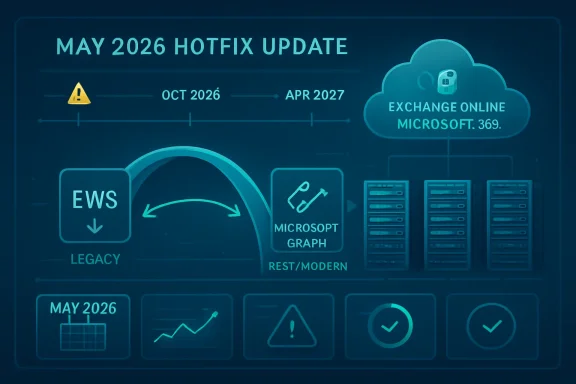
What makes the May 2026 HU different is that it carries a strategic message inside a maintenance wrapper. Microsoft is using an optional, non-security update to introduce functionality that changes how Exchange Server SE talks to Exchange Online in hybrid rich coexistence scenarios. The shift is from EWS, the venerable API that underpinned years of Exchange integration, to REST-based Microsoft Graph API calls.
That may sound like plumbing. In practice, plumbing is exactly where enterprise risk lives. Hybrid Exchange has long been the compromise architecture for organizations that cannot, will not, or should not move every mailbox to the cloud in one sweep. It lets the old world and the new world share free/busy lookups, mailbox moves, management flows, and coexistence behaviors that users mostly notice only when they break.
Microsoft’s message is therefore blunt beneath the polite release language: if your hybrid deployment depends on rich coexistence, the future path now runs through Exchange Server SE and Graph. Exchange 2016 and Exchange 2019 are not invited.
EWS Is Not Dying Everywhere, But It Is Dying Where Hybrid Needs It Most
Exchange Web Services has had one of those long enterprise afterlives that makes platform retirement so difficult. Introduced in the Exchange Server 2007 era, EWS became a dependable abstraction layer for mailbox data, calendaring, applications, migration tools, backup tools, archiving systems, mobile workflows, and a generation of bespoke integrations written by people who have since changed jobs twice.
Microsoft has been warning for years that EWS in Exchange Online would not remain the preferred API surface. Graph is the company’s strategic API layer for Microsoft 365, and the architectural direction has been obvious: one cloud API, modern authentication, tighter app consent, and a security model that fits the way Microsoft now wants tenants to be administered. The May 2026 Exchange Server SE hotfix brings that transition into the on-prem hybrid lane.
The nuance matters. Microsoft is not saying that EWS disappears from every on-premises Exchange Server installation overnight. The company’s target here is the hybrid path where Exchange Server reaches into Exchange Online for rich coexistence. That is exactly the place where Microsoft has the strongest incentive to reduce legacy protocol exposure and the most leverage to force modernization.
For administrators, this distinction is both comforting and dangerous. It is comforting because not every internal EWS-dependent process breaks simply because Microsoft has a cloud retirement date. It is dangerous because hybrid coexistence is often treated as background infrastructure until a mailbox migration, calendar lookup, or cross-premises workflow fails in front of executives.
The Calendar Is Now the Product Roadmap
Microsoft’s schedule gives this release its force. EWS access in Exchange Online begins its serious disablement phase in October 2026, while April 2027 is the harder endpoint for the cloud-side retirement that matters to hybrid coexistence. The May 2026 HU is therefore not urgent in the narrow security sense, but it is urgent in the project-management sense.
That distinction is easy to miss in Exchange shops accustomed to triaging updates by CVE severity. A security update with active exploitation gets an emergency bridge call. A hotfix with new functionality can get pushed into the next maintenance cycle, then the next quarter, then the mythical “after the migration” window. Microsoft is betting that administrators will understand that this hotfix is part of the migration, not a detour from it.
The calendar also exposes a familiar enterprise contradiction. Microsoft’s cloud moves quickly and deprecates old interfaces aggressively; on-premises environments move slowly because they are entangled with identity, compliance, regional data requirements, line-of-business applications, and organizational politics. Hybrid Exchange exists precisely because the real world is not as clean as a cloud architecture diagram.
The May 2026 hotfix does not solve that contradiction. It narrows the available escape routes. If you want rich hybrid coexistence to survive the EWS retirement, you need Exchange Server SE and the Graph-based hybrid model. If you are still depending on Exchange 2016 or Exchange 2019 servers to host on-premises mailboxes, Microsoft’s guidance is no longer a nudge. It is a countdown.
Exchange 2016 and 2019 Have Become the Wrong Side of the Line
The harshest part of Microsoft’s announcement is reserved for customers still running Exchange 2016 or Exchange 2019. Those versions are out of support, and Microsoft says it will not release updates for them that enable Graph API hybrid calls. Even updates made available under Extended Security Update arrangements do not change that.
This is a critical separation between security maintenance and platform evolution. ESU-style coverage may buy time against certain vulnerabilities, but it does not buy entry into the new hybrid architecture. Organizations that believed extended security coverage would preserve operational parity with supported Exchange should read the May 2026 hotfix announcement as a correction.
Microsoft’s position is predictable and defensible from a product lifecycle standpoint. Exchange 2016 and 2019 had their time, and the company wants customers on Exchange Server SE if they remain on-premises. But predictability does not make the operational reality easier for organizations that upgraded to Exchange 2019 relatively late, sometimes precisely because Exchange SE required a supported stepping stone.
The result is a narrow and uncomfortable runway. Customers still hosting mailboxes on Exchange 2016 or 2019 must keep allowing EWS use in their tenant past October 2026 if they want hybrid rich coexistence to keep working temporarily. But by April 2027, when EWS is disabled in Exchange Online, those rich coexistence features will permanently stop working on unsupported versions.
That is the real headline for many WindowsForum readers. The May 2026 HU is not just a feature update for Exchange SE. It is the moment Microsoft formally ties hybrid survivability to the supported subscription-era Exchange codebase.
Optional Does Not Mean Irrelevant
Microsoft calls the May 2026 HU optional, and in a narrow servicing sense, that is true. It contains no new Exchange Server security updates. It is not being pushed through Microsoft Update. Administrators who want it must obtain it from the Download Center, and its contents will be included in future Exchange Server SE updates.
That optional label may be technically accurate, but it undersells the update’s importance. Optional updates can still be strategically mandatory when they unlock migration paths, reduce future disruption, or allow administrators to test new behavior before the deadline arrives. In this case, installing the HU is less about immediate protection than about gaining time to validate Graph-based coexistence before EWS retirement becomes a production incident.
The history of Exchange patching gives administrators good reason to be cautious. Exchange updates are cumulative, but they are not casual. A failed setup can leave services disabled, version mismatches can create confusing symptoms, and a reboot that was supposed to be routine can become the start of a long evening. Microsoft’s own guidance points administrators back to the Health Checker script, the Exchange Update Wizard, SetupAssist, and failed-update recovery documentation for a reason.
Still, caution should not become paralysis. The organizations that wait for the final cumulative update before touching this functionality will compress testing, troubleshooting, change approval, vendor coordination, and user-impact analysis into a smaller and riskier window. Exchange administrators should know better than anyone that “we’ll do it later” is not a plan; it is a future outage wearing a calendar reminder.
Graph Is the Future, But It Is Not a Drop-In Replacement for Every Habit
Microsoft Graph is the obvious destination for Exchange Online and Microsoft 365 integration. It offers a modern REST surface, aligns with Azure identity, supports granular permissions, and fits the broader Microsoft cloud management model. From Microsoft’s point of view, consolidating integrations around Graph is cleaner than preserving EWS indefinitely.
But enterprise administrators do not live in the abstract. They live with scripts, service accounts, vendor agents, custom middleware, old migration utilities, compliance tooling, and application owners who describe a dependency as “just email” until someone inspects the logs. EWS is not merely an API; it is an ecosystem of assumptions.
The Exchange SE hybrid change is narrower than a full EWS application migration, but it sits inside that wider upheaval. Organizations must separate their dependencies into categories: what Exchange Server uses for hybrid rich coexistence, what third-party applications use against Exchange Online, what internal tools use against on-premises mailboxes, and what old workflows nobody remembers until a disablement test breaks them.
That inventory work is tedious, but it is where success will be decided. The technology change from EWS to Graph is only the visible layer. Beneath it are app registrations, permissions, tenant policies, allow lists, certificate handling, OAuth configuration, delegated versus application permissions, vendor readiness, and the politics of telling a business unit that its decade-old mailbox integration needs a rewrite.
Microsoft’s hotfix gives Exchange SE administrators a supported bridge for hybrid coexistence. It does not magically modernize every surrounding dependency. Anyone treating Graph migration as a checkbox will discover that the checkbox has submenus.
The Dedicated Hybrid App Is Microsoft’s New Trust Boundary
The Graph transition is not only about swapping one API for another. Microsoft’s related hybrid security changes push organizations toward a dedicated Exchange hybrid application model, replacing older trust patterns that were more acceptable in a different era of cloud identity. That makes the May 2026 HU part of a larger redesign of how Exchange Server is allowed to authenticate and operate across the on-premises/cloud boundary.
This matters because hybrid Exchange has always been a privileged creature. It sits near identity, mail routing, administrative control, and mailbox data. A compromised or over-permissioned hybrid path is not just another application risk; it is a route into sensitive communications and tenant-level operations.
By moving to Graph API calls and a dedicated app model, Microsoft can bring hybrid Exchange closer to the permissioning, auditing, and conditional control structures used elsewhere in Microsoft 365. That is good security architecture in principle. It also means administrators must understand the app as a first-class security object, not as a wizard-generated artifact to be forgotten after setup.
The dedicated hybrid app should be documented, monitored, and owned. Its permissions should be reviewed. Its credentials or certificates should be tracked. Its role in the tenant should be clear enough that a future administrator can distinguish it from the graveyard of old enterprise applications that accumulates in many Entra ID tenants.
This is where Microsoft’s security argument is strongest. Legacy protocols and broad trust relationships are difficult to defend in a threat environment where identity abuse is often the shortest path to impact. But the operational burden still lands on customers, and customers will need more than a successful setup wizard to prove the new trust model is working as intended.
The Supported Path Is Clearer Than the Human Path
On paper, the supported path is simple. Inventory Exchange servers. Bring Exchange Server SE current. Install the relevant cumulative update and hotfix or a later update containing the same functionality. Deploy the dedicated hybrid app. Switch rich coexistence from EWS to Graph. Re-run health checks. Validate services. Remove or constrain legacy EWS exposure where possible.
In reality, each sentence in that plan can expand into weeks. Some organizations still have Exchange servers whose main documented function is “recipient management,” only to discover they also host arbitration mailboxes, public folder remnants, relay connectors, certificate dependencies, or hybrid configuration objects nobody has touched since the last migration. Others have compliance rules that make mailbox movement politically harder than technically hard.
Exchange also tends to be owned by teams that have spent the last decade being told their platform is transitional. That creates a strange incentive problem. Leadership wants to avoid investing in on-prem Exchange because the strategic direction is cloud. But the same leadership still expects hybrid coexistence to work flawlessly until the last dependency is gone.
The May 2026 HU is a reminder that transitional systems require active maintenance. Hybrid Exchange is not a museum exhibit. It is production infrastructure, and Microsoft is changing the terms under which that infrastructure can safely connect to Exchange Online.
For IT pros, the argument to management should be concrete: this is not a vanity upgrade, and it is not merely “keeping Exchange current.” It is preserving coexistence functionality through a Microsoft-imposed API transition with known enforcement dates. If the organization needs hybrid Exchange after October 2026, it needs project time before October 2026.
The Risk Is Not the Hotfix; It Is the Deferred Decision
Administrators naturally worry about installing Exchange updates because Exchange updates have consequences. That caution is rational. But with this release, the greater risk may be delaying the organizational decision around Exchange SE and Graph readiness.
A shop that is already on Exchange Server SE can treat the HU as an opportunity to begin controlled testing. That means lab validation, pilot servers, health checks before and after, careful review of hybrid configuration, and coordination with identity administrators. The work is not trivial, but the path is visible.
A shop still on Exchange 2016 or 2019 has a more fundamental problem. It cannot simply install this functionality. It must decide whether to upgrade to Exchange SE, complete a migration away from on-prem mailboxes, or accept that rich coexistence will degrade and then stop as EWS disappears from Exchange Online. None of those decisions gets easier if postponed.
The most dangerous organizations are the ones that assume their current hybrid state is static. Exchange hybrid is a negotiated relationship with a cloud service Microsoft controls. When Microsoft retires a cloud API, the on-premises side does not get to vote. It only gets to prepare.
That is why the word “optional” deserves skepticism. The HU is optional in the way an early boarding call is optional. You may not need to stand up immediately, but the plane is still leaving.
The Real Work Starts Before the Maintenance Window
The practical response to the May 2026 HU should start with discovery, not installation. Administrators need to know which Exchange servers exist, what versions they run, which roles and workloads they carry, and whether any unsupported servers still host mailboxes or hybrid-critical components. The Health Checker script is not busywork; it is the baseline for every decision that follows.
The next layer is tenant-side dependency mapping. Which applications still use EWS against Exchange Online? Which vendors have Graph-ready versions? Which internal tools authenticate as legacy service accounts? Which workflows can tolerate interruption, and which will trigger a business escalation after five minutes of failure? The hybrid coexistence change is one part of a broader EWS retirement exercise, and the two should not be managed in isolation.
Change management also needs to account for timing. If the organization wants to use Microsoft’s temporary EWS allow-listing approach to survive the October 2026 disablement phase, that must be configured deliberately rather than discovered after the switch flips. But allow-listing is a bridge, not a destination. April 2027 remains the date that matters for permanent Exchange Online EWS retirement.
Exchange SE adoption should be treated as the supported foundation for any organization retaining on-prem mailboxes. If that statement is politically inconvenient, it is still technically true. Microsoft has drawn the line: Graph-based hybrid coexistence is for Exchange SE, not for Exchange 2016 or 2019.
The May 2026 hotfix therefore belongs in both the patch calendar and the migration plan. If it appears only in the patch calendar, the organization may install bits without changing its posture. If it appears only in the migration plan, the organization may discuss architecture until the deadline becomes uncomfortably close. It needs to be in both places.
Exchange Admins Get a Countdown, Not a Crisis
The useful way to read Microsoft’s announcement is as a countdown that still leaves room for competent execution. The dates are close enough to matter, but not so close that every organization must panic. The advantage belongs to teams that turn the hotfix into a forcing function now rather than a postmortem topic later.
- The May 2026 Exchange Server SE Hotfix Update is optional and non-security, but it introduces functionality needed to begin moving supported hybrid rich coexistence from EWS to Microsoft Graph.
- Exchange 2016 and Exchange 2019 do not receive the new Graph-based hybrid coexistence functionality, even through extended security update channels.
- Organizations still hosting on-premises mailboxes on unsupported Exchange versions need an Exchange SE upgrade plan before the April 2027 Exchange Online EWS cutoff breaks rich coexistence permanently.
- The October 2026 EWS disablement phase should be treated as an operational deadline, not as the start of planning.
- Installing the hotfix is only one step; administrators also need dependency discovery, dedicated hybrid app deployment, health checks, service validation, and vendor readiness tracking.
- The safest organizations will use the optional HU to test early, document the new trust model, and reduce EWS exposure before Microsoft’s cloud-side enforcement removes the old path.
The May 2026 HU is not dramatic in the way Exchange security emergencies are dramatic, and that may be precisely why it deserves attention. Microsoft is giving hybrid customers a supported route from the EWS era into the Graph era, but it is also making clear that unsupported Exchange servers will not be carried across that bridge. For administrators, the work now is to turn a seemingly modest hotfix into a disciplined migration program, because by the time EWS finally disappears from Exchange Online, the only acceptable surprise will be how little users noticed.
References
- Released: May 2026 Exchange Server Hotfix Update | Microsoft Community Hub Microsoft Exchange Team Blog