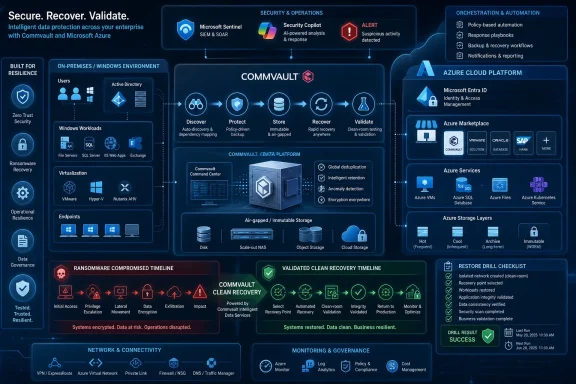
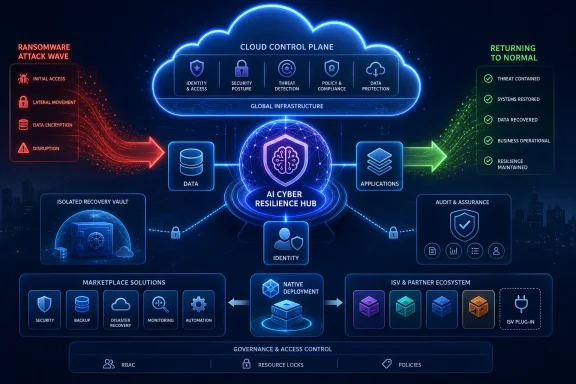
Commvault and Microsoft announced on June 24, 2026, that Microsoft will offer Commvault’s AI-powered cyber resilience technology as a native independent software vendor service inside Microsoft Azure for enterprise customers. The move is not just another marketplace listing with friendlier billing. It is a wager that backup, recovery, identity restoration, and incident response are becoming part of the cloud control plane itself. For Windows and Microsoft 365 administrators, that changes both the promise and the risk model of resilience.
The traditional backup pitch was built on distance. Keep a clean copy somewhere else, protect it from whatever breaks production, and restore when the primary environment fails. That logic still matters, but it is increasingly strained by the way enterprises now run Microsoft 365, Entra ID, Azure virtual machines, Kubernetes, databases, and SaaS workflows across the same identity and automation fabric.
Commvault’s new Azure-native positioning pushes recovery in the opposite direction: closer to the place where systems are deployed, billed, governed, and monitored. Microsoft says Azure customers will be able to discover, provision, and integrate Commvault’s resilience capabilities directly from the Azure platform, with a unified experience across procurement, onboarding, and operations. That is the real news. The point is not simply that Commvault runs well on Azure; it is that Microsoft is making Commvault look and feel more like part of Azure.
For IT teams, that is appealing because the friction around resilience is often worse than the technology itself. Backup products fail politically before they fail technically: they require separate procurement, separate agents, separate consoles, separate storage planning, and separate teams to agree on what “recoverable” means. A native Azure ISV service is designed to collapse some of that overhead into the same environment administrators already use to deploy workloads.
But the proximity cuts both ways. If cyber recovery becomes a native cloud service, then cloud governance becomes recovery governance. A misconfigured tenant, an overprivileged service principal, a weak change-control process, or a compromised administrator account can now affect not just production workloads, but the machinery meant to bring them back.
A modern ransomware or destructive intrusion does not merely encrypt files. It disables security tools, tampers with retention policies, changes mailbox rules, abuses OAuth grants, creates persistence in Entra ID, and targets backup systems because attackers understand the restoration chain. The difference between a bad incident and an existential one is often whether an organization can prove that its identities, administrative roles, and recovery points are still trustworthy.
That is why Commvault has spent the last few years rebranding itself away from the old backup-and-restore category and toward cyber resilience. The phrase is marketing, but it reflects a genuine shift. Enterprises no longer want only a copy of yesterday’s data; they want a way to determine whether yesterday’s data, yesterday’s identities, and yesterday’s configuration state are clean enough to reintroduce into production.
Microsoft has been moving in the same direction from the other side. Sentinel, Defender, Security Copilot, Entra, Purview, and Azure’s native governance stack all push customers toward an integrated security operations model. Commvault’s closer Azure tie-up fits that pattern: detection, investigation, and recovery are being pulled into a common operational story, even if they remain separate products under the hood.
For Windows administrators, this means the familiar disaster-recovery checklist is no longer enough. Recovering a domain controller, an Azure VM, or a Microsoft 365 mailbox is only part of the problem. The harder question is whether the restored environment is free of the tokens, secrets, app registrations, delegated permissions, and malicious configuration changes that allowed the incident to spread in the first place.
That matters because large organizations increasingly treat Azure as a procurement boundary. If a product can be bought through existing Azure commitments, governed through existing subscriptions, and deployed through familiar role-based access controls, it clears hurdles that might otherwise delay or kill a project. The security team may still evaluate the vendor, but the business machinery becomes simpler.
Commvault benefits from that simplification. Microsoft benefits because every resilience workload that lands inside Azure reinforces Azure as the default enterprise operating environment. Customers benefit if the integration reduces deployment time and gives administrators better visibility into protected workloads. Nobody in this arrangement is being purely altruistic.
This is the cloud platform playbook at its most mature. First the hyperscaler provides infrastructure. Then it provides the marketplace. Then it provides the identity layer, billing layer, policy layer, and operational layer through which third-party tools become easier to consume than external alternatives. The customer experiences it as convenience; the platform experiences it as gravity.
That gravity is powerful. It is also worth scrutinizing. A native service can reduce friction, but it can also encourage monoculture. If the same provider increasingly mediates production, security telemetry, AI assistance, procurement, and recovery operations, enterprise risk becomes concentrated in fewer administrative and contractual systems.
The timing still matters. Commvault operates in a market where the old backup category has been squeezed from every direction. Hyperscalers offer native snapshots and backup services. SaaS vendors increasingly promise their own retention and recovery features. Security vendors want recovery workflows tied to detection. Meanwhile, ransomware has made boards and regulators ask uncomfortable questions about whether “we have backups” means anything in practice.
Commvault’s answer is to move up the stack. It wants to be the resilience layer across cloud, SaaS, identity, and AI-era operations. Azure-native distribution gives that pitch a much larger shop window and lowers the operational barrier for customers already committed to Microsoft’s cloud.
Microsoft, meanwhile, gets a partner that fills gaps Microsoft has not fully closed with its own native services. Microsoft has backup and recovery products, but enterprise recovery is messy, heterogeneous, and politically sensitive. Many customers need support for hybrid estates, legacy workloads, compliance-heavy retention, and operational workflows that do not fit neatly into first-party tooling. A partner like Commvault gives Microsoft a stronger answer without forcing Redmond to own every edge case.
That is why the deal is strategically useful to both sides. Commvault gets Azure’s distribution and credibility. Microsoft gets to strengthen Azure’s resilience story while preserving the ecosystem argument that customers still have choice.
That does not make the Azure-native service a bad idea. It does make the security model more important than the marketing model. A resilience provider is not just another SaaS vendor; it holds privileged pathways into the systems customers need when everything else is on fire. If those pathways are compromised, the impact can extend beyond one console or one dataset.
This is the central paradox of cyber resilience platforms. They must be powerful enough to restore critical systems quickly, which means they often need deep access to workloads, identities, APIs, and storage. But the more powerful they are, the more attractive they become as targets. The backup platform has evolved from a sleepy insurance policy into a high-value control plane.
Microsoft’s involvement can improve that equation if the native service enforces stronger identity boundaries, cleaner provisioning, better monitoring, and more consistent governance than customers would build manually. It can worsen the equation if convenience leads organizations to approve broad permissions without understanding the blast radius. The difference will be in implementation, not announcement language.
For sysadmins and security architects, the lesson is blunt: do not outsource skepticism to the word “native.” Native integration should trigger more review, not less, because it often means the product has more direct access to tenant resources.
Recovery is now being pulled into that same acceleration loop. The old model assumed humans would inspect logs, decide which systems were affected, pick a restore point, rebuild infrastructure, and validate the result. In a major incident, that process can take days or weeks. A modern resilience platform promises to compress that timeline by identifying clean restore points, mapping impacted systems, and guiding recovery across data and identity layers.
That promise is valuable, but it comes with a new governance problem. If AI-assisted tools can recommend or automate recovery actions, then organizations need to know what evidence the system used, what assumptions it made, and where human approval is required. A fast wrong recovery can be worse than a slow correct one, especially if it reintroduces compromised identities or rolls systems back into a vulnerable state.
Microsoft’s Security Copilot strategy has conditioned customers to expect AI inside security operations. Commvault’s own positioning around AI-enabled investigation and recovery fits neatly into that expectation. The practical question is whether AI becomes a decision-support layer for experienced responders or a black box that overworked teams trust because the incident clock is ticking.
The answer will vary by organization. Mature teams will use AI to shorten the path from detection to validation while preserving human control over irreversible actions. Less mature teams may treat AI-generated recommendations as a substitute for incident response planning. That is not a Commvault-specific risk; it is the defining operational risk of enterprise AI in security.
Third-party vendors have built a large business on that distinction. Their argument is that Microsoft protects the service, while customers remain responsible for protecting their data and configuration state inside the service. Microsoft’s own shared-responsibility messaging has generally supported that interpretation, even as Microsoft has introduced more native backup capabilities.
Commvault’s Azure-native service intensifies the debate because it blurs the old line between first-party and third-party protection. From a procurement and portal perspective, customers may experience Commvault as something close to a Microsoft service. From a responsibility perspective, it remains a partner service with its own architecture, permissions, support path, and security obligations.
That distinction matters during an incident. Administrators need to know who owns what: Microsoft, Commvault, the customer’s security team, the customer’s identity team, and any managed service provider in the middle. A beautifully integrated portal is not a substitute for a tested escalation plan.
The same is true for compliance. A regulated enterprise cannot simply say that a service is available through Azure and therefore inherits every control the organization associates with Azure. It has to examine where data resides, how credentials are stored, how administrators authenticate, how logs are retained, how support access is controlled, and how recovery actions are audited.
A native Azure deployment path can remove real pain. If a team can provision resilience services from the Azure portal, connect them to subscriptions, discover workloads, apply policy, and integrate recovery operations without stitching together external tooling, that is meaningful. It reduces the number of places where a deployment can stall because nobody owns the next step.
The operational benefits are especially clear for organizations already standardized on Microsoft. Azure infrastructure teams live in the Azure portal. Microsoft 365 teams live in admin centers and PowerShell. Security teams live in Defender, Sentinel, and ticket queues. Anything that reduces the swivel-chair problem between those worlds has a chance to improve outcomes.
Yet simplification can also conceal complexity. A native service may make onboarding feel easy while the underlying permissions, retention settings, network dependencies, and recovery assumptions remain complicated. The danger is not that administrators will refuse to use the tool; it is that they will deploy it quickly and postpone the hard design work until the first incident.
That is where IT leadership has to resist the worst habit of cloud adoption: treating provisioning as implementation. Clicking “create” in Azure is the start of a resilience program, not the end of one.
Microsoft already owns much of that terrain for Windows-centric enterprises. Defender, Sentinel, Entra, Intune, Purview, Azure Monitor, and Security Copilot form an increasingly integrated administrative universe. Commvault’s play is to insert trusted recovery into that universe deeply enough that it becomes part of the operational muscle memory.
That is not a small ambition. Recovery used to be a back-office function. Now it is becoming a front-line security capability, one that boards ask about and attackers actively test. The vendor that controls recovery context may influence incident response decisions as much as the vendor that detects the attack.
For customers, this raises a strategic choice. They can embrace the Microsoft-centric model and benefit from tighter integration, consolidated billing, unified identity, and potentially faster response. Or they can deliberately preserve architectural distance, using separate tools and administrative boundaries to reduce dependence on a single ecosystem.
There is no universal answer. A global enterprise with deep Microsoft investment may reasonably decide that Azure-native resilience is the fastest path to consistency. A security-sensitive organization may decide that some recovery infrastructure should remain deliberately segregated from the primary cloud tenant. A midmarket company may simply need something deployable and supportable before the next ransomware scare.
The worst answer is not choosing at all. If resilience architecture emerges accidentally from procurement convenience, the organization will discover its real design only during an outage.
But admins should ask harder questions before treating the service as a resilience shortcut. How are service principals created and scoped? What permissions does Commvault require across Entra ID, Microsoft 365, Azure subscriptions, and workloads? How are secrets rotated? What happens if the tenant itself is compromised? Can recovery operations be approved through separate administrative paths? Are backup copies logically or physically isolated from production identities?
Those are not procurement questions. They are architecture questions, and they belong in the same review as privileged access management, conditional access, break-glass accounts, logging, and incident response playbooks. The more native the service becomes, the more it should be included in core tenant security design.
The same applies to testing. Recovery vendors often demonstrate clean restores in controlled environments. Real incidents are uglier. They involve partial compromise, uncertain timelines, legal holds, executive pressure, cyber insurance requirements, forensic preservation, and the possibility that some backups contain the attacker’s foothold. A resilience platform earns trust only when recovery tests include those messy scenarios.
If Commvault and Microsoft can make that testing easier inside Azure, the partnership could deliver genuine operational value. If customers use the integration merely to buy faster and test less, it will become another cloud convenience that ages badly.
 Microsoft Moves Recovery Closer to the Blast Radius
The traditional backup pitch was built on distance. Keep a clean copy somewhere else, protect it from whatever breaks production, and restore when the primary environment fails. That logic still matters, but it is increasingly strained by the way enterprises now run Microsoft 365, Entra ID, Azure virtual machines, Kubernetes, databases, and SaaS workflows across the same identity and automation fabric.Commvault’s new Azure-native positioning pushes recovery in the opposite direction: closer to the place where systems are deployed, billed, governed, and monitored. Microsoft says Azure customers will be able to discover, provision, and integrate Commvault’s resilience capabilities directly from the Azure platform, with a unified experience across procurement, onboarding, and operations. That is the real news. The point is not simply that Commvault runs well on Azure; it is that Microsoft is making Commvault look and feel more like part of Azure.
For IT teams, that is appealing because the friction around resilience is often worse than the technology itself. Backup products fail politically before they fail technically: they require separate procurement, separate agents, separate consoles, separate storage planning, and separate teams to agree on what “recoverable” means. A native Azure ISV service is designed to collapse some of that overhead into the same environment administrators already use to deploy workloads.
But the proximity cuts both ways. If cyber recovery becomes a native cloud service, then cloud governance becomes recovery governance. A misconfigured tenant, an overprivileged service principal, a weak change-control process, or a compromised administrator account can now affect not just production workloads, but the machinery meant to bring them back.
The Partnership Is Really About Identity, Not Just Data
Commvault’s announcement language mentions data, applications, and identities. That third word is the one that should make WindowsForum readers sit up. In the Microsoft ecosystem, identity is no longer a directory service sitting beside the infrastructure; it is the infrastructure’s nervous system.A modern ransomware or destructive intrusion does not merely encrypt files. It disables security tools, tampers with retention policies, changes mailbox rules, abuses OAuth grants, creates persistence in Entra ID, and targets backup systems because attackers understand the restoration chain. The difference between a bad incident and an existential one is often whether an organization can prove that its identities, administrative roles, and recovery points are still trustworthy.
That is why Commvault has spent the last few years rebranding itself away from the old backup-and-restore category and toward cyber resilience. The phrase is marketing, but it reflects a genuine shift. Enterprises no longer want only a copy of yesterday’s data; they want a way to determine whether yesterday’s data, yesterday’s identities, and yesterday’s configuration state are clean enough to reintroduce into production.
Microsoft has been moving in the same direction from the other side. Sentinel, Defender, Security Copilot, Entra, Purview, and Azure’s native governance stack all push customers toward an integrated security operations model. Commvault’s closer Azure tie-up fits that pattern: detection, investigation, and recovery are being pulled into a common operational story, even if they remain separate products under the hood.
For Windows administrators, this means the familiar disaster-recovery checklist is no longer enough. Recovering a domain controller, an Azure VM, or a Microsoft 365 mailbox is only part of the problem. The harder question is whether the restored environment is free of the tokens, secrets, app registrations, delegated permissions, and malicious configuration changes that allowed the incident to spread in the first place.
Azure Native Is a Distribution Strategy Disguised as Architecture
Microsoft’s Azure Native ISV Services model has always been as much about go-to-market power as technical elegance. When an ISV becomes native inside Azure, Microsoft is not merely hosting a partner’s software. It is making that partner purchasable through Azure Marketplace, manageable through Azure resources, and easier to approve under enterprise cloud spending programs.That matters because large organizations increasingly treat Azure as a procurement boundary. If a product can be bought through existing Azure commitments, governed through existing subscriptions, and deployed through familiar role-based access controls, it clears hurdles that might otherwise delay or kill a project. The security team may still evaluate the vendor, but the business machinery becomes simpler.
Commvault benefits from that simplification. Microsoft benefits because every resilience workload that lands inside Azure reinforces Azure as the default enterprise operating environment. Customers benefit if the integration reduces deployment time and gives administrators better visibility into protected workloads. Nobody in this arrangement is being purely altruistic.
This is the cloud platform playbook at its most mature. First the hyperscaler provides infrastructure. Then it provides the marketplace. Then it provides the identity layer, billing layer, policy layer, and operational layer through which third-party tools become easier to consume than external alternatives. The customer experiences it as convenience; the platform experiences it as gravity.
That gravity is powerful. It is also worth scrutinizing. A native service can reduce friction, but it can also encourage monoculture. If the same provider increasingly mediates production, security telemetry, AI assistance, procurement, and recovery operations, enterprise risk becomes concentrated in fewer administrative and contractual systems.
Commvault Needed Microsoft’s Cloud More Than Microsoft Needed Another Backup Partner
Commvault is not a newcomer to Microsoft’s ecosystem. The companies have had a long-running relationship around Metallic, Microsoft 365 backup, Azure-hosted SaaS protection, and integrations with Microsoft security tooling. The June 2026 announcement is best read as another step in that progression rather than a sudden alliance.The timing still matters. Commvault operates in a market where the old backup category has been squeezed from every direction. Hyperscalers offer native snapshots and backup services. SaaS vendors increasingly promise their own retention and recovery features. Security vendors want recovery workflows tied to detection. Meanwhile, ransomware has made boards and regulators ask uncomfortable questions about whether “we have backups” means anything in practice.
Commvault’s answer is to move up the stack. It wants to be the resilience layer across cloud, SaaS, identity, and AI-era operations. Azure-native distribution gives that pitch a much larger shop window and lowers the operational barrier for customers already committed to Microsoft’s cloud.
Microsoft, meanwhile, gets a partner that fills gaps Microsoft has not fully closed with its own native services. Microsoft has backup and recovery products, but enterprise recovery is messy, heterogeneous, and politically sensitive. Many customers need support for hybrid estates, legacy workloads, compliance-heavy retention, and operational workflows that do not fit neatly into first-party tooling. A partner like Commvault gives Microsoft a stronger answer without forcing Redmond to own every edge case.
That is why the deal is strategically useful to both sides. Commvault gets Azure’s distribution and credibility. Microsoft gets to strengthen Azure’s resilience story while preserving the ecosystem argument that customers still have choice.
The 2025 Commvault Incident Shadows the 2026 Pitch
Any serious reading of this partnership has to acknowledge the uncomfortable recent history. In 2025, CISA warned about cyber threat activity targeting Commvault’s Metallic SaaS cloud application, including concerns that threat actors may have accessed client secrets associated with Microsoft 365 backup operations hosted in Azure. Commvault said at the time that it had taken remedial actions and that customer backup data had not been accessed without authorization, but the episode landed directly in the trust zone this new partnership now occupies.That does not make the Azure-native service a bad idea. It does make the security model more important than the marketing model. A resilience provider is not just another SaaS vendor; it holds privileged pathways into the systems customers need when everything else is on fire. If those pathways are compromised, the impact can extend beyond one console or one dataset.
This is the central paradox of cyber resilience platforms. They must be powerful enough to restore critical systems quickly, which means they often need deep access to workloads, identities, APIs, and storage. But the more powerful they are, the more attractive they become as targets. The backup platform has evolved from a sleepy insurance policy into a high-value control plane.
Microsoft’s involvement can improve that equation if the native service enforces stronger identity boundaries, cleaner provisioning, better monitoring, and more consistent governance than customers would build manually. It can worsen the equation if convenience leads organizations to approve broad permissions without understanding the blast radius. The difference will be in implementation, not announcement language.
For sysadmins and security architects, the lesson is blunt: do not outsource skepticism to the word “native.” Native integration should trigger more review, not less, because it often means the product has more direct access to tenant resources.
AI Raises the Stakes Because Recovery Decisions Are Getting Faster
The announcement frames the partnership around AI and cyber resilience, which is inevitable in 2026 but not meaningless. AI is changing the tempo of both attack and response. Attackers use automation to accelerate reconnaissance, credential abuse, phishing, malware adaptation, and lateral movement. Defenders use AI to triage alerts, correlate telemetry, summarize incidents, and recommend actions.Recovery is now being pulled into that same acceleration loop. The old model assumed humans would inspect logs, decide which systems were affected, pick a restore point, rebuild infrastructure, and validate the result. In a major incident, that process can take days or weeks. A modern resilience platform promises to compress that timeline by identifying clean restore points, mapping impacted systems, and guiding recovery across data and identity layers.
That promise is valuable, but it comes with a new governance problem. If AI-assisted tools can recommend or automate recovery actions, then organizations need to know what evidence the system used, what assumptions it made, and where human approval is required. A fast wrong recovery can be worse than a slow correct one, especially if it reintroduces compromised identities or rolls systems back into a vulnerable state.
Microsoft’s Security Copilot strategy has conditioned customers to expect AI inside security operations. Commvault’s own positioning around AI-enabled investigation and recovery fits neatly into that expectation. The practical question is whether AI becomes a decision-support layer for experienced responders or a black box that overworked teams trust because the incident clock is ticking.
The answer will vary by organization. Mature teams will use AI to shorten the path from detection to validation while preserving human control over irreversible actions. Less mature teams may treat AI-generated recommendations as a substitute for incident response planning. That is not a Commvault-specific risk; it is the defining operational risk of enterprise AI in security.
Microsoft 365 Backup Is Still a Live Argument in the Admin Community
The partnership also lands amid a persistent debate among Microsoft 365 administrators: how much backup does Microsoft actually provide, and how much should customers buy from third parties? Microsoft 365 has retention, versioning, litigation hold, recycle bins, and native recovery mechanisms, but those features are not the same as a dedicated backup strategy designed for malicious deletion, tenant compromise, long-term recovery, or cross-service restoration.Third-party vendors have built a large business on that distinction. Their argument is that Microsoft protects the service, while customers remain responsible for protecting their data and configuration state inside the service. Microsoft’s own shared-responsibility messaging has generally supported that interpretation, even as Microsoft has introduced more native backup capabilities.
Commvault’s Azure-native service intensifies the debate because it blurs the old line between first-party and third-party protection. From a procurement and portal perspective, customers may experience Commvault as something close to a Microsoft service. From a responsibility perspective, it remains a partner service with its own architecture, permissions, support path, and security obligations.
That distinction matters during an incident. Administrators need to know who owns what: Microsoft, Commvault, the customer’s security team, the customer’s identity team, and any managed service provider in the middle. A beautifully integrated portal is not a substitute for a tested escalation plan.
The same is true for compliance. A regulated enterprise cannot simply say that a service is available through Azure and therefore inherits every control the organization associates with Azure. It has to examine where data resides, how credentials are stored, how administrators authenticate, how logs are retained, how support access is controlled, and how recovery actions are audited.
The Real Customer Is the Overloaded Enterprise Administrator
The most compelling case for the partnership is not abstract platform strategy. It is the daily reality of enterprise IT teams that are being asked to secure more systems with fewer people, more alerts, more compliance demands, and less tolerance for downtime.A native Azure deployment path can remove real pain. If a team can provision resilience services from the Azure portal, connect them to subscriptions, discover workloads, apply policy, and integrate recovery operations without stitching together external tooling, that is meaningful. It reduces the number of places where a deployment can stall because nobody owns the next step.
The operational benefits are especially clear for organizations already standardized on Microsoft. Azure infrastructure teams live in the Azure portal. Microsoft 365 teams live in admin centers and PowerShell. Security teams live in Defender, Sentinel, and ticket queues. Anything that reduces the swivel-chair problem between those worlds has a chance to improve outcomes.
Yet simplification can also conceal complexity. A native service may make onboarding feel easy while the underlying permissions, retention settings, network dependencies, and recovery assumptions remain complicated. The danger is not that administrators will refuse to use the tool; it is that they will deploy it quickly and postpone the hard design work until the first incident.
That is where IT leadership has to resist the worst habit of cloud adoption: treating provisioning as implementation. Clicking “create” in Azure is the start of a resilience program, not the end of one.
Resilience Becomes a Control Plane Fight
The Commvault-Microsoft partnership is part of a larger industry shift in which backup, security, observability, identity, and compliance vendors are all trying to become control planes. Each wants to be the console that tells the organization what happened, what is exposed, what is recoverable, and what to do next.Microsoft already owns much of that terrain for Windows-centric enterprises. Defender, Sentinel, Entra, Intune, Purview, Azure Monitor, and Security Copilot form an increasingly integrated administrative universe. Commvault’s play is to insert trusted recovery into that universe deeply enough that it becomes part of the operational muscle memory.
That is not a small ambition. Recovery used to be a back-office function. Now it is becoming a front-line security capability, one that boards ask about and attackers actively test. The vendor that controls recovery context may influence incident response decisions as much as the vendor that detects the attack.
For customers, this raises a strategic choice. They can embrace the Microsoft-centric model and benefit from tighter integration, consolidated billing, unified identity, and potentially faster response. Or they can deliberately preserve architectural distance, using separate tools and administrative boundaries to reduce dependence on a single ecosystem.
There is no universal answer. A global enterprise with deep Microsoft investment may reasonably decide that Azure-native resilience is the fastest path to consistency. A security-sensitive organization may decide that some recovery infrastructure should remain deliberately segregated from the primary cloud tenant. A midmarket company may simply need something deployable and supportable before the next ransomware scare.
The worst answer is not choosing at all. If resilience architecture emerges accidentally from procurement convenience, the organization will discover its real design only during an outage.
Windows Shops Should Read the Fine Print Before They Celebrate
For Windows-heavy environments, Commvault’s Azure-native move is likely to look attractive. It promises recovery for the systems administrators actually run: Microsoft 365, Azure workloads, identities, applications, and the hybrid estates that still include plenty of Windows Server. It also aligns with the way many organizations now fund cloud projects through Azure commitments rather than standalone software purchases.But admins should ask harder questions before treating the service as a resilience shortcut. How are service principals created and scoped? What permissions does Commvault require across Entra ID, Microsoft 365, Azure subscriptions, and workloads? How are secrets rotated? What happens if the tenant itself is compromised? Can recovery operations be approved through separate administrative paths? Are backup copies logically or physically isolated from production identities?
Those are not procurement questions. They are architecture questions, and they belong in the same review as privileged access management, conditional access, break-glass accounts, logging, and incident response playbooks. The more native the service becomes, the more it should be included in core tenant security design.
The same applies to testing. Recovery vendors often demonstrate clean restores in controlled environments. Real incidents are uglier. They involve partial compromise, uncertain timelines, legal holds, executive pressure, cyber insurance requirements, forensic preservation, and the possibility that some backups contain the attacker’s foothold. A resilience platform earns trust only when recovery tests include those messy scenarios.
If Commvault and Microsoft can make that testing easier inside Azure, the partnership could deliver genuine operational value. If customers use the integration merely to buy faster and test less, it will become another cloud convenience that ages badly.
The Azure Button Is Not the Recovery Plan
The immediate takeaway is not that every Azure customer should adopt Commvault, nor that Microsoft has solved cyber recovery by bringing another partner closer to the portal. The lesson is that recovery is being promoted from an infrastructure chore to a cloud-native security function, and Windows administrators need to treat it with that level of seriousness.- Microsoft will offer Commvault’s AI and cyber resilience capabilities as a native Azure ISV service, reducing procurement and onboarding friction for Azure customers.
- The partnership matters most for Microsoft-centric environments where data, applications, and identity recovery increasingly have to be coordinated after an attack.
- Azure-native integration may improve governance and visibility, but it can also concentrate risk if permissions and recovery paths are not carefully designed.
- Commvault’s recent security history makes independent validation, credential hygiene, and service-principal review especially important for cautious customers.
- AI-assisted recovery can speed incident response, but organizations still need human approval, auditability, and tested playbooks for high-impact actions.
- The service should be evaluated as part of tenant security architecture, not as a simple marketplace purchase.
References
- Primary source: TipRanks
Published: 2026-06-24T12:39:34.926100
- Independent coverage: SiliconANGLE
Published: Wed, 24 Jun 2026 12:30:50 GMT
Commvault deepens Microsoft tie-up with native Azure resilience service - SiliconANGLE
Commvault deepens Microsoft tie-up with native Azure resilience service - SiliconANGLE siliconangle.com
- Related coverage: ir.commvault.com

Commvault Delivers Complete Cyber Resilience for the AI-Powered Enterprise at Microsoft Ignite 2025 | Commvault
The Investor Relations website contains information about Commvault's business for stockholders, potential investors, and financial analysts.
ir.commvault.com
- Related coverage: commvault.com
Commvault Connects AI Threat Detection, Investigation, and Trusted Recovery with Microsoft Security | News
Commvault announced an expanded integration with Microsoft Security to better connect threat detection with trusted recovery.www.commvault.com - Official source: marketplace.microsoft.com
Microsoft Marketplace | cloud solutions, AI apps, and agents
marketplace.microsoft.com
- Related coverage: storagenewsletter.com
RSAC 2026: Commvault Connects AI Threat Detection, Investigation, and Trusted Recovery with Microsoft Security - StorageNewsletter
RSAC 2026: Commvault Connects AI Threat Detection Investigation Trusted Recovery Microsoft Security www.storagenewsletter.com
- Related coverage: techradar.com
Commvault attack may put SaaS companies across the world at risk, CISA warns | TechRadar
Large campaign targeting SaaS firms, CISA warnswww.techradar.com - Official source: partner.microsoft.com
Commvault | Microsoft Go-To-Market Services
Read how Commvault partnered with Microsoft Go-To-Market Services and Microsoft Azure to witness growth in their sales and joint field activity.partner.microsoft.com
- Related coverage: commvault.gcs-web.com
Commvault Introduces Innovations to Advance Secure, Controlled Agentic Transformation in the Enterprise
PDF documentcommvault.gcs-web.com
- Related coverage: csoonline.com
CISA flags Commvault zero-day as part of wider SaaS attack campaign | CSO Online
Threat actors exploited the Commvault flaw to access M365 secrets, allowing further breaches of SaaS applications.www.csoonline.com
- Related coverage: gbhackers.com
- Related coverage: waterisac.org
(TLP:CLEAR) Advisory Update on Cyber Threat Activity Targeting Commvault’s SaaS Cloud Application (Metallic) - WaterISAC
... Read More www.waterisac.org
- Related coverage: cyberpress.org
- Related coverage: nudgesecurity.com
SaaS Security Alert: Threat actor targeting Commvault SaaS cloud application
CISA issued an alert on May 22 warning that threat actors had compromised Commvault's Azure-hosted Metallic SaaS backup platform.www.nudgesecurity.com - Official source: learn.microsoft.com
Azure Native Integrations - Azure Native Integrations | Microsoft Learn
Azure Native Integrations enables you to easily provision, manage, and tightly integrate independent software vendor (ISV) software and services on Azure. Azure Native Integrations is developed and managed by Microsoft and the ISV.learn.microsoft.com - Official source: azure.microsoft.com
- Related coverage: elastic.co
Elastic Cloud Azure Native Service | Elastic Docs
The Elastic Cloud Azure Native Service allows you to deploy managed instances of the Elastic Stack directly in Azure, through the Microsoft Marketplace...www.elastic.co
- Official source: azure-int.microsoft.com
- Official source: techcommunity.microsoft.com
Deploy Datadog Agent to AKS clusters with Datadog Azure Native ISV Service | Microsoft Community Hub
Having clear visibility and monitoring into your Kubernetes environment is crucial for maintaining the health and performance of your applications. Effective... techcommunity.microsoft.com
- Official source: download.microsoft.com
- Related coverage: insight.com