

The best server backup software in 2026 spans MSP-first platforms such as Datto SIRIS, business appliances such as Unitrends, virtualization-heavy tools such as Veeam and NAKIVO, and enterprise cyber-resilience suites from Cohesity, Rubrik, Commvault, and NetBackup. The more interesting story is not that the market has many capable products. It is that “backup software” has become shorthand for several very different operating models. Choose the wrong one, and the failure may not show up until the night a server is encrypted, a controller dies, or a restore window collapses.
For years, server backup buying was treated like an insurance exercise: pick a product, point it at the servers, and hope the nightly jobs complete. That model has aged badly. Modern backup is now entangled with ransomware response, identity recovery, cloud cost management, compliance retention, and the basic question of who is awake at 2 a.m. when a restore is needed.
The stakes are obvious. ITIC’s 2024 downtime research found that more than 90 percent of large and midsize enterprises report that one hour of server downtime costs at least $300,000. That figure can sound abstract until it is mapped onto a failed domain controller, an unavailable ERP database, or a medical practice unable to access patient records.
This is why the feature checklist alone is a trap. Almost every serious product now claims immutability, ransomware detection, cloud replication, and application-aware recovery. The meaningful distinction is whether those capabilities fit the organization that has to operate them.
An MSP managing dozens or hundreds of client environments needs multitenancy, alerting discipline, predictable recovery workflows, and vendor economics that make backup deliverable as a service. A mid-market IT team running its own infrastructure needs a platform it can own without building a backup engineering department. A large enterprise may need the opposite: deep policy control, broad platform coverage, and the patience to administer a complex system properly.
That matters because MSP backup is a workflow business. The question is not only whether a backup exists, but whether technicians can see its status across clients, prove it boots, price the service predictably, and recover quickly without learning each customer’s infrastructure from scratch during an incident.
Datto’s model combines local appliance recovery, cloud recovery, centralized partner management, and automated verification. Its pitch is less “store your data safely” than “turn business continuity into a repeatable service.” For MSPs, that is the right axis.
Unitrends, also under Kaseya, occupies a different lane. It is aimed more directly at organizations managing their own infrastructure, with physical and virtual appliance options for teams that want an integrated backup target rather than a toolkit assembled from separate software, storage, and cloud components. That distinction is easy to miss, but it is central to choosing between the two.
The appliance gives the client site a local recovery target. If a server fails, the protected machine can be virtualized locally without waiting for replacement hardware or a full restore. If the site is unavailable or compromised, workloads can be virtualized in the Datto Cloud instead.
Datto’s Inverse Chain Technology is designed to reduce the fragility associated with traditional incremental chains, where a broken link can damage restore confidence. Frequent snapshots, instant virtualization, and automated screenshot verification all push the product toward one central promise: the MSP should know the backup is recoverable before the client finds out the server is down.
The company has also leaned hard into ransomware resilience. Immutable cloud storage, deletion defense, and anomaly detection are not luxuries in an MSP context. A compromised client administrator account, a malicious insider, or a ransomware operator looking for backups can turn a nominally protected environment into a dead end if backup deletion is too easy.
There are caveats. Datto SIRIS is not the obvious choice for a business that wants to self-manage everything without an MSP relationship. Its strength is precisely that it assumes a provider-led model. For that audience, it remains one of the clearest examples of backup software becoming an operational platform.
That flexibility matters for small and mid-market IT teams. Many do not want to design a backup architecture from first principles. They want a box, or a virtual appliance, that protects Windows and Linux servers, VMware and Hyper-V virtual machines, and common workloads such as SQL Server, Exchange, and Active Directory.
Unitrends’ argument is operational simplicity. Instant recovery lets protected systems boot as virtual machines while the failed system is repaired. Bare metal recovery helps when hardware is dead or dissimilar replacement hardware is the only practical option. Automated verification reduces the risk that a team discovers a broken backup only after production has failed.
Its limitation is the same one that applies to many appliance-led designs: disaster recovery maturity depends on architecture. A single appliance sitting in the same site as the protected workloads is not a DR strategy by itself. Secondary appliances, cloud replication, and regular test restores are what turn backup into recoverability.
For internal IT teams that understand that distinction, Unitrends is a strong fit. It gives them a coherent platform without requiring them to become specialists in every moving part underneath.
The release of Veeam Backup & Replication 13 sharpened the product’s security story, particularly around Linux-based hardened architecture and stronger controls. That is the correct direction. Backup servers have become high-value targets, and Windows-domain-integrated backup infrastructure has too often become a liability during ransomware incidents.
Veeam’s advantage is depth. It offers granular recovery, instant VM recovery, application-aware processing, broad ecosystem support, and a large community of practitioners who know how to tune it. For organizations with skilled virtualization administrators, it can be both powerful and flexible.
But Veeam is not “simple” in the same way an integrated appliance can be simple. Repository design, immutability configuration, access control, licensing, cloud targets, proxies, and restore testing all require competence. That is not a criticism so much as a warning: Veeam rewards teams that invest in it.
For MSPs, the calculus is more complicated. Veeam can be used in service-provider models, but it is not as natively MSP-shaped as Datto SIRIS. If the business problem is managing many small client environments with minimal per-client overhead, the operational burden may matter as much as the technical feature set.
The backup side includes image-based backup, incremental backup, bare metal restore, cloud replication, and dissimilar hardware restore through Universal Restore. The security side attempts to reduce the chance that recovery is needed in the first place, while ransomware rollback and integrity verification support recovery when prevention fails.
This consolidation strategy has a clear business logic. Many SMBs do not have the staff to administer separate best-in-class tools for backup, EDR, patching, vulnerability management, and web protection. A single platform may be less elegant technically but more realistic operationally.
The trade-off is familiar. A suite is rarely the deepest product in every category. Veeam may offer richer VM recovery for complex environments. Dedicated EDR tools may provide stronger detection and response. Acronis is most compelling where the problem is not maximum specialization, but reducing the number of systems a small team must keep alive.
The product supports Windows Server, SQL Server, Exchange, VMware, Hyper-V, and Linux workloads, with image-based and file-level backup options. It also offers centralized management, role-based access, audit logging, restore verification, and immutability through compatible object storage features such as Object Lock.
The strength here is control. MSPs that understand storage pricing can optimize their own margins. Businesses with cloud standards can align backup with existing procurement and governance. Organizations that distrust vendor lock-in can separate backup software from storage destination.
The weakness is that flexibility creates work. MSP360 does not provide the same fully integrated DR cloud model as Datto. Storage costs, egress behavior, immutability configuration, and recovery design remain the customer’s or provider’s responsibility. That can be empowering or exhausting, depending on the team.
NAKIVO’s appeal is practical. It offers instant VM recovery, bare metal restore, granular recovery, application-consistent protection for common Microsoft workloads, immutable backup options, automated backup testing, and disaster recovery orchestration through Site Recovery Jobs. Those are not toy features.
The pricing story is also part of the attraction. Transparent per-workload subscription pricing and perpetual licensing options make it easier for smaller teams to understand what they are buying. That predictability matters when backup is competing against every other IT budget item.
NAKIVO is not the natural center of gravity for a large MSP with a sprawling customer base. Native multitenancy and service-provider workflow depth are not its defining strengths. But for an internal IT team that wants fast, understandable, cost-conscious protection, it deserves its place on the shortlist.
Cohesity’s story is scale-out consolidation. Its platform brings backup, recovery, file services, analytics, immutability, and ransomware detection into a hyperconverged architecture. The acquisition of Veritas’ enterprise data protection business further reshaped the market, putting NetBackup and Cohesity under the same corporate umbrella and forcing enterprises to think about roadmap convergence as well as product selection.
Rubrik’s pitch is cyber resilience. It emphasizes immutable, logically air-gapped backup storage, threat monitoring, sensitive data discovery, and guided recovery to clean restore points. For enterprises worried less about accidental deletion and more about coordinated ransomware campaigns, that framing resonates.
Commvault remains the heterogeneous heavyweight. Its value is breadth: legacy systems, databases, virtual machines, cloud workloads, Kubernetes, and large policy-driven environments. It can be extraordinarily capable, but it also expects administrators who know what they are doing.
NetBackup retains its identity as a petabyte-scale enterprise workhorse. It has long been used in large, complex environments with demanding retention, deduplication, tape, cloud tiering, and replication needs. Its future inside the Cohesity portfolio will be watched closely by customers that cannot treat backup platform migration as a casual weekend project.
But immutability is not a binary virtue that can be checked off a procurement spreadsheet. It depends on where the data lives, who can change retention settings, whether administrators can shorten immutability windows, how credentials are protected, and whether the backup control plane itself can be compromised.
Cloud object immutability, hardened Linux repositories, appliance-level retention controls, and deletion defense all aim at the same problem from different angles. The best implementation is the one your team can configure correctly and monitor continuously.
The real test is not whether a vendor can say “immutable.” It is whether a ransomware operator with domain admin privileges can still destroy your restore path. If the answer is unclear, the architecture is not finished.
Automated verification has therefore become a defining feature. Datto’s screenshot verification, Unitrends’ post-job verification, NAKIVO’s automated testing, Veeam’s sandbox recovery options, and enterprise cleanroom recovery models all reflect the same shift: backup products must prove recoverability, not merely report job completion.
This is especially critical for Windows Server environments. Active Directory, SQL Server, Exchange, line-of-business applications, and domain-joined systems have dependencies that file-level backup alone may not capture cleanly. Application-consistent snapshots and verified bootability reduce the gap between “we have data” and “the business is back.”
Still, verification can be misunderstood. A screenshot of a booted server is valuable, but it does not prove every application workflow works. A sandbox restore is stronger, but it requires planning. The best teams combine automated verification with periodic full recovery exercises that include application owners, not just backup administrators.
This is one reason integrated MSP platforms are attractive. Predictable service economics help providers package backup and business continuity without needing to explain cloud billing surprises after an incident. It is also why bring-your-own-storage products appeal to buyers that want direct control over cost inputs.
Enterprise products have a different version of the problem. Licensing can be based on capacity, workloads, front-end terabytes, back-end storage, sockets, subscriptions, cloud services, or bundled platform tiers. The larger the environment, the more procurement complexity can shape technical decisions.
The practical advice is blunt: model a disaster before signing. Estimate what happens if ten servers need to run in the vendor cloud for several days, if a large restore crosses cloud boundaries, or if compliance retention forces years of immutable storage. Backup budgets that ignore recovery behavior are incomplete.
Active Directory recovery remains its own discipline. Restoring a domain controller without understanding replication, tombstones, metadata, and authoritative restore scenarios can make a bad incident worse. SQL Server recovery is also more than booting a VM; log handling, point-in-time restore, and application consistency matter.
Hyper-V support varies in depth across products, as does VMware support. With VMware licensing changes still influencing infrastructure plans, broader hypervisor support has become more valuable. NAKIVO’s Proxmox support, Veeam’s deep virtualization ecosystem, and appliance vendors’ support matrices all deserve closer reading than a one-line “supports VMs” claim.
The best Windows backup plan covers the machine, the application, the identity layer, and the restore order. If the backup software cannot express that dependency chain, the runbook must.
The better ranking is by fit. MSPs should start with tools built for multitenant service delivery. Internal SMB and mid-market teams should favor platforms they can operate and test reliably. Enterprises should evaluate policy depth, cyber recovery, data classification, and long-term platform roadmap.
The uncomfortable truth is that backup failures are often human and architectural failures, not product failures. Repositories are placed in the wrong location. Credentials are overprivileged. Immutability is misconfigured. Restores are never tested. Alerts are ignored because they are too noisy.
Good software reduces those risks. It does not eliminate the need for discipline.
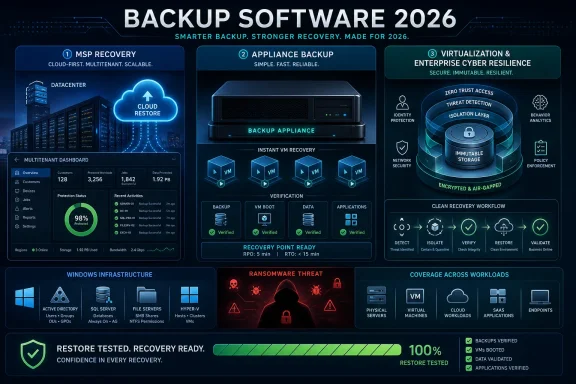 Backup Has Become an Operations Problem, Not a Storage Problem
For years, server backup buying was treated like an insurance exercise: pick a product, point it at the servers, and hope the nightly jobs complete. That model has aged badly. Modern backup is now entangled with ransomware response, identity recovery, cloud cost management, compliance retention, and the basic question of who is awake at 2 a.m. when a restore is needed.The stakes are obvious. ITIC’s 2024 downtime research found that more than 90 percent of large and midsize enterprises report that one hour of server downtime costs at least $300,000. That figure can sound abstract until it is mapped onto a failed domain controller, an unavailable ERP database, or a medical practice unable to access patient records.
This is why the feature checklist alone is a trap. Almost every serious product now claims immutability, ransomware detection, cloud replication, and application-aware recovery. The meaningful distinction is whether those capabilities fit the organization that has to operate them.
An MSP managing dozens or hundreds of client environments needs multitenancy, alerting discipline, predictable recovery workflows, and vendor economics that make backup deliverable as a service. A mid-market IT team running its own infrastructure needs a platform it can own without building a backup engineering department. A large enterprise may need the opposite: deep policy control, broad platform coverage, and the patience to administer a complex system properly.
The First Split Is Between MSP Delivery and Internal IT
The backup market makes more sense once it is divided by operator. Datto SIRIS, for example, is not merely a backup product with MSP-friendly features bolted on. It is built around the assumption that a service provider is responsible for many customer environments and needs to restore from either local hardware or a vendor cloud without improvising.That matters because MSP backup is a workflow business. The question is not only whether a backup exists, but whether technicians can see its status across clients, prove it boots, price the service predictably, and recover quickly without learning each customer’s infrastructure from scratch during an incident.
Datto’s model combines local appliance recovery, cloud recovery, centralized partner management, and automated verification. Its pitch is less “store your data safely” than “turn business continuity into a repeatable service.” For MSPs, that is the right axis.
Unitrends, also under Kaseya, occupies a different lane. It is aimed more directly at organizations managing their own infrastructure, with physical and virtual appliance options for teams that want an integrated backup target rather than a toolkit assembled from separate software, storage, and cloud components. That distinction is easy to miss, but it is central to choosing between the two.
Datto SIRIS Is the MSP Benchmark Because It Treats Recovery as the Product
Datto SIRIS is strongest where MSPs feel the most pain: rapid recovery across many small and midsize client environments. Its architecture combines a physical or virtual backup appliance, Datto Cloud replication, and centralized management through the Datto Partner Portal. That is not a glamorous description, but it is exactly the point.The appliance gives the client site a local recovery target. If a server fails, the protected machine can be virtualized locally without waiting for replacement hardware or a full restore. If the site is unavailable or compromised, workloads can be virtualized in the Datto Cloud instead.
Datto’s Inverse Chain Technology is designed to reduce the fragility associated with traditional incremental chains, where a broken link can damage restore confidence. Frequent snapshots, instant virtualization, and automated screenshot verification all push the product toward one central promise: the MSP should know the backup is recoverable before the client finds out the server is down.
The company has also leaned hard into ransomware resilience. Immutable cloud storage, deletion defense, and anomaly detection are not luxuries in an MSP context. A compromised client administrator account, a malicious insider, or a ransomware operator looking for backups can turn a nominally protected environment into a dead end if backup deletion is too easy.
There are caveats. Datto SIRIS is not the obvious choice for a business that wants to self-manage everything without an MSP relationship. Its strength is precisely that it assumes a provider-led model. For that audience, it remains one of the clearest examples of backup software becoming an operational platform.
Unitrends Is the Sensible Appliance Play for Teams That Own the Mess Themselves
Unitrends Backup is a more natural fit for businesses that want an all-in-one system without outsourcing the backup function to an MSP. Its physical appliance bundles software, storage, deduplication, and replication into a single device. Its virtual appliance and enterprise backup software options give organizations a software-defined path when they already have VMware or Hyper-V capacity.That flexibility matters for small and mid-market IT teams. Many do not want to design a backup architecture from first principles. They want a box, or a virtual appliance, that protects Windows and Linux servers, VMware and Hyper-V virtual machines, and common workloads such as SQL Server, Exchange, and Active Directory.
Unitrends’ argument is operational simplicity. Instant recovery lets protected systems boot as virtual machines while the failed system is repaired. Bare metal recovery helps when hardware is dead or dissimilar replacement hardware is the only practical option. Automated verification reduces the risk that a team discovers a broken backup only after production has failed.
Its limitation is the same one that applies to many appliance-led designs: disaster recovery maturity depends on architecture. A single appliance sitting in the same site as the protected workloads is not a DR strategy by itself. Secondary appliances, cloud replication, and regular test restores are what turn backup into recoverability.
For internal IT teams that understand that distinction, Unitrends is a strong fit. It gives them a coherent platform without requiring them to become specialists in every moving part underneath.
Veeam Remains the Virtualization Power Tool, With All the Complexity That Implies
Veeam Backup & Replication remains one of the most capable products in the market for virtualized infrastructure. Its roots are in VMware and Hyper-V protection, and it has expanded over time into physical servers, cloud workloads, application-item recovery, replication, and hardened repositories.The release of Veeam Backup & Replication 13 sharpened the product’s security story, particularly around Linux-based hardened architecture and stronger controls. That is the correct direction. Backup servers have become high-value targets, and Windows-domain-integrated backup infrastructure has too often become a liability during ransomware incidents.
Veeam’s advantage is depth. It offers granular recovery, instant VM recovery, application-aware processing, broad ecosystem support, and a large community of practitioners who know how to tune it. For organizations with skilled virtualization administrators, it can be both powerful and flexible.
But Veeam is not “simple” in the same way an integrated appliance can be simple. Repository design, immutability configuration, access control, licensing, cloud targets, proxies, and restore testing all require competence. That is not a criticism so much as a warning: Veeam rewards teams that invest in it.
For MSPs, the calculus is more complicated. Veeam can be used in service-provider models, but it is not as natively MSP-shaped as Datto SIRIS. If the business problem is managing many small client environments with minimal per-client overhead, the operational burden may matter as much as the technical feature set.
Acronis Bets That Backup and Endpoint Security Belong in One Agent
Acronis Cyber Protect takes a different approach: combine backup with endpoint security, patch management, vulnerability assessment, URL filtering, and anti-malware in one platform. That is appealing to organizations tired of agent sprawl and console fatigue. It is also appealing to MSPs that want to sell cyber protection as a bundled service rather than a stack of separate point tools.The backup side includes image-based backup, incremental backup, bare metal restore, cloud replication, and dissimilar hardware restore through Universal Restore. The security side attempts to reduce the chance that recovery is needed in the first place, while ransomware rollback and integrity verification support recovery when prevention fails.
This consolidation strategy has a clear business logic. Many SMBs do not have the staff to administer separate best-in-class tools for backup, EDR, patching, vulnerability management, and web protection. A single platform may be less elegant technically but more realistic operationally.
The trade-off is familiar. A suite is rarely the deepest product in every category. Veeam may offer richer VM recovery for complex environments. Dedicated EDR tools may provide stronger detection and response. Acronis is most compelling where the problem is not maximum specialization, but reducing the number of systems a small team must keep alive.
MSP360 Wins When Storage Choice Matters More Than Integrated DR
MSP360 Managed Backup is built around a cloud-agnostic premise. Instead of forcing customers into a proprietary backup cloud, it lets MSPs and businesses use storage providers such as Amazon S3, Microsoft Azure, Wasabi, Backblaze B2, IDrive e2, and others. For organizations that already have cloud commitments or want to tune storage economics directly, that is a serious advantage.The product supports Windows Server, SQL Server, Exchange, VMware, Hyper-V, and Linux workloads, with image-based and file-level backup options. It also offers centralized management, role-based access, audit logging, restore verification, and immutability through compatible object storage features such as Object Lock.
The strength here is control. MSPs that understand storage pricing can optimize their own margins. Businesses with cloud standards can align backup with existing procurement and governance. Organizations that distrust vendor lock-in can separate backup software from storage destination.
The weakness is that flexibility creates work. MSP360 does not provide the same fully integrated DR cloud model as Datto. Storage costs, egress behavior, immutability configuration, and recovery design remain the customer’s or provider’s responsibility. That can be empowering or exhausting, depending on the team.
NAKIVO Is the SMB Value Play That Keeps Getting More Serious
NAKIVO Backup & Replication has carved out a strong position among SMBs and lean IT teams that need capable backup without enterprise-scale cost or complexity. It supports VMware vSphere, Hyper-V, Nutanix AHV, Proxmox, and physical Windows and Linux servers. That breadth is particularly useful now that some organizations are rethinking virtualization strategy and looking beyond VMware-only assumptions.NAKIVO’s appeal is practical. It offers instant VM recovery, bare metal restore, granular recovery, application-consistent protection for common Microsoft workloads, immutable backup options, automated backup testing, and disaster recovery orchestration through Site Recovery Jobs. Those are not toy features.
The pricing story is also part of the attraction. Transparent per-workload subscription pricing and perpetual licensing options make it easier for smaller teams to understand what they are buying. That predictability matters when backup is competing against every other IT budget item.
NAKIVO is not the natural center of gravity for a large MSP with a sprawling customer base. Native multitenancy and service-provider workflow depth are not its defining strengths. But for an internal IT team that wants fast, understandable, cost-conscious protection, it deserves its place on the shortlist.
The Enterprise Platforms Are Selling Cyber Resilience, Not Backup
Cohesity DataProtect, Rubrik Security Cloud, Commvault Complete Data Protection, and Veritas NetBackup operate in a different economic and operational universe. These products are not trying to be the easiest answer for a 30-person business with two servers and a part-time admin. They are aimed at environments where data lives across data centers, public clouds, SaaS platforms, NAS estates, databases, Kubernetes clusters, and legacy systems that refuse to die.Cohesity’s story is scale-out consolidation. Its platform brings backup, recovery, file services, analytics, immutability, and ransomware detection into a hyperconverged architecture. The acquisition of Veritas’ enterprise data protection business further reshaped the market, putting NetBackup and Cohesity under the same corporate umbrella and forcing enterprises to think about roadmap convergence as well as product selection.
Rubrik’s pitch is cyber resilience. It emphasizes immutable, logically air-gapped backup storage, threat monitoring, sensitive data discovery, and guided recovery to clean restore points. For enterprises worried less about accidental deletion and more about coordinated ransomware campaigns, that framing resonates.
Commvault remains the heterogeneous heavyweight. Its value is breadth: legacy systems, databases, virtual machines, cloud workloads, Kubernetes, and large policy-driven environments. It can be extraordinarily capable, but it also expects administrators who know what they are doing.
NetBackup retains its identity as a petabyte-scale enterprise workhorse. It has long been used in large, complex environments with demanding retention, deduplication, tape, cloud tiering, and replication needs. Its future inside the Cohesity portfolio will be watched closely by customers that cannot treat backup platform migration as a casual weekend project.
Immutability Is Now Table Stakes, but It Is Not a Magic Spell
Every serious buyer in 2026 should ask about immutable storage. The reason is simple: ransomware crews understand backup. They look for backup consoles, backup repositories, cloud credentials, and administrative accounts that allow snapshots to be deleted or corrupted before encryption becomes visible.But immutability is not a binary virtue that can be checked off a procurement spreadsheet. It depends on where the data lives, who can change retention settings, whether administrators can shorten immutability windows, how credentials are protected, and whether the backup control plane itself can be compromised.
Cloud object immutability, hardened Linux repositories, appliance-level retention controls, and deletion defense all aim at the same problem from different angles. The best implementation is the one your team can configure correctly and monitor continuously.
The real test is not whether a vendor can say “immutable.” It is whether a ransomware operator with domain admin privileges can still destroy your restore path. If the answer is unclear, the architecture is not finished.
Verification Is Where Marketing Meets Reality
A backup that has not been tested is a theory. That old maxim has become more important as backup products claim faster and more automated recovery. If a system cannot be booted, if an application cannot come online, or if credentials and dependencies break during recovery, the existence of backup data may not help much.Automated verification has therefore become a defining feature. Datto’s screenshot verification, Unitrends’ post-job verification, NAKIVO’s automated testing, Veeam’s sandbox recovery options, and enterprise cleanroom recovery models all reflect the same shift: backup products must prove recoverability, not merely report job completion.
This is especially critical for Windows Server environments. Active Directory, SQL Server, Exchange, line-of-business applications, and domain-joined systems have dependencies that file-level backup alone may not capture cleanly. Application-consistent snapshots and verified bootability reduce the gap between “we have data” and “the business is back.”
Still, verification can be misunderstood. A screenshot of a booted server is valuable, but it does not prove every application workflow works. A sandbox restore is stronger, but it requires planning. The best teams combine automated verification with periodic full recovery exercises that include application owners, not just backup administrators.
Pricing Models Can Break the Recovery Plan
Backup pricing matters most when something has gone wrong. A product that looks affordable during steady-state operation can become uncomfortable if restores incur egress charges, cloud compute costs, per-restore fees, or unexpected storage expansion. The finance model becomes part of the recovery model.This is one reason integrated MSP platforms are attractive. Predictable service economics help providers package backup and business continuity without needing to explain cloud billing surprises after an incident. It is also why bring-your-own-storage products appeal to buyers that want direct control over cost inputs.
Enterprise products have a different version of the problem. Licensing can be based on capacity, workloads, front-end terabytes, back-end storage, sockets, subscriptions, cloud services, or bundled platform tiers. The larger the environment, the more procurement complexity can shape technical decisions.
The practical advice is blunt: model a disaster before signing. Estimate what happens if ten servers need to run in the vendor cloud for several days, if a large restore crosses cloud boundaries, or if compliance retention forces years of immutable storage. Backup budgets that ignore recovery behavior are incomplete.
Windows Shops Need to Think Beyond the VM
For WindowsForum readers, the server backup question often starts with familiar workloads: Windows Server, Hyper-V, Active Directory, SQL Server, file servers, and the occasional Exchange environment still doing its duty. The temptation is to evaluate backup products by whether they can snapshot the VM. That is necessary, but not sufficient.Active Directory recovery remains its own discipline. Restoring a domain controller without understanding replication, tombstones, metadata, and authoritative restore scenarios can make a bad incident worse. SQL Server recovery is also more than booting a VM; log handling, point-in-time restore, and application consistency matter.
Hyper-V support varies in depth across products, as does VMware support. With VMware licensing changes still influencing infrastructure plans, broader hypervisor support has become more valuable. NAKIVO’s Proxmox support, Veeam’s deep virtualization ecosystem, and appliance vendors’ support matrices all deserve closer reading than a one-line “supports VMs” claim.
The best Windows backup plan covers the machine, the application, the identity layer, and the restore order. If the backup software cannot express that dependency chain, the runbook must.
The Ranking Is Less Important Than the Match
A clean top-ten list is useful, but it can create a false sense of universal hierarchy. Datto SIRIS is a strong answer for MSPs, but that does not make it the right answer for a self-managed enterprise. Commvault is immensely capable, but that does not make it sensible for a small business without dedicated backup staff. MSP360 is flexible, but flexibility is not the same as integrated disaster recovery.The better ranking is by fit. MSPs should start with tools built for multitenant service delivery. Internal SMB and mid-market teams should favor platforms they can operate and test reliably. Enterprises should evaluate policy depth, cyber recovery, data classification, and long-term platform roadmap.
The uncomfortable truth is that backup failures are often human and architectural failures, not product failures. Repositories are placed in the wrong location. Credentials are overprivileged. Immutability is misconfigured. Restores are never tested. Alerts are ignored because they are too noisy.
Good software reduces those risks. It does not eliminate the need for discipline.
The Shortlist Only Makes Sense After You Name the Operator
The 2026 server backup market is mature enough that most leading products can protect common workloads. The harder task is matching the platform to the people, process, and failure scenario it must support.- Datto SIRIS is the strongest fit for MSPs that need multitenant BCDR, rapid local and cloud virtualization, immutable cloud storage, and centralized client management.
- Unitrends Backup is the practical choice for businesses that want appliance-style protection or a virtual appliance they can run themselves without stitching together a multi-vendor stack.
- Veeam Backup & Replication remains a top option for skilled IT teams with complex virtual infrastructure and the expertise to design repositories, immutability, and recovery workflows correctly.
- Acronis Cyber Protect is best suited to teams that value consolidation across backup, endpoint security, patching, and anti-malware more than best-in-class specialization in each category.
- MSP360 and NAKIVO are compelling value plays, with MSP360 favoring cloud-storage flexibility and NAKIVO favoring affordable, capable VM and server protection for SMB environments.
- Cohesity, Rubrik, Commvault, and NetBackup belong in enterprise conversations where scale, heterogeneous coverage, cyber recovery, and dedicated administration justify the cost and complexity.
References
- Primary source: Kaseya
Published: 2026-06-04T22:40:11.949268
Best Server Backup Software in 2026 | Kaseya
Compare the best server backup solutions in 2026, ranked for MSPs and IT teams on recovery speed, ransomware protection, and ease of management.www.kaseya.com
- Related coverage: crn.com
It’s Official: Cohesity Closes Veritas Acquisition, Claims No.1 Data Protection Software Prize
With the close of Cohesity’s acquisition of Veritas’ enterprise business, the remaining parts of Veritas have been spun into a new company Arctera.www.crn.com - Related coverage: community.veeam.com
Early Availability for Veeam Backup & Replication 13 Veeam Software Appliance | Veeam Community Resource Hub
We are excited to announce early availability for the Veeam Backup & Replication Veeam Software Appliance! The appliance is delivered through a boot... community.veeam.com
- Related coverage: vinfrastructure.it
Veeam Backup and Replication 13 is available... but only the Linux version - vInfrastructure Blog
Explore Veeam Backup and Replication 13. Learn about its new Pre-Hardened Software Appliance and download options available. vinfrastructure.it
- Related coverage: itpro.com
Cloud Software Group snaps up data management provider Arctera | ChannelPro
The acquisition will see the data management vendor operate as a standalone business within CSG’s wider portfoliowww.itpro.com
