

Kaseya’s 2026 ranking of server backup software puts Datto SIRIS, Unitrends, Veeam Backup & Replication, Acronis Cyber Protect, MSP360, NAKIVO, Cohesity, Rubrik, Commvault, and Veritas NetBackup into a market now defined less by backup jobs than by ransomware recovery. The list is vendor-authored, and it gives Kaseya’s own products the top two spots, but its framing is still useful: server backup has become a test of operational maturity. The hard question is no longer whether a product can copy data. It is whether an organization can restore clean systems quickly, prove those restores work, and keep attackers from deleting the escape hatch.
For years, backup was treated as plumbing. It sat in the corner, ran overnight, complained by email, and occasionally rescued a deleted file or a failed database migration. That world is gone. In 2026, backup is part disaster recovery platform, part security control, part insurance policy, and part operational lie detector.
The lie it exposes is simple: many organizations say they have a recovery plan when what they really have is a collection of backup jobs. A backup job is not a recovery strategy. A cloud copy is not an incident response plan. A green check mark on last night’s run does not mean the domain controller will boot when ransomware has eaten the production network.
That is why the Kaseya list, despite its obvious commercial angle, lands on the right criteria. Recovery speed, immutable storage, ransomware detection, automated verification, cross-platform coverage, centralized management, and predictable pricing are not decorative features. They are the difference between “we restored from backup” and “we are negotiating with criminals because the backups are gone too.”
The stakes are not theoretical. Downtime costs have become severe enough that even midmarket outages now look like enterprise crises. ITIC’s 2024 downtime research found that more than 90 percent of large and midsize enterprises said a single hour of server downtime cost at least $300,000. That number is not a universal bill, but it explains why backup buying has moved from a storage conversation to a boardroom conversation.
Datto SIRIS is built for managed service providers that need to deliver backup and disaster recovery across many client environments from a shared operational model. Unitrends is aimed more directly at businesses that want a self-contained backup platform they can run themselves. Veeam appeals to virtualization-heavy shops that want depth and control. Acronis tries to collapse backup and endpoint protection into one agent. MSP360 bets on bring-your-own-cloud economics. NAKIVO courts the cost-conscious SMB and midmarket administrator.
At the top end, Cohesity, Rubrik, Commvault, and NetBackup are not merely backup tools. They are enterprise data protection estates. Their value depends on scale, compliance pressure, heterogeneous workloads, and staff who can actually operate them. Put one of those platforms into a small IT department without the right expertise and it can become a very expensive way to fail slowly.
This is the real lesson hidden inside any “best backup software” list. The best product in the abstract may be the wrong product in production. Backup software punishes mismatch more than most infrastructure tools because the failure only becomes obvious at the worst possible moment.
A firewall misconfiguration may create noise immediately. A bad backup design can remain invisible for months. Then a server fails, a ransomware note appears, or a storage array corrupts data, and the organization discovers that its restore workflow was never tested, its cloud egress costs were never modeled, and its “immutable” copy was only immutable until someone with the wrong credentials logged in.
An MSP does not protect one environment. It protects dozens, hundreds, or thousands of client environments, each with its own risk tolerance, budget, workload mix, retention needs, and panic threshold. The backup platform has to make sense not only technically, but also commercially and operationally. If every client requires artisanal handholding, the service does not scale.
Datto’s formula is the integrated appliance-plus-cloud model. SIRIS combines a physical or virtual backup appliance, local recovery, Datto Cloud recovery, and centralized partner management. The pitch is not simply “we can restore your server.” It is “we can keep the client running while the original server is dead.”
That distinction is critical. Instant virtualization changes the psychology of recovery. Instead of waiting for replacement hardware, rebuilding an operating system, restoring volumes, and hoping applications behave, the protected server can be booted as a VM locally on the appliance or in the vendor’s cloud. If that works as advertised, the outage shifts from an existential business interruption to an ugly but manageable incident.
The Kaseya source claims backups can run as frequently as every five minutes and that Datto’s Inverse Chain Technology makes each incremental snapshot an independent recovery point. That is the kind of architectural claim that matters because traditional backup chains can create unpleasant dependencies. A long incremental chain is efficient right up until a bad link turns a theoretical restore into a support ticket.
Datto also leans heavily into verification. AI-powered screenshot verification, which Kaseya says now reaches 99.9 percent accuracy in its newer cyber resilience announcements, is meant to answer the question admins hate most: did the backup merely complete, or did the system actually boot? Screenshot verification is not a full application test, and no one should pretend it is. But it is vastly better than discovering during an incident that a critical server image has been unbootable for weeks.
The limitation is equally important. Datto SIRIS is not the natural choice for a business that wants to own and operate everything directly without an MSP. It is an MSP platform, and that focus is both its strength and its boundary.
The appliance argument remains persuasive in 2026 because backup complexity is still a serious operational risk. A typical DIY backup architecture may include backup software, a repository, deduplication storage, a cloud target, replication policy, retention policy, encryption setup, monitoring, alerting, and a test plan. Each piece may be defensible. Together, they may exceed what a small IT team can safely run.
Unitrends tries to collapse that sprawl. Its physical backup appliance combines backup software, local deduplication, and cloud replication in a single package. Its virtual appliance and enterprise software options serve organizations that prefer to run on existing VMware or Hyper-V infrastructure. The shared point is operational containment: fewer moving parts, one interface, one support path.
That model is especially attractive to small and midsize organizations with Windows Server, Linux, VMware, Hyper-V, SQL Server, Exchange, and Active Directory in the mix. These environments are rarely simple, but they often lack enterprise backup specialists. They need practical recovery more than theoretical platform elegance.
Unitrends’ instant recovery, bare metal restore, hardware-independent recovery, and automated verification features match what buyers should now consider table stakes. The more interesting question is whether an appliance-based model encourages better behavior. In many cases, it does, because the path of least resistance is also the safer path: run the jobs, replicate offsite, verify, and restore from a known interface.
The tradeoff is flexibility. If a business wants elaborate disaster recovery testing, multiple sites, and isolated recovery environments, a single appliance can become a constraint. Kaseya’s own limitation note acknowledges that full DR testing benefits from a secondary appliance or secondary deployment. That is not a fatal flaw, but it is a reminder that “all-in-one” does not mean “all scenarios.”
The 2026 version of that story is more security-conscious. Veeam Backup & Replication 13 is now the current major branch, with a 13.0.2 build posted in late May 2026. Veeam’s documentation and release materials emphasize Linux-based infrastructure, hardened repositories, role-based controls, four-eyes authorization, and immutable backup behavior. That is the right direction because backup servers have become prime attack targets.
Four-eyes authorization is a particularly telling feature. It recognizes that backup administration itself is now a high-risk privilege. If a compromised or malicious administrator can delete backups, disable jobs, or perform sensitive restores without oversight, the backup platform becomes a single point of catastrophic failure. Requiring approval workflows for dangerous operations may annoy small teams, but in larger environments it reflects reality.
Veeam’s strength is control. It lets skilled teams design sophisticated recovery architectures, integrate with storage and cloud platforms, and tune behavior across complicated estates. For organizations with the expertise to run it, that is exactly what they want.
But control carries a tax. Veeam can be more complex to license, size, secure, and administer than appliance-led alternatives. Its MSP story also depends more on partner tooling and operational discipline than on the kind of native multitenant simplicity that Datto was designed around. That does not make Veeam a poor MSP choice, but it does mean service providers must understand the management overhead they are accepting.
For WindowsForum readers, the practical point is blunt: Veeam is excellent when the operator is excellent. It is less forgiving when the team wants the software to impose the model for them.
The case for Acronis is strongest where operational simplicity matters more than category purity. If an organization wants image-based backup, bare metal restore, cloud replication, anti-malware, patch management, URL filtering, and ransomware rollback under a single interface, Acronis offers a coherent package. For MSPs, Acronis Cyber Protect Cloud adds multitenant management across client environments.
The risk is equally obvious. Bundles rarely beat focused specialists at every component. Veeam is deeper for VM-centric backup. Dedicated EDR platforms are stronger for advanced endpoint detection and response. Enterprise patching tools may offer more control. Acronis’ value proposition is not that it wins every category independently, but that it reduces the number of platforms an organization must deploy and monitor.
That tradeoff is not inherently bad. In security and resilience, the tool a team actually operates well is often more valuable than the theoretically superior tool it neglects. A small IT department that keeps Acronis configured, monitored, tested, and patched may be safer than one that buys five best-of-breed products and lets three of them drift.
Still, buyers should be clear-eyed about tiering and licensing. Acronis’ portfolio can become complicated as organizations move between Cyber Protect editions, cloud management, storage, and add-on capabilities. Consolidation is only simplifying if the bill and feature entitlements remain intelligible.
The advantage is freedom. An MSP can build margin around its preferred storage provider. A business already standardized on Wasabi, Backblaze B2, Azure, Amazon S3, or another compatible target can avoid paying for a proprietary backup cloud. Object Lock support gives the model a route to immutability when the underlying storage provider supports it properly.
The downside is that flexibility becomes design responsibility. MSP360 does not include the same kind of integrated disaster recovery cloud that Datto sells. Storage costs, retention behavior, immutability settings, egress exposure, and recovery workflows must be planned. That may be a feature for capable operators and a trap for teams that wanted an appliance-like experience.
NAKIVO sits nearby but speaks to a slightly different buyer. It has become a favorite among SMBs and lean IT teams because it combines broad VM coverage, straightforward management, and transparent pricing. Support for VMware, Hyper-V, Nutanix AHV, Proxmox, and physical Windows and Linux servers gives it credibility in heterogeneous small and midsize environments.
The Proxmox support is worth noticing. Broadcom’s VMware licensing changes pushed many organizations to reassess virtualization platforms, and backup vendors that support alternative hypervisors are better positioned for that unsettled market. NAKIVO’s value is not just low cost; it is the sense that a pragmatic IT team can deploy it without turning backup into a consulting project.
Its limitation is scale of service delivery. NAKIVO is not as naturally MSP-native as Datto, and large client portfolios may require more hands-on management. But for SMBs that want reliable VM and server backup without enterprise overhead, it remains one of the more sensible options on the list.
Cohesity and Rubrik, in particular, represent the modern “cyber resilience” framing. They do not merely promise to restore data. They promise to help identify clean recovery points, detect suspicious changes, isolate recovery, and reduce the chaos of a ransomware event. This is where backup crosses into security operations.
Cohesity’s DataProtect runs on a scale-out architecture and protects a wide range of workloads: VMs, physical servers, NAS, databases, Microsoft 365, cloud workloads, and enterprise applications. Its DataHawk ransomware detection and CrowdStrike threat intelligence integration show where the category is moving. The backup platform is expected to know something about threats, not just blocks and files.
Rubrik Security Cloud makes a similar argument through immutability, air-gapped architecture, threat monitoring, sensitive data discovery, and guided ransomware investigation. The goal is to reduce the amount of manual judgment required under pressure. During a ransomware incident, the question “which recovery point is clean?” can be painfully difficult. Vendors that can answer it with evidence have an advantage.
Commvault remains the old-school heavyweight that has adapted into the new world. Its strength is breadth: hundreds of platforms, operating systems, applications, databases, cloud services, and Kubernetes environments under policy-driven management. In the kinds of enterprises where every acquisition brings another platform and every compliance audit finds another retention requirement, breadth still matters.
NetBackup, now part of the Cohesity portfolio after the Veritas enterprise data protection business combination closed in late 2024, remains a symbol of enterprise backup’s long memory. It is petabyte-scale, deeply integrated with legacy and modern environments, and designed for organizations where tape, cloud, disk, databases, mainframe-adjacent systems, and strict retention can all coexist.
The warning is that enterprise platforms can become their own ecosystems. They require dedicated owners, architecture reviews, upgrade plans, security hardening, and operational discipline. Buying Rubrik, Cohesity, Commvault, or NetBackup because it appears in a top-ten list is like buying a commercial aircraft because it is safer than a car. True, perhaps, but only if you have pilots, maintenance crews, hangars, procedures, and a destination that justifies the machine.
A backup copy stored on the same domain, managed by the same credentials, and reachable from the same compromised management plane is not meaningfully safe just because a console says “protected.” Attackers have learned to target backup infrastructure first. They delete restore points, disable jobs, corrupt repositories, steal credentials, and wait until victims discover their safety net has been cut.
Good immutability changes the attacker’s job. It should prevent even administrators from modifying or deleting protected recovery points during the retention period. It should survive compromise of production credentials. It should be paired with offsite or logically isolated copies. It should be monitored for suspicious behavior. And it should be tested.
That last point is where many organizations still fail. Backup vendors now advertise automated verification because manual testing does not happen often enough. A backup that has not been booted, mounted, restored, or otherwise validated is a promise, not a fact.
Verification also has layers. A screenshot of a booted VM proves more than a completed backup job, but it does not prove the application is healthy. A database mount proves more than a screenshot, but it may not prove business process continuity. A full disaster recovery exercise proves the most, but it takes time, planning, and organizational attention.
The modern backup strategy therefore needs tiers of confidence. Automated verification after every job catches obvious failures. Scheduled restore testing catches procedural drift. Periodic DR exercises catch the unpleasant human realities: missing passwords, unclear authority, network dependencies, DNS assumptions, application owners who have never seen the runbook, and executives who do not know how long recovery actually takes.
This is one reason appliance and integrated-cloud vendors keep winning in certain segments. Predictability has value. An MSP selling business continuity wants to know what recovery will cost before the client is in crisis. A small business wants to avoid discovering that its cheapest backup plan became expensive only when it actually needed to recover.
Bring-your-own-storage models can be cheaper, but they move cost modeling onto the customer. Object storage looks inexpensive until retention, API calls, replication, lifecycle policies, retrieval patterns, and egress are included. None of that is inherently bad. It simply means storage architecture and financial architecture are now the same conversation.
Enterprise platforms add another dimension. Their licensing may reflect workloads, front-end terabytes, back-end capacity, cloud targets, modules, users, SaaS workloads, or security features. Large organizations can negotiate and optimize this. Smaller ones can drown in it.
The practical test is simple: during a ransomware event, could your team restore aggressively without first asking finance what the bill might be? If the answer is no, the pricing model is part of the risk.
Restoring the machine image is only part of the job. Active Directory recovery has ordering issues. SQL Server needs application-consistent backups. Exchange recovery, where still relevant, is its own specialized headache. File servers involve permissions, shares, deduplication, shadow copies, and user expectations. Hyper-V hosts require clarity about whether the backup protects the host, the guests, or both.
This is where application-aware backup matters. A crash-consistent VM backup may boot, but that does not guarantee a healthy database. Granular recovery matters too. Restoring an entire server because one executive folder disappeared is operationally absurd if item-level restore is available.
Bare metal restore also remains relevant, especially outside pure virtualization shops. Hardware fails. Remote offices still exist. Industrial and branch environments still run odd physical servers. Dissimilar hardware recovery is not glamorous, but it is exactly the feature people remember when a motherboard dies and the replacement system is not identical.
The Windows ecosystem also complicates identity and privilege. Backup service accounts, domain membership, local administrator rights, repository access, encryption keys, and recovery credentials must be treated as sensitive assets. A backup platform integrated too casually into Active Directory can inherit the blast radius of a domain compromise.
For sysadmins, the uncomfortable conclusion is that backup design is now security design. The backup server should not be just another joined machine with broad privileges and a forgotten patch schedule. It is one of the most valuable systems in the environment.
Datto SIRIS is strongest where an MSP needs repeatable client recovery, centralized management, local and cloud failover, and vendor-integrated BCDR. Unitrends is strongest where an internal IT team wants an all-in-one appliance or virtual appliance with fewer architectural decisions. Veeam is strongest where a skilled team wants deep VM protection and flexible design. Acronis is strongest where consolidation matters. MSP360 is strongest where storage choice is the strategy. NAKIVO is strongest where affordability and straightforward VM backup matter.
Cohesity and Rubrik are strongest when cyber recovery is an enterprise program, not a side task. Commvault and NetBackup are strongest when the environment is so broad and complex that platform coverage is the primary requirement. These are not interchangeable tools separated only by feature counts. They are different operating philosophies.
That is why the classic feature checklist can mislead buyers. A product with more capabilities may require more people, better processes, and stricter governance. A simpler product may recover faster in the hands of a small team because there are fewer ways to misuse it. The question is not which vendor has the longest datasheet. The question is which recovery model your organization can execute at 2 a.m. with phones ringing and executives hovering.
The best evaluation process should therefore include a restore. Not a demo restore performed by a sales engineer. A real restore, performed by the people who will own the platform, using the documentation they will have during an incident. If that exercise is embarrassing, that is useful information. Better embarrassment during procurement than paralysis during an outage.
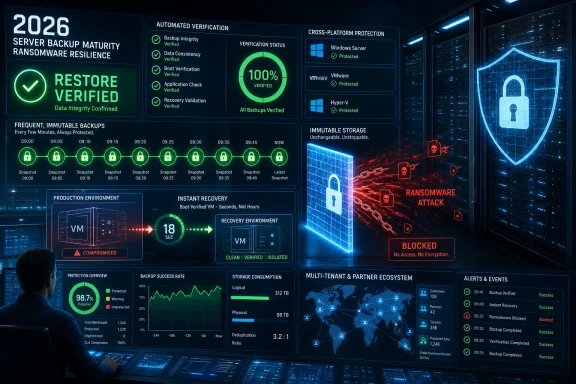 Backup Software Has Become the Last Security Control Standing
For years, backup was treated as plumbing. It sat in the corner, ran overnight, complained by email, and occasionally rescued a deleted file or a failed database migration. That world is gone. In 2026, backup is part disaster recovery platform, part security control, part insurance policy, and part operational lie detector.The lie it exposes is simple: many organizations say they have a recovery plan when what they really have is a collection of backup jobs. A backup job is not a recovery strategy. A cloud copy is not an incident response plan. A green check mark on last night’s run does not mean the domain controller will boot when ransomware has eaten the production network.
That is why the Kaseya list, despite its obvious commercial angle, lands on the right criteria. Recovery speed, immutable storage, ransomware detection, automated verification, cross-platform coverage, centralized management, and predictable pricing are not decorative features. They are the difference between “we restored from backup” and “we are negotiating with criminals because the backups are gone too.”
The stakes are not theoretical. Downtime costs have become severe enough that even midmarket outages now look like enterprise crises. ITIC’s 2024 downtime research found that more than 90 percent of large and midsize enterprises said a single hour of server downtime cost at least $300,000. That number is not a universal bill, but it explains why backup buying has moved from a storage conversation to a boardroom conversation.
The Kaseya List Is Also a Map of the Market’s Fault Lines
The most important thing about the 2026 server backup field is not that there are ten plausible contenders. It is that they are no longer trying to solve the same problem for the same buyer.Datto SIRIS is built for managed service providers that need to deliver backup and disaster recovery across many client environments from a shared operational model. Unitrends is aimed more directly at businesses that want a self-contained backup platform they can run themselves. Veeam appeals to virtualization-heavy shops that want depth and control. Acronis tries to collapse backup and endpoint protection into one agent. MSP360 bets on bring-your-own-cloud economics. NAKIVO courts the cost-conscious SMB and midmarket administrator.
At the top end, Cohesity, Rubrik, Commvault, and NetBackup are not merely backup tools. They are enterprise data protection estates. Their value depends on scale, compliance pressure, heterogeneous workloads, and staff who can actually operate them. Put one of those platforms into a small IT department without the right expertise and it can become a very expensive way to fail slowly.
This is the real lesson hidden inside any “best backup software” list. The best product in the abstract may be the wrong product in production. Backup software punishes mismatch more than most infrastructure tools because the failure only becomes obvious at the worst possible moment.
A firewall misconfiguration may create noise immediately. A bad backup design can remain invisible for months. Then a server fails, a ransomware note appears, or a storage array corrupts data, and the organization discovers that its restore workflow was never tested, its cloud egress costs were never modeled, and its “immutable” copy was only immutable until someone with the wrong credentials logged in.
Datto SIRIS Shows Why MSP Backup Is Its Own Category
Kaseya gives Datto SIRIS the top spot, and the reason is clear: SIRIS is not being pitched as generic backup software. It is purpose-built business continuity and disaster recovery for MSPs. That matters because MSP backup is a different operating model from internal IT backup.An MSP does not protect one environment. It protects dozens, hundreds, or thousands of client environments, each with its own risk tolerance, budget, workload mix, retention needs, and panic threshold. The backup platform has to make sense not only technically, but also commercially and operationally. If every client requires artisanal handholding, the service does not scale.
Datto’s formula is the integrated appliance-plus-cloud model. SIRIS combines a physical or virtual backup appliance, local recovery, Datto Cloud recovery, and centralized partner management. The pitch is not simply “we can restore your server.” It is “we can keep the client running while the original server is dead.”
That distinction is critical. Instant virtualization changes the psychology of recovery. Instead of waiting for replacement hardware, rebuilding an operating system, restoring volumes, and hoping applications behave, the protected server can be booted as a VM locally on the appliance or in the vendor’s cloud. If that works as advertised, the outage shifts from an existential business interruption to an ugly but manageable incident.
The Kaseya source claims backups can run as frequently as every five minutes and that Datto’s Inverse Chain Technology makes each incremental snapshot an independent recovery point. That is the kind of architectural claim that matters because traditional backup chains can create unpleasant dependencies. A long incremental chain is efficient right up until a bad link turns a theoretical restore into a support ticket.
Datto also leans heavily into verification. AI-powered screenshot verification, which Kaseya says now reaches 99.9 percent accuracy in its newer cyber resilience announcements, is meant to answer the question admins hate most: did the backup merely complete, or did the system actually boot? Screenshot verification is not a full application test, and no one should pretend it is. But it is vastly better than discovering during an incident that a critical server image has been unbootable for weeks.
The limitation is equally important. Datto SIRIS is not the natural choice for a business that wants to own and operate everything directly without an MSP. It is an MSP platform, and that focus is both its strength and its boundary.
Unitrends Is the Appliance Argument for Internal IT
Unitrends, also owned by Kaseya, gets the second slot because it serves the other half of Kaseya’s preferred market split: organizations managing their own infrastructure. Where Datto is the MSP-centric BCDR service platform, Unitrends is the all-in-one appliance story.The appliance argument remains persuasive in 2026 because backup complexity is still a serious operational risk. A typical DIY backup architecture may include backup software, a repository, deduplication storage, a cloud target, replication policy, retention policy, encryption setup, monitoring, alerting, and a test plan. Each piece may be defensible. Together, they may exceed what a small IT team can safely run.
Unitrends tries to collapse that sprawl. Its physical backup appliance combines backup software, local deduplication, and cloud replication in a single package. Its virtual appliance and enterprise software options serve organizations that prefer to run on existing VMware or Hyper-V infrastructure. The shared point is operational containment: fewer moving parts, one interface, one support path.
That model is especially attractive to small and midsize organizations with Windows Server, Linux, VMware, Hyper-V, SQL Server, Exchange, and Active Directory in the mix. These environments are rarely simple, but they often lack enterprise backup specialists. They need practical recovery more than theoretical platform elegance.
Unitrends’ instant recovery, bare metal restore, hardware-independent recovery, and automated verification features match what buyers should now consider table stakes. The more interesting question is whether an appliance-based model encourages better behavior. In many cases, it does, because the path of least resistance is also the safer path: run the jobs, replicate offsite, verify, and restore from a known interface.
The tradeoff is flexibility. If a business wants elaborate disaster recovery testing, multiple sites, and isolated recovery environments, a single appliance can become a constraint. Kaseya’s own limitation note acknowledges that full DR testing benefits from a secondary appliance or secondary deployment. That is not a fatal flaw, but it is a reminder that “all-in-one” does not mean “all scenarios.”
Veeam Remains the Virtualization Powerhouse, but Power Has a Cost
Veeam Backup & Replication remains the default mental benchmark for many Windows and virtualization administrators. It earned that status by being exceptionally good at VM-centric backup and recovery. In VMware and Hyper-V environments, Veeam’s image-level backup, instant recovery, replication, and application-aware restores have long been strong enough that many admins evaluate competitors by asking, “How close is it to Veeam?”The 2026 version of that story is more security-conscious. Veeam Backup & Replication 13 is now the current major branch, with a 13.0.2 build posted in late May 2026. Veeam’s documentation and release materials emphasize Linux-based infrastructure, hardened repositories, role-based controls, four-eyes authorization, and immutable backup behavior. That is the right direction because backup servers have become prime attack targets.
Four-eyes authorization is a particularly telling feature. It recognizes that backup administration itself is now a high-risk privilege. If a compromised or malicious administrator can delete backups, disable jobs, or perform sensitive restores without oversight, the backup platform becomes a single point of catastrophic failure. Requiring approval workflows for dangerous operations may annoy small teams, but in larger environments it reflects reality.
Veeam’s strength is control. It lets skilled teams design sophisticated recovery architectures, integrate with storage and cloud platforms, and tune behavior across complicated estates. For organizations with the expertise to run it, that is exactly what they want.
But control carries a tax. Veeam can be more complex to license, size, secure, and administer than appliance-led alternatives. Its MSP story also depends more on partner tooling and operational discipline than on the kind of native multitenant simplicity that Datto was designed around. That does not make Veeam a poor MSP choice, but it does mean service providers must understand the management overhead they are accepting.
For WindowsForum readers, the practical point is blunt: Veeam is excellent when the operator is excellent. It is less forgiving when the team wants the software to impose the model for them.
Acronis Bets That Backup and Endpoint Security Belong Together
Acronis Cyber Protect occupies a different lane: one agent, one console, one vendor for backup and a set of endpoint security functions. That consolidation pitch has obvious appeal. Tool sprawl is real, and many smaller IT teams are tired of managing separate backup, anti-malware, vulnerability, patch, and web protection products.The case for Acronis is strongest where operational simplicity matters more than category purity. If an organization wants image-based backup, bare metal restore, cloud replication, anti-malware, patch management, URL filtering, and ransomware rollback under a single interface, Acronis offers a coherent package. For MSPs, Acronis Cyber Protect Cloud adds multitenant management across client environments.
The risk is equally obvious. Bundles rarely beat focused specialists at every component. Veeam is deeper for VM-centric backup. Dedicated EDR platforms are stronger for advanced endpoint detection and response. Enterprise patching tools may offer more control. Acronis’ value proposition is not that it wins every category independently, but that it reduces the number of platforms an organization must deploy and monitor.
That tradeoff is not inherently bad. In security and resilience, the tool a team actually operates well is often more valuable than the theoretically superior tool it neglects. A small IT department that keeps Acronis configured, monitored, tested, and patched may be safer than one that buys five best-of-breed products and lets three of them drift.
Still, buyers should be clear-eyed about tiering and licensing. Acronis’ portfolio can become complicated as organizations move between Cyber Protect editions, cloud management, storage, and add-on capabilities. Consolidation is only simplifying if the bill and feature entitlements remain intelligible.
MSP360 and NAKIVO Prove the Midmarket Still Wants Choice
Not every organization wants an integrated vendor cloud. MSP360 Managed Backup takes the opposite position: let the customer or MSP bring the storage. It supports a wide range of cloud providers, including the major hyperscalers and lower-cost object storage services. That cloud-agnostic model can be extremely attractive when storage economics matter.The advantage is freedom. An MSP can build margin around its preferred storage provider. A business already standardized on Wasabi, Backblaze B2, Azure, Amazon S3, or another compatible target can avoid paying for a proprietary backup cloud. Object Lock support gives the model a route to immutability when the underlying storage provider supports it properly.
The downside is that flexibility becomes design responsibility. MSP360 does not include the same kind of integrated disaster recovery cloud that Datto sells. Storage costs, retention behavior, immutability settings, egress exposure, and recovery workflows must be planned. That may be a feature for capable operators and a trap for teams that wanted an appliance-like experience.
NAKIVO sits nearby but speaks to a slightly different buyer. It has become a favorite among SMBs and lean IT teams because it combines broad VM coverage, straightforward management, and transparent pricing. Support for VMware, Hyper-V, Nutanix AHV, Proxmox, and physical Windows and Linux servers gives it credibility in heterogeneous small and midsize environments.
The Proxmox support is worth noticing. Broadcom’s VMware licensing changes pushed many organizations to reassess virtualization platforms, and backup vendors that support alternative hypervisors are better positioned for that unsettled market. NAKIVO’s value is not just low cost; it is the sense that a pragmatic IT team can deploy it without turning backup into a consulting project.
Its limitation is scale of service delivery. NAKIVO is not as naturally MSP-native as Datto, and large client portfolios may require more hands-on management. But for SMBs that want reliable VM and server backup without enterprise overhead, it remains one of the more sensible options on the list.
Enterprise Backup Is Now Cyber Recovery by Another Name
The bottom half of the Kaseya list is not weaker. It is heavier. Cohesity DataProtect, Rubrik Security Cloud, Commvault Complete Data Protection, and Veritas NetBackup are built for organizations where data protection is entangled with governance, cyber recovery, regulatory obligations, massive scale, and heterogeneous infrastructure.Cohesity and Rubrik, in particular, represent the modern “cyber resilience” framing. They do not merely promise to restore data. They promise to help identify clean recovery points, detect suspicious changes, isolate recovery, and reduce the chaos of a ransomware event. This is where backup crosses into security operations.
Cohesity’s DataProtect runs on a scale-out architecture and protects a wide range of workloads: VMs, physical servers, NAS, databases, Microsoft 365, cloud workloads, and enterprise applications. Its DataHawk ransomware detection and CrowdStrike threat intelligence integration show where the category is moving. The backup platform is expected to know something about threats, not just blocks and files.
Rubrik Security Cloud makes a similar argument through immutability, air-gapped architecture, threat monitoring, sensitive data discovery, and guided ransomware investigation. The goal is to reduce the amount of manual judgment required under pressure. During a ransomware incident, the question “which recovery point is clean?” can be painfully difficult. Vendors that can answer it with evidence have an advantage.
Commvault remains the old-school heavyweight that has adapted into the new world. Its strength is breadth: hundreds of platforms, operating systems, applications, databases, cloud services, and Kubernetes environments under policy-driven management. In the kinds of enterprises where every acquisition brings another platform and every compliance audit finds another retention requirement, breadth still matters.
NetBackup, now part of the Cohesity portfolio after the Veritas enterprise data protection business combination closed in late 2024, remains a symbol of enterprise backup’s long memory. It is petabyte-scale, deeply integrated with legacy and modern environments, and designed for organizations where tape, cloud, disk, databases, mainframe-adjacent systems, and strict retention can all coexist.
The warning is that enterprise platforms can become their own ecosystems. They require dedicated owners, architecture reviews, upgrade plans, security hardening, and operational discipline. Buying Rubrik, Cohesity, Commvault, or NetBackup because it appears in a top-ten list is like buying a commercial aircraft because it is safer than a car. True, perhaps, but only if you have pilots, maintenance crews, hangars, procedures, and a destination that justifies the machine.
Immutability Is Necessary, but It Is Not Magic
The most abused word in backup marketing is now immutable. Every serious backup vendor uses it, and every buyer should demand it. But immutability is not a magic spell. It is an implementation detail that depends on architecture, credentials, retention configuration, storage behavior, and administrative access.A backup copy stored on the same domain, managed by the same credentials, and reachable from the same compromised management plane is not meaningfully safe just because a console says “protected.” Attackers have learned to target backup infrastructure first. They delete restore points, disable jobs, corrupt repositories, steal credentials, and wait until victims discover their safety net has been cut.
Good immutability changes the attacker’s job. It should prevent even administrators from modifying or deleting protected recovery points during the retention period. It should survive compromise of production credentials. It should be paired with offsite or logically isolated copies. It should be monitored for suspicious behavior. And it should be tested.
That last point is where many organizations still fail. Backup vendors now advertise automated verification because manual testing does not happen often enough. A backup that has not been booted, mounted, restored, or otherwise validated is a promise, not a fact.
Verification also has layers. A screenshot of a booted VM proves more than a completed backup job, but it does not prove the application is healthy. A database mount proves more than a screenshot, but it may not prove business process continuity. A full disaster recovery exercise proves the most, but it takes time, planning, and organizational attention.
The modern backup strategy therefore needs tiers of confidence. Automated verification after every job catches obvious failures. Scheduled restore testing catches procedural drift. Periodic DR exercises catch the unpleasant human realities: missing passwords, unclear authority, network dependencies, DNS assumptions, application owners who have never seen the runbook, and executives who do not know how long recovery actually takes.
Pricing Becomes Part of the Recovery Architecture
Backup pricing is not just procurement trivia. It shapes recovery behavior. If restoring data triggers unpredictable egress charges, compute-hour fees, per-restore costs, or emergency licensing conversations, the organization may hesitate at exactly the wrong time.This is one reason appliance and integrated-cloud vendors keep winning in certain segments. Predictability has value. An MSP selling business continuity wants to know what recovery will cost before the client is in crisis. A small business wants to avoid discovering that its cheapest backup plan became expensive only when it actually needed to recover.
Bring-your-own-storage models can be cheaper, but they move cost modeling onto the customer. Object storage looks inexpensive until retention, API calls, replication, lifecycle policies, retrieval patterns, and egress are included. None of that is inherently bad. It simply means storage architecture and financial architecture are now the same conversation.
Enterprise platforms add another dimension. Their licensing may reflect workloads, front-end terabytes, back-end capacity, cloud targets, modules, users, SaaS workloads, or security features. Large organizations can negotiate and optimize this. Smaller ones can drown in it.
The practical test is simple: during a ransomware event, could your team restore aggressively without first asking finance what the bill might be? If the answer is no, the pricing model is part of the risk.
Windows Shops Need to Think Beyond the Server Name
For Windows-heavy environments, “server backup” can be a misleadingly narrow phrase. A Windows Server is rarely just a server. It may be a domain controller, certificate authority, file server, SQL Server host, Exchange relic, line-of-business application box, Hyper-V host, or licensing server that three forgotten applications still depend on.Restoring the machine image is only part of the job. Active Directory recovery has ordering issues. SQL Server needs application-consistent backups. Exchange recovery, where still relevant, is its own specialized headache. File servers involve permissions, shares, deduplication, shadow copies, and user expectations. Hyper-V hosts require clarity about whether the backup protects the host, the guests, or both.
This is where application-aware backup matters. A crash-consistent VM backup may boot, but that does not guarantee a healthy database. Granular recovery matters too. Restoring an entire server because one executive folder disappeared is operationally absurd if item-level restore is available.
Bare metal restore also remains relevant, especially outside pure virtualization shops. Hardware fails. Remote offices still exist. Industrial and branch environments still run odd physical servers. Dissimilar hardware recovery is not glamorous, but it is exactly the feature people remember when a motherboard dies and the replacement system is not identical.
The Windows ecosystem also complicates identity and privilege. Backup service accounts, domain membership, local administrator rights, repository access, encryption keys, and recovery credentials must be treated as sensitive assets. A backup platform integrated too casually into Active Directory can inherit the blast radius of a domain compromise.
For sysadmins, the uncomfortable conclusion is that backup design is now security design. The backup server should not be just another joined machine with broad privileges and a forgotten patch schedule. It is one of the most valuable systems in the environment.
The Best Product Is the One Your Team Can Prove Under Stress
The Kaseya ranking puts Datto SIRIS first for MSPs and Unitrends second for self-managed businesses. That is predictable, but not automatically wrong. The bigger truth is that each product’s natural buyer is fairly distinct.Datto SIRIS is strongest where an MSP needs repeatable client recovery, centralized management, local and cloud failover, and vendor-integrated BCDR. Unitrends is strongest where an internal IT team wants an all-in-one appliance or virtual appliance with fewer architectural decisions. Veeam is strongest where a skilled team wants deep VM protection and flexible design. Acronis is strongest where consolidation matters. MSP360 is strongest where storage choice is the strategy. NAKIVO is strongest where affordability and straightforward VM backup matter.
Cohesity and Rubrik are strongest when cyber recovery is an enterprise program, not a side task. Commvault and NetBackup are strongest when the environment is so broad and complex that platform coverage is the primary requirement. These are not interchangeable tools separated only by feature counts. They are different operating philosophies.
That is why the classic feature checklist can mislead buyers. A product with more capabilities may require more people, better processes, and stricter governance. A simpler product may recover faster in the hands of a small team because there are fewer ways to misuse it. The question is not which vendor has the longest datasheet. The question is which recovery model your organization can execute at 2 a.m. with phones ringing and executives hovering.
The best evaluation process should therefore include a restore. Not a demo restore performed by a sales engineer. A real restore, performed by the people who will own the platform, using the documentation they will have during an incident. If that exercise is embarrassing, that is useful information. Better embarrassment during procurement than paralysis during an outage.
The 2026 Shortlist Belongs to Operators, Not Spec Sheets
The server backup market has matured enough that buyers should stop asking for a universal winner. The right shortlist depends on who operates the platform, what must be recovered, how quickly it must return, and how much complexity the team can sustain.- MSPs that need scalable, multitenant business continuity should evaluate Datto SIRIS first because its architecture is built around service delivery, not just backup jobs.
- Internal IT teams that want a contained appliance or virtual appliance model should look closely at Unitrends because operational simplicity is often more valuable than theoretical flexibility.
- Virtualization-heavy organizations with skilled administrators should keep Veeam on the shortlist because its recovery depth and ecosystem remain difficult to ignore.
- SMBs and midmarket teams should not overlook NAKIVO, MSP360, or Acronis because cost, storage choice, and tool consolidation can matter as much as enterprise feature breadth.
- Large enterprises should treat Cohesity, Rubrik, Commvault, and NetBackup as cyber recovery platforms that require staffing, governance, and architecture commensurate with their scale.
- Every buyer should demand immutable storage, automated verification, application-aware recovery, and a documented restore process that has been tested by the actual operations team.
References
- Primary source: Kaseya
Published: 2026-06-05T16:40:12.474413
Best Server Backup Software in 2026 | Kaseya
Compare the best server backup solutions in 2026, ranked for MSPs and IT teams on recovery speed, ransomware protection, and ease of management.www.kaseya.com
- Related coverage: helpcenter.veeam.com
Four-Eyes Authorization - Veeam Backup & Replication User Guide
You can enable four-eyes authorization to reduce the risk of accidental actions affecting sensitive data. This functionality requires additional approval for certain operations in Veeam Backup & Replication given by another user.helpcenter.veeam.com - Related coverage: endoflife.date
Veeam Backup & Replication | endoflife.date
Check end-of-life, release policy and support schedule for Veeam Backup & Replication.endoflife.date - Related coverage: crn.com
It’s Official: Cohesity Closes Veritas Acquisition, Claims No.1 Data Protection Software Prize
With the close of Cohesity’s acquisition of Veritas’ enterprise business, the remaining parts of Veritas have been spun into a new company Arctera.www.crn.com - Related coverage: help.unitrends.kaseya.com
- Related coverage: itpro.com
Cloud Software Group snaps up data management provider Arctera | ChannelPro
The acquisition will see the data management vendor operate as a standalone business within CSG’s wider portfoliowww.itpro.com
