
On May 28, 2026, the Regional Court of Munich issued a preliminary injunction against Google over AI Overviews that allegedly linked two Munich publishers to scams and dubious business practices, treating the generated summaries as Google’s own statements rather than neutral search results. That is the hinge on which the next phase of AI liability may turn. The decision is not final, and Google is reportedly appealing, but the court’s logic cuts directly against the industry’s favorite defense: the machine merely reflects the web. If an answer engine replaces the click, the law may eventually decide that it also inherits the risk.
For most of Google’s history, the company’s legal and cultural defense was simple: it organized other people’s information. Search results were a map, not the territory; a directory, not a publisher; a pointer, not an author. That distinction was never perfectly clean, but it was sturdy enough to build one of the most powerful businesses in history.
AI Overviews weaken that architecture because they do not look or behave like a list of links. They appear above the old blue-link web, compress multiple sources into a fluent paragraph, and deliver a conclusion in Google’s own interface. The user does not experience that as a bibliography. The user experiences it as an answer.
That is what makes the Munich case more than a local defamation dispute. The legal claim involved two German publishers, Verlagshaus24 and GeraMond Verlag, which said Google’s AI-generated summary falsely associated them with scams, subscription traps, and dubious conduct. According to reporting on the ruling, those claims were not supported by the sources the AI Overview cited; the system had apparently confused the publishers with other entities and then presented the confusion as fact.
The court’s crucial move was to treat the summary not as a neutral transmission of third-party content, but as an independent, new, and substantive statement generated by Google’s system. That phrase matters because it pushes AI search out of the old safe harbor imagination and into the realm of speech made by the service itself. Google can still argue on appeal that the court has overreached. But the line has been drawn.
That logic is more dangerous to AI companies than it first appears. The industry has spent the past two years describing generative systems as both revolutionary and derivative, depending on which argument is useful at the moment. In product demos, AI tools are agents, assistants, copilots, and answer engines. In courtrooms and policy debates, they often become probabilistic mirrors of user prompts and web data.
Munich’s court did not have to solve the philosophy of machine speech to puncture that maneuver. It focused on control. Google built the product, placed it at the top of search results, chose the interface, and operates the algorithms. If the result is a new statement that users reasonably attribute to Google, the company cannot fully retreat behind the publishers whose pages were scraped or cited.
This is why the case should worry not only Google but every vendor that has embedded generative AI into a front-line customer experience. Once AI output becomes the default interface, the vendor’s claim to be merely relaying information becomes less persuasive. The more polished the answer, the less plausible it is to say nobody really said it.
Pew Research Center’s finding that users click through to an AI Overview source at a vanishingly low rate has become a devastating data point in this debate. If only a tiny fraction of users inspect the underlying sources, then source links are less a real safeguard than a liability decoration. They help the interface look accountable without meaningfully changing how most people consume the answer.
That matters for publishers because AI search can absorb the value of their work while reducing visits to their sites. But it matters just as much for liability. A traditional search result tells the user, “Here are places where you might find information.” An AI Overview says, “Here is the information.” Courts, regulators, and users are beginning to understand that these are different acts.
Google knows this, of course. The company is not investing in AI Overviews because users prefer doing more work. It is investing because the search market is shifting toward answer-first interfaces, and because rivals from OpenAI to Perplexity to Microsoft are trying to loosen Google’s hold on information retrieval. But once a product competes on being the final answer, it should not be shocking when a court treats it like one.
Generative AI scrambles that bargain. If a chatbot invents a false allegation, or an AI search box synthesizes a defamatory claim from mismatched sources, is the company hosting third-party content or producing its own? There is no settled U.S. answer. That uncertainty is the legal oxygen around every hallucination case.
Even the law’s authors have argued that Section 230 should not be read to protect companies for content their own systems create or develop. That does not automatically decide how courts will apply the statute to AI tools, because judges will have to parse prompts, training data, retrieval systems, generated text, and product design. But it does undercut the broadest version of the industry’s defense.
The U.S. has already seen an important early case in Walters v. OpenAI, where radio host Mark Walters sued after ChatGPT falsely described him as having embezzled money from a gun-rights organization. OpenAI won summary judgment in Georgia state court in 2025, but not because a court declared all AI hallucinations immune. The ruling turned on ordinary defamation issues: the recipient reportedly knew the output was false, disclaimers warned of possible inaccuracies, and the plaintiff could not prove the required harm.
That case is useful precisely because it was narrow. It did not give AI companies a nationwide get-out-of-liability card. It showed that some hallucination claims will fail under existing defamation doctrine, especially when the false output is seen by a skeptical intermediary and causes no demonstrable damage. A consumer who loses money after relying on a search summary, or a business whose reputation is harmed at scale, may present a different fact pattern.
The problem is that a disclaimer becomes less persuasive as the product becomes more authoritative. If a system is marketed as an assistant for coding, finance, health, travel, legal research, or enterprise productivity, the vendor cannot indefinitely argue that every answer should be treated like a rumor overheard at a bus stop. The more users are trained to rely on the tool, the weaker the “you should have checked” defense becomes.
This does not mean every AI error should produce liability. Software has always contained bugs, and information products have always made mistakes. A legal regime that punished every incorrect answer would chill useful tools and reward opportunistic litigation. But the opposite regime — one where vendors can automate authoritative-sounding misinformation at scale and call every victim careless — is equally untenable.
The real question is where courts place the burden of verification. In the old search model, users were expected to evaluate sources because the product foregrounded sources. In the AI answer model, the product foregrounds synthesis. That shift should change the responsibility calculus.
For WindowsForum readers, this may sound familiar from decades of computing history. Microsoft has long been blamed for design choices that made unsafe behavior easy, even when users technically clicked the wrong thing. Security law and security culture both learned that interface design matters. AI liability is now entering the same stage.
A chatbot can be wrong in a way that is funny, annoying, or catastrophic. It may misstate the release date of a video game, invent a PowerShell flag, or confuse a tax rule that costs someone a penalty. The same technical failure — a confident but unsupported answer — occupies very different moral and legal territory depending on what the user does next.
The rapid growth of AI use in personal finance makes this more than a hypothetical. Banks, fintech firms, search engines, and standalone chatbot vendors are all trying to put AI between consumers and complexity. Budgeting advice, mortgage comparisons, savings rates, credit-card terms, fund fees, tax deadlines, and scam warnings are exactly the kinds of topics where users want quick answers.
Yet financial information is also where context matters most. A rate may depend on state, credit score, account type, date, promotional terms, or eligibility. A tax answer may depend on filing status, jurisdiction, income category, and the year in question. A scam warning may depend on whether the tool has correctly identified the entity being discussed.
The Munich case is a warning about identity confusion, not just factual error. The AI Overview allegedly mixed up reputable publishers with questionable businesses. In finance, the equivalent could be confusing a legitimate credit union with a scam site, a registered adviser with an impersonator, or an old fee schedule with a current one. The answer may look tidy while the underlying match is wrong.
AI Overviews alter that bargain by turning source material into substituted material. A publisher’s reporting, review, database, or explanation may help produce an answer that prevents the user from visiting the publisher. The publisher supplies the raw material; the platform captures the attention; the user sees the platform’s synthesis.
That is why source links are politically and legally inadequate as a complete answer. They are not nothing. They can help a motivated user verify a claim and can send some traffic back to the web. But when the interface is optimized to answer before the click, links become secondary.
For Google, this is not just a legal problem; it is a product identity problem. Search used to be the place you went to find the web. Increasingly, it is becoming the place where the web is summarized for you. That makes Google more useful in the short term and more exposed in the long term.
The company’s scale makes the exposure especially acute. A false AI Overview is not a bad blog post buried on page six of results. It can be a high-visibility statement delivered by one of the most trusted information interfaces on the planet. If courts treat those statements as Google’s own, the risk profile of search changes dramatically.
In enterprise settings, the old “user should verify everything” defense collides with procurement reality. Companies buy AI copilots to reduce manual verification, not to create a second job for every employee. If a tool summarizes a contract incorrectly, mishandles a compliance requirement, or gives a help desk technician a dangerous remediation step, the question will not be whether AI can make mistakes in the abstract. It will be whether the vendor and customer allocated that risk clearly and reasonably.
Windows administrators already live this tension. AI-assisted troubleshooting can be useful when it helps identify a known error code or draft a script. It can be dangerous when it invents registry keys, misstates Group Policy behavior, or recommends commands without understanding environment-specific constraints. In a lab, that is a learning moment. In production, it can become downtime.
This is where vendor positioning deserves skepticism. “Copilot” is a comforting word because it implies a human remains in command. But if the human is overloaded, undertrained, or pressured to move quickly, the copilot’s suggestion can become the operational decision. The liability conversation will eventually follow the workflow, not the branding.
Security teams should be especially alert. An AI system that confidently misclassifies a threat, fabricates a remediation path, or summarizes an incident incorrectly can alter response decisions. If the tool is merely a drafting aid, the risk is contained. If it becomes part of the decision chain, documentation, auditability, and escalation paths matter.
We saw versions of this with malware, privacy, ad tracking, app stores, cloud outages, and algorithmic feeds. At first, harms are described as edge cases. Then they become patterns. Eventually regulators and courts stop asking whether the technology is novel and start asking who controlled the design, who profited, who could have prevented the harm, and who was best positioned to fix it.
AI does add a genuine complication: the output is probabilistic and dynamic. A traditional software bug can often be reproduced. A hallucination may vary by prompt, model version, retrieval context, personalization, and timing. That makes evidence harder, but it does not eliminate responsibility.
The Munich court’s approach suggests one possible path: do not try to metaphysically classify the model’s “intent”; examine the statement, the interface, the control, and the attribution. If a reasonable user understands the output as the platform’s answer, and the platform had operational control over the system, liability can attach under ordinary doctrines. That is not anti-technology. It is anti-laundering.
The U.S. may develop a more platform-friendly rule, especially given Section 230’s history and the First Amendment implications around information tools. But even in America, the broad immunity story is not guaranteed. The more generative systems create new text rather than display third-party speech, the more they invite old-fashioned accountability.
That means the near-term American rulebook will probably emerge from a messy combination of state law, contract disputes, agency enforcement, product liability theories, consumer protection claims, and defamation cases. Courts will proceed fact by fact. Some plaintiffs will lose because they cannot prove falsity, reliance, damages, or publication. Some defendants will lose because their systems made specific, harmful claims that disclaimers cannot cure.
Regulators may not need a grand AI statute to act. Consumer protection agencies can scrutinize deceptive claims about accuracy. Financial regulators can examine AI tools used in advice, lending, marketing, or customer support. State attorneys general can pursue unfair or deceptive practices. Professional licensing boards can discipline humans who outsource judgment to unreliable systems.
This patchwork will frustrate vendors, but it may also be the only realistic way the law learns. Broad rules written too early risk either freezing useful experimentation or blessing harmful design choices. Case-by-case pressure, for all its inefficiency, forces the industry to reveal where the real harms are.
For users, though, patchwork means uncertainty. A German publisher may get an injunction. An American plaintiff may lose on defamation elements. A consumer harmed by a financial hallucination may discover that no clear doctrine fits. That uncertainty is not a reason to panic, but it is a reason to treat AI answers as unverified outputs rather than settled facts.
For the next few years, the prudent user has to behave as though liability remains uncertain. That means checking primary sources for anything involving money, health, law, security, employment, or reputation. It means treating generated summaries as leads, not conclusions. It means saving screenshots or logs when a tool gives consequential advice, because transient AI output can vanish or change.
But it would be wrong to frame this entirely as a personal responsibility story. Most users will not inspect every source link, read every disclaimer, or understand the difference between retrieval-augmented generation and model training. Product designers know this. If a system is placed above search results and written in a confident explanatory voice, predictable reliance is part of the design.
That is why the German ruling feels like an early correction to a market imbalance. The company with the interface, data, engineers, and monetization model is usually better positioned to reduce systematic harm than the individual user is to detect it. The user can verify one answer. The platform can change how millions of answers are generated, labeled, constrained, and corrected.
A mature AI ecosystem will need both. Users should not blindly trust generated text, and vendors should not be allowed to hide behind the fact that users should not blindly trust generated text. Those two propositions are not in conflict. They are the beginning of a workable standard.
For Google, the immediate legal effect is limited by the preliminary nature of the injunction and the specific facts of the case. But the reputational effect is broader. The court has given critics, publishers, regulators, and future plaintiffs a clean phrase for what AI Overviews are: Google’s own statements. Even if that exact formulation does not survive everywhere, it will travel.
The industry response should not be to bury users in longer warnings. It should be to narrow high-risk answer categories, improve entity disambiguation, show uncertainty more honestly, create faster correction channels, and preserve auditable records when harmful outputs are reported. AI systems will never be perfect, but liability often turns on whether a company behaved reasonably once risks were known.
There is also a ranking problem hiding inside the case. If the AI Overview cites sources that do not support the generated claim, the interface creates a false sense of verification. Users see links and assume the answer is grounded. A source that merely appears near an assertion is not the same thing as evidence for that assertion.
That distinction will matter for AI search more broadly. The next generation of answer engines will need to prove not just that they retrieved documents, but that their claims are faithful to those documents. Claim-level provenance may sound like academic plumbing, but it may become a legal necessity.
Windows users already live in a world of opaque prompts and persuasive snippets. Search for an error message, a driver issue, a BitLocker recovery problem, or a Windows Update failure, and an AI answer may increasingly appear before the forum thread, Microsoft Learn page, vendor advisory, or KB article. That can save time. It can also flatten nuance.
The safest workflow is not anti-AI. It is layered. Use AI to identify possibilities, translate jargon, draft checklists, and speed up initial triage. Then verify against primary documentation, vendor advisories, known-good community posts, and your own environment before acting.
Administrators should also think about internal policy. If employees use public AI tools for troubleshooting, legal research, finance, HR, or customer communications, the organization needs guidance on when generated output must be verified. Shadow AI is not only a data-leak problem. It is a decision-quality problem.
The Munich ruling gives IT leaders a useful language for procurement conversations. If a vendor’s AI system produces a false statement inside your workflow, who owns the correction process? Are outputs logged? Can harmful answers be reported? Are sources claim-specific or decorative? Does the contract disclaim everything that the sales deck promises?
But legal outcomes are only one part of the story. The argument that AI-generated summaries are merely neutral pointers to the web is becoming less credible as the products become more answer-like. Users do not treat them as search indexes. Companies do not market them as search indexes. Competitors do not fear them because they are search indexes.
That is the strategic bind. The more useful AI search becomes, the more it displaces the user’s independent evaluation of sources. The more it displaces that evaluation, the more courts may ask why the platform should not bear greater responsibility. Product success creates legal exposure.
This is not an existential threat to AI search, but it is a threat to the low-accountability version of AI search. The answer box cannot be both the center of the product and a legal ghost. If it shapes user decisions, it will eventually be treated as an act with consequences.
Google, Microsoft, OpenAI, and the rest of the market can still build systems that reduce risk. They can decline to answer in high-stakes categories when confidence is low. They can distinguish supported claims from inferred ones. They can build stronger correction pipelines. They can stop pretending that a tiny source link fully transfers responsibility to the user.
The next phase will be uneven. Europe will probably move faster toward platform responsibility. The United States will wrestle with Section 230, the First Amendment, state defamation law, and consumer protection statutes. Enterprise contracts will quietly allocate risks long before public law catches up.
For readers trying to make practical sense of it, the immediate lessons are more concrete than the legal theory:
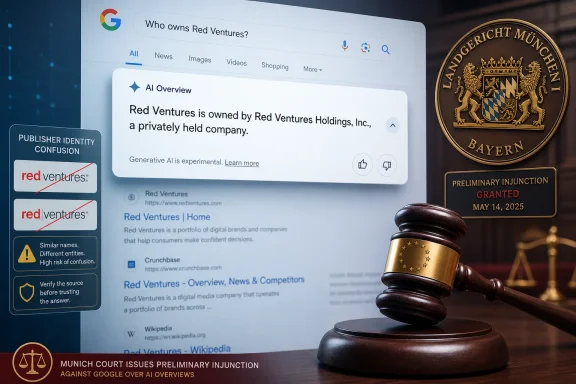 The Search Box Has Become a Speaker
For most of Google’s history, the company’s legal and cultural defense was simple: it organized other people’s information. Search results were a map, not the territory; a directory, not a publisher; a pointer, not an author. That distinction was never perfectly clean, but it was sturdy enough to build one of the most powerful businesses in history.AI Overviews weaken that architecture because they do not look or behave like a list of links. They appear above the old blue-link web, compress multiple sources into a fluent paragraph, and deliver a conclusion in Google’s own interface. The user does not experience that as a bibliography. The user experiences it as an answer.
That is what makes the Munich case more than a local defamation dispute. The legal claim involved two German publishers, Verlagshaus24 and GeraMond Verlag, which said Google’s AI-generated summary falsely associated them with scams, subscription traps, and dubious conduct. According to reporting on the ruling, those claims were not supported by the sources the AI Overview cited; the system had apparently confused the publishers with other entities and then presented the confusion as fact.
The court’s crucial move was to treat the summary not as a neutral transmission of third-party content, but as an independent, new, and substantive statement generated by Google’s system. That phrase matters because it pushes AI search out of the old safe harbor imagination and into the realm of speech made by the service itself. Google can still argue on appeal that the court has overreached. But the line has been drawn.
Germany Did Not Ban AI Search; It Rejected the Magic Trick
The most revealing part of the German ruling is not that Google lost a preliminary round. It is why the court was reportedly unconvinced by Google’s framing. Google argued, in effect, that AI Overviews synthesize information from the web and provide source links that users can inspect for themselves. The court answered with a commonsense principle: if you make a false statement, the existence of a source link does not make the statement disappear.That logic is more dangerous to AI companies than it first appears. The industry has spent the past two years describing generative systems as both revolutionary and derivative, depending on which argument is useful at the moment. In product demos, AI tools are agents, assistants, copilots, and answer engines. In courtrooms and policy debates, they often become probabilistic mirrors of user prompts and web data.
Munich’s court did not have to solve the philosophy of machine speech to puncture that maneuver. It focused on control. Google built the product, placed it at the top of search results, chose the interface, and operates the algorithms. If the result is a new statement that users reasonably attribute to Google, the company cannot fully retreat behind the publishers whose pages were scraped or cited.
This is why the case should worry not only Google but every vendor that has embedded generative AI into a front-line customer experience. Once AI output becomes the default interface, the vendor’s claim to be merely relaying information becomes less persuasive. The more polished the answer, the less plausible it is to say nobody really said it.
The One Percent Click Is the Quiet Fact Under the Whole Case
The practical heart of this fight is user behavior. AI summaries are designed to end the search session early. That is not an accident or a bug; it is the product promise. A user asks a question, the system answers, and the messy work of visiting multiple pages becomes optional.Pew Research Center’s finding that users click through to an AI Overview source at a vanishingly low rate has become a devastating data point in this debate. If only a tiny fraction of users inspect the underlying sources, then source links are less a real safeguard than a liability decoration. They help the interface look accountable without meaningfully changing how most people consume the answer.
That matters for publishers because AI search can absorb the value of their work while reducing visits to their sites. But it matters just as much for liability. A traditional search result tells the user, “Here are places where you might find information.” An AI Overview says, “Here is the information.” Courts, regulators, and users are beginning to understand that these are different acts.
Google knows this, of course. The company is not investing in AI Overviews because users prefer doing more work. It is investing because the search market is shifting toward answer-first interfaces, and because rivals from OpenAI to Perplexity to Microsoft are trying to loosen Google’s hold on information retrieval. But once a product competes on being the final answer, it should not be shocking when a court treats it like one.
America’s Section 230 Shield Was Built for a Different Internet
The obvious American comparison is Section 230 of the Communications Decency Act, the 1996 law that has protected online platforms from being treated as the publisher or speaker of content created by others. Without Section 230, the modern social web would probably be smaller, more cautious, and more heavily moderated. Search engines, forums, marketplaces, and social networks have all depended on the idea that hosting or organizing someone else’s speech is not the same as creating it.Generative AI scrambles that bargain. If a chatbot invents a false allegation, or an AI search box synthesizes a defamatory claim from mismatched sources, is the company hosting third-party content or producing its own? There is no settled U.S. answer. That uncertainty is the legal oxygen around every hallucination case.
Even the law’s authors have argued that Section 230 should not be read to protect companies for content their own systems create or develop. That does not automatically decide how courts will apply the statute to AI tools, because judges will have to parse prompts, training data, retrieval systems, generated text, and product design. But it does undercut the broadest version of the industry’s defense.
The U.S. has already seen an important early case in Walters v. OpenAI, where radio host Mark Walters sued after ChatGPT falsely described him as having embezzled money from a gun-rights organization. OpenAI won summary judgment in Georgia state court in 2025, but not because a court declared all AI hallucinations immune. The ruling turned on ordinary defamation issues: the recipient reportedly knew the output was false, disclaimers warned of possible inaccuracies, and the plaintiff could not prove the required harm.
That case is useful precisely because it was narrow. It did not give AI companies a nationwide get-out-of-liability card. It showed that some hallucination claims will fail under existing defamation doctrine, especially when the false output is seen by a skeptical intermediary and causes no demonstrable damage. A consumer who loses money after relying on a search summary, or a business whose reputation is harmed at scale, may present a different fact pattern.
Disclaimers Are Starting to Look Like Seat Belts Made of Paper
AI companies love disclaimers because disclaimers are cheap. A warning that an answer may be inaccurate can be placed under a text box, inside a terms-of-service document, or beside a generated response. It signals caution without changing the product’s central promise: ask us and we will tell you.The problem is that a disclaimer becomes less persuasive as the product becomes more authoritative. If a system is marketed as an assistant for coding, finance, health, travel, legal research, or enterprise productivity, the vendor cannot indefinitely argue that every answer should be treated like a rumor overheard at a bus stop. The more users are trained to rely on the tool, the weaker the “you should have checked” defense becomes.
This does not mean every AI error should produce liability. Software has always contained bugs, and information products have always made mistakes. A legal regime that punished every incorrect answer would chill useful tools and reward opportunistic litigation. But the opposite regime — one where vendors can automate authoritative-sounding misinformation at scale and call every victim careless — is equally untenable.
The real question is where courts place the burden of verification. In the old search model, users were expected to evaluate sources because the product foregrounded sources. In the AI answer model, the product foregrounds synthesis. That shift should change the responsibility calculus.
For WindowsForum readers, this may sound familiar from decades of computing history. Microsoft has long been blamed for design choices that made unsafe behavior easy, even when users technically clicked the wrong thing. Security law and security culture both learned that interface design matters. AI liability is now entering the same stage.
The Financial Advice Angle Turns Hallucination Into Harm
The AOL article frames the Munich ruling through money decisions, and that is the right instinct. A false statement about a publisher’s reputation is serious, but the broader consumer risk emerges when AI summaries influence taxes, loans, investments, insurance, benefits, or retirement planning. Money questions have clear downstream consequences.A chatbot can be wrong in a way that is funny, annoying, or catastrophic. It may misstate the release date of a video game, invent a PowerShell flag, or confuse a tax rule that costs someone a penalty. The same technical failure — a confident but unsupported answer — occupies very different moral and legal territory depending on what the user does next.
The rapid growth of AI use in personal finance makes this more than a hypothetical. Banks, fintech firms, search engines, and standalone chatbot vendors are all trying to put AI between consumers and complexity. Budgeting advice, mortgage comparisons, savings rates, credit-card terms, fund fees, tax deadlines, and scam warnings are exactly the kinds of topics where users want quick answers.
Yet financial information is also where context matters most. A rate may depend on state, credit score, account type, date, promotional terms, or eligibility. A tax answer may depend on filing status, jurisdiction, income category, and the year in question. A scam warning may depend on whether the tool has correctly identified the entity being discussed.
The Munich case is a warning about identity confusion, not just factual error. The AI Overview allegedly mixed up reputable publishers with questionable businesses. In finance, the equivalent could be confusing a legitimate credit union with a scam site, a registered adviser with an impersonator, or an old fee schedule with a current one. The answer may look tidy while the underlying match is wrong.
Google’s Problem Is That AI Overviews Compete With the Web They Cite
The publisher angle should not be treated as a side issue. Google’s relationship with the web has always been symbiotic and extractive at the same time. Publishers wanted traffic, Google wanted indexable content, and users wanted relevance. Everyone complained, but the bargain mostly held.AI Overviews alter that bargain by turning source material into substituted material. A publisher’s reporting, review, database, or explanation may help produce an answer that prevents the user from visiting the publisher. The publisher supplies the raw material; the platform captures the attention; the user sees the platform’s synthesis.
That is why source links are politically and legally inadequate as a complete answer. They are not nothing. They can help a motivated user verify a claim and can send some traffic back to the web. But when the interface is optimized to answer before the click, links become secondary.
For Google, this is not just a legal problem; it is a product identity problem. Search used to be the place you went to find the web. Increasingly, it is becoming the place where the web is summarized for you. That makes Google more useful in the short term and more exposed in the long term.
The company’s scale makes the exposure especially acute. A false AI Overview is not a bad blog post buried on page six of results. It can be a high-visibility statement delivered by one of the most trusted information interfaces on the planet. If courts treat those statements as Google’s own, the risk profile of search changes dramatically.
The Enterprise Version Will Not Be Softer
Consumer AI hallucinations get headlines, but enterprise AI may produce the more consequential liability fights. Microsoft, Google, OpenAI, Anthropic, Salesforce, ServiceNow, and countless smaller vendors are embedding generative systems into business workflows. These tools summarize emails, draft policies, analyze tickets, classify incidents, write code, and surface answers from internal knowledge bases.In enterprise settings, the old “user should verify everything” defense collides with procurement reality. Companies buy AI copilots to reduce manual verification, not to create a second job for every employee. If a tool summarizes a contract incorrectly, mishandles a compliance requirement, or gives a help desk technician a dangerous remediation step, the question will not be whether AI can make mistakes in the abstract. It will be whether the vendor and customer allocated that risk clearly and reasonably.
Windows administrators already live this tension. AI-assisted troubleshooting can be useful when it helps identify a known error code or draft a script. It can be dangerous when it invents registry keys, misstates Group Policy behavior, or recommends commands without understanding environment-specific constraints. In a lab, that is a learning moment. In production, it can become downtime.
This is where vendor positioning deserves skepticism. “Copilot” is a comforting word because it implies a human remains in command. But if the human is overloaded, undertrained, or pressured to move quickly, the copilot’s suggestion can become the operational decision. The liability conversation will eventually follow the workflow, not the branding.
Security teams should be especially alert. An AI system that confidently misclassifies a threat, fabricates a remediation path, or summarizes an incident incorrectly can alter response decisions. If the tool is merely a drafting aid, the risk is contained. If it becomes part of the decision chain, documentation, auditability, and escalation paths matter.
The Law Is Relearning an Old Software Lesson
The industry tends to treat AI hallucination as a strange new phenomenon, but the policy pattern is familiar. A powerful technology spreads before institutions know how to assign responsibility. Vendors emphasize innovation and user choice. Users discover that “choice” often means absorbing risk created by systems they cannot inspect.We saw versions of this with malware, privacy, ad tracking, app stores, cloud outages, and algorithmic feeds. At first, harms are described as edge cases. Then they become patterns. Eventually regulators and courts stop asking whether the technology is novel and start asking who controlled the design, who profited, who could have prevented the harm, and who was best positioned to fix it.
AI does add a genuine complication: the output is probabilistic and dynamic. A traditional software bug can often be reproduced. A hallucination may vary by prompt, model version, retrieval context, personalization, and timing. That makes evidence harder, but it does not eliminate responsibility.
The Munich court’s approach suggests one possible path: do not try to metaphysically classify the model’s “intent”; examine the statement, the interface, the control, and the attribution. If a reasonable user understands the output as the platform’s answer, and the platform had operational control over the system, liability can attach under ordinary doctrines. That is not anti-technology. It is anti-laundering.
The U.S. may develop a more platform-friendly rule, especially given Section 230’s history and the First Amendment implications around information tools. But even in America, the broad immunity story is not guaranteed. The more generative systems create new text rather than display third-party speech, the more they invite old-fashioned accountability.
Washington Will Move Slower Than the Products
Anyone waiting for Congress to settle AI liability cleanly should prepare for disappointment. U.S. lawmakers have held hearings, floated frameworks, and debated safety obligations, but comprehensive federal AI legislation remains difficult. The technology is moving through products much faster than statutes are moving through committees.That means the near-term American rulebook will probably emerge from a messy combination of state law, contract disputes, agency enforcement, product liability theories, consumer protection claims, and defamation cases. Courts will proceed fact by fact. Some plaintiffs will lose because they cannot prove falsity, reliance, damages, or publication. Some defendants will lose because their systems made specific, harmful claims that disclaimers cannot cure.
Regulators may not need a grand AI statute to act. Consumer protection agencies can scrutinize deceptive claims about accuracy. Financial regulators can examine AI tools used in advice, lending, marketing, or customer support. State attorneys general can pursue unfair or deceptive practices. Professional licensing boards can discipline humans who outsource judgment to unreliable systems.
This patchwork will frustrate vendors, but it may also be the only realistic way the law learns. Broad rules written too early risk either freezing useful experimentation or blessing harmful design choices. Case-by-case pressure, for all its inefficiency, forces the industry to reveal where the real harms are.
For users, though, patchwork means uncertainty. A German publisher may get an injunction. An American plaintiff may lose on defamation elements. A consumer harmed by a financial hallucination may discover that no clear doctrine fits. That uncertainty is not a reason to panic, but it is a reason to treat AI answers as unverified outputs rather than settled facts.
The User’s Burden Is Shrinking in Theory and Growing in Practice
There is an uncomfortable contradiction at the center of AI adoption. In theory, courts like Munich’s may begin shifting responsibility toward the companies that generate answers. In practice, users are being asked to rely on those answers before the law has caught up. The burden is moving in both directions at once.For the next few years, the prudent user has to behave as though liability remains uncertain. That means checking primary sources for anything involving money, health, law, security, employment, or reputation. It means treating generated summaries as leads, not conclusions. It means saving screenshots or logs when a tool gives consequential advice, because transient AI output can vanish or change.
But it would be wrong to frame this entirely as a personal responsibility story. Most users will not inspect every source link, read every disclaimer, or understand the difference between retrieval-augmented generation and model training. Product designers know this. If a system is placed above search results and written in a confident explanatory voice, predictable reliance is part of the design.
That is why the German ruling feels like an early correction to a market imbalance. The company with the interface, data, engineers, and monetization model is usually better positioned to reduce systematic harm than the individual user is to detect it. The user can verify one answer. The platform can change how millions of answers are generated, labeled, constrained, and corrected.
A mature AI ecosystem will need both. Users should not blindly trust generated text, and vendors should not be allowed to hide behind the fact that users should not blindly trust generated text. Those two propositions are not in conflict. They are the beginning of a workable standard.
The Munich Ruling Turns the Answer Box Into Evidence
The most concrete consequence of the German case is that AI output is becoming litigable as product behavior. That should change how companies design, monitor, and correct answer systems. A hallucination is no longer merely embarrassing; it may become a record of publication.For Google, the immediate legal effect is limited by the preliminary nature of the injunction and the specific facts of the case. But the reputational effect is broader. The court has given critics, publishers, regulators, and future plaintiffs a clean phrase for what AI Overviews are: Google’s own statements. Even if that exact formulation does not survive everywhere, it will travel.
The industry response should not be to bury users in longer warnings. It should be to narrow high-risk answer categories, improve entity disambiguation, show uncertainty more honestly, create faster correction channels, and preserve auditable records when harmful outputs are reported. AI systems will never be perfect, but liability often turns on whether a company behaved reasonably once risks were known.
There is also a ranking problem hiding inside the case. If the AI Overview cites sources that do not support the generated claim, the interface creates a false sense of verification. Users see links and assume the answer is grounded. A source that merely appears near an assertion is not the same thing as evidence for that assertion.
That distinction will matter for AI search more broadly. The next generation of answer engines will need to prove not just that they retrieved documents, but that their claims are faithful to those documents. Claim-level provenance may sound like academic plumbing, but it may become a legal necessity.
The Court Case Windows Users Should Read as a Product Warning
For the WindowsForum audience, the lesson is not that Google is uniquely careless or that AI search should be abandoned. The lesson is that AI answers are crossing from convenience into infrastructure before the accountability model is finished. That is exactly when IT people should pay attention.Windows users already live in a world of opaque prompts and persuasive snippets. Search for an error message, a driver issue, a BitLocker recovery problem, or a Windows Update failure, and an AI answer may increasingly appear before the forum thread, Microsoft Learn page, vendor advisory, or KB article. That can save time. It can also flatten nuance.
The safest workflow is not anti-AI. It is layered. Use AI to identify possibilities, translate jargon, draft checklists, and speed up initial triage. Then verify against primary documentation, vendor advisories, known-good community posts, and your own environment before acting.
Administrators should also think about internal policy. If employees use public AI tools for troubleshooting, legal research, finance, HR, or customer communications, the organization needs guidance on when generated output must be verified. Shadow AI is not only a data-leak problem. It is a decision-quality problem.
The Munich ruling gives IT leaders a useful language for procurement conversations. If a vendor’s AI system produces a false statement inside your workflow, who owns the correction process? Are outputs logged? Can harmful answers be reported? Are sources claim-specific or decorative? Does the contract disclaim everything that the sales deck promises?
Google May Win the Appeal and Still Lose the Argument
It is entirely possible that Google narrows or overturns the Munich injunction on appeal. Preliminary rulings are not final judgments, and national legal systems differ sharply in how they treat speech, defamation, platform liability, and personality rights. Anyone declaring a settled global precedent is getting ahead of the record.But legal outcomes are only one part of the story. The argument that AI-generated summaries are merely neutral pointers to the web is becoming less credible as the products become more answer-like. Users do not treat them as search indexes. Companies do not market them as search indexes. Competitors do not fear them because they are search indexes.
That is the strategic bind. The more useful AI search becomes, the more it displaces the user’s independent evaluation of sources. The more it displaces that evaluation, the more courts may ask why the platform should not bear greater responsibility. Product success creates legal exposure.
This is not an existential threat to AI search, but it is a threat to the low-accountability version of AI search. The answer box cannot be both the center of the product and a legal ghost. If it shapes user decisions, it will eventually be treated as an act with consequences.
Google, Microsoft, OpenAI, and the rest of the market can still build systems that reduce risk. They can decline to answer in high-stakes categories when confidence is low. They can distinguish supported claims from inferred ones. They can build stronger correction pipelines. They can stop pretending that a tiny source link fully transfers responsibility to the user.
The New Rule Is Simple: If You Replace the Click, You Inherit the Doubt
The Munich case is best understood as an early signal, not a final destination. It shows how courts may reason when AI-generated text appears in a trusted interface, makes a concrete factual claim, and causes reputational harm. It also shows why the industry’s existing disclaimers and source-link rituals may not satisfy judges.The next phase will be uneven. Europe will probably move faster toward platform responsibility. The United States will wrestle with Section 230, the First Amendment, state defamation law, and consumer protection statutes. Enterprise contracts will quietly allocate risks long before public law catches up.
For readers trying to make practical sense of it, the immediate lessons are more concrete than the legal theory:
- AI Overviews and chatbot answers should be treated as generated claims, not as primary sources.
- Source links are useful only when they actually support the specific claim being made.
- Financial, legal, medical, security, and reputational decisions still require independent verification.
- Disclaimers may help vendors in some lawsuits, but they do not make false statements harmless.
- Organizations should create internal rules for when AI-assisted output can be used, reviewed, logged, and challenged.
- The most important liability fights will turn on product design, user reliance, evidence of harm, and who had the practical ability to prevent the mistake.
References
- Primary source: aol.com
Published: 2026-06-24T17:30:13.343187
Germany just handed Google a landmark defeat, ruling its AI-generated summaries can be held liable for misinformation — is the U.S. next? - AOL
The decision is not yet final, but a German court is treating AI's answers as the company's own words rather than a neutral list of search results.www.aol.com - Independent coverage: The Guardian
Published: Wed, 24 Jun 2026 17:06:00 GMT
If an AI chatbot misleads you, who is to blame? | Bruce Schneier and Nathan E Sanders | The Guardian
A court in Germany found that Google was responsible for what its chatbots say in search summaries. This is the accountability we needwww.theguardian.com - Related coverage: pewresearch.org
- Related coverage: luxgap.com
Munich: Google held liable for false “AI Overviews” — Luxgap
On May 28, 2026, the Munich I Regional Court barred Google from publishing false claims via “AI Overviews,” deeming them Google’s “own statements,” with penalties of up to €250,000 per breach.luxgap.com - Related coverage: ppc.land
Munich court holds Google liable for AI Overviews defamation - a first
A Munich court on May 28, 2026, held Google directly liable for false claims its AI Overviews generated about a German publisher, in a new legal precedent.ppc.land
- Related coverage: elevarus.com
AI Overviews Liability: Munich Ruling Playbook
A Munich court ruled Google directly liable for false AI Overviews claims. Use this weekly operator playbook to monitor and defend your brand now.elevarus.com
- Related coverage: whysogermany.com
Munich Court Holds Google Liable for AI Misinformation, Setting Precedent - whysogermany.com
A Munich court has issued a preliminary injunction against Google, holding it liable for false information generated by its 'AI Overviews' feature. The ruling, dated May 28, 2026, supports two Munich-based publishers who were falsely accused of unfair business practices by...whysogermany.com - Related coverage: pcgamer.com
Google claims most users know 'information generated with AI should not be blindly trusted,' but a court ruled it's still liable for false claims made in AI Overview | PC Gamer
I doubt this will be the last time an AI getting it wrong results in legal repercussions.www.pcgamer.com
