

CambrianEdge.ai’s “AI at Work: The Collaboration Gap 2026” report, published in June 2026 and reported by News First Prime, says 18 percent of surveyed organizations have already reversed or abandoned AI initiatives after adoption failures and quality breakdowns. The headline is not that artificial intelligence has suddenly stopped working. It is that companies bought AI as if it were software and then discovered it behaves more like a co-worker, a process change, and a governance problem all at once. The corporate AI retreat is less a rejection of the technology than a vote of no confidence in the way businesses have tried to bolt it onto work.
The past three years of enterprise AI adoption have been sold with the language of inevitability. Executives were told that copilots, chatbots, agents, and model-powered automation would compress knowledge work, unblock software teams, write first drafts, improve service desks, and make the enterprise faster without necessarily making it different.
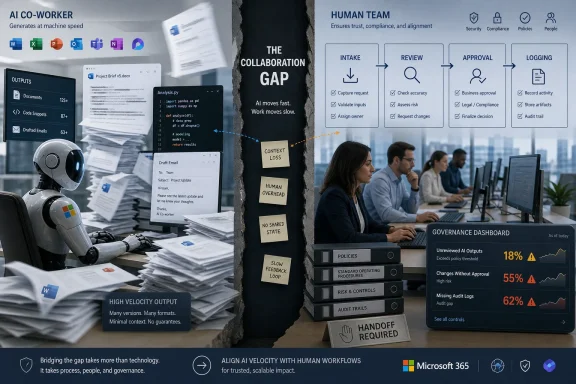
That was always the fragile part of the pitch. AI tools can generate content, code, summaries, tickets, forecasts, and recommendations at machine speed, but companies still approve, route, audit, explain, secure, and maintain work at human-and-committee speed. When those two rhythms collide, the result is not a sleek augmented workplace. It is often a faster way to create unreviewed work, duplicated effort, and confusion over who is accountable.
The CambrianEdge.ai report’s most useful contribution is that it names the missing layer: collaboration infrastructure. According to the study, 55 percent of professionals identify isolated solo AI use or the absence of structured human-machine workflows as a primary operational bottleneck. That finding cuts against the consumerized mythology of generative AI, where a smart person with a prompt box becomes a one-person production engine.
In an enterprise, the unit of productivity is rarely the individual keystroke. It is the handoff, the approval, the escalation, the shared repository, the exception path, the audit trail, and the boring meeting where people agree what “good enough” means. AI can accelerate many of those steps, but only if the company has bothered to define them.
In many companies, AI has become a polished version of shadow IT. Employees use it to draft emails, summarize documents, generate spreadsheet formulas, rewrite code, prepare slide outlines, and troubleshoot problems. Some of that work is genuinely useful. But much of it happens outside shared standards, outside review loops, and outside the systems where enterprise knowledge is supposed to live.
The old shadow IT problem was that people built rogue spreadsheets and unofficial SaaS workflows because central IT could not move fast enough. The new version is subtler. The tools may be approved, licensed, and visible to procurement, but the method is still private. One employee’s prompt pattern, source selection, review threshold, and hallucination checks may never leave their laptop.
That is why the report’s figure that 27 percent of businesses have no collaboration framework in place matters. A company can have enterprise AI subscriptions, usage dashboards, executive sponsorship, and an internal policy portal while still having no real operating model for AI-assisted work. In that environment, every employee becomes a tiny systems integrator.
The result is predictable inconsistency. One team treats AI output as a rough draft. Another treats it as near-final. A third quietly avoids it because the risk is unclear. A fourth uses it heavily but keeps no record of how inputs were selected or how outputs were verified. Senior leadership sees adoption; middle management sees rework.
A model-generated contract summary still needs a legal review. A customer-service response still needs tone, policy, and factual validation. A code suggestion still needs testing, security analysis, and maintainability checks. A financial forecast still needs assumptions, provenance, and sign-off. If none of those checkpoints are standardized, the time saved in drafting can be lost in downstream suspicion.
This is where many executives misunderstand the economics of AI. They focus on the minutes saved by generating a first draft and ignore the minutes added by verification. If the reviewer does not know what sources the AI used, what constraints it was given, what confidence level is appropriate, or what policy applies, review becomes forensic labor.
Poor handoffs also create accountability fog. If an AI-assisted memo contains a bad claim, is the fault with the employee who prompted it, the manager who approved it, the tool owner who configured it, or the department that never created a review process? Enterprises are designed to route responsibility. AI, deployed casually, can blur it.
The report’s claim that structured handoff processes raise goal achievement from 38 percent in unstructured environments to 71 percent in structured ones should not surprise anyone who has run production systems. The history of IT is the history of handoffs becoming formalized: ticket queues, change-management boards, version control, incident response playbooks, CI/CD pipelines, records management, and access-control reviews. AI work now needs its own equivalent.
That is precisely the point. Enterprise technology becomes valuable when the demo is domesticated. The impressive capability must be turned into a repeatable, inspectable, supportable workflow that normal employees can use without improvising the rules every time.
Shared access matters because AI work cannot become a caste system where a few power users generate output that others cannot reproduce. Training matters because prompts are not magic words; they are a way of encoding task intent, constraints, context, and evaluation criteria. Prompt libraries matter because organizations need reusable patterns, not folklore passed around in private chats.
Quality standards are the hardest layer because they require management to say what level of accuracy, sourcing, tone, security, and human review is appropriate for different classes of work. Mandatory review processes are the layer that turns AI from a personal accelerator into a controlled production method. They are also the layer most likely to annoy employees who have grown used to treating chatbots as private assistants.
The report’s starkest statistic is that only 32 percent of companies with no collaboration infrastructure report a significant positive impact from AI, while organizations with all five layers report success at 100 percent. That perfect figure should be read cautiously, as with any vendor-adjacent survey result, but the direction of travel is credible. The more AI is embedded into the way work is governed, the less it resembles a novelty tool.
Those features matter. Integration reduces friction, and security controls are better inside managed platforms than in random consumer accounts. But the platform cannot decide whether the legal department trusts AI-generated summaries, whether HR has approved a review standard for performance documents, whether developers may accept generated code without a second human review, or whether a support agent can send an AI-drafted response to an angry customer.
This distinction is particularly relevant to Windows-heavy organizations. Microsoft has positioned Copilot as a new operating layer for knowledge work, and Windows PCs are now marketed with dedicated neural processing units, Copilot keys, and AI-first experiences. But the existence of AI on the desktop does not answer the enterprise question: what work is allowed to move through this layer, under whose supervision, and with what evidence trail?
For sysadmins and IT pros, that means AI adoption is starting to look less like a licensing project and more like endpoint management, identity governance, data-loss prevention, and change control rolled into one. The question is not merely whether a user has access to an AI tool. It is what data the tool can see, what actions it can take, where outputs are stored, and how exceptions are reviewed.
Platform vendors can provide hooks. They cannot supply institutional judgment. That is why companies that treat AI as a procurement line item often end up disappointed. They bought the instrument, not the orchestra.
That speed creates a trap. A pilot can succeed as a demonstration of possibility while failing as a model of operations. A chatbot can answer questions in a test environment. An agent can process a curated workflow. A model can draft content for a friendly team that already understands the subject. Then the project expands, the inputs get messier, edge cases multiply, review labor grows, and the quality curve bends downward.
This is the quality collapse many organizations are now discovering. The model did not necessarily get worse. The environment got real. Real work contains ambiguous ownership, stale documents, contradictory policies, insecure data habits, hidden dependencies, and employees with uneven training. AI systems amplify whatever they are plugged into.
The phrase “AI readiness” is often used as if it describes infrastructure: data lakes, APIs, compute, model access, and security controls. Those are necessary, but they are not sufficient. A company is not ready for AI merely because its documents are searchable and its users have licenses. It is ready when it can describe how AI changes the work and how the work changes to accommodate AI.
That is a management problem before it is a technology problem. It requires saying no to some use cases, slowing down others, and refusing to count usage as impact. For companies intoxicated by the speed of the AI cycle, that discipline can feel like retreat. In practice, it may be the only route to durable value.
Which human? At what stage? With what training? Using what evidence? Under what deadline? With what authority to reject the AI output? With what record kept afterward? These are not pedantic questions. They are the difference between meaningful oversight and a rubber stamp.
In many workplaces, the human in the loop is simply the person unlucky enough to be downstream from the AI output. They receive a draft, a summary, a ticket, a code block, or a decision recommendation and must decide whether to trust it. If the system saved five minutes for the originator but added fifteen minutes of checking for the reviewer, the productivity gain has merely been shifted around the organization.
Structured review processes change that equation. They can define which outputs require sampling, which require full review, which require source attachment, and which are too sensitive for AI assistance at all. They can also create feedback loops so that bad outputs improve future prompts, retrieval sources, or tool settings rather than becoming one-off frustrations.
This is where AI governance should move beyond policy PDFs. Employees do not need a 40-page document telling them to be careful. They need workflows that make careful work the default. Good governance is embedded in the path of least resistance.
AI is different in capability but familiar in failure mode. It expands what users can do before organizations have decided what users should do. It creates new productivity surfaces before IT has mapped the control plane. It rewards experimentation while punishing ambiguity at scale.
The Copilot era will sharpen this tension. As AI features become native to operating systems, browsers, productivity suites, developer tools, and service platforms, opting out will become harder. Employees will not experience AI as a discrete application. They will experience it as an ambient option: summarize this, draft that, generate this, explain that, automate this next step.
That ambient quality is both powerful and dangerous. It lowers the threshold for useful assistance, but it also lowers the threshold for accidental policy violations, lazy verification, and undocumented decision-making. If the AI button is everywhere, the rules for using it cannot live nowhere.
For administrators, this creates a new layer of work. AI policy will need to intersect with identity, conditional access, sensitivity labels, logging, retention, endpoint configuration, browser controls, and SaaS governance. The organizations that handle this well will not be the ones with the flashiest demos. They will be the ones that make AI boringly manageable.
An AI user improves a task. An AI-capable organization improves the system around the task. The distinction matters because individual productivity can vanish when work enters a team process. A salesperson may write faster emails, but if CRM notes remain poor, forecasting does not improve. A developer may generate code faster, but if review and testing lag, release quality falls. A marketer may produce more copy, but if brand and legal review become overwhelmed, campaign velocity does not increase.
This is why isolated usage can hurt firm productivity even when it helps individual employees. The bottleneck moves. The organization sees more drafts, more variants, more output, and more decisions requiring review. Without shared standards, AI increases the volume of work that must be sorted.
The next phase of enterprise AI will therefore reward companies that stop asking, “How many employees are using AI?” and start asking, “Which workflows have been redesigned around AI from intake to approval?” That is a less flattering question because it exposes whether leadership has done the organizational work.
It also forces a budget conversation. If AI is supposed to change workflows, then the investment cannot stop at licenses. It must include training time, process redesign, internal documentation, governance tooling, audit capacity, and managers capable of measuring outcomes rather than anecdotes.
Pulling back from a failed deployment is not necessarily anti-innovation. It may be the first adult decision in an AI program that started with executive panic and vendor enthusiasm. The danger is that boards and leadership teams learn the wrong lesson, concluding that AI itself is unreliable rather than that their deployment model was immature.
A healthier reset would treat the rollback as a post-incident review. What tasks were targeted? What data was available? Who reviewed output? What quality failures occurred? Were employees trained? Were prompts shared? Were policies enforceable inside the workflow? Did success metrics measure business outcomes or simply tool usage?
That kind of review will often reveal that AI did exactly what it was allowed to do: generate plausible work quickly inside a poorly designed system. The failure was not imagination. It was integration.
Enterprises have gone through this cycle before with cloud, mobile, collaboration suites, robotic process automation, and low-code tools. The winning pattern is rarely total abandonment. It is consolidation, standardization, governance, and a second wave of adoption with clearer boundaries.
 The AI Backlash Is Really a Workflow Backlash
The past three years of enterprise AI adoption have been sold with the language of inevitability. Executives were told that copilots, chatbots, agents, and model-powered automation would compress knowledge work, unblock software teams, write first drafts, improve service desks, and make the enterprise faster without necessarily making it different.That was always the fragile part of the pitch. AI tools can generate content, code, summaries, tickets, forecasts, and recommendations at machine speed, but companies still approve, route, audit, explain, secure, and maintain work at human-and-committee speed. When those two rhythms collide, the result is not a sleek augmented workplace. It is often a faster way to create unreviewed work, duplicated effort, and confusion over who is accountable.
The CambrianEdge.ai report’s most useful contribution is that it names the missing layer: collaboration infrastructure. According to the study, 55 percent of professionals identify isolated solo AI use or the absence of structured human-machine workflows as a primary operational bottleneck. That finding cuts against the consumerized mythology of generative AI, where a smart person with a prompt box becomes a one-person production engine.
In an enterprise, the unit of productivity is rarely the individual keystroke. It is the handoff, the approval, the escalation, the shared repository, the exception path, the audit trail, and the boring meeting where people agree what “good enough” means. AI can accelerate many of those steps, but only if the company has bothered to define them.
The Prompt Box Became the New Shadow IT
The first wave of corporate AI adoption was driven by access. Give employees a sanctioned chatbot, connect it to Microsoft 365 or Google Workspace, run a few lunch-and-learns, and assume the usage graph will bend toward productivity. That strategy produced activity, but activity is not the same as operational value.In many companies, AI has become a polished version of shadow IT. Employees use it to draft emails, summarize documents, generate spreadsheet formulas, rewrite code, prepare slide outlines, and troubleshoot problems. Some of that work is genuinely useful. But much of it happens outside shared standards, outside review loops, and outside the systems where enterprise knowledge is supposed to live.
The old shadow IT problem was that people built rogue spreadsheets and unofficial SaaS workflows because central IT could not move fast enough. The new version is subtler. The tools may be approved, licensed, and visible to procurement, but the method is still private. One employee’s prompt pattern, source selection, review threshold, and hallucination checks may never leave their laptop.
That is why the report’s figure that 27 percent of businesses have no collaboration framework in place matters. A company can have enterprise AI subscriptions, usage dashboards, executive sponsorship, and an internal policy portal while still having no real operating model for AI-assisted work. In that environment, every employee becomes a tiny systems integrator.
The result is predictable inconsistency. One team treats AI output as a rough draft. Another treats it as near-final. A third quietly avoids it because the risk is unclear. A fourth uses it heavily but keeps no record of how inputs were selected or how outputs were verified. Senior leadership sees adoption; middle management sees rework.
Productivity Gains Disappear at the Handoff
The most dangerous moment in AI-assisted work is not always the generation step. It is the handoff from machine output to human responsibility. CambrianEdge.ai says 62 percent of organizations have no formally defined process for handing AI-generated material to human reviewers for quality control. That is the crack through which many promised productivity gains disappear.A model-generated contract summary still needs a legal review. A customer-service response still needs tone, policy, and factual validation. A code suggestion still needs testing, security analysis, and maintainability checks. A financial forecast still needs assumptions, provenance, and sign-off. If none of those checkpoints are standardized, the time saved in drafting can be lost in downstream suspicion.
This is where many executives misunderstand the economics of AI. They focus on the minutes saved by generating a first draft and ignore the minutes added by verification. If the reviewer does not know what sources the AI used, what constraints it was given, what confidence level is appropriate, or what policy applies, review becomes forensic labor.
Poor handoffs also create accountability fog. If an AI-assisted memo contains a bad claim, is the fault with the employee who prompted it, the manager who approved it, the tool owner who configured it, or the department that never created a review process? Enterprises are designed to route responsibility. AI, deployed casually, can blur it.
The report’s claim that structured handoff processes raise goal achievement from 38 percent in unstructured environments to 71 percent in structured ones should not surprise anyone who has run production systems. The history of IT is the history of handoffs becoming formalized: ticket queues, change-management boards, version control, incident response playbooks, CI/CD pipelines, records management, and access-control reviews. AI work now needs its own equivalent.
The Five-Layer Stack Is Less Glamorous Than the Demo
CambrianEdge.ai identifies five layers that separate productive AI deployments from disappointing ones: shared tool access, formal training programs, standardized prompt libraries, strict quality standards, and mandatory review processes. None of these is as exciting as a stage demo in which an agent builds an app, answers a question, or reconciles a pile of documents in seconds.That is precisely the point. Enterprise technology becomes valuable when the demo is domesticated. The impressive capability must be turned into a repeatable, inspectable, supportable workflow that normal employees can use without improvising the rules every time.
Shared access matters because AI work cannot become a caste system where a few power users generate output that others cannot reproduce. Training matters because prompts are not magic words; they are a way of encoding task intent, constraints, context, and evaluation criteria. Prompt libraries matter because organizations need reusable patterns, not folklore passed around in private chats.
Quality standards are the hardest layer because they require management to say what level of accuracy, sourcing, tone, security, and human review is appropriate for different classes of work. Mandatory review processes are the layer that turns AI from a personal accelerator into a controlled production method. They are also the layer most likely to annoy employees who have grown used to treating chatbots as private assistants.
The report’s starkest statistic is that only 32 percent of companies with no collaboration infrastructure report a significant positive impact from AI, while organizations with all five layers report success at 100 percent. That perfect figure should be read cautiously, as with any vendor-adjacent survey result, but the direction of travel is credible. The more AI is embedded into the way work is governed, the less it resembles a novelty tool.
Microsoft, Google, and OpenAI Cannot Fix the Org Chart
This is uncomfortable for the major platform vendors because it means the hardest part of enterprise AI sits outside the model. Microsoft can put Copilot into Windows, Edge, Teams, Outlook, Word, Excel, PowerPoint, GitHub, and the admin stack. Google can push Gemini through Workspace and Cloud. OpenAI, Anthropic, Meta, Amazon, Salesforce, ServiceNow, and a long tail of vendors can offer agents, connectors, memory, retrieval, and workflow automation.Those features matter. Integration reduces friction, and security controls are better inside managed platforms than in random consumer accounts. But the platform cannot decide whether the legal department trusts AI-generated summaries, whether HR has approved a review standard for performance documents, whether developers may accept generated code without a second human review, or whether a support agent can send an AI-drafted response to an angry customer.
This distinction is particularly relevant to Windows-heavy organizations. Microsoft has positioned Copilot as a new operating layer for knowledge work, and Windows PCs are now marketed with dedicated neural processing units, Copilot keys, and AI-first experiences. But the existence of AI on the desktop does not answer the enterprise question: what work is allowed to move through this layer, under whose supervision, and with what evidence trail?
For sysadmins and IT pros, that means AI adoption is starting to look less like a licensing project and more like endpoint management, identity governance, data-loss prevention, and change control rolled into one. The question is not merely whether a user has access to an AI tool. It is what data the tool can see, what actions it can take, where outputs are stored, and how exceptions are reviewed.
Platform vendors can provide hooks. They cannot supply institutional judgment. That is why companies that treat AI as a procurement line item often end up disappointed. They bought the instrument, not the orchestra.
The Quality Collapse Was Built Into the Pilot Culture
The retreat described in the CambrianEdge.ai report also reflects a deeper problem: the corporate pilot machine. Enterprises love pilots because they are small enough to approve, exciting enough to publicize internally, and vague enough to avoid the brutal details of production. AI pilots, in particular, are easy to start because the first visible result appears quickly.That speed creates a trap. A pilot can succeed as a demonstration of possibility while failing as a model of operations. A chatbot can answer questions in a test environment. An agent can process a curated workflow. A model can draft content for a friendly team that already understands the subject. Then the project expands, the inputs get messier, edge cases multiply, review labor grows, and the quality curve bends downward.
This is the quality collapse many organizations are now discovering. The model did not necessarily get worse. The environment got real. Real work contains ambiguous ownership, stale documents, contradictory policies, insecure data habits, hidden dependencies, and employees with uneven training. AI systems amplify whatever they are plugged into.
The phrase “AI readiness” is often used as if it describes infrastructure: data lakes, APIs, compute, model access, and security controls. Those are necessary, but they are not sufficient. A company is not ready for AI merely because its documents are searchable and its users have licenses. It is ready when it can describe how AI changes the work and how the work changes to accommodate AI.
That is a management problem before it is a technology problem. It requires saying no to some use cases, slowing down others, and refusing to count usage as impact. For companies intoxicated by the speed of the AI cycle, that discipline can feel like retreat. In practice, it may be the only route to durable value.
The Human-in-the-Loop Cliché Finally Meets Operations
For years, vendors and executives have reassured anxious employees with the phrase human in the loop. It sounded balanced: AI would do the repetitive work, humans would supervise, and everyone would move up the value chain. The problem is that “human in the loop” was often a slogan rather than a design.Which human? At what stage? With what training? Using what evidence? Under what deadline? With what authority to reject the AI output? With what record kept afterward? These are not pedantic questions. They are the difference between meaningful oversight and a rubber stamp.
In many workplaces, the human in the loop is simply the person unlucky enough to be downstream from the AI output. They receive a draft, a summary, a ticket, a code block, or a decision recommendation and must decide whether to trust it. If the system saved five minutes for the originator but added fifteen minutes of checking for the reviewer, the productivity gain has merely been shifted around the organization.
Structured review processes change that equation. They can define which outputs require sampling, which require full review, which require source attachment, and which are too sensitive for AI assistance at all. They can also create feedback loops so that bad outputs improve future prompts, retrieval sources, or tool settings rather than becoming one-off frustrations.
This is where AI governance should move beyond policy PDFs. Employees do not need a 40-page document telling them to be careful. They need workflows that make careful work the default. Good governance is embedded in the path of least resistance.
The Windows Enterprise Has Seen This Movie Before
WindowsForum readers do not need to be told that technology adoption fails when tooling outruns process. The history of enterprise Windows is full of similar lessons: unmanaged local admin rights, chaotic Group Policy sprawl, rushed cloud migrations, unowned SharePoint sites, Teams channels that became document graveyards, and endpoint fleets whose security posture depended on heroic administrators rather than coherent design.AI is different in capability but familiar in failure mode. It expands what users can do before organizations have decided what users should do. It creates new productivity surfaces before IT has mapped the control plane. It rewards experimentation while punishing ambiguity at scale.
The Copilot era will sharpen this tension. As AI features become native to operating systems, browsers, productivity suites, developer tools, and service platforms, opting out will become harder. Employees will not experience AI as a discrete application. They will experience it as an ambient option: summarize this, draft that, generate this, explain that, automate this next step.
That ambient quality is both powerful and dangerous. It lowers the threshold for useful assistance, but it also lowers the threshold for accidental policy violations, lazy verification, and undocumented decision-making. If the AI button is everywhere, the rules for using it cannot live nowhere.
For administrators, this creates a new layer of work. AI policy will need to intersect with identity, conditional access, sensitivity labels, logging, retention, endpoint configuration, browser controls, and SaaS governance. The organizations that handle this well will not be the ones with the flashiest demos. They will be the ones that make AI boringly manageable.
The Real Divide Is Between AI Users and AI Organizations
The corporate AI conversation often measures adoption by asking whether employees use AI tools. That is the wrong ceiling. A business can have thousands of AI users and still not be an AI-capable organization.An AI user improves a task. An AI-capable organization improves the system around the task. The distinction matters because individual productivity can vanish when work enters a team process. A salesperson may write faster emails, but if CRM notes remain poor, forecasting does not improve. A developer may generate code faster, but if review and testing lag, release quality falls. A marketer may produce more copy, but if brand and legal review become overwhelmed, campaign velocity does not increase.
This is why isolated usage can hurt firm productivity even when it helps individual employees. The bottleneck moves. The organization sees more drafts, more variants, more output, and more decisions requiring review. Without shared standards, AI increases the volume of work that must be sorted.
The next phase of enterprise AI will therefore reward companies that stop asking, “How many employees are using AI?” and start asking, “Which workflows have been redesigned around AI from intake to approval?” That is a less flattering question because it exposes whether leadership has done the organizational work.
It also forces a budget conversation. If AI is supposed to change workflows, then the investment cannot stop at licenses. It must include training time, process redesign, internal documentation, governance tooling, audit capacity, and managers capable of measuring outcomes rather than anecdotes.
The Retrenchment May Be Healthier Than the Hype
There is a temptation to read the 18 percent rollback figure as evidence that enterprise AI was overhyped. It was. But the more interesting reading is that companies are beginning to distinguish between AI theater and AI operations.Pulling back from a failed deployment is not necessarily anti-innovation. It may be the first adult decision in an AI program that started with executive panic and vendor enthusiasm. The danger is that boards and leadership teams learn the wrong lesson, concluding that AI itself is unreliable rather than that their deployment model was immature.
A healthier reset would treat the rollback as a post-incident review. What tasks were targeted? What data was available? Who reviewed output? What quality failures occurred? Were employees trained? Were prompts shared? Were policies enforceable inside the workflow? Did success metrics measure business outcomes or simply tool usage?
That kind of review will often reveal that AI did exactly what it was allowed to do: generate plausible work quickly inside a poorly designed system. The failure was not imagination. It was integration.
Enterprises have gone through this cycle before with cloud, mobile, collaboration suites, robotic process automation, and low-code tools. The winning pattern is rarely total abandonment. It is consolidation, standardization, governance, and a second wave of adoption with clearer boundaries.
The Companies That Slow Down Now May Move Faster Later
The practical lesson from the CambrianEdge.ai report is not that organizations should pause AI until every process is perfect. That would be impossible, and it would surrender too much learning. The lesson is that companies should stop confusing permission with readiness.- Companies that have abandoned AI projects should examine whether the failed initiative lacked workflow design before blaming the model or the vendor.
- IT teams should treat AI output handoffs as a first-class process, with defined reviewers, quality thresholds, and audit expectations.
- Business leaders should measure AI success by completed workflow outcomes rather than individual usage rates or anecdotal time savings.
- Employees need shared prompt patterns, training, and review norms so that AI-assisted work can be reproduced and trusted by colleagues.
- Windows and Microsoft 365 administrators should expect AI governance to become part of ordinary endpoint, identity, compliance, and data-protection work.
References
- Primary source: NewsFirst Prime
Published: 2026-06-27T14:23:11.176500
The AI retreat: Why poor teamwork is derailing corporate tech
Companies are abandoning AI due to poor human-machine teamwork. A new report warns that isolated AI usage without structured workflows hurts firm productivity. TECHNOLOGY, TOP NEWS newsfirstprime.com
