

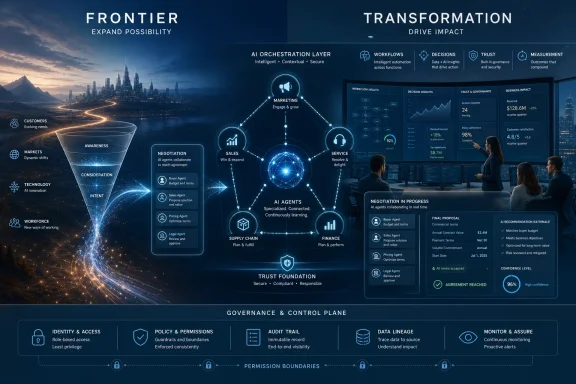
Microsoft said on June 11, 2026, that its CMO AI Innovation Forums at CES and Cannes Lions showed marketing leaders moving from AI pilots toward “Frontier Transformation,” a Microsoft framing for embedding AI into everyday workflows to produce measurable business outcomes. The important word is not AI. It is work. Microsoft is arguing that the next competitive divide in marketing will not be between companies that have tried generative AI and companies that have not, but between organizations that can wire AI into decisions and organizations still treating it as a clever add-on.
That is a useful provocation, even if it arrives wrapped in the usual enterprise-platform language. The post is not a product launch, and it is not really a marketing thought piece in the old sense. It is a signal about where Microsoft wants the AI conversation to go next: away from novelty, away from isolated copilots, and toward operating models in which AI touches revenue, attribution, customer service, supply chains, governance, and the uncomfortable politics of who owns a decision.
The first phase of enterprise generative AI was unusually theatrical. Companies ran workshops, launched internal sandboxes, built prompt libraries, and put “AI transformation” on quarterly slides. Marketing departments were among the earliest and loudest adopters because the use cases were obvious: drafting copy, resizing campaigns, summarizing research, generating variants, and reducing the blank-page problem that has haunted creative teams since long before ChatGPT.
Microsoft’s latest CMO framing says that phase is over. Boards and CEOs, in the company’s telling, are no longer interested in the mere existence of pilots. They want monetization, measurable growth, margin expansion, and a visible line from AI investment to business impact.
That shift matters because it changes the burden of proof. In 2023 and 2024, a marketing leader could plausibly defend AI experimentation as strategic learning. By mid-2026, the argument has hardened: if the budget is real, the return has to be real too.
The tension is that marketing has always been a measurement swamp. The industry has spent decades arguing over attribution, incrementality, brand lift, funnel leakage, media mix modeling, and the difference between a customer being persuaded and a customer merely being counted. AI does not simplify that problem. It makes it faster, murkier, and more expensive to misunderstand.
Microsoft’s thesis is therefore more disruptive than it first sounds. If AI is embedded “in the flow of work,” it cannot be measured like a separate tool. It becomes part of the process that produces the campaign, targets the customer, informs the salesperson, updates the website, triggers the offer, and resolves the complaint. That is good for platform vendors. It is also a governance headache for everyone else.
Microsoft’s forum recap says CMOs are moving beyond proxy metrics such as content output and hours saved toward value-based measurement. That sounds obvious until one tries to implement it. The difference between “we generated more assets” and “we increased conversion quality without eroding trust” is the difference between an activity report and a business case.
This is where the pressure on CMOs becomes especially acute. Marketing is often asked to be both creative engine and revenue instrument, both brand steward and performance machine. AI intensifies both sides of that job. It can industrialize personalization, but it can also industrialize sameness. It can speed up campaign execution, but it can also speed up bad assumptions.
The phrase “speed-to-market as a competitive advantage” deserves scrutiny. Speed is valuable when the organization is learning faster than its rivals. It is dangerous when the organization is merely publishing faster than it can validate. Generative AI makes both outcomes possible, and the difference depends less on the model than on the management system around it.
For WindowsForum readers who live closer to IT operations than brand strategy, this should sound familiar. The history of enterprise software is full of tools sold as productivity multipliers that later became integration, security, licensing, and audit problems. Marketing’s AI moment is following the same arc, just with better demos and more Cannes lighting.
The post says CMOs described teams juggling 25 to 30 disconnected applications, with AI pilots layered on top but rarely integrated end to end. That number will feel painfully plausible to anyone who has seen a modern marketing stack. CRM, campaign automation, analytics, web personalization, data clean rooms, social tools, creative suites, commerce platforms, survey systems, support platforms, and BI dashboards often coexist more than they collaborate.
AI does not magically solve that fragmentation. In many cases, it exposes it. A language model can summarize a customer record only if the record exists, is accessible, is clean enough to use, and is governed in a way the business can defend. An agent can orchestrate a workflow only if the workflow is documented. A recommendation system can improve a handoff only if departments agree on what a good handoff looks like.
This is the unglamorous core of the “Frontier Transformation” argument. The frontier is not a chatbot that writes better subject lines. The frontier is the messy interior of the company: permissions, data contracts, process ownership, escalation rules, identity, audit trails, and the awkward fact that many business processes still rely on tribal knowledge.
Marketing leaders may be the public face of this shift because AI’s creative abilities are highly visible. But the work quickly becomes cross-functional plumbing. That is why Microsoft’s framing lands so close to its broader enterprise pitch: the company wants AI to sit across productivity, cloud, data, security, CRM, and collaboration rather than remain trapped in a point solution.
That idea should unsettle marketers more than another round of generative copywriting tools. Traditional digital marketing assumes, however imperfectly, that a person sees a message, clicks a result, visits a page, compares options, and eventually buys or leaves. The analytics stack was built around that fiction.
AI agents complicate the fiction. If a customer asks an assistant to find the best laptop, cloud backup plan, CRM package, antivirus suite, or vacation bundle, the brand may never get the same kind of impression it once optimized for. The agent may summarize options, filter claims, rank vendors, negotiate price, or complete a transaction with little exposure to the old funnel.
That does not mean brand disappears. It means brand becomes machine-readable. Product data, reviews, support history, pricing transparency, trust signals, return policies, security disclosures, and content structure all become part of what a model or agent may interpret as the “truth” about a company.
Microsoft phrases this as optimizing not just for human attention but for machine comprehension and recommendation. That is a profound shift. Search engine optimization trained companies to write for algorithms while pretending to write for people. Agentic commerce may force them to write for machines that are themselves acting as customer proxies.
There is a risk here of overclaiming the speed of behavioral change. Consumers do not abandon habits overnight, and purchasing decisions vary wildly by category. A person may delegate commodity purchases to an agent long before trusting one to choose a mortgage, a medical device, or a wedding venue. Still, the direction is clear enough that CMOs would be negligent to ignore it.
That second form of trust is often under-discussed. Enterprise AI fails not only when it produces bad answers, but when nobody knows whether a good answer is safe to use. If a marketing analyst receives an AI-generated recommendation to shift budget, who is accountable? If a customer-facing agent offers the wrong discount, who owns the mistake? If an AI system synthesizes market research from incomplete data, how does the organization know when confidence is warranted?
These are not philosophical edge cases. They are operating questions. Marketing departments already deal with brand safety, regulatory claims, regional privacy rules, accessibility requirements, and industry-specific compliance. AI inserts a probabilistic layer into work that was already full of approval gates.
The most mature organizations will not be the ones that blindly trust AI. They will be the ones that know where trust is appropriate, where review is mandatory, and where automation is simply not worth the risk. That requires more than a responsible AI slide. It requires instrumentation, logging, policy, training, and escalation paths that employees can actually follow.
This is where Microsoft’s enterprise heritage helps its argument. The company knows that large organizations do not adopt technology solely because it is impressive. They adopt it when legal, security, compliance, procurement, and IT can live with it. The AI race is now partly a trust-infrastructure race.
When a company says it wants AI embedded in workflows, it is also saying it wants AI embedded in the tools employees use all day. That means Office documents, Teams meetings, Outlook threads, SharePoint libraries, Dynamics records, Power Platform automations, browser sessions, and Windows endpoints become part of the AI substrate.
The opportunity is obvious. A marketer could move from campaign planning to audience insight to sales enablement to customer follow-up without constantly translating context between systems. A manager could ask for a pipeline narrative that reflects recent meetings, campaign performance, and support escalations. A service lead could see marketing promises and customer complaints in the same operational frame.
The risk is equally obvious. The more AI can see, the more permission hygiene matters. The more it can summarize, the more oversharing becomes visible. The more it can act, the more identity, conditional access, data loss prevention, retention, and audit policy become business-critical rather than back-office controls.
This is not just a cloud story. It is an endpoint story because employees experience AI through the workstation. The quality of that experience will depend on performance, integration, policy, and whether admins can control the blast radius when a vendor’s exciting new capability meets a company’s messy reality.
That does not make the argument wrong. It does mean buyers should read it with their procurement brain switched on. “End-to-end” can mean fewer seams and better governance. It can also mean deeper dependence on one vendor’s identity model, data layer, licensing strategy, admin center, roadmap, and interpretation of what work should look like.
Marketing leaders may welcome that integration because their current toolchains are exhausting. But IT leaders will ask a different set of questions. Can the organization export the data? Can third-party models participate? Can policies be enforced consistently? Can logs be reviewed outside the vendor’s preferred dashboard? Can a business unit adopt an AI agent without creating a shadow process nobody can audit?
The answer will vary by product and tenant configuration, and it will change over time. That is precisely why the AI-at-work conversation cannot stay in the keynote layer. If AI becomes workflow infrastructure, then architecture decisions made in the name of speed will shape governance for years.
The best customers will use Microsoft’s framing without surrendering to it. They will accept that AI must move from pilots into operational systems, while still demanding portability, observability, administrative control, and honest economics. The worst customers will confuse platform coherence with strategy.
That is not the traditional marketing job. It is closer to systems leadership. The CMO now has to care not only about what message reaches the customer, but how the organization senses demand, interprets intent, acts on signals, and learns from outcomes.
This changes the political economy of marketing. If AI-powered personalization depends on supply chain visibility, marketing needs a relationship with operations. If agentic commerce changes attribution, marketing needs a new compact with finance. If content must be structured and verifiable for machine interpretation, marketing needs closer ties to data teams and product owners. If AI interactions affect brand trust, marketing needs governance with legal, security, and customer support.
The result is that “functional excellence” becomes insufficient. A brilliant campaign that cannot connect to inventory, pricing, sales readiness, or service reality is not brilliant in an AI-mediated operating model. It is a local optimization.
This may be the most important managerial implication of Microsoft’s post. AI is not merely giving marketers better tools. It is making the boundaries of marketing less defensible. The department that once owned attention must now help orchestrate intent.
The hard part is that AI’s effects may be distributed. A model that improves sales prioritization may depend on marketing data. A service agent that reduces churn may depend on campaign promises being captured correctly. A personalization engine may improve conversion while also changing customer expectations in ways that raise support costs.
Traditional departmental budgeting struggles with those cross-functional effects. If marketing pays for the AI system but sales captures the revenue, who funds the next iteration? If service absorbs the risk of a marketing automation decision, who owns the control? If IT enforces the governance, who gets credit for the safe outcome?
These are not merely accounting details. They determine behavior. Organizations that keep measuring AI within narrow departmental boundaries will keep funding narrow departmental automations. Organizations that want cross-functional AI need cross-functional value models.
Microsoft is nudging customers toward that conclusion because it aligns with the company’s platform story. But the operational point stands on its own. The next stage of AI deployment will reward companies that can measure across workflows rather than count tools inside silos.
That kind of work rarely gets a Cannes panel excited. It is also the work that separates a demo from a system. Microsoft’s post hints at this when it says agentic AI exposes undocumented processes, tribal knowledge, and governance gaps. In other words, AI does not just automate the enterprise. It audits the enterprise.
This is a useful corrective to the fantasy that agents can be dropped into chaotic workflows and simply figure things out. They can infer, summarize, and recommend, but reliable business action requires explicit rules and clean context. A human employee can sometimes compensate for organizational ambiguity through relationships and judgment. An AI agent may instead reproduce the ambiguity at machine speed.
The companies that win early will probably be the ones that treat AI deployment as an organizational design project. They will ask what decisions should be automated, what decisions should be assisted, what decisions should remain human, and what evidence is required before action. That is slower than buying software. It is also how software becomes durable.
That tension is the story. AI is dragging the soft and hard sides of business into the same room. Brand teams must care about data schemas. IT teams must care about customer experience. Finance teams must care about attribution models that may include machine agents. Legal teams must care about AI-generated interactions that can scale faster than review processes.
For Microsoft, this is a commercial opening. For customers, it is an organizational reckoning. The company is effectively saying that AI transformation will not be won by the department with the most imaginative prompts, but by the enterprise that can connect its workflows well enough for AI to matter.
That is a high bar. It also explains why so many pilots feel impressive and unsatisfying at the same time. They show what a model can do in isolation. They do not prove what a business can do when the model is embedded in the messy chain of decisions that produces value.
That is a useful provocation, even if it arrives wrapped in the usual enterprise-platform language. The post is not a product launch, and it is not really a marketing thought piece in the old sense. It is a signal about where Microsoft wants the AI conversation to go next: away from novelty, away from isolated copilots, and toward operating models in which AI touches revenue, attribution, customer service, supply chains, governance, and the uncomfortable politics of who owns a decision.
 Microsoft Wants AI to Leave the Demo Room
The first phase of enterprise generative AI was unusually theatrical. Companies ran workshops, launched internal sandboxes, built prompt libraries, and put “AI transformation” on quarterly slides. Marketing departments were among the earliest and loudest adopters because the use cases were obvious: drafting copy, resizing campaigns, summarizing research, generating variants, and reducing the blank-page problem that has haunted creative teams since long before ChatGPT.Microsoft’s latest CMO framing says that phase is over. Boards and CEOs, in the company’s telling, are no longer interested in the mere existence of pilots. They want monetization, measurable growth, margin expansion, and a visible line from AI investment to business impact.
That shift matters because it changes the burden of proof. In 2023 and 2024, a marketing leader could plausibly defend AI experimentation as strategic learning. By mid-2026, the argument has hardened: if the budget is real, the return has to be real too.
The tension is that marketing has always been a measurement swamp. The industry has spent decades arguing over attribution, incrementality, brand lift, funnel leakage, media mix modeling, and the difference between a customer being persuaded and a customer merely being counted. AI does not simplify that problem. It makes it faster, murkier, and more expensive to misunderstand.
Microsoft’s thesis is therefore more disruptive than it first sounds. If AI is embedded “in the flow of work,” it cannot be measured like a separate tool. It becomes part of the process that produces the campaign, targets the customer, informs the salesperson, updates the website, triggers the offer, and resolves the complaint. That is good for platform vendors. It is also a governance headache for everyone else.
The Spreadsheet Era of AI ROI Is Already Cracking
The easiest AI metric is time saved. It is also the least satisfying. If a content marketer produces ten campaign variants in the time it once took to produce three, that may be useful, but it does not prove that the company has grown revenue, improved retention, or strengthened its brand.Microsoft’s forum recap says CMOs are moving beyond proxy metrics such as content output and hours saved toward value-based measurement. That sounds obvious until one tries to implement it. The difference between “we generated more assets” and “we increased conversion quality without eroding trust” is the difference between an activity report and a business case.
This is where the pressure on CMOs becomes especially acute. Marketing is often asked to be both creative engine and revenue instrument, both brand steward and performance machine. AI intensifies both sides of that job. It can industrialize personalization, but it can also industrialize sameness. It can speed up campaign execution, but it can also speed up bad assumptions.
The phrase “speed-to-market as a competitive advantage” deserves scrutiny. Speed is valuable when the organization is learning faster than its rivals. It is dangerous when the organization is merely publishing faster than it can validate. Generative AI makes both outcomes possible, and the difference depends less on the model than on the management system around it.
For WindowsForum readers who live closer to IT operations than brand strategy, this should sound familiar. The history of enterprise software is full of tools sold as productivity multipliers that later became integration, security, licensing, and audit problems. Marketing’s AI moment is following the same arc, just with better demos and more Cannes lighting.
The Real Bottleneck Is the Organization Chart
Microsoft’s strongest claim is that AI initiatives fail when they are contained within a single function. That is not vendor poetry; it is a practical observation. A marketing department can produce better segmentation, sharper content, and more responsive campaigns, but if sales ignores the signals, commerce cannot personalize inventory, service cannot see the customer context, and finance cannot recognize the value, the system remains fragmented.The post says CMOs described teams juggling 25 to 30 disconnected applications, with AI pilots layered on top but rarely integrated end to end. That number will feel painfully plausible to anyone who has seen a modern marketing stack. CRM, campaign automation, analytics, web personalization, data clean rooms, social tools, creative suites, commerce platforms, survey systems, support platforms, and BI dashboards often coexist more than they collaborate.
AI does not magically solve that fragmentation. In many cases, it exposes it. A language model can summarize a customer record only if the record exists, is accessible, is clean enough to use, and is governed in a way the business can defend. An agent can orchestrate a workflow only if the workflow is documented. A recommendation system can improve a handoff only if departments agree on what a good handoff looks like.
This is the unglamorous core of the “Frontier Transformation” argument. The frontier is not a chatbot that writes better subject lines. The frontier is the messy interior of the company: permissions, data contracts, process ownership, escalation rules, identity, audit trails, and the awkward fact that many business processes still rely on tribal knowledge.
Marketing leaders may be the public face of this shift because AI’s creative abilities are highly visible. But the work quickly becomes cross-functional plumbing. That is why Microsoft’s framing lands so close to its broader enterprise pitch: the company wants AI to sit across productivity, cloud, data, security, CRM, and collaboration rather than remain trapped in a point solution.
Agentic Commerce Turns the Funnel Into a Negotiation With Machines
The most interesting part of Microsoft’s post is not the familiar claim that AI will improve productivity. It is the claim that marketers are no longer marketing only to humans. The company points to “agentic commerce,” where discovery, consideration, and purchase decisions are increasingly mediated by AI agents.That idea should unsettle marketers more than another round of generative copywriting tools. Traditional digital marketing assumes, however imperfectly, that a person sees a message, clicks a result, visits a page, compares options, and eventually buys or leaves. The analytics stack was built around that fiction.
AI agents complicate the fiction. If a customer asks an assistant to find the best laptop, cloud backup plan, CRM package, antivirus suite, or vacation bundle, the brand may never get the same kind of impression it once optimized for. The agent may summarize options, filter claims, rank vendors, negotiate price, or complete a transaction with little exposure to the old funnel.
That does not mean brand disappears. It means brand becomes machine-readable. Product data, reviews, support history, pricing transparency, trust signals, return policies, security disclosures, and content structure all become part of what a model or agent may interpret as the “truth” about a company.
Microsoft phrases this as optimizing not just for human attention but for machine comprehension and recommendation. That is a profound shift. Search engine optimization trained companies to write for algorithms while pretending to write for people. Agentic commerce may force them to write for machines that are themselves acting as customer proxies.
There is a risk here of overclaiming the speed of behavioral change. Consumers do not abandon habits overnight, and purchasing decisions vary wildly by category. A person may delegate commodity purchases to an agent long before trusting one to choose a mortgage, a medical device, or a wedding venue. Still, the direction is clear enough that CMOs would be negligent to ignore it.
Trust Stops Being a Soft Metric When AI Speaks for the Brand
Microsoft’s post treats trust as both external and internal. Externally, customers must believe that AI-generated interactions are authentic, accurate, and respectful of data boundaries. Internally, employees must trust AI outputs enough to act on them at speed.That second form of trust is often under-discussed. Enterprise AI fails not only when it produces bad answers, but when nobody knows whether a good answer is safe to use. If a marketing analyst receives an AI-generated recommendation to shift budget, who is accountable? If a customer-facing agent offers the wrong discount, who owns the mistake? If an AI system synthesizes market research from incomplete data, how does the organization know when confidence is warranted?
These are not philosophical edge cases. They are operating questions. Marketing departments already deal with brand safety, regulatory claims, regional privacy rules, accessibility requirements, and industry-specific compliance. AI inserts a probabilistic layer into work that was already full of approval gates.
The most mature organizations will not be the ones that blindly trust AI. They will be the ones that know where trust is appropriate, where review is mandatory, and where automation is simply not worth the risk. That requires more than a responsible AI slide. It requires instrumentation, logging, policy, training, and escalation paths that employees can actually follow.
This is where Microsoft’s enterprise heritage helps its argument. The company knows that large organizations do not adopt technology solely because it is impressive. They adopt it when legal, security, compliance, procurement, and IT can live with it. The AI race is now partly a trust-infrastructure race.
The Windows Angle Is the Workstation, Not the Slogan
For a Windows audience, the CMO conversation may seem distant from the daily realities of endpoints, identity, patching, Microsoft 365 administration, Intune policies, Teams sprawl, and the perennial question of whether the latest feature is useful or merely unavoidable. But the connection is direct: AI-at-work strategies eventually land on devices, tenants, permissions, and data boundaries.When a company says it wants AI embedded in workflows, it is also saying it wants AI embedded in the tools employees use all day. That means Office documents, Teams meetings, Outlook threads, SharePoint libraries, Dynamics records, Power Platform automations, browser sessions, and Windows endpoints become part of the AI substrate.
The opportunity is obvious. A marketer could move from campaign planning to audience insight to sales enablement to customer follow-up without constantly translating context between systems. A manager could ask for a pipeline narrative that reflects recent meetings, campaign performance, and support escalations. A service lead could see marketing promises and customer complaints in the same operational frame.
The risk is equally obvious. The more AI can see, the more permission hygiene matters. The more it can summarize, the more oversharing becomes visible. The more it can act, the more identity, conditional access, data loss prevention, retention, and audit policy become business-critical rather than back-office controls.
This is not just a cloud story. It is an endpoint story because employees experience AI through the workstation. The quality of that experience will depend on performance, integration, policy, and whether admins can control the blast radius when a vendor’s exciting new capability meets a company’s messy reality.
Microsoft’s Platform Pitch Is Also a Warning About Lock-In
Microsoft’s argument naturally benefits Microsoft. A company that sells cloud infrastructure, productivity software, collaboration tools, CRM, developer platforms, security products, and AI services has every reason to tell customers that AI must be embedded across the enterprise. The broader the workflow, the more attractive an integrated platform becomes.That does not make the argument wrong. It does mean buyers should read it with their procurement brain switched on. “End-to-end” can mean fewer seams and better governance. It can also mean deeper dependence on one vendor’s identity model, data layer, licensing strategy, admin center, roadmap, and interpretation of what work should look like.
Marketing leaders may welcome that integration because their current toolchains are exhausting. But IT leaders will ask a different set of questions. Can the organization export the data? Can third-party models participate? Can policies be enforced consistently? Can logs be reviewed outside the vendor’s preferred dashboard? Can a business unit adopt an AI agent without creating a shadow process nobody can audit?
The answer will vary by product and tenant configuration, and it will change over time. That is precisely why the AI-at-work conversation cannot stay in the keynote layer. If AI becomes workflow infrastructure, then architecture decisions made in the name of speed will shape governance for years.
The best customers will use Microsoft’s framing without surrendering to it. They will accept that AI must move from pilots into operational systems, while still demanding portability, observability, administrative control, and honest economics. The worst customers will confuse platform coherence with strategy.
The CMO Is Becoming a Systems Executive
The modern CMO was already a hybrid figure: part storyteller, part growth operator, part data executive, part technologist. AI pushes that evolution further. Microsoft’s forum recap presents CMOs as leaders who must think across sales, commerce, service, supply chain, governance, and trust.That is not the traditional marketing job. It is closer to systems leadership. The CMO now has to care not only about what message reaches the customer, but how the organization senses demand, interprets intent, acts on signals, and learns from outcomes.
This changes the political economy of marketing. If AI-powered personalization depends on supply chain visibility, marketing needs a relationship with operations. If agentic commerce changes attribution, marketing needs a new compact with finance. If content must be structured and verifiable for machine interpretation, marketing needs closer ties to data teams and product owners. If AI interactions affect brand trust, marketing needs governance with legal, security, and customer support.
The result is that “functional excellence” becomes insufficient. A brilliant campaign that cannot connect to inventory, pricing, sales readiness, or service reality is not brilliant in an AI-mediated operating model. It is a local optimization.
This may be the most important managerial implication of Microsoft’s post. AI is not merely giving marketers better tools. It is making the boundaries of marketing less defensible. The department that once owned attention must now help orchestrate intent.
Measurement Will Decide Which AI Projects Survive Budget Season
The unresolved measurement problem is where enthusiasm will meet finance. AI programs that cannot show a path to revenue, margin, retention, or risk reduction will eventually be treated as overhead. That does not mean every use case needs a perfect attribution model, but it does mean the vague language of “transformation” will not survive indefinitely.The hard part is that AI’s effects may be distributed. A model that improves sales prioritization may depend on marketing data. A service agent that reduces churn may depend on campaign promises being captured correctly. A personalization engine may improve conversion while also changing customer expectations in ways that raise support costs.
Traditional departmental budgeting struggles with those cross-functional effects. If marketing pays for the AI system but sales captures the revenue, who funds the next iteration? If service absorbs the risk of a marketing automation decision, who owns the control? If IT enforces the governance, who gets credit for the safe outcome?
These are not merely accounting details. They determine behavior. Organizations that keep measuring AI within narrow departmental boundaries will keep funding narrow departmental automations. Organizations that want cross-functional AI need cross-functional value models.
Microsoft is nudging customers toward that conclusion because it aligns with the company’s platform story. But the operational point stands on its own. The next stage of AI deployment will reward companies that can measure across workflows rather than count tools inside silos.
The Near-Term Winners Will Be Boring in All the Right Ways
The public imagination of AI still favors magic: agents that negotiate, copilots that produce finished work, models that understand context like a tireless colleague. The organizations that actually benefit first may look much less glamorous. They will document processes, clean up permissions, rationalize apps, standardize data definitions, decide where humans remain accountable, and create repeatable ways to test AI output.That kind of work rarely gets a Cannes panel excited. It is also the work that separates a demo from a system. Microsoft’s post hints at this when it says agentic AI exposes undocumented processes, tribal knowledge, and governance gaps. In other words, AI does not just automate the enterprise. It audits the enterprise.
This is a useful corrective to the fantasy that agents can be dropped into chaotic workflows and simply figure things out. They can infer, summarize, and recommend, but reliable business action requires explicit rules and clean context. A human employee can sometimes compensate for organizational ambiguity through relationships and judgment. An AI agent may instead reproduce the ambiguity at machine speed.
The companies that win early will probably be the ones that treat AI deployment as an organizational design project. They will ask what decisions should be automated, what decisions should be assisted, what decisions should remain human, and what evidence is required before action. That is slower than buying software. It is also how software becomes durable.
The Cannes Message Has a Redmond Subtext
There is a certain irony in Microsoft using marketing forums to deliver what is essentially an enterprise architecture message. Cannes Lions is associated with creativity, brand, and advertising culture. Microsoft’s argument is that the future of marketing depends on workflow integration, measurement frameworks, trust systems, and cross-functional orchestration.That tension is the story. AI is dragging the soft and hard sides of business into the same room. Brand teams must care about data schemas. IT teams must care about customer experience. Finance teams must care about attribution models that may include machine agents. Legal teams must care about AI-generated interactions that can scale faster than review processes.
For Microsoft, this is a commercial opening. For customers, it is an organizational reckoning. The company is effectively saying that AI transformation will not be won by the department with the most imaginative prompts, but by the enterprise that can connect its workflows well enough for AI to matter.
That is a high bar. It also explains why so many pilots feel impressive and unsatisfying at the same time. They show what a model can do in isolation. They do not prove what a business can do when the model is embedded in the messy chain of decisions that produces value.
The New CMO Playbook Is Written in Workflows
Microsoft’s forum recap leaves CMOs with a practical message: the AI conversation has moved from experimentation to operating discipline. The clearest implications are concrete, not mystical.- AI projects that only report time saved will face growing pressure to prove revenue, margin, retention, or measurable customer impact.
- Marketing teams cannot treat AI as a departmental upgrade if customer journeys depend on sales, commerce, service, supply chain, and finance systems working together.
- Brands will increasingly need content and product information that machines can parse, verify, and recommend, not just campaigns designed for human attention.
- Agentic AI will expose weak process documentation, unclear accountability, poor permissions, and governance gaps faster than traditional software rollouts did.
- Trust will become an internal operating requirement as much as an external brand promise, because employees need to know when AI-generated outputs are safe to act on.
- IT leaders should expect marketing AI strategies to increase demand for identity hygiene, data governance, endpoint readiness, auditability, and platform integration.
References
- Primary source: Microsoft
Published: 2026-06-11T16:50:29.811627
The CMO on the frontier: From AI experimentation to AI at work | The Microsoft Cloud Blog
CMOs are moving from AI experimentation to enterprise AI transformation. Learn how leaders operationalize AI for real impact across the business.www.microsoft.com
