

CVE-2026-53226 is a newly published Linux kernel vulnerability, added to NVD on June 25, 2026, in the Rockchip GPIO driver, where generic IRQ chip structures can leak during device removal and later trigger use-after-free crashes during kernel power-management callbacks. The bug is narrow, but it is not trivial. It sits in the kind of low-level plumbing that most users never see and every embedded Linux vendor eventually depends on. The lesson is not that Rockchip boards are suddenly unsafe; it is that kernel driver teardown paths are now part of the security perimeter.
The vulnerability description is almost comically unglamorous:
That is precisely why this CVE matters. Modern Linux security work is increasingly about the correctness of the boring parts: reference counts, lifetime rules, suspend and resume paths, hot-unplug behavior, and the error handling that rarely appears in product brochures. CVE-2026-53226 belongs to that class of vulnerability where the dangerous part is not the initial allocation, but what remains reachable after the hardware context that justified it has disappeared.
The affected code lives in
The fix is straightforward: call
During probe, the Rockchip GPIO driver allocates domain generic chips using
The problem is that removing the IRQ domain does not automatically free those generic chips unless the relevant domain flags include
A memory leak would be annoying on its own, especially on embedded systems with limited RAM. But the more serious condition is the stale global linkage. The generic chips can remain on the global
That turns a cleanup bug into a possible use-after-free. In kernel terms, that is the difference between a slow drip and a trapdoor. A stale pointer in privileged code does not need to be fashionable to be dangerous.
That does not mean every Rockchip system is practically exploitable. The vulnerability depends on driver removal or teardown behavior, followed by later kernel paths that encounter the leaked generic IRQ chip state. Many deployed devices may never unload the driver during normal operation. Others may not expose the required conditions to unprivileged users at all.
But embedded Linux has a way of turning “unlikely” into “eventually.” Devices suspend and resume. Vendors ship custom kernels. Integrators backport only selected patches. Test labs exercise shutdown paths that production devices almost never hit—until a brownout, watchdog reset, module reload, containerized hardware test, or field update creates the wrong sequence.
The serious risk, then, is operational reliability as much as adversarial exploitation. A kernel crash on a desktop is irritating. A kernel crash on an access-control box, camera gateway, digital signage controller, factory edge node, or kiosk can become a service outage.
Kernel CVEs often arrive this way. The upstream Linux process identifies a resolved vulnerability, attaches the relevant commits, and the public databases catch up with scoring and classification later. For administrators, the useful question is not whether a score exists today, but whether the affected code is present in a kernel they ship or support.
The CVE record identifies the affected program file as
That is especially true in the Arm ecosystem. A device may report something that looks like an old long-term kernel while carrying a vendor pile of backports, board-support changes, and downstream patches. Conversely, a kernel with a familiar version number may still lack a specific stable fix if the vendor’s maintenance branch has drifted.
For WindowsForum readers who also run Linux on home labs, NAS boxes, SBC clusters, routers, hypervisor hosts, or appliance-style hardware, the practical test is simple: do not stop at the CVSS field. Check whether the Rockchip GPIO driver is built or loaded, whether your vendor kernel includes the relevant fix, and whether updates are actually available for your device.
That sounds obvious until one remembers that kernel resource management is a web of conventions, helpers, flags, and subsystem-specific expectations. Some objects are reference-counted. Some are device-managed. Some are destroyed by domain teardown if a flag is set. Some must be explicitly unwound in the reverse order of allocation. The hard part is not allocating memory; the hard part is knowing which layer owns the final goodbye.
This bug appears to trace back to the original addition of the Rockchip GPIO driver lineage identified in the CVE’s affected range. The record references an original affected commit and multiple stable fix commits, which is typical for kernel vulnerabilities that must be corrected across maintained branches. That tells us the bug was not a flashy new regression introduced last week. It was a latent teardown flaw made visible by more careful auditing, testing, or failure reports.
The Linux kernel has spent years improving these edges. The driver core, GPIO subsystem, IRQ subsystem, and device-tree ecosystem have all accumulated abstractions to make hardware support less fragile. Yet abstractions do not erase lifetime bugs; they relocate them. The more generic infrastructure becomes, the more important it is for each driver to satisfy the exact contract of that infrastructure.
In this case, the contract was simple enough to fit in a CVE sentence. Without the flag that tells the IRQ domain to destroy generic chips automatically, the driver needs to do the cleanup itself.
Power management is a recurring source of Linux driver bugs because it exercises paths that ordinary runtime testing misses. A device can appear stable under load, pass network tests, run workloads for days, and still fall over when asked to suspend, resume, or shut down cleanly. Those paths invert assumptions. Hardware may disappear. Clocks may be gated. Interrupts may be masked. Memory may remain, but the device state it points to may no longer be valid.
Embedded boards make this worse. They often combine board-specific device trees, vendor boot firmware, out-of-tree patches, and power-management behavior that differs from reference hardware. A suspend callback that is harmless on one board can be fatal on another if the driver teardown order changes.
The CVE language is careful: stale generic chips may later be visited, potentially resulting in a use-after-free and kernel crash. That is not a claim of a weaponized exploit. It is a statement that a freed object can remain reachable through a global path and that the kernel may dereference it later.
For defenders, that distinction matters. Treating every kernel CVE as a full exploit can lead to fatigue. Treating use-after-free conditions in kernel infrastructure as mere tidying can lead to outages. CVE-2026-53226 sits between those extremes: not a panic button, but definitely a patch item.
But modern Windows environments are surrounded by Linux in places administrators do not always inventory. The conference-room panel, badge reader, build-lab SBC, network appliance, KVM-over-IP device, Android-derived endpoint, CI runner, home automation hub, signage player, or edge gateway may be running a Linux kernel with board-support code that rarely appears in enterprise vulnerability dashboards.
That is the uncomfortable part. Windows admins have become better at tracking Windows builds, Microsoft Defender versions, Edge updates, firmware advisories, and driver rollups. The Linux appliances sitting beside those systems are often tracked by vendor model number, not kernel provenance. Their security posture depends on whether the vendor treats stable kernel fixes as a maintenance obligation or a marketing inconvenience.
Rockchip devices are particularly visible in enthusiast and embedded settings. Homelab users may run them as lightweight servers, media boxes, retro-gaming devices, Kubernetes toys, or low-power service nodes. Small businesses may inherit them inside products that never advertise their SoC. The GPIO driver is not something those users chose directly, but it is part of the trust chain.
That makes CVE-2026-53226 a reminder to look beyond operating-system branding. If it boots, suspends, resumes, handles interrupts, and exposes services on a network, it belongs in the asset inventory.
A vendor kernel may be based on an older long-term branch and still include a backported fix. Another may report a newer-looking version and omit a specific stable patch. Some embedded vendors maintain BSP kernels that are effectively parallel universes: recognizable as Linux, but not identical to any clean upstream release.
The safer workflow is to ask three questions. Is
For general-purpose distributions, the answer will usually arrive through normal kernel security updates. For appliances and SBC images, it may arrive through vendor forums, Git repositories, nightly images, or not at all. That gap is where many embedded Linux vulnerabilities become long-lived operational risks.
The lack of an NVD score can also slow enterprise handling. Some scanners prioritize scored vulnerabilities, and some procurement processes still treat CVSS as the beginning and end of risk triage. CVE-2026-53226 argues for a better habit: for kernel CVEs, track affected subsystems and hardware relevance first, scoring second.
A Rockchip GPIO flaw on an x86 workstation is noise. The same flaw on a Rockchip-based controller in a remote cabinet is signal.
That should shape the response. Security teams should avoid dressing this up as a catastrophic internet-scale bug. At the same time, reliability teams should not ignore it because it lacks drama. Kernel crash conditions in infrastructure hardware are security-relevant because availability is part of security.
The exploitability question depends on who can trigger driver removal, what module configuration is used, how the board is described in device tree, whether the GPIO driver is built-in or modular, and what suspend/resume or shutdown paths are reachable. On many systems, the answer may be “not by a normal user.” On custom embedded systems, the answer may be more complicated.
There is also the broader kernel-hardening point. Use-after-free bugs in the kernel are dangerous because they describe a class of memory safety failure that can sometimes be shaped into more than a crash. Whether that is plausible here requires more evidence than the public CVE provides. The responsible wording is that the record supports a potential crash and a use-after-free condition, not a proven privilege-escalation path.
For device operators, that uncertainty should not delay patching. The cost of applying a stable kernel fix is usually lower than the cost of debugging intermittent shutdown crashes on hardware with limited console access.
That matters because embedded hardware does not all move at mainline speed. Vendors may stay on long-term kernels for years because of certification, board-support dependencies, binary blobs, or simple engineering inertia. Stable backports are the difference between “upgrade the whole platform” and “take the surgical fix.”
The catch is that backports only help if vendors consume them. In the PC world, Windows users are accustomed to a centralized update channel, even if they sometimes resent it. In the embedded Linux world, the update channel may be a vendor download page, a GitHub release, a forum post, an over-the-air appliance update, or nothing visible at all.
That fragmentation is not unique to Rockchip. It is the recurring bargain of embedded Linux: incredible hardware reach, low cost, rapid board enablement, and a long tail of maintenance responsibility. CVE-2026-53226 is one more small debit in that ledger.
For organizations using Rockchip-based devices, the right question for vendors is not “Are we affected by this CVE?” in the abstract. It is “Which kernel tree and commit level are you shipping, and does your build include the Rockchip GPIO generic IRQ chip removal fix?”
On a Linux system, the usual clues include
If the driver is built into the kernel, it may not appear as a module. If it is modular, module listings can help. If the product is sealed, the vendor’s firmware changelog may be the only practical source. That is why commit-level fixes matter so much: they give maintainers something precise to ask about.
For homelab users, the practical answer is usually to update to a kernel release or image that includes the fix. For enterprise operators, the answer may involve vendor tickets, maintenance windows, regression testing, and a decision about whether affected devices can be rebooted safely after patching.
Power-management testing deserves special attention. Since the described failure path involves suspend, resume, and shutdown callbacks, merely booting the patched kernel is not the whole story. Hardware that relies on low-power states should be tested through the same suspend and shutdown flows used in production.
There is a temptation to complain that this dilutes the meaning of a CVE. Sometimes that criticism is fair. Not every memory leak or obscure driver cleanup issue carries equal operational weight, and vulnerability feeds can overwhelm teams with records that have little bearing on their environment.
But granularity also has benefits. It gives downstream vendors a precise identifier for a fix. It gives scanners a hook. It gives administrators a reason to ask whether a quiet driver patch has actually landed in a product kernel. And it creates a public record that a bug was not merely cosmetic.
The answer is not to ignore low-drama kernel CVEs. The answer is to triage them by hardware, configuration, reachability, and operational consequence. CVE-2026-53226 is irrelevant to many systems and important to some. That is exactly the sort of distinction mature vulnerability management is supposed to make.
For WindowsForum’s audience, the useful mental model is the driver update problem. Windows users know that a GPU, Wi-Fi, storage, or chipset driver can be the difference between a stable machine and a blue-screen generator. Linux embedded systems have the same problem, except the driver may be buried in a vendor kernel that nobody has updated since deployment.
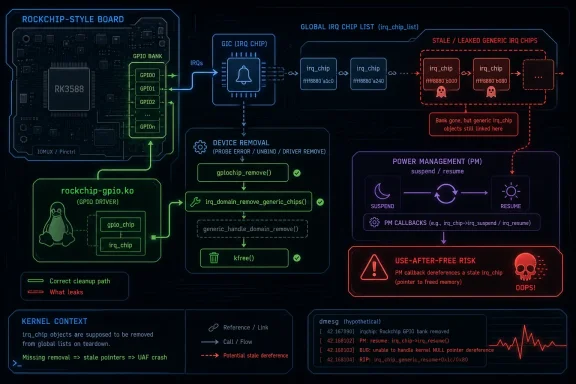 A Small GPIO Bug Exposes a Large Kernel Maintenance Problem
The vulnerability description is almost comically unglamorous: gpio: rockchip: fix generic IRQ chip leak on remove. There is no remote code execution headline, no browser exploit chain, no nation-state flourish. There is a driver, an IRQ domain, a teardown path, and a missing cleanup call.That is precisely why this CVE matters. Modern Linux security work is increasingly about the correctness of the boring parts: reference counts, lifetime rules, suspend and resume paths, hot-unplug behavior, and the error handling that rarely appears in product brochures. CVE-2026-53226 belongs to that class of vulnerability where the dangerous part is not the initial allocation, but what remains reachable after the hardware context that justified it has disappeared.
The affected code lives in
drivers/gpio/gpio-rockchip.c, the GPIO driver used for Rockchip SoCs. Rockchip chips appear across single-board computers, TV boxes, industrial controllers, edge appliances, tablets, and other Arm-based hardware where Linux is often customized, frozen, forked, or updated at a pace that would make a desktop sysadmin wince.The fix is straightforward: call
irq_domain_remove_generic_chips() before removing the IRQ domain in rockchip_gpio_remove(). The implications are less straightforward. If a generic IRQ chip remains on the global list after the associated GPIO bank has been removed, later suspend, resume, or shutdown callbacks may walk that stale object and crash the kernel.The Vulnerability Is About Lifetime, Not Exposure
CVE-2026-53226 is not a classic network-facing vulnerability. An attacker does not simply send a packet to a Rockchip board and hit the GPIO driver. The vulnerability is about object lifetime inside the kernel: what gets allocated during driver probe, what should be freed during driver removal, and what other subsystems may still touch later.During probe, the Rockchip GPIO driver allocates domain generic chips using
irq_alloc_domain_generic_chips(). Those generic IRQ chips are part of the kernel’s interrupt-handling machinery. They help represent and manage interrupt lines associated with the GPIO controller.The problem is that removing the IRQ domain does not automatically free those generic chips unless the relevant domain flags include
IRQ_DOMAIN_FLAG_DESTROY_GC. According to the CVE record, those flags are not present here. The result is a leak of both the domain generic chips structure and the associated generic chips.A memory leak would be annoying on its own, especially on embedded systems with limited RAM. But the more serious condition is the stale global linkage. The generic chips can remain on the global
gc_list, and generic IRQ chip suspend, resume, or shutdown callbacks may later visit them after the Rockchip GPIO bank has already gone away.That turns a cleanup bug into a possible use-after-free. In kernel terms, that is the difference between a slow drip and a trapdoor. A stale pointer in privileged code does not need to be fashionable to be dangerous.
Rockchip Makes This More Than a Niche Kernel Footnote
The Rockchip angle matters because these SoCs are not rare curiosities. They are common in enthusiast boards, media hardware, embedded Linux appliances, and industrial designs where GPIO is not an optional convenience but part of the product’s interaction with the real world. GPIO pins may handle buttons, LEDs, reset lines, wake signals, sensors, relays, and board-specific control logic.That does not mean every Rockchip system is practically exploitable. The vulnerability depends on driver removal or teardown behavior, followed by later kernel paths that encounter the leaked generic IRQ chip state. Many deployed devices may never unload the driver during normal operation. Others may not expose the required conditions to unprivileged users at all.
But embedded Linux has a way of turning “unlikely” into “eventually.” Devices suspend and resume. Vendors ship custom kernels. Integrators backport only selected patches. Test labs exercise shutdown paths that production devices almost never hit—until a brownout, watchdog reset, module reload, containerized hardware test, or field update creates the wrong sequence.
The serious risk, then, is operational reliability as much as adversarial exploitation. A kernel crash on a desktop is irritating. A kernel crash on an access-control box, camera gateway, digital signage controller, factory edge node, or kiosk can become a service outage.
The CVSS Gap Should Not Be Mistaken for Safety
As of publication, NVD has not assigned CVSS 4.0, CVSS 3.x, or CVSS 2.0 scores to CVE-2026-53226. That absence is easy to misread. No score does not mean no severity; it means the enrichment process has not yet converted the published kernel CVE record into a quantified NVD assessment.Kernel CVEs often arrive this way. The upstream Linux process identifies a resolved vulnerability, attaches the relevant commits, and the public databases catch up with scoring and classification later. For administrators, the useful question is not whether a score exists today, but whether the affected code is present in a kernel they ship or support.
The CVE record identifies the affected program file as
drivers/gpio/gpio-rockchip.c. It also lists stable commit references for fixes and describes affected and unaffected ranges. Those commit-level references are more useful for kernel maintainers than a single severity number because Linux distributions and embedded vendors often carry heavily patched kernels that do not map cleanly to mainline version labels.That is especially true in the Arm ecosystem. A device may report something that looks like an old long-term kernel while carrying a vendor pile of backports, board-support changes, and downstream patches. Conversely, a kernel with a familiar version number may still lack a specific stable fix if the vendor’s maintenance branch has drifted.
For WindowsForum readers who also run Linux on home labs, NAS boxes, SBC clusters, routers, hypervisor hosts, or appliance-style hardware, the practical test is simple: do not stop at the CVSS field. Check whether the Rockchip GPIO driver is built or loaded, whether your vendor kernel includes the relevant fix, and whether updates are actually available for your device.
The Fix Is One Line in Spirit, but Years in Context
The repair described in the CVE is conceptually modest: explicitly remove generic IRQ chips before removing the IRQ domain. The function named in the fix,irq_domain_remove_generic_chips(), says almost everything. The driver allocated generic chips; it must remove them when the driver goes away.That sounds obvious until one remembers that kernel resource management is a web of conventions, helpers, flags, and subsystem-specific expectations. Some objects are reference-counted. Some are device-managed. Some are destroyed by domain teardown if a flag is set. Some must be explicitly unwound in the reverse order of allocation. The hard part is not allocating memory; the hard part is knowing which layer owns the final goodbye.
This bug appears to trace back to the original addition of the Rockchip GPIO driver lineage identified in the CVE’s affected range. The record references an original affected commit and multiple stable fix commits, which is typical for kernel vulnerabilities that must be corrected across maintained branches. That tells us the bug was not a flashy new regression introduced last week. It was a latent teardown flaw made visible by more careful auditing, testing, or failure reports.
The Linux kernel has spent years improving these edges. The driver core, GPIO subsystem, IRQ subsystem, and device-tree ecosystem have all accumulated abstractions to make hardware support less fragile. Yet abstractions do not erase lifetime bugs; they relocate them. The more generic infrastructure becomes, the more important it is for each driver to satisfy the exact contract of that infrastructure.
In this case, the contract was simple enough to fit in a CVE sentence. Without the flag that tells the IRQ domain to destroy generic chips automatically, the driver needs to do the cleanup itself.
Suspend and Resume Are Where Old Bugs Learn New Tricks
The most interesting part of CVE-2026-53226 is not the leak. It is the callback timing. The generic chips remain on a global list, and later suspend, resume, or shutdown callbacks may visit them. That is where a dormant cleanup mistake becomes a live crash.Power management is a recurring source of Linux driver bugs because it exercises paths that ordinary runtime testing misses. A device can appear stable under load, pass network tests, run workloads for days, and still fall over when asked to suspend, resume, or shut down cleanly. Those paths invert assumptions. Hardware may disappear. Clocks may be gated. Interrupts may be masked. Memory may remain, but the device state it points to may no longer be valid.
Embedded boards make this worse. They often combine board-specific device trees, vendor boot firmware, out-of-tree patches, and power-management behavior that differs from reference hardware. A suspend callback that is harmless on one board can be fatal on another if the driver teardown order changes.
The CVE language is careful: stale generic chips may later be visited, potentially resulting in a use-after-free and kernel crash. That is not a claim of a weaponized exploit. It is a statement that a freed object can remain reachable through a global path and that the kernel may dereference it later.
For defenders, that distinction matters. Treating every kernel CVE as a full exploit can lead to fatigue. Treating use-after-free conditions in kernel infrastructure as mere tidying can lead to outages. CVE-2026-53226 sits between those extremes: not a panic button, but definitely a patch item.
The Windows Angle Is the Hardware You Forgot Was Linux
At first glance, a Rockchip GPIO driver vulnerability may seem outside the WindowsForum orbit. It is not a Windows kernel bug. It does not affect Windows Update. It will not break a mainstream x86 gaming rig.But modern Windows environments are surrounded by Linux in places administrators do not always inventory. The conference-room panel, badge reader, build-lab SBC, network appliance, KVM-over-IP device, Android-derived endpoint, CI runner, home automation hub, signage player, or edge gateway may be running a Linux kernel with board-support code that rarely appears in enterprise vulnerability dashboards.
That is the uncomfortable part. Windows admins have become better at tracking Windows builds, Microsoft Defender versions, Edge updates, firmware advisories, and driver rollups. The Linux appliances sitting beside those systems are often tracked by vendor model number, not kernel provenance. Their security posture depends on whether the vendor treats stable kernel fixes as a maintenance obligation or a marketing inconvenience.
Rockchip devices are particularly visible in enthusiast and embedded settings. Homelab users may run them as lightweight servers, media boxes, retro-gaming devices, Kubernetes toys, or low-power service nodes. Small businesses may inherit them inside products that never advertise their SoC. The GPIO driver is not something those users chose directly, but it is part of the trust chain.
That makes CVE-2026-53226 a reminder to look beyond operating-system branding. If it boots, suspends, resumes, handles interrupts, and exposes services on a network, it belongs in the asset inventory.
Version Labels Help Less Than Patch Provenance
The CVE record lists affected and unaffected version information, including kernel version ranges and fix commits. That is useful, but administrators should be careful with version shorthand. In Linux, especially outside mainstream distributions, a version number is not a complete security statement.A vendor kernel may be based on an older long-term branch and still include a backported fix. Another may report a newer-looking version and omit a specific stable patch. Some embedded vendors maintain BSP kernels that are effectively parallel universes: recognizable as Linux, but not identical to any clean upstream release.
The safer workflow is to ask three questions. Is
CONFIG_GPIO_ROCKCHIP enabled or is the Rockchip GPIO driver present? Does the tree include the fix that removes generic IRQ chips during Rockchip GPIO removal? Has the device vendor shipped a kernel update that includes that fix?For general-purpose distributions, the answer will usually arrive through normal kernel security updates. For appliances and SBC images, it may arrive through vendor forums, Git repositories, nightly images, or not at all. That gap is where many embedded Linux vulnerabilities become long-lived operational risks.
The lack of an NVD score can also slow enterprise handling. Some scanners prioritize scored vulnerabilities, and some procurement processes still treat CVSS as the beginning and end of risk triage. CVE-2026-53226 argues for a better habit: for kernel CVEs, track affected subsystems and hardware relevance first, scoring second.
A Rockchip GPIO flaw on an x86 workstation is noise. The same flaw on a Rockchip-based controller in a remote cabinet is signal.
Exploitability Is Unclear, but Crashability Is Enough
The CVE text does not present a public exploit. It does not claim local privilege escalation. It does not describe an unprivileged trigger. What it does say is that stale generic IRQ chip structures may be visited after the GPIO bank has been removed, potentially causing a use-after-free and kernel crash.That should shape the response. Security teams should avoid dressing this up as a catastrophic internet-scale bug. At the same time, reliability teams should not ignore it because it lacks drama. Kernel crash conditions in infrastructure hardware are security-relevant because availability is part of security.
The exploitability question depends on who can trigger driver removal, what module configuration is used, how the board is described in device tree, whether the GPIO driver is built-in or modular, and what suspend/resume or shutdown paths are reachable. On many systems, the answer may be “not by a normal user.” On custom embedded systems, the answer may be more complicated.
There is also the broader kernel-hardening point. Use-after-free bugs in the kernel are dangerous because they describe a class of memory safety failure that can sometimes be shaped into more than a crash. Whether that is plausible here requires more evidence than the public CVE provides. The responsible wording is that the record supports a potential crash and a use-after-free condition, not a proven privilege-escalation path.
For device operators, that uncertainty should not delay patching. The cost of applying a stable kernel fix is usually lower than the cost of debugging intermittent shutdown crashes on hardware with limited console access.
This Is Exactly Why Stable Kernel Backports Exist
The Linux stable process can look chaotic from the outside: patches moving through subsystem trees, mainline commits, stable queues, vendor branches, and distribution advisories. CVE-2026-53226 shows the value of that machinery. A specific driver bug is fixed not only in one development branch but across relevant maintained lines.That matters because embedded hardware does not all move at mainline speed. Vendors may stay on long-term kernels for years because of certification, board-support dependencies, binary blobs, or simple engineering inertia. Stable backports are the difference between “upgrade the whole platform” and “take the surgical fix.”
The catch is that backports only help if vendors consume them. In the PC world, Windows users are accustomed to a centralized update channel, even if they sometimes resent it. In the embedded Linux world, the update channel may be a vendor download page, a GitHub release, a forum post, an over-the-air appliance update, or nothing visible at all.
That fragmentation is not unique to Rockchip. It is the recurring bargain of embedded Linux: incredible hardware reach, low cost, rapid board enablement, and a long tail of maintenance responsibility. CVE-2026-53226 is one more small debit in that ledger.
For organizations using Rockchip-based devices, the right question for vendors is not “Are we affected by this CVE?” in the abstract. It is “Which kernel tree and commit level are you shipping, and does your build include the Rockchip GPIO generic IRQ chip removal fix?”
Administrators Should Treat This as an Inventory Test
The immediate work is modest. Identify Rockchip-based systems, check kernel updates, and watch for vendor advisories. The larger work is cultural: make sure embedded Linux devices are part of the same vulnerability-management conversation as servers and desktops.On a Linux system, the usual clues include
uname -a, kernel package metadata, /proc/config.gz where available, loaded modules, device-tree model strings, and distribution or vendor release notes. On appliance hardware, the clues may be much thinner. Some products hide the kernel version behind a web UI; others expose it only through SSH or serial console.If the driver is built into the kernel, it may not appear as a module. If it is modular, module listings can help. If the product is sealed, the vendor’s firmware changelog may be the only practical source. That is why commit-level fixes matter so much: they give maintainers something precise to ask about.
For homelab users, the practical answer is usually to update to a kernel release or image that includes the fix. For enterprise operators, the answer may involve vendor tickets, maintenance windows, regression testing, and a decision about whether affected devices can be rebooted safely after patching.
Power-management testing deserves special attention. Since the described failure path involves suspend, resume, and shutdown callbacks, merely booting the patched kernel is not the whole story. Hardware that relies on low-power states should be tested through the same suspend and shutdown flows used in production.
The Real Signal Is in the Kernel’s Growing CVE Granularity
Linux kernel CVEs have become more numerous and more granular, and that can make each individual record feel less important. Many recent entries look like routine bug fixes translated into vulnerability language. CVE-2026-53226 fits that trend.There is a temptation to complain that this dilutes the meaning of a CVE. Sometimes that criticism is fair. Not every memory leak or obscure driver cleanup issue carries equal operational weight, and vulnerability feeds can overwhelm teams with records that have little bearing on their environment.
But granularity also has benefits. It gives downstream vendors a precise identifier for a fix. It gives scanners a hook. It gives administrators a reason to ask whether a quiet driver patch has actually landed in a product kernel. And it creates a public record that a bug was not merely cosmetic.
The answer is not to ignore low-drama kernel CVEs. The answer is to triage them by hardware, configuration, reachability, and operational consequence. CVE-2026-53226 is irrelevant to many systems and important to some. That is exactly the sort of distinction mature vulnerability management is supposed to make.
For WindowsForum’s audience, the useful mental model is the driver update problem. Windows users know that a GPU, Wi-Fi, storage, or chipset driver can be the difference between a stable machine and a blue-screen generator. Linux embedded systems have the same problem, except the driver may be buried in a vendor kernel that nobody has updated since deployment.
The Rockchip GPIO Fix Leaves a Short Checklist Behind
The practical conclusion is not complicated: this is a targeted Linux kernel driver fix with potentially serious consequences for affected Rockchip systems, especially where suspend, resume, shutdown, or driver teardown paths are exercised. The absence of an NVD score should not block triage, and the presence of the CVE should not cause panic.- Systems that do not use Rockchip GPIO hardware are unlikely to have practical exposure to this specific flaw.
- Rockchip-based Linux devices should be checked for a kernel update that includes the generic IRQ chip cleanup fix in
gpio-rockchip. - Embedded and appliance vendors should confirm commit-level status, not merely advertise a broad kernel version.
- Administrators should test suspend, resume, and shutdown behavior after patching affected devices.
- Vulnerability scanners may lag behind the real risk until NVD enrichment and vendor advisories catch up.
- The most important operational impact is likely kernel crash risk, with exploitability beyond denial of service remaining unclear from the public record.
References
- Primary source: NVD / Linux Kernel
Published: 2026-06-28T01:47:06-07:00
NVD - CVE-2026-53226
 nvd.nist.gov
- Security advisory: MSRC
Published: 2026-06-28T01:47:06-07:00
Original feed URL
Security Update Guide - Microsoft Security Response Center
 msrc.microsoft.com
- Related coverage: db.gcve.eu
Vulnerability-Lookup
Vulnerability-Lookup - Fast vulnerability lookup correlation from different sources.db.gcve.eu - Related coverage: cateee.net
- Related coverage: kernel.googlesource.com
- Related coverage: lkml.iu.edu

- Related coverage: gitlab.com
drivers/gpio · v6.0.12 · Adam Honse / Linux · GitLab
Linux mainline fork with SDM845 patches, currently supported devices: OnePlus 6/6T, Xiaomi Pocophone F1gitlab.com - Related coverage: rockchips.net
- Related coverage: lo01.g77k.com
