

On May 28, 2026, NVD published CVE-2026-46125, a Linux kernel mac80211 Wi-Fi vulnerability fixed upstream after failed Wi-Fi 7 Multi-Link Operation connection preparation could leave behind a stale station object and trigger a use-after-free or double-free path when debugfs is enabled. The bug is narrow, but it sits in a part of the kernel that increasingly matters: the compatibility layer between old Wi-Fi assumptions and new multi-link radios. For WindowsForum readers, the lesson is not that every Linux laptop is suddenly exposed over the air; it is that modern wireless stacks are becoming state-machine minefields, and administrators who treat kernel Wi-Fi fixes as “desktop-only noise” are taking on unnecessary risk.
CVE-2026-46125 is not the sort of vulnerability that arrives with a logo, a branded exploit name, or a breathless claim of instant remote compromise. Its description reads like ordinary kernel housekeeping: if connection preparation fails for an MLO connection, remove the existing station because the virtual interface is being reset from MLD mode back to non-MLD mode. That sentence is dull until you unpack what it means.
In mac80211, a “station” is not just a friendly label for a connected Wi-Fi peer. It is a kernel data structure with lifetime rules, debug entries, references from other pieces of the stack, and assumptions about which interface owns it. If that ownership changes under it — as can happen when Multi-Link Operation setup fails and the interface is rebuilt — keeping the station around is no longer harmless. It can become a pointer into a world that has already been torn down.
The fix is therefore conceptually simple: delete the station that belongs to the link being removed. The CVE record says any newly created station is already removed on the failing path, so the missing cleanup concerned an existing station. In kernel security, those one-line or two-line lifetime fixes are often more revealing than dramatic rewrites, because they show exactly where the model leaked.
This one leaked at the seam between MLO and debugfs. The vulnerability description says the stale station could cause a use-after-free or double-free in debugfs when enabled, because moving a virtual interface into or out of MLD mode recreates its debugfs hierarchy. That is not a universal “Wi-Fi equals root” claim. It is a very specific lifetime bug in a very specific kernel path. But specific does not mean irrelevant.
Classic Wi-Fi client code could often reason about one client interface, one access point, and one association at a time. MLO complicates that picture by introducing a Multi-Link Device abstraction, with links that may be prepared, associated, reset, or discarded as part of a broader logical connection. The failure path matters because connection setup is not a ceremonial step; it is where half-created structures and partially initialized relationships accumulate.
CVE-2026-46125 appears to live precisely in that uncomfortable middle ground. The system is preparing an MLO connection. Preparation fails. The interface is reset to non-MLD mode. The debugfs tree associated with the old mode is recreated. A station tied to the removed link remains unless the fix is present. That is the kind of chain that security teams often miss because no single step sounds alarming in isolation.
The deeper issue is that Wi-Fi 7 is not merely a faster radio bolted onto the same software architecture. It asks kernel networking code, driver code, firmware interfaces, user-space network managers, and diagnostics tooling to agree on richer states. Every additional state transition creates new error paths, and error paths are where memory safety bugs like use-after-free and double-free conditions love to hide.
But debugfs being involved does not automatically make a bug disposable. Many real systems ship with debugfs available during development, validation, field troubleshooting, or in appliances where engineering convenience wins over ideal hardening. Embedded Linux devices, Wi-Fi gateways, lab machines, test fleets, and custom kernels can all carry configurations that differ sharply from a locked-down enterprise server.
The more subtle point is that debugfs is where a lifetime error becomes visible, not necessarily where the bad lifetime begins. The stale station object is wrong because it belongs to a link and interface state that have been removed. Debugfs cleanup is simply one place where the kernel may trip over that inconsistency. Good administrators do not need to panic over that distinction, but they should respect it.
For desktop Linux users, this is likely to be an update-and-move-on issue. For vendors shipping Wi-Fi-enabled devices, it is more significant. A bug tied to MLO setup failure may be hard to trigger accidentally, but vendors need to consider repeated association attempts, hostile RF environments, unusual access point behavior, and automated testing that exercises failure paths far more aggressively than ordinary users do.
This is a recurring problem for administrators who depend too heavily on CVSS as the first filter. A vulnerability without a score can look administratively invisible: no red dashboard tile, no urgent vendor advisory, no easy ranking in a weekly patch meeting. Yet kernel fixes often land before the public scoring ecosystem catches up, especially when the vulnerability is tied to a precise commit and backported across stable trees.
The right reading is more disciplined. We know the affected area is Linux mac80211. We know the condition involves MLO connection preparation failure and a transition away from MLD mode. We know the failure can produce a use-after-free or double-free in debugfs when that interface is enabled. We know stable kernel references exist, indicating the fix has been carried into maintained branches. What we do not yet know from NVD is the standardized severity shorthand that procurement tools and compliance reports prefer.
That distinction is particularly relevant for mixed Windows and Linux shops. The Windows estate may dominate the help desk, but Linux quietly runs wireless test rigs, developer laptops, lab gateways, kiosks, edge appliances, and network infrastructure. If patch triage waits for a polished CVSS score, those systems can lag behind even when upstream has already done the hard work.
The Wi-Fi angle widens the relevance. Wireless infrastructure is one of those areas where operating system boundaries blur. A Windows laptop might connect through a Linux-based access point. A Windows-heavy office might use Linux appliances for monitoring, packet capture, authentication testing, or embedded operations. A security team might reproduce wireless bugs on Linux because the tooling is better, then forget that the test hardware itself needs routine kernel maintenance.
This CVE also intersects with the broader Wi-Fi 7 rollout. Organizations refreshing client devices and access points are now introducing MLO-capable hardware into environments whose patch processes were designed for simpler wireless stacks. That mismatch creates a predictable failure mode: shiny radios arrive before operational teams have updated their assumptions about driver maturity, firmware cadence, kernel branches, and diagnostics exposure.
The practical message for Windows administrators is not to become Linux kernel maintainers overnight. It is to know where Linux Wi-Fi code exists in your estate and whether those systems receive timely kernel updates. If the answer is “we are not sure,” CVE-2026-46125 is a useful excuse to inventory before a more dramatic wireless vulnerability forces the same conversation under pressure.
The patch subject is blunt: “wifi: mac80211: remove station if connection prep fails.” There is no marketing prose hiding the ball. The code had a cleanup gap. When MLO connection preparation failed and the interface was reset, an existing station needed to be deleted. The fix closes that lifetime mismatch.
The interesting part is how unglamorous the change is. Kernel security is full of these tiny patches with large conceptual payloads. A missing destroy call, an object retained past a mode transition, a debug directory rebuilt while a child still points at an old parent — none of that sounds like a blockbuster. But memory safety bugs are often born from precisely those gaps between what the code used to mean and what a new feature makes it mean now.
Stable backports matter because most users do not run Linus Torvalds’ latest tree or a wireless development branch. They run distribution kernels, vendor kernels, Android-derived kernels, router SDK kernels, enterprise LTS kernels, or OEM-customized builds. The existence of upstream stable commits is the starting gun for downstream remediation, not the finish line.
The most plausible immediate impact is instability or crash potential in affected configurations, particularly where debugfs is enabled and the relevant MLO failure path can be exercised. Whether an attacker can reliably trigger the condition depends on hardware, driver support, kernel configuration, access point behavior, and local system exposure. Those details matter, and anyone claiming universal exploitability from the current public description is getting ahead of the evidence.
Still, administrators should not dismiss a kernel memory lifetime bug just because the public record is restrained. Wi-Fi code processes complex, often attacker-influenced inputs from nearby radios. MLO is new enough that edge cases will continue to surface. Debugfs and diagnostic interfaces are frequently more available than security architects would prefer. A narrow bug in a narrow subsystem can become relevant when deployed at scale across unmanaged or semi-managed devices.
The best security posture is boring: patch supported kernels, disable unnecessary debug surfaces, and do not expose experimental wireless features on systems that cannot be updated quickly. That advice will not trend on social media, but it is exactly how organizations avoid turning small upstream fixes into long-lived operational debt.
Driver maturity therefore becomes a security question, not just a compatibility question. A driver that mishandles a new link state might merely fail to connect, or it might leave stale kernel state behind. A diagnostics interface that was safe under simpler assumptions might become fragile when interface hierarchies are rebuilt. A recovery path that rarely ran under Wi-Fi 5 or Wi-Fi 6 might suddenly become ordinary under Wi-Fi 7 roaming and negotiation behavior.
That does not mean organizations should avoid Wi-Fi 7. It means early adoption should be paired with more aggressive firmware and kernel hygiene. The first year or two of any major wireless transition tends to flush out these assumptions. The safe move is not to freeze technology, but to treat wireless stack updates as part of the deployment plan rather than as an afterthought.
This is especially true for Linux-based access points and client devices using fast-moving wireless hardware. The kernel’s mac80211 layer is shared infrastructure for many drivers, which is efficient but also concentrates risk. A fix in mac80211 may matter across multiple chipsets and products, depending on how those products use the subsystem and which kernel branch they ship.
The worst response is binary thinking. Some teams treat every kernel CVE as urgent because the kernel is privileged code. Others ignore anything without a high CVSS score or a known exploit. Both habits are lazy. Kernel bugs need contextual triage: reachability, configuration, hardware dependence, namespace exposure, local versus remote triggerability, and vendor patch availability all matter.
For this CVE, the context points toward targeted remediation rather than emergency shutdowns. Systems with MLO-capable Wi-Fi hardware, kernels containing the affected code, and debugfs enabled deserve attention first. Developer workstations, wireless labs, embedded devices, routers, gateways, and custom images are more interesting than ordinary servers with no Wi-Fi hardware. But ordinary servers are not the whole estate.
The administrative trap is that the most relevant devices may not be in the main patch-management console. They may be under a network team, an IoT team, a facilities vendor, a product engineering group, or a lab manager. That is why kernel wireless CVEs can be deceptively persistent. The machines that need the fix are often the machines least likely to be managed like corporate laptops.
For Linux distributions, the key question is when the relevant stable fix lands in packaged kernels. For appliance vendors, the question is more uncomfortable: whether their shipped kernel branch receives the backport at all. Many embedded products advertise Wi-Fi capabilities for years while quietly freezing kernel maintenance after launch. That pattern is precisely where small mac80211 fixes can become long-tail risk.
For enterprise administrators, inventory is the first mitigation. Identify Linux systems with Wi-Fi hardware, especially those testing or deploying Wi-Fi 7. Check whether debugfs is mounted by default, whether local users can reach it, and whether device images derive from maintained kernel branches. The goal is not to create a bespoke CVE-2026-46125 project; the goal is to make sure the next wireless kernel fix does not require a scavenger hunt.
For security teams, the useful detection angle is configuration awareness rather than signature hunting. A crash tied to mac80211 station debugfs cleanup might be interesting, but absence of crashes does not prove absence of exposure. Kernel memory bugs are not always chatty. Patch state and configuration state are more reliable inputs than waiting for a dramatic log entry.
This is a familiar pattern beyond Wi-Fi. Filesystems hit it with mount and namespace transitions. Graphics drivers hit it with device reset and hotplug paths. Container runtimes hit it where kernel objects outlive the namespace assumptions that created them. Modern systems are less likely to fail in the straight-line path and more likely to fail when a half-completed operation is unwound.
MLO is a particularly rich source of such cases because it blends hardware capability, protocol negotiation, driver behavior, and user-space orchestration. A connection attempt can fail for many reasons, and each failure has to leave the system as clean as if it never happened. That is easy to state and difficult to guarantee.
The fix for CVE-2026-46125 is therefore not just “delete a station.” It is a reaffirmation of ownership rules under a new wireless model. If an interface link is removed, objects tied to that link must go with it. Anything else is a stale pointer waiting for the right diagnostic or cleanup path to expose the mistake.
For Windows-heavy organizations, that means treating Linux not as an exception but as part of the endpoint and appliance fabric. The Wi-Fi analyzer under a desk, the Linux-based access point in a branch office, the developer laptop used to test wireless drivers, and the embedded gateway bolted to a wall can all matter. They may not run Microsoft software, but they still sit inside the same risk perimeter.
The most mature response is to fold this into existing hygiene. Kernel update cadence, debugfs policy, hardware inventory, and Wi-Fi 7 rollout planning should already be connected. If they are not, CVE-2026-46125 is a low-drama opportunity to connect them before a higher-drama wireless bug appears.
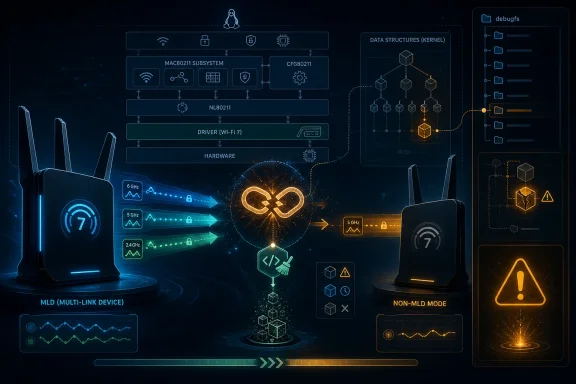 A Small Cleanup Patch Exposes a Bigger Wi-Fi Transition
CVE-2026-46125 is not the sort of vulnerability that arrives with a logo, a branded exploit name, or a breathless claim of instant remote compromise. Its description reads like ordinary kernel housekeeping: if connection preparation fails for an MLO connection, remove the existing station because the virtual interface is being reset from MLD mode back to non-MLD mode. That sentence is dull until you unpack what it means.In mac80211, a “station” is not just a friendly label for a connected Wi-Fi peer. It is a kernel data structure with lifetime rules, debug entries, references from other pieces of the stack, and assumptions about which interface owns it. If that ownership changes under it — as can happen when Multi-Link Operation setup fails and the interface is rebuilt — keeping the station around is no longer harmless. It can become a pointer into a world that has already been torn down.
The fix is therefore conceptually simple: delete the station that belongs to the link being removed. The CVE record says any newly created station is already removed on the failing path, so the missing cleanup concerned an existing station. In kernel security, those one-line or two-line lifetime fixes are often more revealing than dramatic rewrites, because they show exactly where the model leaked.
This one leaked at the seam between MLO and debugfs. The vulnerability description says the stale station could cause a use-after-free or double-free in debugfs when enabled, because moving a virtual interface into or out of MLD mode recreates its debugfs hierarchy. That is not a universal “Wi-Fi equals root” claim. It is a very specific lifetime bug in a very specific kernel path. But specific does not mean irrelevant.
Multi-Link Operation Makes Wi-Fi State Less Boring
Multi-Link Operation is one of Wi-Fi 7’s marquee features, letting a device use multiple links across bands or channels as part of a single logical connection. From a user’s perspective, the promise is obvious: more throughput, lower latency, better resilience, and smarter use of crowded spectrum. From a kernel developer’s perspective, the cost is equally obvious: more state, more transitions, and more chances for one object to outlive the context that made it valid.Classic Wi-Fi client code could often reason about one client interface, one access point, and one association at a time. MLO complicates that picture by introducing a Multi-Link Device abstraction, with links that may be prepared, associated, reset, or discarded as part of a broader logical connection. The failure path matters because connection setup is not a ceremonial step; it is where half-created structures and partially initialized relationships accumulate.
CVE-2026-46125 appears to live precisely in that uncomfortable middle ground. The system is preparing an MLO connection. Preparation fails. The interface is reset to non-MLD mode. The debugfs tree associated with the old mode is recreated. A station tied to the removed link remains unless the fix is present. That is the kind of chain that security teams often miss because no single step sounds alarming in isolation.
The deeper issue is that Wi-Fi 7 is not merely a faster radio bolted onto the same software architecture. It asks kernel networking code, driver code, firmware interfaces, user-space network managers, and diagnostics tooling to agree on richer states. Every additional state transition creates new error paths, and error paths are where memory safety bugs like use-after-free and double-free conditions love to hide.
The Debugfs Detail Is a Constraint, Not a Reassurance
The CVE text’s mention of debugfs is important, but it should not be misread. Debugfs is a Linux kernel debugging interface used by developers, distributions, appliance vendors, and power users to inspect internal state. It is not supposed to be a hardened public API, and production systems often restrict or avoid mounting it. That naturally reduces the practical attack surface for this particular bug.But debugfs being involved does not automatically make a bug disposable. Many real systems ship with debugfs available during development, validation, field troubleshooting, or in appliances where engineering convenience wins over ideal hardening. Embedded Linux devices, Wi-Fi gateways, lab machines, test fleets, and custom kernels can all carry configurations that differ sharply from a locked-down enterprise server.
The more subtle point is that debugfs is where a lifetime error becomes visible, not necessarily where the bad lifetime begins. The stale station object is wrong because it belongs to a link and interface state that have been removed. Debugfs cleanup is simply one place where the kernel may trip over that inconsistency. Good administrators do not need to panic over that distinction, but they should respect it.
For desktop Linux users, this is likely to be an update-and-move-on issue. For vendors shipping Wi-Fi-enabled devices, it is more significant. A bug tied to MLO setup failure may be hard to trigger accidentally, but vendors need to consider repeated association attempts, hostile RF environments, unusual access point behavior, and automated testing that exercises failure paths far more aggressively than ordinary users do.
NVD Has Not Scored It, and That Silence Matters
At publication time, NVD had marked CVE-2026-46125 as awaiting enrichment and had not assigned CVSS 4.0, 3.x, or 2.0 vector strings. That absence is not a loophole, and it is not a verdict of low severity. It is simply a reminder that the kernel CVE pipeline and the operational patch pipeline run on different clocks.This is a recurring problem for administrators who depend too heavily on CVSS as the first filter. A vulnerability without a score can look administratively invisible: no red dashboard tile, no urgent vendor advisory, no easy ranking in a weekly patch meeting. Yet kernel fixes often land before the public scoring ecosystem catches up, especially when the vulnerability is tied to a precise commit and backported across stable trees.
The right reading is more disciplined. We know the affected area is Linux mac80211. We know the condition involves MLO connection preparation failure and a transition away from MLD mode. We know the failure can produce a use-after-free or double-free in debugfs when that interface is enabled. We know stable kernel references exist, indicating the fix has been carried into maintained branches. What we do not yet know from NVD is the standardized severity shorthand that procurement tools and compliance reports prefer.
That distinction is particularly relevant for mixed Windows and Linux shops. The Windows estate may dominate the help desk, but Linux quietly runs wireless test rigs, developer laptops, lab gateways, kiosks, edge appliances, and network infrastructure. If patch triage waits for a polished CVSS score, those systems can lag behind even when upstream has already done the hard work.
This Is Not a Windows Bug, but Windows Shops Still Own the Exposure
WindowsForum readers may reasonably ask why a Linux mac80211 bug deserves attention on a Windows-centered site. The answer is that almost no serious Windows environment is purely Windows anymore. The same administrators who manage Microsoft Intune, Group Policy, Defender, and Windows Update also inherit Linux-based wireless controllers, container hosts, developer workstations, dual-boot laptops, NAS boxes, and lab gear.The Wi-Fi angle widens the relevance. Wireless infrastructure is one of those areas where operating system boundaries blur. A Windows laptop might connect through a Linux-based access point. A Windows-heavy office might use Linux appliances for monitoring, packet capture, authentication testing, or embedded operations. A security team might reproduce wireless bugs on Linux because the tooling is better, then forget that the test hardware itself needs routine kernel maintenance.
This CVE also intersects with the broader Wi-Fi 7 rollout. Organizations refreshing client devices and access points are now introducing MLO-capable hardware into environments whose patch processes were designed for simpler wireless stacks. That mismatch creates a predictable failure mode: shiny radios arrive before operational teams have updated their assumptions about driver maturity, firmware cadence, kernel branches, and diagnostics exposure.
The practical message for Windows administrators is not to become Linux kernel maintainers overnight. It is to know where Linux Wi-Fi code exists in your estate and whether those systems receive timely kernel updates. If the answer is “we are not sure,” CVE-2026-46125 is a useful excuse to inventory before a more dramatic wireless vulnerability forces the same conversation under pressure.
The Commit Trail Tells a Familiar Stable-Kernel Story
The CVE record lists multiple stable kernel commit references, which is typical for Linux fixes that must be applied across supported branches. Unlike a proprietary operating system patch note that hides most of the engineering detail, the Linux model leaves a public trail: a patch is posted, reviewed, merged, and backported where maintainers judge it relevant. That visibility is one of Linux’s strengths, but it also demands more literacy from downstream consumers.The patch subject is blunt: “wifi: mac80211: remove station if connection prep fails.” There is no marketing prose hiding the ball. The code had a cleanup gap. When MLO connection preparation failed and the interface was reset, an existing station needed to be deleted. The fix closes that lifetime mismatch.
The interesting part is how unglamorous the change is. Kernel security is full of these tiny patches with large conceptual payloads. A missing destroy call, an object retained past a mode transition, a debug directory rebuilt while a child still points at an old parent — none of that sounds like a blockbuster. But memory safety bugs are often born from precisely those gaps between what the code used to mean and what a new feature makes it mean now.
Stable backports matter because most users do not run Linus Torvalds’ latest tree or a wireless development branch. They run distribution kernels, vendor kernels, Android-derived kernels, router SDK kernels, enterprise LTS kernels, or OEM-customized builds. The existence of upstream stable commits is the starting gun for downstream remediation, not the finish line.
The Risk Is Narrower Than the Acronym, but Wider Than the Laptop
Use-after-free and double-free are scary phrases because they describe classes of memory corruption that can sometimes become privilege escalation or code execution. In this case, the published record does not establish a ready-made exploit, a remote attack path, or a CVSS severity. It names the failing path and the debugfs condition. That should keep the discussion grounded.The most plausible immediate impact is instability or crash potential in affected configurations, particularly where debugfs is enabled and the relevant MLO failure path can be exercised. Whether an attacker can reliably trigger the condition depends on hardware, driver support, kernel configuration, access point behavior, and local system exposure. Those details matter, and anyone claiming universal exploitability from the current public description is getting ahead of the evidence.
Still, administrators should not dismiss a kernel memory lifetime bug just because the public record is restrained. Wi-Fi code processes complex, often attacker-influenced inputs from nearby radios. MLO is new enough that edge cases will continue to surface. Debugfs and diagnostic interfaces are frequently more available than security architects would prefer. A narrow bug in a narrow subsystem can become relevant when deployed at scale across unmanaged or semi-managed devices.
The best security posture is boring: patch supported kernels, disable unnecessary debug surfaces, and do not expose experimental wireless features on systems that cannot be updated quickly. That advice will not trend on social media, but it is exactly how organizations avoid turning small upstream fixes into long-lived operational debt.
Wi-Fi 7 Is Turning Driver Maturity Into a Security Question
The industry likes to sell Wi-Fi 7 as a performance upgrade. That is true, but incomplete. Features such as MLO alter not only throughput and latency but the internal shape of the wireless stack. They force software to represent multiple simultaneous links, link-specific state, shared authentication context, and transitions between multi-link and non-multi-link operation.Driver maturity therefore becomes a security question, not just a compatibility question. A driver that mishandles a new link state might merely fail to connect, or it might leave stale kernel state behind. A diagnostics interface that was safe under simpler assumptions might become fragile when interface hierarchies are rebuilt. A recovery path that rarely ran under Wi-Fi 5 or Wi-Fi 6 might suddenly become ordinary under Wi-Fi 7 roaming and negotiation behavior.
That does not mean organizations should avoid Wi-Fi 7. It means early adoption should be paired with more aggressive firmware and kernel hygiene. The first year or two of any major wireless transition tends to flush out these assumptions. The safe move is not to freeze technology, but to treat wireless stack updates as part of the deployment plan rather than as an afterthought.
This is especially true for Linux-based access points and client devices using fast-moving wireless hardware. The kernel’s mac80211 layer is shared infrastructure for many drivers, which is efficient but also concentrates risk. A fix in mac80211 may matter across multiple chipsets and products, depending on how those products use the subsystem and which kernel branch they ship.
The Security Industry Still Struggles With Kernel CVE Triage
CVE-2026-46125 also illustrates a larger frustration: kernel CVEs often arrive with too little context for non-specialists and too much raw detail for ordinary patch dashboards. The record names the subsystem, the condition, and the fix, but it does not yet provide a severity score or a polished exploitation narrative. That leaves administrators to translate mailing-list language into operational decisions.The worst response is binary thinking. Some teams treat every kernel CVE as urgent because the kernel is privileged code. Others ignore anything without a high CVSS score or a known exploit. Both habits are lazy. Kernel bugs need contextual triage: reachability, configuration, hardware dependence, namespace exposure, local versus remote triggerability, and vendor patch availability all matter.
For this CVE, the context points toward targeted remediation rather than emergency shutdowns. Systems with MLO-capable Wi-Fi hardware, kernels containing the affected code, and debugfs enabled deserve attention first. Developer workstations, wireless labs, embedded devices, routers, gateways, and custom images are more interesting than ordinary servers with no Wi-Fi hardware. But ordinary servers are not the whole estate.
The administrative trap is that the most relevant devices may not be in the main patch-management console. They may be under a network team, an IoT team, a facilities vendor, a product engineering group, or a lab manager. That is why kernel wireless CVEs can be deceptively persistent. The machines that need the fix are often the machines least likely to be managed like corporate laptops.
Hardening Beats Heroics When the Bug Is This Specific
There is no need to invent exotic mitigations for CVE-2026-46125. The obvious controls are also the right ones. Run a supported kernel, take vendor updates, and avoid leaving debugfs mounted or accessible on production systems unless there is a clear operational reason. If debugfs is needed temporarily, treat it as a diagnostic exception rather than a permanent convenience.For Linux distributions, the key question is when the relevant stable fix lands in packaged kernels. For appliance vendors, the question is more uncomfortable: whether their shipped kernel branch receives the backport at all. Many embedded products advertise Wi-Fi capabilities for years while quietly freezing kernel maintenance after launch. That pattern is precisely where small mac80211 fixes can become long-tail risk.
For enterprise administrators, inventory is the first mitigation. Identify Linux systems with Wi-Fi hardware, especially those testing or deploying Wi-Fi 7. Check whether debugfs is mounted by default, whether local users can reach it, and whether device images derive from maintained kernel branches. The goal is not to create a bespoke CVE-2026-46125 project; the goal is to make sure the next wireless kernel fix does not require a scavenger hunt.
For security teams, the useful detection angle is configuration awareness rather than signature hunting. A crash tied to mac80211 station debugfs cleanup might be interesting, but absence of crashes does not prove absence of exposure. Kernel memory bugs are not always chatty. Patch state and configuration state are more reliable inputs than waiting for a dramatic log entry.
The Patch Is Small Because the Lesson Is Architectural
The most important word in the CVE description may be “recreates.” The virtual interface changes mode, and debugfs is recreated. That is the architectural moment: a subsystem that once held relatively stable relationships now has to destroy and rebuild them as part of normal feature negotiation. If every related object is not cleaned up in the correct order, the kernel can end up with references to dead structures.This is a familiar pattern beyond Wi-Fi. Filesystems hit it with mount and namespace transitions. Graphics drivers hit it with device reset and hotplug paths. Container runtimes hit it where kernel objects outlive the namespace assumptions that created them. Modern systems are less likely to fail in the straight-line path and more likely to fail when a half-completed operation is unwound.
MLO is a particularly rich source of such cases because it blends hardware capability, protocol negotiation, driver behavior, and user-space orchestration. A connection attempt can fail for many reasons, and each failure has to leave the system as clean as if it never happened. That is easy to state and difficult to guarantee.
The fix for CVE-2026-46125 is therefore not just “delete a station.” It is a reaffirmation of ownership rules under a new wireless model. If an interface link is removed, objects tied to that link must go with it. Anything else is a stale pointer waiting for the right diagnostic or cleanup path to expose the mistake.
The Practical Reading for WindowsForum’s Mixed Estates
This CVE is unlikely to be the vulnerability that defines 2026. It is, however, a clean example of the kind of maintenance issue that defines real infrastructure security. The fix is available upstream. The affected area is specialized. The exploit story is not yet inflated. The operational burden is to know whether your Linux wireless systems are maintained well enough that the patch arrives before the bug becomes interesting to someone else.For Windows-heavy organizations, that means treating Linux not as an exception but as part of the endpoint and appliance fabric. The Wi-Fi analyzer under a desk, the Linux-based access point in a branch office, the developer laptop used to test wireless drivers, and the embedded gateway bolted to a wall can all matter. They may not run Microsoft software, but they still sit inside the same risk perimeter.
The most mature response is to fold this into existing hygiene. Kernel update cadence, debugfs policy, hardware inventory, and Wi-Fi 7 rollout planning should already be connected. If they are not, CVE-2026-46125 is a low-drama opportunity to connect them before a higher-drama wireless bug appears.
The Station That Should Have Been Deleted
CVE-2026-46125 is small enough to summarize without theatrics, but concrete enough to justify action. The bug sits at the intersection of MLO failure handling, station lifetime management, and debugfs recreation, which makes it a useful signal for anyone deploying newer Wi-Fi hardware on Linux.- CVE-2026-46125 was published by NVD on May 28, 2026, and was still awaiting NVD enrichment and CVSS scoring at the time of publication.
- The vulnerability affects the Linux kernel’s mac80211 Wi-Fi subsystem when MLO connection preparation fails and the interface is reset back to non-MLD mode.
- The upstream fix removes an existing station object that belongs to the link being removed, preventing stale state from surviving the failed transition.
- The public description ties the visible memory-safety failure to debugfs being enabled, where interface debug entries are recreated during MLD mode transitions.
- The most relevant systems to prioritize are Linux devices with Wi-Fi hardware, especially Wi-Fi 7 or MLO-capable systems, custom kernels, embedded products, wireless labs, and machines where debugfs is mounted.
- The absence of an NVD score should not delay normal kernel patching, because stable kernel fixes and distribution updates are the operational source of truth.
References
- Primary source: NVD / Linux Kernel
Published: 2026-05-29T01:07:18-07:00
NVD - CVE-2026-46125
 nvd.nist.gov
- Security advisory: MSRC
Published: 2026-05-29T01:07:18-07:00
Original feed URL
Security Update Guide - Microsoft Security Response Center
 msrc.microsoft.com
- Related coverage: kernel.googlesource.com
- Related coverage: kernel.org
- Related coverage: lists.ubuntu.com
- Related coverage: spinics.net
[PATCH wireless-next] wifi: mac80211: fix use-after-free risk in sta debugfs removal (Linux Wireless)
Linux Wireless: [PATCH wireless-next] wifi: mac80211: fix use-after-free risk in sta debugfs removalwww.spinics.net

- Related coverage: vuldb.com
CVE-2026-43125 Linux Kernel dlm dlm_dump_rsb_name buffer overflow
A vulnerability was determined in Linux Kernel up to 6.12.74/6.18.15/6.19.5. This vulnerability is tracked as CVE-2026-43125. It is advisable to upgrade the affected component.vuldb.com - Related coverage: windowsforum.com
CVE-2026-31394 mac80211 Crash in AP VLAN: Fix and Risk Overview | Windows Forum
When Microsoft’s update guide flags a Linux kernel issue like CVE-2026-31394, it is usually a sign that the bug is both specific and operationally...windowsforum.com - Related coverage: lists-ec2.96boards.org
- Related coverage: labs.cloudsecurityalliance.org
CSA research note dirty frag linux lpe container 20260509 csa styled
PDF documentlabs.cloudsecurityalliance.org
- Related coverage: kernelnewbies.org
