

CVE-2026-52930 is a Linux kernel shared-memory race condition, published in Microsoft’s Security Update Guide, that fixes how orphaned System V shared-memory segments are cleaned up when their attachment counter changes concurrently in the kernel’s ipc/shm code. The bug is small in patch size but large in lesson: modern Windows estates increasingly inherit Linux kernel risk through WSL, Azure Linux, containers, appliances, and hybrid developer workflows. This is not a classic “Windows flaw,” yet Microsoft’s publication of it is a reminder that the Windows security boundary now runs through more kernels, images, and supply chains than many patch calendars admit.
The phrase “ipc/shm: serialize orphan cleanup with shm_nattch updates” reads like something only a kernel maintainer could love. It is terse, precise, and almost aggressively unmarketed. But buried in that line is the kind of bug that defines a large share of kernel security work: two pieces of code made reasonable assumptions about locking, and one of those assumptions stopped being true.
The vulnerable area is System V shared memory, one of Unix’s older inter-process communication mechanisms. Applications can create shared-memory segments, attach to them, detach from them, and rely on the kernel to account for who still has access. The field at the center of this fix,
The problem was not that Linux forgot shared memory existed, nor that some exotic feature suddenly became dangerous. The issue was more prosaic: orphan cleanup could decide a segment was unused before taking the object lock that serialized the attachment count. If another path updated
That is the security story in miniature. A counter that looks boring becomes a trust boundary. A cleanup routine that looks housekeeping-adjacent becomes a potential destroy path. A lock that once seemed sufficient turns out not to cover the whole state being tested.
The interesting part is the comment changed by the patch. The old logic treated the namespace read-write semaphore as sufficient for checking the relevant fields. The fix explicitly says
That kind of delta matters more than the number of lines changed. Security advisories often flatten bugs into severity scores and product grids, but kernel bugs are usually about invariants. Once the invariant is wrong, everything built on top of it is suspect.
For administrators, this means the right question is not “was the patch big?” It is “does my supported kernel line include the fixed locking behavior?” In kernel security, a six-line fix can be the difference between a benign race and a primitive someone eventually weaponizes.
The reason is simple: shared memory is fast. If two processes need to exchange large amounts of data on the same machine, avoiding unnecessary copies is attractive. The kernel’s job is to make that efficient path safe enough that one process cannot trip another, corrupt accounting, or leave privileged state dangling.
That job gets harder as systems become more concurrent. Linux is not one thread gently walking through a linked list. It is a constantly shifting set of CPUs, processes, namespaces, containers, reference counters, and locks. A cleanup path may run because a process exited, a namespace is being dismantled, or an object has become unreachable from the place that created it.
The danger is not that every shared-memory race becomes a remote-code-execution blockbuster. Many do not. The danger is that attackers love places where lifetimes, counters, and cleanup disagree. Those are the neighborhoods where use-after-free bugs, stale references, and privilege-boundary mistakes tend to live.
Windows Subsystem for Linux is the obvious example for enthusiasts and developers. WSL puts a real Linux kernel into the Windows developer experience, and that kernel needs updates like any other. A vulnerability in Linux IPC may not affect every WSL user in the same way it affects a multi-user Linux server, but it still belongs on the Windows admin radar when WSL is enabled across developer fleets.
Azure is the bigger enterprise story. Cloud workloads routinely mix Windows Server, Linux virtual machines, container hosts, Kubernetes nodes, managed images, and vendor appliances. Even shops that call themselves “Windows-first” often run Linux in build systems, CI runners, security tooling, ingress layers, and data platforms.
Then there is Azure Linux, Microsoft’s own Linux distribution lineage for cloud and edge scenarios. When Microsoft tracks Linux CVEs, it is not doing charity work for the broader open-source ecosystem. It is managing exposure in products and services where Linux is part of Microsoft’s delivery model.
A local race in shared memory is not the same thing as an unauthenticated network worm. Exploitation generally requires a foothold, the ability to run code locally, and enough timing control to hit the vulnerable window. Those constraints matter, and they should keep panic out of the room.
But “local” is not comforting in environments where local code execution is routine. Shared developer workstations, CI/CD runners, container hosts, jump boxes, university systems, remote desktop farms, and multi-tenant research machines all give users or workloads some local execution surface. In those places, local privilege escalation and containment escape bugs are not theoretical second-order concerns; they are how attackers turn an initial foothold into persistence or broader access.
The better model is contextual severity. On a locked-down single-user desktop with WSL disabled, this advisory may be noise. On a developer laptop running multiple WSL distributions, Docker integration, and untrusted build scripts, it deserves attention. On a container host or Linux-backed service tier, it belongs in the normal kernel patch pipeline.
Asset systems usually track package names, versions, and CVE identifiers. They are less good at tracking whether an exposure is reachable in a particular runtime configuration. Is System V IPC enabled? Is the vulnerable code compiled into the kernel? Is the affected path usable inside a namespace? Is the workload single-user, multi-user, containerized, or ephemeral?
That uncertainty is why kernel CVEs create so much operational drag. The remediation answer is usually “take the vendor kernel update,” but the risk answer varies from “not reachable” to “patch this fleet before the weekend.” Mature teams separate those two tracks instead of waiting for perfect scoring.
Microsoft’s involvement sharpens the point. A Windows-centered security team may see an MSRC entry and assume Windows Update will handle the blast radius. Sometimes it will. Sometimes the relevant fix lives in a WSL kernel package, a Linux VM image, a container base layer, a Kubernetes node pool, or a third-party appliance firmware stream. The advisory is the starting gun, not the finish line.
The risk from CVE-2026-52930 on WSL depends on the kernel version and the local threat model. A personal machine used by one developer is different from a managed workstation that pulls untrusted repositories, runs package install scripts, builds third-party code, and executes containers. In modern software development, “local” can include a lot of code the user did not write and barely inspected.
This is where endpoint management often lags. Security teams have years of muscle memory around Windows cumulative updates, Defender baselines, BitLocker posture, and application control. WSL introduces another update stream and another inventory dimension. If an organization cannot answer which endpoints have WSL enabled and which WSL kernel they are running, it cannot confidently answer whether this CVE is present.
The same applies to golden images and developer onboarding scripts. If WSL is installed as part of a standard engineering setup, kernel update verification should be part of that setup. Treating WSL as a personal convenience rather than a managed platform was always going to age badly.
System V IPC also intersects with container configuration. Containers can have isolated IPC namespaces, share IPC with the host, or be configured in ways that change what processes can see and manipulate. A vulnerability in IPC cleanup must therefore be evaluated against runtime settings, orchestration defaults, and workload privilege.
For Kubernetes operators, the practical response is familiar. Node images need to be updated, drained, and rotated. Managed node pools may receive fixes through cloud-provider image updates, but customers still need to roll nodes or ensure automatic upgrade channels are doing what policy says they do. Self-managed clusters have even less excuse to treat the advisory as abstract.
The uncomfortable truth is that container security programs often spend more energy scanning images than patching kernels. Image scanning is visible and automatable; kernel maintenance is disruptive and requires coordination. CVE-2026-52930 is another reminder that the host remains the real security boundary.
That breadth is useful, but it can also confuse readers. A CVE entry in Microsoft’s guide does not always mean the vulnerable code originated at Microsoft. It may mean Microsoft ships or consumes an affected component, provides an update through a supported product channel, or is documenting exposure for customers who depend on Microsoft-managed infrastructure.
For WindowsForum readers, this is a cultural shift worth naming. Windows administration is no longer just the art of managing Windows. It is the art of managing Microsoft-centered computing environments, many of which contain Linux kernels, Chromium engines, OpenSSH components, Python packages, container images, and firmware stacks.
The skill set follows the architecture. Admins who can read a Windows KB article but cannot interpret a kernel patch note are at a disadvantage. Conversely, Linux teams that ignore MSRC because it says “Microsoft” miss signals about Azure-hosted or Microsoft-supported exposure. The modern patch desk has to be bilingual.
Still, the disclaimer captures an uncomfortable truth about vulnerability management. Vendors can publish advisories, patches, and known-issue notes, but the customer owns the messy middle: asset discovery, staging, compatibility testing, maintenance windows, rollback planning, and proof that the right systems actually changed.
For kernel fixes, that middle is especially messy. Updating the package is not always enough if the running kernel does not change until reboot. Live patching can reduce disruption for some classes of bugs, but it is not universal, and teams should not assume a livepatch stream covers every CVE unless their vendor says so. Container hosts and WSL environments add their own restart semantics.
This is why a modest kernel race can become an audit finding. The fix may be available, the advisory may be clear, and the risk may be manageable, yet the organization may still fail because it cannot prove which machines were affected and when they were remediated.
That does not mean treating every Linux CVE as a five-alarm fire. It means making Linux exposure visible in the same governance language already used for Windows. Inventory, ownership, severity, exploitability, maintenance windows, exception handling, and validation should not depend on whether the kernel came from Redmond, Canonical, Red Hat, SUSE, Debian, or a cloud image pipeline.
CVE-2026-52930 is a good test case precisely because it is not a media-friendly vulnerability with a catchy name. There is no viral logo, no branded exploit kit, no obvious board-level panic. If your process can handle this kind of advisory calmly and accurately, it will probably handle louder ones better.
If it cannot, the weakness is not the kernel bug. The weakness is the assumption that Linux risk in a Microsoft estate is someone else’s problem.
CVE-2026-52930 will probably not be remembered as the defining vulnerability of 2026, and that is exactly why it is useful. It shows how ordinary kernel maintenance now crosses the Windows boundary, how developer convenience expands patch scope, and how hybrid infrastructure turns once-separate advisory streams into one operational reality. The next Linux kernel CVE in Microsoft’s orbit may be louder, but the organizations best prepared for it will be the ones that treated this quiet shared-memory race as a warning about where their security perimeter already moved.
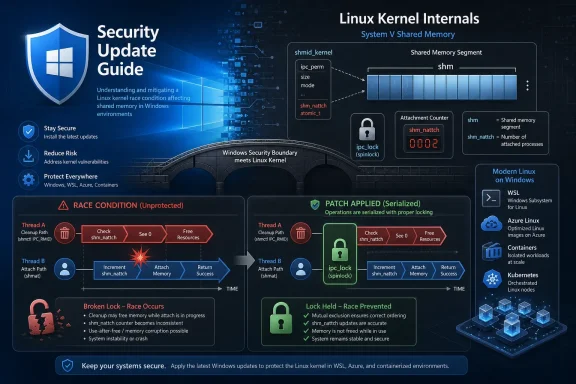 Microsoft’s Advisory Points at a Linux Problem Inside a Windows World
The phrase “ipc/shm: serialize orphan cleanup with shm_nattch updates” reads like something only a kernel maintainer could love. It is terse, precise, and almost aggressively unmarketed. But buried in that line is the kind of bug that defines a large share of kernel security work: two pieces of code made reasonable assumptions about locking, and one of those assumptions stopped being true.The vulnerable area is System V shared memory, one of Unix’s older inter-process communication mechanisms. Applications can create shared-memory segments, attach to them, detach from them, and rely on the kernel to account for who still has access. The field at the center of this fix,
shm_nattch, tracks the number of current attachments to a shared-memory segment.The problem was not that Linux forgot shared memory existed, nor that some exotic feature suddenly became dangerous. The issue was more prosaic: orphan cleanup could decide a segment was unused before taking the object lock that serialized the attachment count. If another path updated
shm_nattch under a different lock, cleanup could act on stale understanding.That is the security story in miniature. A counter that looks boring becomes a trust boundary. A cleanup routine that looks housekeeping-adjacent becomes a potential destroy path. A lock that once seemed sufficient turns out not to cover the whole state being tested.
The Patch Is Short Because the Assumption Was the Bug
The upstream Linux patch associated with this issue moves the decisiveshm_may_destroy() check under the shared-memory object lock. In plain English, the kernel should not decide that an orphaned segment is safe to destroy until it holds the lock that protects the data used to make that decision. That is not a glamorous mitigation, but it is the exact kind of correction kernel maintainers prefer: narrow, mechanical, and aligned with existing locking rules.The interesting part is the comment changed by the patch. The old logic treated the namespace read-write semaphore as sufficient for checking the relevant fields. The fix explicitly says
shm_nattch can change under shm_perm.lock without holding that semaphore, so the object lock must be taken before checking whether the segment may be destroyed.That kind of delta matters more than the number of lines changed. Security advisories often flatten bugs into severity scores and product grids, but kernel bugs are usually about invariants. Once the invariant is wrong, everything built on top of it is suspect.
For administrators, this means the right question is not “was the patch big?” It is “does my supported kernel line include the fixed locking behavior?” In kernel security, a six-line fix can be the difference between a benign race and a primitive someone eventually weaponizes.
Shared Memory Is Old Infrastructure, Not Dead Infrastructure
System V IPC can look antique next to modern container runtimes, gRPC services, and cloud-native messaging systems. That impression is misleading. Shared memory remains part of the substrate used by databases, browsers, language runtimes, scientific workloads, legacy enterprise software, and compatibility layers that prize speed over novelty.The reason is simple: shared memory is fast. If two processes need to exchange large amounts of data on the same machine, avoiding unnecessary copies is attractive. The kernel’s job is to make that efficient path safe enough that one process cannot trip another, corrupt accounting, or leave privileged state dangling.
That job gets harder as systems become more concurrent. Linux is not one thread gently walking through a linked list. It is a constantly shifting set of CPUs, processes, namespaces, containers, reference counters, and locks. A cleanup path may run because a process exited, a namespace is being dismantled, or an object has become unreachable from the place that created it.
The danger is not that every shared-memory race becomes a remote-code-execution blockbuster. Many do not. The danger is that attackers love places where lifetimes, counters, and cleanup disagree. Those are the neighborhoods where use-after-free bugs, stale references, and privilege-boundary mistakes tend to live.
The Windows Angle Is No Longer Optional
A decade ago, a Linux kernel CVE appearing in a Microsoft security feed would have felt like a category error to many Windows administrators. In 2026, it is routine. Microsoft ships, supports, consumes, and secures Linux in enough places that the old platform boundary is no longer operationally useful.Windows Subsystem for Linux is the obvious example for enthusiasts and developers. WSL puts a real Linux kernel into the Windows developer experience, and that kernel needs updates like any other. A vulnerability in Linux IPC may not affect every WSL user in the same way it affects a multi-user Linux server, but it still belongs on the Windows admin radar when WSL is enabled across developer fleets.
Azure is the bigger enterprise story. Cloud workloads routinely mix Windows Server, Linux virtual machines, container hosts, Kubernetes nodes, managed images, and vendor appliances. Even shops that call themselves “Windows-first” often run Linux in build systems, CI runners, security tooling, ingress layers, and data platforms.
Then there is Azure Linux, Microsoft’s own Linux distribution lineage for cloud and edge scenarios. When Microsoft tracks Linux CVEs, it is not doing charity work for the broader open-source ecosystem. It is managing exposure in products and services where Linux is part of Microsoft’s delivery model.
Severity Scores Will Not Tell You Where This Matters
The temptation with a CVE like this is to wait for the score. If it is high, patch. If it is low or medium, defer. That workflow is understandable, but it is also how infrastructure teams get surprised by local kernel bugs that become useful inside chained attacks.A local race in shared memory is not the same thing as an unauthenticated network worm. Exploitation generally requires a foothold, the ability to run code locally, and enough timing control to hit the vulnerable window. Those constraints matter, and they should keep panic out of the room.
But “local” is not comforting in environments where local code execution is routine. Shared developer workstations, CI/CD runners, container hosts, jump boxes, university systems, remote desktop farms, and multi-tenant research machines all give users or workloads some local execution surface. In those places, local privilege escalation and containment escape bugs are not theoretical second-order concerns; they are how attackers turn an initial foothold into persistence or broader access.
The better model is contextual severity. On a locked-down single-user desktop with WSL disabled, this advisory may be noise. On a developer laptop running multiple WSL distributions, Docker integration, and untrusted build scripts, it deserves attention. On a container host or Linux-backed service tier, it belongs in the normal kernel patch pipeline.
The Race Is a Governance Problem as Much as a Kernel Problem
Concurrency bugs are difficult because they are bugs in time. Code reviewers can read each branch and conclude that each branch is locally sensible, while the failure only appears when two paths interleave in just the wrong order. Kernel maintainers are trained to think this way, but enterprise governance tools often are not.Asset systems usually track package names, versions, and CVE identifiers. They are less good at tracking whether an exposure is reachable in a particular runtime configuration. Is System V IPC enabled? Is the vulnerable code compiled into the kernel? Is the affected path usable inside a namespace? Is the workload single-user, multi-user, containerized, or ephemeral?
That uncertainty is why kernel CVEs create so much operational drag. The remediation answer is usually “take the vendor kernel update,” but the risk answer varies from “not reachable” to “patch this fleet before the weekend.” Mature teams separate those two tracks instead of waiting for perfect scoring.
Microsoft’s involvement sharpens the point. A Windows-centered security team may see an MSRC entry and assume Windows Update will handle the blast radius. Sometimes it will. Sometimes the relevant fix lives in a WSL kernel package, a Linux VM image, a container base layer, a Kubernetes node pool, or a third-party appliance firmware stream. The advisory is the starting gun, not the finish line.
WSL Turns Developer Convenience Into Patch Scope
WSL has been one of Microsoft’s most successful developer moves because it reduces friction. Windows users can run Linux tooling without leaving Windows, and organizations can standardize on Windows endpoints while still giving engineers the command-line environment they expect. That convenience comes with a quiet obligation: the Linux side must be governed.The risk from CVE-2026-52930 on WSL depends on the kernel version and the local threat model. A personal machine used by one developer is different from a managed workstation that pulls untrusted repositories, runs package install scripts, builds third-party code, and executes containers. In modern software development, “local” can include a lot of code the user did not write and barely inspected.
This is where endpoint management often lags. Security teams have years of muscle memory around Windows cumulative updates, Defender baselines, BitLocker posture, and application control. WSL introduces another update stream and another inventory dimension. If an organization cannot answer which endpoints have WSL enabled and which WSL kernel they are running, it cannot confidently answer whether this CVE is present.
The same applies to golden images and developer onboarding scripts. If WSL is installed as part of a standard engineering setup, kernel update verification should be part of that setup. Treating WSL as a personal convenience rather than a managed platform was always going to age badly.
Containers Make “Local” a Word That Needs Translation
Containerization muddies kernel risk because containers share the host kernel. A bug in application code can be isolated by a container boundary; a bug in the kernel sits underneath that boundary. That does not automatically make every kernel CVE a container escape, but it means kernel patching remains central to container security.System V IPC also intersects with container configuration. Containers can have isolated IPC namespaces, share IPC with the host, or be configured in ways that change what processes can see and manipulate. A vulnerability in IPC cleanup must therefore be evaluated against runtime settings, orchestration defaults, and workload privilege.
For Kubernetes operators, the practical response is familiar. Node images need to be updated, drained, and rotated. Managed node pools may receive fixes through cloud-provider image updates, but customers still need to roll nodes or ensure automatic upgrade channels are doing what policy says they do. Self-managed clusters have even less excuse to treat the advisory as abstract.
The uncomfortable truth is that container security programs often spend more energy scanning images than patching kernels. Image scanning is visible and automatable; kernel maintenance is disruptive and requires coordination. CVE-2026-52930 is another reminder that the host remains the real security boundary.
Microsoft’s Security Feed Is Becoming a Hybrid Infrastructure Map
MSRC advisories used to be read mainly as a Windows patch map. That era is over. The Security Update Guide now reflects a Microsoft estate that spans Windows, Azure, Edge, Office, developer tools, Linux components, open-source dependencies, and cloud infrastructure.That breadth is useful, but it can also confuse readers. A CVE entry in Microsoft’s guide does not always mean the vulnerable code originated at Microsoft. It may mean Microsoft ships or consumes an affected component, provides an update through a supported product channel, or is documenting exposure for customers who depend on Microsoft-managed infrastructure.
For WindowsForum readers, this is a cultural shift worth naming. Windows administration is no longer just the art of managing Windows. It is the art of managing Microsoft-centered computing environments, many of which contain Linux kernels, Chromium engines, OpenSSH components, Python packages, container images, and firmware stacks.
The skill set follows the architecture. Admins who can read a Windows KB article but cannot interpret a kernel patch note are at a disadvantage. Conversely, Linux teams that ignore MSRC because it says “Microsoft” miss signals about Azure-hosted or Microsoft-supported exposure. The modern patch desk has to be bilingual.
The Disclaimer Is Boilerplate, but the Operational Burden Is Real
The Microsoft Knowledge Base disclaimer attached to advisories is legal boilerplate, and nobody should confuse it with technical guidance. Microsoft says the information is provided as-is and disclaims warranties; that language exists to limit liability, not to help an administrator decide whether to reboot a node pool.Still, the disclaimer captures an uncomfortable truth about vulnerability management. Vendors can publish advisories, patches, and known-issue notes, but the customer owns the messy middle: asset discovery, staging, compatibility testing, maintenance windows, rollback planning, and proof that the right systems actually changed.
For kernel fixes, that middle is especially messy. Updating the package is not always enough if the running kernel does not change until reboot. Live patching can reduce disruption for some classes of bugs, but it is not universal, and teams should not assume a livepatch stream covers every CVE unless their vendor says so. Container hosts and WSL environments add their own restart semantics.
This is why a modest kernel race can become an audit finding. The fix may be available, the advisory may be clear, and the risk may be manageable, yet the organization may still fail because it cannot prove which machines were affected and when they were remediated.
The Patch Calendar Needs a Linux Column
For Windows-heavy shops, the practical action is not to build a one-off response ritual around CVE-2026-52930. It is to add a durable Linux column to the patch calendar. That column should include WSL kernels, Azure Linux images, Linux VMs, Kubernetes nodes, build agents, security appliances, and vendor-managed Linux-based systems where customers have update responsibility.That does not mean treating every Linux CVE as a five-alarm fire. It means making Linux exposure visible in the same governance language already used for Windows. Inventory, ownership, severity, exploitability, maintenance windows, exception handling, and validation should not depend on whether the kernel came from Redmond, Canonical, Red Hat, SUSE, Debian, or a cloud image pipeline.
CVE-2026-52930 is a good test case precisely because it is not a media-friendly vulnerability with a catchy name. There is no viral logo, no branded exploit kit, no obvious board-level panic. If your process can handle this kind of advisory calmly and accurately, it will probably handle louder ones better.
If it cannot, the weakness is not the kernel bug. The weakness is the assumption that Linux risk in a Microsoft estate is someone else’s problem.
The Small CVE That Exposes the Bigger Patch Boundary
CVE-2026-52930 should push administrators toward a few concrete checks rather than dramatic conclusions. The bug is a kernel shared-memory locking issue, and the fix is to serialize orphan cleanup with the lock that protects attachment updates. The security consequence is contextual, but the operational lesson is broad.- Organizations should identify whether they run affected Linux kernel builds through WSL, Azure Linux, Linux VMs, container hosts, appliances, or managed service images.
- WSL should be inventoried as part of endpoint management, including whether it is enabled and which kernel update channel is in use.
- Container platforms should be evaluated at the host-kernel level, not only through application image scanning.
- Kernel updates should be verified against the running kernel after reboot or livepatch application, not merely against installed package metadata.
- Security teams should treat MSRC Linux-related advisories as signals about Microsoft ecosystem exposure, not as curiosities outside the Windows patch cycle.
CVE-2026-52930 will probably not be remembered as the defining vulnerability of 2026, and that is exactly why it is useful. It shows how ordinary kernel maintenance now crosses the Windows boundary, how developer convenience expands patch scope, and how hybrid infrastructure turns once-separate advisory streams into one operational reality. The next Linux kernel CVE in Microsoft’s orbit may be louder, but the organizations best prepared for it will be the ones that treated this quiet shared-memory race as a warning about where their security perimeter already moved.
References
- Primary source: MSRC
Published: 2026-06-28T01:48:01-07:00
Security Update Guide - Microsoft Security Response Center
 msrc.microsoft.com
- Related coverage: talosintelligence.com
Vulnerability Reports - Latest network security threats and zeroday discoveries || Cisco Talos Intelligence Group - Comprehensive Threat Intelligence
Talos investigates software and operating system vulnerabilities in order to discover them before malicious threat actors do. We provide this information to vendors so that they can create patches and protect their customers as soon as possible.talosintelligence.com
- Related coverage: vulnerability.circl.lu
Vulnerability-Lookup
Vulnerability-Lookup - Fast vulnerability lookup correlation from different sources.vulnerability.circl.lu
