

On May 27, 2026, NVD published CVE-2026-45932, a Linux kernel vulnerability in BPF detach handling that allowed unprivileged users to detach tcx or netkit programs when no program file descriptor was supplied. The bug is narrow, local, and not yet scored by NVD, but it lands in one of the kernel’s most security-sensitive neighborhoods. For WindowsForum readers, the point is not that Windows desktops are suddenly at risk; it is that the modern Windows estate increasingly includes Linux kernels in WSL, containers, developer workstations, appliances, and cloud nodes. A small permission check in BPF is exactly the kind of detail that decides whether a platform boundary is real or merely assumed.
CVE-2026-45932 is not a buffer overflow, not a remote code execution bug, and not the sort of vulnerability that arrives with a proof-of-concept video and a dramatic logo. It is a permission bypass in the Linux kernel’s BPF subsystem, specifically around
That is a modest description with serious implications. BPF is not an obscure debug interface anymore; it is a programmable execution layer used for networking, observability, filtering, security monitoring, and container infrastructure. If the kernel lets the wrong actor detach the wrong program from the wrong network hook, the practical result may be loss of policy enforcement, loss of telemetry, or disruption of traffic handling.
The upstream fix is equally modest: require
This is why CVE records that say “awaiting enrichment” are not safe to ignore. NVD had not assigned CVSS scores at publication time, and the record contained no enriched severity vector. But the absence of a score is not the absence of risk; it is the absence of a completed bureaucratic sentence.
That architecture has made eBPF extremely attractive. Cloud networking stacks use it. Container platforms use it. Observability agents use it. Security tools use it. Packet filtering, traffic shaping, service meshes, tracing, and policy enforcement increasingly rely on BPF programs sitting in the data path rather than bolted on from userspace.
The strength of that model is also the reason permission bugs are treated with suspicion. BPF programs can be extremely powerful even when they are carefully constrained. The kernel verifier limits what they can do, but the attach and detach interfaces decide where they can do it. If unprivileged users can alter those attachments, the question quickly shifts from “Can they run arbitrary kernel code?” to “Can they remove code that someone else deliberately put there?”
CVE-2026-45932 is about that second question. The vulnerable path concerns detaching programs, not loading them. In some environments, that can be the more interesting primitive: an attacker may not need to install a malicious filter if they can remove a defensive one.
tcx is part of the kernel’s newer work around traffic-control-style BPF attachment. Netkit, meanwhile, is tied to virtual networking use cases and BPF attachment semantics around netkit devices. These are not the oldest, most familiar BPF paths, which is part of the lesson. As BPF expands across networking subsystems, every new attach model inherits the old security burden: the kernel must know who is allowed to change what.
The fix checks for
The interesting detail is not that Linux requires capabilities for sensitive network operations. It is that the detach operation already lived in a permission-sensitive ecosystem, yet one argument pattern slipped through. This is the type of bug that mature subsystems produce: not a failure to understand the security model, but a failure to apply it consistently in one corner.
The second calming fact is that many mainstream systems restrict unprivileged BPF aggressively. Over the past several years, distributions have tightened BPF access because the subsystem has repeatedly sat at the intersection of performance engineering and privilege escalation research. In hardened environments, ordinary users may not be able to get far enough to exploit a BPF-adjacent weakness.
But those facts do not make the bug irrelevant. Local vulnerabilities matter because attackers often arrive with some foothold already in hand: a compromised web app, a low-privilege shell, an escaped service account, a developer account on a shared machine, or a container workload running with more access than anyone remembers approving. The question for defenders is not whether the CVE is remotely wormable. It is whether it gives a lower-privileged actor a way to weaken controls inside the host or namespace they can reach.
The bug’s most plausible impact is disruption or bypass of BPF-based network behavior. That might mean detaching a program used for traffic classification, filtering, policy enforcement, instrumentation, or virtual networking. In some deployments, detaching the wrong BPF program is merely noisy. In others, it can remove a control plane assumption that higher-level software treats as guaranteed.
Containers complicate the picture further. A vulnerability requiring local access can still be meaningful if the “local” actor is a container workload on a shared host. The impact depends heavily on namespace boundaries, granted capabilities, mounted filesystems, BPF restrictions, and whether a workload has access to the relevant network devices or BPF commands. There is no universal answer because container security is a pile of deployment-specific choices.
The most important operational question is whether untrusted or semi-trusted users can execute BPF detach operations against relevant tcx or netkit devices. On a locked-down server running only trusted services, the risk may be low. On a multi-tenant host, a developer workstation with broad experimentation privileges, or a Kubernetes node running privileged networking components, the calculus changes.
This is where CVSS scores can be actively misleading even after they arrive. A single base score will flatten the difference between a lab VM, a hardened production server, and a container host whose networking policy depends on BPF. The vulnerability’s severity is not just in the kernel code. It is in the environment that code governs.
The CVE references stable kernel commits, which means the fix has been backported through relevant stable trees rather than left as a mainline-only correction. That is the practical milestone administrators should care about. For Linux kernel CVEs, the question is not simply “Is there a patch?” but “Has my distribution pulled the exact stable fix into the kernel package I actually run?”
That distinction matters because kernel version numbers are not a clean map of exposure. Enterprise distributions backport fixes without necessarily changing to the newest upstream release. Cloud vendors carry their own kernels. Appliance makers may lag or selectively patch. WSL kernels follow Microsoft’s packaging and update cadence rather than a generic distro kernel path.
The safe operational posture is to treat the CVE identifier as a tracking label, not a patch instruction. Administrators should map CVE-2026-45932 to vendor advisories, package changelogs, and kernel build metadata. If the only evidence is that the upstream tree has a fix, the estate is not yet done.
For security teams that still drive patch priority from NVD severity alone, this creates a blind spot. A vulnerability can be real, fixed upstream, and relevant to your systems while still appearing as “N/A” in score fields. Automated scanners may flag it inconsistently, suppress it, or fail to rank it in the way a human operator would.
That does not mean every unscored Linux CVE deserves emergency treatment. It means unscored kernel CVEs need context. Which subsystem is involved? Is it reachable by unprivileged users? Is it local or remote? Does it affect confidentiality, integrity, availability, or enforcement of security controls? Is there a stable fix? Have your vendors shipped it?
CVE-2026-45932 scores as “interesting” before it scores as “critical.” It touches BPF. It touches network attachment points. It bypasses a permission check. It appears to be local and narrow. That combination argues for prompt normal patching on exposed Linux fleets, faster review on container and networking-heavy hosts, and calm disregard on systems that do not run affected kernels or expose the relevant paths.
WSL is the obvious example. Developers using WSL 2 run a real Linux kernel under lightweight virtualization. A local Linux kernel bug inside WSL is not automatically a Windows host compromise, and CVE-2026-45932 does not describe such an escape. Still, WSL environments are part of the developer workstation attack surface, and they often contain credentials, source code, package tokens, SSH keys, and build tooling that matter more than the VM boundary in day-to-day incident response.
The bigger exposure is usually server-side. Windows administrators increasingly manage hybrid infrastructure where Linux hosts provide container runtimes, ingress controllers, monitoring agents, and network policy engines. If BPF programs are part of how those systems enforce or observe traffic, a detach permission bypass becomes relevant even when the admin workstation runs Windows 11.
Then there are vendor appliances and security products. Many “black box” network and security appliances are Linux systems underneath. Some rely heavily on BPF or related kernel networking hooks for performance and visibility. Customers may not be able to inspect those internals, but they can still ask vendors the right question: does your shipped kernel include the fix for CVE-2026-45932?
That divergence is dangerous because it may not always look like compromise. A missing BPF program can resemble a misconfiguration, a failed agent, a race during restart, or an ordinary network glitch. An attacker who removes an enforcement or monitoring hook may be able to create a temporary blind spot without writing anything obviously malicious to disk.
Defenders should therefore think beyond exploitability and consider observability. Can your tooling detect when expected BPF programs are missing? Can your network agent reconcile attachments automatically? Do alerts fire when enforcement hooks disappear? Do privileged operations around BPF appear in audit logs with enough detail to distinguish maintenance from abuse?
This is the kind of vulnerability that rewards environments with strong desired-state management. If your platform continuously verifies that required BPF programs are attached, the bug’s window narrows. If your environment assumes attachment state is static after boot, a successful detach may persist until someone notices the secondary effects.
CVE-2026-45932 is a reminder that capability models do not enforce themselves. Every kernel path that changes privileged state has to ask the right question at the right time. If a code path handles a file descriptor case and a no-file-descriptor case differently, both paths must still land on the same security principle.
The bug also highlights a recurring issue in API evolution. BPF has accumulated multiple attach styles, link abstractions, program types, and networking integrations over time. Those changes make the subsystem more useful, but they also create compatibility seams where permission assumptions can become uneven.
Security bugs often hide in seams. The old path is well understood. The new path borrows the old model. A special case is added for flexibility. A caller omits an argument. Suddenly, the security boundary depends on whether the less common branch remembered to call the same gatekeeper.
Before patching, administrators should identify systems where BPF is operationally important. Container networking nodes, observability-heavy hosts, security monitoring appliances, traffic-control systems, and developer machines used for eBPF work deserve earlier attention than ordinary single-user Linux VMs with no relevant exposure. That is triage, not complacency.
After patching, confirm the running kernel, not just the installed package. Linux systems can have a fixed kernel on disk while still running the old one in memory. This is a classic post-update failure mode, and it is especially common on servers with long uptimes or reboot-averse owners.
Where immediate patching is not possible, reduce access. Limit local shell access, review container capabilities, avoid granting broad networking capabilities to workloads, restrict unprivileged BPF where supported, and watch for unexpected changes to BPF attachment state. These measures are not a substitute for the patch, but they reduce the number of users and processes that can approach the vulnerable path.
The practical reading is compact:
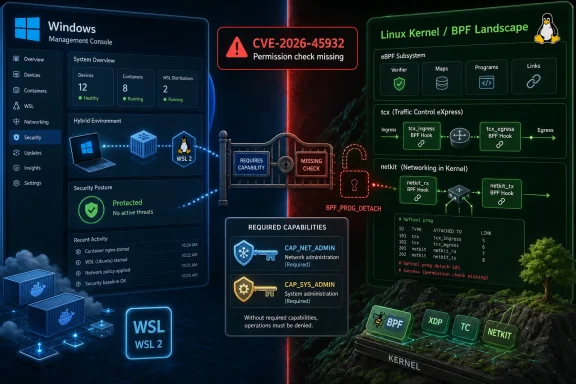 A Missing File Descriptor Turned Into a Missing Gate
CVE-2026-45932 is not a buffer overflow, not a remote code execution bug, and not the sort of vulnerability that arrives with a proof-of-concept video and a dramatic logo. It is a permission bypass in the Linux kernel’s BPF subsystem, specifically around BPF_PROG_DETACH operations for tcx and netkit devices. When a program file descriptor was not provided, the detach path could be reached by any user, skipping the capability checks that should have stood between an ordinary account and network-facing BPF plumbing.That is a modest description with serious implications. BPF is not an obscure debug interface anymore; it is a programmable execution layer used for networking, observability, filtering, security monitoring, and container infrastructure. If the kernel lets the wrong actor detach the wrong program from the wrong network hook, the practical result may be loss of policy enforcement, loss of telemetry, or disruption of traffic handling.
The upstream fix is equally modest: require
CAP_NET_ADMIN or CAP_SYS_ADMIN when no program file descriptor is supplied. That sounds almost banal, but kernel security often lives in precisely those banal clauses. The vulnerability exists because one invocation pattern did not receive the same gatekeeping treatment as the surrounding code expected.This is why CVE records that say “awaiting enrichment” are not safe to ignore. NVD had not assigned CVSS scores at publication time, and the record contained no enriched severity vector. But the absence of a score is not the absence of risk; it is the absence of a completed bureaucratic sentence.
BPF Has Become Infrastructure, Not an Experiment
To understand why this CVE matters, you have to resist the temptation to read “BPF” as a developer-only subsystem. Extended Berkeley Packet Filter began life as a way to filter packets efficiently, but modern eBPF has grown into a kernel-resident programmable framework. It lets privileged software load small programs into the kernel, attach them to defined hooks, and execute them under verifier constraints.That architecture has made eBPF extremely attractive. Cloud networking stacks use it. Container platforms use it. Observability agents use it. Security tools use it. Packet filtering, traffic shaping, service meshes, tracing, and policy enforcement increasingly rely on BPF programs sitting in the data path rather than bolted on from userspace.
The strength of that model is also the reason permission bugs are treated with suspicion. BPF programs can be extremely powerful even when they are carefully constrained. The kernel verifier limits what they can do, but the attach and detach interfaces decide where they can do it. If unprivileged users can alter those attachments, the question quickly shifts from “Can they run arbitrary kernel code?” to “Can they remove code that someone else deliberately put there?”
CVE-2026-45932 is about that second question. The vulnerable path concerns detaching programs, not loading them. In some environments, that can be the more interesting primitive: an attacker may not need to install a malicious filter if they can remove a defensive one.
The Vulnerability Is Small Because the Boundary Is Precise
The affected operation isBPF_PROG_DETACH, used to detach BPF programs from supported attach points. For tcx and netkit devices, the vulnerable case occurred when no program file descriptor was provided. In that path, the kernel could allow a user without appropriate capabilities to perform the detach.tcx is part of the kernel’s newer work around traffic-control-style BPF attachment. Netkit, meanwhile, is tied to virtual networking use cases and BPF attachment semantics around netkit devices. These are not the oldest, most familiar BPF paths, which is part of the lesson. As BPF expands across networking subsystems, every new attach model inherits the old security burden: the kernel must know who is allowed to change what.
The fix checks for
CAP_NET_ADMIN or CAP_SYS_ADMIN when the caller does not provide a program file descriptor. That is a telling choice. CAP_NET_ADMIN is the classic permission boundary for network administration inside a namespace, while CAP_SYS_ADMIN remains the famously overloaded capability that still gates a vast amount of privileged Linux behavior.The interesting detail is not that Linux requires capabilities for sensitive network operations. It is that the detach operation already lived in a permission-sensitive ecosystem, yet one argument pattern slipped through. This is the type of bug that mature subsystems produce: not a failure to understand the security model, but a failure to apply it consistently in one corner.
The Attack Surface Depends on Who Gets Near the Kernel
The first calming fact is that this is a local vulnerability. The record does not describe a remote network attack, and there is no indication that packets arriving from the internet can trigger the issue by themselves. An attacker needs local ability to invoke the relevant BPF detach operation on a vulnerable kernel.The second calming fact is that many mainstream systems restrict unprivileged BPF aggressively. Over the past several years, distributions have tightened BPF access because the subsystem has repeatedly sat at the intersection of performance engineering and privilege escalation research. In hardened environments, ordinary users may not be able to get far enough to exploit a BPF-adjacent weakness.
But those facts do not make the bug irrelevant. Local vulnerabilities matter because attackers often arrive with some foothold already in hand: a compromised web app, a low-privilege shell, an escaped service account, a developer account on a shared machine, or a container workload running with more access than anyone remembers approving. The question for defenders is not whether the CVE is remotely wormable. It is whether it gives a lower-privileged actor a way to weaken controls inside the host or namespace they can reach.
The bug’s most plausible impact is disruption or bypass of BPF-based network behavior. That might mean detaching a program used for traffic classification, filtering, policy enforcement, instrumentation, or virtual networking. In some deployments, detaching the wrong BPF program is merely noisy. In others, it can remove a control plane assumption that higher-level software treats as guaranteed.
Containers Make “Local” a More Complicated Word
For Windows administrators, Linux local bugs used to belong to a separate mental cabinet. That separation is obsolete. A modern Microsoft estate may include AKS nodes, Linux appliances, WSL developer environments, Linux build agents, GitHub Actions runners, container hosts, security sensors, and vendor-provided virtual machines. The management console may be Windows, but the kernel fleet is mixed.Containers complicate the picture further. A vulnerability requiring local access can still be meaningful if the “local” actor is a container workload on a shared host. The impact depends heavily on namespace boundaries, granted capabilities, mounted filesystems, BPF restrictions, and whether a workload has access to the relevant network devices or BPF commands. There is no universal answer because container security is a pile of deployment-specific choices.
The most important operational question is whether untrusted or semi-trusted users can execute BPF detach operations against relevant tcx or netkit devices. On a locked-down server running only trusted services, the risk may be low. On a multi-tenant host, a developer workstation with broad experimentation privileges, or a Kubernetes node running privileged networking components, the calculus changes.
This is where CVSS scores can be actively misleading even after they arrive. A single base score will flatten the difference between a lab VM, a hardened production server, and a container host whose networking policy depends on BPF. The vulnerability’s severity is not just in the kernel code. It is in the environment that code governs.
The Patch Says More Than the Score Will
The patch is straightforward: add a capability check forCAP_NET_ADMIN or CAP_SYS_ADMIN in the no-program-fd detach case. That may not satisfy readers looking for a dramatic exploit chain, but simple patches often carry the clearest security signal. The kernel should not let an unprivileged caller change network-attached BPF state merely because a particular argument is omitted.The CVE references stable kernel commits, which means the fix has been backported through relevant stable trees rather than left as a mainline-only correction. That is the practical milestone administrators should care about. For Linux kernel CVEs, the question is not simply “Is there a patch?” but “Has my distribution pulled the exact stable fix into the kernel package I actually run?”
That distinction matters because kernel version numbers are not a clean map of exposure. Enterprise distributions backport fixes without necessarily changing to the newest upstream release. Cloud vendors carry their own kernels. Appliance makers may lag or selectively patch. WSL kernels follow Microsoft’s packaging and update cadence rather than a generic distro kernel path.
The safe operational posture is to treat the CVE identifier as a tracking label, not a patch instruction. Administrators should map CVE-2026-45932 to vendor advisories, package changelogs, and kernel build metadata. If the only evidence is that the upstream tree has a fix, the estate is not yet done.
NVD’s Empty Score Is a Symptom of a Bigger Linux CVE Problem
The NVD entry for CVE-2026-45932 was published on May 27, 2026, but at the time described in the record, it had not yet received NVD CVSS enrichment. That is increasingly common in the Linux kernel world, where the volume of CVE assignments and the complexity of kernel backports make public vulnerability records feel like half-finished index cards. The kernel project may identify and fix an issue, while scoring, weakness classification, affected product mapping, and vendor impact analysis arrive later.For security teams that still drive patch priority from NVD severity alone, this creates a blind spot. A vulnerability can be real, fixed upstream, and relevant to your systems while still appearing as “N/A” in score fields. Automated scanners may flag it inconsistently, suppress it, or fail to rank it in the way a human operator would.
That does not mean every unscored Linux CVE deserves emergency treatment. It means unscored kernel CVEs need context. Which subsystem is involved? Is it reachable by unprivileged users? Is it local or remote? Does it affect confidentiality, integrity, availability, or enforcement of security controls? Is there a stable fix? Have your vendors shipped it?
CVE-2026-45932 scores as “interesting” before it scores as “critical.” It touches BPF. It touches network attachment points. It bypasses a permission check. It appears to be local and narrow. That combination argues for prompt normal patching on exposed Linux fleets, faster review on container and networking-heavy hosts, and calm disregard on systems that do not run affected kernels or expose the relevant paths.
Windows Shops Should Read This as a Linux Kernel Story Inside Their Perimeter
WindowsForum readers do not need to pretend this is a Windows kernel bug. It is not. But the operational perimeter of a Windows shop now includes Linux in too many places to draw comfort from branding.WSL is the obvious example. Developers using WSL 2 run a real Linux kernel under lightweight virtualization. A local Linux kernel bug inside WSL is not automatically a Windows host compromise, and CVE-2026-45932 does not describe such an escape. Still, WSL environments are part of the developer workstation attack surface, and they often contain credentials, source code, package tokens, SSH keys, and build tooling that matter more than the VM boundary in day-to-day incident response.
The bigger exposure is usually server-side. Windows administrators increasingly manage hybrid infrastructure where Linux hosts provide container runtimes, ingress controllers, monitoring agents, and network policy engines. If BPF programs are part of how those systems enforce or observe traffic, a detach permission bypass becomes relevant even when the admin workstation runs Windows 11.
Then there are vendor appliances and security products. Many “black box” network and security appliances are Linux systems underneath. Some rely heavily on BPF or related kernel networking hooks for performance and visibility. Customers may not be able to inspect those internals, but they can still ask vendors the right question: does your shipped kernel include the fix for CVE-2026-45932?
The Real Risk Is Control-Plane Drift
The phrase “detach permissions” sounds technical and contained, but in production it points to a larger reliability problem: control-plane drift. Security and networking platforms install BPF programs because they expect those programs to remain attached until deliberately changed. If an unprivileged actor can detach them, state diverges from intent.That divergence is dangerous because it may not always look like compromise. A missing BPF program can resemble a misconfiguration, a failed agent, a race during restart, or an ordinary network glitch. An attacker who removes an enforcement or monitoring hook may be able to create a temporary blind spot without writing anything obviously malicious to disk.
Defenders should therefore think beyond exploitability and consider observability. Can your tooling detect when expected BPF programs are missing? Can your network agent reconcile attachments automatically? Do alerts fire when enforcement hooks disappear? Do privileged operations around BPF appear in audit logs with enough detail to distinguish maintenance from abuse?
This is the kind of vulnerability that rewards environments with strong desired-state management. If your platform continuously verifies that required BPF programs are attached, the bug’s window narrows. If your environment assumes attachment state is static after boot, a successful detach may persist until someone notices the secondary effects.
Capability Boundaries Are Only as Good as Their Weirdest Exception
Linux capabilities were designed to break the all-powerful root model into narrower privileges. In practice, they are both essential and messy.CAP_NET_ADMIN covers a broad range of network administration operations, while CAP_SYS_ADMIN is so expansive that kernel developers have long joked about it being the new root.CVE-2026-45932 is a reminder that capability models do not enforce themselves. Every kernel path that changes privileged state has to ask the right question at the right time. If a code path handles a file descriptor case and a no-file-descriptor case differently, both paths must still land on the same security principle.
The bug also highlights a recurring issue in API evolution. BPF has accumulated multiple attach styles, link abstractions, program types, and networking integrations over time. Those changes make the subsystem more useful, but they also create compatibility seams where permission assumptions can become uneven.
Security bugs often hide in seams. The old path is well understood. The new path borrows the old model. A special case is added for flexibility. A caller omits an argument. Suddenly, the security boundary depends on whether the less common branch remembered to call the same gatekeeper.
For Administrators, the Fix Is Patch Management Plus Exposure Management
The most direct remediation is to install a kernel containing the upstream stable fix or the equivalent vendor backport. That sounds simple until it meets production maintenance windows, reboot requirements, clustered workloads, and appliance firmware cycles. Kernel vulnerabilities are still kernel vulnerabilities: in most environments, applying the fix means scheduling a reboot or live-patching only where vendor-supported live patching is available.Before patching, administrators should identify systems where BPF is operationally important. Container networking nodes, observability-heavy hosts, security monitoring appliances, traffic-control systems, and developer machines used for eBPF work deserve earlier attention than ordinary single-user Linux VMs with no relevant exposure. That is triage, not complacency.
After patching, confirm the running kernel, not just the installed package. Linux systems can have a fixed kernel on disk while still running the old one in memory. This is a classic post-update failure mode, and it is especially common on servers with long uptimes or reboot-averse owners.
Where immediate patching is not possible, reduce access. Limit local shell access, review container capabilities, avoid granting broad networking capabilities to workloads, restrict unprivileged BPF where supported, and watch for unexpected changes to BPF attachment state. These measures are not a substitute for the patch, but they reduce the number of users and processes that can approach the vulnerable path.
The Small CVE That Belongs on the Patch Calendar
CVE-2026-45932 should not trigger panic, but it should survive the first pass of vulnerability triage. It is a kernel permission bypass in a powerful networking subsystem, fixed upstream and published before NVD completed scoring. That combination is exactly where mature patch programs earn their keep.The practical reading is compact:
- Systems running kernels with the vulnerable tcx or netkit BPF detach behavior should receive vendor kernels that include the stable fix.
- Hosts that rely on BPF for networking, policy enforcement, observability, or container infrastructure deserve higher priority than generic Linux desktops.
- The absence of an NVD score on May 27, 2026 should not be treated as evidence that the issue is harmless.
- Windows administrators should check WSL, Linux build agents, container hosts, appliances, and cloud nodes rather than limiting review to traditional Linux server inventories.
- Teams should verify the running kernel after updates, because installed-but-not-booted kernel fixes do not close kernel vulnerabilities.
- Environments that can detect missing or altered BPF attachments will be better positioned to spot both exploitation and ordinary agent failure.
References
- Primary source: NVD / Linux Kernel
Published: 2026-05-28T01:05:54-07:00
NVD - CVE-2026-45932
 nvd.nist.gov
- Security advisory: MSRC
Published: 2026-05-28T01:05:54-07:00
Original feed URL
Security Update Guide - Microsoft Security Response Center
 msrc.microsoft.com
- Related coverage: stackoverflow.com
linux kernel - How to detach ebpf program with 'bpftool prog detach' - Stack Overflow
I am trying to understand how 'bpftool prog detach' works. To experiment, I created a simple ebpf program and below is output from 'bpftool prog show name sys_exit' at runtime
81: tracing name sys...stackoverflow.com
- Related coverage: docs.ebpf.io
Libbpf userspace function 'bpf_program__attach_netkit' - eBPF Docs
This page documents the 'bpf_program__attach_netkit' libbpf userspace function, including its definition, usage, and examples. docs.ebpf.io
- Related coverage: kernel.googlesource.com
- Related coverage: kernel.org
- Related coverage: codebrowser.dev
- Related coverage: bpfman.io
Linux Capabilities - bpfd
bpfman.io
- Related coverage: labs.cloudsecurityalliance.org
CSA research note linux copy fail CVE 2026 31431 20260503 csa styled
PDF documentlabs.cloudsecurityalliance.org
- Related coverage: netdev.bots.linux.dev
- Related coverage: bpfconf.ebpf.io
