

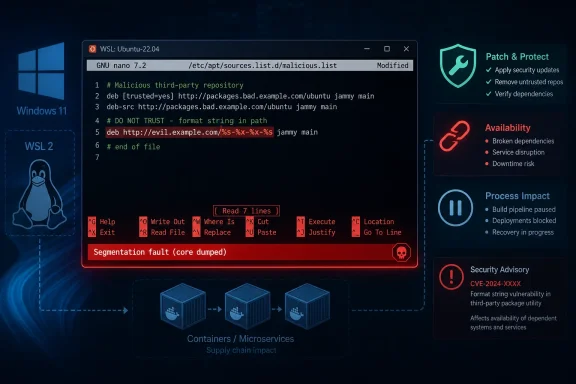
printf-style format specifiers. The bug is not a Windows remote-code-execution panic button, and treating it like one would miss the point. Its real importance is that a humble terminal editor, pulled into servers, containers, WSL images, build agents, and cloud distributions, can still become an availability problem when old C programming mistakes meet modern automation. This is the kind of flaw that looks small until it appears in the one place where “just edit the file” is part of recovery.
The Small Bug That Fits the Modern Supply Chain Too Well
Nano is the software equivalent of a screwdriver in a datacenter drawer. It is not glamorous, it is rarely the thing architects draw on a whiteboard, and it is often installed because someone needs a friendly text editor on a system where vi feels punitive. That ordinariness is precisely why CVE-2026-6843 deserves more attention than its medium score might suggest.
The vulnerability is a classic format string issue in nano’s statusline() path. According to public vulnerability records, a local user can create a directory whose name contains printf format specifiers; when nano attempts to display that name, the application can crash with a segmentation fault. The result is denial of service against nano itself, not compromise of the host.
That distinction matters. A crashing editor is not the same thing as a crashed server, leaked database, stolen Kerberos ticket, or arbitrary code execution in a privileged daemon. But the CVE’s availability impact is rated high because the targeted component becomes unavailable when the attack is triggered, and the trigger is low-complexity once a user can shape the filesystem environment that nano later displays.
This is why dismissing the flaw as “just nano” is too glib. Many operational failures start with a modest tool failing at an inconvenient moment. If the editor is part of an emergency workflow, a provisioning script, a support jump box, or a constrained shell used during incident response, denial of access to that tool can become more than a cosmetic crash.
Format Strings Are Ancient, but They Keep Surviving Audits
A format string vulnerability is one of C’s oldest security footguns. The short version is that a program should treat user-controlled text as data, but accidentally treats it as a formatting recipe. In the printf family of functions, sequences such as %s, %x, or %n are not just characters; they instruct the function how to interpret arguments and memory.
In many historical cases, format string bugs have led to information disclosure or code execution. CVE-2026-6843 appears narrower: the public descriptions emphasize a segmentation fault and denial of service in nano when it displays a crafted directory name. That is still enough to produce a CVSS vector with local attack vector, low attack complexity, no privileges required, user interaction required, unchanged scope, no confidentiality or integrity impact, and high availability impact.
The “user interaction required” part is doing a lot of work. An attacker does not simply packet-blast nano from across the internet. Someone or something has to cause nano to render the maliciously named directory in a context that reaches the vulnerable status-line code. That might be a person navigating into a directory, opening nano from a crafted path, or running a workflow that invokes nano in a location influenced by another local user.
Security teams should read that correctly, not emotionally. This is not a wormable exploit. It is also not irrelevant. Local, interaction-dependent bugs are exactly the sort of defects that become useful in shared systems, multi-user development environments, education labs, CI sandboxes, support shells, and container images where users can write names into places other users later inspect.
The Microsoft Angle Is Less About Windows Than About Windows Workflows
The presence of this CVE in Microsoft’s Security Update Guide can look odd at first glance. Nano is a GNU/Linux terminal editor, not a native Windows component in the way Notepad, Explorer, or Win32k are. But in 2026, Windows administration is no longer a cleanly Windows-only discipline.
Windows Subsystem for Linux, Azure-hosted Linux images, container build environments, GitHub Actions runners, Azure DevOps agents, mixed estates, and Microsoft’s own Linux-based platform components have made Linux package hygiene part of the Windows administrator’s job. A WindowsForum audience knows this reality well: the same admin who patches Windows Server may also maintain Ubuntu WSL images, Kubernetes nodes, Linux containers, and cloud appliances.
That is the practical reason this CVE belongs in the conversation here. Microsoft’s ecosystem now includes enough Linux-adjacent surfaces that vulnerability tracking has to follow the tools, not the old operating-system tribal lines. A nano issue may not threaten the Windows kernel, but it can still affect the way Windows shops operate, troubleshoot, and automate.
There is also a subtler point. Administrators increasingly rely on curated vulnerability portals rather than manually following every upstream project, distribution tracker, and package advisory. When MSRC surfaces a CVE like this, it signals that Microsoft’s security view has to encompass dependencies and environments that once sat outside the company’s traditional patch narrative.
Medium Severity Is Not a Synonym for Optional
The public CVSS v3.1 score for CVE-2026-6843 is 5.5, placing it in the medium range. That rating is sensible. The vulnerability requires local positioning and user interaction, and it does not claim confidentiality or integrity loss. If your patching program ranks this below actively exploited browser flaws, VPN edge bugs, domain controller vulnerabilities, and kernel privilege escalations, that is not negligence; it is prioritization.
The mistake would be translating “medium” into “ignore indefinitely.” Medium vulnerabilities are the sediment that accumulates in base images, golden templates, appliance builds, and developer workstations. One bug is rarely existential, but a culture of leaving low-friction package updates undone is how organizations end up running fragile infrastructure whose components fail in unexpected combinations.
Nano also sits in an awkward category for patch governance. It is often installed by default, pulled in by metapackages, or added manually for convenience. It may not appear in application owners’ mental inventory because it is not “the app.” That makes it easy for the package to remain stale even where more prominent services get patched on schedule.
For administrators, the correct response is not an emergency change freeze-breaking rollout. It is to make sure nano is included in normal Linux package update cycles, base-image refreshes, and container rebuilds. If a distribution has not yet shipped a fixed package, note the exposure and avoid treating untrusted filesystem names as harmless in shared environments.
The Exploit Path Is Local, but Local Is Not Comforting Everywhere
“Local attacker” used to imply a relatively narrow threat model: someone already has shell access, so you have bigger problems. That framing is increasingly obsolete. Modern infrastructure routinely gives users partial local influence without giving them full trust.
Think about shared bastion hosts, university Linux machines, developer jump boxes, internal Git servers, build workers, container volumes, and support environments. In those settings, one user may be able to create directories or check out repositories that another user later inspects. The target is not necessarily the root account; it may be the human operator trying to diagnose a problem under pressure.
The interaction requirement also maps neatly onto social engineering. A malicious repository could contain a weirdly named folder. A support bundle could unpack into a path designed to crash nano when inspected. A teammate could ask an admin to “open the config in this directory,” and the editor failure becomes the payload.
Again, that payload is a crash, not a shell. But availability attacks against tools used during troubleshooting have an outsized nuisance value. If a responder cannot open a file with the editor they expect, they lose time, switch tools, rerun commands, or misdiagnose the issue as terminal corruption, package breakage, or filesystem damage.
The Status Line Is a Reminder That UI Code Is Attack Surface
The vulnerable path is particularly instructive because it sits in user-interface plumbing. The status line is not parsing a network protocol, verifying a signature, deserializing a file format, or executing a plugin. It is showing the user where they are.
That is the lesson. Display code is still code. Logging code is still code. Error reporting, prompts, banners, titles, progress messages, and status bars all carry user-controlled strings through formatting paths. Developers are generally more suspicious of external input when it arrives as a packet or document, and less suspicious when it arrives as a filename or directory name.
Unix-like systems make filenames wonderfully permissive, and that permissiveness is a security boundary test in disguise. Paths can contain spaces, control characters, leading dashes, Unicode oddities, and, in this case, characters that become dangerous only when passed to the wrong formatting function. The filesystem is not a sanctuary where input becomes safe merely because it has a name.
For a terminal editor, the fix is conceptually simple: pass untrusted strings as arguments to constant format strings, or otherwise ensure they are rendered literally. The persistence of such bugs is not because the rule is unknown. It is because large C programs contain many old paths, many convenience wrappers, and many places where display logic gradually becomes trusted by habit.
Distribution Status Tells the Real Story of Linux Patching
The public distribution trackers show a familiar patch landscape. Debian’s tracker has listed older stable releases as vulnerable while identifying nano 9.0-1 in unstable as fixed. Ubuntu’s page has carried a medium priority and evaluation status across multiple releases. Amazon Linux has identified Amazon Linux 2023 as pending fix while Amazon Linux 2 is not affected.
Those differences are not contradictions so much as the normal rhythm of downstream security maintenance. Upstream may have a fix, one distribution may have it in unstable, another may still be evaluating affected releases, and a cloud image vendor may be deciding whether its packaged version is affected or when to ship an advisory. For enterprise IT, the question is less “does a fix exist somewhere?” than “has the fix reached the channel I actually consume?”
This is where vulnerability management often becomes more complicated than the CVE description. A scanner may flag nano in one image and not another. A container built last week may remain vulnerable even after the base distribution publishes a fixed package. A long-lived development VM may never get refreshed because no one considers it production.
The operational answer is boring but effective: update packages through the distribution, rebuild images from updated bases, and verify that the installed nano version corresponds to the fixed package for that release. If a vendor has not completed evaluation, do not invent a private severity rating; document the uncertainty and apply compensating controls where local untrusted users can influence paths.
Containers Make Small Userland Bugs Harder to Inventory
CVE-2026-6843 is also a useful case study in container sprawl. Nano should not be in many production containers at all. Yet anyone who has inspected real-world images knows that shells, package managers, editors, curl, git, and debugging utilities frequently survive the journey from development convenience to production artifact.
That matters because vulnerability scanners do not care why a package is present. If nano is in the image and matches an affected version, it becomes part of the report. Security teams then spend time triaging a package that the application may never need at runtime.
There are two different lessons here. The first is conventional: minimal images reduce attack surface and reduce vulnerability noise. If nano is not required in production containers, remove it from the final stage. Multi-stage builds exist so that debugging and build-time conveniences do not have to ship with the workload.
The second lesson is more human. Organizations often add tools like nano because debugging production containers is still treated as a normal practice. If your operating model assumes interactive editing inside containers, a denial-of-service bug in an editor suddenly becomes more relevant. If your model treats containers as replaceable artifacts, the right fix is probably not just patching nano but removing the need to edit inside the container at all.
WSL Turns Linux Package Hygiene Into a Desktop Admin Problem
For Windows administrators, Windows Subsystem for Linux is the most obvious place where this CVE could surface. WSL distributions are Linux systems with Linux packages, maintained through their own package managers. They do not magically inherit Windows Update behavior for every userland package inside every installed distribution.
That division is easy to forget. A corporate laptop can be fully current on Windows patches while its Ubuntu, Debian, or other WSL distribution contains stale packages. If developers use WSL as their primary shell, and if repositories or directories from untrusted sources are opened in terminal editors, a nano crash is plausible.
The risk is still contained. A WSL nano crash does not mean Windows is compromised. But from an IT operations standpoint, WSL has become part of the endpoint. Developer productivity, build reproducibility, secrets handling, and compliance scanning increasingly depend on what lives inside those distributions.
Enterprises that allow WSL should therefore define basic maintenance expectations. That can include user education, scripted package updates, standard base distributions, periodic inventory, and guidance against using unmaintained WSL instances as long-term development platforms. CVE-2026-6843 is not the reason to build that program, but it is a tidy example of why the program should already exist.
The Denial-of-Service Label Needs a Narrow Reading
The CVE language describes total loss of availability for the impacted component. That phrase can sound dramatic, and in CVSS terms it is valid: if nano crashes reliably, nano’s availability is fully lost for that execution. But readers should not inflate that into total system denial of service.
The impacted component is the editor. Existing network connections are not severed. The kernel does not panic. A database is not forced offline. The attacker’s win condition is making nano unavailable when the vulnerable condition is reached.
That narrower reading should shape response. Security teams should avoid alarmist messaging that suggests business-critical services are directly halted by this flaw. Overstatement burns credibility, especially with administrators who already struggle to separate serious security work from scanner-generated noise.
At the same time, under-reading the availability impact is also a mistake. Tool availability matters during operations. If a local attacker can repeatedly crash a maintenance utility in a shared environment, that can obstruct work, waste responder time, and create friction in recovery scenarios. Severity is not only about the blast radius of a single process; it is also about where that process sits in real workflows.
The Patch Is Simple; The Inventory Is Not
For most systems, remediation should be straightforward once the distribution ships an update. Install the fixed nano package through the normal package manager. Rebuild images. Refresh templates. Let configuration management enforce the desired state.
The harder part is knowing where nano exists. It may be present in server images, desktop WSL distributions, containers, recovery environments, cloud-init templates, lab machines, classroom systems, and old VM snapshots. It may also be installed manually by users who prefer it and never reported back through central software inventory.
This is where organizations with mature software bills of materials have an advantage. SBOMs are often discussed in the context of application dependencies, but userland operating-system packages matter too. If you can query which images include nano, you can decide whether to update, remove, or accept the risk. If you cannot, the CVE becomes one more item in a spreadsheet of uncertainty.
For small shops and home labs, the answer is less formal. Run package updates. Check the distributions you actually use. Do not leave old WSL instances or cloud VMs untouched for months because they are “just dev.” The boring maintenance habit beats the heroic one-off scramble.
Security Teams Should Resist the Temptation to Overfit Policy
A medium local denial-of-service flaw in a text editor is not a reason to ban nano. It is not a reason to forbid developers from using terminal editors. It is certainly not evidence that Linux tooling inside Windows environments is inherently unsafe.
The better policy response is more restrained. Keep packages current. Reduce unnecessary tools in production images. Avoid shared writable locations where untrusted users can create pathnames that administrators later inspect without caution. Teach teams that filenames are input, not decoration.
This is also a useful moment to tune scanner handling. If every medium package CVE triggers the same escalation path as an actively exploited edge-device vulnerability, teams will either burn out or ignore the queue. CVE-2026-6843 belongs in a normal remediation lane, with faster action for shared systems where local users can influence each other’s working directories.
Risk management is the art of saying both things at once: this is not a five-alarm fire, and it should still be fixed. The industry too often treats those positions as opposites. They are not.
The Nano Bug Says More About Operational Dependency Than Exploit Drama
The most interesting thing about CVE-2026-6843 is not the exploit primitive. It is the dependency story around it. A small C editor, a filesystem name, a status line, a segmentation fault, distribution-specific patch timing, cloud images, WSL, containers, and Microsoft’s security portal all intersect in one modest CVE.
That intersection is what modern administration looks like. Windows shops run Linux. Linux shops run Microsoft identity. Developers build on WSL and deploy to containers. Security dashboards ingest CVEs from multiple ecosystems and present them to teams that do not always know which component owner is responsible.
In that world, the old habit of sorting vulnerabilities by product tribe is increasingly unhelpful. A GNU nano flaw can matter to a Microsoft-centered organization because the organization’s workflows are hybrid. The label on the operating system is less important than the path the vulnerable package takes into daily work.
This is also why endpoint and server hygiene need to include development environments. The workstation is no longer just a place where code is typed. It is a build host, a test lab, a credential cache, a container factory, and sometimes an emergency operations console. Tools inside that environment deserve maintenance even when they are not internet-facing services.
The Practical Lesson Is to Patch the Tool and Shrink Its Habitat
The sensible reading of CVE-2026-6843 is neither panic nor apathy. It is a modest but real availability flaw in a widely carried utility, most relevant where untrusted local filesystem input can meet interactive editing.
- Administrators should update nano through their distribution’s package manager as fixed packages become available for the affected release.
- Image owners should rebuild container and VM bases rather than assuming a patched host fixes stale userland inside artifacts.
- Windows teams using WSL should remember that Linux packages inside distributions require their own maintenance path.
- Production containers should not carry nano unless there is a specific operational reason for an interactive editor to exist at runtime.
- Shared systems should treat filenames and directory names as untrusted input, especially when users can influence paths other users later inspect.
- Vulnerability teams should prioritize this as a normal medium-severity remediation item, with extra attention to multi-user development and support environments.
CVE-2026-6843 will not define 2026’s security calendar, but it is a useful reminder of how the edges of modern Windows administration have moved. The next consequential outage may not begin with a spectacular exploit against a flagship service; it may begin with a small utility failing inside the workflow everyone reaches for when something else is already broken. The organizations that handle this well will not be the ones that panic over every medium CVE, but the ones that keep their toolchains current, their images lean, and their operational assumptions honest.
References
- CVE-2026-6843 Nano: nano: format string vulnerability leads to denial of service MSRC · 2026-06-03T01:45:04-07:00