

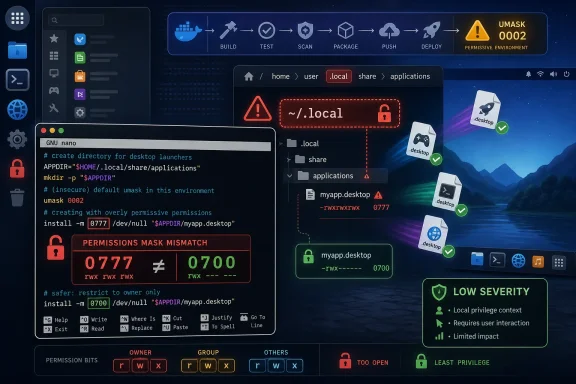
.desktop launcher under a user’s home directory. The bug is not a Windows vulnerability in the traditional Patch Tuesday sense, but Microsoft’s listing of it in the Security Update Guide is still a useful reminder of how much Linux plumbing now lives near Windows workflows. The weakness sits in the gray zone where “low severity” does not mean “irrelevant,” especially for administrators running Linux tools inside containers, CI systems, WSL-adjacent environments, or mixed estates. Its real lesson is less about nano itself than about the security assumptions we make when small utilities create files in places desktop software later decides to trust.
A Tiny Editor Exposes a Bigger Trust Boundary
The vulnerability is straightforward on paper. In certain environments with permissive umask settings, nano can create the ~/.local directory with mode 0777 rather than the tighter 0700 permission one would expect for a per-user application data directory. That difference turns a private directory into a writable neighborhood.
The reported impact is correspondingly narrow. A local attacker with access to the same system may be able to race or otherwise take advantage of those permissions to inject a malicious .desktop launcher. If that launcher is later processed by desktop environment components, the attacker may trigger unintended behavior or information disclosure.
This is not the sort of bug that lets an anonymous attacker reach across the internet and own a fleet before lunch. It requires local positioning, specific environmental conditions, and a downstream component willing to process the planted file. That is why the CVSS 3.1 score is low, and why the attack complexity is marked high.
But the interesting part is precisely that awkward chain. Modern security failures increasingly live between components: one program creates a directory, another interprets a file, a third exposes the session, and the administrator assumes the boring defaults are safe. CVE-2026-6842 is a modest bug, but it points directly at that uncomfortable seam.
“Low Severity” Is Doing a Lot of Work Here
Security teams have learned to distrust severity labels, but they still have to triage by them. A low-severity local issue in nano will not, and should not, outrank exploited browser zero-days, domain controller bugs, VPN appliances, or cloud identity misconfigurations. The risk calculus is not complicated: if an attacker already has local access, many worse things may already be possible.
Still, “local attacker” is not the comfort phrase it used to be. Multi-user Linux hosts, developer workstations, jump boxes, shared build systems, containers, and remote coding environments all complicate the meaning of local. In a tidy single-user laptop model, local access often implies game over. In enterprise reality, local access may mean an unprivileged shell inside a constrained account, a compromised build step, a low-trust user on a shared machine, or a container escape attempt looking for frictionless pivots.
The attack described for CVE-2026-6842 also depends on conditions outside the attacker’s full control. Microsoft’s Security Update Guide language emphasizes that a successful attack cannot simply be performed at will; the attacker must prepare, understand the environment, or find themselves in the right execution path. That phrasing is important because it separates exploitability from theoretical possibility.
Yet attackers love conditional bugs when the condition is common enough. Permissive umask settings do appear in automation-heavy environments, and directories under home paths are often treated casually by developers and tools. A vulnerability that looks unimpressive in a single-host lab can become more useful in a fleet where the same flawed assumption is repeated hundreds of times.
The Bug Lives in the Gap Between CLI and GUI
Nano is a command-line editor. .desktop launchers belong to the graphical Linux desktop world. At first glance, the pairing seems odd, almost like a plumbing leak in the basement affecting the smart thermostat upstairs.
That mismatch is the point. Linux user environments are full of shared conventions rather than strict ownership boundaries. The ~/.local tree is used by applications for data, launchers, metadata, and user-scoped integration with the desktop. If a command-line tool creates part of that tree with the wrong permissions, the blast radius may be determined later by graphical software that trusts what it finds there.
The .desktop file format is especially sensitive because it is not merely decorative metadata. Depending on location, trust settings, and desktop behavior, launcher files can describe commands to execute, icons to display, application names to present, and integration points for menus or file handling. Desktop environments have spent years tightening the handling of untrusted launchers, but the format remains powerful by design.
CVE-2026-6842 therefore lands in a familiar Unix security pattern: a small permissions mistake creates an opportunity for another component to interpret attacker-controlled content. The vulnerable action is not necessarily the final damaging action. It is the opening of a door that other software may later walk through.
That is why the phrase “if the launcher is subsequently processed” matters. The exploit is not just “write file, win.” It is “write file in a place that should have been private, then wait for some part of the user environment to make that file meaningful.” High complexity, yes. Meaningless, no.
Umask Is the Ancient Setting Still Breaking Modern Systems
The umask is one of those Unix concepts that is easy to explain and easier to forget. It defines which permission bits are withheld when new files or directories are created. A safe application should not blindly rely on the ambient umask when creating security-sensitive paths, because the process environment may not reflect the assumptions of the original developer.
That is the heart of this bug. If a private application directory is supposed to be readable and writable only by the user, the application should enforce that expectation when it creates the directory. A mode like 0700 says exactly that. A mode like 0777 says everyone can read, write, and traverse it, subject only to sticky-bit or filesystem nuances that may or may not exist.
The Red Hat bug record points to nano creating ~/.local too broadly while a later mkdir for ~/.local/share uses tighter permissions. That contrast is telling. It suggests not a grand architectural failure, but an inconsistent assumption in a path-creation sequence. One directory got the treatment sensitive user data deserves; its parent did not.
That is exactly the kind of defect that slips past casual review because the code “works.” Nano runs. History files persist. Users are not interrupted. The security property only becomes visible when an attacker shares the machine or when automation creates a home directory layout under unusual defaults.
The deeper lesson is that ambient process settings are hostile input. Environment variables, working directories, path search order, locale settings, and umask values are all inherited context. Mature software treats them as part of the attack surface, not as a gentleman’s agreement with the operating system.
Containers and CI Make “Permissive” Less Exotic
The public description calls out permissive-umask environments such as containers and CI. That detail matters for WindowsForum readers because this is where the Windows and Linux worlds increasingly overlap. Windows shops now run Linux containers on developer laptops, Linux agents in CI pipelines, and WSL-based tooling on machines that otherwise live under Microsoft management.
In old enterprise mental models, Linux desktop oddities belonged to a different fleet. In 2026, they may sit inside the developer workflow for a Windows application, the build pipeline for an Azure-hosted service, or the administrative workstation used to manage cross-platform infrastructure. The host may be Windows; the risky file operation may be happening in a Linux userland.
CI environments are particularly strange because they are both ephemeral and highly privileged in practice. A runner may be rebuilt frequently, but it may also touch secrets, source code, artifacts, package registries, signing material, or deployment credentials. A local-only issue inside such a context should not be waved away merely because the machine is temporary.
Containers complicate the story further. Many container images run with simplified users, unusual home directories, or broad filesystem permissions that would be unacceptable on a traditional multi-user host. Build stages may execute tools under assumptions that nobody would intentionally approve for a persistent workstation. A flaw that requires a permissive umask may find exactly that in a containerized build step.
None of this turns CVE-2026-6842 into a critical emergency. It does, however, make the affected condition less theoretical. The more Linux utilities are embedded into automated pipelines, the more old-fashioned local file-permission bugs become part of supply-chain hygiene rather than just desktop hardening.
Microsoft’s Presence in the Story Is Not Accidental
The obvious question for a Windows audience is why this appears in Microsoft’s orbit at all. The answer is not that nano suddenly became a Windows kernel component. It is that Microsoft’s security ecosystem now spans Windows, Linux, open source packages, Azure workloads, container images, developer tooling, and downstream distributions.
The Microsoft Security Update Guide has become broader than the old mental model of Windows patches delivered on the second Tuesday of the month. It tracks vulnerabilities relevant to Microsoft products, services, dependencies, and supported ecosystems. In that world, a Linux utility can matter if it appears in environments Microsoft customers deploy, scan, support, or secure.
That shift is healthy but disorienting. Windows administrators who once treated CVEs as either “for us” or “not for us” now need a more contextual filter. A nano vulnerability might be irrelevant to a fleet of locked-down Windows 11 kiosks. It might be relevant to a developer workstation standard image that includes WSL, a build host running Linux containers, or an Azure environment using Red Hat Enterprise Linux images.
This is also where Microsoft’s vulnerability wording earns its keep. The Security Update Guide does not simply scream “attacker can inject malicious launcher.” It explains that exploitation depends on conditions beyond the attacker’s control. That nuance helps prevent panic while still preserving the chain of risk.
The industry needs more of that middle register. Too much vulnerability coverage oscillates between “ignore it, it’s low” and “everything is burning.” CVE-2026-6842 deserves neither. It deserves inventory, patching when updates arrive, and a quick sanity check of permission defaults in environments where local users or build steps are not equally trusted.
The Desktop Launcher Is a Surprisingly Durable Attack Surface
The .desktop file has always been a small but potent object in Linux environments. It is a bridge between files and behavior, between names and commands, between what the user sees and what the system executes. That makes it useful for legitimate integration and attractive for trickery.
Windows readers can think of it loosely as occupying some of the same emotional territory as shortcuts, file associations, startup entries, and shell integration points. The analogy is imperfect, but the security instinct is familiar: anything that turns a passive-looking object into an action deserves suspicion. If an attacker can place such an object where software will later discover it, the file’s format becomes part of the exploit chain.
Desktop environments have made progress here. Many now mark downloaded launchers as untrusted, require explicit user action, or constrain automatic execution. But real systems are messy. Enterprise images vary, distributions patch differently, user habits differ, and old assumptions linger in corners of the stack.
That is why a permissions flaw in a text editor can plausibly matter to the desktop. Nano is not executing the malicious launcher. It is helping create a directory state in which someone else may be able to plant one. The eventual trigger may involve the desktop shell, an indexer, a file manager, a menu updater, or a user action shaped by social engineering.
The exploit story is therefore less Hollywood than most vulnerability marketing. It is not a single magic packet. It is the dull accumulation of trust mistakes: a broad directory here, a writable path there, a launcher format with behavior attached, and a user session that assumes its home directory belongs to the user.
Administrators Should Patch, but They Should Also Inspect Assumptions
For most organizations, the practical response is simple: take the vendor update when it is available through the normal package channel. If nano is present on managed Linux systems, update it as part of routine patching. If it is baked into container images, rebuild the images from updated bases.
But patching alone should not be the whole story. This bug is an opportunity to inspect whether user home directories and application data trees have sane permissions across the environments that matter. The specific path ~/.local should generally not be world-writable in a way that allows other local users to plant content.
That inspection need not become a months-long audit. Administrators can sample representative Linux hosts, shared build machines, developer images, and container bases. The goal is to find whether permissive defaults are widespread, especially in places where untrusted or semi-trusted code executes beside secrets or user sessions.
Security teams should also look at CI runner design. If runners are single-tenant and ephemeral, the risk profile differs sharply from shared, persistent runners. If jobs from different trust zones can influence the same filesystem state, a low-severity local permissions bug becomes more interesting.
For Windows-heavy teams, the key is to include the Linux layer in endpoint and build security discussions. WSL distributions, Dev Containers, remote development hosts, and package caches should not live outside the policy conversation simply because they are not classic Windows applications. Attackers do not care which administrative silo owns the path.
Developers Should Stop Treating Home Directories as Harmless
Developers often view the home directory as a convenience zone. Tools create caches, histories, configs, sockets, launchers, and state files there constantly. The security model is usually implicit: the user owns the home directory, so files under it are trusted enough.
CVE-2026-6842 is a reminder that this model depends on every parent directory along the way being correctly protected. If a tool creates a directory with world-writable permissions, it weakens the trust story for everything below or around it. The bug does not need to expose /etc/shadow to be a bug; it merely needs to let the wrong principal influence a trusted namespace.
The fix pattern is not exotic. When creating per-user state directories, applications should specify restrictive permissions explicitly and verify the result. They should handle pre-existing paths carefully, reject unsafe ownership or mode combinations where appropriate, and avoid following attacker-controlled symlink tricks. These practices are old, but their relevance increases as developer tools become part of larger automated chains.
The uncomfortable truth is that small tools are often under-reviewed precisely because they are small. Nano is ubiquitous, familiar, and boring in the best sense. That familiarity can produce a kind of security underestimation: surely the editor is not where the interesting risk lives.
But infrastructure is made of boring tools. The more foundational a utility becomes, the more damage can flow from a tiny assumption when it is multiplied across distributions, images, and pipelines.
The CVSS Score Is Right, and Still Incomplete
The reported CVSS vector captures the vulnerability’s constraints well. The attack vector is local, attack complexity is high, privileges are required at a low level, user interaction is not required in the scoring model, scope is unchanged, confidentiality impact is none, integrity impact is low, and availability impact is none. The resulting 2.5 score communicates that this is not a top-tier emergency.
Where CVSS struggles, as usual, is environmental texture. It cannot know whether your build runner processes untrusted contributions. It cannot know whether your developer desktops run Linux userlands with permissive defaults. It cannot know whether a low-privileged local foothold is common in your threat model.
That is not a flaw in CVSS so much as a warning about how to use it. Scores are useful sorting mechanisms, not risk verdicts. A low score can still merit quick action if the affected component sits in a sensitive workflow, and a high score can be less urgent if the vulnerable service is absent or isolated.
CVE-2026-6842 should therefore be triaged with an environmental question: where can an untrusted local actor influence the same user data paths that trusted desktop or automation components later process? If the answer is “nowhere,” routine patching is enough. If the answer is “our CI runners are complicated,” the bug deserves a closer look.
The phrase “successful attack depends on conditions beyond the attacker’s control” should not be read as a dismissal. It should be read as a map. Find the conditions. If your environment supplies them, reduce them.
The Windows Angle Is the Mixed-Estate Reality
For WindowsForum readers, the most practical mistake would be to file this under “Linux desktop trivia” and move on. Windows administration now routinely touches Linux in places that are easy to overlook. WSL made Linux userlands ordinary on Windows laptops. Containers made Linux package hygiene part of Windows developer productivity. Azure made Linux estate management a mainstream Microsoft customer concern.
That does not mean every Windows admin needs to become a Linux desktop security expert. It does mean vulnerability management should follow software reality rather than brand boundaries. If nano ships in a Linux image your organization uses, it belongs in the same inventory conversation as PowerShell modules, Visual Studio components, browser extensions, and third-party Windows agents.
The mixed-estate angle also affects detection. Traditional Windows endpoint tooling may not inspect Linux filesystem permissions inside WSL distributions with the same fidelity it applies to NTFS paths. Container image scanners may flag CVEs but miss runtime permission drift. CI platforms may rebuild images while preserving caches or workspaces that carry unsafe state forward.
That is where process matters more than panic. Organizations should know which Linux distributions they support, where packages come from, how base images are rebuilt, and which scanners cover which layers. A nano CVE is a small test of whether that machinery works before a more dangerous dependency asks the same question.
The Patch Is the Easy Part; the Hard Part Is Inventory
The most reassuring thing about CVE-2026-6842 is that it is not conceptually hard to remediate. Package maintainers can correct the directory creation mode. Distributions can ship updates. Users can update through their normal channels. Administrators can check permissions and clean up unsafe directories.
The less reassuring part is knowing where nano is installed and relevant. It may be present by default on many Linux systems because it is the friendly editor distributions include for humans who do not want to learn vi. It may exist in images where no one thinks of it as an attack surface. It may sit in developer containers because it is convenient during troubleshooting.
That convenience creates inventory fog. Nobody procures nano. Few teams list it in architecture diagrams. It arrives as part of the operating system furniture. When a CVE lands, security teams must rely on package inventories, image manifests, SBOMs, or scanner output to determine exposure.
This is where mature organizations separate themselves. They do not need an emergency war room for a low-severity nano bug, but they should be able to answer whether it exists in their managed images. If the answer requires guesswork, the vulnerability has already taught its lesson.
Inventory also helps prevent overreaction. A Windows-only environment without Linux workloads does not need to spend cycles on a non-existent exposure. A cloud-heavy engineering group with many Linux build images may need a routine rebuild. The right answer depends on facts, not branding.
The Nano Flaw Leaves a Short, Practical Checklist
CVE-2026-6842 is not the vulnerability that will define 2026, but it is a clean example of how small permission mistakes can acquire significance when they intersect with desktop launchers, shared systems, and automated developer environments. The response should be disciplined rather than dramatic.
- Organizations should update nano through their Linux distribution or base-image pipeline when fixed packages are available.
- Administrators should verify that
~/.localand related per-user application directories are not world-writable on shared or sensitive systems. - Security teams should pay special attention to CI runners, containers, and developer environments that use permissive
umaskvalues. - Windows-focused shops should include WSL distributions, Linux containers, and Azure Linux images in vulnerability management rather than treating them as edge cases.
- Developers maintaining command-line tools should explicitly create private user directories with restrictive permissions instead of relying on inherited process defaults.
The lesson is not that nano is dangerous. The lesson is that trust boundaries are often built out of mundane filesystem choices that nobody revisits until a CVE gives them a number.
CVE-2026-6842 will likely be patched quietly, absorbed into distribution updates, and forgotten by most users within weeks. That is appropriate for a low-severity local flaw, but the pattern it illustrates will keep returning: Windows estates are no longer purely Windows, developer machines are no longer simple endpoints, and the boring corners of Linux userland increasingly sit inside business-critical workflows. The organizations that handle this well will not be the ones that panic over every small CVE; they will be the ones that can see exactly where the small CVE lives, understand whether their environment supplies the missing exploit conditions, and close the gap before a more serious bug follows the same path.
References
- CVE-2026-6842 Nano: nano: local attacker can inject malicious .desktop launcher due to insecure directory permissions MSRC · 2026-06-03T01:44:56-07:00