

CVE-2026-42504 is a newly published denial-of-service vulnerability in Go’s standard-library
The vulnerable code lives in Go’s MIME header decoding path, specifically the routine used to decode MIME “encoded-words” in message headers. That sounds narrow, almost quaint, until you remember how much modern infrastructure still speaks email-shaped text. MIME parsing shows up in mail systems, ticketing tools, notification pipelines, webhook processors, security scanners, archival systems, and any service that accepts or normalizes user-supplied message metadata.
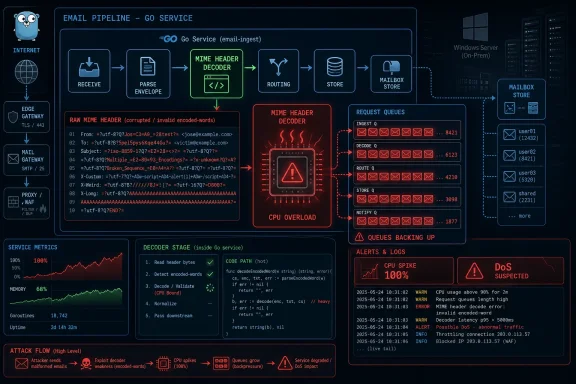
The issue is classified as inefficient algorithmic complexity, the family of bugs where an attacker does not smuggle shellcode or steal a token but instead makes legitimate code do punishing amounts of work. In this case, a maliciously crafted MIME header containing many invalid encoded-words can cause excessive CPU consumption. The core danger is not that one message is strange; it is that each strange message can make a service spend disproportionate time trying to be standards-compliant.
That is why the availability language attached to this CVE reads more severe than the underlying mechanism might suggest. A total loss of availability does not require a spectacular crash. A service pinned at 100 percent CPU, thread pools starved, health checks failing, and queues backing up is functionally down even if every process is still technically alive.
For WindowsForum readers, the Microsoft Security Response Center listing is the connective tissue. Microsoft’s advisory ecosystem frequently tracks vulnerabilities in upstream components that can affect Microsoft-built, Microsoft-distributed, or Microsoft-hosted software. The entry should push administrators to ask where Go binaries are running in their environment, not merely whether Windows Update has a new cumulative patch waiting.
CVE-2026-42504 is especially uncomfortable because the trigger is not exotic. MIME headers are supposed to be parsed. Encoded-words are a normal part of internationalized email subjects and display names. The hostile input hides inside a structure that many systems are designed to accept from untrusted sources.
The Go issue describes the crux: when decoding fails, the decoder preserved undecoded input, but it advanced through the malformed encoded-word in a way that allowed repeated reprocessing-like behavior. With many malformed prefixes followed by a terminal marker, runtime could grow quadratically or nearly so. That is the software equivalent of asking a receptionist to re-read the front of a form thousands of times because every field is wrong in a slightly strategic way.
Quadratic complexity bugs are effective because defenders often size systems for average-case traffic. The attacker brings worst-case traffic. A single request or message may not look large enough to trip payload-size limits, yet it can still consume far more CPU than its byte count implies.
The affected versions are clear enough for triage: Go versions before 1.25.11 are affected, and the 1.26 line is affected before 1.26.4. The fixed releases, Go 1.25.11 and Go 1.26.4, were published as security point releases alongside fixes for other standard-library issues. That matters because the correct remediation is not a local code tweak in most cases; it is rebuilding and redeploying software with a fixed Go toolchain.
That rebuild requirement is where many enterprises stumble. Go commonly produces static binaries, which is wonderful for deployment and miserable for inventory. Updating a system package named “golang” on a build host does not automatically patch every Go binary already shipped into production. Containers, appliance images, internal command-line tools, agents, and sidecars may all carry their own compiled copy of the vulnerable standard-library code.
This is the paradox of modern dependency management: fewer DLL hell problems, more artifact archaeology. Windows administrators who are used to tracking MSI packages, services, and update rings now also need software bill of materials data, container image provenance, and build pipeline discipline. CVE-2026-42504 is a small bug that exposes a large operational habit gap.
The vulnerable function decodes MIME headers, so the highest-interest targets are applications that accept email or email-like header material from outside the trust boundary. A public-facing mail ingestion service is the obvious case. Less obvious are systems that parse forwarded messages, consume support tickets, archive inbound mail, scan reports, ingest abuse complaints, or normalize notification payloads from partners.
The threat model changes with placement. A desktop app that only decodes locally opened messages may require user interaction or a particular workflow. A server-side service that decodes headers automatically can be hit remotely and repeatedly. A queue-based system may appear resilient until malformed items pile up and every worker burns CPU on the same pathological parse.
That last point matters for incident response. Algorithmic complexity vulnerabilities can create feedback loops: retries amplify the attack, dead-letter handling repeats expensive parsing, monitoring floods teams with secondary symptoms, and autoscaling dutifully adds more expensive compute to do more useless work. The failure mode looks like traffic growth until someone notices that the traffic is small and the CPU cost is absurd.
If Microsoft consumes the affected code in a product or service, Microsoft’s guidance should be followed for that product. But many Windows environments run Go software that Microsoft neither built nor updates through Windows Update. Prometheus exporters, reverse proxies, developer tools, internal microservices, backup agents, EDR-adjacent utilities, Kubernetes components, and SaaS connectors may all be in scope depending on how they handle MIME headers.
The right question is therefore not “Did I install the Microsoft patch?” The right question is “Which deployed binaries were built with affected Go versions and can an attacker reach their MIME header decoding path?” That is a more annoying question, but it is the one that maps to risk.
This distinction is also why vulnerability scanners can produce noisy or incomplete answers. A scanner may identify a Go runtime version in a binary, or it may miss a statically linked executable entirely. It may flag every Go binary regardless of reachability. It may also fail to understand whether the vulnerable symbol is used in a way that matters. Administrators should treat scanner output as a starting point, not a verdict.
The first priority is to identify externally reachable services that ingest email, MIME, or header-like content. Mail gateways, inbound ticket processors, abuse desks, contact-form relays, notification processors, and document workflow systems deserve early attention. If those services are written in Go or contain Go-built components, they should move toward the front of the patch queue.
The second priority is to examine choke points. Reverse proxies, API gateways, rate limiters, and message brokers may be able to reduce attack volume, but they will not necessarily understand the expensive structure inside a MIME header. Payload-size limits help only if the malicious input must be large. Algorithmic attacks are dangerous precisely because they can be compact.
The third priority is observability. CPU spikes without corresponding bandwidth spikes should draw attention. So should workers stuck on message parsing, queue latency that grows around malformed messages, and logs showing repeated decode failures. The fix is still to update, but detection determines whether this remains maintenance or becomes an incident.
This is where internal software often lags behind vendor products. A commercial appliance may receive a vendor advisory and patched build. An internal tool written three years ago by a team that has since reorganized may still be running quietly on a Windows Server VM, doing one narrow but business-critical job. If it parses inbound email, it is now part of the security story.
Containers do not remove the work. A container image built with an affected Go compiler remains affected even if the base image is updated, because the vulnerable code is compiled into the binary. Rebuilding the image from source with the fixed toolchain is the meaningful step. Re-tagging or redeploying an unchanged artifact is security theater.
The same principle applies to Windows services distributed as single executables. File version metadata may not tell the whole story. Teams may need build manifests, SBOMs,
Microsoft’s advisory language around availability underscores the worst-case consequence: sustained or persistent denial of access to resources in the impacted component. That phrasing should not be read as a guarantee that every affected application will collapse. It should be read as a warning that, under the right exposure conditions, the bug can remove a service from use without requiring code execution.
There is also a subtler point for Windows shops adopting more cloud-native tooling. The old perimeter between “Windows vulnerabilities” and “developer stack vulnerabilities” has eroded. A Windows Server running a Go-based mail processor is both a Windows asset and a Go supply-chain asset. A Microsoft 365-adjacent workflow that feeds headers into a Go service is both a collaboration workflow and a parser attack surface.
That mixed reality makes ownership messy. Security teams may track the CVE. Windows admins may own the host. Developers may own the binary. A vendor may own the source. The attacker does not care which spreadsheet contains the asset.
But concentrated risk is still real risk. The services most likely to parse hostile MIME are also the services that sit near untrusted traffic. Mail-adjacent systems receive content from the entire internet by design. Security scanners and content processors often inspect exactly the material that attackers craft. Support and ticketing pipelines may process messages automatically before a human ever sees them.
That makes CVE-2026-42504 a good example of a vulnerability that should be prioritized by data flow, not by brand recognition. The vulnerable component is small. The attack path is specific. The business impact can be large if that path sits on a critical queue or externally reachable service.
A sane response avoids both panic and dismissal. Patch reachable services quickly, validate vendor status for opaque products, and schedule broader rebuilds for lower-risk internal tools. Meanwhile, add temporary controls where possible: rate limits, message-size ceilings, queue isolation, monitoring for repeated decode errors, and worker timeouts that prevent one malformed item from monopolizing processing.
mime package, disclosed on June 2, 2026, affecting WordDecoder.DecodeHeader before Go 1.25.11 and from Go 1.26.0 through versions before Go 1.26.4. The bug is not a Windows flaw in the traditional Patch Tuesday sense, but it matters to Windows shops because Go-built services now sit everywhere from mail gateways and security appliances to cloud agents and internal APIs. Its lesson is blunt: a parser does not need memory corruption to become an outage machine. Sometimes it only needs to be slow in exactly the wrong place.
 A Small MIME Parser Bug Lands in a Very Large Attack Surface
The vulnerable code lives in Go’s MIME header decoding path, specifically the routine used to decode MIME “encoded-words” in message headers. That sounds narrow, almost quaint, until you remember how much modern infrastructure still speaks email-shaped text. MIME parsing shows up in mail systems, ticketing tools, notification pipelines, webhook processors, security scanners, archival systems, and any service that accepts or normalizes user-supplied message metadata.The issue is classified as inefficient algorithmic complexity, the family of bugs where an attacker does not smuggle shellcode or steal a token but instead makes legitimate code do punishing amounts of work. In this case, a maliciously crafted MIME header containing many invalid encoded-words can cause excessive CPU consumption. The core danger is not that one message is strange; it is that each strange message can make a service spend disproportionate time trying to be standards-compliant.
That is why the availability language attached to this CVE reads more severe than the underlying mechanism might suggest. A total loss of availability does not require a spectacular crash. A service pinned at 100 percent CPU, thread pools starved, health checks failing, and queues backing up is functionally down even if every process is still technically alive.
For WindowsForum readers, the Microsoft Security Response Center listing is the connective tissue. Microsoft’s advisory ecosystem frequently tracks vulnerabilities in upstream components that can affect Microsoft-built, Microsoft-distributed, or Microsoft-hosted software. The entry should push administrators to ask where Go binaries are running in their environment, not merely whether Windows Update has a new cumulative patch waiting.
The Attack Is Boring, Which Is Why It Is Useful
Denial-of-service bugs often receive less attention than remote code execution because they do not promise immediate compromise. That bias is understandable and dangerous. Availability is a security property, and for mail-facing infrastructure, identity services, monitoring systems, and customer-facing APIs, losing availability can be the incident.CVE-2026-42504 is especially uncomfortable because the trigger is not exotic. MIME headers are supposed to be parsed. Encoded-words are a normal part of internationalized email subjects and display names. The hostile input hides inside a structure that many systems are designed to accept from untrusted sources.
The Go issue describes the crux: when decoding fails, the decoder preserved undecoded input, but it advanced through the malformed encoded-word in a way that allowed repeated reprocessing-like behavior. With many malformed prefixes followed by a terminal marker, runtime could grow quadratically or nearly so. That is the software equivalent of asking a receptionist to re-read the front of a form thousands of times because every field is wrong in a slightly strategic way.
Quadratic complexity bugs are effective because defenders often size systems for average-case traffic. The attacker brings worst-case traffic. A single request or message may not look large enough to trip payload-size limits, yet it can still consume far more CPU than its byte count implies.
Go’s Strength Becomes Part of the Blast Radius
Go’s standard library is one of the language’s selling points. Developers use it because it is cohesive, portable, well documented, and usually safer than a pile of third-party parsing libraries. That trust is earned, but it also means a vulnerability in a standard package can ripple widely.The affected versions are clear enough for triage: Go versions before 1.25.11 are affected, and the 1.26 line is affected before 1.26.4. The fixed releases, Go 1.25.11 and Go 1.26.4, were published as security point releases alongside fixes for other standard-library issues. That matters because the correct remediation is not a local code tweak in most cases; it is rebuilding and redeploying software with a fixed Go toolchain.
That rebuild requirement is where many enterprises stumble. Go commonly produces static binaries, which is wonderful for deployment and miserable for inventory. Updating a system package named “golang” on a build host does not automatically patch every Go binary already shipped into production. Containers, appliance images, internal command-line tools, agents, and sidecars may all carry their own compiled copy of the vulnerable standard-library code.
This is the paradox of modern dependency management: fewer DLL hell problems, more artifact archaeology. Windows administrators who are used to tracking MSI packages, services, and update rings now also need software bill of materials data, container image provenance, and build pipeline discipline. CVE-2026-42504 is a small bug that exposes a large operational habit gap.
MIME Is Old Plumbing, Not Dead Plumbing
It is tempting to treat MIME as legacy email machinery and therefore someone else’s problem. That would be a mistake. The format has escaped its original context and become part of the grammar of web uploads, multipart APIs, mail notifications, authentication workflows, and content-processing back ends.The vulnerable function decodes MIME headers, so the highest-interest targets are applications that accept email or email-like header material from outside the trust boundary. A public-facing mail ingestion service is the obvious case. Less obvious are systems that parse forwarded messages, consume support tickets, archive inbound mail, scan reports, ingest abuse complaints, or normalize notification payloads from partners.
The threat model changes with placement. A desktop app that only decodes locally opened messages may require user interaction or a particular workflow. A server-side service that decodes headers automatically can be hit remotely and repeatedly. A queue-based system may appear resilient until malformed items pile up and every worker burns CPU on the same pathological parse.
That last point matters for incident response. Algorithmic complexity vulnerabilities can create feedback loops: retries amplify the attack, dead-letter handling repeats expensive parsing, monitoring floods teams with secondary symptoms, and autoscaling dutifully adds more expensive compute to do more useless work. The failure mode looks like traffic growth until someone notices that the traffic is small and the CPU cost is absurd.
This Is Not Patch Tuesday as Usual
The Microsoft angle invites a familiar mental model: find the KB, patch the Windows machines, reboot in waves, watch for known issues. That model may not be enough here. CVE-2026-42504 originates in the Go standard library, and the authoritative fix lives in Go’s security releases.If Microsoft consumes the affected code in a product or service, Microsoft’s guidance should be followed for that product. But many Windows environments run Go software that Microsoft neither built nor updates through Windows Update. Prometheus exporters, reverse proxies, developer tools, internal microservices, backup agents, EDR-adjacent utilities, Kubernetes components, and SaaS connectors may all be in scope depending on how they handle MIME headers.
The right question is therefore not “Did I install the Microsoft patch?” The right question is “Which deployed binaries were built with affected Go versions and can an attacker reach their MIME header decoding path?” That is a more annoying question, but it is the one that maps to risk.
This distinction is also why vulnerability scanners can produce noisy or incomplete answers. A scanner may identify a Go runtime version in a binary, or it may miss a statically linked executable entirely. It may flag every Go binary regardless of reachability. It may also fail to understand whether the vulnerable symbol is used in a way that matters. Administrators should treat scanner output as a starting point, not a verdict.
Availability Bugs Deserve Production-Grade Triage
The severity of this CVE depends heavily on exposure. A Go binary that never parses MIME headers is not an urgent problem merely because it was built with an affected toolchain. A public service that decodes attacker-supplied email headers before authentication is in a different category entirely.The first priority is to identify externally reachable services that ingest email, MIME, or header-like content. Mail gateways, inbound ticket processors, abuse desks, contact-form relays, notification processors, and document workflow systems deserve early attention. If those services are written in Go or contain Go-built components, they should move toward the front of the patch queue.
The second priority is to examine choke points. Reverse proxies, API gateways, rate limiters, and message brokers may be able to reduce attack volume, but they will not necessarily understand the expensive structure inside a MIME header. Payload-size limits help only if the malicious input must be large. Algorithmic attacks are dangerous precisely because they can be compact.
The third priority is observability. CPU spikes without corresponding bandwidth spikes should draw attention. So should workers stuck on message parsing, queue latency that grows around malformed messages, and logs showing repeated decode failures. The fix is still to update, but detection determines whether this remains maintenance or becomes an incident.
Rebuilding Is the Patch, and That Is the Catch
Go’s fixed releases are straightforward: move to Go 1.25.11 or Go 1.26.4, depending on the branch in use, and rebuild affected software. For developers, that sounds simple. For enterprises, it means finding owners, confirming build reproducibility, testing release artifacts, and getting them back through deployment controls.This is where internal software often lags behind vendor products. A commercial appliance may receive a vendor advisory and patched build. An internal tool written three years ago by a team that has since reorganized may still be running quietly on a Windows Server VM, doing one narrow but business-critical job. If it parses inbound email, it is now part of the security story.
Containers do not remove the work. A container image built with an affected Go compiler remains affected even if the base image is updated, because the vulnerable code is compiled into the binary. Rebuilding the image from source with the fixed toolchain is the meaningful step. Re-tagging or redeploying an unchanged artifact is security theater.
The same principle applies to Windows services distributed as single executables. File version metadata may not tell the whole story. Teams may need build manifests, SBOMs,
go version -m output where available, vendor attestations, or direct confirmation from maintainers.Microsoft’s Listing Is a Signal, Not the Whole Map
The MSRC entry is useful because it places CVE-2026-42504 into the workflow of administrators who already watch Microsoft’s security guidance. But the vulnerability’s operational footprint extends beyond anything Microsoft can enumerate for a given organization. This is an upstream ecosystem issue, and ecosystem issues are always partly local.Microsoft’s advisory language around availability underscores the worst-case consequence: sustained or persistent denial of access to resources in the impacted component. That phrasing should not be read as a guarantee that every affected application will collapse. It should be read as a warning that, under the right exposure conditions, the bug can remove a service from use without requiring code execution.
There is also a subtler point for Windows shops adopting more cloud-native tooling. The old perimeter between “Windows vulnerabilities” and “developer stack vulnerabilities” has eroded. A Windows Server running a Go-based mail processor is both a Windows asset and a Go supply-chain asset. A Microsoft 365-adjacent workflow that feeds headers into a Go service is both a collaboration workflow and a parser attack surface.
That mixed reality makes ownership messy. Security teams may track the CVE. Windows admins may own the host. Developers may own the binary. A vendor may own the source. The attacker does not care which spreadsheet contains the asset.
The Practical Risk Is Concentrated, Not Universal
Not every Go application is now a denial-of-service hazard. The vulnerable routine has to be reachable, and the input has to be shaped around invalid MIME encoded-words. A command-line utility used by trusted operators is not the same as a public ingestion endpoint. A service that never calls MIME header decoding is not directly exposed by this specific bug.But concentrated risk is still real risk. The services most likely to parse hostile MIME are also the services that sit near untrusted traffic. Mail-adjacent systems receive content from the entire internet by design. Security scanners and content processors often inspect exactly the material that attackers craft. Support and ticketing pipelines may process messages automatically before a human ever sees them.
That makes CVE-2026-42504 a good example of a vulnerability that should be prioritized by data flow, not by brand recognition. The vulnerable component is small. The attack path is specific. The business impact can be large if that path sits on a critical queue or externally reachable service.
A sane response avoids both panic and dismissal. Patch reachable services quickly, validate vendor status for opaque products, and schedule broader rebuilds for lower-risk internal tools. Meanwhile, add temporary controls where possible: rate limits, message-size ceilings, queue isolation, monitoring for repeated decode errors, and worker timeouts that prevent one malformed item from monopolizing processing.
The Decoder Bug Leaves Administrators With Uncomfortable Homework
The concrete work is not glamorous, but it is manageable if teams resist turning this into a generic “update Go everywhere” exercise. The point is to connect affected versions, reachable parsing paths, and service criticality. That is how this CVE becomes a prioritized maintenance plan rather than another red line in a scanner dashboard.- Inventory Go-built services that parse email, MIME headers, support tickets, multipart content, or message metadata from untrusted sources.
- Treat Go 1.25.11 and Go 1.26.4 as the fixed baselines for the affected branches, and rebuild deployed binaries rather than assuming host package updates are enough.
- Ask vendors for explicit confirmation when products contain Go components that ingest MIME or email-like content, especially for mail gateways, security appliances, monitoring tools, and workflow systems.
- Watch for CPU saturation, queue backlogs, repeated MIME decode failures, and low-bandwidth traffic that produces unusually high processing cost.
- Use rate limiting, worker timeouts, and queue isolation as compensating controls, but do not mistake them for a code-level fix.
- Prioritize externally reachable and unauthenticated ingestion paths before internal tools whose inputs are trusted or tightly controlled.
References
- Primary source: MSRC
Published: 2026-06-07T01:02:12-07:00
Security Update Guide - Microsoft Security Response Center
 msrc.microsoft.com
- Related coverage: vulert.com
CVE-2026-42504: High CPU Consumption in golang due to Quadratic Complexity in MIME Header Decoding
Learn about CVE-2026-42504, a vulnerability in golang that can lead to high CPU consumption due to MIME header decoding issues. Update your golang package to secure versions to mitigate risks.vulert.com - Related coverage: mondoo.com
CVE-2026-42504 | Mondoo Vulnerability Intelligence
CVE-2026-42504 - HIGH severity: Quadratic complexity in WordDecoder.DecodeHeader in mimemondoo.com - Official source: microsoft.com
MSRC - Microsoft Security Response Center
The Microsoft Security Response Center is part of the defender community and on the front line of security response evolution. For over twenty years, we have been engaged with security researchers working to protect customers and the broader ecosystem.www.microsoft.com
- Official source: support.microsoft.com
Description of the security update for Word 2016: May 12, 2026 (KB5002858) | Microsoft Support
Description of the security update for Word 2016: May 12, 2026 (KB5002858)support.microsoft.com - Related coverage: cert.gov.vu
Advisory 117 CVE 2026 20805 Microsoft Windows Information Disclosure Vulnerability
PDF documentcert.gov.vu
