

CVE-2026-53232 is a newly published Linux kernel vulnerability disclosed by kernel.org and added to the NVD dataset on June 25, 2026, affecting PHY/SFP probing logic in
At first glance, CVE-2026-53232 reads like one of those kernel entries that makes vulnerability management feel absurdly theatrical. The fix is described in plain maintainer language: if PHY probing fails, the SFP upstream relationship needs to be cleaned up with
That is not the marketing copy of a dramatic exploit. It is the language of kernel housekeeping: one error path failed to unwind state that a successful path had partially initialized. Yet the CNA score from kernel.org lands at CVSS 3.1 8.8, rated high, with adjacent-network attack vector, low complexity, no privileges, no user interaction, and high impact across confidentiality, integrity, and availability.
The tension between those two descriptions is the story. A bug can be structurally mundane and still dangerous if it lives in privileged kernel code, touches hot-plug network hardware state, and can be reached by asynchronous events after a failed probe. The Linux kernel’s CVE stream increasingly forces administrators to read past the score and understand the shape of the subsystem.
For Windows admins, the lesson is familiar from Patch Tuesday: severity is a triage input, not a substitute for asset knowledge. The same CVE can be irrelevant to a desktop fleet, urgent for a storage appliance, and awkwardly ambiguous for a virtualization host with pass-through NICs or SFP-backed uplinks.
That dynamism is what makes the bug more interesting than a simple failed initialization. The CVE description says the SFP bus is left with a dangling
If later SFP events use that dangling upstream state, the kernel may act on something that is no longer valid. The public record does not, by itself, demonstrate a weaponized exploit chain. But it does describe a classic class of kernel reliability and safety failure: cleanup code misses one object relationship, then a later event path assumes that relationship is still legitimate.
The affected file,
The CVE record says the issue existed before generic phylib SFP support, when drivers were calling
In practical terms, that tends to shift concern away from random internet scans and toward local network segments, data-center fabrics, lab environments, and potentially hostile devices or modules placed near the target. The no-privileges and no-user-interaction parts of the vector are what make the score climb. If a reachable event path can be influenced without credentials or a human click, defenders cannot dismiss the bug as merely theoretical.
But admins should be careful not to overread the CVSS vector as a confirmed exploit recipe. CVSS compresses assumptions about access, complexity, and impact into a score; it does not prove exploit maturity. The NVD page, as provided, had not yet added its own independent NIST assessment, and that absence is important.
Kernel.org’s CNA score is the best available severity signal in the record, but it is still an initial vendor-side assessment. Until distributions publish their own advisories and affected package ranges, enterprises will need to map the upstream fix onto the kernels they actually run.
For WindowsForum readers running mostly Windows endpoints, the risk may seem distant. For readers running Hyper-V labs with Linux routers, Proxmox hosts, OpenWrt gear, TrueNAS SCALE appliances, container hosts, or SFP-equipped edge boxes, it is much less abstract.
This is the modern vulnerability-management reality: the CVE name, CNA score, upstream patch, NVD enrichment, distribution advisories, scanner signatures, and enterprise risk decisions do not arrive at the same moment. They are a pipeline. If your patch workflow treats the first populated database field as gospel, it will occasionally produce poor prioritization.
The affected-version data in the record is also written in a way that rewards careful reading. One section identifies a git range from an affected commit to the fixing commit. Another says Linux 5.5 is affected, versions below 5.5 are unaffected, and an original commit for the fix is listed as unaffected in the record’s versioning language.
That is normal for kernel CVEs but annoying for administrators who think in vendor kernels rather than upstream tags. A Red Hat, Ubuntu, Debian, SUSE, Synology, OpenWrt, or appliance-vendor kernel may contain backports that do not line up neatly with the upstream version number printed by
The record’s reference to the stable commit is therefore the anchor, not the entire map. The practical question is whether your vendor has incorporated that fix or determined that its kernel configuration and driver set are not exposed.
A clean failure path is a security boundary in kernel code. If setup says “this bus now has an upstream,” then failure has to say “this bus no longer has an upstream” before any later event can observe the stale state. Missing that step leaves future code operating on a lie.
The CVE description’s mention of later SFP events is the crux. Hardware and driver events do not politely wait for administrators to inspect logs. Hot-plug behavior, module detection, link transitions, and deferred work can all revisit state after an earlier failure. That is why a stale pointer in a driver subsystem can be more than a crash bug.
Still, the public description does not establish that every affected system is equally exposed. Systems without SFP hardware, without the relevant drivers, or without a reachable path to trigger the failed probe and later event sequence may face little practical risk. The correct posture is not panic; it is inventory.
The real Windows angle is infrastructure adjacency. Many Windows environments depend on Linux-based devices that sit underneath or beside Active Directory, file services, virtualization, backup, routing, monitoring, and lab automation. Those devices are often patched less visibly than Windows servers because they are appliances, not “Linux servers” in the mental inventory.
That is where a PHY/SFP kernel CVE deserves attention. SFP ports are common in the very places where small outages become large operational headaches: storage networks, uplinks, hypervisor hosts, top-of-rack switching, firewall appliances, and enthusiast homelab routers. A kernel crash or compromise on one of those boxes can have consequences that Windows administrators feel immediately.
The hardest part is not understanding the function name. It is finding every place in the environment where that function might matter. A Windows-first shop may have excellent WSUS, Intune, Defender, and Patch Tuesday processes while still relying on a forgotten Linux storage appliance with 10 GbE SFP+ ports and an update cadence best described as “when someone remembers the web UI password.”
That is not a Linux problem or a Windows problem. It is an asset-management problem wearing a kernel CVE badge.
Some vendors are excellent at tracking kernel CVEs, backporting fixes, and publishing clear advisories. Others roll security fixes into opaque maintenance releases. Still others ship devices that receive kernel updates only when a larger firmware train happens to move.
That makes CVE-2026-53232 a good test of an organization’s non-Windows patch visibility. Can you identify Linux-based devices with SFP ports? Can you determine their kernel lineage? Can you tell whether the vendor has shipped the fixing commit or an equivalent backport? Can you update without taking down a critical uplink during business hours?
For enthusiasts, the same logic applies at smaller scale. If your home lab runs fiber between a mini server, a managed switch, and a Linux firewall, you have entered the world where kernel network-driver CVEs are not somebody else’s problem. You do not need a compliance department to benefit from keeping firmware current.
The awkward truth is that appliance security often depends less on CVSS than on vendor update hygiene. A high score with a fast firmware update is manageable. A medium score with no vendor acknowledgement can be worse operationally because it leaves defenders guessing.
The adjacent attack vector is the first filter. If exploitation requires adjacency, then segmentation and physical control matter. A tightly controlled data-center network is different from a shared lab bench, a campus environment, a colocation rack with mixed administrative domains, or an edge deployment where untrusted devices may be connected.
The hardware dependency is the second filter. SFP-related paths are relevant to systems that actually use or expose that subsystem. Many general-purpose Linux installations may carry the code but never exercise it. Security teams should distinguish between package presence, kernel capability, module loading, and operational exposure.
The third filter is patch availability. If your distribution or appliance vendor has already issued a kernel update containing the fix, this becomes an ordinary maintenance decision. If not, you may need compensating controls: restrict physical and network access, avoid unnecessary SFP module changes, monitor logs for PHY/SFP probe failures, and pressure the vendor for a clear statement.
The final filter is blast radius. A vulnerable lab host is not the same as a storage switch, firewall, virtualization node, or backup network endpoint. Kernel-level networking bugs become urgent when they sit on infrastructure that many other systems trust.
The wrong response is to scoff at every small patch as “not a real vulnerability.” The other wrong response is to treat every kernel CVE with a high score as an all-hands emergency. Both reactions are shortcuts around the real work.
CVE-2026-53232 sits in the middle. It is not a flashy remote-code-execution story with public exploit code splashed across social media. It is also not a harmless typo. It is a kernel state-management bug in a network hardware path, scored high by the assigning CNA, with a concrete upstream fix.
That makes it a perfect candidate for disciplined triage. Identify assets, map vendor kernels, check for SFP use, patch where available, and document where exposure is implausible. The process is boring because it is supposed to be boring. Boredom is what successful infrastructure security feels like before the incident happens.
For Windows admins, this is also a reminder that vulnerability management has escaped the operating-system silo. The Windows fleet may be beautifully governed while the network fabric underneath it quietly depends on Linux code paths that nobody has assigned an owner.
The larger story is that infrastructure risk now lives in the seams: Windows clients authenticating through Microsoft services, Linux appliances moving their packets, embedded kernels managing their storage, and vulnerability databases trying to describe all of it in a few compressed fields. CVE-2026-53232 will probably not be remembered as a landmark kernel flaw, but it is a useful warning shot. The next urgent security problem in a Windows shop may arrive through a fiber module, a firmware train, and a Linux driver path most of the organization never knew it owned.
drivers/net/phy/phy_device.c when a failed probe leaves stale upstream SFP state behind. The bug is not a Windows vulnerability, but it matters to the WindowsForum audience because modern Windows estates are rarely Windows-only anymore. Hypervisors, NAS boxes, routers, lab servers, WSL-adjacent developer environments, and Linux-based network appliances all sit beside Windows clients and servers. A high CVSS score attached to a low-level networking fix is exactly the kind of alert that can either sharpen an admin’s patching discipline or drown it in noise.
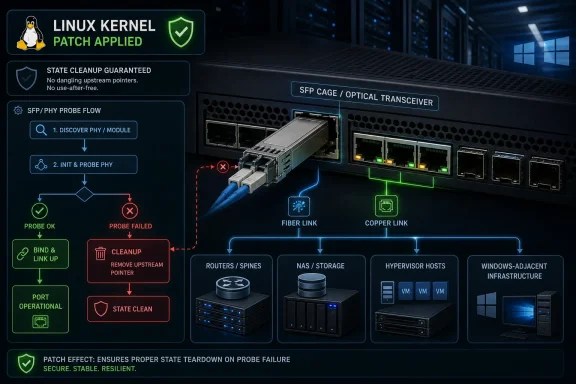 A Tiny Cleanup Patch Becomes a High-Severity Vulnerability
At first glance, CVE-2026-53232 reads like one of those kernel entries that makes vulnerability management feel absurdly theatrical. The fix is described in plain maintainer language: if PHY probing fails, the SFP upstream relationship needs to be cleaned up with sfp_bus_del_upstream(). Without that cleanup, the SFP bus can retain a dangling upstream pointer that may later be used during SFP events.That is not the marketing copy of a dramatic exploit. It is the language of kernel housekeeping: one error path failed to unwind state that a successful path had partially initialized. Yet the CNA score from kernel.org lands at CVSS 3.1 8.8, rated high, with adjacent-network attack vector, low complexity, no privileges, no user interaction, and high impact across confidentiality, integrity, and availability.
The tension between those two descriptions is the story. A bug can be structurally mundane and still dangerous if it lives in privileged kernel code, touches hot-plug network hardware state, and can be reached by asynchronous events after a failed probe. The Linux kernel’s CVE stream increasingly forces administrators to read past the score and understand the shape of the subsystem.
For Windows admins, the lesson is familiar from Patch Tuesday: severity is a triage input, not a substitute for asset knowledge. The same CVE can be irrelevant to a desktop fleet, urgent for a storage appliance, and awkwardly ambiguous for a virtualization host with pass-through NICs or SFP-backed uplinks.
The Vulnerability Lives Where Copper, Fiber, and Kernel State Meet
The affected area is the Linux kernel’s PHY layer, specifically the machinery that helps Ethernet drivers talk to physical-layer devices and, in this case, SFP modules. SFP cages are common in switches, routers, servers, NAS devices, and lab hardware because they allow the same port to take different optical or copper transceiver modules. They are also dynamic by nature: modules can be inserted, removed, probed, rejected, or reinitialized as link state changes.That dynamism is what makes the bug more interesting than a simple failed initialization. The CVE description says the SFP bus is left with a dangling
upstream field after PHY probing fails. In kernel terms, stale references are not paperwork errors; they are latent claims about memory and object lifetime.If later SFP events use that dangling upstream state, the kernel may act on something that is no longer valid. The public record does not, by itself, demonstrate a weaponized exploit chain. But it does describe a classic class of kernel reliability and safety failure: cleanup code misses one object relationship, then a later event path assumes that relationship is still legitimate.
The affected file,
drivers/net/phy/phy_device.c, also matters. This is not a user-space daemon that can simply crash and be restarted. It is kernel networking infrastructure, the sort of code that network-facing devices and embedded distributions may carry for years.The CVE record says the issue existed before generic phylib SFP support, when drivers were calling
phy_sfp_probe themselves. That detail suggests this is not merely a brand-new regression in a bleeding-edge branch. It is a long-tail bug exposed by how older and newer PHY/SFP handling paths evolved.“Adjacent Network” Is Doing a Lot of Work Here
The CVSS vector assigned by kernel.org usesAV:A, meaning adjacent network. That matters because it puts the vulnerability in a middle category between “local only” and “remotely reachable from anywhere.” It implies an attacker would need access to the same logical or physical network adjacency rather than arbitrary internet reachability.In practical terms, that tends to shift concern away from random internet scans and toward local network segments, data-center fabrics, lab environments, and potentially hostile devices or modules placed near the target. The no-privileges and no-user-interaction parts of the vector are what make the score climb. If a reachable event path can be influenced without credentials or a human click, defenders cannot dismiss the bug as merely theoretical.
But admins should be careful not to overread the CVSS vector as a confirmed exploit recipe. CVSS compresses assumptions about access, complexity, and impact into a score; it does not prove exploit maturity. The NVD page, as provided, had not yet added its own independent NIST assessment, and that absence is important.
Kernel.org’s CNA score is the best available severity signal in the record, but it is still an initial vendor-side assessment. Until distributions publish their own advisories and affected package ranges, enterprises will need to map the upstream fix onto the kernels they actually run.
For WindowsForum readers running mostly Windows endpoints, the risk may seem distant. For readers running Hyper-V labs with Linux routers, Proxmox hosts, OpenWrt gear, TrueNAS SCALE appliances, container hosts, or SFP-equipped edge boxes, it is much less abstract.
The NVD Entry Is Useful, but It Is Not the Finish Line
The NVD entry was published on June 25, 2026, and modified on June 28, 2026, according to the supplied record. That modification added the CVSS 3.1 vector from kernel.org. NVD’s own CVSS 4.0 and 3.x assessments were not yet provided in the record.This is the modern vulnerability-management reality: the CVE name, CNA score, upstream patch, NVD enrichment, distribution advisories, scanner signatures, and enterprise risk decisions do not arrive at the same moment. They are a pipeline. If your patch workflow treats the first populated database field as gospel, it will occasionally produce poor prioritization.
The affected-version data in the record is also written in a way that rewards careful reading. One section identifies a git range from an affected commit to the fixing commit. Another says Linux 5.5 is affected, versions below 5.5 are unaffected, and an original commit for the fix is listed as unaffected in the record’s versioning language.
That is normal for kernel CVEs but annoying for administrators who think in vendor kernels rather than upstream tags. A Red Hat, Ubuntu, Debian, SUSE, Synology, OpenWrt, or appliance-vendor kernel may contain backports that do not line up neatly with the upstream version number printed by
uname -r. A 6.1-based long-term kernel can contain selected fixes from later trees, while a vendor-customized kernel can carry subsystem changes not obvious from the headline version.The record’s reference to the stable commit is therefore the anchor, not the entire map. The practical question is whether your vendor has incorporated that fix or determined that its kernel configuration and driver set are not exposed.
The Fix Is Simple Because the Bug Is About Lifetime
The patch concept is small: call the missing cleanup function when PHY probing fails. That simplicity should not be mistaken for insignificance. Kernel object lifetime bugs often live in precisely these corners, where a partially constructed relationship must be unwound in the exact reverse order of setup.A clean failure path is a security boundary in kernel code. If setup says “this bus now has an upstream,” then failure has to say “this bus no longer has an upstream” before any later event can observe the stale state. Missing that step leaves future code operating on a lie.
The CVE description’s mention of later SFP events is the crux. Hardware and driver events do not politely wait for administrators to inspect logs. Hot-plug behavior, module detection, link transitions, and deferred work can all revisit state after an earlier failure. That is why a stale pointer in a driver subsystem can be more than a crash bug.
Still, the public description does not establish that every affected system is equally exposed. Systems without SFP hardware, without the relevant drivers, or without a reachable path to trigger the failed probe and later event sequence may face little practical risk. The correct posture is not panic; it is inventory.
Windows Shops Keep Rediscovering That Linux Is in the Room
The Windows angle is not WSL in the narrow sense. WSL uses a Microsoft-supplied Linux kernel, and typical WSL users are not hot-plugging SFP modules through a Windows laptop into kernel PHY code. For ordinary developer workstations, this CVE is unlikely to be the patch that changes the week.The real Windows angle is infrastructure adjacency. Many Windows environments depend on Linux-based devices that sit underneath or beside Active Directory, file services, virtualization, backup, routing, monitoring, and lab automation. Those devices are often patched less visibly than Windows servers because they are appliances, not “Linux servers” in the mental inventory.
That is where a PHY/SFP kernel CVE deserves attention. SFP ports are common in the very places where small outages become large operational headaches: storage networks, uplinks, hypervisor hosts, top-of-rack switching, firewall appliances, and enthusiast homelab routers. A kernel crash or compromise on one of those boxes can have consequences that Windows administrators feel immediately.
The hardest part is not understanding the function name. It is finding every place in the environment where that function might matter. A Windows-first shop may have excellent WSUS, Intune, Defender, and Patch Tuesday processes while still relying on a forgotten Linux storage appliance with 10 GbE SFP+ ports and an update cadence best described as “when someone remembers the web UI password.”
That is not a Linux problem or a Windows problem. It is an asset-management problem wearing a kernel CVE badge.
Appliance Firmware Is the Slow Lane of Kernel Security
Upstream Linux fixes move faster than appliance firmware. That gap is where risk accumulates. A patch can land in stable kernels while the affected code remains present for weeks or months in router firmware, NAS distributions, hypervisor appliances, and vendor-custom images.Some vendors are excellent at tracking kernel CVEs, backporting fixes, and publishing clear advisories. Others roll security fixes into opaque maintenance releases. Still others ship devices that receive kernel updates only when a larger firmware train happens to move.
That makes CVE-2026-53232 a good test of an organization’s non-Windows patch visibility. Can you identify Linux-based devices with SFP ports? Can you determine their kernel lineage? Can you tell whether the vendor has shipped the fixing commit or an equivalent backport? Can you update without taking down a critical uplink during business hours?
For enthusiasts, the same logic applies at smaller scale. If your home lab runs fiber between a mini server, a managed switch, and a Linux firewall, you have entered the world where kernel network-driver CVEs are not somebody else’s problem. You do not need a compliance department to benefit from keeping firmware current.
The awkward truth is that appliance security often depends less on CVSS than on vendor update hygiene. A high score with a fast firmware update is manageable. A medium score with no vendor acknowledgement can be worse operationally because it leaves defenders guessing.
CVSS 8.8 Does Not Mean “Drop Everything” Everywhere
The 8.8 score will catch scanner dashboards, and it should. But it should not flatten context. A Windows desktop with no Linux kernel and no SFP hardware is not in the same risk universe as a Linux router with exposed SFP module handling on an untrusted network edge.The adjacent attack vector is the first filter. If exploitation requires adjacency, then segmentation and physical control matter. A tightly controlled data-center network is different from a shared lab bench, a campus environment, a colocation rack with mixed administrative domains, or an edge deployment where untrusted devices may be connected.
The hardware dependency is the second filter. SFP-related paths are relevant to systems that actually use or expose that subsystem. Many general-purpose Linux installations may carry the code but never exercise it. Security teams should distinguish between package presence, kernel capability, module loading, and operational exposure.
The third filter is patch availability. If your distribution or appliance vendor has already issued a kernel update containing the fix, this becomes an ordinary maintenance decision. If not, you may need compensating controls: restrict physical and network access, avoid unnecessary SFP module changes, monitor logs for PHY/SFP probe failures, and pressure the vendor for a clear statement.
The final filter is blast radius. A vulnerable lab host is not the same as a storage switch, firewall, virtualization node, or backup network endpoint. Kernel-level networking bugs become urgent when they sit on infrastructure that many other systems trust.
The Kernel CVE Firehose Rewards Boring Discipline
Linux kernel CVEs have become a constant stream, partly because the kernel is enormous, heavily scrutinized, and increasingly mapped into CVE records for flaws that previously might have been treated as ordinary bug fixes. That is not bad. Naming bugs helps defenders track fixes. But it does change how teams must consume vulnerability data.The wrong response is to scoff at every small patch as “not a real vulnerability.” The other wrong response is to treat every kernel CVE with a high score as an all-hands emergency. Both reactions are shortcuts around the real work.
CVE-2026-53232 sits in the middle. It is not a flashy remote-code-execution story with public exploit code splashed across social media. It is also not a harmless typo. It is a kernel state-management bug in a network hardware path, scored high by the assigning CNA, with a concrete upstream fix.
That makes it a perfect candidate for disciplined triage. Identify assets, map vendor kernels, check for SFP use, patch where available, and document where exposure is implausible. The process is boring because it is supposed to be boring. Boredom is what successful infrastructure security feels like before the incident happens.
For Windows admins, this is also a reminder that vulnerability management has escaped the operating-system silo. The Windows fleet may be beautifully governed while the network fabric underneath it quietly depends on Linux code paths that nobody has assigned an owner.
The Practical Read Is Written on the SFP Cage
The immediate action is not to rewrite your network architecture. It is to find the machines and appliances where this bug could plausibly matter, then line them up against vendor fixes. The more your environment depends on SFP or SFP+ connectivity, the more seriously you should treat the entry.- Systems running Linux kernels from 5.5 onward should be checked against vendor advisories or upstream backports if they use PHY/SFP networking paths.
- Devices with SFP or SFP+ ports deserve higher priority than generic Linux servers that never exercise the affected subsystem.
- Windows-only endpoints are not directly affected, but Windows environments may depend on Linux-based routers, NAS devices, hypervisors, and appliances that are.
- The kernel.org CNA score is high, but NVD had not supplied its own assessment in the provided record, so administrators should avoid treating database enrichment as complete.
- The most reliable remediation is a kernel or firmware update containing the upstream cleanup fix or an equivalent vendor backport.
- Where updates are not yet available, limiting physical and adjacent-network exposure to affected devices is the sensible interim control.
The larger story is that infrastructure risk now lives in the seams: Windows clients authenticating through Microsoft services, Linux appliances moving their packets, embedded kernels managing their storage, and vulnerability databases trying to describe all of it in a few compressed fields. CVE-2026-53232 will probably not be remembered as a landmark kernel flaw, but it is a useful warning shot. The next urgent security problem in a Windows shop may arrive through a fiber module, a firmware train, and a Linux driver path most of the organization never knew it owned.
References
- Primary source: NVD / Linux Kernel
Published: 2026-06-28T01:41:39-07:00
NVD - CVE-2026-53232
 nvd.nist.gov
- Security advisory: MSRC
Published: 2026-06-28T01:41:39-07:00
Original feed URL
Security Update Guide - Microsoft Security Response Center
 msrc.microsoft.com
- Related coverage: db.gcve.eu
Vulnerability-Lookup
Vulnerability-Lookup - Fast vulnerability lookup correlation from different sources.db.gcve.eu - Official source: nist.gov
National Vulnerability Database
NIST maintains the National Vulnerability Database (NVD), a repository of information on software and hardware flaws that can compromise computer security. This is a key piece of the nation’s cybersecurity infrastructure.www.nist.gov - Related coverage: opennet.me
- Related coverage: labs.cloudsecurityalliance.org
NVD Enrichment Triage: Enterprise Vulnerability Programs Must Adapt
PDF documentlabs.cloudsecurityalliance.org
