CVE-2026-46047 is a newly published Linux kernel flaw, received by NVD from kernel.org on May 27, 2026, affecting the QRTR nameservice removal path where late-arriving packets can trigger a use-after-free after workqueue teardown. The bug is narrow, technical, and not yet scored by NVD, but it is exactly the kind of kernel race that matters in real systems because it lives in teardown code administrators rarely think about until something crashes. For WindowsForum readers, the story is not that Linux suddenly became unsafe; it is that mixed-platform infrastructure keeps making “Linux kernel bug” a Windows operations issue. WSL, Android-adjacent hardware, Qualcomm-based devices, embedded appliances, hypervisors, and container hosts all sit close enough to Windows estates that kernel maintenance is now everyone’s problem.
The vulnerability sits in QRTR, the Qualcomm IPC Router transport used in Linux environments that communicate with Qualcomm modem and remote processor services. That alone makes the bug easy to dismiss if your daily work is Active Directory, Intune, Exchange, Windows Server, or endpoint hardening. Most administrators do not wake up planning to audit QRTR nameservice teardown behavior.
But kernel bugs do not need celebrity branding to be operationally relevant. CVE-2026-46047 is a use-after-free, a class of memory-safety flaw where code continues to touch an object after the kernel has begun dismantling or freeing the underlying memory. In user space, this can mean a crash or exploit primitive. In kernel space, the blast radius is more serious because the bug happens inside the privileged machinery that arbitrates hardware, networking, memory, and process isolation.
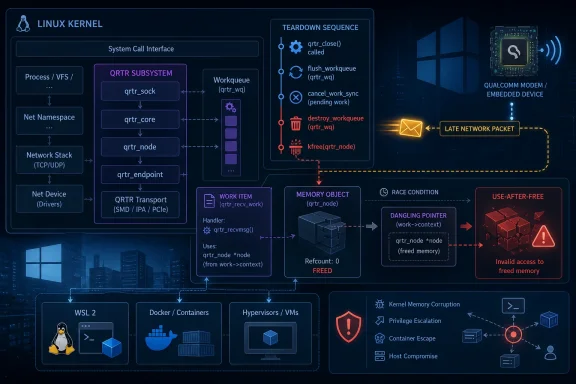
The specific failure mode described by kernel.org is a timing problem during driver removal. The QRTR nameservice remove callback destroys a workqueue before the socket is fully released. If a packet arrives in the wrong window, the
This is also why NVD’s “awaiting enrichment” label should not be misread as “awaiting importance.” As of the CVE publication, NVD had not assigned CVSS vectors or a base score. That means defenders lack the familiar shorthand that vulnerability scanners, ticketing systems, and patch dashboards use to sort urgency. It does not mean the flaw is theoretical, unfixed, or irrelevant.
That simplicity is what makes the bug interesting. Kernel subsystems often fail not because the normal path is poorly understood, but because the shutdown path is messier than anyone wants to admit. Initialization code tends to be linear. Runtime code gets exercised constantly. Removal code is where concurrency, callbacks, interrupts, workqueues, reference counts, and late packets collide.
CVE-2026-46047 is a classic teardown race. One thread is trying to dismantle a subsystem, while another path can still be invoked by incoming data. The workqueue has been destroyed, but the callback that queues work has not yet been replaced. The system’s mental model says the device is going away; the networking path says a packet just arrived.
That mismatch is the vulnerability. It is not glamorous, but it is the sort of thing that separates robust kernel engineering from code that only behaves under polite timing. The fix says, in effect: before you remove the floor, stop letting anyone walk through the door.
In practice, Windows estates have become less monocultural. Windows administrators may manage Linux virtual machines on Hyper-V, Linux containers in CI/CD systems, WSL instances on developer workstations, Azure-hosted Linux appliances, security tools packaged as Linux sensors, and network devices whose firmware is built around vendor Linux kernels. The boundary between “Windows shop” and “Linux exposure” is now more administrative than real.
That does not make every Linux kernel CVE an emergency for Windows teams. It does mean the old habit of ignoring Linux advisories because the desktop fleet runs Windows is increasingly dangerous. A domain admin’s laptop may run WSL. A developer workstation may build containers against a Linux kernel interface. A network appliance in the server room may ship a Qualcomm-adjacent kernel configuration. A mobile device management program may include Android-based hardware that inherits kernel fixes through a vendor pipeline.
QRTR itself is most relevant to Qualcomm platforms and kernel builds that include that subsystem. For many x86 server deployments, the affected code may be absent, built as a module that is not loaded, or unreachable in the environment. That distinction matters. The rational response is not panic patching; it is inventory-driven triage.
This is one of the quiet weaknesses of CVSS-driven operations. Scores are useful, but they are downstream artifacts. They often arrive after vendor advisories, upstream fixes, mailing-list discussions, and distribution patches. If an organization waits for scoring before starting triage, it can lose valuable time even for bugs that later turn out to be mundane.
The better model is to separate technical relevance from numeric severity. For CVE-2026-46047, the first triage questions are straightforward. Do we run Linux kernels with QRTR nameservice support? Are any of those systems Qualcomm-based, embedded, mobile, or appliance-like? Do our distributions already carry the stable-tree fix? Is the code built in, modular, or absent? Is there any plausible local or remote path to trigger driver removal while packets are still arriving?
Only after those questions should a team argue over the future CVSS number. A score can help prioritize across hundreds of tickets. It cannot replace knowing whether the vulnerable code exists in your environment.
That is what happened here. The data-ready callback was still capable of queueing work after the workqueue had been destroyed. The fix does not require a new mitigation technology or a dramatic architectural change. It requires respecting object lifetime: replace the callback before teardown, and wait for receive-side activity before destroying shared work structures.
This is also why memory-safety debates around operating systems are no longer abstract. Microsoft, Google, Apple, and the Linux community have all invested in hardening, fuzzing, sanitizers, safer languages, and better review practices. Yet mature kernels still accumulate bugs in boundary cases because the surface area is huge and the ordering constraints are unforgiving.
For administrators, the lesson is more practical than philosophical. Kernel security is not only about internet-facing daemons and famous privilege escalations. It is also about small race windows in subsystems that a vendor enabled for hardware support years ago. If that code ships in your kernel, its bugs ship in your risk register.
This is where Linux patching can become more complex than Windows patching. Microsoft’s monthly update model centralizes many decisions for Windows estates, even if the results are sometimes controversial. Linux updates depend on distribution policy, kernel branch, vendor enablement, custom modules, and the organization’s tolerance for rebooting critical systems.
For mainstream distributions, the practical move is to watch the vendor security tracker rather than trying to hand-apply upstream commits. Enterprise distributions often backport fixes without changing the visible kernel version in a way that looks intuitive to administrators. A system may still report an older major kernel branch while containing the relevant patch. Conversely, a custom kernel may report a newer version but lack a particular stable backport if it was built from an unusual tree.
That is why “what kernel version fixes this?” is often the wrong first question. The better question is whether your vendor’s kernel package includes the patch for CVE-2026-46047 or the corresponding upstream stable commit. Package changelogs, distribution advisories, and vendor errata are more reliable than version-number guesswork.
That distinction matters. Not every kernel use-after-free is an instant local root exploit, and not every network-adjacent bug is remotely exploitable from the internet. Exploitability depends on whether an attacker can trigger the vulnerable path, control timing, shape memory reuse, and reach the affected subsystem in a real configuration. Those details are not present in the NVD entry.
Still, defenders should not dismiss it as “just a crash.” Kernel availability is security. A device that panics under malformed or well-timed traffic is a reliability problem. A host that can be knocked over by a local user, container workload, or peripheral-adjacent subsystem may become a stepping stone in a broader incident. In embedded and appliance environments, reboots can mean service interruption, telemetry loss, or a stuck recovery process.
The most honest assessment is that CVE-2026-46047 currently looks like a narrow kernel race with uncertain exploitability and a clear upstream fix. That makes it less alarming than a widely reachable privilege escalation, but more important than a cosmetic advisory.
The first step is identifying where Linux kernels exist in the estate. That includes obvious servers and less obvious dependencies: developer workstations running WSL, container build hosts, CI runners, network monitoring appliances, EDR sensors, storage platforms, lab devices, and Linux-based management controllers. Many organizations discover during incidents that they have more Linux than their asset inventory admits.
The second step is determining exposure. QRTR is not universally relevant across all Linux systems. It is tied to Qualcomm IPC routing and may matter most on systems with Qualcomm hardware support, mobile-derived platforms, embedded devices, or kernels built with broad hardware enablement. A cloud VM running a minimal enterprise kernel may have no meaningful exposure, while an edge gateway or specialized appliance may.
The third step is patch validation. Administrators should look for distribution-specific advisories or kernel package updates that mention CVE-2026-46047 or the QRTR nameservice use-after-free fix. If the system uses a vendor appliance kernel, the vendor’s firmware update channel becomes the source of truth. If the system uses a custom kernel, the engineering team needs to confirm whether the relevant stable commit has been applied.
The broader point is more important: Windows endpoints increasingly host Linux execution environments. Developers use WSL for build tooling, security researchers use it for analysis, and administrators use it for automation. Those environments create a patching surface that does not fit neatly into old Windows Update mental models.
A Windows laptop can be fully patched from a Microsoft desktop perspective while still running container images, Linux packages, language runtimes, and tooling with separate update channels. Kernel-level WSL updates are more centralized than a random Linux VM, but the habit of checking only Windows cumulative updates is no longer enough for many technical users.
That does not mean WSL users should overreact to CVE-2026-46047. It means organizations should have a repeatable answer for how WSL kernels are updated, how developer systems are inventoried, and who owns Linux security on Windows-hosted development machines.
That matters because QRTR’s Qualcomm association points toward hardware ecosystems where kernel updates are not always clean, fast, or transparent. Phones, IoT gateways, modems, routers, industrial devices, and specialized edge systems often depend on vendor kernel branches. Those branches can lag upstream, carry extensive local changes, and expose administrators to opaque firmware release notes.
For enterprise IT, the practical question is not whether kernel.org fixed the bug. It is whether the device vendor you actually depend on will ship that fix, tell you about it, and give you a safe way to deploy it. If the answer is unclear, the vulnerability becomes part of a larger vendor-risk conversation.
This is where Windows shops may feel the pain indirectly. A Windows network can be disrupted by a Linux-based VPN appliance. A Windows-managed branch office can depend on an embedded gateway. A Windows-heavy manufacturing environment can include Linux controllers and sensors. The operating system named in the CVE is not always the operating system whose users notice the outage.
That principle extends well beyond QRTR. Network drivers, filesystems, USB stacks, graphics drivers, and virtualization layers all rely on callbacks and deferred work. A workqueue makes it easier to move work out of a hot path, but it also creates lifetime obligations. If anything can still schedule work, the queue and its backing structures must still exist.
The phrase “use-after-free” often makes readers think of an attacker manipulating heap memory. Sometimes that is the story. Here, the more immediate story is lifecycle correctness. The kernel must coordinate shutdown so no callback can reach into an object after that object has been dismantled.
This is also the kind of bug that automated testing can expose, especially with sanitizers and fuzzers that stress odd interleavings. But concurrency bugs are notoriously hard to exhaustively test because the bad state may require a narrow race: a packet arriving after one teardown step but before another. The fix is therefore not just a patch; it is documentation of an ordering rule future code needs to respect.
A useful internal classification would say something like: Linux kernel QRTR nameservice use-after-free, likely configuration-dependent, patch available upstream, monitor vendor updates, prioritize Qualcomm or embedded Linux systems. That is more actionable than waiting for a scanner to turn gray into yellow or red.
Security teams should also resist the opposite failure mode: inflating every kernel memory bug into a crisis. A good triage note should preserve uncertainty. Public information does not currently establish broad remote exploitability. NVD has not assigned severity. The affected code path appears tied to driver removal and packet arrival timing. Those caveats are not excuses to ignore the bug; they are how serious defenders avoid wasting credibility.
The best patch programs are boring because they are evidence-driven. They do not need every CVE to be a headline. They need enough process discipline to move from upstream fix to local relevance to scheduled remediation.
 A Small Race in a Quiet Subsystem Still Counts as a Kernel Security Event
The vulnerability sits in QRTR, the Qualcomm IPC Router transport used in Linux environments that communicate with Qualcomm modem and remote processor services. That alone makes the bug easy to dismiss if your daily work is Active Directory, Intune, Exchange, Windows Server, or endpoint hardening. Most administrators do not wake up planning to audit QRTR nameservice teardown behavior.But kernel bugs do not need celebrity branding to be operationally relevant. CVE-2026-46047 is a use-after-free, a class of memory-safety flaw where code continues to touch an object after the kernel has begun dismantling or freeing the underlying memory. In user space, this can mean a crash or exploit primitive. In kernel space, the blast radius is more serious because the bug happens inside the privileged machinery that arbitrates hardware, networking, memory, and process isolation.
The specific failure mode described by kernel.org is a timing problem during driver removal. The QRTR nameservice remove callback destroys a workqueue before the socket is fully released. If a packet arrives in the wrong window, the
qrtr_ns_data_ready() callback can try to queue work against a structure that has already been torn down. That is the kind of defect that sounds academic until it becomes a panic on a production host, a denial-of-service condition on an appliance, or a reliability problem on devices running vendor kernels.This is also why NVD’s “awaiting enrichment” label should not be misread as “awaiting importance.” As of the CVE publication, NVD had not assigned CVSS vectors or a base score. That means defenders lack the familiar shorthand that vulnerability scanners, ticketing systems, and patch dashboards use to sort urgency. It does not mean the flaw is theoretical, unfixed, or irrelevant.
The Bug Is Really About Teardown, Not QRTR Glamour
The kernel fix is conceptually simple: restore the socket’s defaultsk_data_ready callback at the start of removal, before the workqueue is destroyed, and ensure receive-side threads are done before destroying that workqueue. In plain English, the subsystem stops accepting the special QRTR callback before it starts taking apart the machinery that callback depends on. It is a sequencing fix, not a wholesale redesign.That simplicity is what makes the bug interesting. Kernel subsystems often fail not because the normal path is poorly understood, but because the shutdown path is messier than anyone wants to admit. Initialization code tends to be linear. Runtime code gets exercised constantly. Removal code is where concurrency, callbacks, interrupts, workqueues, reference counts, and late packets collide.
CVE-2026-46047 is a classic teardown race. One thread is trying to dismantle a subsystem, while another path can still be invoked by incoming data. The workqueue has been destroyed, but the callback that queues work has not yet been replaced. The system’s mental model says the device is going away; the networking path says a packet just arrived.
That mismatch is the vulnerability. It is not glamorous, but it is the sort of thing that separates robust kernel engineering from code that only behaves under polite timing. The fix says, in effect: before you remove the floor, stop letting anyone walk through the door.
Why Windows Administrators Should Not Scroll Past a Linux CVE
On paper, this is not a Windows vulnerability. It is a Linux kernel CVE, published by kernel.org, with stable-tree commits referenced as fixes. It does not mean Windows 11, Windows Server, or Microsoft’s NT kernel is affected.In practice, Windows estates have become less monocultural. Windows administrators may manage Linux virtual machines on Hyper-V, Linux containers in CI/CD systems, WSL instances on developer workstations, Azure-hosted Linux appliances, security tools packaged as Linux sensors, and network devices whose firmware is built around vendor Linux kernels. The boundary between “Windows shop” and “Linux exposure” is now more administrative than real.
That does not make every Linux kernel CVE an emergency for Windows teams. It does mean the old habit of ignoring Linux advisories because the desktop fleet runs Windows is increasingly dangerous. A domain admin’s laptop may run WSL. A developer workstation may build containers against a Linux kernel interface. A network appliance in the server room may ship a Qualcomm-adjacent kernel configuration. A mobile device management program may include Android-based hardware that inherits kernel fixes through a vendor pipeline.
QRTR itself is most relevant to Qualcomm platforms and kernel builds that include that subsystem. For many x86 server deployments, the affected code may be absent, built as a module that is not loaded, or unreachable in the environment. That distinction matters. The rational response is not panic patching; it is inventory-driven triage.
The Missing CVSS Score Is a Workflow Problem
NVD had not enriched CVE-2026-46047 with CVSS 4.0, 3.x, or 2.0 scoring when the record was published. That leaves security teams without a standardized severity label. In many organizations, that creates a strange limbo: the CVE exists, the patch exists, the description is clear, but the dashboard cannot yet tell the patching team whether to treat it as critical, high, medium, or informational.This is one of the quiet weaknesses of CVSS-driven operations. Scores are useful, but they are downstream artifacts. They often arrive after vendor advisories, upstream fixes, mailing-list discussions, and distribution patches. If an organization waits for scoring before starting triage, it can lose valuable time even for bugs that later turn out to be mundane.
The better model is to separate technical relevance from numeric severity. For CVE-2026-46047, the first triage questions are straightforward. Do we run Linux kernels with QRTR nameservice support? Are any of those systems Qualcomm-based, embedded, mobile, or appliance-like? Do our distributions already carry the stable-tree fix? Is the code built in, modular, or absent? Is there any plausible local or remote path to trigger driver removal while packets are still arriving?
Only after those questions should a team argue over the future CVSS number. A score can help prioritize across hundreds of tickets. It cannot replace knowing whether the vulnerable code exists in your environment.
The Kernel’s Security Model Still Depends on Memory Discipline
Use-after-free vulnerabilities remain stubborn because the Linux kernel is written largely in C, with enormous amounts of concurrency and hardware-facing code. The kernel must handle events from devices, sockets, timers, interrupts, workqueues, user requests, and subsystem shutdown paths. Many of those events are valid individually; the bug appears when their ordering creates a state the original code did not guard against.That is what happened here. The data-ready callback was still capable of queueing work after the workqueue had been destroyed. The fix does not require a new mitigation technology or a dramatic architectural change. It requires respecting object lifetime: replace the callback before teardown, and wait for receive-side activity before destroying shared work structures.
This is also why memory-safety debates around operating systems are no longer abstract. Microsoft, Google, Apple, and the Linux community have all invested in hardening, fuzzing, sanitizers, safer languages, and better review practices. Yet mature kernels still accumulate bugs in boundary cases because the surface area is huge and the ordering constraints are unforgiving.
For administrators, the lesson is more practical than philosophical. Kernel security is not only about internet-facing daemons and famous privilege escalations. It is also about small race windows in subsystems that a vendor enabled for hardware support years ago. If that code ships in your kernel, its bugs ship in your risk register.
Stable Kernel Fixes Are the Beginning, Not the End
The CVE record references multiple stable kernel commits, which indicates the fix has been backported across supported kernel lines. That is good news, but it is not the same thing as being patched everywhere. Upstream stable commits must still flow through distributions, cloud images, appliance vendors, enterprise support channels, and sometimes mobile or embedded OEM update systems.This is where Linux patching can become more complex than Windows patching. Microsoft’s monthly update model centralizes many decisions for Windows estates, even if the results are sometimes controversial. Linux updates depend on distribution policy, kernel branch, vendor enablement, custom modules, and the organization’s tolerance for rebooting critical systems.
For mainstream distributions, the practical move is to watch the vendor security tracker rather than trying to hand-apply upstream commits. Enterprise distributions often backport fixes without changing the visible kernel version in a way that looks intuitive to administrators. A system may still report an older major kernel branch while containing the relevant patch. Conversely, a custom kernel may report a newer version but lack a particular stable backport if it was built from an unusual tree.
That is why “what kernel version fixes this?” is often the wrong first question. The better question is whether your vendor’s kernel package includes the patch for CVE-2026-46047 or the corresponding upstream stable commit. Package changelogs, distribution advisories, and vendor errata are more reliable than version-number guesswork.
The Risk Is Probably Availability First, Exploitability Second
Based on the public description, the most immediate concern is a crash or denial-of-service condition caused by a use-after-free during QRTR nameservice driver removal. The CVE text does not establish public exploitation, privilege escalation, or remote code execution. It describes a race that can dereference a work structure after teardown if a packet arrives at precisely the wrong time.That distinction matters. Not every kernel use-after-free is an instant local root exploit, and not every network-adjacent bug is remotely exploitable from the internet. Exploitability depends on whether an attacker can trigger the vulnerable path, control timing, shape memory reuse, and reach the affected subsystem in a real configuration. Those details are not present in the NVD entry.
Still, defenders should not dismiss it as “just a crash.” Kernel availability is security. A device that panics under malformed or well-timed traffic is a reliability problem. A host that can be knocked over by a local user, container workload, or peripheral-adjacent subsystem may become a stepping stone in a broader incident. In embedded and appliance environments, reboots can mean service interruption, telemetry loss, or a stuck recovery process.
The most honest assessment is that CVE-2026-46047 currently looks like a narrow kernel race with uncertain exploitability and a clear upstream fix. That makes it less alarming than a widely reachable privilege escalation, but more important than a cosmetic advisory.
Inventory Beats Alarmism in the QRTR Patch Cycle
For WindowsForum’s audience, the operational response should be disciplined. Do not open a sev-one bridge because a Linux kernel CVE has a use-after-free label. Do not ignore it because the affected component sounds obscure. Treat it as a kernel maintenance item that deserves environment-specific triage.The first step is identifying where Linux kernels exist in the estate. That includes obvious servers and less obvious dependencies: developer workstations running WSL, container build hosts, CI runners, network monitoring appliances, EDR sensors, storage platforms, lab devices, and Linux-based management controllers. Many organizations discover during incidents that they have more Linux than their asset inventory admits.
The second step is determining exposure. QRTR is not universally relevant across all Linux systems. It is tied to Qualcomm IPC routing and may matter most on systems with Qualcomm hardware support, mobile-derived platforms, embedded devices, or kernels built with broad hardware enablement. A cloud VM running a minimal enterprise kernel may have no meaningful exposure, while an edge gateway or specialized appliance may.
The third step is patch validation. Administrators should look for distribution-specific advisories or kernel package updates that mention CVE-2026-46047 or the QRTR nameservice use-after-free fix. If the system uses a vendor appliance kernel, the vendor’s firmware update channel becomes the source of truth. If the system uses a custom kernel, the engineering team needs to confirm whether the relevant stable commit has been applied.
WSL Is a Reminder, Not the Center of the Story
It is tempting to drag Windows Subsystem for Linux into every Linux kernel conversation because it is the most visible Linux component on many Windows desktops. In this case, WSL should be treated as a reminder of cross-platform dependency rather than the obvious center of impact. WSL uses Microsoft-supplied kernel builds, and exposure depends on whether the affected code is present and reachable in that kernel configuration.The broader point is more important: Windows endpoints increasingly host Linux execution environments. Developers use WSL for build tooling, security researchers use it for analysis, and administrators use it for automation. Those environments create a patching surface that does not fit neatly into old Windows Update mental models.
A Windows laptop can be fully patched from a Microsoft desktop perspective while still running container images, Linux packages, language runtimes, and tooling with separate update channels. Kernel-level WSL updates are more centralized than a random Linux VM, but the habit of checking only Windows cumulative updates is no longer enough for many technical users.
That does not mean WSL users should overreact to CVE-2026-46047. It means organizations should have a repeatable answer for how WSL kernels are updated, how developer systems are inventoried, and who owns Linux security on Windows-hosted development machines.
The Vendor Pipeline Is Where Small Kernel Bugs Go to Linger
The uncomfortable part of CVE-2026-46047 is not the upstream fix. It is the long tail. The Linux kernel community can repair the bug and land stable commits quickly, but downstream adoption varies widely. Servers managed by disciplined patch programs may be updated in the next maintenance window. Consumer devices and embedded appliances may wait weeks or months. Some unsupported devices may never receive the fix.That matters because QRTR’s Qualcomm association points toward hardware ecosystems where kernel updates are not always clean, fast, or transparent. Phones, IoT gateways, modems, routers, industrial devices, and specialized edge systems often depend on vendor kernel branches. Those branches can lag upstream, carry extensive local changes, and expose administrators to opaque firmware release notes.
For enterprise IT, the practical question is not whether kernel.org fixed the bug. It is whether the device vendor you actually depend on will ship that fix, tell you about it, and give you a safe way to deploy it. If the answer is unclear, the vulnerability becomes part of a larger vendor-risk conversation.
This is where Windows shops may feel the pain indirectly. A Windows network can be disrupted by a Linux-based VPN appliance. A Windows-managed branch office can depend on an embedded gateway. A Windows-heavy manufacturing environment can include Linux controllers and sensors. The operating system named in the CVE is not always the operating system whose users notice the outage.
The Patch Teaches a Bigger Lesson About Callback Ownership
The fix for CVE-2026-46047 is a callback ownership lesson. When a subsystem replaces a socket callback, it inherits responsibility for restoring safe behavior before destroying the resources that callback can touch. The code must not merely clean up everything eventually; it must clean up in an order that remains safe under concurrent events.That principle extends well beyond QRTR. Network drivers, filesystems, USB stacks, graphics drivers, and virtualization layers all rely on callbacks and deferred work. A workqueue makes it easier to move work out of a hot path, but it also creates lifetime obligations. If anything can still schedule work, the queue and its backing structures must still exist.
The phrase “use-after-free” often makes readers think of an attacker manipulating heap memory. Sometimes that is the story. Here, the more immediate story is lifecycle correctness. The kernel must coordinate shutdown so no callback can reach into an object after that object has been dismantled.
This is also the kind of bug that automated testing can expose, especially with sanitizers and fuzzers that stress odd interleavings. But concurrency bugs are notoriously hard to exhaustively test because the bad state may require a narrow race: a packet arriving after one teardown step but before another. The fix is therefore not just a patch; it is documentation of an ordering rule future code needs to respect.
Security Teams Need a Better Category Than “No Score Yet”
The vulnerability-management industry has a bad habit of treating unscored CVEs as background noise until a number appears. CVE-2026-46047 shows why that habit is fragile. The public record already tells us the component, bug class, teardown sequence, fix strategy, and publication date. That is enough to start triage.A useful internal classification would say something like: Linux kernel QRTR nameservice use-after-free, likely configuration-dependent, patch available upstream, monitor vendor updates, prioritize Qualcomm or embedded Linux systems. That is more actionable than waiting for a scanner to turn gray into yellow or red.
Security teams should also resist the opposite failure mode: inflating every kernel memory bug into a crisis. A good triage note should preserve uncertainty. Public information does not currently establish broad remote exploitability. NVD has not assigned severity. The affected code path appears tied to driver removal and packet arrival timing. Those caveats are not excuses to ignore the bug; they are how serious defenders avoid wasting credibility.
The best patch programs are boring because they are evidence-driven. They do not need every CVE to be a headline. They need enough process discipline to move from upstream fix to local relevance to scheduled remediation.
The Useful Facts Before the Score Arrives
CVE-2026-46047 is small enough to fit in a patch note but broad enough to test whether an organization understands its Linux exposure. The work now is not dramatic; it is the ordinary business of mapping components, checking vendor kernels, and making sure update channels are alive.- CVE-2026-46047 was published by NVD on May 27, 2026, after being received from kernel.org.
- The flaw is a Linux kernel use-after-free in the QRTR nameservice removal path.
- The race occurs when a packet arrives after the workqueue is destroyed but before the socket is released.
- NVD had not yet assigned CVSS severity or vector information at publication time.
- The upstream fix changes teardown ordering by restoring the default data-ready callback early and ensuring receive-side activity completes before destroying the workqueue.
- Administrators should prioritize systems with Qualcomm-related Linux kernels, embedded devices, appliances, and custom kernel builds before assuming broad exposure across generic servers.
References
- Primary source: NVD / Linux Kernel
Published: 2026-05-28T01:07:25-07:00
NVD - CVE-2026-46047
 nvd.nist.gov
- Security advisory: MSRC
Published: 2026-05-28T01:07:25-07:00
Original feed URL
Security Update Guide - Microsoft Security Response Center
 msrc.microsoft.com
- Related coverage: stack.watch