

A Small SPI Bug Exposes a Big Maintenance Reality
The vulnerability sits in the Linux kernel’s SPI subsystem, specifically the spi-imx driver used with NXP/Freescale i.MX system-on-chip hardware. SPI, or Serial Peripheral Interface, is not glamorous infrastructure. It is the kind of low-level bus used to talk to flash chips, sensors, controllers, and board-specific peripherals that most desktop users never consciously encounter.
That is precisely why bugs like this tend to be underestimated. They live below the application layer, below most endpoint tools, and below the level where administrators are used to thinking about attack surface. When something goes wrong, the result may not be a neat security alert; it may be a crash, a hung board, an unreliable appliance, or a kernel warning that appears only when hardware is removed, rebound, power-managed, or tested.
The core issue is a use-after-free, one of the classic memory-safety failure modes in systems software. The kernel frees an object, but some code path still assumes the object is alive. If the stale pointer is later dereferenced, the best case is a clean crash; the worse cases involve memory corruption, privilege-boundary confusion, or behavior that depends on what has since occupied that memory.
In CVE-2026-45996, the offending path is not day-to-day SPI traffic. It is device unbind and teardown. That distinction matters, because it pushes the bug toward admins, developers, test rigs, hotplug-style workflows, and embedded platforms rather than the average laptop user clicking a malicious link.
The Unbind Path Is Where Driver Assumptions Go to Die
Linux drivers are full of lifecycle choreography. Devices appear, probe functions run, controllers register, runtime power management begins, DMA resources may be initialized, and subsystem-specific objects are attached to generic kernel structures. The reverse path has to unwind all of that in the right order.
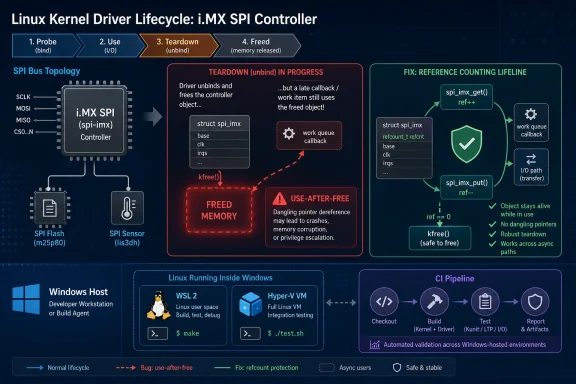
The i.MX SPI bug is about that reverse path. During deregistration, the SPI subsystem can free the controller and driver data that were allocated by the subsystem, unless the allocation was handled through device-managed mechanisms. The fix takes an additional reference before deregistering the controller, then drops that reference after the driver finishes its cleanup. In plain English: the driver now keeps the controller alive long enough to finish using it.
That is an almost comically small patch for something that receives a CVE. The stable patch adds a get before unregister and a put afterward. Four lines changed, one lifetime assumption corrected.
But small patches often reveal large classes of bugs. Driver teardown is where abstractions meet reality. A subsystem may believe it owns an object’s lifetime; a driver may believe it can still read its private data after deregistration; runtime power management may wake a device during removal; DMA cleanup may depend on fields stored behind a pointer that has already been invalidated. Any one of those assumptions can be locally reasonable and globally wrong.
The patch history also suggests this was not treated as a one-off curiosity. The i.MX change was part of a broader SPI cleanup series that included related controller deregistration and managed-allocation work for other drivers. That is the kernel development process doing what it often does best: finding a concrete bug, then tightening the surrounding pattern before the same mistake repeats elsewhere.
The CVE Is Fresh, but the Kernel Lesson Is Old
NVD listed CVE-2026-45996 as awaiting enrichment when the record appeared. That means there was no NVD-provided CVSS score, no finalized severity vector, and no populated weakness mapping at publication time. For defenders used to sorting vulnerability queues by a red, orange, or yellow number, that absence is uncomfortable.
It is also normal. Kernel CVEs often arrive before the downstream ecosystem has finished translating commits into distribution advisories, vendor notices, appliance firmware updates, and scanner logic. The CVE record tells us the bug exists and points to stable kernel commits. It does not, by itself, tell every organization whether the bug is reachable, exploitable, or present on a device they actually own.
That is where security operations has to resist both extremes. Treating every fresh kernel CVE as an emergency is unsustainable. Treating every device-driver flaw as irrelevant is how quiet infrastructure risk accumulates.
The right reading is narrower and more operational. If you run general-purpose x86 Windows desktops, this CVE is unlikely to be directly relevant. If you manage Linux-based edge systems, ARM boards, industrial controllers, network appliances, storage boxes, lab hardware, or custom kernels that include i.MX SPI support, it belongs on the patch radar.
The affected code path also shapes practical risk. Unbinding a device usually requires local administrative capability or a privileged path through sysfs or driver management. That reduces the likelihood of drive-by exploitation. It does not eliminate concern, because many environments give automation, containers, test frameworks, hardware-management daemons, or vendor scripts more influence over device state than administrators realize.
Memory Safety Keeps Winning the Argument Against Complacency
Use-after-free vulnerabilities have an unfortunate persistence because they arise from ownership ambiguity. C and kernel C give developers enough control to build high-performance hardware support, but they also require exact agreement about who owns an object and when it dies. The compiler cannot reliably save a driver from a lifecycle misunderstanding embedded across subsystem calls.
The i.MX SPI flaw is a classic example of that bargain. The SPI subsystem is allowed to free controller data during deregistration. The driver still needs information from that controller while it unwinds runtime power management and exits SDMA handling. The fix is not a rewrite; it is a reference-counting correction.
That can sound mechanical, but reference counting is one of the most important security tools in a kernel built around shared objects. It turns “I hope this is still alive” into “I have explicitly kept this alive.” When the object’s lifetime becomes contractual rather than assumed, an entire category of teardown race and stale-pointer bugs becomes less likely.
The catch is that reference counting is also easy to get wrong. Too few references and you get use-after-free. Too many and you leak memory or keep hardware resources alive too long. Dropping a reference in the wrong path can be just as dangerous as not taking one in the first place.
This is why kernel bug fixes often read like small accounting corrections. They are not merely tidying code. They are repairing a ledger of ownership, and in kernel space, bad accounting can crash the machine.
Why Windows People Should Care About a Linux Driver CVE
A WindowsForum audience might reasonably ask why a Linux i.MX SPI driver deserves attention here. The answer is not that Windows users are suddenly exposed to an i.MX controller bug. The answer is that the boundary between Windows and Linux infrastructure is no longer clean.
Windows shops routinely run Linux in WSL, Hyper-V guests, Kubernetes clusters, CI pipelines, firewall appliances, NAS systems, routers, monitoring boxes, developer boards, Android-derived devices, and vendor-managed hardware. The security perimeter of a Windows environment often includes a surprising amount of Linux kernel code. Sometimes it is visible. Often it is hidden behind a web console and a firmware version string.
This CVE is especially relevant to mixed estates because it touches embedded hardware rather than cloud-native Linux servers alone. i.MX chips show up in industrial, automotive, IoT, and appliance-like systems. Those systems may not be patched on the same cadence as mainstream distributions, and they often ship kernels with long-lived vendor modifications.
That means the practical question is not “Does my Windows PC have this bug?” It is “Do any Linux-based devices in my environment carry an i.MX kernel with this SPI driver path, and who is responsible for updating it?” In many organizations, that question crosses departmental lines: IT owns the network, OT owns the plant floor, vendors own firmware, and security owns the risk register.
The uncomfortable reality is that embedded Linux vulnerabilities frequently outlive their upstream fixes. A patch can be merged, backported, and documented, while deployed appliances remain frozen on an old vendor kernel. CVE-2026-45996 may or may not become a major real-world issue, but it is a useful reminder that “patched upstream” is not the same thing as “fixed in your environment.”
The Lack of a Score Is Not the Lack of a Problem
NVD’s missing CVSS score should not be mistaken for a verdict of low severity. It is simply an unfinished enrichment state. The record was received from kernel.org, the description identifies the resolved vulnerability, and the references point to stable commits. The scoring machinery had not yet caught up.
That matters because many vulnerability dashboards lean heavily on numeric severity. A CVE without a score can fall into an awkward limbo: visible enough to create noise, incomplete enough to be deferred. In mature programs, “no score yet” should trigger triage, not paralysis.
For this flaw, a sensible provisional assessment starts with reachability. Is the spi-imx driver built into the kernel or loaded as a module? Is the hardware present? Can unbind be triggered by an unprivileged user, a container, a management service, a test harness, or only by root? Does the system expose device-management paths to remote orchestration?
The likely answer in many environments will be boring: not applicable. That is fine. Vulnerability management is mostly the art of proving non-applicability quickly and correctly.
But where the answer is “yes, this driver is present on production hardware,” the lack of a score should not delay remediation planning. A memory-safety bug in a privileged kernel teardown path is the kind of defect that administrators should prefer to remove rather than debate indefinitely.
Stable Backports Are the Real Security Product
One of the most important details in the CVE record is the set of stable kernel references. The fix was not just an abstract upstream change destined for some future mainline release; it was backported into stable series. That is how kernel security actually reaches users.
Linux kernel development is not a single stream. There is the mainline tree, subsystem maintainer trees, linux-next integration, stable branches, long-term support kernels, distribution kernels, Android and embedded vendor kernels, and product-specific forks. A fix becomes operationally meaningful only when it lands in the branch that a given device or distro actually ships.
The stable mailing-list entry for the 6.12 series shows the patch being reviewed as part of a broad stable update. It identifies the upstream commit, the file touched, the fix that introduced the vulnerable pattern, and the stable applicability note. That metadata is the breadcrumb trail maintainers need when deciding whether their branch is affected.
This is where the Linux ecosystem can be both strong and maddening. Strong, because the public patch trail is detailed and fast. Maddening, because the final mile depends on distributions, vendors, integrators, and device makers whose timelines vary wildly.
For sysadmins, the action is not to cherry-pick random commits from kernel.org onto production systems. The action is to track your vendor’s kernel advisory stream, verify whether the relevant stable update is included, and update through supported channels. For embedded teams maintaining custom kernels, the action is more direct: inspect the driver, compare the teardown path, and carry the reference-counting fix if your branch has the vulnerable structure.
The Fix Says More Than the CVE Text
The CVE description is terse because it inherits the language of the kernel commit. That is not a flaw in itself. Kernel commit messages are written for maintainers, not procurement departments.
Still, the fix tells a richer story. The driver obtains private data from the SPI controller, unregisters the controller, then continues cleanup that still uses data reachable through that controller. If deregistration drops the final reference, the driver’s subsequent operations are walking through memory that no longer belongs to it.
The patch adds spi_controller_get() before deregistration and spi_controller_put() after cleanup. This brackets the dangerous interval. The controller may be deregistered from the SPI subsystem’s point of view, but the underlying object remains alive until the driver finishes its removal routine.
That is the kind of fix administrators rarely see because it hides behind a package update. But it is worth understanding. It distinguishes a real lifecycle bug from a speculative scanner match. It also helps explain why exploitation is tied to unbind and removal rather than ordinary SPI device use.
The notable phrase in the CVE description is “unless the allocation is device managed.” Device-managed allocation is the kernel’s way of tying resource lifetimes to the device model so cleanup happens automatically at the right time. The broader patch series moved toward that model in places, which is the more durable solution. The immediate CVE fix is the safety belt; managed allocation is the better road design.
Exploitability Is Plausible, Not Proven
There is no public indication in the provided record that CVE-2026-45996 is being exploited in the wild. There is also no NVD severity vector yet to frame attack complexity, privileges required, or impact. That uncertainty should be stated plainly rather than filled with marketing-grade panic.
Use-after-free bugs can be exploitable, but not all use-after-free bugs are practical exploits. A teardown path that requires privileged device unbinding is a different animal from a remotely reachable parser bug or a browser heap vulnerability. The attacker may need local root-like capability, physical influence over hardware state, or a chained path through a management interface.
In some deployments, that makes the vulnerability mostly a reliability issue. A lab user unbinds and rebinds a controller and trips a kernel crash. A firmware test suite exercises removal paths and finds instability. A board under development behaves unpredictably during driver reload.
In other deployments, “mostly reliability” is still security. A local denial of service against an embedded gateway can be operationally serious. A kernel crash on an industrial controller can have business impact. A memory corruption primitive in kernel space can become more interesting if paired with another bug that gives partial control over object reuse.
The honest assessment is therefore conditional. CVE-2026-45996 is not a universal emergency, but it is not noise. Its importance rises sharply in environments where i.MX-based Linux systems are exposed to untrusted local users, remote management workflows, automated device rebinding, or high-availability requirements.
Embedded Linux Turns Patch Management Into Archaeology
The hardest part of responding to this CVE may not be applying the fix. It may be discovering whether you are affected at all.
On a normal Linux server, administrators can identify the running kernel, check vendor advisories, and update through package management. On embedded systems, kernel provenance is often murky. A product may run a vendor BSP derived from an old LTS kernel, with hundreds of patches and a version string that tells only half the story.
That matters for i.MX platforms because hardware enablement commonly depends on vendor kernels. Mainline Linux support may exist, but product teams often ship kernels from board vendors or SoC vendors because those trees carry display, power, boot, or peripheral support needed for the device. Security fixes then have to be backported into a branch that may look only distantly related to upstream.
This is where SBOMs and firmware inventories stop being compliance theater and start being useful. If your asset system cannot tell you which devices run Linux, which kernel branch they use, and which hardware families they contain, you cannot quickly scope a driver CVE. You are reduced to emailing vendors and hoping the person who understands the BSP is still there.
The lesson is broader than this one SPI bug. Modern infrastructure includes a long tail of Linux kernels that are not administered like servers. They sit in cameras, controllers, access systems, storage appliances, network gear, lab instruments, and edge gateways. A kernel CVE may be “low priority” until one of those devices becomes the weak link in an otherwise well-managed Windows estate.
The Scanner Will Be Both Helpful and Wrong
Security scanners will eventually learn about CVE-2026-45996, but their findings should be interpreted carefully. Kernel CVE detection is notoriously messy because version numbers alone are unreliable. A distribution kernel may have an old base version with the fix backported, or a newer-looking vendor kernel may still lack the specific patch.
This is especially true for stable kernel commits. The presence of a fix cannot always be inferred from “Linux 6.12.x” or a generic package name. Administrators need to know the vendor’s exact patch level or inspect whether the relevant change exists in the source package.
False positives are therefore likely. A scanner may flag a system because its kernel version falls within a broad range, even though the distributor backported the patch. False negatives are also possible if a vendor fork carries the vulnerable code under a custom version scheme that does not match scanner logic.
The practical response is to treat scanner output as a prompt for verification. On mainstream distributions, look for vendor advisories and changelog entries. On custom kernels, check the drivers/spi/spi-imx.c removal path. On appliances, ask the vendor whether the stable fixes referenced by the CVE are included in the firmware train.
This is less satisfying than a single green check mark. It is also how kernel vulnerability management actually works.
Microsoft Shops Need a Linux Kernel Playbook
Windows-first organizations should not wait for a Linux driver CVE to improvise a Linux kernel response process. By the time a CVE appears in an embedded subsystem, the organization should already know who owns Linux assets, who tracks vendor firmware, and who can validate kernel exposure.
That playbook does not need to be elaborate. It needs to be clear. Inventory first, applicability second, vendor status third, patch or mitigation fourth. The failure mode is letting every Linux CVE bounce between teams because nobody “owns” the kernel inside a device bought as an appliance.
For WSL users, this specific CVE is unlikely to be the issue. WSL’s kernel is maintained and updated through Microsoft’s channels and does not turn a Windows laptop into an i.MX SPI board. The larger lesson is different: once Linux enters a Windows environment, kernel maintenance becomes part of the Windows admin’s world whether or not the desktop OS is affected.
For Hyper-V and virtualization environments, the concern is guest and appliance kernels. A Linux VM used for development or CI probably will not have i.MX SPI hardware, but a virtual appliance or hardware-management image might include broad driver support. In most cases, the driver is irrelevant without matching hardware, but minimal kernels and disciplined module policies still reduce noise and attack surface.
For edge and IoT fleets, the lesson is sharper. If devices are built on i.MX SoCs, administrators should track vendor firmware updates and kernel BSP maintenance. If those devices support remote diagnostics that can unbind drivers or reload modules, the operational risk deserves closer scrutiny.
The Kernel Community Is Quietly Rewriting Its Own Assumptions
The most interesting part of this story is not the CVE number. It is the maintenance pattern around it. A bug is found in a driver’s removal path; the fix lands; related drivers are nudged toward safer managed allocation. This is how a decades-old C kernel slowly becomes less fragile without becoming something else overnight.
The Linux kernel cannot simply flip a switch and become memory safe. It is too large, too hardware-facing, and too entangled with performance and compatibility. But it can keep improving ownership models, subsystem APIs, testing, sanitizers, and review patterns. Each small lifetime fix is part of that larger grind.
That does not make the vulnerability harmless. It makes it legible. CVE-2026-45996 is the kind of defect that better abstractions are designed to prevent, and the kernel patch discussion shows maintainers pushing in that direction. The immediate repair is reference counting; the longer-term answer is reducing the number of places where individual drivers must manually get lifetime rules exactly right.
For defenders, this is a useful antidote to CVE fatigue. Not every new CVE is a catastrophe, but every concrete fix carries information about where software was brittle. The question is not only “How bad is this bug?” It is also “Do we have systems that depend on this brittle pattern, and can we update them before it matters?”
The Patch Is Tiny; the Operational Trail Is Not
For teams trying to decide what to do today, CVE-2026-45996 should be handled as a targeted kernel maintenance item rather than a broad emergency. The systems most likely to matter are Linux devices using NXP/Freescale i.MX hardware with the affected SPI driver and a kernel branch that has not yet absorbed the stable fix.
The absence of an NVD score makes local triage more important, not less. The right response is to determine exposure, map vendor fixes, and avoid assuming that upstream stability equals fleet-wide remediation.
- Systems that do not include the
spi-imxdriver or do not run on relevant i.MX hardware are unlikely to be practically affected. - Systems that allow privileged users, scripts, or management agents to unbind and rebind devices should receive closer review.
- Mainstream Linux distributions should be checked through their own advisories rather than judged solely by upstream kernel version numbers.
- Embedded and appliance vendors should be asked specifically whether the stable i.MX SPI use-after-free fix is present in their firmware.
- Custom kernel maintainers should inspect the controller removal path and carry the reference-counting fix if their branch matches the vulnerable pattern.
The broader security lesson is that kernel vulnerabilities increasingly arrive not as cinematic remote-code-execution events, but as precise corrections to lifetime, locking, and teardown behavior in subsystems most users never see. CVE-2026-45996 is a small bug with a narrow likely blast radius, yet it points to a large administrative truth: Windows environments are full of Linux dependencies now, and the organizations that know where those kernels live will patch calmly while everyone else is still trying to find the device.
References
- CVE-2026-45996 spi: imx: fix use-after-free on unbind NVD / Linux Kernel · 2026-05-28T01:08:11-07:00