

A Small SPI Leak Shows How Kernel Security Has Changed
CVE-2026-46083 arrives with the modern Linux-kernel CVE signature: a terse description, a set of stable-tree commits, and no NVD score at publication. That absence is not a mistake. As of the initial NVD record, the vulnerability was still awaiting enrichment, with no CVSS 4.0, 3.x, or 2.0 assessment from NIST.
That makes the entry easy to misunderstand. In the old vulnerability economy, a missing score often made a CVE feel unfinished or unimportant. In the Linux kernel’s current workflow, many CVEs are born from already-merged fixes, and the public record can look more like a changelog excerpt than a traditional advisory.
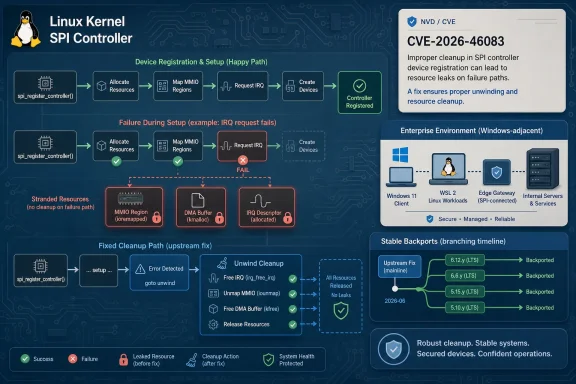
The bug itself is plain enough. During SPI device registration, spi_setup() can fail after a controller’s setup path has already allocated resources. The fix ensures the matching controller cleanup path runs when that failure happens, preventing those resources from being stranded.
That is the kind of bug administrators often file under “stability” rather than “security.” But in kernel space, the distinction is thinner than it looks. A leak that is reachable repeatedly can become a denial-of-service condition, and a failure path that forgets cleanup may signal broader uncertainty about ownership, teardown order, or device lifecycle assumptions.
The Vulnerability Is in the Plumbing, Not the Faucet
SPI, or Serial Peripheral Interface, is not a desktop feature most Windows users think about. It is a low-level bus used to connect chips and peripherals: flash devices, sensors, controllers, touch hardware, radio modules, and the sort of board-specific components that make embedded Linux both powerful and maddening.
That matters because CVE-2026-46083 is not about an attacker browsing to a malicious web page and taking over a laptop. It is about the kernel’s SPI core managing device setup and cleanup correctly when something goes wrong. The immediate failure mode is resource leakage on setup failure, not arbitrary code execution.
Still, the SPI subsystem is not exotic in the environments that increasingly surround Windows estates. Linux powers management controllers, industrial gateways, developer boards, storage appliances, routers, security cameras, and small edge devices that often end up authenticated against, monitored by, or managed from Windows networks. A bug does not need to be a Windows bug to become a Windows administrator’s operational problem.
The most important word in the description is failure. Security engineering is often less about the happy path than about what happens when initialization is interrupted, hardware is half-present, a driver returns an error, or a device tree describes something that does not quite match reality. The kernel has to unwind those partial states perfectly, again and again, under conditions developers may rarely see in normal testing.
CVE-2026-46083 says one such unwind path was incomplete. That is mundane, but it is not trivial.
Resource Leaks Are Boring Until They Are Repeatable
A resource leak in user space is usually annoying. A resource leak in kernel space can be strategic. If the leaked object is scarce, pinned, unreclaimable, or tied to a path a local actor can trigger repeatedly, the result can be gradual system degradation, memory pressure, or a denial of service.
The public description for CVE-2026-46083 does not establish that ordinary unprivileged users can trigger the bug on a typical system. It also does not claim data disclosure, privilege escalation, or remote exploitation. That restraint is important, because a CVE ID is not a permission slip to invent an exploit chain.
But resource leaks live in the category of vulnerabilities whose severity depends heavily on reachability. A leak buried in a probe path for fixed board hardware may require unusual privileges, physical device manipulation, malicious firmware tables, or repeated driver binding operations. A leak in a path exposed through hotplug, overlays, containerized device access, or automation can become more interesting.
This is why kernel CVEs often frustrate enterprise scanners. The scanner sees a CVE and wants a universal answer. The kernel gives you a conditional one: affected code, affected configuration, affected hardware, affected branch, affected distribution, affected workload.
The right operational stance is neither dismissal nor drama. Treat CVE-2026-46083 as a patch-management item for Linux kernels that include the vulnerable SPI behavior, with priority rising for embedded, edge, and hardware-facing systems where SPI devices are actively registered or manipulated.
The NVD Record Is Sparse Because the Fix Is the Disclosure
The NVD page for CVE-2026-46083 says the record has been marked for enrichment, lists kernel.org as the source, and references multiple stable commits. That is enough to establish that the Linux stable process has already carried the fix into supported branches, but not enough to produce a fully scored risk narrative.
This is increasingly normal. Linux kernel CVEs frequently appear after the patch trail exists, not before. The CVE text is often lifted from the commit message, which explains the fix in developer terms rather than security-advisory terms.
That creates a gap for defenders. A security team wants to know whether exploitation is remote, local, privileged, network-adjacent, or theoretical. The initial record may answer none of those questions. It may simply say that a resource leak has been fixed and point at the relevant commits.
For Linux specialists, that is workable. For mixed Windows-and-Linux shops, it can look like ambiguity. The job is to translate from kernel maintenance language into risk language without overstating the case.
Here, the safe translation is this: CVE-2026-46083 fixes a cleanup omission in the SPI device setup failure path. The plausible risk is resource exhaustion or system instability under conditions where the failing registration path can be reached repeatedly. The public record does not support claims of remote compromise, credential theft, or direct privilege escalation.
The Stable Commits Matter More Than the CVSS Box
Security dashboards love severity scores because they allow sorting. Kernel teams care more about whether the fix is in the branch you actually run. CVE-2026-46083 illustrates the tension.
At publication, NVD had not assigned a base score. That does not mean the issue is harmless. It means the scoring body had not yet attached a formal vector. In practical kernel operations, the more urgent question is whether your vendor kernel has absorbed one of the stable fixes referenced by kernel.org.
That is especially true because most organizations do not run vanilla upstream kernels. They run Ubuntu, Debian, Red Hat, SUSE, Oracle, Amazon Linux, Raspberry Pi OS, Yocto-derived builds, Android-derived kernels, vendor appliance kernels, or cloud-specific builds with backports. The version number alone can mislead when vendors apply security fixes without changing to the exact upstream release where the fix first appeared.
For administrators, the work is vendor-specific. Check your distribution’s kernel advisory stream, not just the NVD entry. If you maintain custom kernels, compare your tree against the stable commits. If you ship embedded Linux images, verify whether your BSP or long-term support branch contains the cleanup fix.
The uncomfortable part is that embedded and appliance kernels are often the slowest to receive the least glamorous fixes. A high-profile remote-code-execution bug gets everyone’s attention. A one-line lifecycle correction in an SPI registration path can sit quietly until a device starts leaking resources in the field.
Windows Shops Are Not Outside the Blast Radius
A Windows-first organization may be tempted to ignore a Linux SPI CVE. That instinct is understandable and increasingly wrong. Microsoft’s own ecosystem has spent years making Linux a first-class neighbor: WSL for developers, Linux containers in CI/CD pipelines, Azure Linux workloads, Linux-based network appliances, and IoT deployments managed from Windows tooling.
For ordinary WSL users, CVE-2026-46083 is unlikely to be a headline risk. WSL2 uses a Microsoft-provided Linux kernel in a virtualized environment, and SPI hardware exposure is not the normal use case. If your only Linux footprint is WSL for development on a managed laptop, this CVE should follow normal WSL and Windows Update hygiene rather than emergency action.
The calculus changes on hardware-facing systems. Think lab workstations flashing devices, industrial PCs, embedded development boards, kiosks, point-of-sale controllers, maker-space infrastructure, and edge boxes that expose hardware buses. Those are exactly the environments where SPI is not theoretical.
It also changes for vendors. If you sell or manage appliances that include Linux under the hood, your customers may never know SPI exists, but they will notice if a device degrades after repeated initialization failures. A resource leak CVE may be a security item in the database and a reliability issue in the support queue.
Windows administrators increasingly inherit these problems indirectly. The Linux box may not be domain-joined, but it may store backups, terminate VPNs, bridge OT networks, host Git runners, or manage firmware. When it fails, the Windows estate feels it.
The Real Risk Is in Error Paths Nobody Tests Hard Enough
The fix behind CVE-2026-46083 is a classic example of an error-path bug. The normal path sets up a device, allocates what it needs, and continues. The abnormal path fails midway and must unwind the exact subset of actions already performed.
That sounds simple until you have worked in a large kernel subsystem. Setup functions can allocate memory, acquire references, initialize queues, register child devices, pin resources, configure DMA, touch firmware-described state, and call controller-specific hooks. Cleanup must mirror that sequence without double-freeing, leaking, or racing with another subsystem.
These bugs survive because failure paths are combinatorial. Testers can validate that a device boots. They can validate that an obviously missing device fails. It is harder to validate every possible failure after partial setup, especially across dozens of controller drivers, board descriptions, and stable kernel branches.
The Linux kernel has been steadily replacing hand-managed lifetime code with device-managed APIs where appropriate, but the old truth remains: ownership is hard. A single missing cleanup call is a small defect in text and a large defect in state.
That is why CVE-2026-46083 belongs in the security feed even if it never becomes a dramatic exploit. Security is not only about clever attackers; it is also about ensuring that privileged code remains predictable under stress.
Scanners Will Overstate It, Engineers Will Understate It
The predictable next act is that vulnerability scanners will flag CVE-2026-46083 across Linux assets, and some engineers will immediately mark it as noise. Both reactions contain a piece of truth.
The scanner is right that kernel CVEs should not be ignored. A vulnerable kernel is a privileged attack surface, and Linux’s internal subsystems can matter even when no one on the security team has heard of the component. Asset owners have been burned too many times by “irrelevant” kernel modules that turned out to be reachable in a particular configuration.
The engineer is right that CVE-2026-46083 does not read like a stop-the-world emergency. The public description does not describe remote exploitation, a weaponized proof of concept, or broad privilege escalation. It describes a cleanup path that now calls the controller’s cleanup routine when setup fails.
The way through is to enrich internally. Identify which systems run affected kernels, which expose SPI-relevant hardware or driver paths, and which are operationally sensitive. Prioritize edge and embedded fleets ahead of ordinary virtual servers that lack SPI device exposure.
This is where configuration management beats vulnerability management theater. A red dashboard full of unsorted kernel CVEs is less useful than a smaller map showing which devices actually have SPI controllers, custom kernels, hardware overlays, or vendor BSPs that lag upstream.
The Kernel CVE Firehose Rewards Better Asset Memory
CVE-2026-46083 is part of a broader shift that defenders are still adjusting to. The Linux kernel now produces a steady stream of CVE records for fixes that might previously have appeared only as ordinary commits. This improves visibility, but it also raises the noise floor.
Security teams cannot treat every kernel CVE as equal. They also cannot safely ignore the low-drama ones. The only sustainable answer is better asset memory: knowing what runs where, why it runs, which kernel branch it tracks, and who owns the update path.
That is harder than it sounds. A Windows estate has recognizable landmarks: Active Directory, Intune, WSUS, Configuration Manager, Defender, Group Policy, Entra ID. Linux estates often sprawl across package managers, container hosts, vendor appliances, hand-built images, cloud templates, and one-off developer machines.
The SPI angle adds another wrinkle. Hardware-facing Linux devices are often managed by operations teams, lab teams, facilities teams, or product engineering rather than central IT. They may live outside the clean inventory that vulnerability managers assume exists.
A small CVE like this therefore becomes a test of process. If your organization can answer where Linux kernels are running and how they are updated, CVE-2026-46083 is routine. If you cannot, the problem is not this CVE. It is the next one.
Patch, But Patch With Context
The appropriate remediation is straightforward: run a kernel that includes the stable fix or a vendor backport of it. For mainstream distributions, that generally means waiting for and applying the relevant security or stable kernel package. For custom and embedded kernels, it means pulling the patch into the maintained branch and testing device registration behavior.
There is no public basis for disabling SPI globally as a blanket mitigation. On systems that use SPI, disabling it may break storage, sensors, display controllers, touch input, TPM-adjacent components, or board-specific devices. On systems that do not use SPI, the risk is already likely constrained by lack of reachable hardware paths.
Administrators should also be wary of version-number absolutism. A distribution kernel may carry the fix even if its base version appears older than an upstream stable release. Conversely, a vendor appliance may advertise a modern kernel family while omitting a specific backport. The only reliable answer is the vendor advisory, package changelog, or commit comparison.
For WindowsForum’s mixed-audience readership, the best practical advice is to tie this CVE to normal Linux kernel maintenance unless your environment has SPI-heavy devices or unstable hardware registration. If you do, test the fix deliberately rather than letting it ride silently into production.
That testing should include boot-time probes, device overlay changes, hotplug-like workflows if applicable, and failure injection where your platform supports it. The point is not merely to make the scanner green. It is to confirm that the cleanup path now behaves correctly on the hardware you actually run.
The SPI Fix Is a Reminder That Embedded Linux Is Enterprise Linux Now
There was a time when a bug like CVE-2026-46083 would have felt far away from enterprise IT. SPI lived on boards, boards lived in labs, and labs were someone else’s problem. That world is gone.
Enterprise networks are full of Linux devices that are neither servers nor desktops. They are gateways, badge systems, cameras, thin clients, conference-room controllers, Wi-Fi gear, storage boxes, backup appliances, environmental monitors, and industrial bridges. Many are small computers with real kernels, real attack surfaces, and uneven patch stories.
Those devices often outlive the administrative assumptions around them. A Windows server may have a patch calendar and an owner. An embedded Linux appliance may have a web UI, a forgotten password, and firmware last updated three budget cycles ago.
CVE-2026-46083 is not the scariest thing in that universe. But it is representative. It is a reminder that kernel correctness on obscure buses is part of the reliability and security of the modern enterprise perimeter.
The deeper issue is vendor accountability. If an appliance contains Linux, the vendor should be able to say whether a kernel CVE applies, whether the affected subsystem is enabled, and when a fixed firmware image will ship. Customers should ask those questions even when the CVE looks small.
The Practical Read on CVE-2026-46083
CVE-2026-46083 should be handled as a disciplined kernel maintenance item, not as a breach indicator or a reason to tear apart production systems. Its value is that it points defenders toward a specific class of failure: partial device setup that leaks resources because cleanup did not run.
- The vulnerability was published by NVD on May 27, 2026, sourced from kernel.org, and was still awaiting NVD enrichment at the time of the initial record.
- The affected code path is in the Linux kernel’s SPI device registration flow, where
spi_setup()failure needed to trigger controller cleanup. - The public description supports a resource-leak and potential stability or denial-of-service interpretation, but it does not establish remote code execution or direct privilege escalation.
- Windows-only desktops are not the natural concern, while WSL should follow normal Microsoft kernel update channels unless unusual hardware exposure is involved.
- Linux-based appliances, embedded systems, edge devices, and custom kernels deserve closer review because SPI is common in hardware-facing environments.
- The right remediation is to apply a vendor kernel update or confirm that the relevant stable-tree fix has been backported into the kernel branch you actually run.
CVE-2026-46083 will probably not become a famous vulnerability, and that is precisely why it is useful. It shows the real work of security maintenance: not chasing only the spectacular bugs, but steadily removing the small correctness failures that make privileged systems brittle. As Linux continues to occupy the spaces between Windows desktops, cloud services, industrial hardware, and edge infrastructure, the organizations that handle these quiet kernel fixes well will be the ones least surprised when the next louder CVE arrives.
References
- CVE-2026-46083 spi: fix resource leaks on device setup failure NVD / Linux Kernel · 2026-05-28T01:10:30-07:00