

CVE-2026-46241 is a Linux kernel vulnerability published by NVD on May 28, 2026, affecting the
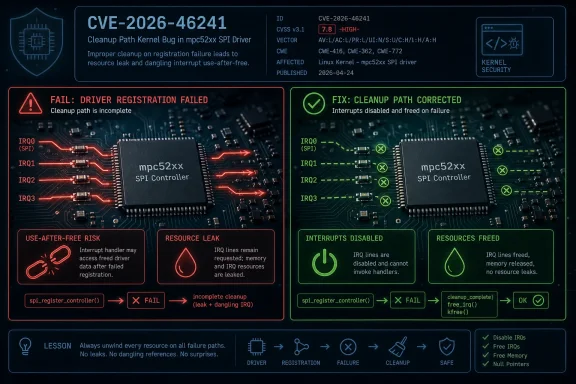
The description of CVE-2026-46241 is almost aggressively unglamorous. In the Linux kernel’s MPC52xx SPI controller driver, the fix makes sure interrupts are disabled and freed if controller registration fails. Without that cleanup, the system can retain references into driver state that should no longer be live.
That is the shape of a use-after-free: code continues to access memory after the object that owned it has been released. In many security advisories, that phrase is enough to summon worst-case assumptions about privilege escalation or arbitrary code execution. Here, the publicly available record is more cautious. NVD had not yet assigned a CVSS score at publication time, and the entry was marked as awaiting enrichment.
That lack of a score matters, but it should not be mistaken for lack of significance. CVSS often arrives after the initial kernel.org assignment, and kernel CVEs frequently begin life as terse summaries of merged fixes rather than polished vulnerability narratives. The responsible reading is that this is a real kernel memory-safety bug in a specific driver path, not that it is known to be broadly exploitable across commodity desktops and servers.
The affected code is tied to the MPC52xx SPI controller, part of a PowerPC-era embedded hardware family rather than something most Windows users will find in a laptop, workstation, or Azure VM. That hardware specificity narrows the blast radius. It also makes the vulnerability easy to ignore in exactly the places where it may matter most: industrial systems, long-lived embedded boards, niche appliances, lab hardware, and custom Linux images that do not track mainstream distribution patch cycles with much urgency.
The vulnerability involves an SPI controller driver for MPC52xx hardware. SPI is a low-level bus used to connect processors to peripherals such as flash chips, sensors, controllers, and other embedded components. It is essential in the systems that use it, but it is not a general-purpose attack surface in the way a network stack, filesystem parser, browser engine, or container runtime might be.
The bug is also in the registration failure path. That means the risky sequence appears when the driver is being initialized and controller registration fails, not during the ordinary happy path of every SPI transaction. Failure-path bugs are often hard to weaponize because they require a particular state transition, often at boot, probe, module load, hardware fault, or driver bind time.
That does not make them harmless. Kernel failure paths are privileged, timing-sensitive, and frequently under-tested. A driver that mishandles interrupts during error unwinding can leave behind precisely the sort of dangling state that later turns a recoverable initialization failure into memory corruption.
For mainstream WindowsForum readers running Windows 11, Windows Server, WSL, or Linux VMs on x86-64 machines, the direct exposure is likely low. The more realistic concern is indirect: Linux is everywhere around Windows. It is in network appliances, storage devices, management controllers, build systems, CI runners, edge gateways, and the embedded devices that administrators tend to remember only when they fail.
Interrupt handling is one of the places where kernel bugs become especially unforgiving. An interrupt can arrive asynchronously, outside the neat control flow that programmers prefer to reason about. If the handler points at freed driver data, the system has entered a zone where ordinary C memory safety rules offer no protection.
This is also why resource leaks and use-after-free flaws often appear together. A cleanup routine that fails to release everything can keep stale activity alive. A cleanup routine that releases memory before shutting down all users of that memory can create the opposite problem. The kernel has to get the order right: stop the external event source, unregister the handler, ensure no more callbacks can run, and only then release the state those callbacks might touch.
The CVE description says the issue was flagged by Sashiko while reviewing a controller deregistration fix. That is an important clue. This was not necessarily discovered because someone weaponized the bug in the field. It appears to have surfaced through review and tooling around a nearby lifecycle problem. In kernel security, that is exactly the kind of dull, persistent work that prevents obscure driver mistakes from becoming expensive incident reports later.
A CVSS score would not answer every practical question, but it would force some useful assumptions into the open. Is the attack local? Does exploitation require privileges? Is user interaction involved? Does the bug affect confidentiality, integrity, availability, or some combination of the three? Without an NVD vector, readers are left to infer from the patch language and affected subsystem.
That is where kernel CVEs can distort risk conversations. A use-after-free in a widely reachable subsystem may be urgent. A use-after-free in an obscure embedded controller driver may be routine maintenance. A use-after-free in a subsystem used by a cloud provider’s fleet may be quietly critical even if almost nobody outside that fleet has the hardware.
The right response is not to wait passively for a number. Administrators should treat the absence of a score as absence of standardized assessment, not absence of vulnerability. For this CVE, the practical triage begins with inventory: do you ship, operate, or depend on Linux kernels built for MPC52xx-class hardware with the affected SPI driver enabled?
For enterprise IT, that is the part that matters. Few organizations consume vanilla upstream kernels directly. They receive kernel code through Red Hat, SUSE, Canonical, Debian, Yocto layers, Buildroot trees, Android-derived vendor kernels, appliance vendors, or board support packages maintained by silicon and device manufacturers. By the time a fix reaches production, it may have passed through several hands.
That supply chain is strongest on mainstream server and desktop distributions. It is weaker in embedded Linux, where kernel trees are often forked, customized, pinned, and forgotten. A vulnerability like CVE-2026-46241 may be irrelevant to a fleet of Ubuntu servers and highly relevant to a forgotten industrial controller image built from an old long-term kernel with a vendor patch stack.
This is why the stable backport list is more useful than the CVE prose alone. It tells maintainers that upstream considered the fix appropriate for supported stable kernels. It also gives downstream vendors a concrete change to pick up, test, and ship. The vulnerability record may still be awaiting enrichment, but the remediation path is already visible.
That specificity is precisely why they accumulate. An organization may have a crisp patching process for Windows endpoints and cloud workloads while having almost no live inventory of embedded Linux devices. The same shop may know the build number of every Windows Server VM but not the kernel configuration of a storage appliance, serial gateway, lab instrument, power controller, or factory floor device.
CVE-2026-46241 is unlikely to be the vulnerability that changes that overnight. But it is a useful reminder that Linux kernel exposure is not limited to machines with SSH prompts and package managers. If a device boots Linux, contains hardware-specific drivers, and receives rare firmware updates, it belongs in the vulnerability management conversation.
The problem is not that every obscure driver bug is catastrophic. The problem is that organizations often cannot tell whether an obscure driver bug applies to them. That uncertainty turns narrow technical issues into operational noise, and enough noise eventually becomes risk.
Windows shops run Linux appliances for firewalls, VPNs, NAS devices, backup targets, monitoring probes, CI runners, Kubernetes nodes, edge gateways, and hypervisor-adjacent tooling. Developers run WSL locally and deploy into Linux containers. Administrators manage mixed fleets even when their official endpoint standard remains Windows. The practical boundary between “Windows security” and “Linux security” has been porous for years.
That does not mean CVE-2026-46241 threatens WSL users in any obvious way. WSL kernels on ordinary x86-64 Windows systems are not the natural habitat for an MPC52xx PowerPC SPI controller driver. The relevance is broader: the Windows estate is surrounded by Linux devices whose kernel update posture may be far less mature than Windows Update, WSUS, Intune, or enterprise patch orchestration.
Microsoft has spent years making Windows patching more centralized, more measurable, and more policy-driven. Embedded Linux has moved in the same direction in some sectors, especially where vendors support over-the-air updates and software bills of materials. But plenty of devices still live in the old world: manual firmware downloads, opaque release notes, no clear kernel version mapping, and no easy way to confirm whether a stable kernel fix has landed.
A local attacker with the ability to influence driver probing or hardware state might have a different opportunity than a remote attacker with no path to the device. A lab environment with hot-pluggable or reconfigurable hardware might differ from a sealed appliance. A debug-heavy kernel may behave differently from a production kernel with hardening features and different memory allocation patterns.
The better first question is whether the affected code exists in your environment. If it does not, the rest is academic. If it does, the next question is whether the fix is already in the vendor-supported kernel you run. Only then does it make sense to spend time on exploitability debates.
This is especially true for teams with constrained patch windows. A missing CVSS score can cause either overreaction or neglect. A disciplined inventory check avoids both. Patch when the vendor ships the fix, prioritize systems where the affected driver is present, and do not let a low-profile CVE become a reason to defer broader kernel maintenance.
It also creates a more honest record. Kernel bugs with memory-safety implications do not become less real because they are discovered in obscure drivers or failure paths. The old model often left downstream consumers guessing which stable fixes mattered for security. The newer model errs on the side of labeling more fixes as vulnerabilities.
The cost is triage fatigue. Security dashboards fill with kernel CVEs that have no obvious exploit, no NVD score, and no relevance to most systems. Teams that treat every kernel CVE as an emergency will burn out. Teams that ignore them all will eventually miss the one that matters.
CVE-2026-46241 is a good example of the middle category. It deserves tracking, patching through normal vendor channels, and attention from embedded maintainers. It does not, on the current public record, justify panic in ordinary Windows or x86 Linux environments.
That creates a mismatch between upstream security velocity and downstream operational reality. The kernel community can identify and fix a bug quickly. Stable maintainers can backport the patch. NVD can publish a CVE. None of that guarantees that a device in a rack, cabinet, vehicle, or plant floor will receive the update soon.
Administrators should therefore avoid treating vendor silence as proof of non-exposure. If a device vendor does not publish detailed advisories, customers may need to ask directly whether the product includes the affected driver or the relevant stable backport. In regulated or safety-sensitive settings, that question should be part of supplier management, not an afterthought.
The irony is that many embedded devices have small attack surfaces by design. They may not expose shells, package managers, or general-purpose user accounts. But they also tend to have weak transparency. When a kernel CVE appears, defenders may know less about a sealed appliance than they know about a public cloud VM.
That matters because human reviewers are bad at exhaustively modeling failure paths across thousands of drivers. Driver code often follows patterns: allocate resource, request interrupt, register controller, publish device, unwind in reverse order on failure. When one step is missing or out of order, the bug may be invisible in normal testing because normal testing rarely exercises every failed initialization branch.
Tools can be irritating, noisy, and wrong. The discussion around this patch even reflects the usual reality that a flagged issue can lead to follow-up clarification rather than instant certainty. But that is still progress. A false alarm in review is cheaper than a field failure in a kernel interrupt path.
The larger story is that security tooling is moving closer to the code paths developers have historically trusted least: cleanup, probe failure, teardown, and asynchronous callbacks. That is where many mature C codebases hide their most persistent bugs. CVE-2026-46241 is small, but it fits the pattern.
The picture changes if you maintain embedded Linux images, custom kernels, or hardware fleets with PowerPC-era components. In that case, CVE-2026-46241 should go into the normal kernel intake process. Check whether the
For appliance customers, the work is mostly vendor pressure. Ask for a statement of applicability. Ask for the fixed firmware version if applicable. Ask whether the product’s kernel lineage includes the stable backport. Those are mundane questions, but they are the difference between a CVE being “not applicable” and being merely “not understood.”
Security teams should also resist scanner absolutism. A scanner may flag the kernel version without knowing whether the vulnerable driver is configured, loaded, or reachable. Conversely, a scanner may miss a vendor fork that backported the fix without changing the version string. Kernel vulnerability management still requires human interpretation.
spi: mpc52xx controller path, where failed controller registration could leave interrupts active and create a possible use-after-free and resource leak. The flaw is not the kind of headline-grabbing remote-code-execution event that sends patch teams scrambling overnight. It is more revealing than that: a small driver bug, found during review of a related deregistration fix, that shows how much of modern kernel security depends on getting the boring failure paths right. For WindowsForum readers, the lesson is not “panic about PowerPC SPI,” but “watch the kernel supply chain beneath your appliances, hypervisors, lab boards, and embedded Linux estates.”
 The Kernel Bug That Lives in the Cleanup Path
The description of CVE-2026-46241 is almost aggressively unglamorous. In the Linux kernel’s MPC52xx SPI controller driver, the fix makes sure interrupts are disabled and freed if controller registration fails. Without that cleanup, the system can retain references into driver state that should no longer be live.That is the shape of a use-after-free: code continues to access memory after the object that owned it has been released. In many security advisories, that phrase is enough to summon worst-case assumptions about privilege escalation or arbitrary code execution. Here, the publicly available record is more cautious. NVD had not yet assigned a CVSS score at publication time, and the entry was marked as awaiting enrichment.
That lack of a score matters, but it should not be mistaken for lack of significance. CVSS often arrives after the initial kernel.org assignment, and kernel CVEs frequently begin life as terse summaries of merged fixes rather than polished vulnerability narratives. The responsible reading is that this is a real kernel memory-safety bug in a specific driver path, not that it is known to be broadly exploitable across commodity desktops and servers.
The affected code is tied to the MPC52xx SPI controller, part of a PowerPC-era embedded hardware family rather than something most Windows users will find in a laptop, workstation, or Azure VM. That hardware specificity narrows the blast radius. It also makes the vulnerability easy to ignore in exactly the places where it may matter most: industrial systems, long-lived embedded boards, niche appliances, lab hardware, and custom Linux images that do not track mainstream distribution patch cycles with much urgency.
This Is Not a Desktop Linux Fire Drill
The first filter for any kernel CVE is reachability. A Linux vulnerability can sound severe in isolation, but the actual risk depends on whether the affected code is present, compiled, loaded, mapped to real hardware, reachable by an attacker, and operating in a context where the bug can be triggered. CVE-2026-46241 sits several filters deep.The vulnerability involves an SPI controller driver for MPC52xx hardware. SPI is a low-level bus used to connect processors to peripherals such as flash chips, sensors, controllers, and other embedded components. It is essential in the systems that use it, but it is not a general-purpose attack surface in the way a network stack, filesystem parser, browser engine, or container runtime might be.
The bug is also in the registration failure path. That means the risky sequence appears when the driver is being initialized and controller registration fails, not during the ordinary happy path of every SPI transaction. Failure-path bugs are often hard to weaponize because they require a particular state transition, often at boot, probe, module load, hardware fault, or driver bind time.
That does not make them harmless. Kernel failure paths are privileged, timing-sensitive, and frequently under-tested. A driver that mishandles interrupts during error unwinding can leave behind precisely the sort of dangling state that later turns a recoverable initialization failure into memory corruption.
For mainstream WindowsForum readers running Windows 11, Windows Server, WSL, or Linux VMs on x86-64 machines, the direct exposure is likely low. The more realistic concern is indirect: Linux is everywhere around Windows. It is in network appliances, storage devices, management controllers, build systems, CI runners, edge gateways, and the embedded devices that administrators tend to remember only when they fail.
The Interesting Part Is the Interrupt, Not the Acronym
The wording of the fix tells us where the real engineering mistake lived. When controller registration fails, the driver must disable and free interrupts. If it does not, an interrupt handler may remain connected to state that the driver assumes has been torn down.Interrupt handling is one of the places where kernel bugs become especially unforgiving. An interrupt can arrive asynchronously, outside the neat control flow that programmers prefer to reason about. If the handler points at freed driver data, the system has entered a zone where ordinary C memory safety rules offer no protection.
This is also why resource leaks and use-after-free flaws often appear together. A cleanup routine that fails to release everything can keep stale activity alive. A cleanup routine that releases memory before shutting down all users of that memory can create the opposite problem. The kernel has to get the order right: stop the external event source, unregister the handler, ensure no more callbacks can run, and only then release the state those callbacks might touch.
The CVE description says the issue was flagged by Sashiko while reviewing a controller deregistration fix. That is an important clue. This was not necessarily discovered because someone weaponized the bug in the field. It appears to have surfaced through review and tooling around a nearby lifecycle problem. In kernel security, that is exactly the kind of dull, persistent work that prevents obscure driver mistakes from becoming expensive incident reports later.
NVD’s “Awaiting Enrichment” Is a Warning Label for Readers, Too
The NVD page for CVE-2026-46241 arrived with the now-familiar placeholder feel of many new kernel CVEs: a description, a source, references to stable commits, publication and modification dates, and no NVD-provided CVSS vector yet. That is not unusual. It is also not ideal for administrators who need to triage quickly.A CVSS score would not answer every practical question, but it would force some useful assumptions into the open. Is the attack local? Does exploitation require privileges? Is user interaction involved? Does the bug affect confidentiality, integrity, availability, or some combination of the three? Without an NVD vector, readers are left to infer from the patch language and affected subsystem.
That is where kernel CVEs can distort risk conversations. A use-after-free in a widely reachable subsystem may be urgent. A use-after-free in an obscure embedded controller driver may be routine maintenance. A use-after-free in a subsystem used by a cloud provider’s fleet may be quietly critical even if almost nobody outside that fleet has the hardware.
The right response is not to wait passively for a number. Administrators should treat the absence of a score as absence of standardized assessment, not absence of vulnerability. For this CVE, the practical triage begins with inventory: do you ship, operate, or depend on Linux kernels built for MPC52xx-class hardware with the affected SPI driver enabled?
The Stable Backports Tell the Real Operational Story
The references attached to CVE-2026-46241 point to multiple stable kernel commits. That means the fix was not merely accepted in an upstream development branch and left for future kernels. It was backported across maintained stable lines, which is how most real systems receive kernel security fixes.For enterprise IT, that is the part that matters. Few organizations consume vanilla upstream kernels directly. They receive kernel code through Red Hat, SUSE, Canonical, Debian, Yocto layers, Buildroot trees, Android-derived vendor kernels, appliance vendors, or board support packages maintained by silicon and device manufacturers. By the time a fix reaches production, it may have passed through several hands.
That supply chain is strongest on mainstream server and desktop distributions. It is weaker in embedded Linux, where kernel trees are often forked, customized, pinned, and forgotten. A vulnerability like CVE-2026-46241 may be irrelevant to a fleet of Ubuntu servers and highly relevant to a forgotten industrial controller image built from an old long-term kernel with a vendor patch stack.
This is why the stable backport list is more useful than the CVE prose alone. It tells maintainers that upstream considered the fix appropriate for supported stable kernels. It also gives downstream vendors a concrete change to pick up, test, and ship. The vulnerability record may still be awaiting enrichment, but the remediation path is already visible.
Small Drivers Make Large Estates Untidy
Security coverage tends to favor the glamorous layers of the stack: browsers, identity systems, cloud APIs, VPN gateways, and remote management tools. Kernel driver fixes like this one sit at the other end of the spectrum. They are specific, quiet, and often hardware-bound.That specificity is precisely why they accumulate. An organization may have a crisp patching process for Windows endpoints and cloud workloads while having almost no live inventory of embedded Linux devices. The same shop may know the build number of every Windows Server VM but not the kernel configuration of a storage appliance, serial gateway, lab instrument, power controller, or factory floor device.
CVE-2026-46241 is unlikely to be the vulnerability that changes that overnight. But it is a useful reminder that Linux kernel exposure is not limited to machines with SSH prompts and package managers. If a device boots Linux, contains hardware-specific drivers, and receives rare firmware updates, it belongs in the vulnerability management conversation.
The problem is not that every obscure driver bug is catastrophic. The problem is that organizations often cannot tell whether an obscure driver bug applies to them. That uncertainty turns narrow technical issues into operational noise, and enough noise eventually becomes risk.
The Windows Angle Is the Infrastructure Around Windows
A Linux SPI driver bug may look out of place on a Windows-focused site. It is not. Windows environments increasingly depend on Linux in ways that are easy to forget until a security advisory makes the dependency visible.Windows shops run Linux appliances for firewalls, VPNs, NAS devices, backup targets, monitoring probes, CI runners, Kubernetes nodes, edge gateways, and hypervisor-adjacent tooling. Developers run WSL locally and deploy into Linux containers. Administrators manage mixed fleets even when their official endpoint standard remains Windows. The practical boundary between “Windows security” and “Linux security” has been porous for years.
That does not mean CVE-2026-46241 threatens WSL users in any obvious way. WSL kernels on ordinary x86-64 Windows systems are not the natural habitat for an MPC52xx PowerPC SPI controller driver. The relevance is broader: the Windows estate is surrounded by Linux devices whose kernel update posture may be far less mature than Windows Update, WSUS, Intune, or enterprise patch orchestration.
Microsoft has spent years making Windows patching more centralized, more measurable, and more policy-driven. Embedded Linux has moved in the same direction in some sectors, especially where vendors support over-the-air updates and software bills of materials. But plenty of devices still live in the old world: manual firmware downloads, opaque release notes, no clear kernel version mapping, and no easy way to confirm whether a stable kernel fix has landed.
Exploitability Is the Wrong First Question
The natural security reflex is to ask whether CVE-2026-46241 is exploitable. That is understandable, but it can be a trap. For a bug like this, exploitability is not a single property; it is a function of hardware, kernel configuration, driver load path, attacker position, timing, and the behavior of the surrounding system when registration fails.A local attacker with the ability to influence driver probing or hardware state might have a different opportunity than a remote attacker with no path to the device. A lab environment with hot-pluggable or reconfigurable hardware might differ from a sealed appliance. A debug-heavy kernel may behave differently from a production kernel with hardening features and different memory allocation patterns.
The better first question is whether the affected code exists in your environment. If it does not, the rest is academic. If it does, the next question is whether the fix is already in the vendor-supported kernel you run. Only then does it make sense to spend time on exploitability debates.
This is especially true for teams with constrained patch windows. A missing CVSS score can cause either overreaction or neglect. A disciplined inventory check avoids both. Patch when the vendor ships the fix, prioritize systems where the affected driver is present, and do not let a low-profile CVE become a reason to defer broader kernel maintenance.
The Kernel CVE Machine Is Producing More Noise—and More Truth
The Linux kernel’s CVE process has changed the texture of vulnerability reporting. More bug fixes are being assigned CVEs, including fixes that would once have appeared only as terse commit messages in stable updates. That creates noise for administrators, security scanners, and compliance teams.It also creates a more honest record. Kernel bugs with memory-safety implications do not become less real because they are discovered in obscure drivers or failure paths. The old model often left downstream consumers guessing which stable fixes mattered for security. The newer model errs on the side of labeling more fixes as vulnerabilities.
The cost is triage fatigue. Security dashboards fill with kernel CVEs that have no obvious exploit, no NVD score, and no relevance to most systems. Teams that treat every kernel CVE as an emergency will burn out. Teams that ignore them all will eventually miss the one that matters.
CVE-2026-46241 is a good example of the middle category. It deserves tracking, patching through normal vendor channels, and attention from embedded maintainers. It does not, on the current public record, justify panic in ordinary Windows or x86 Linux environments.
Embedded Linux Remains the Patch Management Blind Spot
The systems most likely to care about an MPC52xx SPI controller are not always the systems with the cleanest update story. PowerPC embedded platforms have long service lives. Industrial and specialized devices can remain deployed for a decade or more. Kernel upgrades in those environments may require vendor validation, field certification, or physical access.That creates a mismatch between upstream security velocity and downstream operational reality. The kernel community can identify and fix a bug quickly. Stable maintainers can backport the patch. NVD can publish a CVE. None of that guarantees that a device in a rack, cabinet, vehicle, or plant floor will receive the update soon.
Administrators should therefore avoid treating vendor silence as proof of non-exposure. If a device vendor does not publish detailed advisories, customers may need to ask directly whether the product includes the affected driver or the relevant stable backport. In regulated or safety-sensitive settings, that question should be part of supplier management, not an afterthought.
The irony is that many embedded devices have small attack surfaces by design. They may not expose shells, package managers, or general-purpose user accounts. But they also tend to have weak transparency. When a kernel CVE appears, defenders may know less about a sealed appliance than they know about a public cloud VM.
Sashiko’s Role Shows Where Security Work Is Going
The CVE description says the issue was flagged by Sashiko while reviewing a controller deregistration fix. Even without turning that into a grand claim about automation, the signal is clear: kernel security increasingly benefits from tools and review systems that reason about lifetimes, cleanup ordering, and error paths.That matters because human reviewers are bad at exhaustively modeling failure paths across thousands of drivers. Driver code often follows patterns: allocate resource, request interrupt, register controller, publish device, unwind in reverse order on failure. When one step is missing or out of order, the bug may be invisible in normal testing because normal testing rarely exercises every failed initialization branch.
Tools can be irritating, noisy, and wrong. The discussion around this patch even reflects the usual reality that a flagged issue can lead to follow-up clarification rather than instant certainty. But that is still progress. A false alarm in review is cheaper than a field failure in a kernel interrupt path.
The larger story is that security tooling is moving closer to the code paths developers have historically trusted least: cleanup, probe failure, teardown, and asynchronous callbacks. That is where many mature C codebases hide their most persistent bugs. CVE-2026-46241 is small, but it fits the pattern.
The Practical Reading for Patch Teams
The immediate action for most WindowsForum readers is not dramatic. If you manage ordinary Windows endpoints, there is no evidence that this CVE changes your patch priority. If you manage mainstream Linux servers on x86-64, your distribution’s kernel advisories and package updates remain the authoritative path.The picture changes if you maintain embedded Linux images, custom kernels, or hardware fleets with PowerPC-era components. In that case, CVE-2026-46241 should go into the normal kernel intake process. Check whether the
mpc52xx SPI driver is enabled, whether the hardware exists in deployed systems, and whether your kernel tree contains the referenced fix or an equivalent backport.For appliance customers, the work is mostly vendor pressure. Ask for a statement of applicability. Ask for the fixed firmware version if applicable. Ask whether the product’s kernel lineage includes the stable backport. Those are mundane questions, but they are the difference between a CVE being “not applicable” and being merely “not understood.”
Security teams should also resist scanner absolutism. A scanner may flag the kernel version without knowing whether the vulnerable driver is configured, loaded, or reachable. Conversely, a scanner may miss a vendor fork that backported the fix without changing the version string. Kernel vulnerability management still requires human interpretation.
The Lesson Hidden in a PowerPC SPI Driver
CVE-2026-46241 is a narrow bug, but it teaches a broad operational lesson.- The vulnerability concerns a Linux kernel MPC52xx SPI controller failure path, not a general Windows desktop or Windows Server attack surface.
- The public record describes a possible use-after-free and resource leak when controller registration fails and interrupts are not properly disabled and freed.
- NVD published the entry on May 28, 2026, but had not yet provided CVSS scoring at the time reflected in the record.
- The practical exposure is most relevant to embedded Linux, custom kernels, appliance firmware, and hardware fleets that may include MPC52xx-class platforms.
- Administrators should prioritize vendor kernel updates and applicability checks over speculation about exploitability.
- The case is another reminder that kernel security often turns on teardown ordering, not just flashy bugs in network-facing code.
References
- Primary source: NVD / Linux Kernel
Published: 2026-05-29T01:07:42-07:00
NVD - CVE-2026-46241
 nvd.nist.gov
- Security advisory: MSRC
Published: 2026-05-29T01:07:42-07:00
Original feed URL
Security Update Guide - Microsoft Security Response Center
 msrc.microsoft.com
- Related coverage: cvefeed.io
CVE-2026-46241 - spi: mpc52xx: fix use-after-free on registration failure
In the Linux kernel, the following vulnerability has been resolved: spi: mpc52xx: fix use-after-free on registration failure Make sure to disable and free the interrupts in case controller registration fails to avoid a potential use-after-free and resource leak. This issue was flagged by Sashiko...cvefeed.io - Related coverage: spinics.net

Re: [PATCH] spi: mpc52xx: fix use-after-free on registration failure — Linux Kernel
Linux Kernel: Re: [PATCH] spi: mpc52xx: fix use-after-free on registration failure
www.spinics.net
