

A Small Driver Bug Exposes a Big Kernel Habit
CVE-2026-46219 lives in the SPI subsystem, not in a browser sandbox, authentication stack, VPN appliance, or Windows kernel component. That matters. The affected code is for the MPC52xx SPI controller, a Freescale/NXP-era embedded platform driver that most consumer PCs will never load and most cloud servers will never ship.
But small driver bugs have a way of revealing the kernel’s least glamorous attack surface. The Linux kernel is not merely a scheduler and a network stack; it is a vast collection of device-specific assumptions, many of them written for hardware families that remain in service far longer than their marketing brochures. A flaw in a controller driver may be irrelevant to a laptop and still matter deeply to a railway cabinet, factory gateway, lab instrument, or custom appliance image.
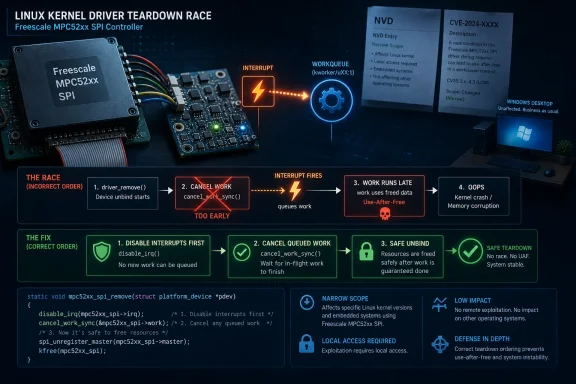
The reported fix is deceptively simple. The driver’s interrupt handler can schedule state-machine work, and that work must not survive past the point where the driver’s private state is being torn down. The patch moves cancellation of that work until after the relevant interrupts are freed, closing a race in which an interrupt could queue work after the driver thought it had already drained it.
That is the whole story technically, and it is also not the whole story operationally. Kernel vulnerabilities often look trivial once reduced to a three-line diff. The danger is in the timing window, the hardware configuration, and the assumption that cleanup paths are boring.
The Vulnerability Is in the Goodbye, Not the Hello
Use-after-free bugs are often described as if they happen during active data processing: malformed packets, hostile files, or clever syscall abuse. CVE-2026-46219 is different in tone. It sits in the unbind path, the part of driver life where the system is removing or detaching a device and trying to put everything away in the right order.
That lifecycle matters because device removal is not a single action. A driver may unregister from a subsystem, release IRQs, cancel deferred work, drop GPIO descriptors, and free memory owned by its controller state. If any deferred task still holds a pointer into that state after it has been freed, the kernel has a classic use-after-free hazard.
The key sentence in the CVE description is that the state machine work is scheduled by the interrupt handler. If interrupts remain live while work cancellation has already run, the driver can lose the race against its own hardware. It cancels the workqueue item, then an interrupt arrives and schedules it again, and later cleanup proceeds as though the problem has been drained.
The patch therefore changes ordering, not architecture. Free the IRQs first, preventing fresh scheduling from the interrupt handler, then cancel the work. This is the kind of fix that reads obvious in retrospect and is easy to miss during review because both operations were already present. They were simply in the wrong order.
Why “Awaiting Enrichment” Should Not Be Read as “Awaiting Importance”
NVD currently marks the record as awaiting enrichment, with no NVD-provided CVSS 4.0, CVSS 3.x, or CVSS 2.0 score. That absence will tempt scanners and dashboards to treat the issue as ambiguous noise until a number appears. In practice, the lack of a score says more about the processing pipeline than about whether the bug exists.
Kernel.org has already supplied the substance: the Linux kernel vulnerability has been resolved, and stable-tree references are available. NVD’s enrichment process may later attach a severity vector, weakness classification, and affected-version metadata. Until then, administrators are left with a familiar Linux kernel reality: the fix is real before the vulnerability database has finished making it legible to compliance tooling.
This is a recurring problem for infrastructure teams. Vulnerability management systems want normalized metadata, but kernel maintenance often moves through mailing lists, Git commits, stable backports, and distribution advisories before centralized databases settle down. The operational question is not “what is the badge color today?” but “does any supported system in my estate build or load this driver?”
For many WindowsForum readers, the answer will be no. For anyone maintaining embedded Linux devices, custom PowerPC boards, industrial controllers, or long-lived vendor appliances, the answer deserves verification rather than assumption.
The MPC52xx Clue Narrows the Blast Radius
The affected driver name is the most important scoping fact. MPC52xx refers to a family of Freescale PowerPC-based embedded processors, and the SPI controller driver is not a general-purpose SPI flaw across every Linux machine. SPI itself is common, but this particular bug is in the MPC52xx non-PSC SPI controller implementation.
That distinction matters because vulnerability headlines often flatten subsystem bugs into platform-wide fear. “Linux kernel SPI use-after-free” sounds broad. “MPC52xx SPI controller unbind race” is narrower, stranger, and more actionable.
A typical Windows workstation running WSL, a standard x86 Linux server, or a virtual machine in a hyperscale cloud is unlikely to expose this driver. Even many Linux systems with SPI hardware will use different controller drivers entirely. The affected configuration requires the relevant kernel code and hardware context, or at least a build where the module can be loaded in a meaningful way.
The more plausible exposure is in embedded products where kernel configurations are vendor-supplied and rarely scrutinized by end customers. That includes routers, control systems, test equipment, edge gateways, and specialty devices whose update cadence is governed less by upstream Linux than by hardware vendors and certification cycles.
Exploitability Is Probably Narrow, but Race Bugs Punish Certainty
There is no public NVD severity score yet, and the provided description does not claim known active exploitation. The bug is framed as a potential use-after-free during unbind, which generally implies that an attacker needs some way to trigger driver removal, device teardown, or a related lifecycle transition. On many locked-down embedded systems, ordinary users may not have that ability.
That said, “local-only” or “requires device unbind” should not be mistaken for harmless. Modern systems expose driver binding controls through sysfs, module unload paths, hotplug mechanisms, container-host boundaries, privileged service helpers, and vendor maintenance tools. A vulnerability that is unreachable in one deployment may be reachable in another because an automation daemon, diagnostic interface, or poorly constrained admin panel does the attacker’s work.
Use-after-free conditions also vary widely in consequence. Some collapse into a crash. Some become memory corruption primitives. Some are theoretically exploitable but practically brittle because timing, heap layout, and hardware interrupts must align. Without a published exploit or deeper analysis, the honest position is that CVE-2026-46219 appears narrowly scoped but should not be waved away on the basis of its simplicity.
The security value of the fix is that it removes uncertainty from a teardown path. The operational value is that administrators do not need to prove exploitability before accepting a small stable kernel patch that corrects the lifecycle ordering.
The Patch Tells a Cleaner Story Than the CVE Record
The upstream mailing-list patch is concise: the driver unregisters the SPI controller, frees its IRQs, then cancels pending work. Before the change, the cancellation happened before the IRQs were freed. That old order created the possibility that an interrupt handler could schedule the same work after cancellation had already completed.
This is a classic kernel concurrency lesson. When one execution context can enqueue work and another context is trying to drain it, the enqueue path must be stopped first. Otherwise, “cancel” only means there was no work queued at that instant, not that no work can appear a moment later.
The fix also references an earlier change that added cancel_work_sync before module removal. That earlier fix was in the right neighborhood but did not fully close the race. This is common in driver hardening: the first patch acknowledges that work must be drained, and the second patch notices that the producer must be shut down before the drain is meaningful.
For IT teams, that history matters because it reminds us not to overread patch names. A driver can already contain a function named like a safety belt and still have the belt fastened in the wrong sequence. Kernel reliability is often an argument about ordering, not feature presence.
Windows Shops Still Need to Care About Linux Driver CVEs
A Windows-focused audience might reasonably ask why this belongs in the same feed as Patch Tuesday, BitLocker changes, Copilot policy, and Microsoft 365 incidents. The answer is that Windows environments are no longer Windows-only environments, even when Active Directory, Intune, and Defender define the management plane.
Linux kernels run in NAS devices, backup appliances, hypervisor hosts, security cameras, Kubernetes nodes, firewalls, print infrastructure, out-of-band management devices, developer boards, and vendor-supplied virtual appliances. Many of those systems authenticate against Microsoft identity, sit on Windows-administered networks, or provide services consumed by Windows clients. The blast radius of a Linux kernel flaw is therefore not limited by the desktop operating system on an employee’s desk.
This particular CVE will not be relevant to most of that estate. But the workflow is relevant. A mature Windows shop should be able to answer whether it has embedded Linux systems, whether those systems receive vendor kernel updates, and whether vulnerability intake covers kernel.org CVEs that may not arrive through Microsoft’s advisory channels.
The friction is cultural as much as technical. Windows administrators are used to named cumulative updates and vendor-owned servicing stacks. Embedded Linux often arrives as firmware, board-support packages, or opaque appliance updates. CVE-2026-46219 is a reminder that even when the vulnerable code is narrow, the discovery process has to be broad.
The Real Risk Is the Device You Forgot Was a Computer
The MPC52xx family points toward old-fashioned embedded computing, the kind that does not show up in asset inventories as “Linux server.” That is where narrow kernel CVEs become annoying. The affected device may be a controller with a web UI, a sensor gateway with SSH disabled, or a vendor appliance whose operating system version is hidden behind a product firmware number.
Security teams are much better at inventorying laptops and cloud instances than they are at inventorying Linux-capable embedded boards. The reason is not negligence; it is that enterprise tooling was built around endpoints, servers, and SaaS identities. A surprising number of specialized devices do not run an endpoint agent, do not expose a standard package database, and do not map neatly to CVE scanners unless the scanner already knows the product firmware.
That does not mean every shop should start hunting for MPC52xx boards by hand. It means the CVE should trigger a targeted question: do we own or operate any systems based on Freescale/NXP MPC52xx-class hardware, or any vendor products that disclose this SPI controller driver in their software bill of materials?
If the answer is unknown, that is the finding. Not the CVE itself, but the inability to decide relevance without a vendor ticket or physical inventory check.
NVD Lag Makes Upstream Literacy a Security Skill
The CVE record’s “awaiting enrichment” status is not unusual, but it is increasingly awkward. Kernel.org, stable maintainers, distribution maintainers, NVD, commercial scanners, and appliance vendors all operate on different clocks. The result is a period where the fix exists, the CVE exists, but the machine-readable risk picture remains incomplete.
For sysadmins, the gap creates two bad incentives. One is to ignore the issue until a CVSS score arrives. The other is to treat every unscored kernel CVE as emergency work. Neither scales.
The better habit is upstream literacy. Read the subsystem. Read the affected driver. Read the patch shape. Ask whether the code is built, loaded, and reachable. In this case, the words “mpc52xx,” “SPI,” “unbind,” and “interrupt handler” are more useful than a provisional score would be.
That does not make scoring irrelevant. CVSS helps prioritize at scale, especially in large estates with thousands of findings. But for kernel driver CVEs, the first pass should be architectural scoping, not dashboard obedience.
Distribution Backports Will Decide What Most Users Actually See
Upstream Linux fixes are only the beginning. Most administrators do not deploy raw kernel.org stable trees; they consume kernels from Debian, Ubuntu, Red Hat, SUSE, Arch, Fedora, Android vendors, appliance manufacturers, or board-support-package maintainers. Whether CVE-2026-46219 appears as a named advisory, a quiet stable backport, or a vendor firmware update will depend on that downstream path.
For mainstream x86 distributions, the fix may be present in a kernel update even if no one in the organization has affected hardware. That is fine. Kernel packages carry many driver fixes that are irrelevant to a particular machine but valuable to the distribution’s supported hardware matrix.
For embedded systems, the calculus is different. Vendors may freeze kernels for years, backport selectively, or bundle security patches into infrequent firmware releases. If the affected driver is actually used, the question becomes whether the vendor tracks stable kernel fixes and whether the product is still inside its support window.
There is also a configuration dimension. A kernel may compile the driver built-in, compile it as a module, or omit it entirely. Vulnerability scanners that do not understand kernel configuration may overreport, while asset systems that do not inspect firmware may underreport. The truth lives in the build, not just the version string.
The Fix Is Small Enough That Delay Needs a Reason
When a vulnerability fix is large, administrators sometimes have a legitimate stability debate. Does the patch touch a core subsystem? Does it risk regressions in storage, networking, or boot? Does it demand a major kernel jump? CVE-2026-46219 does not appear to fit that pattern.
The change is narrow and localized to the MPC52xx SPI driver’s remove path. It does not redesign SPI, change user-facing APIs, or alter broad scheduling behavior. For systems that actually use the driver, applying the relevant stable update is the ordinary low-drama answer.
The bigger challenge is reboot policy. Kernel updates still require planning in environments that cannot tolerate downtime, and embedded devices may require maintenance windows, physical access, or vendor approval. A narrow fix can still be operationally expensive when the device sits in a plant, clinic, vehicle, or remote cabinet.
That is why scoping should come before alarm. If the driver is not present, no action beyond routine kernel updates may be needed. If it is present and reachable, the smallness of the patch argues against prolonged deferral.
This Is the Kind of CVE That Tests Patch Discipline, Not Incident Response
Nobody should treat CVE-2026-46219 like a wormable remote exploit. The facts available point to a specific driver, a specific teardown race, and no published NVD severity at the time of the record’s initial enrichment phase. The practical response is asset identification, vendor tracking, and kernel update hygiene.
That makes it less exciting than the vulnerabilities that dominate security headlines, but not less useful as a test case. Good patch programs are not only built for spectacular failures. They are built for the steady stream of narrow, real, low-visibility fixes that prevent tomorrow’s exploit chain from finding an old foothold.
For Windows-centric administrators, the most important move is to widen the mental map. The Linux systems in your environment may not be servers with names and owners. They may be appliances purchased by another department, lab gear attached to a Windows workstation, or edge devices installed by a vendor whose maintenance portal has not been checked in months.
The boring CVEs are where asset management either proves itself or quietly fails.
The Practical Reading of CVE-2026-46219
This vulnerability is best understood as a lifecycle-ordering bug in a specialized Linux driver, not as a broad SPI catastrophe. The patch prevents a workqueue item from being scheduled by an interrupt handler after the driver has already attempted to cancel it during unbind.
- Most Windows desktops, standard x86 Linux servers, and cloud VMs are unlikely to be affected because they do not use the Freescale MPC52xx SPI controller driver.
- Embedded Linux devices, vendor appliances, and long-lived industrial systems deserve closer review if they use MPC52xx-class hardware or ship kernels with the relevant driver enabled.
- The absence of an NVD CVSS score at publication time should not be treated as proof of low impact; it mainly means enrichment has not caught up with the upstream fix.
- The most important mitigation is to take the relevant stable kernel or vendor firmware update once it is available for affected products.
- Security teams should ask vendors whether their firmware includes the MPC52xx SPI driver and whether the upstream fix has been backported.
- If the driver is not built, not loaded, and not present on the platform, this CVE is likely a routine tracking item rather than an emergency.
CVE-2026-46219 will probably disappear into the long tail of kernel maintenance, which is exactly where many important fixes belong. Its value is as a reminder that modern infrastructure depends on old drivers, deferred work, and teardown paths that only become visible when something goes wrong. The organizations that handle this well will not be the ones that panic at every unscored CVE; they will be the ones that know which kernels they run, which hardware those kernels serve, and how quickly a three-line upstream fix can become a trusted update in the field.
References
- CVE-2026-46219 spi: mpc52xx: fix use-after-free on unbind NVD / Linux Kernel · 2026-05-29T01:01:29-07:00