

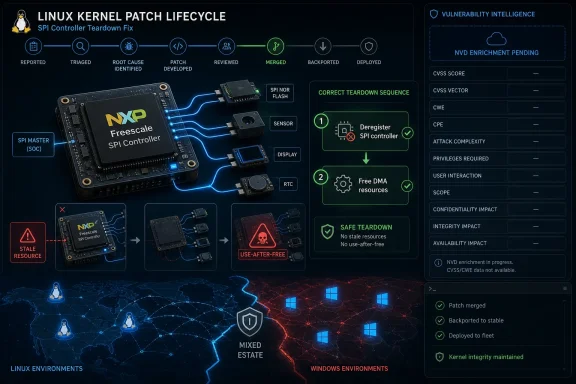
A Small Driver Bug Lands in a Very Large Supply Chain
At first glance, CVE-2026-46226 looks like the sort of kernel entry that only a board-support-package maintainer could love. It concerns the spi-fsl driver, part of the Linux kernel’s support for Freescale/NXP-style Serial Peripheral Interface controllers. The stated fix is procedural rather than dramatic: deregister the SPI controller before releasing resources underneath it during driver unbind.
But kernel lifecycle bugs rarely deserve to be dismissed simply because their descriptions are short. The ordering of registration, deregistration, DMA teardown, interrupt handling, and device removal is exactly where use-after-free bugs, stale references, and hard-to-reproduce crashes tend to hide. The kernel is not just a program; it is the part of the system that arbitrates whether every other program gets to pretend the hardware is sane.
The practical question is not whether every WindowsForum reader has an affected Freescale SPI controller under their desk. Most do not. The better question is whether your organization runs Linux anywhere close to hardware: embedded gateways, industrial controllers, NAS appliances, ARM development boards, hypervisor hosts, storage gear, or vendor-supplied appliances that quietly ship a Linux kernel inside a product that otherwise presents itself as a black box.
That is where a modest SPI fix becomes operationally relevant. The vulnerability may never matter to a Windows 11 laptop. It may matter quite a bit to the firmware image running on the device that feeds telemetry into a Windows management console, bridges a factory network, or sits in a server room because procurement treated it as “an appliance,” not as a Linux system.
The Bug Is About Teardown, Not Initial Compromise
The terse kernel.org description says the driver must deregister the controller before releasing underlying resources like DMA during driver unbind. That tells us a great deal, even without a polished vulnerability write-up. This is not being described as a remote network exploit, a cryptographic bypass, or a flaw in user authentication. It is a lifetime-management bug in a hardware driver.
Driver unbind paths are the exit ramps of kernel code. They run when a driver is being detached from a device, when a module is unloaded, when hardware disappears, during error handling, or as part of certain reconfiguration flows. These paths are often less exercised than probe paths, but they still need to be correct because other parts of the kernel may hold references into the object being torn down.
The danger is the classic order-of-operations problem. If the SPI controller remains registered while the driver has already released DMA resources, another code path may still believe the controller is usable. That gap can lead to use-after-free behavior, unclocked register access, crashes, or undefined behavior depending on timing and hardware.
That does not automatically make CVE-2026-46226 exploitable in the way headline security bugs are exploitable. The available public description does not establish a privilege-escalation path, a remote trigger, or a reliable attack primitive. But it does put the bug in a class that security teams cannot simply ignore, because memory-lifetime errors in kernel space have a long history of turning from “stability issue” into “security issue” once researchers understand the reachable states.
NVD’s Blank Severity Field Is a Signal, Not a Verdict
The NVD entry is currently marked as awaiting enrichment. That means NIST has not yet added its own CVSS 4.0, CVSS 3.x, CVSS 2.0, or CWE assessment. In earlier years, many security programs treated an NVD score as the starting gun for action. In 2026, that habit is increasingly brittle.
NVD has been dealing with a volume problem, and its own public communications this year have emphasized prioritization and selective enrichment. The result is that CVE publication and CVE enrichment are no longer the same event. A vulnerability can be public, patched upstream, and relevant to your environment while still looking strangely empty in NVD.
CVE-2026-46226 is a textbook example of that gap. The kernel has a fix. The record has references to stable kernel commits. The description identifies the faulty lifecycle ordering. What it does not yet have is the convenient metadata that vulnerability-management dashboards love: a severity score, a CWE category, and a clean product matrix.
For IT teams, the absence of a score should not be interpreted as low risk. It should be interpreted as not yet classified by NVD. Those are very different things. One is a technical conclusion; the other is a workflow state.
The Kernel CVE Pipeline Has Become Faster Than the Scoring Pipeline
Linux kernel CVEs now often surface as patch-linked records whose descriptions closely mirror commit messages. That is good for transparency and poor for anyone expecting a fully narrated advisory on day one. The upstream kernel process is optimized around code review, regression risk, maintainership, and backporting; enterprise vulnerability management is optimized around asset matching, severity scoring, and remediation deadlines.
Those two worlds overlap, but they do not move at the same speed. A kernel maintainer can fix a bug with a concise patch because the relevant audience understands the subsystem and the lifecycle model. A security operations team, by contrast, wants to know whether the flaw is remotely reachable, whether it affects default configurations, whether a local user can trigger it, and whether exploit code exists.
CVE-2026-46226 arrives closer to the kernel-maintainer end of that spectrum. The most concrete information is in the fix itself: during driver unbind, deregister the controller before releasing DMA and similar resources. That is enough for distribution maintainers and kernel integrators to pick up the patch. It is not enough for a compliance team to write a neat risk exception without doing additional analysis.
This is becoming the normal shape of Linux vulnerability intake. The CVE ID is not the finish line of analysis. It is the handle by which the rest of the ecosystem starts connecting upstream commits, distribution advisories, vendor firmware updates, and customer exposure.
Windows Shops Still Own Linux Risk
For a Windows-centric audience, the temptation is to file this under “not our platform.” That is increasingly a bad inventory habit. Many Windows environments are not Windows-only environments; they are Windows-administered environments with Linux substrates scattered through virtualization, networking, storage, DevOps, and embedded operations.
The obvious Linux touchpoints include WSL images, developer workstations, Hyper-V guests, Kubernetes nodes, and cloud Linux virtual machines. CVE-2026-46226 is unlikely to be most relevant in those general-purpose environments unless the affected driver and hardware path are present. The less obvious touchpoints may matter more: ARM boards, industrial systems, edge gateways, point-of-sale devices, out-of-band management appliances, and vendor hardware that ships with customized kernels.
That is why driver CVEs are inventory tests. They force administrators to ask not merely “do we run Linux?” but “which kernels do we run, which drivers are compiled in, which hardware is present, and who owns the patch path?” In a mature environment, those questions have answers. In many real environments, they expose a spreadsheet, a procurement portal, and a vendor support ticket.
The Windows angle is therefore not that CVE-2026-46226 threatens Windows directly. It is that Windows administrators often inherit responsibility for mixed estates where Linux is embedded, abstracted, or outsourced. A bug in a Linux SPI controller driver may sit far from Active Directory, yet still affect the operational technology or infrastructure stack that Windows admins are expected to keep alive.
Hardware-Specific Does Not Mean Harmless
Security teams often triage hardware-specific kernel bugs downward because the affected code path appears narrow. That can be reasonable, but it can also become a blind spot. Narrow exposure is not the same as no exposure, especially in embedded environments where the hardware profile is fixed and the vulnerable driver may be present across an entire product line.
The spi-fsl driver is not a fashionable attack surface in the way browsers, VPN appliances, or file-sharing services are. SPI itself is a low-level bus used for communication with peripherals. The risk sits closer to device control and kernel stability than to internet-facing exploitation. That lowers the likelihood of broad opportunistic attacks, but it does not eliminate the need to patch where the driver is in use.
The bigger concern is that embedded Linux devices often lag behind upstream stable kernels. A fix can exist in the kernel tree while customers wait weeks or months for it to appear in a vendor firmware package. Some devices never receive regular updates at all. In those cases, the exposure question becomes less about whether upstream Linux is fixed and more about whether your actual deployed appliance will ever consume the fix.
This is especially important for organizations with industrial, lab, or edge deployments. Those environments frequently contain hardware that is expensive, specialized, and difficult to reboot. Patching is not just a technical act; it is a maintenance window, a vendor relationship, and sometimes a physical-site operation. That reality is why even a modest kernel CVE can deserve early attention.
The Patch Teaches the Risk Model
The fix attached to CVE-2026-46226 is valuable because it reveals the failure mode. Deregistration must happen before the driver releases resources beneath the controller. That means the old ordering allowed the kernel to maintain a public-facing registration state longer than the backing resources safely allowed.
In kernel terms, that is not cosmetic. Registration makes an object discoverable and callable by other parts of the system. Releasing DMA or other resources first can leave a registered controller pointing into a partially dismantled driver. If another path tries to use it during that window, the kernel may reach into freed or invalid state.
The security implications depend on reachability. Can an unprivileged user trigger driver unbind? Usually not directly in hardened systems. Can privileged local users, hotplug events, module unloads, test frameworks, or error paths trigger the vulnerable path? Potentially, depending on configuration. Can a malicious peripheral or physical attacker influence timing? That is a more specialized question, but not absurd in embedded and lab contexts.
The right stance is disciplined uncertainty. The public record does not justify panic. It also does not justify pretending the flaw is meaningless because it lacks a score. Kernel resource lifetime bugs are exactly the kind of issue where exploitability can be highly configuration-specific.
Stable Backports Matter More Than Mainline Bragging Rights
The CVE record lists multiple stable kernel commit references, which suggests the fix has been carried into more than one maintained kernel line. That is the practical detail administrators should care about. Very few production environments run Linus Torvalds’ latest mainline tree. Most run distribution kernels, vendor kernels, or long-term-support branches with backported security fixes.
For Linux servers, that means the relevant question is not “what upstream version first fixed this?” but “has my distribution shipped the backport?” For embedded systems, it is even more indirect: “has my device vendor rebuilt and released firmware that includes the relevant kernel stable fix?” For appliances, it may be more painful still: “does the vendor acknowledge the CVE at all?”
This is where vulnerability scanners can mislead. A scanner that relies on version strings may flag a kernel as vulnerable even when a distribution has backported the patch without changing the upstream version number. Conversely, a device may claim a newer vendor build while still carrying an old custom driver tree. Kernel patch management has always punished shallow version matching.
The better workflow is evidence-based. Map the affected driver to actual assets. Check whether the driver is present and used. Track distribution advisories or vendor firmware notes. If necessary, compare the applied patch content rather than relying solely on a banner version. That is dull work, but it is the difference between real risk management and dashboard theater.
The Embedded Vendor Problem Is the Enterprise Problem
The enterprise security industry likes to talk about software bills of materials, but CVE-2026-46226 illustrates why kernel bills of materials are harder than application dependency lists. A Linux kernel is not a tidy library import. It is a configuration-specific artifact: drivers enabled or disabled, vendor patches applied, stable backports selected, board files or device trees included, and hardware-specific code paths exercised only on certain platforms.
Embedded vendors often fork kernels, carry board-support patches, and ship firmware images on long maintenance cycles. That creates a lag between upstream remediation and customer protection. Even when the vendor is responsible and responsive, the customer may still need to schedule downtime, validate compatibility, and coordinate field updates.
For regulated environments, that lag becomes a governance issue. A CVE without an NVD score may not automatically trigger the same service-level agreements as a high-severity scored vulnerability. But if the affected device performs a safety, monitoring, access-control, or industrial function, waiting for enrichment may be the wrong policy.
This is the uncomfortable truth for Windows-heavy enterprises: Linux risk often enters through procurement rather than server administration. The Linux kernel may be inside the camera, the storage head, the badge reader, the lab instrument, or the edge gateway. The patch process then depends less on your Linux team’s competence than on whether your vendor treats kernel maintenance as a first-class product obligation.
CVE Inflation Makes Context More Valuable, Not Less
The flood of kernel CVEs has created fatigue. Security teams are seeing more identifiers, more terse descriptions, more vendor advisories, and more records whose metadata is incomplete at publication. It is tempting to respond by ignoring anything that lacks a high score or a catchy exploit name.
That would be a mistake. The correct response to CVE volume is not apathy; it is sharper context. A kernel driver bug in unused hardware support should not receive the same urgency as an exploited privilege escalation in a default subsystem. But the only way to know which is which is to have enough asset intelligence to separate theoretical exposure from deployed exposure.
CVE-2026-46226 sits in the middle of that tension. It is not the kind of bug that should send every Windows administrator sprinting toward emergency change control. It is also not just trivia. It is a newly published kernel vulnerability, tied to stable fixes, in a driver family relevant to particular hardware ecosystems.
The security value comes from classification. If your environment does not use affected Freescale/NXP SPI controller hardware and does not ship products based on it, document that and move on. If your environment does, this becomes a patch-tracking item. If you do not know, the CVE has already done you a favor by revealing an inventory gap.
For WSL and Cloud Linux, the Risk Is Mostly Elsewhere
Some Windows users will naturally ask whether WSL is affected. Based on the public description, this does not look like a WSL-first concern. WSL environments do not generally expose arbitrary physical SPI controller drivers in the same way a native embedded Linux system does. The issue is tied to a specific kernel hardware driver and driver unbind behavior, not to the Linux userland tools most Windows developers run inside WSL.
Cloud Linux instances are similar. Unless the kernel build and virtual hardware expose this driver path, the practical exposure is likely low. Most cloud guests do not present Freescale SPI controller hardware to tenants. The more relevant Linux systems are those close to physical hardware, especially ARM and embedded deployments.
That distinction matters because overbroad vulnerability response wastes credibility. If every kernel CVE becomes a universal emergency, teams stop listening. CVE-2026-46226 should be routed toward the people who manage kernels on hardware platforms, vendor firmware, and embedded fleets—not blasted as a generic endpoint crisis.
Still, WSL and cloud teams should not ignore the broader lesson. Kernel CVEs increasingly arrive before clean scoring, and platform-specific exposure analysis is becoming part of routine operations. Even when this particular SPI flaw is not your problem, the process gap it exposes probably is.
The Useful Response Is Boring, Which Is Why It Works
The correct response to CVE-2026-46226 is not dramatic. It is to identify whether affected code is present, determine whether the relevant driver is used, track fixed kernel branches or vendor advisories, and update through normal tested channels. That sounds mundane because good infrastructure security often is.
Administrators should resist two opposite errors. The first is panic, driven by the mere existence of a CVE in the Linux kernel. The second is complacency, driven by the lack of an NVD score. Both outsource judgment to incomplete signals.
The practical middle ground is to treat this as a hardware-scoped kernel maintenance item. For general-purpose Windows desktops, it is almost certainly background noise. For embedded Linux estates, device vendors, and organizations with Freescale/NXP-based systems, it belongs in the patch queue and vendor follow-up process.
Security teams should also capture the timing. The CVE was published on May 28, 2026, and was still awaiting NVD enrichment at publication time. If an internal tool shows “unknown severity,” that is not a reason to close the ticket. It is a reason to add local exposure notes until authoritative scoring or vendor guidance arrives.
The Real Lesson Is Hidden in the Deregistration Order
CVE-2026-46226’s most important facts are concrete, even if the severity remains unsettled.
- The vulnerability is a Linux kernel flaw in the Freescale SPI controller driver, fixed by changing the order of controller deregistration during driver unbind.
- The public NVD record was published on May 28, 2026, but NIST had not yet supplied CVSS scores or CWE enrichment at the time of publication.
- The available description points to a kernel resource-lifetime problem rather than a broad remote-execution scenario.
- Windows desktops and WSL environments are unlikely to be the primary exposure path unless an unusual hardware and kernel configuration brings the affected driver into play.
- Embedded Linux systems, vendor appliances, and hardware-close deployments deserve the closest review because they are more likely to use specialized SPI controller drivers.
- The safest operational move is to track distribution or vendor kernel updates rather than waiting for NVD metadata to make the risk feel official.
The kernel bug itself may turn out to be narrow, but the pattern is broad. Modern vulnerability management is moving into a world where upstream fixes, CVE publication, NVD enrichment, distribution backports, and vendor firmware updates no longer arrive as a single tidy package. The teams that handle CVE-2026-46226 well will not be the ones with the loudest scanner alert; they will be the ones that can connect a terse upstream patch to real hardware, real products, and a real maintenance plan before the next quiet driver bug appears.
References
- CVE-2026-46226 spi: fsl: fix controller deregistration NVD / Linux Kernel · 2026-05-29T01:04:34-07:00