

CVE-2026-46200 is a Linux kernel vulnerability published by NVD on May 28, 2026, covering a teardown-ordering bug in the Freescale MPC52xx SPI controller driver where the controller could remain registered while interrupts and GPIO resources were already being disabled or released. That sounds obscure because it is obscure, at least for the average Windows desktop user. But the record is a useful reminder of how modern vulnerability tracking increasingly turns small kernel lifetime bugs into public CVEs before NVD has even assigned a score. For administrators, embedded vendors, and anyone maintaining Linux-backed infrastructure alongside Windows fleets, the practical lesson is not panic; it is patch discipline.
The vulnerability sits in
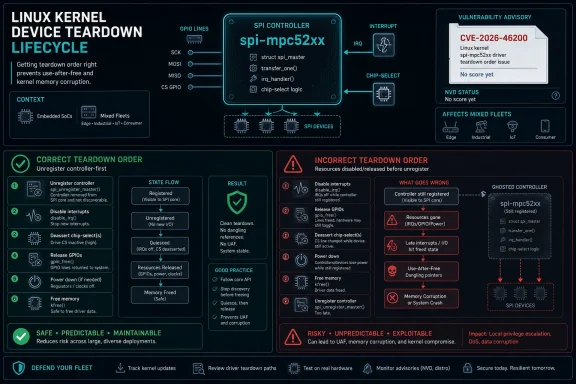
That distinction matters. CVE-2026-46200 is about lifetime management, not a glamorous remote-code-execution chain. The fix makes sure the SPI controller is deregistered before interrupts and GPIOs are disabled or released during driver unbind. In kernel terms, the order of operations is the security boundary: first tell the rest of the kernel that the device is gone, then tear down the resources that made the device work.
NVD’s page is still marked as awaiting enrichment, with no CVSS v4.0, v3.x, or v2.0 score from NIST at the time of publication. That is not unusual for newly issued kernel CVEs, especially ones flowing from kernel.org’s CNA process. The CVE exists because a bug class was fixed and assigned a tracking number; the risk judgment comes later, and in some cases never tells the whole story.
For WindowsForum readers, the immediate question is obvious: why should a Windows community care about a PowerPC-era Linux SPI driver? The answer is that Windows shops rarely run only Windows anymore. Linux appears in hypervisors, appliances, storage boxes, routers, Kubernetes nodes, CI systems, embedded controllers, and vendor-managed “black boxes” sitting inside otherwise Microsoft-heavy environments.
The patch series that surfaced this issue described a broader cleanup across multiple SPI drivers. The concern was that several drivers could get teardown ordering wrong when explicitly deregistering controllers. The failure modes listed around the series were the classic symptoms of resource lifetime mistakes: unclocked accesses, null-pointer dereferences, hangs, failed I/O during deregistration, and related crashes while devices are being powered down or removed.
The MPC52xx-specific CVE record narrows that down to one concrete ordering fix. During driver unbind, the controller must be unregistered before interrupts and GPIOs are disabled and released. If the old order allowed the controller to remain known to the SPI core while its interrupt lines or chip-select GPIOs were already gone, then later code could interact with a partially destroyed object.
That is exactly the sort of bug that looks minor in a patch diff and serious in a field failure. A server does not need to be “owned” for a kernel panic to become a business incident. An industrial device does not need a public exploit module for an unreliable unbind path to matter during update, hotplug, shutdown, or recovery workflows.
This is also why CVE severity scores can be misleading in both directions. A low or absent score does not mean “ignore forever,” and a CVE label does not mean “drop everything.” It means the bug has entered the vulnerability-management bloodstream, and organizations need to decide whether the affected code is present in their own systems.
That narrow hardware target is the central reason this CVE should not be treated like a broad Linux desktop emergency. If your exposure inventory is mostly Windows clients, Azure services, Microsoft 365, and commodity x86 Linux servers, the odds that CVE-2026-46200 is directly relevant are low. The driver name itself is the first triage clue:
But narrow does not mean irrelevant. Embedded systems are exactly where old kernels, custom board support packages, and delayed vendor updates tend to accumulate. A vulnerability that seems academic on a workstation can be operationally relevant in a manufacturing line, lab instrument, network appliance, or vendor-supplied Linux controller that nobody has logged into since installation.
The irony is familiar to anyone who manages mixed estates. The systems least likely to appear in glossy security dashboards are often the ones with the longest maintenance tail. The question is not whether CVE-2026-46200 affects “Linux” in the abstract. The question is whether your organization has Linux images containing the MPC52xx SPI driver in products that can unbind or remove the controller under real operating conditions.
CVE-2026-46200 is a clean example of the new normal. The record was received from kernel.org, NVD listed the description and stable references, and enrichment lagged behind the publication. There is no NVD score yet, no CWE classification yet, and no vendor-specific advisory language to tell a sysadmin whether to panic, patch, or file it away. The vulnerability record is real, but the context is incomplete.
That puts more interpretive burden on defenders. A CVE feed entry is no longer a finished risk assessment; it is often the beginning of one. Security teams must map the affected code to actual deployed kernels, architectures, modules, and vendor firmware. This is especially true for hardware-specific Linux drivers, where the presence of the source file in the upstream tree does not mean the driver is compiled, shipped, loaded, or reachable.
There is an upside. Public CVEs for small kernel fixes make it easier for downstream vendors to track what they have or have not backported. They also help regulated organizations prove that a bug was considered, even if the final answer is “not applicable.” The cost is that vulnerability scanners may light up before the ecosystem has supplied enough metadata to rank the issue sensibly.
CVE-2026-46200 violates that expectation by implication. If a driver disables interrupts and releases GPIOs before unregistering the controller, the SPI core and related device paths may still see an object that no longer has the hardware scaffolding it needs. In benign cases, that could simply fail an operation. In worse cases, it can become a crash, hang, or use-after-resource condition.
This is not exotic kernel theory. The same class of mistake appears across operating systems and driver models: remove the back-end first, forget to withdraw the front-end, and eventually someone walks through a door that no longer has a floor behind it. Windows driver developers know the shape of this problem even if the APIs differ. Device teardown is where concurrency, callbacks, interrupts, and reference counts all meet, and the wrong order can turn rare timing into production failure.
The SPI patch series around this issue also shows that maintainers were not chasing a single typo. They were auditing a pattern across several drivers. That is usually a sign that a bug fix has matured into a design lesson: the API contract was understood in one place, violated in another, and then checked across similar code.
Could this be locally triggered? Possibly, depending on whether an attacker or unprivileged user can cause module removal, device unbind, power transitions, or other teardown paths on an affected system. In many hardened environments, those operations are privileged. In embedded environments, they may only occur during update, boot, shutdown, or fault recovery. In a lab or developer system, they may be easier to exercise.
Could it be remotely exploitable? Nothing in the public description supports treating it as a remote network vulnerability. The bug concerns driver unbind and resource release. Unless a particular product exposes a remote management path that can trigger the relevant teardown sequence, remote exploitation is not the natural reading.
Could it still matter for availability? Yes. Kernel crashes, hangs, and failed I/O during deregistration are operational security issues, especially in systems expected to run unattended. Availability is one of the three legs of security, even when confidentiality and privilege escalation are not obviously in play.
The right posture is therefore measured. Do not inflate the bug into a universal Linux crisis. Do not dismiss it merely because the driver is obscure. Treat it as a hardware-specific kernel maintenance item that deserves attention wherever MPC52xx-based Linux systems remain in service.
A Windows estate often depends on Linux at the edges. Hyperconverged appliances, backup repositories, NAS devices, firewalls, load balancers, badge systems, OT gateways, build servers, and monitoring probes may all run Linux. Some are administered directly; others are wrapped in a vendor UI that hides the operating system until an advisory lands.
That hidden Linux layer changes how CVE-2026-46200 should be read. The most likely directly affected systems are not general-purpose Windows endpoints. They are specialized devices that may sit adjacent to Windows infrastructure, authenticate with Active Directory, collect logs from Windows hosts, store backups of Windows servers, or bridge industrial systems into enterprise networks.
The risk is not that your Windows 11 laptop secretly uses an MPC52xx SPI controller. It does not. The risk is that asset management built around familiar Windows categories misses the small Linux computers that make the environment work. Those devices may have slower patch cycles, weaker inventory coverage, and less transparent vendor communication.
That is where a minor kernel CVE earns its keep. It forces an uncomfortable but productive question: do you actually know which kernels and board support packages your non-Windows infrastructure is running?
Most organizations should not manually cherry-pick this patch into production kernels. If you are running an enterprise distribution, wait for the vendor kernel package unless you maintain your own kernel tree. If you are running embedded Linux, check whether your board support package pulls from a stable branch that contains the fix. If you are using a vendor appliance, ask the vendor whether the affected driver is present and whether the fix is included in the next firmware update.
The stable-tree model matters because kernel fixes are rarely consumed directly from upstream by ordinary users. Red Hat, SUSE, Canonical, Debian, Yocto-based vendors, Android-derived trees, and industrial suppliers all have their own packaging and backport logic. A CVE may be fixed upstream while remaining absent from a shipping product, or irrelevant to a product that never enabled the driver.
This is why version-number absolutism can mislead. A newer upstream kernel line may contain the fix, but an older enterprise kernel may also be patched through a backport while retaining an older visible version. Conversely, a vendor firmware image may advertise a kernel series that sounds fixed but omit a specific stable backport. The only reliable answer is the vendor’s changelog, package metadata, or source tree.
On conventional Linux hosts, administrators can inspect kernel configuration files, module directories, and loaded modules. On embedded products, the answer may require a vendor SBOM, firmware manifest, build configuration, or support case. On appliances, customers may not have shell access at all, which makes vendor disclosure and lifecycle support more important.
For Windows-heavy teams, this is a chance to test cross-platform vulnerability workflows without the pressure of a headline-grabbing exploit. Can the security team identify Linux-based appliances? Can procurement name the vendors responsible for firmware? Can operations determine whether those devices are still supported? Can patch exceptions distinguish “not affected” from “unknown”?
Too many vulnerability programs collapse those categories into a single unresolved bucket. CVE-2026-46200 deserves better than that. “Not affected because the driver is not built” is a useful conclusion. “Affected and awaiting vendor firmware” is a useful conclusion. “Unknown because nobody owns the appliance” is not a conclusion; it is a governance bug.
CVE-2026-46200 is not likely to cause a boardroom-level scramble. But it belongs to a class of flaws that embedded vendors often accumulate: resource leaks, use-after-free opportunities, teardown races, suspend/resume bugs, and shutdown crashes. These defects may not produce spectacular exploits, yet they erode reliability and complicate secure update mechanisms.
That last point is easy to overlook. A driver bug in an unbind or removal path may be most visible during maintenance—the very moment when a system is trying to update, restart, or recover. If a device hangs during shutdown or fails I/O while powering down peripherals, administrators experience it as a reliability problem. Security teams experience it as an unpatched asset that is harder to bring forward.
The kernel community’s willingness to assign CVEs to these fixes makes the maintenance gap more visible. That visibility will annoy teams that equate CVE counts with vendor negligence. It should instead push buyers to ask better questions about update cadence, upstream tracking, and how quickly suppliers consume stable-tree fixes.
WSL itself is not the issue in CVE-2026-46200; Windows Subsystem for Linux on ordinary PCs does not make an MPC52xx SPI controller appear out of thin air. Nor is Hyper-V directly implicated. But the administrative culture around Windows increasingly intersects with Linux in places where the abstraction leaks. Containers run on Linux nodes. Appliances export SMB shares to Windows clients. Backup products protect Windows workloads from Linux-based storage. Monitoring tools straddle both.
That means Windows administrators need enough Linux literacy to triage—not necessarily to debug the driver, but to ask whether the driver exists in the estate. The same is true in reverse for Linux administrators responsible for Active Directory integration, Windows file services, or Microsoft cloud connectors. Platform boundaries are operational conveniences, not security boundaries.
CVE-2026-46200 is therefore a small story with a large shadow. It shows how a hardware-specific kernel cleanup can still matter to an organization whose official desktop standard is Windows. The dependency graph does not care what the endpoint standard says.
If you are responsible for mixed Windows and Linux infrastructure, treat this CVE as a small drill in kernel-aware asset management. It is an opportunity to separate machines that are plainly unaffected from devices that need vendor confirmation. It is also a reminder that low-level buses and board files can be part of your security exposure even when nobody has typed
 A Tiny Driver Bug Becomes a Public Security Object
The vulnerability sits in spi-mpc52xx, a Linux driver for the MPC52xx family’s SPI controller. SPI, or Serial Peripheral Interface, is the kind of low-level bus most users never think about, but operating systems depend on it to talk to flash chips, sensors, controllers, and board-specific hardware. In this case, the problem is not that a network attacker can send a magic packet and seize a machine. It is that the driver’s removal path could dismantle the hardware resources underneath a still-registered controller.That distinction matters. CVE-2026-46200 is about lifetime management, not a glamorous remote-code-execution chain. The fix makes sure the SPI controller is deregistered before interrupts and GPIOs are disabled or released during driver unbind. In kernel terms, the order of operations is the security boundary: first tell the rest of the kernel that the device is gone, then tear down the resources that made the device work.
NVD’s page is still marked as awaiting enrichment, with no CVSS v4.0, v3.x, or v2.0 score from NIST at the time of publication. That is not unusual for newly issued kernel CVEs, especially ones flowing from kernel.org’s CNA process. The CVE exists because a bug class was fixed and assigned a tracking number; the risk judgment comes later, and in some cases never tells the whole story.
For WindowsForum readers, the immediate question is obvious: why should a Windows community care about a PowerPC-era Linux SPI driver? The answer is that Windows shops rarely run only Windows anymore. Linux appears in hypervisors, appliances, storage boxes, routers, Kubernetes nodes, CI systems, embedded controllers, and vendor-managed “black boxes” sitting inside otherwise Microsoft-heavy environments.
The Security Story Is the Removal Path, Not the Exploit Demo
Kernel bugs often get discussed as though they begin with an exploit and end with a shell. CVE-2026-46200 is the opposite kind of case. It begins with a boring driver lifecycle rule: do not leave an object visible to the kernel after the resources behind it have been pulled away.The patch series that surfaced this issue described a broader cleanup across multiple SPI drivers. The concern was that several drivers could get teardown ordering wrong when explicitly deregistering controllers. The failure modes listed around the series were the classic symptoms of resource lifetime mistakes: unclocked accesses, null-pointer dereferences, hangs, failed I/O during deregistration, and related crashes while devices are being powered down or removed.
The MPC52xx-specific CVE record narrows that down to one concrete ordering fix. During driver unbind, the controller must be unregistered before interrupts and GPIOs are disabled and released. If the old order allowed the controller to remain known to the SPI core while its interrupt lines or chip-select GPIOs were already gone, then later code could interact with a partially destroyed object.
That is exactly the sort of bug that looks minor in a patch diff and serious in a field failure. A server does not need to be “owned” for a kernel panic to become a business incident. An industrial device does not need a public exploit module for an unreliable unbind path to matter during update, hotplug, shutdown, or recovery workflows.
This is also why CVE severity scores can be misleading in both directions. A low or absent score does not mean “ignore forever,” and a CVE label does not mean “drop everything.” It means the bug has entered the vulnerability-management bloodstream, and organizations need to decide whether the affected code is present in their own systems.
The Affected Hardware Narrows the Blast Radius
The MPC52xx family is not lurking in the average Windows 11 laptop. It is associated with Freescale/NXP embedded PowerPC-era systems, the sort of hardware that shows up in industrial, networking, automotive, control, and long-lived embedded deployments rather than consumer PCs. The Linux kernel configuration option for this driver is highly specific, and many mainstream distributions on x86-64 will not build or load it in ordinary use.That narrow hardware target is the central reason this CVE should not be treated like a broad Linux desktop emergency. If your exposure inventory is mostly Windows clients, Azure services, Microsoft 365, and commodity x86 Linux servers, the odds that CVE-2026-46200 is directly relevant are low. The driver name itself is the first triage clue:
mpc52xx is not generic SPI support; it is a specific controller family.But narrow does not mean irrelevant. Embedded systems are exactly where old kernels, custom board support packages, and delayed vendor updates tend to accumulate. A vulnerability that seems academic on a workstation can be operationally relevant in a manufacturing line, lab instrument, network appliance, or vendor-supplied Linux controller that nobody has logged into since installation.
The irony is familiar to anyone who manages mixed estates. The systems least likely to appear in glossy security dashboards are often the ones with the longest maintenance tail. The question is not whether CVE-2026-46200 affects “Linux” in the abstract. The question is whether your organization has Linux images containing the MPC52xx SPI driver in products that can unbind or remove the controller under real operating conditions.
Kernel.org’s CVE Pipeline Changes the Noise Floor
The Linux kernel becoming its own CVE Numbering Authority changed how many kernel fixes appear in vulnerability feeds. Bugs that once looked like ordinary stable-tree maintenance now arrive with CVE identifiers attached. That is good for traceability, but it also raises the noise floor for security teams.CVE-2026-46200 is a clean example of the new normal. The record was received from kernel.org, NVD listed the description and stable references, and enrichment lagged behind the publication. There is no NVD score yet, no CWE classification yet, and no vendor-specific advisory language to tell a sysadmin whether to panic, patch, or file it away. The vulnerability record is real, but the context is incomplete.
That puts more interpretive burden on defenders. A CVE feed entry is no longer a finished risk assessment; it is often the beginning of one. Security teams must map the affected code to actual deployed kernels, architectures, modules, and vendor firmware. This is especially true for hardware-specific Linux drivers, where the presence of the source file in the upstream tree does not mean the driver is compiled, shipped, loaded, or reachable.
There is an upside. Public CVEs for small kernel fixes make it easier for downstream vendors to track what they have or have not backported. They also help regulated organizations prove that a bug was considered, even if the final answer is “not applicable.” The cost is that vulnerability scanners may light up before the ecosystem has supplied enough metadata to rank the issue sensibly.
The Patch Is Really About Trusting the Kernel’s Object Model
The Linux driver model assumes that registration and deregistration are meaningful boundaries. Register a controller, and other kernel subsystems may discover it, bind devices to it, schedule work against it, or assume that callbacks and resources exist. Unregister it, and the kernel begins the process of making sure nobody should still be using it.CVE-2026-46200 violates that expectation by implication. If a driver disables interrupts and releases GPIOs before unregistering the controller, the SPI core and related device paths may still see an object that no longer has the hardware scaffolding it needs. In benign cases, that could simply fail an operation. In worse cases, it can become a crash, hang, or use-after-resource condition.
This is not exotic kernel theory. The same class of mistake appears across operating systems and driver models: remove the back-end first, forget to withdraw the front-end, and eventually someone walks through a door that no longer has a floor behind it. Windows driver developers know the shape of this problem even if the APIs differ. Device teardown is where concurrency, callbacks, interrupts, and reference counts all meet, and the wrong order can turn rare timing into production failure.
The SPI patch series around this issue also shows that maintainers were not chasing a single typo. They were auditing a pattern across several drivers. That is usually a sign that a bug fix has matured into a design lesson: the API contract was understood in one place, violated in another, and then checked across similar code.
The Absence of a Score Is Not the Absence of Risk
NVD’s missing CVSS score will tempt some dashboards to treat CVE-2026-46200 as a gray blob. That is understandable, but it is not ideal. CVSS is useful when the affected product, attack vector, privileges, user interaction, scope, and impact are clear. For kernel driver teardown bugs in specialized hardware, those variables can depend heavily on deployment.Could this be locally triggered? Possibly, depending on whether an attacker or unprivileged user can cause module removal, device unbind, power transitions, or other teardown paths on an affected system. In many hardened environments, those operations are privileged. In embedded environments, they may only occur during update, boot, shutdown, or fault recovery. In a lab or developer system, they may be easier to exercise.
Could it be remotely exploitable? Nothing in the public description supports treating it as a remote network vulnerability. The bug concerns driver unbind and resource release. Unless a particular product exposes a remote management path that can trigger the relevant teardown sequence, remote exploitation is not the natural reading.
Could it still matter for availability? Yes. Kernel crashes, hangs, and failed I/O during deregistration are operational security issues, especially in systems expected to run unattended. Availability is one of the three legs of security, even when confidentiality and privilege escalation are not obviously in play.
The right posture is therefore measured. Do not inflate the bug into a universal Linux crisis. Do not dismiss it merely because the driver is obscure. Treat it as a hardware-specific kernel maintenance item that deserves attention wherever MPC52xx-based Linux systems remain in service.
Windows Shops Still Own Linux Risk
WindowsForum’s audience knows Patch Tuesday, Defender signatures, Group Policy, Intune rings, and the strange art of explaining reboot windows to impatient users. Linux kernel CVEs can feel like someone else’s weather. In modern enterprise IT, that attitude is increasingly untenable.A Windows estate often depends on Linux at the edges. Hyperconverged appliances, backup repositories, NAS devices, firewalls, load balancers, badge systems, OT gateways, build servers, and monitoring probes may all run Linux. Some are administered directly; others are wrapped in a vendor UI that hides the operating system until an advisory lands.
That hidden Linux layer changes how CVE-2026-46200 should be read. The most likely directly affected systems are not general-purpose Windows endpoints. They are specialized devices that may sit adjacent to Windows infrastructure, authenticate with Active Directory, collect logs from Windows hosts, store backups of Windows servers, or bridge industrial systems into enterprise networks.
The risk is not that your Windows 11 laptop secretly uses an MPC52xx SPI controller. It does not. The risk is that asset management built around familiar Windows categories misses the small Linux computers that make the environment work. Those devices may have slower patch cycles, weaker inventory coverage, and less transparent vendor communication.
That is where a minor kernel CVE earns its keep. It forces an uncomfortable but productive question: do you actually know which kernels and board support packages your non-Windows infrastructure is running?
Stable Backports Are the Signal to Watch
The CVE record lists multiple stable kernel references, which means the fix is not merely an upstream development-tree cleanup. It has been routed through stable maintenance paths for affected branches. For administrators, that is the practical trigger: watch your distribution or device vendor for kernel updates incorporating the relevant stable commit.Most organizations should not manually cherry-pick this patch into production kernels. If you are running an enterprise distribution, wait for the vendor kernel package unless you maintain your own kernel tree. If you are running embedded Linux, check whether your board support package pulls from a stable branch that contains the fix. If you are using a vendor appliance, ask the vendor whether the affected driver is present and whether the fix is included in the next firmware update.
The stable-tree model matters because kernel fixes are rarely consumed directly from upstream by ordinary users. Red Hat, SUSE, Canonical, Debian, Yocto-based vendors, Android-derived trees, and industrial suppliers all have their own packaging and backport logic. A CVE may be fixed upstream while remaining absent from a shipping product, or irrelevant to a product that never enabled the driver.
This is why version-number absolutism can mislead. A newer upstream kernel line may contain the fix, but an older enterprise kernel may also be patched through a backport while retaining an older visible version. Conversely, a vendor firmware image may advertise a kernel series that sounds fixed but omit a specific stable backport. The only reliable answer is the vendor’s changelog, package metadata, or source tree.
The Real Test Is Inventory, Not Alarm
The useful response to CVE-2026-46200 begins with inventory. Do you have systems using the Freescale/NXP MPC52xx family? Do your Linux kernels buildCONFIG_SPI_MPC52xx? Is the driver present as a module? Is it loaded? Is the affected hardware reachable in production? Those are boring questions, and they are the only ones that matter.On conventional Linux hosts, administrators can inspect kernel configuration files, module directories, and loaded modules. On embedded products, the answer may require a vendor SBOM, firmware manifest, build configuration, or support case. On appliances, customers may not have shell access at all, which makes vendor disclosure and lifecycle support more important.
For Windows-heavy teams, this is a chance to test cross-platform vulnerability workflows without the pressure of a headline-grabbing exploit. Can the security team identify Linux-based appliances? Can procurement name the vendors responsible for firmware? Can operations determine whether those devices are still supported? Can patch exceptions distinguish “not affected” from “unknown”?
Too many vulnerability programs collapse those categories into a single unresolved bucket. CVE-2026-46200 deserves better than that. “Not affected because the driver is not built” is a useful conclusion. “Affected and awaiting vendor firmware” is a useful conclusion. “Unknown because nobody owns the appliance” is not a conclusion; it is a governance bug.
The Patch Also Exposes an Embedded Maintenance Problem
Embedded Linux has always lived in tension with upstream Linux. Upstream moves fast, stable trees carry fixes, and product vendors freeze kernels for certification, driver compatibility, or simple economics. The result is that small bugs can survive in deployed products long after the kernel community has fixed them.CVE-2026-46200 is not likely to cause a boardroom-level scramble. But it belongs to a class of flaws that embedded vendors often accumulate: resource leaks, use-after-free opportunities, teardown races, suspend/resume bugs, and shutdown crashes. These defects may not produce spectacular exploits, yet they erode reliability and complicate secure update mechanisms.
That last point is easy to overlook. A driver bug in an unbind or removal path may be most visible during maintenance—the very moment when a system is trying to update, restart, or recover. If a device hangs during shutdown or fails I/O while powering down peripherals, administrators experience it as a reliability problem. Security teams experience it as an unpatched asset that is harder to bring forward.
The kernel community’s willingness to assign CVEs to these fixes makes the maintenance gap more visible. That visibility will annoy teams that equate CVE counts with vendor negligence. It should instead push buyers to ask better questions about update cadence, upstream tracking, and how quickly suppliers consume stable-tree fixes.
Microsoft’s World Is Full of Non-Microsoft Dependencies
There is a broader platform lesson here. Microsoft has spent years pushing customers toward cloud identity, hybrid management, virtualization, containers, WSL, Azure Arc, and heterogeneous operations. The practical effect is that Windows expertise now sits inside a larger systems stack. Linux kernel security is no longer a niche concern for “the Linux people.”WSL itself is not the issue in CVE-2026-46200; Windows Subsystem for Linux on ordinary PCs does not make an MPC52xx SPI controller appear out of thin air. Nor is Hyper-V directly implicated. But the administrative culture around Windows increasingly intersects with Linux in places where the abstraction leaks. Containers run on Linux nodes. Appliances export SMB shares to Windows clients. Backup products protect Windows workloads from Linux-based storage. Monitoring tools straddle both.
That means Windows administrators need enough Linux literacy to triage—not necessarily to debug the driver, but to ask whether the driver exists in the estate. The same is true in reverse for Linux administrators responsible for Active Directory integration, Windows file services, or Microsoft cloud connectors. Platform boundaries are operational conveniences, not security boundaries.
CVE-2026-46200 is therefore a small story with a large shadow. It shows how a hardware-specific kernel cleanup can still matter to an organization whose official desktop standard is Windows. The dependency graph does not care what the endpoint standard says.
Where the Practical Advice Lands
The most important thing about CVE-2026-46200 is that it should produce calm, targeted action rather than generalized alert fatigue. The affected area is specific, the public description is narrow, and NVD has not yet supplied severity enrichment. But the fix is real, the bug class is familiar, and organizations with embedded Linux should not ignore it.If you are responsible for mixed Windows and Linux infrastructure, treat this CVE as a small drill in kernel-aware asset management. It is an opportunity to separate machines that are plainly unaffected from devices that need vendor confirmation. It is also a reminder that low-level buses and board files can be part of your security exposure even when nobody has typed
ssh into the device for years.The MPC52xx Fix Leaves a Clear Paper Trail
The concrete action items are not dramatic, but they are specific enough to be useful.- Administrators should first determine whether any deployed systems use MPC52xx-class hardware or ship a kernel with the
spi-mpc52xxdriver enabled. - Security teams should avoid assigning emergency priority solely because the issue has a CVE, since the public record currently lacks an NVD severity score and points to a specialized driver-unbind path.
- Embedded and appliance owners should ask vendors whether their firmware includes the stable kernel fix, especially if the product uses older PowerPC-era board support packages.
- Linux maintainers carrying custom kernels should verify that the controller deregistration fix has been applied or backported to their relevant branches.
- Windows-focused IT teams should use this case to improve inventory coverage for Linux-based appliances, storage systems, industrial gateways, and other infrastructure that supports Windows operations.
- Risk registers should distinguish clearly between systems confirmed unaffected, systems confirmed fixed, systems awaiting vendor updates, and systems whose kernel contents are still unknown.
References
- Primary source: NVD / Linux Kernel
Published: 2026-05-29T01:01:53-07:00
NVD - CVE-2026-46200
 nvd.nist.gov
- Security advisory: MSRC
Published: 2026-05-29T01:01:53-07:00
Original feed URL
Security Update Guide - Microsoft Security Response Center
 msrc.microsoft.com
- Related coverage: spinics.net
[PATCH 0/8] spi: fix explicit controller deregistration — Linux SPI
Linux SPI: [PATCH 0/8] spi: fix explicit controller deregistrationwww.spinics.net - Related coverage: cvefeed.io
CVE-2026-46241 - spi: mpc52xx: fix use-after-free on registration failure
In the Linux kernel, the following vulnerability has been resolved: spi: mpc52xx: fix use-after-free on registration failure Make sure to disable and free the interrupts in case controller registration fails to avoid a potential use-after-free and resource leak. This issue was flagged by Sashiko...cvefeed.io - Related coverage: cateee.net
- Related coverage: lkml.iu.edu
Linux-Kernel Archive: [PATCH] spi: mpc52xx: clean up interrupt handling
[PATCH] spi: mpc52xx: clean up interrupt handlinglkml.iu.edu

- Related coverage: android.googlesource.com
- Related coverage: codebrowser.dev

spi-mpc52xx.c source code [linux/drivers/spi/spi-mpc52xx.c] - Codebrowser
Source code of linux/drivers/spi/spi-mpc52xx.c linux v6.19-r on KDAB Codebrowser
codebrowser.dev
