

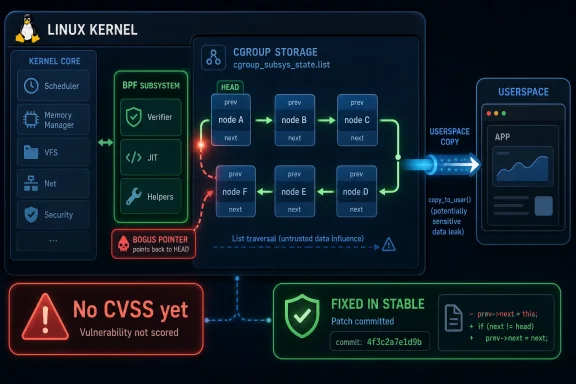
cgroup_storage_get_next_key() where incorrect end-of-list handling can copy data from an invalid internal pointer to userspace. The bug is not yet scored by NVD, which means defenders are staring at the familiar gray zone between “fixed upstream” and “risk understood.” Its narrow technical shape should not lull anyone into ignoring it. This is exactly the kind of small kernel bookkeeping error that matters in modern Linux estates because BPF, containers, and cgroups now sit directly on the fault line between observability, isolation, and privilege.
A One-Line List Bug Lands in the Most Sensitive Part of Linux
The vulnerability description is almost comic in its brevity: list_next_entry() never returns NULL. That is the sort of sentence kernel developers recognize immediately, and everyone else should read twice. In Linux’s intrusive linked-list idiom, reaching the end of a list does not mean receiving a friendly null pointer; it means wrapping around to the list head unless the caller explicitly checks for that condition.
In cgroup_storage_get_next_key(), the kernel expected a null-style failure signal that was never going to arrive. When the current storage entry was the last entry, the function continued as if it had found another valid object. Instead, it could read storage->key from a bogus pointer that actually aliases internal map fields, then copy that value back to userspace.
That is why the fix is conceptually simple: replace the dead NULL check with list_entry_is_head(), the helper designed to detect that the traversal has returned to the list head. When there are no more entries, the function should return -ENOENT. The old behavior failed to say “we’re done,” and in kernel code, failing to stop cleanly can become a security boundary problem.
The important point is not that this bug is spectacular. It is that it is ordinary. Linux kernel security in 2026 is increasingly shaped by defects that do not look like cinematic memory corruption at first glance, but still live in code paths reachable from powerful interfaces.
BPF Has Become Both a Superpower and a Blast Radius
Berkeley Packet Filter began life as a way to filter packets efficiently, but modern eBPF is much more than that. It is a programmable substrate for tracing, networking, security policy, performance analysis, and container-aware telemetry. In enterprise Linux, BPF is no longer a weird corner of the kernel; it is where cloud-native operations teams often place their most sophisticated tooling.
That success changes the threat model. A BPF-related flaw no longer affects only kernel hackers and packet-filtering purists. It can matter to Kubernetes clusters, endpoint monitoring agents, observability stacks, network policy engines, service meshes, and security products that rely on kernel probes and maps.
CVE-2026-45838 sits specifically in cgroup storage, which should sharpen the ears of anyone running containers or multi-tenant Linux workloads. Cgroups are the kernel’s accounting and resource-control machinery, and they underpin container isolation as much as namespaces do. BPF’s integration with cgroups lets programs attach behavior and store state in ways that are useful, but also inherently close to the machinery that separates one workload from another.
That does not automatically make this bug a container escape or privilege-escalation emergency. The public record does not yet support that claim, and NVD has not assigned CVSS metrics. But a bug that exposes internal map-derived data to userspace through a kernel API deserves attention precisely because BPF and cgroups are common in the places where “local” bugs can become operationally significant.
The Missing CVSS Score Is Not a Permission Slip
The NVD entry currently says the record is awaiting enrichment. That means there is no NIST-provided CVSS 4.0, CVSS 3.x, or CVSS 2.0 score yet, and no weakness enumeration has been filled in. Security teams that sort patch queues by score alone will be tempted to let this one drift until scanners agree on a number.
That is the wrong instinct. CVSS is useful, but it is not the first signal in the Linux kernel’s security pipeline. The first signal is usually that the kernel stable trees have accepted a fix, the CVE record has been populated by kernel.org, and the affected subsystem is important enough to justify a backport across supported branches.
Kernel CVEs often arrive before downstream distributions have fully mapped affected packages, before exploitability is publicly clear, and before enterprise scanners have normalized the advisory. That lag is not a conspiracy or a failure; it is a side effect of the kernel’s scale. Thousands of drivers, subsystems, configuration choices, and distribution backports have to be reconciled against a moving upstream.
The practical lesson is simple: treat “awaiting enrichment” as incomplete metadata, not low risk. The absence of a score is not evidence that the bug is harmless. It is evidence that the scoring machinery has not caught up.
The Vulnerability Is Small Because the Kernel’s List API Is Sharp
The root cause here is a mismatch between what the caller believed an API would do and what the API actually guarantees. list_next_entry() is a convenience macro for walking Linux kernel lists. It does not perform semantic end-of-list validation for the caller, and it is not designed to return NULL when iteration reaches the list head.
That behavior is not a kernel oddity so much as a performance and design tradeoff. Linux list handling is compact, fast, and widely used, but it assumes callers understand the invariants. Use the wrong helper, or check for the wrong terminal condition, and the code can remain perfectly compilable while becoming logically impossible.
The vulnerability description makes that impossible branch explicit: the subsequent NULL check was dead code. In other words, the safety check existed in the source tree, but it could never fire. That is the kind of bug static analysis tools are supposed to notice, and the kind reviewers can miss because the code looks defensive.
This is where kernel security differs from application security in uncomfortable ways. In a web app, a dead check might produce a bad error message. In kernel code, a dead check can cause a pointer to be reinterpreted as a different object type and copied across the kernel-userspace boundary.
Information Disclosure Still Counts When Nobody Has a Logo for It
The description says the bug reads storage->key from a bogus pointer that aliases internal map fields and copies the result to userspace. That wording points most naturally toward information disclosure, though the final severity depends on reachability, required privileges, kernel configuration, and what data can realistically be exposed.
Information disclosure bugs are often underrated because they do not always crash systems or grant immediate root access. That is a mistake. Kernel info leaks can help defeat address-space layout randomization, expose internal state, reveal object layout assumptions, or provide exploit primitives for chained attacks.
Not every leak is equally useful. A bogus pointer that aliases internal map fields may disclose limited or low-value data in common configurations. It may also be reachable only by users who already have permission to use the relevant BPF map operations. Those details matter, and responsible analysis should not overstate them.
But neither should defenders dismiss the issue as “just a leak.” Modern exploitation is compositional. Attackers increasingly combine small bugs into larger outcomes, and kernel hardening has made reliable memory disclosure more valuable, not less.
Windows Shops Still Have a Linux Kernel Problem
At first glance, a Linux BPF CVE may seem off-topic for WindowsForum readers. It is not. The modern Windows estate is full of Linux, even when the desktop fleet is not.
Developers run WSL. Security teams deploy Linux-based sensors. Cloud teams operate Linux containers on Azure, AWS, and private Kubernetes. Network appliances, CI runners, build hosts, storage systems, hypervisors, and monitoring stacks often depend on Linux kernels that are patched through entirely different channels from Windows Update.
WSL deserves special care in this discussion. Windows Subsystem for Linux 2 uses a real Linux kernel in a lightweight virtualized environment, not a syscall translation layer like the original WSL design. That does not mean every upstream Linux CVE maps cleanly into WSL exposure, because Microsoft ships its own WSL kernel builds and configuration choices. It does mean Windows administrators should not assume Linux kernel CVEs are irrelevant simply because the endpoint says Windows on the asset sheet.
The same goes for container-heavy Windows environments. Even organizations standardized on Windows clients may be running Linux containers in development pipelines, cloud deployments, or hybrid clusters. In those environments, a BPF/cgroup bug is closer to the daily operating model than many traditional server vulnerabilities.
Patch Reality Runs Through Distributions, Not Headlines
The NVD record references multiple kernel stable commits, which is a strong sign that the fix has been backported across supported upstream stable branches. For administrators, however, the actionable question is not whether a git commit exists. It is whether their distribution has shipped a kernel package containing the fix and whether that kernel has actually booted.
This distinction is boring until it matters. A server can have a patched kernel installed on disk and still be running the vulnerable one in memory. A container host can show green package compliance while workloads continue under an old kernel until the next maintenance reboot. A fleet can include custom kernels, vendor appliances, cloud images, and live-patched systems that all answer the same CVE differently.
Kernel patching is also where enterprises discover the limits of “just update.” BPF-heavy environments may depend on out-of-tree agents, CO-RE assumptions, tracing programs, or vendor modules that need validation against new kernels. That is a reason to test; it is not a reason to postpone indefinitely.
The right operational posture is to follow distribution advisories, identify affected kernel package versions, schedule reboots or live patches where available, and verify the running kernel after remediation. In kernel security, installed is not the same as protected.
The Container Angle Is About Exposure, Not Panic
Because the bug touches cgroup storage, it is tempting to jump straight to containers. That temptation should be resisted, but not ignored. Cgroups are central to container resource management, and BPF is heavily used in container observability and enforcement, yet a cgroup-adjacent vulnerability does not automatically break container isolation.
The better question is reachability. Can an unprivileged local user trigger the affected path? Does the system permit unprivileged BPF use? Are container workloads granted capabilities that widen access to BPF or cgroup interfaces? Are privileged containers present? Does the host run security agents that create or expose relevant BPF maps?
Those deployment details can swing practical risk significantly. A locked-down production server with restrictive BPF settings may face a very different exposure profile from a developer workstation, CI runner, or observability-heavy Kubernetes node. That variability is why early CVE records can feel unsatisfying: the same upstream bug can have different consequences depending on policy and configuration.
Still, container platforms deserve priority review because they concentrate mutually distrusting workloads on shared kernels. Even when a flaw is only local, “local” in a container host can mean any compromised workload on the node. That is the uncomfortable truth behind many kernel CVEs in cloud-native estates.
BPF Hardening Is Now Baseline Hygiene
For years, one common mitigation theme around BPF has been restricting unprivileged BPF access. Many distributions and hardened environments already do this by default or through sysctl policy. That does not eliminate BPF risk, especially for privileged services and root-owned agents, but it narrows who can exercise the subsystem directly.
Administrators should view CVE-2026-45838 as another prompt to revisit BPF exposure rather than as a one-off anomaly. If unprivileged users can create BPF maps or programs on general-purpose systems, the security team should know why. If containers have elevated capabilities that allow BPF interaction, that should be a deliberate exception, not an accidental inheritance from a permissive deployment template.
The tricky part is that BPF is not merely an attack surface; it is also a defense and operations surface. Endpoint products, network monitors, performance tools, and policy engines depend on it. Disabling everything is rarely viable in sophisticated environments, and doing so blindly can degrade visibility.
The mature answer is segmentation of capability. Let trusted agents use BPF where needed. Keep ordinary users and ordinary containers away from it. Audit privileged workloads, and treat BPF permissions with the same seriousness given to filesystem mounts, host PID namespace access, and raw socket privileges.
The Stable Kernel Machine Is Doing Its Job, But Slowly for Defenders
There is a reassuring side to this story: the bug has been fixed in the kernel’s stable process. The CVE entry came from kernel.org, not from a mystery vendor blog or a proof-of-concept drop on social media. The description is precise, the offending logic is clear, and the remedial change is straightforward.
That is the good news. The less comfortable news is that the stable kernel process is not the same as fleet remediation. Upstream fixes must move into distribution kernels, cloud images, embedded vendor builds, live-patch streams, and appliance firmware. Then those updates must move through change windows, reboot policies, and compatibility testing.
Security teams often talk about mean time to remediate as if all patches are equivalent. Kernel fixes are not equivalent to browser updates or userland library patches. They touch the running foundation of the system, and they frequently require coordination between infrastructure, application owners, and platform teams.
That is why small kernel CVEs accumulate operational debt. Each one looks modest in isolation. Together, they create a constant pressure to improve kernel update discipline, reboot automation, node rotation, and inventory accuracy.
The Real Risk Is Losing Track of the Kernel You Actually Run
CVE-2026-45838 is a reminder that kernel vulnerability management fails less often from ignorance than from ambiguity. Teams may know a CVE exists but not know which machines are affected. They may know patched packages exist but not know which nodes have rebooted. They may know BPF is present but not know who can use it.
That ambiguity is especially common in mixed Windows and Linux estates. Windows endpoints are often tracked through mature management tooling, while Linux servers, appliances, containers, and developer environments sit in parallel systems. WSL adds yet another wrinkle because it lives at the boundary of endpoint management and developer autonomy.
A credible response starts with inventory. Which Linux kernels are running? Which are vendor-managed? Which are cloud-image-managed? Which are inside developer platforms? Which are in Kubernetes nodes, and how quickly can nodes be drained and replaced?
The answer cannot be “we will check when a critical score appears.” By then, the organization is already behind. Kernel CVEs reward teams that maintain boring, accurate operational data before the advisory lands.
The Kernel Patch Queue Has a New BPF Reminder
CVE-2026-45838 is not the kind of bug that should trigger performative panic, but it is concrete enough to justify action now. Its practical importance depends on distribution status and local exposure, yet the affected code path sits in a subsystem that modern Linux environments increasingly rely on.
- Administrators should track their distribution’s kernel advisories for CVE-2026-45838 rather than relying only on the unscored NVD entry.
- Systems should be checked for the running kernel version after updates, because a patched package on disk does not protect a machine still booted into an older kernel.
- Container hosts, CI runners, developer workstations, and observability-heavy Linux systems deserve earlier review because BPF and cgroups are more likely to be actively used there.
- Unprivileged BPF access should be restricted unless there is a documented operational reason to allow it.
- Windows-centric teams should include WSL, Linux VMs, appliances, and cloud container nodes in their exposure assessment instead of treating this as somebody else’s Linux problem.
This is the rhythm of kernel security now: not one thunderclap vulnerability every few months, but a steady series of precise fixes in complex subsystems that enterprises have quietly made essential. CVE-2026-45838 may ultimately receive a modest severity score, and it may prove hard to exploit in many default configurations. Even so, it points toward the larger truth administrators cannot avoid in 2026: the more programmable the kernel becomes, the more disciplined the patching, privilege, and inventory story has to be.
References
- CVE-2026-45838 bpf: fix end-of-list detection in cgroup_storage_get_next_key() NVD / Linux Kernel · 2026-05-28T01:02:48-07:00