

CVE-2026-46234 is a newly published Linux kernel vulnerability, received by NVD from kernel.org on May 28, 2026, that fixes a vsock buffer-size clamping bug where a misordered minimum and maximum check could let a socket buffer exceed its configured maximum. It is not, at least from the public record so far, the sort of branded, weaponized Linux flaw that sends incident-response teams into weekend mode. But it is exactly the kind of small kernel invariant failure that matters in virtualized infrastructure, because vsock sits in the narrow and often under-watched lane between guests and hosts. For WindowsForum readers, the interesting story is not “Linux has another CVE”; it is that modern Windows estates increasingly depend on Linux kernels hiding inside WSL, containers, appliances, CI runners, and virtual machines.
The bug fixed under CVE-2026-46234 lives in
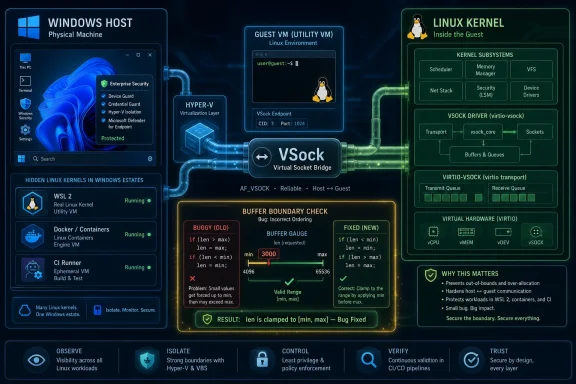
The faulty logic clamped the requested value to the maximum first, then checked it against the minimum. That order is safe only if the minimum is guaranteed to be less than or equal to the maximum. If a user can configure a minimum larger than the maximum, the second check can override the first one and push the effective buffer size beyond the maximum the kernel thought it had enforced.
In plain English, the code said “do not go above this ceiling,” then immediately allowed a strangely placed floor to lift the value through the ceiling. The fix is correspondingly small: check the minimum first, then the maximum. The last operation now enforces the upper bound, which is what administrators and kernel developers expected all along.
That simplicity should not be mistaken for triviality. Kernel security is full of bugs where the patch is smaller than the consequence. CVE-2026-46234 is a reminder that a boundary check is not merely a comparison; it is a promise about which rule wins when inputs become adversarial.
That usefulness is also what makes vsock security-relevant. A host-to-guest or guest-to-host communication mechanism is not just another local socket API; it is a seam between trust domains. The more invisible the seam becomes to operators, the more important its resource controls become.
CVE-2026-46234 concerns memory boundary enforcement rather than packet parsing theatrics. But resource boundaries are security boundaries. If a socket buffer can grow past the maximum chosen by the kernel or administrator, the system may spend memory in places where it was supposed to refuse. In a shared virtualization host, that difference can matter.
The public CVE text does not yet include an NVD CVSS score, vector, or fully enriched weakness classification. That absence is worth emphasizing. At the time of writing, the record tells us what was fixed and why the invariant was wrong, but it does not yet provide a national-database severity verdict that administrators can mechanically slot into a scanner dashboard.
The upstream patch history is more informative than the empty scoring fields. The change was posted to the Linux networking lists in April 2026 and later surfaced in the CVE record with multiple stable commit references. That is the normal path for many Linux kernel CVEs now: a bug is fixed in public kernel development first, then receives CVE bookkeeping afterward.
The code delta is almost comically small: move the maximum clamp after the minimum clamp. Yet that movement expresses the whole security argument. When two limits conflict, the kernel must decide which one is authoritative. For memory safety and resource governance, the maximum must win.
This is also why automated vulnerability management often feels unsatisfying around kernel bugs. A scanner may eventually say “medium” or “high,” but the practical question for an operator is more contextual: who can set the relevant socket options, which transports are enabled, what workloads run in the guest, and whether untrusted users can reach the affected path.
That does not mean CVE-2026-46234 automatically compromises Windows. It does mean Windows teams cannot wave away Linux kernel advisories as irrelevant by default. The boundary between “Windows issue” and “Linux issue” has become a deployment detail.
WSL is the obvious example for WindowsForum readers. Microsoft’s WSL 2 architecture uses a Linux kernel delivered on its own servicing track, separate from the Windows image itself. That separation is convenient most of the time, but it also means kernel security posture depends on WSL kernel updates, Store/AppX servicing behavior, enterprise update controls, and custom kernel choices.
The risk is sharper for developers and power users who build or pin custom WSL kernels. If a machine uses a Microsoft-serviced WSL kernel, the path to remediation is likely a normal WSL kernel update once Microsoft incorporates the relevant upstream fix. If a machine uses a custom-built kernel, the owner has also accepted custom patch responsibility. That bargain is easy to forget until a small upstream fix turns into a local inventory question.
Vsock exists precisely because guests and hosts need a cleaner way to communicate. That means administrators should examine the vulnerability through the lens of workload placement, not just traditional remote-versus-local scoring. A developer’s Ubuntu instance under WSL, a CI job inside a nested virtualized environment, and a multi-tenant Linux VM host all present different exposure stories.
The public description of CVE-2026-46234 does not claim a host escape, remote code execution, or privilege escalation. It says the buffer size can exceed the configured maximum when the minimum is set larger than the maximum. That is a resource-boundary failure, and the most plausible immediate concern is memory pressure or denial-of-service behavior rather than cinematic exploitation.
Still, kernel history teaches caution. Resource-accounting bugs can become useful primitives when chained with other flaws or exposed to untrusted tenants. A bug that merely lets something grow “too large” may not sound dramatic, but limits exist because unlimited growth has consequences.
Good defensive code assumes that the caller will eventually do something unreasonable. It also assumes that one guardrail may interact badly with another. In CVE-2026-46234, neither the minimum check nor the maximum check was inherently wrong. The problem was their sequence.
This class of bug is especially annoying because it survives casual code review. A reviewer sees both a minimum clamp and a maximum clamp and may mentally mark the value as bounded. The vulnerability lives in the fact that the two checks are not commutative when the configured bounds are inverted.
That matters beyond vsock. Kernel subsystems are full of minimums, maximums, watermarks, quotas, credits, socket buffers, ring sizes, and tunables. The more configurable the subsystem, the more the kernel must define what happens when configuration values contradict each other. “Administrators should not do that” is not a satisfying security boundary.
For rolling distributions and users tracking recent stable kernels, the fix may arrive quickly or already be present through normal kernel updates. For long-term-support distributions, the patch may be backported without a visible jump to a newer upstream kernel version. That is why checking only
Windows administrators managing WSL fleets should pay particular attention to machines with custom kernels or update restrictions. WSL’s convenience can obscure its kernel lifecycle. In many organizations, WSL is treated as a developer feature rather than a managed Linux estate, which is exactly how kernel drift sneaks into otherwise disciplined environments.
The same logic applies to security appliances and vendor VM images. If a product ships a Linux kernel and uses vsock-related functionality, the vendor needs to answer whether the affected code is present and patched. Customers should not assume that an appliance is safe because its web interface says nothing about Linux.
For CVE-2026-46234, the practical triage starts with three questions. Is the affected kernel code present? Can untrusted local users or guest workloads manipulate the relevant vsock buffer settings? Is the machine part of a virtualization boundary where memory pressure or guest-host communication matters?
If the answer to all three is yes, waiting for NVD enrichment is not a strategy. If the answer is no, the vulnerability may be low urgency even if a later score looks uncomfortable in a dashboard. The point is not to ignore scoring, but to put it in its proper place.
This is where Windows-heavy shops sometimes struggle with Linux advisories. The Windows patch model encourages centralized monthly reasoning: install the cumulative update, verify the KB, move on. Linux kernel exposure is more fragmented, particularly when the Linux instance is embedded inside another product. CVE-2026-46234 is small enough to be overlooked and low-level enough to reward careful inventory.
Developer workstations are the first stop. WSL distributions share the WSL 2 kernel rather than each shipping their own in the traditional VM sense, but custom kernels change that calculus. Docker Desktop, local Kubernetes clusters, and test VMs may also introduce Linux kernels that are updated through different mechanisms.
Server estates need a broader pass. Hyper-V guests, VMware guests, KVM hosts, CI runners, lab systems, and vendor virtual appliances may all expose vsock-capable kernels. Not every one of those systems will be exploitable in a meaningful way, but security teams cannot know that without first knowing they exist.
The most productive response is not panic-patching every Linux instance at random. It is targeted hygiene: identify the kernel, identify the servicing source, confirm whether the fix has been included, and prioritize systems where untrusted users or workloads sit near virtualization boundaries.
 A Tiny Ordering Bug With a Very Kernel-Sized Shadow
The bug fixed under CVE-2026-46234 lives in vsock_update_buffer_size(), part of the Linux kernel’s virtual socket implementation. The function’s job sounds mundane: take a requested buffer size and make sure it stays within configured boundaries. That is the kind of defensive plumbing nobody thinks about until the plumbing starts defining the blast radius.The faulty logic clamped the requested value to the maximum first, then checked it against the minimum. That order is safe only if the minimum is guaranteed to be less than or equal to the maximum. If a user can configure a minimum larger than the maximum, the second check can override the first one and push the effective buffer size beyond the maximum the kernel thought it had enforced.
In plain English, the code said “do not go above this ceiling,” then immediately allowed a strangely placed floor to lift the value through the ceiling. The fix is correspondingly small: check the minimum first, then the maximum. The last operation now enforces the upper bound, which is what administrators and kernel developers expected all along.
That simplicity should not be mistaken for triviality. Kernel security is full of bugs where the patch is smaller than the consequence. CVE-2026-46234 is a reminder that a boundary check is not merely a comparison; it is a promise about which rule wins when inputs become adversarial.
Vsock Is the Quiet Pipe Between Worlds
Virtual sockets, or vsock, provide communication between virtual machines and their hosts without requiring conventional network configuration. Instead of assigning IP addresses and routing traffic, software can use an address family designed for guest-host communication. That makes vsock useful in hypervisors, sandboxing systems, container-adjacent tooling, and development environments where the “network” is really a private channel between layers of the same machine.That usefulness is also what makes vsock security-relevant. A host-to-guest or guest-to-host communication mechanism is not just another local socket API; it is a seam between trust domains. The more invisible the seam becomes to operators, the more important its resource controls become.
CVE-2026-46234 concerns memory boundary enforcement rather than packet parsing theatrics. But resource boundaries are security boundaries. If a socket buffer can grow past the maximum chosen by the kernel or administrator, the system may spend memory in places where it was supposed to refuse. In a shared virtualization host, that difference can matter.
The public CVE text does not yet include an NVD CVSS score, vector, or fully enriched weakness classification. That absence is worth emphasizing. At the time of writing, the record tells us what was fixed and why the invariant was wrong, but it does not yet provide a national-database severity verdict that administrators can mechanically slot into a scanner dashboard.
The Patch Says More Than the Scoreboard
NVD’s current entry is marked as awaiting enrichment, which means security teams should resist the urge to overread the missing score. “N/A” is not “safe,” and it is not “critical.” It is a placeholder while the vulnerability record catches up with the kernel-side disclosure and the stable-tree references.The upstream patch history is more informative than the empty scoring fields. The change was posted to the Linux networking lists in April 2026 and later surfaced in the CVE record with multiple stable commit references. That is the normal path for many Linux kernel CVEs now: a bug is fixed in public kernel development first, then receives CVE bookkeeping afterward.
The code delta is almost comically small: move the maximum clamp after the minimum clamp. Yet that movement expresses the whole security argument. When two limits conflict, the kernel must decide which one is authoritative. For memory safety and resource governance, the maximum must win.
This is also why automated vulnerability management often feels unsatisfying around kernel bugs. A scanner may eventually say “medium” or “high,” but the practical question for an operator is more contextual: who can set the relevant socket options, which transports are enabled, what workloads run in the guest, and whether untrusted users can reach the affected path.
Windows Shops Are Linux Shops Now, Whether They Admit It or Not
For a traditional Windows administrator, a Linux kernel CVE used to be somebody else’s problem. That mental model no longer survives contact with the average enterprise endpoint or developer workstation. WSL 2 runs a real Linux kernel. Docker Desktop commonly rides on WSL 2 or Hyper-V-backed virtualization. Security tools, build agents, Kubernetes nodes, network appliances, and vendor-supplied virtual machines all bring Linux into otherwise Windows-centered estates.That does not mean CVE-2026-46234 automatically compromises Windows. It does mean Windows teams cannot wave away Linux kernel advisories as irrelevant by default. The boundary between “Windows issue” and “Linux issue” has become a deployment detail.
WSL is the obvious example for WindowsForum readers. Microsoft’s WSL 2 architecture uses a Linux kernel delivered on its own servicing track, separate from the Windows image itself. That separation is convenient most of the time, but it also means kernel security posture depends on WSL kernel updates, Store/AppX servicing behavior, enterprise update controls, and custom kernel choices.
The risk is sharper for developers and power users who build or pin custom WSL kernels. If a machine uses a Microsoft-serviced WSL kernel, the path to remediation is likely a normal WSL kernel update once Microsoft incorporates the relevant upstream fix. If a machine uses a custom-built kernel, the owner has also accepted custom patch responsibility. That bargain is easy to forget until a small upstream fix turns into a local inventory question.
Hypervisors Turn “Local” Into a More Complicated Word
Many kernel CVEs are described as local because the attacker needs code execution on the same system. In virtualized environments, “local” is a slippery category. Code running inside a guest is local to that guest, but it may be less trusted than the host, less trusted than neighboring tenants, and less trusted than management software that assumes guest boundaries hold.Vsock exists precisely because guests and hosts need a cleaner way to communicate. That means administrators should examine the vulnerability through the lens of workload placement, not just traditional remote-versus-local scoring. A developer’s Ubuntu instance under WSL, a CI job inside a nested virtualized environment, and a multi-tenant Linux VM host all present different exposure stories.
The public description of CVE-2026-46234 does not claim a host escape, remote code execution, or privilege escalation. It says the buffer size can exceed the configured maximum when the minimum is set larger than the maximum. That is a resource-boundary failure, and the most plausible immediate concern is memory pressure or denial-of-service behavior rather than cinematic exploitation.
Still, kernel history teaches caution. Resource-accounting bugs can become useful primitives when chained with other flaws or exposed to untrusted tenants. A bug that merely lets something grow “too large” may not sound dramatic, but limits exist because unlimited growth has consequences.
The Real Lesson Is That Invariants Need Owners
The vulnerability is best understood as an invariant bug. The intended invariant was simple:buffer_size must not exceed buffer_max_size. The implementation violated that invariant under a contradictory configuration. In a kernel subsystem, contradictory configuration is not an edge case to shrug off; it is an input class to defend against.Good defensive code assumes that the caller will eventually do something unreasonable. It also assumes that one guardrail may interact badly with another. In CVE-2026-46234, neither the minimum check nor the maximum check was inherently wrong. The problem was their sequence.
This class of bug is especially annoying because it survives casual code review. A reviewer sees both a minimum clamp and a maximum clamp and may mentally mark the value as bounded. The vulnerability lives in the fact that the two checks are not commutative when the configured bounds are inverted.
That matters beyond vsock. Kernel subsystems are full of minimums, maximums, watermarks, quotas, credits, socket buffers, ring sizes, and tunables. The more configurable the subsystem, the more the kernel must define what happens when configuration values contradict each other. “Administrators should not do that” is not a satisfying security boundary.
Distros and Vendors Will Decide the Practical Clock
The CVE was published on May 28, 2026, but remediation timelines will vary by distribution and vendor. Upstream stable commits are only the start of the journey. Enterprise Linux distributions, appliance vendors, cloud images, WSL kernels, NAS vendors, hypervisor stacks, and container-host platforms each carry their own patch pipelines.For rolling distributions and users tracking recent stable kernels, the fix may arrive quickly or already be present through normal kernel updates. For long-term-support distributions, the patch may be backported without a visible jump to a newer upstream kernel version. That is why checking only
uname -r can be misleading; the distribution changelog often matters more than the apparent major kernel lineage.Windows administrators managing WSL fleets should pay particular attention to machines with custom kernels or update restrictions. WSL’s convenience can obscure its kernel lifecycle. In many organizations, WSL is treated as a developer feature rather than a managed Linux estate, which is exactly how kernel drift sneaks into otherwise disciplined environments.
The same logic applies to security appliances and vendor VM images. If a product ships a Linux kernel and uses vsock-related functionality, the vendor needs to answer whether the affected code is present and patched. Customers should not assume that an appliance is safe because its web interface says nothing about Linux.
The Missing CVSS Score Should Not Become a Waiting Room
Security teams often wait for a CVSS number before prioritizing action. That habit is understandable, but it is also brittle. CVSS is useful for normalization; it is not a substitute for architectural knowledge.For CVE-2026-46234, the practical triage starts with three questions. Is the affected kernel code present? Can untrusted local users or guest workloads manipulate the relevant vsock buffer settings? Is the machine part of a virtualization boundary where memory pressure or guest-host communication matters?
If the answer to all three is yes, waiting for NVD enrichment is not a strategy. If the answer is no, the vulnerability may be low urgency even if a later score looks uncomfortable in a dashboard. The point is not to ignore scoring, but to put it in its proper place.
This is where Windows-heavy shops sometimes struggle with Linux advisories. The Windows patch model encourages centralized monthly reasoning: install the cumulative update, verify the KB, move on. Linux kernel exposure is more fragmented, particularly when the Linux instance is embedded inside another product. CVE-2026-46234 is small enough to be overlooked and low-level enough to reward careful inventory.
The Fix Is Small, the Inventory Is Not
The concrete remediation is straightforward: run a kernel that contains the vsock clamping-order fix. The operational work is finding every kernel for which that sentence is relevant. On a modern Windows-centered network, that can include more places than the Windows team expects.Developer workstations are the first stop. WSL distributions share the WSL 2 kernel rather than each shipping their own in the traditional VM sense, but custom kernels change that calculus. Docker Desktop, local Kubernetes clusters, and test VMs may also introduce Linux kernels that are updated through different mechanisms.
Server estates need a broader pass. Hyper-V guests, VMware guests, KVM hosts, CI runners, lab systems, and vendor virtual appliances may all expose vsock-capable kernels. Not every one of those systems will be exploitable in a meaningful way, but security teams cannot know that without first knowing they exist.
The most productive response is not panic-patching every Linux instance at random. It is targeted hygiene: identify the kernel, identify the servicing source, confirm whether the fix has been included, and prioritize systems where untrusted users or workloads sit near virtualization boundaries.
The Clamp Bug Leaves a Short Checklist for Long-Lived Kernels
CVE-2026-46234 is not a headline-grabbing kernel apocalypse, and that is exactly why it is useful as a test of operational maturity. The organizations that handle it well will be the ones that already know where their Linux kernels live, who services them, and which ones are allowed to lag.- Administrators should treat the May 28, 2026 CVE publication as a prompt to verify kernel servicing rather than as a complete severity assessment.
- Systems using Linux vsock in virtualization, guest-host communication, or sandboxed development workflows deserve earlier attention than ordinary single-user machines.
- WSL 2 users should distinguish between Microsoft-serviced kernels and custom kernels, because custom kernels shift patch responsibility back to the user or organization.
- Distribution backports may contain the fix without changing the apparent upstream kernel version, so package changelogs and vendor advisories matter.
- The absence of an NVD CVSS score at publication time should not block triage for systems where untrusted code can influence vsock behavior.
- The safest remediation path is to move to a vendor-supported kernel build that includes the corrected minimum-then-maximum clamping order.
References
- Primary source: NVD / Linux Kernel
Published: 2026-05-29T01:05:06-07:00
NVD - CVE-2026-46234
 nvd.nist.gov
- Security advisory: MSRC
Published: 2026-05-29T01:05:06-07:00
Original feed URL
Security Update Guide - Microsoft Security Response Center
 msrc.microsoft.com
- Related coverage: spinics.net
Re: [PATCH v3 net] vsock: fix buffer size clamping order — Linux Kernel
Linux Kernel: Re: [PATCH v3 net] vsock: fix buffer size clamping order www.spinics.net
- Related coverage: mail-archive.com
[PATCH v3 net] vsock: fix buffer size clamping order
www.mail-archive.com
- Related coverage: docs.redhat.com
- Related coverage: support.bull.com
- Official source: github.com
GitHub - microsoft/WSL2-Linux-Kernel: The source for the Linux kernel used in Windows Subsystem for Linux 2 (WSL2) · GitHub
The source for the Linux kernel used in Windows Subsystem for Linux 2 (WSL2) - microsoft/WSL2-Linux-Kernel github.com
- Official source: learn.microsoft.com
Release Notes for WSL kernel | Microsoft Learn
Release notes for the Windows Subsystem for Linux. Updated monthly.learn.microsoft.com - Related coverage: kubevirt.io

- Official source: devblogs.microsoft.com
Servicing the Windows Subsystem for Linux (WSL) 2 Linux kernel - Windows Command Line
Note: This blog post is co-authored by the awesome WSL dev Pierre Boulay. Thanks Pierre! 😊 We’ve just shipped the 5.10.16.3 WSL 2 Linux kernel versiondevblogs.microsoft.com - Official source: hellogithub.com
microsoft/WSL2-Linux-Kernel: The Secret of Running Native Linux Under Windows - HelloGitHub
This project is the official open-source source code and configuration files of Windows Subsystem for Linux 2 (WSL2) by Microsoft, aiming to help Windows users run a complete Linux system locally. WSL2 provides better compatibility and performance by introducing a lightweight virtual machine and...hellogithub.com - Related coverage: gitlab.com
- Related coverage: sourceforge.net
WSL2-Linux-Kernel - Browse Files at SourceForge.net
WSL2-Linux-Kernel files. Full list of files for WSL2-Linux-Kernel, The source for the Linux kernel used in Windows Subsystem for Linux 2sourceforge.net - Related coverage: docs.kernel.org

VMBus — The Linux Kernel documentation
docs.kernel.org
- Related coverage: man7.org
- Related coverage: linux-kvm.org
- Related coverage: scottibyte.com
- Related coverage: archive.fosdem.org
