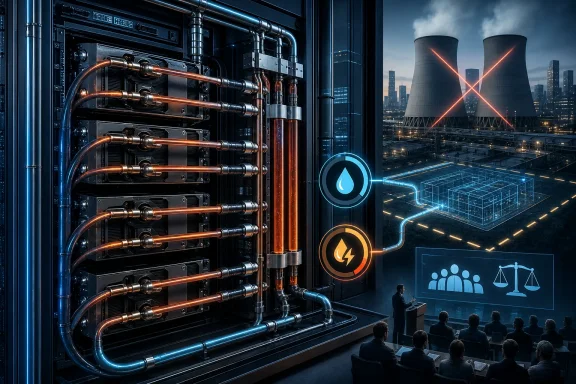
On June 22, 2026, Nvidia used London Climate Week to promote a Vera Rubin DSX data center reference design that can cool next-generation AI racks with a closed liquid loop and, in favorable climates, consume virtually no water inside the facility. That is a real engineering achievement, and the company is right to treat it as more than a lab curiosity. But it is not the same thing as solving AI’s water problem. Nvidia has moved the thermal boundary of the data center; the environmental boundary remains much wider.
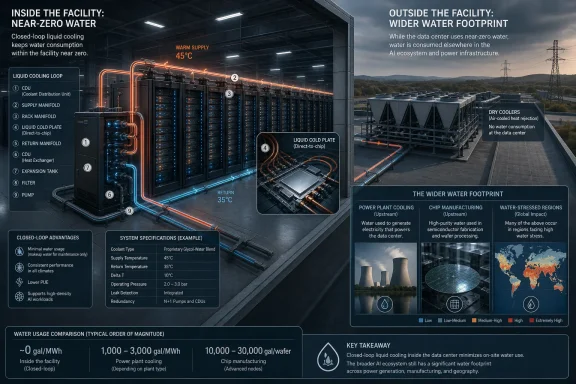
The important word in Nvidia’s pitch is not “zero.” It is inside. The company’s claim applies to the cooling system within the data center facility, not to the full chain that makes AI compute possible.
That distinction sounds pedantic until the numbers come into view. A modern AI data center consumes water directly when it uses evaporative cooling, but it also depends on power plants that may consume water to generate electricity and semiconductor fabs that use vast quantities of ultrapure water to manufacture chips. The facility wall is a convenient accounting line for an infrastructure vendor; it is not where the resource footprint ends.
Nvidia’s DSX design appears to address one of the most visible and politically combustible parts of the problem. Cooling towers are easy for communities to understand because they draw from local water systems, sit beside local substations, and appear in planning disputes. If Nvidia can remove or sharply reduce that demand, it gives hyperscalers a powerful answer to mayors, regulators, and residents worried about whether AI campuses are drinking from the same scarce supplies as farms and households.
But a powerful answer is not a complete answer. The risk is that “near-zero water” becomes a slogan detached from its perimeter. Once that happens, a specific thermal advance starts being sold as absolution for an entire industrial stack.
Nvidia’s reference design uses a closed loop of coolant, reportedly a mixture of water and propylene glycol, moved through cold plates that sit close to the heat-producing components. Instead of blasting air across servers and relying on chillers or evaporative towers to manage the resulting heat, the system captures that heat at the chip and carries it out to dry coolers. The loop is filled and recirculated rather than continuously consuming fresh water.
The striking part is the temperature. Nvidia is pushing coolant inlet temperatures up to around 45°C, far warmer than the chilled-water assumptions that shaped much of the data center industry. That higher temperature makes the heat easier to reject outdoors without conventional chilling because the system has a larger useful gap between the coolant and ambient air for much of the year.
This is why the design is not merely “liquid cooling,” a phrase that has been around long enough to become marketing wallpaper. Warm-water cooling at this scale changes the economics of the plant. If the coolant can run hot, the facility can often lean on dry coolers rather than evaporative systems, reducing both water use and the power load tied to chilling equipment.
For WindowsForum readers used to thinking at the PC level, it is the difference between adding a better radiator and redesigning the platform around a new thermal envelope. Nvidia is not just swapping the cooler. It is telling facility designers, rack vendors, cloud operators, and procurement teams to build around a new assumption: the AI rack is now a liquid-cooled machine room component, not a server cabinet with heroic airflow.
Power generation is the first omitted layer. Thermal power plants, including coal, gas, and nuclear facilities, often withdraw and consume water as part of steam-cycle generation and cooling. The exact water intensity varies enormously by plant type, cooling method, region, and grid mix, but the basic point is not controversial: electricity is not water-free simply because the server hall is.
Semiconductor manufacturing is the second omitted layer. Advanced chips require ultrapure water in fabrication, and AI accelerators are among the most demanding products in the electronics supply chain. When Nvidia ships a Rubin platform, its water story began long before a contractor filled the coolant loop at the data center.
This is the uncomfortable truth behind AI infrastructure accounting. The cleanest story is usually the narrowest one. “Zero water cooling” is measurable, defensible, and valuable. “Zero water AI” is not.
The industry has played this perimeter game before with carbon. A company can buy renewable energy certificates, report lower operational emissions, and still depend on hardware supply chains with substantial embodied carbon. The same pattern is now emerging around water: direct consumption is being optimized first because it is visible, local, and easier to claim, while indirect water remains harder to measure and easier to bury in scope definitions.
Nvidia has acknowledged that some climates may still require chillers for a small share of operating hours. That caveat is doing a lot of work. The difference between “almost never” and “often enough to matter” is not a philosophical dispute; it is a site-selection issue, an engineering issue, and eventually a permitting issue.
This is where the climate-week announcement collides with the geography of the AI buildout. Much of the United States data center boom is happening in regions where land, power interconnection, tax incentives, and fiber routes line up better than water availability. Those regions are not always the regions where dry cooling performs best.
The result is a paradox that local governments will notice quickly. The same design that makes AI data centers easier to defend in water-stressed places may be least able to deliver its cleanest water claims in the hottest of those places. A closed loop helps everywhere, but the promise of eliminating chillers is climate-dependent.
That does not make the technology unsuitable for hot regions. It means the headline number should travel with a weather map attached. A facility in a temperate climate and a facility in the desert may share the same Nvidia reference architecture while delivering very different real-world water and energy outcomes.
This matters for adoption. A cooling paper from a university lab can be admired and ignored. A reference design from Nvidia, tied to the next generation of high-margin AI systems, becomes a procurement template. If cloud providers want the Rubin platform at scale, they will have strong incentives to adopt the supporting thermal assumptions.
That is why the HVAC market noticed. Chillers, cooling towers, pumps, controls, and mechanical systems are not side businesses in hyperscale construction; they are large capital line items with entrenched suppliers. If AI racks move decisively toward warm-water liquid cooling and dry heat rejection, a meaningful share of future data center mechanical spending shifts with them.
The change will not be instant. Existing facilities were not designed around 45°C coolant loops, and retrofitting them is harder than building new campuses around the assumption. Operators have to worry about serviceability, leak detection, materials compatibility, technician training, redundancy, and the awkward transitional years when air-cooled and liquid-cooled systems coexist.
Still, reference architectures have a way of becoming defaults when enough money sits behind them. Nvidia has the leverage to make liquid cooling less exotic by embedding it in the platform roadmap. Once that happens, the question for hyperscalers stops being whether liquid cooling is an experiment and becomes how quickly their construction pipeline can absorb it.
A near-zero on-site cooling design gives developers a better answer to one of those questions. It does not answer the rest. If a proposed AI campus needs a new gas plant, strains transmission capacity, or competes with local industrial and residential growth, the absence of cooling towers will not end the debate.
This is where Nvidia’s advance may change the politics without settling them. Opponents who focused heavily on direct water consumption will have to adapt if future projects can credibly show closed-loop cooling and minimal withdrawals. But developers will also lose the ability to treat water objections as uninformed if the broader water chain remains real.
For public officials, the lesson should be to require more granular disclosures, not to accept or reject data centers based on a single metric. Water-use effectiveness inside the facility is useful. So are annual withdrawal estimates, peak-day cooling assumptions, grid-source analysis, backup generation plans, and supply-chain reporting where available. The more infrastructure becomes essential to AI, the less credible it is to regulate it with brochure-level sustainability claims.
The best version of Nvidia’s announcement would push the permitting conversation upward. If on-site evaporative cooling can be designed out of many facilities, communities can move from arguing about yesterday’s cooling towers to arguing about tomorrow’s full-stack resource demand.
This is the classic Jevons-style problem, and AI is almost built to demonstrate it. If better cooling lowers operating costs, increases rack density, reduces permitting friction, and makes larger clusters easier to deploy, the industry is unlikely to respond by building the same amount of compute with fewer resources. It is more likely to build much more compute.
Nvidia knows this. The company’s business depends on the idea that AI demand will keep scaling, and its infrastructure language is explicitly growth-oriented. The goal is not a smaller AI footprint; it is a more deployable one.
That does not invalidate the cooling advance. Per-unit efficiency matters, especially when the alternative is a less efficient version of the same buildout. But the total environmental outcome depends on whether efficiency gains are swallowed by growth. A 100 percent reduction in one facility’s direct cooling water is impressive; a tenfold increase in facilities changes the accounting.
The industry’s preferred answer is that AI will eventually optimize everything else, from logistics to energy grids to scientific discovery. Maybe it will. But that claim cannot be used as a substitute for measuring the infrastructure being built now.
These commitments are not meaningless corporate varnish. They show that water has become a first-tier constraint, not an afterthought handled by facilities teams after the real decisions are made. The largest AI infrastructure buyers understand that communities and regulators are watching.
But the same perimeter problem appears across the sector. Replenishment projects may occur in different watersheds than the facilities creating demand. Closed-loop cooling may reduce direct withdrawals while electricity demand rises. Annualized water numbers may obscure peak local stress during heat waves or drought.
The industry’s next sustainability battle will be over whether these metrics become more precise or more theatrical. A company can disclose water-use effectiveness and still avoid giving residents a clear picture of local risk. It can promise replenishment and still build in a basin where timing, geography, and legal water rights matter more than global totals.
Nvidia’s DSX design should raise the bar for everyone. If the dominant AI hardware vendor can design around near-zero on-site water cooling, then future facilities that rely heavily on evaporative cooling will face tougher questions. But the bar must rise for indirect water too, or the industry will simply optimize the easiest-to-defend number.
Copilot features, cloud gaming, developer assistants, enterprise security tools, image generators, meeting transcription, and model-powered search all depend on data center capacity. When that capacity becomes more expensive, constrained, or politically controversial, the effects show up in product availability, pricing, regional rollout, and the way vendors package AI into operating systems and subscriptions.
For sysadmins, the issue is even more direct. Enterprises are being asked to adopt AI features across Microsoft 365, Windows management, endpoint security, CRM systems, observability platforms, and developer tooling. Those features carry hidden infrastructure assumptions. Procurement teams increasingly need to ask vendors not only about data residency and model training, but also about energy and water reporting.
Developers should care because infrastructure constraints shape platform behavior. If inference costs fall, software companies will add more AI calls to ordinary workflows. If costs rise or capacity tightens, vendors will gate features, degrade models, or push more workloads onto local NPUs. The thermal design of AI factories may seem remote, but it influences the boundary between cloud intelligence and client-side computing.
Security-minded readers should care because resilience is part of sustainability. A data center that depends on stressed water systems or fragile local power arrangements is not just an environmental story. It is an availability story. The same communities questioning water use today may be the ones deciding whether future expansions are approved, delayed, litigated, or blocked.
 Nvidia’s Water Claim Is Precise, but the Headline Is Not
The important word in Nvidia’s pitch is not “zero.” It is inside. The company’s claim applies to the cooling system within the data center facility, not to the full chain that makes AI compute possible.That distinction sounds pedantic until the numbers come into view. A modern AI data center consumes water directly when it uses evaporative cooling, but it also depends on power plants that may consume water to generate electricity and semiconductor fabs that use vast quantities of ultrapure water to manufacture chips. The facility wall is a convenient accounting line for an infrastructure vendor; it is not where the resource footprint ends.
Nvidia’s DSX design appears to address one of the most visible and politically combustible parts of the problem. Cooling towers are easy for communities to understand because they draw from local water systems, sit beside local substations, and appear in planning disputes. If Nvidia can remove or sharply reduce that demand, it gives hyperscalers a powerful answer to mayors, regulators, and residents worried about whether AI campuses are drinking from the same scarce supplies as farms and households.
But a powerful answer is not a complete answer. The risk is that “near-zero water” becomes a slogan detached from its perimeter. Once that happens, a specific thermal advance starts being sold as absolution for an entire industrial stack.
The Engineering Advance Is Bigger Than a Sustainability Slogan
The DSX design matters because AI hardware has reached a point where air cooling is no longer an adequate default. Rubin-generation systems are expected to push rack densities beyond the comfort zone of traditional server rooms, with power levels that make fans increasingly inefficient, noisy, and physically limiting. Liquid cooling is not a green accessory bolted onto the side of the system; it is becoming a condition of deploying the system at all.Nvidia’s reference design uses a closed loop of coolant, reportedly a mixture of water and propylene glycol, moved through cold plates that sit close to the heat-producing components. Instead of blasting air across servers and relying on chillers or evaporative towers to manage the resulting heat, the system captures that heat at the chip and carries it out to dry coolers. The loop is filled and recirculated rather than continuously consuming fresh water.
The striking part is the temperature. Nvidia is pushing coolant inlet temperatures up to around 45°C, far warmer than the chilled-water assumptions that shaped much of the data center industry. That higher temperature makes the heat easier to reject outdoors without conventional chilling because the system has a larger useful gap between the coolant and ambient air for much of the year.
This is why the design is not merely “liquid cooling,” a phrase that has been around long enough to become marketing wallpaper. Warm-water cooling at this scale changes the economics of the plant. If the coolant can run hot, the facility can often lean on dry coolers rather than evaporative systems, reducing both water use and the power load tied to chilling equipment.
For WindowsForum readers used to thinking at the PC level, it is the difference between adding a better radiator and redesigning the platform around a new thermal envelope. Nvidia is not just swapping the cooler. It is telling facility designers, rack vendors, cloud operators, and procurement teams to build around a new assumption: the AI rack is now a liquid-cooled machine room component, not a server cabinet with heroic airflow.
The Facility Wall Is Where the Marketing Gets Convenient
Nvidia’s claim becomes more fragile when it is stretched beyond the building. On-site cooling is only one slice of AI’s water demand, and some recent analyses put it far below the water associated with electricity generation and chipmaking. That does not make the cooling improvement trivial; it means the improvement is being made in the most visible slice, not necessarily the largest one.Power generation is the first omitted layer. Thermal power plants, including coal, gas, and nuclear facilities, often withdraw and consume water as part of steam-cycle generation and cooling. The exact water intensity varies enormously by plant type, cooling method, region, and grid mix, but the basic point is not controversial: electricity is not water-free simply because the server hall is.
Semiconductor manufacturing is the second omitted layer. Advanced chips require ultrapure water in fabrication, and AI accelerators are among the most demanding products in the electronics supply chain. When Nvidia ships a Rubin platform, its water story began long before a contractor filled the coolant loop at the data center.
This is the uncomfortable truth behind AI infrastructure accounting. The cleanest story is usually the narrowest one. “Zero water cooling” is measurable, defensible, and valuable. “Zero water AI” is not.
The industry has played this perimeter game before with carbon. A company can buy renewable energy certificates, report lower operational emissions, and still depend on hardware supply chains with substantial embodied carbon. The same pattern is now emerging around water: direct consumption is being optimized first because it is visible, local, and easier to claim, while indirect water remains harder to measure and easier to bury in scope definitions.
Hotter Coolant Makes Geography Matter More, Not Less
Warm-water cooling has a simple dependency: the outside world still exists. A dry cooler works best when ambient temperatures are comfortably below the coolant temperature. In Scotland, Scandinavia, the Pacific Northwest, or parts of northern Europe, a 45°C loop gives operators plenty of room for passive heat rejection across most of the year. In Phoenix, Dallas, or Singapore, the equation is less forgiving.Nvidia has acknowledged that some climates may still require chillers for a small share of operating hours. That caveat is doing a lot of work. The difference between “almost never” and “often enough to matter” is not a philosophical dispute; it is a site-selection issue, an engineering issue, and eventually a permitting issue.
This is where the climate-week announcement collides with the geography of the AI buildout. Much of the United States data center boom is happening in regions where land, power interconnection, tax incentives, and fiber routes line up better than water availability. Those regions are not always the regions where dry cooling performs best.
The result is a paradox that local governments will notice quickly. The same design that makes AI data centers easier to defend in water-stressed places may be least able to deliver its cleanest water claims in the hottest of those places. A closed loop helps everywhere, but the promise of eliminating chillers is climate-dependent.
That does not make the technology unsuitable for hot regions. It means the headline number should travel with a weather map attached. A facility in a temperate climate and a facility in the desert may share the same Nvidia reference architecture while delivering very different real-world water and energy outcomes.
The AI Factory Is Becoming a Thermal Product
Nvidia’s role in this story is unusual because the company is no longer just selling chips. It is selling an architecture for the AI factory, a full-stack concept that reaches from GPUs and networking into racks, power, cooling, software, and digital twins. DSX is part of that strategy.This matters for adoption. A cooling paper from a university lab can be admired and ignored. A reference design from Nvidia, tied to the next generation of high-margin AI systems, becomes a procurement template. If cloud providers want the Rubin platform at scale, they will have strong incentives to adopt the supporting thermal assumptions.
That is why the HVAC market noticed. Chillers, cooling towers, pumps, controls, and mechanical systems are not side businesses in hyperscale construction; they are large capital line items with entrenched suppliers. If AI racks move decisively toward warm-water liquid cooling and dry heat rejection, a meaningful share of future data center mechanical spending shifts with them.
The change will not be instant. Existing facilities were not designed around 45°C coolant loops, and retrofitting them is harder than building new campuses around the assumption. Operators have to worry about serviceability, leak detection, materials compatibility, technician training, redundancy, and the awkward transitional years when air-cooled and liquid-cooled systems coexist.
Still, reference architectures have a way of becoming defaults when enough money sits behind them. Nvidia has the leverage to make liquid cooling less exotic by embedding it in the platform roadmap. Once that happens, the question for hyperscalers stops being whether liquid cooling is an experiment and becomes how quickly their construction pipeline can absorb it.
Communities Will Not Grade on Nvidia’s Perimeter
Local opposition to data centers has become more sophisticated. Residents are no longer objecting only to noise, traffic, or the vague idea of “big tech” arriving at the edge of town. They are asking where the power comes from, who pays for grid upgrades, how much water is consumed, whether tax abatements are justified, and what happens during drought.A near-zero on-site cooling design gives developers a better answer to one of those questions. It does not answer the rest. If a proposed AI campus needs a new gas plant, strains transmission capacity, or competes with local industrial and residential growth, the absence of cooling towers will not end the debate.
This is where Nvidia’s advance may change the politics without settling them. Opponents who focused heavily on direct water consumption will have to adapt if future projects can credibly show closed-loop cooling and minimal withdrawals. But developers will also lose the ability to treat water objections as uninformed if the broader water chain remains real.
For public officials, the lesson should be to require more granular disclosures, not to accept or reject data centers based on a single metric. Water-use effectiveness inside the facility is useful. So are annual withdrawal estimates, peak-day cooling assumptions, grid-source analysis, backup generation plans, and supply-chain reporting where available. The more infrastructure becomes essential to AI, the less credible it is to regulate it with brochure-level sustainability claims.
The best version of Nvidia’s announcement would push the permitting conversation upward. If on-site evaporative cooling can be designed out of many facilities, communities can move from arguing about yesterday’s cooling towers to arguing about tomorrow’s full-stack resource demand.
The Efficiency Trap Is Waiting in the Parking Lot
There is another reason to be careful about celebrating efficiency as a straight environmental win. In computing, efficiency gains often enable more consumption rather than less. Cheaper compute tends to create new uses, new products, and new expectations that absorb the savings.This is the classic Jevons-style problem, and AI is almost built to demonstrate it. If better cooling lowers operating costs, increases rack density, reduces permitting friction, and makes larger clusters easier to deploy, the industry is unlikely to respond by building the same amount of compute with fewer resources. It is more likely to build much more compute.
Nvidia knows this. The company’s business depends on the idea that AI demand will keep scaling, and its infrastructure language is explicitly growth-oriented. The goal is not a smaller AI footprint; it is a more deployable one.
That does not invalidate the cooling advance. Per-unit efficiency matters, especially when the alternative is a less efficient version of the same buildout. But the total environmental outcome depends on whether efficiency gains are swallowed by growth. A 100 percent reduction in one facility’s direct cooling water is impressive; a tenfold increase in facilities changes the accounting.
The industry’s preferred answer is that AI will eventually optimize everything else, from logistics to energy grids to scientific discovery. Maybe it will. But that claim cannot be used as a substitute for measuring the infrastructure being built now.
Microsoft, Google, and Amazon Show the Same Perimeter Fight
Nvidia is not alone in trying to reframe the water issue around direct facility consumption. Microsoft has promoted new data center designs that rely on closed-loop cooling and sharply reduced annual water use. Google has committed to becoming water positive by 2030. Amazon has begun disclosing broader water-use figures and progress toward replenishment goals.These commitments are not meaningless corporate varnish. They show that water has become a first-tier constraint, not an afterthought handled by facilities teams after the real decisions are made. The largest AI infrastructure buyers understand that communities and regulators are watching.
But the same perimeter problem appears across the sector. Replenishment projects may occur in different watersheds than the facilities creating demand. Closed-loop cooling may reduce direct withdrawals while electricity demand rises. Annualized water numbers may obscure peak local stress during heat waves or drought.
The industry’s next sustainability battle will be over whether these metrics become more precise or more theatrical. A company can disclose water-use effectiveness and still avoid giving residents a clear picture of local risk. It can promise replenishment and still build in a basin where timing, geography, and legal water rights matter more than global totals.
Nvidia’s DSX design should raise the bar for everyone. If the dominant AI hardware vendor can design around near-zero on-site water cooling, then future facilities that rely heavily on evaporative cooling will face tougher questions. But the bar must rise for indirect water too, or the industry will simply optimize the easiest-to-defend number.
Windows Users Are Not Spectators in This Infrastructure Story
It may seem odd to discuss Nvidia’s data center cooling architecture on a Windows enthusiast site. Most readers are not building 100-kilowatt AI racks in their garages. But the AI infrastructure boom is already reshaping the hardware, software, and cloud services that Windows users touch every day.Copilot features, cloud gaming, developer assistants, enterprise security tools, image generators, meeting transcription, and model-powered search all depend on data center capacity. When that capacity becomes more expensive, constrained, or politically controversial, the effects show up in product availability, pricing, regional rollout, and the way vendors package AI into operating systems and subscriptions.
For sysadmins, the issue is even more direct. Enterprises are being asked to adopt AI features across Microsoft 365, Windows management, endpoint security, CRM systems, observability platforms, and developer tooling. Those features carry hidden infrastructure assumptions. Procurement teams increasingly need to ask vendors not only about data residency and model training, but also about energy and water reporting.
Developers should care because infrastructure constraints shape platform behavior. If inference costs fall, software companies will add more AI calls to ordinary workflows. If costs rise or capacity tightens, vendors will gate features, degrade models, or push more workloads onto local NPUs. The thermal design of AI factories may seem remote, but it influences the boundary between cloud intelligence and client-side computing.
Security-minded readers should care because resilience is part of sustainability. A data center that depends on stressed water systems or fragile local power arrangements is not just an environmental story. It is an availability story. The same communities questioning water use today may be the ones deciding whether future expansions are approved, delayed, litigated, or blocked.
The DSX Shift Leaves Five Hard Facts on the Table
Nvidia’s reference design deserves neither dismissal nor credulous applause. It is a consequential engineering move wrapped in a claim that becomes less true the farther it travels from the cooling loop. The practical reading is narrower and more useful.- Nvidia’s Vera Rubin DSX design can sharply reduce or nearly eliminate direct on-site water use for cooling in facilities and climates where dry coolers can do most of the work.
- The claim does not include the water consumed through electricity generation, semiconductor fabrication, construction, or other supply-chain activity tied to AI infrastructure.
- Warm-water liquid cooling is likely to become a mainstream requirement for high-density AI racks because air cooling is running out of practical headroom.
- Site selection will determine how much of the promised water and energy savings survive contact with local climate, especially in hot or drought-stressed regions.
- Efficiency gains may lower per-unit resource use while accelerating total AI buildout, so the system-wide water impact depends on growth as much as cooling technology.
- Communities and enterprise buyers should demand facility-specific disclosures rather than accepting global “zero water” or “water positive” claims at face value.
References
- Primary source: Tech Times
Published: 2026-06-26T03:20:20.158159
AI Data Center Water Use Is Not Solved: Nvidia's Cooling Fix Stops at the Walls
AI data center water use remains unsolved despite Nvidia’s June 2026 DSX closed-loop cooling breakthrough, which cuts on-site water consumption to near zero but leaves fossil fuel power plant waterwww.techtimes.com - Independent coverage: Memeburn
Published: 2026-06-25T19:20:20.166823
Nvidia Thinks It Can Solve One of AI’s Biggest Data Center Problems - Memeburn
Nvidia says its new data center cooling design can eliminate water use in the cooling system itself. Here is what the claim means and what it leaves out.memeburn.com - Related coverage: axios.com
Water joins energy as top AI flashpoint
Water is fast becoming one of the defining fights around the AI buildout.www.axios.com
- Related coverage: tomsguide.com
NVIDIA claims its new AI data centers use almost no water — here's what that actually means | Tom's Guide
NVIDIA says its new AI data centers can use almost no water thanks to advanced liquid cooling. Here's how the technology works and whether it really solves AI's growing environmental problem.www.tomsguide.com - Related coverage: xylem.com
- Related coverage: tomshardware.com
Nvidia announces liquid cooling system that runs ‘hotter than a hot tub’ — promises to reduce electricity consumption and cut water use by up to 100%, but sustainability challenges remain | Tom's Hardware
Data centers are about to go from freezing to sweltering.www.tomshardware.com
- Related coverage: investor.nvidia.com
NVIDIA Corporation - NVIDIA Releases Vera Rubin DSX AI Factory Reference Design and Omniverse DSX Digital Twin Blueprint With Broad Industry Support
News Summary: The new NVIDIA Vera Rubin DSX AI Factory reference design provides a guide for building codesigned AI infrastructure that delivers maximum token per watt and accelerated time to first production. The NVIDIA Omniverse DSX Blueprint, now generally available with the NVIDIA Vera Rubin...investor.nvidia.com - Related coverage: nvidianews.nvidia.com
NVIDIA DSX Gives Infrastructure Builders the Playbook for AI Factories | NVIDIA Newsroom
NVIDIA today announced the NVIDIA DSX™ platform, which gives infrastructure builders a complete playbook to create AI factories.nvidianews.nvidia.com - Related coverage: weforum.org
- Related coverage: particle.news
Particle: Nvidia Rolls Out 100% Liquid‑Cooled Rubin Servers That Run Coolant to 45°C
The company says its closed‑loop DSX reference design can cut or eliminate facility cooling water use in the right locations, lowering energy needs for large AI deployments.particle.news - Related coverage: it-news.uk
NVIDIA's AI Servers Now Run 100% Liquid-Cooled — at 45°C, Hotter Than Bath Water - IT News
NVIDIA's Rubin AI infrastructure becomes the first to achieve 100% liquid cooling, running at 45°C coolant temperatures that slash energy costs by up to $4 million annually per hyperscale facility.www.it-news.uk
- Related coverage: insidepc.tech
NVIDIA: жидкостное охлаждение AI-серверов до 45 °C
NVIDIA для Vera Rubin поднимает охлаждающую жидкость до 45 °C: меньше чиллеров, экономия энергии и воды. Что это значит для стоимости ИИ-вычислений.insidepc.tech - Related coverage: vff.ai
NVIDIA's 45-Degree Liquid Cooling Cuts AI Data Center Costs by Millions | VFF - The signal in the noise
NVIDIA's Rubin generation AI servers achieve 100% liquid cooling at temperatures up to 45 degrees Celsius, enabling dramatic reductions in data center energy anvff.ai - Related coverage: itechpost.com
Nvidia Says Rubin AI Platform Uses Liquid Cooling to Cut Data Center Water Usage
Nvidia says its Rubin AI platform uses liquid cooling to reduce data center water usage, supporting next-generation AI infrastructure and high-performance computing systems.www.itechpost.com - Related coverage: 0e190a550a8c4c8c4b93-fcd009c875a5577fd4fe2f5b7e3bf4eb.ssl.cf2.rackcdn.com
EINPresswire 886374181 dcx liquid cooling systems announces new 8mw coolant distribution unit optimized for 45 c warm water cooling 2
PDF document0e190a550a8c4c8c4b93-fcd009c875a5577fd4fe2f5b7e3bf4eb.ssl.cf2.rackcdn.com
- Related coverage: images.nvidia.com