

Mphasis announced on June 29, 2026, that it has joined the Microsoft Intelligent Security Association, aligning its managed security, cyber fusion, consulting, and advisory services more tightly with Microsoft’s security platform for enterprise customers. The move is not a product launch in the conventional sense; it is a distribution, integration, and credibility play. But in the Microsoft security ecosystem, those three things increasingly determine which providers get invited into enterprise conversations and which ones remain implementation subcontractors.
The larger story is that Microsoft’s security stack has become too broad, too integrated, and too operationally demanding for many customers to consume alone. Mphasis is positioning itself as the human, process, and automation layer around that stack — a services company trying to turn Microsoft Sentinel, Defender, Entra, Intune, Purview, and Copilot into something closer to an operating model. That is a rational bet, but it also raises the question every CIO and CISO should ask when a partner joins a vendor-backed alliance: does this make security better, or merely make procurement easier?
MISA membership is not just a badge for a partner website. Microsoft describes the Microsoft Intelligent Security Association as an ecosystem of security software companies and service providers whose offerings integrate with Microsoft Security technology. In practice, that means members are expected to align themselves with Microsoft’s security products, marketplace motions, and customer-facing co-sell machinery.
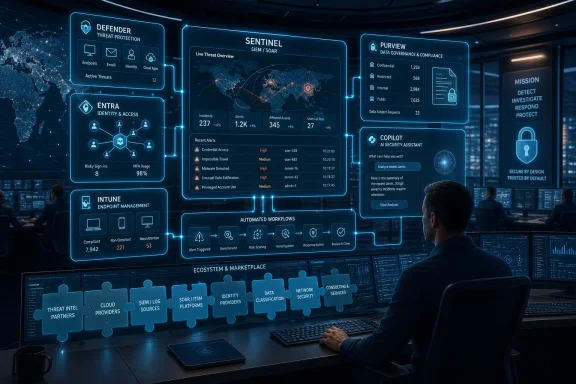
For Mphasis, that alignment is unusually explicit. The company’s security services are described around Microsoft Sentinel for SIEM and security operations, Microsoft Defender for threat protection, Microsoft Entra for identity, Microsoft Intune for endpoint management, Microsoft Purview for data protection and compliance, and Microsoft 365 Copilot or security-oriented AI tooling for analyst productivity and automation. This is not a loose “we support Microsoft” claim; it is a managed-service architecture built around Microsoft’s control plane.
That matters because Microsoft has spent the last several years converting its enterprise footprint into a security platform. Windows, Entra ID, Microsoft 365, Azure, Defender, Purview, and Sentinel now form a dense fabric of telemetry and policy enforcement. The same consolidation that makes Microsoft attractive to customers also makes it difficult to operate well without specialized expertise.
Mphasis is betting that the next wave of security outsourcing will not be defined by who can run a generic SOC cheapest. It will be defined by who can make a large vendor platform work across identity, devices, cloud workloads, data governance, and incident response without drowning customers in alerts and licensing complexity.
That is the old promise of a managed security service provider, updated for the Microsoft era. Sentinel can collect and correlate logs. Defender can detect suspicious activity across endpoints, identities, email, apps, and cloud resources. Entra can enforce access rules. Purview can classify and govern data. Intune can manage devices. But none of that automatically becomes a coherent defense program.
The gap between “deployed” and “operational” is where many Microsoft security projects struggle. Organizations often own licenses to powerful tools long before they have mature detection engineering, incident playbooks, retention policies, conditional access discipline, endpoint hygiene, and data governance practices. A services provider can close that gap — if it brings repeatable process rather than just more consultants.
Mphasis’s pitch leans heavily on AI-driven, data-centric, and automation-first cybersecurity. That phrasing is now nearly unavoidable in security marketing, but it points to a real operational pressure. Security teams are being asked to secure more cloud services, more identities, more unmanaged devices, more SaaS data, and now more AI-assisted workflows without a proportional increase in headcount. Automation is no longer a luxury; it is how overextended teams avoid collapse.
The risk is that “AI-driven” becomes a substitute for explaining how judgment is applied. Agentic AI accelerators sound compelling, especially in a SOC context where triage, enrichment, summarization, and playbook execution can consume enormous amounts of analyst time. But security buyers should press for specifics: where is AI allowed to recommend, where is it allowed to act, and where does a human remain accountable?
Large enterprises rarely run clean Microsoft-only environments. They have legacy infrastructure, multiple clouds, acquired companies, regulatory obligations, regional operating units, privileged users, unmanaged assets, and decades of process debt. Microsoft may provide the platform, but the hard work is mapping that platform onto messy reality.
That is where MISA becomes strategically useful to Microsoft. It gives Redmond a vetted partner ecosystem that can extend adoption, implement use cases, operate customer environments, and reassure buyers that they are not being left alone with a giant toolbox. For services firms, MISA creates a route into Microsoft-aligned customer demand.
Mphasis’s marketplace listing for managed Microsoft security services reinforces that pattern. Marketplace availability is not just a convenience; it reflects the modern enterprise procurement model. Customers increasingly want to evaluate, buy, and attach services through cloud marketplaces because budgets, credits, procurement controls, and vendor management are already organized there.
This also tells us something about where Microsoft wants the security channel to go. The company is not merely selling software seats; it is encouraging packaged service offers that make those seats more valuable. Partners that can show integrated offerings around qualifying Microsoft security products become part of that flywheel.
That assumption is increasingly plausible. Entra governs identity and access, which is now the center of enterprise security. Defender provides endpoint, identity, email, cloud app, and workload protection across Microsoft’s security portfolio. Intune handles device compliance and management. Purview governs information protection, data loss prevention, retention, eDiscovery, and compliance workflows. Sentinel acts as the security operations hub.
The result is a platform that can be powerful precisely because it is interconnected. A risky sign-in can inform conditional access. An endpoint detection can trigger investigation. A data sensitivity label can influence protection policy. A Sentinel rule can orchestrate a response. A Copilot-style assistant can summarize incident context for analysts who otherwise would spend precious minutes moving between portals.
But integration cuts both ways. When the Microsoft stack is well configured, it can reduce fragmentation and speed response. When it is poorly configured, it can create a false sense of security backed by expensive licenses and noisy dashboards. The difference lies in identity design, logging strategy, alert tuning, incident workflow, and governance discipline.
Mphasis is effectively saying it can supply that discipline. The company’s Cyber Fusion Center language suggests a model that blends threat intelligence, detection, incident response, automation, and business context. That is a more ambitious proposition than simply monitoring alerts, and it is the right direction for customers who need security operations to connect with risk management rather than exist as a separate technical silo.
This is where Purview, Entra, and Defender become more than adjacent products. Copilot-era security depends on knowing who can access what, which data is sensitive, how that data is governed, and whether suspicious access patterns are being detected. AI does not eliminate the need for security architecture; it punishes organizations that postponed it.
Mphasis’s data-centric language fits that reality. Enterprises rolling out AI capabilities need to understand not just endpoint compromise or phishing risk, but also overshared files, stale permissions, shadow data repositories, and compliance exposure. Microsoft provides many of the controls, but operating them across a global enterprise is a substantial program.
The more interesting claim is around agentic AI accelerators. In security operations, agentic workflows could help gather evidence, correlate events, draft response steps, open tickets, recommend containment actions, or prepare executive summaries. Used carefully, that can reduce fatigue and speed response. Used carelessly, it can automate bad assumptions at machine speed.
That is why the best test of any AI-driven security service is not whether it has AI, but how it controls AI. Customers should ask about auditability, approval gates, model boundaries, data handling, prompt injection defenses, and how the provider validates AI-generated recommendations. The arrival of AI in the SOC is inevitable; blind trust in AI is optional.
For buyers, that should be treated as a useful signal rather than a final answer. MISA membership can reduce uncertainty around Microsoft alignment, but it cannot replace due diligence on service quality, staffing model, response times, escalation procedures, regulatory expertise, regional coverage, and contract terms. A badge can open the door; operational evidence should decide the deal.
This distinction matters because the managed security market is crowded and sometimes difficult to evaluate. Many providers promise 24/7 monitoring, threat hunting, incident response, compliance support, and automation. The differentiator is often not the brochure but the runbook: what happens at 2:00 a.m. when Defender flags a suspicious token theft, Sentinel correlates lateral movement, and the business wants to know whether to disable accounts, isolate hosts, notify counsel, or halt a deployment?
Mphasis has the advantage of being able to wrap its offer around a platform many enterprises already own. That can simplify adoption, especially for customers standardized on Microsoft 365 E5, Azure, and Defender. But it also means customers must understand which outcomes are included in the service and which still require internal ownership.
The most mature buyers will view Mphasis as a force multiplier, not a substitute for security leadership. Outsourcing monitoring does not outsource accountability. A good managed service sharpens the customer’s security operating model; a weak one becomes a dependency that hides problems until a crisis reveals them.
That does not mean every organization should standardize entirely on Microsoft. There are excellent non-Microsoft tools across endpoint detection, cloud security, identity governance, vulnerability management, data protection, and SIEM. Many enterprises will continue to run hybrid security stacks because risk profiles, acquisitions, regulations, and historical investments demand it.
But it does mean Microsoft-first security strategies are becoming easier to staff, procure, and operate through major service providers. This is a practical advantage. Security architecture is not just about choosing the best individual tool; it is about sustaining a working system over time.
The Windows endpoint remains central to that system, but the perimeter has moved. Identity is the control plane. Data is the asset. Cloud configuration is the attack surface. Devices are policy enforcement points. Email and collaboration suites are both productivity platforms and threat channels. A provider that can connect these pieces through Microsoft’s stack can offer meaningful value.
The caution is vendor concentration. Consolidating around Microsoft can reduce integration overhead, but it can also increase dependency on Microsoft licensing, portals, telemetry assumptions, and roadmap decisions. Mphasis’s Microsoft alignment is a strength for customers committed to that ecosystem; it is less compelling for organizations deliberately pursuing vendor diversity.
Modern MSSPs must understand business context, not just indicators of compromise. They must know which identities are privileged, which systems are crown jewels, which data is regulated, which alerts are noise, and which automated actions are safe. That requires tighter integration with the platforms customers already use.
Mphasis’s MISA membership reflects the industry’s move away from tool-agnostic monitoring as the only selling point. Vendor-agnostic expertise remains valuable, but many customers now want deep operational excellence in the stack they actually own. For Microsoft customers, that means a provider must be fluent in Sentinel analytics rules, Defender incidents, Entra conditional access, Intune compliance, Purview governance, and the evolving role of Copilot.
There is also a commercial reality. Microsoft’s marketplace and partner programs shape demand. A service available through Microsoft channels can be easier to discover, easier to justify, and easier to buy. That does not make it better by itself, but it changes the path from evaluation to deployment.
This is why the announcement lands as more than corporate boilerplate. It shows Mphasis choosing a lane in a market where customers are demanding both consolidation and expertise. The company is not trying to be a neutral overlay above every security platform in this message. It is presenting itself as a specialist operator for enterprises leaning into Microsoft.
Customers should expect Mphasis to define those metrics clearly. They should ask how the service handles onboarding, baseline assessment, detection tuning, identity hardening, incident severity, customer approvals, reporting cadence, and post-incident lessons learned. They should also ask how the provider adapts as Microsoft changes product names, portals, licensing bundles, and feature boundaries.
This is especially important because Microsoft’s security portfolio evolves quickly. Features move, products are renamed, capabilities are bundled differently, and Copilot-related functions continue to mature. A managed service provider must absorb that churn so the customer does not have to relearn the platform every quarter.
The best version of this partnership is straightforward. Mphasis uses Microsoft’s platform depth, adds domain expertise and automation, and gives enterprises a more coherent way to protect identities, endpoints, data, apps, and infrastructure. The weaker version is also easy to imagine: another services wrapper around tools customers already own, heavy on AI vocabulary and light on accountability.
That difference will be determined in delivery, not announcement language. MISA membership gets Mphasis into the right ecosystem. Execution will decide whether it becomes a trusted security operator or just another name in the Microsoft partner catalog.
The larger story is that Microsoft’s security stack has become too broad, too integrated, and too operationally demanding for many customers to consume alone. Mphasis is positioning itself as the human, process, and automation layer around that stack — a services company trying to turn Microsoft Sentinel, Defender, Entra, Intune, Purview, and Copilot into something closer to an operating model. That is a rational bet, but it also raises the question every CIO and CISO should ask when a partner joins a vendor-backed alliance: does this make security better, or merely make procurement easier?
 Mphasis Is Buying Deeper Into Microsoft’s Security Gravity
MISA membership is not just a badge for a partner website. Microsoft describes the Microsoft Intelligent Security Association as an ecosystem of security software companies and service providers whose offerings integrate with Microsoft Security technology. In practice, that means members are expected to align themselves with Microsoft’s security products, marketplace motions, and customer-facing co-sell machinery.For Mphasis, that alignment is unusually explicit. The company’s security services are described around Microsoft Sentinel for SIEM and security operations, Microsoft Defender for threat protection, Microsoft Entra for identity, Microsoft Intune for endpoint management, Microsoft Purview for data protection and compliance, and Microsoft 365 Copilot or security-oriented AI tooling for analyst productivity and automation. This is not a loose “we support Microsoft” claim; it is a managed-service architecture built around Microsoft’s control plane.
That matters because Microsoft has spent the last several years converting its enterprise footprint into a security platform. Windows, Entra ID, Microsoft 365, Azure, Defender, Purview, and Sentinel now form a dense fabric of telemetry and policy enforcement. The same consolidation that makes Microsoft attractive to customers also makes it difficult to operate well without specialized expertise.
Mphasis is betting that the next wave of security outsourcing will not be defined by who can run a generic SOC cheapest. It will be defined by who can make a large vendor platform work across identity, devices, cloud workloads, data governance, and incident response without drowning customers in alerts and licensing complexity.
The Real Product Is Operational Confidence
The announcement emphasizes Managed Security Services, Cyber Fusion Center services, and consulting and advisory work. That combination tells us what Mphasis thinks the market is buying. Enterprises do not simply want dashboards; they want confidence that someone is watching, tuning, investigating, escalating, and translating Microsoft’s telemetry into decisions.That is the old promise of a managed security service provider, updated for the Microsoft era. Sentinel can collect and correlate logs. Defender can detect suspicious activity across endpoints, identities, email, apps, and cloud resources. Entra can enforce access rules. Purview can classify and govern data. Intune can manage devices. But none of that automatically becomes a coherent defense program.
The gap between “deployed” and “operational” is where many Microsoft security projects struggle. Organizations often own licenses to powerful tools long before they have mature detection engineering, incident playbooks, retention policies, conditional access discipline, endpoint hygiene, and data governance practices. A services provider can close that gap — if it brings repeatable process rather than just more consultants.
Mphasis’s pitch leans heavily on AI-driven, data-centric, and automation-first cybersecurity. That phrasing is now nearly unavoidable in security marketing, but it points to a real operational pressure. Security teams are being asked to secure more cloud services, more identities, more unmanaged devices, more SaaS data, and now more AI-assisted workflows without a proportional increase in headcount. Automation is no longer a luxury; it is how overextended teams avoid collapse.
The risk is that “AI-driven” becomes a substitute for explaining how judgment is applied. Agentic AI accelerators sound compelling, especially in a SOC context where triage, enrichment, summarization, and playbook execution can consume enormous amounts of analyst time. But security buyers should press for specifics: where is AI allowed to recommend, where is it allowed to act, and where does a human remain accountable?
Microsoft’s Platform Strategy Creates Room for Partners, Not Less
A superficial reading of Microsoft’s security expansion might suggest that partners should be squeezed out. If Microsoft sells the endpoint agent, the SIEM, the identity platform, the compliance suite, the device manager, and the AI assistant, why does an enterprise need a third party? The answer is that Microsoft’s breadth creates a services problem as much as it solves a tooling problem.Large enterprises rarely run clean Microsoft-only environments. They have legacy infrastructure, multiple clouds, acquired companies, regulatory obligations, regional operating units, privileged users, unmanaged assets, and decades of process debt. Microsoft may provide the platform, but the hard work is mapping that platform onto messy reality.
That is where MISA becomes strategically useful to Microsoft. It gives Redmond a vetted partner ecosystem that can extend adoption, implement use cases, operate customer environments, and reassure buyers that they are not being left alone with a giant toolbox. For services firms, MISA creates a route into Microsoft-aligned customer demand.
Mphasis’s marketplace listing for managed Microsoft security services reinforces that pattern. Marketplace availability is not just a convenience; it reflects the modern enterprise procurement model. Customers increasingly want to evaluate, buy, and attach services through cloud marketplaces because budgets, credits, procurement controls, and vendor management are already organized there.
This also tells us something about where Microsoft wants the security channel to go. The company is not merely selling software seats; it is encouraging packaged service offers that make those seats more valuable. Partners that can show integrated offerings around qualifying Microsoft security products become part of that flywheel.
The Enterprise Security Stack Is Becoming a Microsoft Stack by Default
For WindowsForum readers, the Microsoft product list in this announcement is familiar but important. Sentinel, Defender, Entra, Intune, Purview, and Copilot touch nearly every part of a modern Microsoft estate. This is not a niche integration for one tool; it is a services model built around the assumption that Microsoft is the security backbone.That assumption is increasingly plausible. Entra governs identity and access, which is now the center of enterprise security. Defender provides endpoint, identity, email, cloud app, and workload protection across Microsoft’s security portfolio. Intune handles device compliance and management. Purview governs information protection, data loss prevention, retention, eDiscovery, and compliance workflows. Sentinel acts as the security operations hub.
The result is a platform that can be powerful precisely because it is interconnected. A risky sign-in can inform conditional access. An endpoint detection can trigger investigation. A data sensitivity label can influence protection policy. A Sentinel rule can orchestrate a response. A Copilot-style assistant can summarize incident context for analysts who otherwise would spend precious minutes moving between portals.
But integration cuts both ways. When the Microsoft stack is well configured, it can reduce fragmentation and speed response. When it is poorly configured, it can create a false sense of security backed by expensive licenses and noisy dashboards. The difference lies in identity design, logging strategy, alert tuning, incident workflow, and governance discipline.
Mphasis is effectively saying it can supply that discipline. The company’s Cyber Fusion Center language suggests a model that blends threat intelligence, detection, incident response, automation, and business context. That is a more ambitious proposition than simply monitoring alerts, and it is the right direction for customers who need security operations to connect with risk management rather than exist as a separate technical silo.
The Copilot Era Makes Security Services More Necessary, Not Less
The inclusion of Microsoft 365 Copilot in the broader service framing is particularly telling. AI assistants introduce new productivity opportunities, but they also expose old governance failures. If permissions, labels, retention rules, and data classification are weak, AI can make that weakness more visible and more consequential.This is where Purview, Entra, and Defender become more than adjacent products. Copilot-era security depends on knowing who can access what, which data is sensitive, how that data is governed, and whether suspicious access patterns are being detected. AI does not eliminate the need for security architecture; it punishes organizations that postponed it.
Mphasis’s data-centric language fits that reality. Enterprises rolling out AI capabilities need to understand not just endpoint compromise or phishing risk, but also overshared files, stale permissions, shadow data repositories, and compliance exposure. Microsoft provides many of the controls, but operating them across a global enterprise is a substantial program.
The more interesting claim is around agentic AI accelerators. In security operations, agentic workflows could help gather evidence, correlate events, draft response steps, open tickets, recommend containment actions, or prepare executive summaries. Used carefully, that can reduce fatigue and speed response. Used carelessly, it can automate bad assumptions at machine speed.
That is why the best test of any AI-driven security service is not whether it has AI, but how it controls AI. Customers should ask about auditability, approval gates, model boundaries, data handling, prompt injection defenses, and how the provider validates AI-generated recommendations. The arrival of AI in the SOC is inevitable; blind trust in AI is optional.
MISA Membership Is Credibility, Not a Guarantee
It would be easy to overstate what MISA membership means. It does not mean Mphasis is automatically the right partner for every Microsoft customer, nor does it prove that its services outperform rivals. It does mean the company has joined a Microsoft-recognized ecosystem designed around integrated security offerings and marketplace participation.For buyers, that should be treated as a useful signal rather than a final answer. MISA membership can reduce uncertainty around Microsoft alignment, but it cannot replace due diligence on service quality, staffing model, response times, escalation procedures, regulatory expertise, regional coverage, and contract terms. A badge can open the door; operational evidence should decide the deal.
This distinction matters because the managed security market is crowded and sometimes difficult to evaluate. Many providers promise 24/7 monitoring, threat hunting, incident response, compliance support, and automation. The differentiator is often not the brochure but the runbook: what happens at 2:00 a.m. when Defender flags a suspicious token theft, Sentinel correlates lateral movement, and the business wants to know whether to disable accounts, isolate hosts, notify counsel, or halt a deployment?
Mphasis has the advantage of being able to wrap its offer around a platform many enterprises already own. That can simplify adoption, especially for customers standardized on Microsoft 365 E5, Azure, and Defender. But it also means customers must understand which outcomes are included in the service and which still require internal ownership.
The most mature buyers will view Mphasis as a force multiplier, not a substitute for security leadership. Outsourcing monitoring does not outsource accountability. A good managed service sharpens the customer’s security operating model; a weak one becomes a dependency that hides problems until a crisis reveals them.
Windows Shops Should Read This as a Platform Maturity Signal
For Windows-heavy organizations, the announcement is part of a broader pattern: Microsoft security is no longer a set of add-ons around Windows. It is becoming the default enterprise security layer for identity, endpoint, data, cloud, and operations. Mphasis joining MISA reinforces that partner investment is following the same center of gravity.That does not mean every organization should standardize entirely on Microsoft. There are excellent non-Microsoft tools across endpoint detection, cloud security, identity governance, vulnerability management, data protection, and SIEM. Many enterprises will continue to run hybrid security stacks because risk profiles, acquisitions, regulations, and historical investments demand it.
But it does mean Microsoft-first security strategies are becoming easier to staff, procure, and operate through major service providers. This is a practical advantage. Security architecture is not just about choosing the best individual tool; it is about sustaining a working system over time.
The Windows endpoint remains central to that system, but the perimeter has moved. Identity is the control plane. Data is the asset. Cloud configuration is the attack surface. Devices are policy enforcement points. Email and collaboration suites are both productivity platforms and threat channels. A provider that can connect these pieces through Microsoft’s stack can offer meaningful value.
The caution is vendor concentration. Consolidating around Microsoft can reduce integration overhead, but it can also increase dependency on Microsoft licensing, portals, telemetry assumptions, and roadmap decisions. Mphasis’s Microsoft alignment is a strength for customers committed to that ecosystem; it is less compelling for organizations deliberately pursuing vendor diversity.
The Announcement Says as Much About the MSSP Market as It Does About Mphasis
Managed security has changed because enterprise environments have changed. The old SOC model was built around collecting logs, watching alerts, and escalating tickets. That still exists, but it is insufficient when attacks move through identity systems, SaaS permissions, cloud APIs, endpoint agents, and collaboration platforms in a matter of minutes.Modern MSSPs must understand business context, not just indicators of compromise. They must know which identities are privileged, which systems are crown jewels, which data is regulated, which alerts are noise, and which automated actions are safe. That requires tighter integration with the platforms customers already use.
Mphasis’s MISA membership reflects the industry’s move away from tool-agnostic monitoring as the only selling point. Vendor-agnostic expertise remains valuable, but many customers now want deep operational excellence in the stack they actually own. For Microsoft customers, that means a provider must be fluent in Sentinel analytics rules, Defender incidents, Entra conditional access, Intune compliance, Purview governance, and the evolving role of Copilot.
There is also a commercial reality. Microsoft’s marketplace and partner programs shape demand. A service available through Microsoft channels can be easier to discover, easier to justify, and easier to buy. That does not make it better by itself, but it changes the path from evaluation to deployment.
This is why the announcement lands as more than corporate boilerplate. It shows Mphasis choosing a lane in a market where customers are demanding both consolidation and expertise. The company is not trying to be a neutral overlay above every security platform in this message. It is presenting itself as a specialist operator for enterprises leaning into Microsoft.
The Hard Part Comes After the Press Release
The real test for Mphasis will be whether it can turn Microsoft integration into measurable security outcomes. Faster detection is a claim; mean time to detect is a metric. Automated response is a claim; containment time and false-positive rates are metrics. Data-centric security is a claim; reduced oversharing, better classification coverage, and auditable policy enforcement are metrics.Customers should expect Mphasis to define those metrics clearly. They should ask how the service handles onboarding, baseline assessment, detection tuning, identity hardening, incident severity, customer approvals, reporting cadence, and post-incident lessons learned. They should also ask how the provider adapts as Microsoft changes product names, portals, licensing bundles, and feature boundaries.
This is especially important because Microsoft’s security portfolio evolves quickly. Features move, products are renamed, capabilities are bundled differently, and Copilot-related functions continue to mature. A managed service provider must absorb that churn so the customer does not have to relearn the platform every quarter.
The best version of this partnership is straightforward. Mphasis uses Microsoft’s platform depth, adds domain expertise and automation, and gives enterprises a more coherent way to protect identities, endpoints, data, apps, and infrastructure. The weaker version is also easy to imagine: another services wrapper around tools customers already own, heavy on AI vocabulary and light on accountability.
That difference will be determined in delivery, not announcement language. MISA membership gets Mphasis into the right ecosystem. Execution will decide whether it becomes a trusted security operator or just another name in the Microsoft partner catalog.
The Microsoft Security Bet Now Has a New Services Face
Mphasis’s move is concrete enough to matter, but not so broad that buyers should suspend skepticism. It is best understood as a signal that Microsoft-centered security operations are becoming a mainstream services category, not a niche implementation practice.- Mphasis joined the Microsoft Intelligent Security Association on June 29, 2026, positioning its cybersecurity services more directly inside Microsoft’s security partner ecosystem.
- The company’s offer is built around Microsoft Sentinel, Entra, Intune, Purview, Defender, and Copilot-related capabilities rather than a loosely connected set of third-party tools.
- The practical value for enterprises will depend on whether Mphasis can improve detection, investigation, response, governance, and automation outcomes across real customer environments.
- MISA membership should be treated as a credibility signal and procurement accelerator, not as proof of service quality by itself.
- Microsoft-focused organizations should evaluate the offer against measurable operational metrics, including response times, false positives, incident handling, identity controls, and data protection maturity.
References
- Primary source: scanx.trade
Published: 2026-06-29T08:12:13.729978
Mphasis joins Microsoft Intelligent Security Association
Mphasis has joined the Microsoft Intelligent Security Association (MISA) to enhance its cybersecurity offerings using AI-driven Microsoft technologies. The partnership leverages tools like Microsoft Sentinel and Defender to improve threat detection and response for global enterprises.scanx.trade - Official source: marketplace.microsoft.com
Microsoft Marketplace | cloud solutions, AI apps, and agents
marketplace.microsoft.com
- Official source: microsoft.com
Microsoft Intelligent Security Association (MISA) | Microsoft Security
Explore the Microsoft Intelligent Security Association (MISA), delivering cybersecurity solutions from MSSP and software development partners.www.microsoft.com
- Related coverage: mphasis.com
- Related coverage: mnemonic.io
- Related coverage: logicalis.com
Logicalis joins Microsoft Intelligent Security Association (MISA)
Monday 4th October 2021, London – Logicalis, an international IT solutions and managed service provider, has joined the Microsoft Intelligent Security Association (MISA). MISA is an ecosystem of independent software vendors and managed security service providers that have integrated their... www.logicalis.com

- Official source: microsoftpartners.microsoft.com
- Related coverage: businesswire.com
- Official source: cdn-dynmedia-1.microsoft.com
Microsofts Expanded Horizons in Security licensed INT003 000345
PDF documentcdn-dynmedia-1.microsoft.com
- Related coverage: info.lightstream.io
Microsoft Intelligent Security Association (MISA) - Data Sheet_VFinal
PDF documentinfo.lightstream.io
- Related coverage: marketingable.mphasis.com
