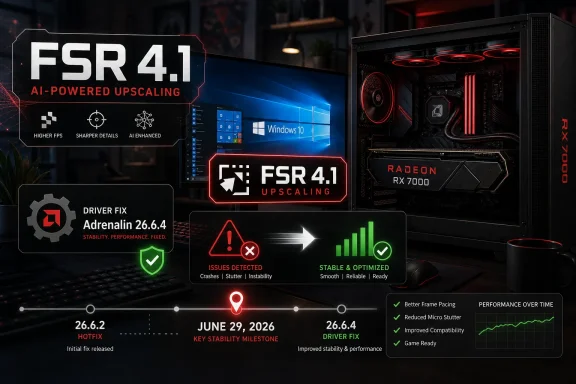
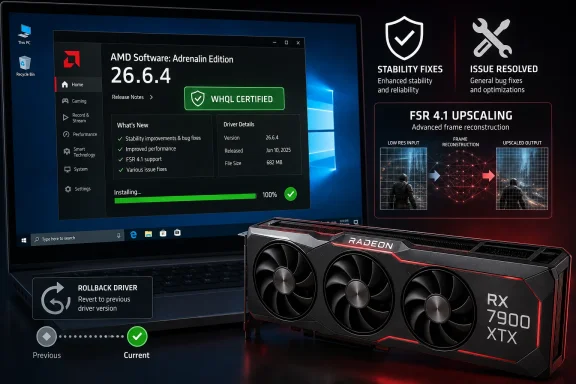
AMD released AMD Software Adrenalin Edition 26.6.4 WHQL on June 29, 2026, for Windows Radeon users, delivering a signed maintenance driver that fixes Windows 10 installation failures on Radeon RX 7000-and-newer GPUs and crashes tied to FSR 4.1 on RDNA 3 cards. The release is small in scope but large in signal: AMD is moving quickly, maybe too quickly, through a messy June driver cycle. For gamers, creators, and admins, 26.6.4 is less a celebration than a stabilization patch after the company’s FSR 4.1 expansion collided with real-world Windows configurations.
The headline fix in Adrenalin 26.6.4 WHQL is an intermittent installation issue seen when installing Adrenalin 26.6.2 on Windows 10 systems with Radeon RX 7000 series and newer graphics products. That matters because 26.6.2 was not an obscure optional drop; it carried the attention-grabbing arrival of AMD FSR Upscaling 4.1 support for Radeon RX 7000 series GPUs.
In other words, AMD pushed a meaningful feature expansion to RDNA 3 users, then had to chase the consequences across the installer, game runtime, and professional rendering stack. A fourth WHQL-signed driver in one month is not business as usual. WHQL certification implies a level of Microsoft validation, but it does not magically turn a fast-moving driver branch into a calm one.
The timing also lands awkwardly for Windows 10 users. Microsoft’s aging OS remains heavily used by gamers and workstation owners, and many of those machines are exactly the kind of systems likely to pair a mature Windows 10 install with a newer Radeon card. When the driver installer itself becomes unreliable, the problem stops being a benchmark footnote and becomes an operational concern.
AMD’s release notes are blunt enough to be useful. The company is not pretending that the only affected audience is a tiny subset of experimental users. It specifically names Windows 10, Radeon RX 7000 series and above, FSR 4.1, Battlefield 6, Blender, Cinema 4D, Ryzen AI, and AI Bundle components.
But image reconstruction features sit in a complicated place. They touch game integration, driver behavior, per-title profiles, latency handling, frame pacing, overlays, capture tools, and vendor control panels. A bug in any one of those layers can look like “the game crashed,” even when the underlying failure is far more specific.
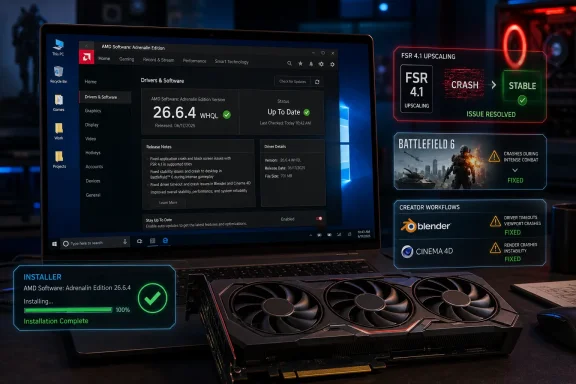
Adrenalin 26.6.4 addresses an intermittent application crash observed in some games with AMD FSR Upscaling 4.1 enabled on Radeon RX 7000 series graphics products. That phrasing is narrow, but the practical implication is broad. If you own an RX 7600, RX 7700 XT, RX 7800 XT, RX 7900 XT, or RX 7900 XTX and installed 26.6.2 mainly to try FSR 4.1, this is the driver AMD now wants you to notice.
The release also shows the limits of feature-first driver marketing. A new upscaler version sounds like a clean product bullet. In the field, it becomes a matrix: Windows version, GPU generation, game build, overlay state, recording state, AI package availability, and application workload.
That creates a support problem for GPU vendors. The most active driver work is aimed at new GPUs, new games, new AI features, and new Windows 11 paths. Yet many of the users buying or keeping high-end Radeon hardware are still sitting on stable Windows 10 images they do not want to disturb.
When an installer problem appears on Windows 10 with RX 7000-and-newer hardware, it lands right at that fault line. This is not a case of someone trying to run a modern driver on a forgotten pre-RDNA card. It affects recent GPU families on an operating system that remains deeply embedded in the Windows gaming base.
For IT pros, the lesson is familiar: support status and deployment reality are not the same thing. A vendor may be steering toward Windows 11, but your installed base may not be. Driver release notes are where that contradiction tends to become visible first.
There is also a Radeon RX 9000 series-specific issue where AMD FSR Upscaling and AMD FSR Frame Generation may show as inactive in AMD Software Adrenalin Edition while playing Battlefield 6 even when enabled. That is a different class of bug from a crash. It is a control-plane problem: the game and software may not agree on feature state, or the software may fail to report it correctly.
This matters because modern GPU drivers are no longer just display drivers. They are game compatibility layers, streaming utilities, AI package launchers, frame generation managers, capture systems, tuning dashboards, and telemetry endpoints. Battlefield 6 is not merely “a game with bugs” in this story; it is a stress test for how many responsibilities AMD has packed into Adrenalin.
The Ryzen AI 9 HX 370 mention is especially interesting because it pulls AMD’s mobile silicon strategy into the driver conversation. This is not only about desktop Radeon cards. AMD’s push into AI-branded notebook platforms means its graphics software must behave across hybrid, mobile, and integrated configurations that are harder to validate than a single desktop GPU in a test bench.
But WHQL has always been misunderstood. It is not a guarantee that Blender will render correctly on every Radeon RX 7900 XTX system, or that Battlefield 6 will behave while Record and Stream is capturing footage, or that every regional AI Bundle dependency will download properly. WHQL validates driver compliance against Microsoft’s certification requirements; it does not certify perfection across the entire PC gaming and content-creation universe.
That gap is where user frustration lives. Gamers see WHQL and assume “safe.” Workstation users see a recommended package and assume “stable.” Vendors see a signed release and assume “deployable.” The truth is narrower: WHQL is a floor, not a finish line.
AMD’s 26.6.4 release is therefore both reassuring and cautionary. It is reassuring because AMD is moving quickly to patch a bad install path and an FSR 4.1 crash. It is cautionary because a signed driver can still contain enough known issues that professional users are told to roll back to a March-era release for specific workloads.
That recommendation is unusually consequential. It means the newest WHQL release is not the best release for everyone, and AMD knows it. If your GPU is part of a production pipeline rather than a gaming rig, 26.6.4 may be a branch to avoid until the rendering issues are resolved.
Blender gets a second warning as well: intermittent application crashes may occur on some models while running Blender on Radeon RX 7000 series and newer products, with the same recommendation to install 26.3.1. That points to a regression serious enough that AMD is not merely advising users to wait for a future fix. It is telling affected users to step back three months.
This is where the enthusiast habit of installing every new driver on release day becomes risky. A driver that fixes one game feature can break a creator workflow. A driver that improves one GPU generation’s upscaling path can destabilize another application’s viewport or render path.
That dependency chain creates problems for users in restricted networks, regulated environments, schools, enterprises, and countries where access to common developer platforms is inconsistent. A driver installer that reaches outside the vendor’s own distribution path may behave differently depending on region, firewall policy, DNS filtering, proxy configuration, or corporate security tooling.
For home users, the fix may be as simple as retrying later or changing network conditions. For administrators, it raises a governance question: what exactly is being installed, from where, and under whose update policy? The more AI functionality gets bundled into GPU software, the more driver deployment starts to resemble application-platform deployment.
This is not unique to AMD. Nvidia, Intel, Microsoft, and the broader PC ecosystem are all moving toward drivers as software suites rather than narrow hardware enablers. But AMD’s release notes make the consequence visible: if your feature stack depends on external AI repositories, regional access becomes a driver reliability issue.
That distinction matters because RX 7000 and RX 9000 users may look at the same driver version and see very different risk profiles. RX 7000 owners get a fix for FSR 4.1 crashes. RX 9000 owners still have a Battlefield 6 feature-state reporting problem. Users on professional apps may be better served by 26.3.1 regardless of which of those newer families they own.
This is the reality of generational GPU software now. A single Adrenalin package can mean feature enablement for one generation, regression mitigation for another, and a known-issue holding pattern for a third. The version number is shared, but the lived experience is not.
For WindowsForum readers, that means the first troubleshooting question should no longer be “Are you on the latest driver?” It should be “Which GPU generation, which Windows version, which application, and which feature path are you using?” The latest driver may be correct for one answer and wrong for another.
The safest approach is to treat this as a targeted maintenance release rather than a universal upgrade. If your current driver is stable, your games work, and you do not need FSR 4.1 on RDNA 3 today, there is little glory in rushing. If you do need the fix, install with a rollback plan.
That means downloading the known-good driver before making changes, creating a restore point or system image where appropriate, and avoiding unnecessary variables during installation. Users who rely on Blender or Cinema 4D should be especially conservative, because AMD’s own guidance points them toward 26.3.1 if they encounter rendering failures or crashes.
Admins should be even more cautious. A WHQL signature may satisfy a deployment policy, but the known-issues list should determine rollout scope. Pilot groups exist for exactly this kind of release: one that fixes real problems while leaving enough unresolved edge cases to punish broad, automatic deployment.
 AMD’s Fourth June Driver Is a Patch for the Patch
The headline fix in Adrenalin 26.6.4 WHQL is an intermittent installation issue seen when installing Adrenalin 26.6.2 on Windows 10 systems with Radeon RX 7000 series and newer graphics products. That matters because 26.6.2 was not an obscure optional drop; it carried the attention-grabbing arrival of AMD FSR Upscaling 4.1 support for Radeon RX 7000 series GPUs.In other words, AMD pushed a meaningful feature expansion to RDNA 3 users, then had to chase the consequences across the installer, game runtime, and professional rendering stack. A fourth WHQL-signed driver in one month is not business as usual. WHQL certification implies a level of Microsoft validation, but it does not magically turn a fast-moving driver branch into a calm one.
The timing also lands awkwardly for Windows 10 users. Microsoft’s aging OS remains heavily used by gamers and workstation owners, and many of those machines are exactly the kind of systems likely to pair a mature Windows 10 install with a newer Radeon card. When the driver installer itself becomes unreliable, the problem stops being a benchmark footnote and becomes an operational concern.
AMD’s release notes are blunt enough to be useful. The company is not pretending that the only affected audience is a tiny subset of experimental users. It specifically names Windows 10, Radeon RX 7000 series and above, FSR 4.1, Battlefield 6, Blender, Cinema 4D, Ryzen AI, and AI Bundle components.
FSR 4.1 Reaches RDNA 3, and the Driver Stack Shows the Strain
FSR 4.1 support for Radeon RX 7000 series cards is the context behind much of this turbulence. AMD’s upscaling and frame generation story has become central to its competitive positioning against Nvidia’s DLSS ecosystem and Intel’s XeSS efforts. Extending newer FSR capabilities to RDNA 3 is therefore not just a nice-to-have update; it is part of AMD’s argument that recent Radeon buyers are still on the train.But image reconstruction features sit in a complicated place. They touch game integration, driver behavior, per-title profiles, latency handling, frame pacing, overlays, capture tools, and vendor control panels. A bug in any one of those layers can look like “the game crashed,” even when the underlying failure is far more specific.
Adrenalin 26.6.4 addresses an intermittent application crash observed in some games with AMD FSR Upscaling 4.1 enabled on Radeon RX 7000 series graphics products. That phrasing is narrow, but the practical implication is broad. If you own an RX 7600, RX 7700 XT, RX 7800 XT, RX 7900 XT, or RX 7900 XTX and installed 26.6.2 mainly to try FSR 4.1, this is the driver AMD now wants you to notice.
The release also shows the limits of feature-first driver marketing. A new upscaler version sounds like a clean product bullet. In the field, it becomes a matrix: Windows version, GPU generation, game build, overlay state, recording state, AI package availability, and application workload.
Windows 10 Is Still Too Big to Treat as Legacy Background Noise
The Windows 10 installer fix is the most WindowsForum-relevant part of this release because it exposes a tension vendors would rather not discuss. Windows 10 is nearing the end of its mainstream life, but it is not functionally irrelevant. Enthusiasts, small businesses, labs, and gaming rigs still run it in enormous numbers.That creates a support problem for GPU vendors. The most active driver work is aimed at new GPUs, new games, new AI features, and new Windows 11 paths. Yet many of the users buying or keeping high-end Radeon hardware are still sitting on stable Windows 10 images they do not want to disturb.
When an installer problem appears on Windows 10 with RX 7000-and-newer hardware, it lands right at that fault line. This is not a case of someone trying to run a modern driver on a forgotten pre-RDNA card. It affects recent GPU families on an operating system that remains deeply embedded in the Windows gaming base.
For IT pros, the lesson is familiar: support status and deployment reality are not the same thing. A vendor may be steering toward Windows 11, but your installed base may not be. Driver release notes are where that contradiction tends to become visible first.
Battlefield 6 Is Becoming the Canary in AMD’s Driver Branch
Battlefield 6 appears repeatedly in AMD’s current known-issues list, and that repetition is telling. AMD says an intermittent application crash or driver timeout may occur while playing Battlefield 6 on AMD Ryzen AI 9 HX 370, and that it is actively working with the developer on a resolution. The company also lists texture flickering or corruption while playing Battlefield 6 with AMD Record and Stream enabled on some AMD graphics products.There is also a Radeon RX 9000 series-specific issue where AMD FSR Upscaling and AMD FSR Frame Generation may show as inactive in AMD Software Adrenalin Edition while playing Battlefield 6 even when enabled. That is a different class of bug from a crash. It is a control-plane problem: the game and software may not agree on feature state, or the software may fail to report it correctly.
This matters because modern GPU drivers are no longer just display drivers. They are game compatibility layers, streaming utilities, AI package launchers, frame generation managers, capture systems, tuning dashboards, and telemetry endpoints. Battlefield 6 is not merely “a game with bugs” in this story; it is a stress test for how many responsibilities AMD has packed into Adrenalin.
The Ryzen AI 9 HX 370 mention is especially interesting because it pulls AMD’s mobile silicon strategy into the driver conversation. This is not only about desktop Radeon cards. AMD’s push into AI-branded notebook platforms means its graphics software must behave across hybrid, mobile, and integrated configurations that are harder to validate than a single desktop GPU in a test bench.
WHQL Still Matters, but It No Longer Means What Users Think It Means
The WHQL label gives this release more weight than a preview or hotfix driver. It means the package has passed Microsoft’s Windows Hardware Quality Labs process and is suitable for broader deployment than an unsigned experimental build. For admins, that distinction still matters.But WHQL has always been misunderstood. It is not a guarantee that Blender will render correctly on every Radeon RX 7900 XTX system, or that Battlefield 6 will behave while Record and Stream is capturing footage, or that every regional AI Bundle dependency will download properly. WHQL validates driver compliance against Microsoft’s certification requirements; it does not certify perfection across the entire PC gaming and content-creation universe.
That gap is where user frustration lives. Gamers see WHQL and assume “safe.” Workstation users see a recommended package and assume “stable.” Vendors see a signed release and assume “deployable.” The truth is narrower: WHQL is a floor, not a finish line.
AMD’s 26.6.4 release is therefore both reassuring and cautionary. It is reassuring because AMD is moving quickly to patch a bad install path and an FSR 4.1 crash. It is cautionary because a signed driver can still contain enough known issues that professional users are told to roll back to a March-era release for specific workloads.
The Creator-App Warnings Are the Loudest Part of the Fine Print
The most sobering part of AMD’s notes is not Battlefield 6. It is the warning around Maxon Cinema 4D and Blender. AMD says model flickering or rendering failure may appear in those applications on Radeon RX 7000 series and newer graphics products, and users experiencing the issue are recommended to install Adrenalin 26.3.1.That recommendation is unusually consequential. It means the newest WHQL release is not the best release for everyone, and AMD knows it. If your GPU is part of a production pipeline rather than a gaming rig, 26.6.4 may be a branch to avoid until the rendering issues are resolved.
Blender gets a second warning as well: intermittent application crashes may occur on some models while running Blender on Radeon RX 7000 series and newer products, with the same recommendation to install 26.3.1. That points to a regression serious enough that AMD is not merely advising users to wait for a future fix. It is telling affected users to step back three months.
This is where the enthusiast habit of installing every new driver on release day becomes risky. A driver that fixes one game feature can break a creator workflow. A driver that improves one GPU generation’s upscaling path can destabilize another application’s viewport or render path.
AI Features Add a New Kind of Failure Mode
AMD also lists a failure to install AI Bundle components in some regions with limited access to Hugging Face and GitHub. This is a very 2026 kind of driver issue. The graphics driver is no longer just a binary package delivered from the GPU vendor; parts of the experience may depend on external model repositories and developer-hosting infrastructure.That dependency chain creates problems for users in restricted networks, regulated environments, schools, enterprises, and countries where access to common developer platforms is inconsistent. A driver installer that reaches outside the vendor’s own distribution path may behave differently depending on region, firewall policy, DNS filtering, proxy configuration, or corporate security tooling.
For home users, the fix may be as simple as retrying later or changing network conditions. For administrators, it raises a governance question: what exactly is being installed, from where, and under whose update policy? The more AI functionality gets bundled into GPU software, the more driver deployment starts to resemble application-platform deployment.
This is not unique to AMD. Nvidia, Intel, Microsoft, and the broader PC ecosystem are all moving toward drivers as software suites rather than narrow hardware enablers. But AMD’s release notes make the consequence visible: if your feature stack depends on external AI repositories, regional access becomes a driver reliability issue.
Radeon RX 9000 Owners Are Watching a Different Bug List
Radeon RX 9000 series users are not the main target of the two headline fixes, but they are present in the known issues. The Battlefield 6 problem where FSR Upscaling and FSR Frame Generation may show as inactive in AMD Software while enabled is explicitly tied to RX 9000 series graphics products.That distinction matters because RX 7000 and RX 9000 users may look at the same driver version and see very different risk profiles. RX 7000 owners get a fix for FSR 4.1 crashes. RX 9000 owners still have a Battlefield 6 feature-state reporting problem. Users on professional apps may be better served by 26.3.1 regardless of which of those newer families they own.
This is the reality of generational GPU software now. A single Adrenalin package can mean feature enablement for one generation, regression mitigation for another, and a known-issue holding pattern for a third. The version number is shared, but the lived experience is not.
For WindowsForum readers, that means the first troubleshooting question should no longer be “Are you on the latest driver?” It should be “Which GPU generation, which Windows version, which application, and which feature path are you using?” The latest driver may be correct for one answer and wrong for another.
The Smart Install Is Now a Managed Install
For individual enthusiasts, Adrenalin 26.6.4 is probably worth installing if they were blocked by the Windows 10 installation issue in 26.6.2 or hit crashes with FSR 4.1 enabled on RX 7000 hardware. For anyone not affected, the calculus is more complicated.The safest approach is to treat this as a targeted maintenance release rather than a universal upgrade. If your current driver is stable, your games work, and you do not need FSR 4.1 on RDNA 3 today, there is little glory in rushing. If you do need the fix, install with a rollback plan.
That means downloading the known-good driver before making changes, creating a restore point or system image where appropriate, and avoiding unnecessary variables during installation. Users who rely on Blender or Cinema 4D should be especially conservative, because AMD’s own guidance points them toward 26.3.1 if they encounter rendering failures or crashes.
Admins should be even more cautious. A WHQL signature may satisfy a deployment policy, but the known-issues list should determine rollout scope. Pilot groups exist for exactly this kind of release: one that fixes real problems while leaving enough unresolved edge cases to punish broad, automatic deployment.
June’s Driver Sprint Leaves a Clear Trail
AMD’s 26.6.4 release is best understood as a corrective move after an ambitious feature push. It fixes important problems, but it also confirms that the 26.6.x branch has been turbulent for some users.- Users on Windows 10 with Radeon RX 7000 series or newer GPUs should treat 26.6.4 as the relevant fix if 26.6.2 produced installation problems.
- Radeon RX 7000 series users who saw crashes with FSR Upscaling 4.1 enabled have a specific reason to move to 26.6.4.
- Battlefield 6 remains a known trouble spot across crashes, driver timeouts, texture corruption, capture features, and FSR status reporting.
- Blender and Cinema 4D users should not assume the newest WHQL driver is the safest choice, because AMD recommends 26.3.1 for affected rendering issues.
- AI Bundle installation failures show how external service access can now affect GPU software deployment.
- WHQL certification makes this release more deployable, but it does not erase the need for workload-specific testing.
References
- Primary source: TechPowerUp
Published: 2026-06-29T18:20:34.436709
AMD Software Adrenalin 26.6.4 WHQL Drivers Released | TechPowerUp
AMD today released its rare fourth WHQL-signed driver release in a month, the Adrenalin 26.6.4 WHQL. The drivers fix an issue seen when installing recent versions of the driver on Windows 10 machines with Radeon RX 7000 series (or later) GPUs. The drivers also address an application crash...www.techpowerup.com - Related coverage: amd.com
AMD Radeon™ RX 6700 Drivers and Downloads | Latest Version
Get drivers and downloads for the latest version of AMD Radeon™ RX 6700www.amd.com - Related coverage: techspot.com
AMD Drivers | TechSpot
www.techspot.com
- Related coverage: pcmasters.net
AMD Adrenalin 26.6.2 WHQL Driver Download: New FSR 4.1 for the Radeon RX 7000 Series - PC Masters
AMD has released the “Adrenalin Edition 26.6.2 WHQL” driver update—the second version in June. This update focuses heavily on the RDNA 3 architecture and, in particular, brings FSR upscaling 4.1 to the Radeon RX 7000 series graphics cards.www.pcmasters.net - Related coverage: windowscentral.com
AMD kills Windows 10 support in its latest Adrenalin update — Battlefield 6 picks up bug fixes and optimizations | Windows Central
Also on the killing floor are new game and Vulkan extension support for RDNA 1 and RDNA 2 GPUs.www.windowscentral.com - Related coverage: drivers.amd.com