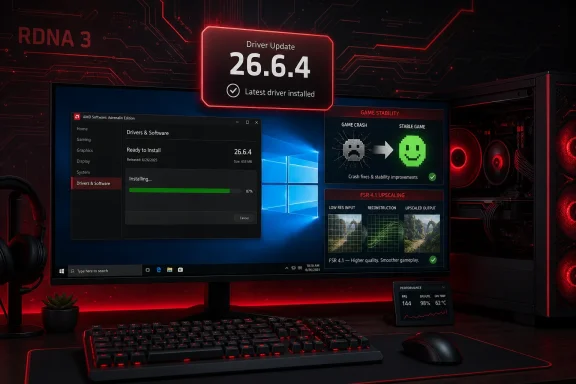
AMD confirmed in late June 2026 that AMD Software: Adrenalin Edition 26.6.2 can fail on some Windows 10 systems with Radeon RX graphics, leaving the GPU flagged in Device Manager and forcing affected users to roll back or install a newer hotfix driver. The failure is not merely a messy installer annoyance; it cuts across the promise AMD attached to this release, namely wider access to FSR 4.1 for Radeon RX 7000 owners. For Windows holdouts, gamers, and IT pros who still maintain Windows 10 fleets, the episode is a reminder that graphics drivers are now platform policy as much as performance plumbing.
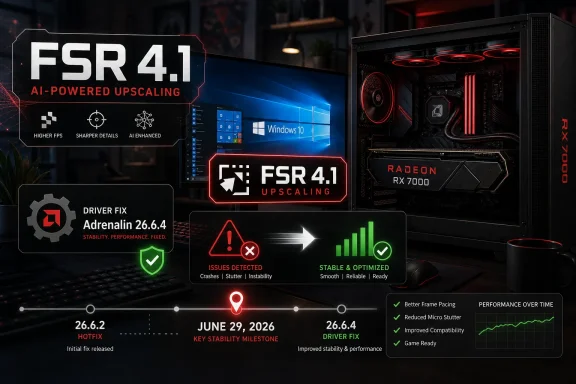
Adrenalin 26.6.2 was supposed to be an enthusiast-friendly driver. Its headline feature was support for AMD FSR Upscaling 4.1 on Radeon RX 7000-series graphics cards, extending newer image reconstruction technology to RDNA 3 hardware rather than keeping it confined to the newest generation.
That matters because the RX 7000 family remains a live, powerful installed base. Many of those cards sit in systems built by users who do not replace a GPU every generation, and many of those systems still run Windows 10 because the machine is stable, the user dislikes Windows 11, or the hardware/software stack has been tuned over years.
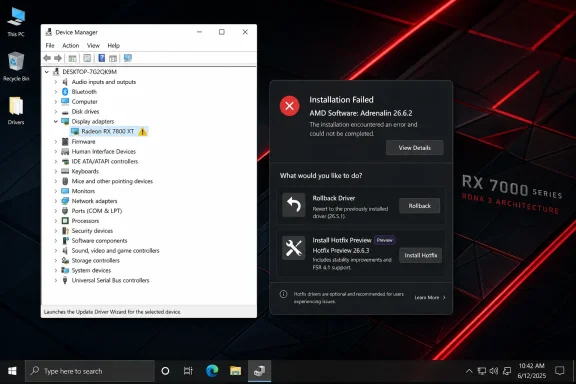
Instead of a clean victory lap, the release exposed a brittle edge in AMD’s Windows support story. Users reported AMD Software failing to launch after installation, Windows showing a yellow warning marker next to the Radeon adapter, and in some cases the familiar Code 43-style failure mode that tells users the device has reported a problem.
The important distinction is that this was not just a game-specific bug. A game crash can often be worked around by changing a graphics preset, disabling an overlay, or waiting for a title patch. A driver that leaves the GPU in a warning state is closer to an operating-system-level breakage, because Windows itself is no longer comfortable loading the device stack.
For a desktop gamer, that can mean missing displays, reduced resolution, broken hardware acceleration, or an AMD control panel that refuses to open. For a workstation user, it can mean lost GPU acceleration in creative apps or a machine that suddenly looks unfit for production work. For an administrator, it means a driver package that cannot be trusted in broad deployment without testing on the exact operating-system image in use.
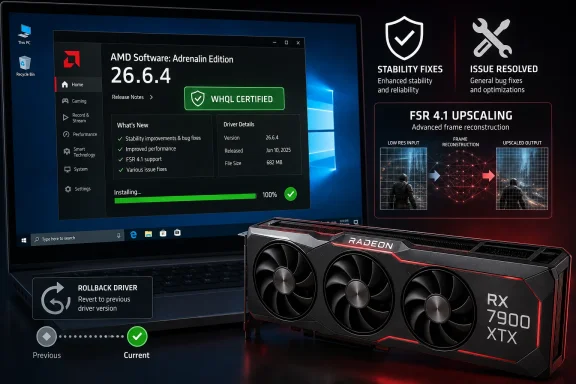
AMD’s own workaround was conservative: affected users could temporarily revert to Adrenalin 26.6.1. That recommendation matters because it implicitly separated the broken package from the hardware itself. The Radeon cards were not failing; the driver/software combination was.
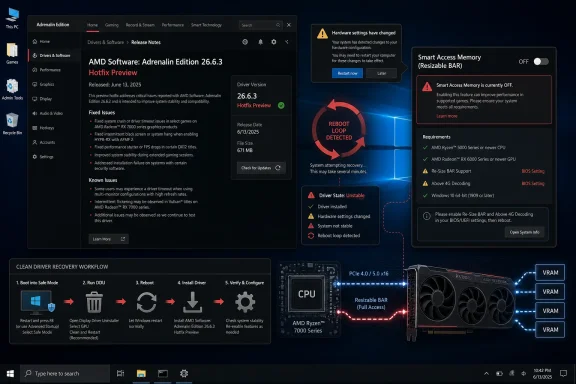
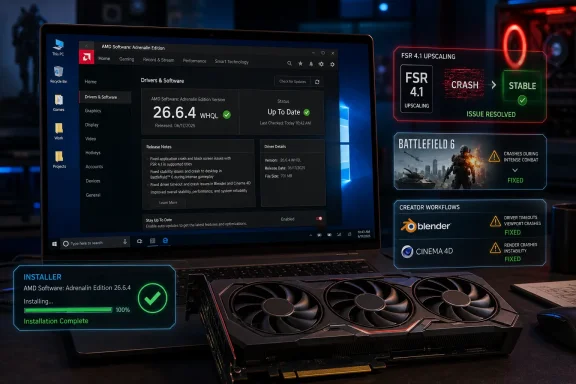
The later 26.6.3 Hotfix Preview driver changes the calculus again. AMD’s hotfix notes identify an intermittent install issue seen when installing 26.6.2 on Windows 10 systems for Radeon RX 7000-series and newer graphics products. In other words, this is no longer just a scattering of forum anecdotes around an unlucky installer path; AMD has acknowledged the class of failure and shipped a targeted repair.
Microsoft’s own Windows 10 lifecycle has changed the psychological context around every driver release. Users know the operating system is aging out of mainstream comfort, and vendors know their engineering attention is shifting toward Windows 11 and newer hardware platforms. That creates a trust problem: every Windows 10-specific failure now looks, fairly or not, like an early warning that support is thinning.
AMD did not say that 26.6.2 failed because Windows 10 is being abandoned. The driver was released for Windows 10 and Windows 11, and the hotfix also targets Windows 10. But perception matters in the GPU market, where a driver reputation can stick long after the individual bug is fixed.
For WindowsForum readers, this is the practical lesson: support matrices are not the same thing as support quality. A release note can list Windows 10 compatibility while still containing an installation edge case serious enough to leave the card flagged by the OS.
That is why the 26.6.2 failure stings for RX 7000 owners. The update promised access to a feature set that many users had been waiting for, especially as AMD works to keep pace with Nvidia’s DLSS ecosystem and Intel’s XeSS efforts. When the driver needed to unlock the feature breaks on a widely used Windows version, the software roadmap becomes the bottleneck.
The irony is sharp: AMD’s driver was meant to extend the useful life of recent Radeon cards, but on some Windows 10 systems it temporarily made those cards look broken. That is the nightmare version of a feature update. The user installs a performance driver and ends up troubleshooting Device Manager.
This is also why the rollback to 26.6.1 was a compromise rather than a complete fix. It restored stability, but it also meant giving up the very FSR 4.1 support that made 26.6.2 worth installing. For many users, the choice became stability now or feature access later.
But hotfix culture has a downside. Preview and hotfix drivers often live in a gray zone between “this is the fix you need” and “this has not had the same runway as a routine WHQL release.” Enthusiasts may accept that tradeoff. IT departments generally do not.
That distinction is crucial. A home user with a single RX 7900 XT can uninstall, clean up, reboot, and test. A school lab, esports venue, visualization workstation pool, or small design shop cannot treat GPU drivers as an adventure. For them, one broken release can turn into hours of lost productivity and a renewed policy of staying one driver behind.
This is where AMD’s communication needs to be brutally clear. Users need to know which products are affected, whether the failure is limited to Windows 10, whether Windows 11 systems need the hotfix, and whether 26.6.3 should replace 26.6.2 for everyone or only for affected machines. Ambiguity is where support tickets breed.
That does not mean users should never update. It means driver updates should be treated like firmware, not like app-store patches. If your system is stable and you do not need the new game profile or FSR feature today, waiting a few days is usually a rational decision.
For Windows 10 Radeon users, the safest sequence is now obvious. Avoid 26.6.2 if it has not already been installed. If the system is affected, move either back to 26.6.1 for maximum caution or forward to 26.6.3 Hotfix Preview if FSR 4.1 support is the reason for updating in the first place.
Clean installs may help in messy driver situations, but they are not magic. Display Driver Uninstaller, AMD Cleanup Utility, Safe Mode, and disabled automatic driver replacement are tools, not guarantees. If the vendor has identified a package-level issue, the correct fix is usually the corrected package.
The concrete readout is fairly simple:
 AMD’s Big FSR Moment Landed on the Wrong Windows Fault Line
Adrenalin 26.6.2 was supposed to be an enthusiast-friendly driver. Its headline feature was support for AMD FSR Upscaling 4.1 on Radeon RX 7000-series graphics cards, extending newer image reconstruction technology to RDNA 3 hardware rather than keeping it confined to the newest generation.That matters because the RX 7000 family remains a live, powerful installed base. Many of those cards sit in systems built by users who do not replace a GPU every generation, and many of those systems still run Windows 10 because the machine is stable, the user dislikes Windows 11, or the hardware/software stack has been tuned over years.
Instead of a clean victory lap, the release exposed a brittle edge in AMD’s Windows support story. Users reported AMD Software failing to launch after installation, Windows showing a yellow warning marker next to the Radeon adapter, and in some cases the familiar Code 43-style failure mode that tells users the device has reported a problem.
The important distinction is that this was not just a game-specific bug. A game crash can often be worked around by changing a graphics preset, disabling an overlay, or waiting for a title patch. A driver that leaves the GPU in a warning state is closer to an operating-system-level breakage, because Windows itself is no longer comfortable loading the device stack.
The Yellow Bang Is Windows Saying the Driver Contract Broke
The “yellow bang” in Device Manager is an old Windows symbol, but it remains one of the clearest signs that something lower than the application layer has gone wrong. In normal language, Windows sees the hardware but cannot use it properly with the driver currently installed.For a desktop gamer, that can mean missing displays, reduced resolution, broken hardware acceleration, or an AMD control panel that refuses to open. For a workstation user, it can mean lost GPU acceleration in creative apps or a machine that suddenly looks unfit for production work. For an administrator, it means a driver package that cannot be trusted in broad deployment without testing on the exact operating-system image in use.
AMD’s own workaround was conservative: affected users could temporarily revert to Adrenalin 26.6.1. That recommendation matters because it implicitly separated the broken package from the hardware itself. The Radeon cards were not failing; the driver/software combination was.
The later 26.6.3 Hotfix Preview driver changes the calculus again. AMD’s hotfix notes identify an intermittent install issue seen when installing 26.6.2 on Windows 10 systems for Radeon RX 7000-series and newer graphics products. In other words, this is no longer just a scattering of forum anecdotes around an unlucky installer path; AMD has acknowledged the class of failure and shipped a targeted repair.
Windows 10 Is Still Too Big to Treat Like a Footnote
The awkward part for AMD is timing. Windows 10 is old, but it is not irrelevant. It remains deeply embedded in enthusiast desktops, gaming PCs, lab systems, small-business machines, and special-purpose setups where “upgrade to Windows 11” is not a casual afternoon decision.Microsoft’s own Windows 10 lifecycle has changed the psychological context around every driver release. Users know the operating system is aging out of mainstream comfort, and vendors know their engineering attention is shifting toward Windows 11 and newer hardware platforms. That creates a trust problem: every Windows 10-specific failure now looks, fairly or not, like an early warning that support is thinning.
AMD did not say that 26.6.2 failed because Windows 10 is being abandoned. The driver was released for Windows 10 and Windows 11, and the hotfix also targets Windows 10. But perception matters in the GPU market, where a driver reputation can stick long after the individual bug is fixed.
For WindowsForum readers, this is the practical lesson: support matrices are not the same thing as support quality. A release note can list Windows 10 compatibility while still containing an installation edge case serious enough to leave the card flagged by the OS.
FSR 4.1 Raises the Stakes Because It Is Not Just Another Toggle
FSR 4.1 is not a minor control-panel flourish. Upscaling and frame-generation technologies now sit at the center of how GPU vendors sell longevity, because they can make older hardware feel meaningfully newer in supported games.That is why the 26.6.2 failure stings for RX 7000 owners. The update promised access to a feature set that many users had been waiting for, especially as AMD works to keep pace with Nvidia’s DLSS ecosystem and Intel’s XeSS efforts. When the driver needed to unlock the feature breaks on a widely used Windows version, the software roadmap becomes the bottleneck.
The irony is sharp: AMD’s driver was meant to extend the useful life of recent Radeon cards, but on some Windows 10 systems it temporarily made those cards look broken. That is the nightmare version of a feature update. The user installs a performance driver and ends up troubleshooting Device Manager.
This is also why the rollback to 26.6.1 was a compromise rather than a complete fix. It restored stability, but it also meant giving up the very FSR 4.1 support that made 26.6.2 worth installing. For many users, the choice became stability now or feature access later.
Hotfix Culture Is Now Part of the GPU Ownership Experience
AMD deserves credit for acknowledging the issue and issuing a hotfix quickly. In the modern driver world, speed matters. A broken release that sits untouched for weeks damages confidence far more than a broken release followed by a prompt, specific repair.But hotfix culture has a downside. Preview and hotfix drivers often live in a gray zone between “this is the fix you need” and “this has not had the same runway as a routine WHQL release.” Enthusiasts may accept that tradeoff. IT departments generally do not.
That distinction is crucial. A home user with a single RX 7900 XT can uninstall, clean up, reboot, and test. A school lab, esports venue, visualization workstation pool, or small design shop cannot treat GPU drivers as an adventure. For them, one broken release can turn into hours of lost productivity and a renewed policy of staying one driver behind.
This is where AMD’s communication needs to be brutally clear. Users need to know which products are affected, whether the failure is limited to Windows 10, whether Windows 11 systems need the hotfix, and whether 26.6.3 should replace 26.6.2 for everyone or only for affected machines. Ambiguity is where support tickets breed.
The Best Driver Strategy Is Boring, and That Is the Point
There is a recurring pattern in PC gaming: the users most eager to install a new driver are often the users most punished by a bad release. Day-one drivers can bring game optimizations, profile updates, new API support, and major feature enablement. They can also bring regressions that only surface once a broad population hits the package with real-world hardware, old Windows images, overlays, tuning utilities, and years of accumulated driver residue.That does not mean users should never update. It means driver updates should be treated like firmware, not like app-store patches. If your system is stable and you do not need the new game profile or FSR feature today, waiting a few days is usually a rational decision.
For Windows 10 Radeon users, the safest sequence is now obvious. Avoid 26.6.2 if it has not already been installed. If the system is affected, move either back to 26.6.1 for maximum caution or forward to 26.6.3 Hotfix Preview if FSR 4.1 support is the reason for updating in the first place.
Clean installs may help in messy driver situations, but they are not magic. Display Driver Uninstaller, AMD Cleanup Utility, Safe Mode, and disabled automatic driver replacement are tools, not guarantees. If the vendor has identified a package-level issue, the correct fix is usually the corrected package.
The Radeon Lesson Hidden Inside the 26.6.2 Mess
The 26.6.2 episode is not a catastrophe for AMD, but it is a revealing stumble. It shows how much modern GPU value depends on driver reliability, how exposed Windows 10 users now feel, and how quickly a feature story can turn into a support story.The concrete readout is fairly simple:
- AMD Adrenalin 26.6.2 brought FSR 4.1 support to Radeon RX 7000-series graphics cards, making it a meaningful update for RDNA 3 owners.
- Some Windows 10 users saw the driver fail badly enough to produce a yellow warning marker in Device Manager and prevent AMD Software from launching correctly.
- AMD acknowledged the issue and initially pointed affected users to Adrenalin 26.6.1 as a temporary workaround.
- AMD then released Adrenalin 26.6.3 Hotfix Preview to address the intermittent Windows 10 installation issue affecting Radeon RX 7000-series and newer cards.
- Windows 11 systems appear less central to this specific failure, but cautious users should still read release notes before moving production or competition machines to a fresh driver.
- The safest policy for stable systems remains simple: do not install a GPU driver on release day unless the new feature or game fix is worth the troubleshooting risk.
References
- Primary source: Research Snipers
Published: 2026-06-29T07:52:13.146106
AMD confirms issues with FSR driver 26.6.2 on many Windows PCs – Research Snipers
The new AMD graphics driver 26.6.2 with FSR 4.1 is actually supposed to bring noticeable...researchsnipers.com - Related coverage: technobezz.com
AMD Confirms Driver Update 26.6.2 Breaks Radeon GPUs on Windows 10 Systems | Technobezz
AMD's latest driver update bricks Radeon GPUs on Windows 10, causing a Code 43 error and forcing users to roll back.www.technobezz.com - Related coverage: overclock3d.net
AMD confirms major Windows 10 bug in its 26.6.2 GPU drivers - OC3D
AMD Software 26.6.2 is causing issues for Radeon GPU users on Windows 10. No FSR 4 upgrades for RDNA 3 users on Windows 10.overclock3d.net - Related coverage: windowsreport.com
AMD Warns Radeon Users of FSR Driver Issue on Windows 10 PCs
AMD has confirmed an Adrenalin 26.6.2 driver issue affecting some Radeon RX users on Windows 10 and recommends a rollback. windowsreport.com
- Related coverage: tweaktown.com
AMD confirms Adrenalin 26.6.2 driver fails to launch on Windows 10, recommends rolling back
AMD confirmed the issue and recommends rolling back to 26.6.1, but that means losing FSR 4.1 support on RDNA 3 until a fixed version ships. www.tweaktown.com
- Related coverage: pcmasters.net
AMD Adrenalin 26.6.2 WHQL Driver Download: New FSR 4.1 for the Radeon RX 7000 Series - PC Masters
AMD has released the “Adrenalin Edition 26.6.2 WHQL” driver update—the second version in June. This update focuses heavily on the RDNA 3 architecture and, in particular, brings FSR upscaling 4.1 to the Radeon RX 7000 series graphics cards.www.pcmasters.net
- Related coverage: thefpsreview.com
AMD Releases Adrenalin Edition 26.6.2 Graphics Driver and FSR SDK v2.3, Bringing FSR 4.1 and Ray Regeneration 1.2 to RDNA 3
Owners of AMD Radeon RDNA 3-based graphics cards can rejoice as the latest FSR SDK is now available to developers who can include FSR Redstone in their games.www.thefpsreview.com - Related coverage: windowsforum.com
AMD Adrenalin 26.6.2 WHQL Adds FSR 4.1 for Radeon RX 7000: Key Fixes & Issues | Windows Forum
AMD released AMD Software: Adrenalin Edition 26.6.2 WHQL on June 22, 2026, adding FSR Upscaling 4.1 support for Radeon RX 7000 graphics cards while bundling...windowsforum.com - Related coverage: vgtimes.com
AMD Driver Update Leaves Some Windows 10 PCs Without a Working Graphics Card
The latest AMD driver, which was supposed to deliver new features and gaming optimizations, has instead turned into a headache for some Windows 10...vgtimes.com - Related coverage: windowscentral.com
AMD kills Windows 10 support in its latest Adrenalin update — Battlefield 6 picks up bug fixes and optimizations | Windows Central
Also on the killing floor are new game and Vulkan extension support for RDNA 1 and RDNA 2 GPUs.www.windowscentral.com - Related coverage: duckittech.com
AMD Adrenalin 26.6.3 Fixes Windows 10 Yellow Bang Error — Duck-IT Tech News
AMD releases Adrenalin 26.6.3 Hotfix Preview to fix Windows 10 installation and Device Manager errors affecting Radeon RX 7000 series and newer GPUs.www.duckittech.com
- Related coverage: videocardz.com