

Hidden settings in AMD’s Adrenalin 26.6.2 driver point to an unreleased FSR Multi-Frame Generation control with ratios extending to 8x, although there is no evidence that the feature can be enabled or used in games yet.
The options were surfaced by RadeonTuner, a third-party utility that exposes experimental Radeon driver switches normally hidden from the Adrenalin interface. As reported by Club386 and VideoCardz, the tool lists an application-controlled mode plus 1x through 8x settings for “FSR Multi-Frame Generation Ratio,” alongside an override switch.
AMD released Adrenalin 26.6.2 on June 22, 2026. Its official release notes advertise FSR Upscaling 4.1 support for Radeon RX 7000-series cards, but make no mention of multi-frame generation, 8x modes, or the other newly exposed controls.
RadeonTuner also reveals entries described as FSR Ray Regeneration Denoiser Override and FSR Neural Radiance Caching Override. AMD has already outlined Ray Regeneration and Radiance Caching as parts of its broader ML-based FSR technology stack, so their presence is less surprising than the apparent frame-generation ratios.
The key qualification is that these controls are placeholders, not a working preview. RadeonTuner developer Dumbie reportedly said AMD had added the relevant profile names to the driver but not the implementation code. Testing has so far failed to activate MFG in supported games. That means screenshots of an 8x menu should not be read as proof of image quality, latency behavior, game compatibility, or a shipping hardware list.
AMD’s ADLX developer SDK has separately exposed APIs for applications to retrieve available frame-generation ratios and set a selected ratio since version 1.5. That confirms AMD has been building the software plumbing for variable-ratio frame generation, but it does not confirm that every enumerated driver value will make it into a public release.
That is why the base performance matters far more than a headline multiplier. High-refresh Windows gaming systems may benefit if AMD can deliver stable frame pacing, clean UI handling and acceptable latency, but the technology needs real testing before anyone can judge it against existing frame-generation implementations.
For now, Radeon owners should treat the hidden 8x switch as evidence of driver work in progress, not a reason to install tools or expect a new FSR option in current games.
The options were surfaced by RadeonTuner, a third-party utility that exposes experimental Radeon driver switches normally hidden from the Adrenalin interface. As reported by Club386 and VideoCardz, the tool lists an application-controlled mode plus 1x through 8x settings for “FSR Multi-Frame Generation Ratio,” alongside an override switch.
AMD released Adrenalin 26.6.2 on June 22, 2026. Its official release notes advertise FSR Upscaling 4.1 support for Radeon RX 7000-series cards, but make no mention of multi-frame generation, 8x modes, or the other newly exposed controls.
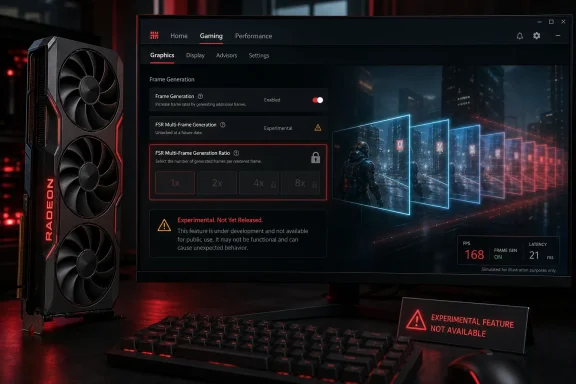 More than one dormant switch
RadeonTuner also reveals entries described as FSR Ray Regeneration Denoiser Override and FSR Neural Radiance Caching Override. AMD has already outlined Ray Regeneration and Radiance Caching as parts of its broader ML-based FSR technology stack, so their presence is less surprising than the apparent frame-generation ratios.The key qualification is that these controls are placeholders, not a working preview. RadeonTuner developer Dumbie reportedly said AMD had added the relevant profile names to the driver but not the implementation code. Testing has so far failed to activate MFG in supported games. That means screenshots of an 8x menu should not be read as proof of image quality, latency behavior, game compatibility, or a shipping hardware list.
AMD’s ADLX developer SDK has separately exposed APIs for applications to retrieve available frame-generation ratios and set a selected ratio since version 1.5. That confirms AMD has been building the software plumbing for variable-ratio frame generation, but it does not confirm that every enumerated driver value will make it into a public release.
What “8x” would mean — and why it needs caution
Multi-frame generation creates additional displayed frames between traditionally rendered frames. In the best-case arithmetic, an 8x setting could turn a 60 fps rendered base into a 480 fps output stream. It cannot make the game simulation, input sampling, or CPU work run at 480 fps, however, and generated frames can amplify artifacts or latency when the underlying frame rate is too low.That is why the base performance matters far more than a headline multiplier. High-refresh Windows gaming systems may benefit if AMD can deliver stable frame pacing, clean UI handling and acceptable latency, but the technology needs real testing before anyone can judge it against existing frame-generation implementations.
For now, Radeon owners should treat the hidden 8x switch as evidence of driver work in progress, not a reason to install tools or expect a new FSR option in current games.
References
- Primary source: dlcompare.com
Published: 2026-07-13T02:30:00+00:00
Loading…
www.dlcompare.com - Related coverage: club386.com
Loading…
www.club386.com - Related coverage: overclock3d.net
Loading…
overclock3d.net - Related coverage: videocardz.com
Loading…
videocardz.com - Related coverage: tech.sportskeeda.com
Loading…
tech.sportskeeda.com - Related coverage: adrenaline.com.br
Loading…
www.adrenaline.com.br