

Microsoft is rolling out a Teams workplace check-in feature in June 2026 that can update an employee’s work location when the Teams desktop app detects a configured corporate Wi-Fi network or managed office device, with tenant administrators controlling whether the capability is enabled. The company frames it as a collaboration feature, not an attendance system. In Germany, that distinction may be legally and politically insufficient. The timing lands almost perfectly inside a national argument over whether work is becoming more flexible, more precarious, or simply more measurable.
The new Teams capability is not, on paper, a boss-facing spy console. Microsoft’s own documentation says workplace check-in is off by default at the tenant level, requires administrative configuration, and is meant to update a user’s visible work location so colleagues can coordinate in-person meetings. It can use administrator-configured wireless networks or managed desk peripherals, and it is designed to show a building-level location when an organization has mapped its workplace estate.
That is the benign version of the product story: fewer manual status updates, better use of hybrid offices, and less friction when trying to find out who is actually in the building. Microsoft has spent the past several years turning Teams from a chat-and-meeting app into the front end for workplace presence, scheduling, phone calls, webinars, town halls, Copilot summaries, and increasingly, office-space orchestration. Workplace check-in is a natural extension of that strategy.
But the same facts read differently from the employee side. A tool that updates presence based on network attachment is still a tool that turns infrastructure into a statement about where a worker is. In countries with relatively weak collective labor protections, that may be treated as another admin setting. In Germany, it enters a much denser legal and cultural ecosystem.
The crucial point is not whether Microsoft intends the feature for surveillance. It is whether employers can use the signal, directly or indirectly, to discipline behavior, enforce return-to-office mandates, challenge remote-work claims, or build a culture in which presence becomes a proxy for trust. Software vendors often describe features by their intended workflow; labor law tends to ask what the feature makes possible.
This does not mean every deployment is unlawful or impossible. It means implementation is not merely an IT decision. Employers may need a works agreement spelling out the purpose, scope, access rights, retention rules, transparency obligations, and limits on disciplinary use. The legal question is not satisfied by saying the feature is “off by default” if management later turns it on and configures it across the workforce.
Microsoft has tried to reduce the blast radius. The feature does not provide admins with a purpose-built historical attendance dashboard, and users can manually set or clear their work location. For Wi-Fi-based check-in, admins can choose a mode where users must opt in, or a mode where users are informed and can opt out. Teams also needs operating-system-level location permission for the relevant location path to function.
Those controls matter, but they do not erase the governance issue. A German works council will ask whether opting out is genuinely voluntary in a workplace where managers expect “visibility.” It will ask whether location signals are visible to colleagues, managers, or analytics systems. It will ask whether data that is not sold as attendance data today could become evidence in tomorrow’s performance dispute.
For IT departments, this is useful. Hybrid work created a coordination problem: offices are expensive, employees are distributed, and managers want enough predictability to plan team days, desks, security, catering, and facilities. If the collaboration suite knows whether someone is in the office, the office can be managed more like a cloud resource.
For workers, the same integration can feel like a quiet collapse of boundaries. The old office badge was visible at the door. The new badge lives inside the communication tool used for meetings, messages, files, calls, and managerial rituals. The concern is not one data point; it is the way many small signals combine into a portrait of availability, responsiveness, movement, and conformity.
That is why Microsoft’s “not a tracking tool” language is both important and incomplete. The company is right that this is not GPS-style live tracking of a worker moving through a city. But workers are not wrong to see it as another step toward inferred presence, where the tools of collaboration double as instruments of verification.
That matters because workplace check-in lands precisely where the new employment bargain is most fragile. Employers want flexibility too, but often in a different direction: flexible staffing, flexible restructuring, flexible dismissal rules, and flexible interpretation of office policies. Employees, meanwhile, want flexible time and location without being forced to prove that autonomy has not become shirking.
The term “soft off days” captures the anxiety from management’s side. If employees use some home-office time for errands, care duties, recovery, or fragmented personal obligations, executives may see abuse. Employees may see survival inside an economy where stress, commuting, childcare, aging parents, and digital overload have all intensified.
Teams check-in does not solve that conflict. It gives organizations a sharper way to encode it. If office presence becomes easier to prove, it may become easier to demand. If remote status becomes more visible, it may become easier to stigmatize. The technology does not create the trust problem, but it gives the trust problem a user interface.
This is the context in which calls for longer working hours and looser dismissal protection are landing. Employers argue that Germany’s cost base is too high and its labor rules too rigid for a more competitive global economy. Unions argue that workers are being asked to absorb the consequences of strategic missteps, underinvestment, and industrial transformation.
A Teams feature cannot bear the weight of that argument alone. But it becomes symbolic because it sits at the intersection of control and insecurity. When companies are hiring aggressively, workplace analytics can be sold as optimization. When companies are cutting jobs, the same analytics can look like evidence-gathering.
That is particularly true in environments where performance is difficult to measure cleanly. Presence data is tempting because it is simple. It is also dangerous because it is simple. A worker in the office is not necessarily productive; a worker at home is not necessarily disengaged. Yet dashboards, policies, and managerial habits often privilege the measurable over the meaningful.
Unions understand this dynamic. Their resistance to weakening dismissal protections is not separate from their suspicion of workplace monitoring. Both are about the balance of power inside the firm. The more discretion employers gain over employment security, the more consequential every piece of employee data becomes.
This is why the works council process matters beyond legal compliance. It is one of the few institutional mechanisms that can slow down the automatic conversion of software capability into management practice. It forces employers to explain not only what a feature does, but why they need it and what they promise not to do with it.
If Microsoft hoped privacy controls would drain the controversy from workplace check-in, Germany is a reminder that product design and labor governance are different disciplines. A user opt-in can be meaningful in a consumer app. In an employment relationship, consent is always shadowed by hierarchy.
At minimum, organizations should separate collaboration use from compliance use in writing. If the purpose is to help employees find colleagues and coordinate office days, then policies should prohibit using the signal for attendance discipline, productivity scoring, or return-to-office enforcement unless a separate legal basis and employee-representation agreement exist. Without that line, the stated purpose will not survive contact with workplace reality.
Admins should also understand the difference between building-level visibility and desk-level inference. Wi-Fi mapping, desk peripherals, docking stations, monitors, and managed devices can create different levels of precision. A system that merely distinguishes “remote” from “in office” presents a different risk profile from one that identifies a building, floor, desk zone, or repeated pattern.
The other operational issue is expectations. If users can manually override or clear work location, then the feature is weak as an attendance system by design. If managers nevertheless treat it as authoritative, IT will be stuck defending a tool that was never meant to carry that evidentiary burden. That is how collaboration features become grievance generators.
Those details deserve to be stated because panic makes for bad policy. Microsoft has clearly adjusted its framing and controls after criticism, emphasizing opt-in paths, user awareness, and the absence of an attendance dashboard. The company also says the feature is for collaboration rather than compliance.
Yet the privacy debate is not only about what the first version does. It is about feature adjacency. Once presence, location, calendars, office maps, room booking, Copilot, and employee experience platforms sit inside the same productivity estate, organizations will naturally ask for correlations. Which office days lead to more meetings? Which teams comply with hybrid policy? Which employees are never seen in the building?
Microsoft may not expose all of those answers in this feature. But enterprise software history suggests that once data exists, pressure builds to operationalize it. Today’s “find a colleague” signal can become tomorrow’s facilities metric, HR exception report, or management nudge. The governance has to be designed for the incentives, not just the current UI.
The danger is that presence becomes the easiest thing to measure and therefore the thing most aggressively managed. Companies may not know how to quantify collaboration quality, engineering creativity, customer empathy, or institutional trust. They can, however, count badge swipes, Wi-Fi associations, desk bookings, calendar density, and Teams status.
That shift favors a managerial style that mistakes observability for effectiveness. It also risks punishing the very autonomy that made hybrid work successful for many teams. A worker who arranges the day around deep work, school pickup, and asynchronous collaboration may look less present in the office graph than a worker who attends every meeting in person and produces little of value.
The irony is that Microsoft’s collaboration pitch is plausible. Knowing who is in the office can help people make better use of office time. But the feature will only serve that purpose if organizations resist the urge to convert it into a compliance instrument. The more employers insist it is harmless, the more they should be willing to bind themselves not to misuse it.
For German employers, the safest path is not secrecy or speed. It is negotiation before activation, clear limits before data collection, and a deployment model that treats employee trust as infrastructure. If the feature is genuinely for collaboration, then employees and their representatives should be able to shape how it works.
For Microsoft, Germany is a warning about the global portability of product assumptions. A feature that looks like a convenience in Redmond can become a co-determination issue in Cologne, Munich, Wolfsburg, or Stuttgart. The company can design privacy controls, but it cannot design away labor politics.
For workers, the lesson is equally blunt. Hybrid work will not remain protected by vibes, manager discretion, or the memory of pandemic productivity. It will be negotiated through policies, defaults, data rights, and the boring mechanics of enterprise administration.
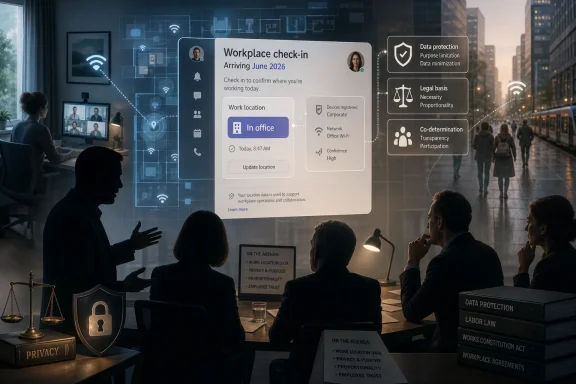 Microsoft Put the Office Badge Inside Teams
The new Teams capability is not, on paper, a boss-facing spy console. Microsoft’s own documentation says workplace check-in is off by default at the tenant level, requires administrative configuration, and is meant to update a user’s visible work location so colleagues can coordinate in-person meetings. It can use administrator-configured wireless networks or managed desk peripherals, and it is designed to show a building-level location when an organization has mapped its workplace estate.That is the benign version of the product story: fewer manual status updates, better use of hybrid offices, and less friction when trying to find out who is actually in the building. Microsoft has spent the past several years turning Teams from a chat-and-meeting app into the front end for workplace presence, scheduling, phone calls, webinars, town halls, Copilot summaries, and increasingly, office-space orchestration. Workplace check-in is a natural extension of that strategy.
But the same facts read differently from the employee side. A tool that updates presence based on network attachment is still a tool that turns infrastructure into a statement about where a worker is. In countries with relatively weak collective labor protections, that may be treated as another admin setting. In Germany, it enters a much denser legal and cultural ecosystem.
The crucial point is not whether Microsoft intends the feature for surveillance. It is whether employers can use the signal, directly or indirectly, to discipline behavior, enforce return-to-office mandates, challenge remote-work claims, or build a culture in which presence becomes a proxy for trust. Software vendors often describe features by their intended workflow; labor law tends to ask what the feature makes possible.
Germany’s Works Councils Will Not Treat This as a Checkbox
Germany’s Works Constitution Act gives works councils co-determination rights over technical systems that can monitor employee behavior or performance. That is why a Teams setting that looks routine to a Microsoft 365 administrator can become a negotiation in a German enterprise. If a tool can generate or reveal data about whether a worker is in the office, the works council is likely to care.This does not mean every deployment is unlawful or impossible. It means implementation is not merely an IT decision. Employers may need a works agreement spelling out the purpose, scope, access rights, retention rules, transparency obligations, and limits on disciplinary use. The legal question is not satisfied by saying the feature is “off by default” if management later turns it on and configures it across the workforce.
Microsoft has tried to reduce the blast radius. The feature does not provide admins with a purpose-built historical attendance dashboard, and users can manually set or clear their work location. For Wi-Fi-based check-in, admins can choose a mode where users must opt in, or a mode where users are informed and can opt out. Teams also needs operating-system-level location permission for the relevant location path to function.
Those controls matter, but they do not erase the governance issue. A German works council will ask whether opting out is genuinely voluntary in a workplace where managers expect “visibility.” It will ask whether location signals are visible to colleagues, managers, or analytics systems. It will ask whether data that is not sold as attendance data today could become evidence in tomorrow’s performance dispute.
The Feature Arrives After Years of Presence Creep
Teams did not suddenly become a workplace presence system in June 2026. The modern Microsoft 365 stack has been moving toward ambient workplace awareness for years, with calendars, status indicators, meeting metadata, Viva signals, Places, desk booking, Copilot summaries, and identity systems all forming a thick layer of operational context. The Wi-Fi check-in feature is controversial because it makes the physical office part of that layer.For IT departments, this is useful. Hybrid work created a coordination problem: offices are expensive, employees are distributed, and managers want enough predictability to plan team days, desks, security, catering, and facilities. If the collaboration suite knows whether someone is in the office, the office can be managed more like a cloud resource.
For workers, the same integration can feel like a quiet collapse of boundaries. The old office badge was visible at the door. The new badge lives inside the communication tool used for meetings, messages, files, calls, and managerial rituals. The concern is not one data point; it is the way many small signals combine into a portrait of availability, responsiveness, movement, and conformity.
That is why Microsoft’s “not a tracking tool” language is both important and incomplete. The company is right that this is not GPS-style live tracking of a worker moving through a city. But workers are not wrong to see it as another step toward inferred presence, where the tools of collaboration double as instruments of verification.
Flexibility Became the Benefit Workers Now Defend Like Pay
The German reaction cannot be understood without the broader labor mood. Hybrid work is no longer a pandemic-era exception for many professionals; it has become part of the compensation package. Surveys across Europe have repeatedly shown that employees treat flexibility as a core employment condition, not a perk that can be withdrawn without consequence.That matters because workplace check-in lands precisely where the new employment bargain is most fragile. Employers want flexibility too, but often in a different direction: flexible staffing, flexible restructuring, flexible dismissal rules, and flexible interpretation of office policies. Employees, meanwhile, want flexible time and location without being forced to prove that autonomy has not become shirking.
The term “soft off days” captures the anxiety from management’s side. If employees use some home-office time for errands, care duties, recovery, or fragmented personal obligations, executives may see abuse. Employees may see survival inside an economy where stress, commuting, childcare, aging parents, and digital overload have all intensified.
Teams check-in does not solve that conflict. It gives organizations a sharper way to encode it. If office presence becomes easier to prove, it may become easier to demand. If remote status becomes more visible, it may become easier to stigmatize. The technology does not create the trust problem, but it gives the trust problem a user interface.
Germany’s Industrial Crisis Makes Surveillance Feel Less Abstract
The politics are sharper because Germany is also wrestling with industrial weakness. Automakers and suppliers face pressure from electrification, Chinese competition, high energy costs, software transition failures, and sluggish investment. When workers hear about job cuts and restructuring while employers demand more office presence, location tracking does not sound like a convenience feature.This is the context in which calls for longer working hours and looser dismissal protection are landing. Employers argue that Germany’s cost base is too high and its labor rules too rigid for a more competitive global economy. Unions argue that workers are being asked to absorb the consequences of strategic missteps, underinvestment, and industrial transformation.
A Teams feature cannot bear the weight of that argument alone. But it becomes symbolic because it sits at the intersection of control and insecurity. When companies are hiring aggressively, workplace analytics can be sold as optimization. When companies are cutting jobs, the same analytics can look like evidence-gathering.
That is particularly true in environments where performance is difficult to measure cleanly. Presence data is tempting because it is simple. It is also dangerous because it is simple. A worker in the office is not necessarily productive; a worker at home is not necessarily disengaged. Yet dashboards, policies, and managerial habits often privilege the measurable over the meaningful.
Dismissal Reform Turns a Product Update Into a Political Object
The German government’s reported interest in loosening dismissal protection raises the stakes further. If employers gain more room to terminate or restructure, workers will be more sensitive to any technology that could support negative inferences about attendance, flexibility, or commitment. A work-location signal that seems harmless in a stable job can feel threatening in an unstable one.Unions understand this dynamic. Their resistance to weakening dismissal protections is not separate from their suspicion of workplace monitoring. Both are about the balance of power inside the firm. The more discretion employers gain over employment security, the more consequential every piece of employee data becomes.
This is why the works council process matters beyond legal compliance. It is one of the few institutional mechanisms that can slow down the automatic conversion of software capability into management practice. It forces employers to explain not only what a feature does, but why they need it and what they promise not to do with it.
If Microsoft hoped privacy controls would drain the controversy from workplace check-in, Germany is a reminder that product design and labor governance are different disciplines. A user opt-in can be meaningful in a consumer app. In an employment relationship, consent is always shadowed by hierarchy.
Admins Will Be Asked to Translate Law Into Policy
For WindowsForum readers on the IT side, the practical lesson is uncomfortable: this is not a feature to quietly enable because it appears in the admin center. The technical deployment may be straightforward, but the organizational deployment is not. Microsoft 365 administrators will need to be prepared for questions from legal, HR, data protection officers, works councils, and security teams.At minimum, organizations should separate collaboration use from compliance use in writing. If the purpose is to help employees find colleagues and coordinate office days, then policies should prohibit using the signal for attendance discipline, productivity scoring, or return-to-office enforcement unless a separate legal basis and employee-representation agreement exist. Without that line, the stated purpose will not survive contact with workplace reality.
Admins should also understand the difference between building-level visibility and desk-level inference. Wi-Fi mapping, desk peripherals, docking stations, monitors, and managed devices can create different levels of precision. A system that merely distinguishes “remote” from “in office” presents a different risk profile from one that identifies a building, floor, desk zone, or repeated pattern.
The other operational issue is expectations. If users can manually override or clear work location, then the feature is weak as an attendance system by design. If managers nevertheless treat it as authoritative, IT will be stuck defending a tool that was never meant to carry that evidentiary burden. That is how collaboration features become grievance generators.
Microsoft’s Privacy Design Is Better Than the Headline, But Not Strong Enough to End the Debate
The early backlash to Teams location detection sometimes overstated the mechanism. This is not a universal live-tracking beacon broadcasting personal GPS coordinates to a manager. It is a workplace-location update based on configured enterprise signals, with tenant controls, user-facing settings, and limits on historical administrative reporting.Those details deserve to be stated because panic makes for bad policy. Microsoft has clearly adjusted its framing and controls after criticism, emphasizing opt-in paths, user awareness, and the absence of an attendance dashboard. The company also says the feature is for collaboration rather than compliance.
Yet the privacy debate is not only about what the first version does. It is about feature adjacency. Once presence, location, calendars, office maps, room booking, Copilot, and employee experience platforms sit inside the same productivity estate, organizations will naturally ask for correlations. Which office days lead to more meetings? Which teams comply with hybrid policy? Which employees are never seen in the building?
Microsoft may not expose all of those answers in this feature. But enterprise software history suggests that once data exists, pressure builds to operationalize it. Today’s “find a colleague” signal can become tomorrow’s facilities metric, HR exception report, or management nudge. The governance has to be designed for the incentives, not just the current UI.
The Return-to-Office War Is Becoming a Data War
Return-to-office mandates have struggled because they often rest on contested claims. Executives say in-person work improves culture, mentoring, creativity, and speed. Employees ask for evidence and point to commuting costs, housing patterns, caregiving responsibilities, and the productivity they maintained remotely. Into that stalemate comes a flood of workplace data.The danger is that presence becomes the easiest thing to measure and therefore the thing most aggressively managed. Companies may not know how to quantify collaboration quality, engineering creativity, customer empathy, or institutional trust. They can, however, count badge swipes, Wi-Fi associations, desk bookings, calendar density, and Teams status.
That shift favors a managerial style that mistakes observability for effectiveness. It also risks punishing the very autonomy that made hybrid work successful for many teams. A worker who arranges the day around deep work, school pickup, and asynchronous collaboration may look less present in the office graph than a worker who attends every meeting in person and produces little of value.
The irony is that Microsoft’s collaboration pitch is plausible. Knowing who is in the office can help people make better use of office time. But the feature will only serve that purpose if organizations resist the urge to convert it into a compliance instrument. The more employers insist it is harmless, the more they should be willing to bind themselves not to misuse it.
The German Fight Shows Where Hybrid Work Is Really Heading
The Teams check-in controversy is not a narrow story about one Microsoft roadmap item. It is a preview of the next phase of hybrid work, where the battle is less about whether employees can work remotely and more about who controls the data trail around that choice. The office is becoming software-defined, and that means labor relations are becoming software-mediated.For German employers, the safest path is not secrecy or speed. It is negotiation before activation, clear limits before data collection, and a deployment model that treats employee trust as infrastructure. If the feature is genuinely for collaboration, then employees and their representatives should be able to shape how it works.
For Microsoft, Germany is a warning about the global portability of product assumptions. A feature that looks like a convenience in Redmond can become a co-determination issue in Cologne, Munich, Wolfsburg, or Stuttgart. The company can design privacy controls, but it cannot design away labor politics.
For workers, the lesson is equally blunt. Hybrid work will not remain protected by vibes, manager discretion, or the memory of pandemic productivity. It will be negotiated through policies, defaults, data rights, and the boring mechanics of enterprise administration.
The Office Signal Now Carries More Than Location
Here is the practical shape of the issue as Teams workplace check-in moves from roadmap controversy to tenant-level decision:- Microsoft’s workplace check-in feature is disabled by default, but administrators can enable it and configure how users are prompted for Wi-Fi-based location updates.
- The feature is designed to support collaboration by showing work location, not to provide a formal attendance-monitoring dashboard.
- In Germany, works councils are likely to treat the capability as subject to co-determination because it can reveal employee behavior or presence.
- Employers that deploy the feature without clear agreements risk turning a collaboration tool into a labor dispute.
- The technical distinction between opt-in, opt-out, building-level detection, and historical reporting will matter less if managers use the signal as a proxy for commitment.
- The controversy reflects a larger shift in hybrid work, where office policy is increasingly enforced or contested through data generated by everyday productivity tools.
References
- Primary source: AD HOC NEWS
Published: 2026-06-30T21:42:07.639103
Microsoft's New Teams Tracking Feature Fuels German Labour Tensions Over Surveillance
Microsoft Teams location tracking in Germany off by default under labor law. Workers demand flexibility, firms cut jobs, government reform faces union protests.www.ad-hoc-news.de - Related coverage: gadgets360.com
Loading…
www.gadgets360.com - Related coverage: berrall.com
Microsoft Teams will auto-detect when you’re at the office via Wi-Fi, roll out confirmed, but you can opt-out - Peer Networks UK
Wales & West leading provider of PC repairs & IT support for home & business. Peer Networks delivers prompt, no fuss, PC repair services to customers.www.berrall.com
- Related coverage: computerbild.de
Microsoft Teams führt Standort-Tracking bis Ende Juni 2026 ein - COMPUTER BILD
Microsoft erweitert Teams um eine automatische Arbeitsplatzerkennung. Datenschützer äußern weiterhin Bedenken.www.computerbild.de - Related coverage: softwarebay.de
Microsoft Teams Introduces Workplace Check-in - softwarebay.de
Starting June 2026, Microsoft will activate the controversial Workplace Check-in feature in Teams, which provides employers with information about their employe softwarebay.de
- Related coverage: windowscentral.com
Microsoft’s controversial Wi‑Fi tracking in Teams is back — but this time with better privacy controls | Windows Central
After multiple delays, Microsoft finally launched its controversial Teams Wi‑Fi tracking feature, promising more transparency and better user control.www.windowscentral.com
- Related coverage: allwork.space
Microsoft Teams Adds A Wi-Fi Feature That Can Share Employees’ Office Location
Microsoft is preparing to roll out a new Microsoft Teams feature that can automatically update an employee's work location whenallwork.space - Related coverage: pcworld.com
Microsoft says new Teams location feature isn't for 'employee tracking'
When this new feature rolls out, your bosses and colleagues will always know where you are. www.pcworld.com
- Related coverage: blog-en.topedia.com
Configure work location auto-detection via WLAN in Microsoft Places and Teams | Topedia Blog
Microsoft Places and Teams now support work location auto-detection via WLAN signals, allowing Teams to automatically check users in at the connected building.blog-en.topedia.com - Related coverage: techradar.com
I can't believe Microsoft Teams is still releasing this new feature which might rat you out to your boss | TechRadar
Microsoft Teams will use Wi-Fi connectivity to automatically update your work locationwww.techradar.com
