

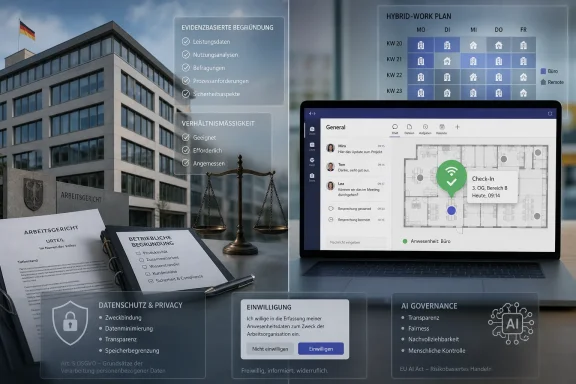
On February 11, 2026, the Düsseldorf Labour Court invalidated an employer’s order requiring an IT employee to work in the office four days a week, finding that the company had not shown why physical presence would actually fix its alleged workflow problems. The ruling is not a German right-to-home-office revolution. It is something more awkward for employers: a demand for evidence at precisely the moment when software vendors are making attendance easier to measure than ever. Hybrid work is moving out of the realm of managerial preference and into a collision zone of labor law, privacy law, works councils, AI governance, and automated presence signals.
The Düsseldorf case matters because the court did not romanticize remote work. It did not say an employee who has worked from home for years automatically owns that arrangement forever, nor did it convert internal home-office guidance into a permanent entitlement. German employers still retain broad authority to determine where work is performed under their managerial direction.
But the court drew a line around how that authority is exercised. A company cannot simply invoke “collaboration,” “communication,” or “organizational problems” as magic words and then order an employee back to the office most of the week. If the employer says presence is necessary, it must be able to explain why presence is suitable, necessary, and proportionate for the actual problem.
That distinction is going to haunt return-to-office policies across Europe. Many mandates have been written as if attendance itself were the management objective. The Düsseldorf ruling treats attendance as a means, not an end, and asks whether the means fit the evidence.
The employee in the case reportedly had long used home office for roughly half the working week. The employer later reduced that flexibility to one day per week, effectively imposing a four-day office requirement. The court accepted that there was no general claim to a fixed home-office quota, yet still found the specific instruction invalid because the employer’s reasoning did not carry the weight placed on it.
That is the legal needle employers now have to thread. They may be allowed to call people back, but not by treating office attendance as a self-proving good.
That is a plausible use case. Hybrid work has created a genuine coordination problem. Employees commute in only to discover the people they wanted to meet are at home; managers struggle to plan team days; facilities teams want to understand building usage without relying on guesswork. A workplace-presence layer inside Teams and Microsoft Places is not inherently sinister.
But it is also not neutral. Once presence becomes machine-readable, exportable, and visible inside the collaboration stack, it becomes part of the management substrate. The same signal that helps someone find a colleague for coffee can help a manager compare expected attendance with observed attendance.
Microsoft has tried to reduce the blast radius by making the feature opt-in at multiple levels. Organizations must enable it, administrators must configure the relevant networks, and users must consent to location sharing. The feature is off by default, and Microsoft has emphasized collaboration rather than compliance.
That privacy posture matters, but it does not settle the issue. In employment relationships, consent is rarely as clean as it looks in consumer software. When the boss wants a feature enabled, the employee’s “choice” may feel less like a free preference and more like a workplace expectation wrapped in a dialog box.
Section 87 of the Works Constitution Act gives works councils co-determination rights over technical systems capable of monitoring employee behavior or performance. That phrase has long been broader than many foreign employers expect. A system does not need to be designed as surveillance software to fall into co-determination territory; it may be enough that the system can be used to monitor.
Workplace Check-in sits squarely in that danger zone. It uses network signals to infer whether a worker is in the office, and it publishes that inference into a Microsoft workplace-presence environment. Even if the feature is framed as a convenience, it creates a record or status signal tied to a person’s physical workplace presence.
For German employers, enabling the tool without involving the works council would be reckless. The question is not simply whether the feature is useful. The question is what data is collected, who sees it, how long it is retained, whether it can be queried historically, whether managers can use it in performance discussions, and whether employees can refuse without disadvantage.
Those questions are not theoretical. They determine whether a collaboration feature becomes an attendance enforcement mechanism. The Düsseldorf ruling makes that distinction more important because it implies employers may need to justify office requirements with concrete operational reasoning. Presence data could become tempting evidence — and therefore tempting surveillance.
That shift makes the legal and ethical problem harder. A Wi-Fi-based office check-in does not necessarily reveal what someone is doing. It reveals where the system believes the person is, and it can do so in a way that feels mundane because the data is generated by ordinary infrastructure.
Yet inference is powerful. If Teams says an employee checked in from the office three days this week, a manager may infer compliance with a hybrid policy. If the signal is absent, the manager may infer noncompliance. If those inferences are wrong, incomplete, or used outside their stated purpose, the employee may be stuck challenging a machine-generated management narrative.
This is why proportionality matters. A company that wants to improve collaboration should not silently build an attendance dossier. A company that wants to optimize office space should not give line managers individualized presence histories. A company that wants to enforce a return-to-office rule should not pretend it is merely helping colleagues schedule lunch.
The workplace technology market often sells these distinctions as configurable permissions. Labor law treats them as power relationships. That gap is where the next set of disputes will emerge.
If private use is allowed or tolerated, the situation changes dramatically. Monitoring then collides with privacy expectations and telecommunications secrecy concerns, and inspection generally requires a much stronger justification. A concrete suspicion of a criminal offense or serious breach of duty may be needed, and even then the search must be proportionate and transparent.
The practical consequence is simple: employers cannot have it both ways. They cannot tolerate personal use for convenience and morale, then later treat the platform as a fully inspectable corporate filing cabinet. Nor can they bury monitoring rights in vague policies and expect courts to bless fishing expeditions.
For WindowsForum readers who administer Microsoft 365 tenants, this should sound familiar. The technical ability to search mailboxes, audit logs, chats, eDiscovery exports, and Teams activity is far broader than the legal permission to do so. The admin center will often let you do things that employment law may punish you for doing.
That mismatch is one of the defining problems of modern IT governance. Microsoft, Google, Slack, Zoom, and security vendors keep adding observability because customers ask for control. But once those controls enter the workplace, every click becomes a governance decision.
That matters because works councils often receive some of the most sensitive data inside an organization. They may see personnel files, disciplinary material, health-related information, restructuring plans, pay data, and complaints. If those records leave company-controlled systems for private inboxes or unmanaged devices, the privacy risk is obvious.
The political temptation is to treat works councils as the privacy counterweight to management surveillance. In many situations, they are. But the law does not give employee representatives a free pass to mishandle data because their institutional role is protective.
For IT departments, the implication is operational. Works councils need secure devices, managed accounts, access controls, retention rules, and training. “Do not forward this to Gmail” is not a data protection strategy; it is a hope with a footer.
The more workplace governance depends on data, the more every participant in that governance becomes part of the attack surface. That includes HR, legal, managers, works councils, and outside advisers. Hybrid work did not create that reality, but it multiplied the number of places where sensitive employment data can leak.
For companies, this means pay data will become more discoverable, more comparable, and more legally consequential. Employees will have stronger tools to ask how pay is set. Employers will face pressure to explain gaps that cannot be justified by objective, gender-neutral criteria.
The reversal of the burden of proof is especially important. If an employer fails to meet transparency obligations, it may become harder to defend pay disparities later. Poor records, inconsistent job architecture, and informal salary exceptions will no longer be merely untidy HR practices. They will be litigation risks.
That also connects back to workplace surveillance and AI. The same companies that want granular attendance data may soon be required to provide granular pay explanations. The more management relies on data to control the workforce, the more employees and regulators will demand data to challenge management.
This is the symmetry many executives miss. Digitization does not only increase employer visibility into employees. It increases employee visibility into the employer.
The headline fine of up to €35 million or 7 percent of global annual turnover applies to the most serious prohibited practices. Other categories of noncompliance, including many high-risk obligations, can carry lower but still severe penalties. Either way, the regulatory message is clear: AI systems used in consequential workplace contexts are no longer experimental conveniences.
This matters because employers are not only buying obvious “AI hiring” tools. They are embedding AI into productivity suites, HR platforms, security analytics, workforce planning, help desks, and collaboration software. A model that summarizes performance feedback, ranks candidates, predicts attrition, flags “low engagement,” or recommends staffing changes can drift from assistance into decision support.
That drift is where compliance teams should focus. The legal risk does not begin when a company says, “We are using AI to fire people.” It begins when AI-generated signals become part of the evidence chain for decisions affecting workers.
A Teams presence feature is not automatically an AI Act problem. But combine presence data with AI-driven productivity scoring, attrition prediction, sentiment analysis, or workforce optimization, and the picture changes. The office check-in becomes one data point among many in a machine-assisted management system.
That distinction will matter in Europe. A company that deploys AI as a surveillance amplifier will invite legal resistance, union pressure, employee distrust, and regulatory scrutiny. A company that deploys AI as a documented assistive system, with clear human oversight and negotiated guardrails, has a better chance of extracting productivity without turning the workplace into a compliance minefield.
IG Metall’s call for clear workplace AI rules should be read in that context. The union is not reacting to science fiction. It is reacting to procurement reality. Employers are already buying systems that can classify, score, recommend, summarize, predict, and rank.
For IT leaders, the hard part is that these capabilities increasingly arrive as features inside platforms already approved for use. Yesterday’s collaboration suite becomes tomorrow’s workplace analytics layer. Yesterday’s HR database becomes tomorrow’s AI decision engine. Yesterday’s security telemetry becomes tomorrow’s behavioral profile.
Procurement, security, privacy, HR, and labor relations can no longer operate as separate committees meeting after the contract is signed. If a system touches worker data and uses automation to produce consequential inferences, it belongs in a joined-up governance process before rollout.
That is why the ruling should worry lazy managers more than disciplined ones. A well-run organization can explain why certain teams need certain rhythms. A poorly run organization reaches for blanket mandates because it lacks the management vocabulary to describe the actual work.
The same is true of surveillance tools. Presence data can support legitimate workplace coordination if its purpose is narrow, its use is transparent, and its access is controlled. It becomes toxic when the stated purpose is collaboration but the practical use is discipline.
This is the core governance challenge of 2026: the same data can be benign or coercive depending on context. Wi-Fi check-in can help colleagues find each other. It can also become an attendance trap. AI can help workers draft, analyze, and prioritize. It can also become an opaque scoring machine.
Courts and regulators are not banning management. They are insisting that management explain itself.
This creates a new duty of translation. IT must be able to explain to HR and legal what a feature actually collects, how it infers status, where the data flows, who can access it, and whether logs remain available after the user changes a setting. Legal must explain what uses are permitted. HR must explain the workplace purpose. Works councils must be involved early enough that co-determination is real rather than decorative.
The alternative is the worst possible rollout pattern: enable first, negotiate later, litigate eventually. That pattern was already risky under GDPR. Under the AI Act, pay transparency rules, and a growing body of workplace case law, it becomes a governance failure.
Microsoft and other vendors can help by making defaults conservative and documentation plain. But they cannot solve the employment-law problem for customers. A vendor can say a tool is designed for collaboration; an employer decides whether it becomes surveillance.
That distinction will be tested repeatedly as AI and presence features spread through the productivity stack.
 The Office Mandate Is No Longer Just a Calendar Policy
The Düsseldorf case matters because the court did not romanticize remote work. It did not say an employee who has worked from home for years automatically owns that arrangement forever, nor did it convert internal home-office guidance into a permanent entitlement. German employers still retain broad authority to determine where work is performed under their managerial direction.But the court drew a line around how that authority is exercised. A company cannot simply invoke “collaboration,” “communication,” or “organizational problems” as magic words and then order an employee back to the office most of the week. If the employer says presence is necessary, it must be able to explain why presence is suitable, necessary, and proportionate for the actual problem.
That distinction is going to haunt return-to-office policies across Europe. Many mandates have been written as if attendance itself were the management objective. The Düsseldorf ruling treats attendance as a means, not an end, and asks whether the means fit the evidence.
The employee in the case reportedly had long used home office for roughly half the working week. The employer later reduced that flexibility to one day per week, effectively imposing a four-day office requirement. The court accepted that there was no general claim to a fixed home-office quota, yet still found the specific instruction invalid because the employer’s reasoning did not carry the weight placed on it.
That is the legal needle employers now have to thread. They may be allowed to call people back, but not by treating office attendance as a self-proving good.
Microsoft Places Turns Presence Into Infrastructure
The timing is uncomfortable for Microsoft. Its Workplace Check-in feature for Teams and Microsoft Places arrives in the same season that courts and regulators are sharpening the rules around workplace monitoring. Microsoft presents the feature as a coordination tool: when a user connects to a configured corporate Wi-Fi network, Teams can update that person’s work location so colleagues know who is in the office.That is a plausible use case. Hybrid work has created a genuine coordination problem. Employees commute in only to discover the people they wanted to meet are at home; managers struggle to plan team days; facilities teams want to understand building usage without relying on guesswork. A workplace-presence layer inside Teams and Microsoft Places is not inherently sinister.
But it is also not neutral. Once presence becomes machine-readable, exportable, and visible inside the collaboration stack, it becomes part of the management substrate. The same signal that helps someone find a colleague for coffee can help a manager compare expected attendance with observed attendance.
Microsoft has tried to reduce the blast radius by making the feature opt-in at multiple levels. Organizations must enable it, administrators must configure the relevant networks, and users must consent to location sharing. The feature is off by default, and Microsoft has emphasized collaboration rather than compliance.
That privacy posture matters, but it does not settle the issue. In employment relationships, consent is rarely as clean as it looks in consumer software. When the boss wants a feature enabled, the employee’s “choice” may feel less like a free preference and more like a workplace expectation wrapped in a dialog box.
German Works Councils Will Not Treat Wi-Fi Check-In as a Mere Feature Flag
In Germany, the decisive audience may not be Microsoft’s product team or even the IT administrator. It may be the works council.Section 87 of the Works Constitution Act gives works councils co-determination rights over technical systems capable of monitoring employee behavior or performance. That phrase has long been broader than many foreign employers expect. A system does not need to be designed as surveillance software to fall into co-determination territory; it may be enough that the system can be used to monitor.
Workplace Check-in sits squarely in that danger zone. It uses network signals to infer whether a worker is in the office, and it publishes that inference into a Microsoft workplace-presence environment. Even if the feature is framed as a convenience, it creates a record or status signal tied to a person’s physical workplace presence.
For German employers, enabling the tool without involving the works council would be reckless. The question is not simply whether the feature is useful. The question is what data is collected, who sees it, how long it is retained, whether it can be queried historically, whether managers can use it in performance discussions, and whether employees can refuse without disadvantage.
Those questions are not theoretical. They determine whether a collaboration feature becomes an attendance enforcement mechanism. The Düsseldorf ruling makes that distinction more important because it implies employers may need to justify office requirements with concrete operational reasoning. Presence data could become tempting evidence — and therefore tempting surveillance.
The New Surveillance Fight Is About Inference, Not Screenshots
The old image of workplace surveillance was crude: keyloggers, screen recordings, webcam checks, or software that counted mouse movements. The new version is more ambient. It is built from metadata, presence states, timestamps, network associations, badge swipes, calendar patterns, and communication graphs.That shift makes the legal and ethical problem harder. A Wi-Fi-based office check-in does not necessarily reveal what someone is doing. It reveals where the system believes the person is, and it can do so in a way that feels mundane because the data is generated by ordinary infrastructure.
Yet inference is powerful. If Teams says an employee checked in from the office three days this week, a manager may infer compliance with a hybrid policy. If the signal is absent, the manager may infer noncompliance. If those inferences are wrong, incomplete, or used outside their stated purpose, the employee may be stuck challenging a machine-generated management narrative.
This is why proportionality matters. A company that wants to improve collaboration should not silently build an attendance dossier. A company that wants to optimize office space should not give line managers individualized presence histories. A company that wants to enforce a return-to-office rule should not pretend it is merely helping colleagues schedule lunch.
The workplace technology market often sells these distinctions as configurable permissions. Labor law treats them as power relationships. That gap is where the next set of disputes will emerge.
Teams and Slack Messages Are Not a Manager’s Private Search Index
The same logic applies to communications monitoring. Employment lawyers in Germany have been warning that the legality of checking Teams, Slack, or email messages depends heavily on whether private use is permitted. If private use is strictly prohibited and employees have been told so clearly, the employer has more room to inspect business communications.If private use is allowed or tolerated, the situation changes dramatically. Monitoring then collides with privacy expectations and telecommunications secrecy concerns, and inspection generally requires a much stronger justification. A concrete suspicion of a criminal offense or serious breach of duty may be needed, and even then the search must be proportionate and transparent.
The practical consequence is simple: employers cannot have it both ways. They cannot tolerate personal use for convenience and morale, then later treat the platform as a fully inspectable corporate filing cabinet. Nor can they bury monitoring rights in vague policies and expect courts to bless fishing expeditions.
For WindowsForum readers who administer Microsoft 365 tenants, this should sound familiar. The technical ability to search mailboxes, audit logs, chats, eDiscovery exports, and Teams activity is far broader than the legal permission to do so. The admin center will often let you do things that employment law may punish you for doing.
That mismatch is one of the defining problems of modern IT governance. Microsoft, Google, Slack, Zoom, and security vendors keep adding observability because customers ask for control. But once those controls enter the workplace, every click becomes a governance decision.
Works Councils Are Data Controllers in Everything but Vibes
The March 2025 Hesse State Labour Court decision involving a works council chairperson adds another uncomfortable layer. According to reports, the chairperson was removed after forwarding sensitive personnel data to private email addresses. The lesson is not merely that management must respect data protection. Employee representatives must, too.That matters because works councils often receive some of the most sensitive data inside an organization. They may see personnel files, disciplinary material, health-related information, restructuring plans, pay data, and complaints. If those records leave company-controlled systems for private inboxes or unmanaged devices, the privacy risk is obvious.
The political temptation is to treat works councils as the privacy counterweight to management surveillance. In many situations, they are. But the law does not give employee representatives a free pass to mishandle data because their institutional role is protective.
For IT departments, the implication is operational. Works councils need secure devices, managed accounts, access controls, retention rules, and training. “Do not forward this to Gmail” is not a data protection strategy; it is a hope with a footer.
The more workplace governance depends on data, the more every participant in that governance becomes part of the attack surface. That includes HR, legal, managers, works councils, and outside advisers. Hybrid work did not create that reality, but it multiplied the number of places where sensitive employment data can leak.
Pay Transparency Makes the Spreadsheet a Legal Weapon
The EU Pay Transparency Directive adds another pressure point. Germany missed the June 7, 2026 deadline to transpose the directive into national law, but missing the deadline does not make the policy problem disappear. The directive is designed to strengthen employees’ rights to information and force employers to confront pay discrimination with more structured reporting and remedies.For companies, this means pay data will become more discoverable, more comparable, and more legally consequential. Employees will have stronger tools to ask how pay is set. Employers will face pressure to explain gaps that cannot be justified by objective, gender-neutral criteria.
The reversal of the burden of proof is especially important. If an employer fails to meet transparency obligations, it may become harder to defend pay disparities later. Poor records, inconsistent job architecture, and informal salary exceptions will no longer be merely untidy HR practices. They will be litigation risks.
That also connects back to workplace surveillance and AI. The same companies that want granular attendance data may soon be required to provide granular pay explanations. The more management relies on data to control the workforce, the more employees and regulators will demand data to challenge management.
This is the symmetry many executives miss. Digitization does not only increase employer visibility into employees. It increases employee visibility into the employer.
The AI Act Moves Workplace Software Into the Compliance Core
The EU AI Act raises the stakes again. From August 2, 2026, many obligations for high-risk AI systems begin applying, including governance duties around risk management, data quality, technical documentation, logging, transparency, human oversight, accuracy, robustness, and cybersecurity. Employment is one of the areas where AI can quickly become high-risk because decisions about hiring, promotion, task allocation, performance, and termination affect livelihoods.The headline fine of up to €35 million or 7 percent of global annual turnover applies to the most serious prohibited practices. Other categories of noncompliance, including many high-risk obligations, can carry lower but still severe penalties. Either way, the regulatory message is clear: AI systems used in consequential workplace contexts are no longer experimental conveniences.
This matters because employers are not only buying obvious “AI hiring” tools. They are embedding AI into productivity suites, HR platforms, security analytics, workforce planning, help desks, and collaboration software. A model that summarizes performance feedback, ranks candidates, predicts attrition, flags “low engagement,” or recommends staffing changes can drift from assistance into decision support.
That drift is where compliance teams should focus. The legal risk does not begin when a company says, “We are using AI to fire people.” It begins when AI-generated signals become part of the evidence chain for decisions affecting workers.
A Teams presence feature is not automatically an AI Act problem. But combine presence data with AI-driven productivity scoring, attrition prediction, sentiment analysis, or workforce optimization, and the picture changes. The office check-in becomes one data point among many in a machine-assisted management system.
The Human-AI Strategy Is the Only One That Survives Contact With Labor Law
The PwC Global AI Jobs Barometer’s reported finding that companies pursuing a combined human-AI strategy show stronger workforce growth and productivity gains than those focused mainly on automation is politically convenient, but also plausible. The firms getting value from AI are less likely to be the ones simply replacing people task by task. They are more likely to be redesigning work around people who can use better tools.That distinction will matter in Europe. A company that deploys AI as a surveillance amplifier will invite legal resistance, union pressure, employee distrust, and regulatory scrutiny. A company that deploys AI as a documented assistive system, with clear human oversight and negotiated guardrails, has a better chance of extracting productivity without turning the workplace into a compliance minefield.
IG Metall’s call for clear workplace AI rules should be read in that context. The union is not reacting to science fiction. It is reacting to procurement reality. Employers are already buying systems that can classify, score, recommend, summarize, predict, and rank.
For IT leaders, the hard part is that these capabilities increasingly arrive as features inside platforms already approved for use. Yesterday’s collaboration suite becomes tomorrow’s workplace analytics layer. Yesterday’s HR database becomes tomorrow’s AI decision engine. Yesterday’s security telemetry becomes tomorrow’s behavioral profile.
Procurement, security, privacy, HR, and labor relations can no longer operate as separate committees meeting after the contract is signed. If a system touches worker data and uses automation to produce consequential inferences, it belongs in a joined-up governance process before rollout.
The Düsseldorf Lesson Is That Evidence Cuts Both Ways
The Düsseldorf ruling is a warning to employers, but it is not an anti-office manifesto. The court’s logic leaves room for return-to-office mandates that are specific, justified, and proportionate. If a company can show that a particular role requires physical presence for security, equipment access, training, incident response, customer service, or demonstrably better coordination, the legal outcome may look different.That is why the ruling should worry lazy managers more than disciplined ones. A well-run organization can explain why certain teams need certain rhythms. A poorly run organization reaches for blanket mandates because it lacks the management vocabulary to describe the actual work.
The same is true of surveillance tools. Presence data can support legitimate workplace coordination if its purpose is narrow, its use is transparent, and its access is controlled. It becomes toxic when the stated purpose is collaboration but the practical use is discipline.
This is the core governance challenge of 2026: the same data can be benign or coercive depending on context. Wi-Fi check-in can help colleagues find each other. It can also become an attendance trap. AI can help workers draft, analyze, and prioritize. It can also become an opaque scoring machine.
Courts and regulators are not banning management. They are insisting that management explain itself.
The Admin Console Is Now a Labor-Law Surface
For Windows administrators, the uncomfortable takeaway is that workplace compliance is moving into settings screens. A toggle in Teams, Places, Entra ID, Purview, Viva, Intune, or an HR SaaS platform can have consequences far beyond IT operations. The person enabling a feature may not be the person legally accountable for how it is used, but the audit trail will not care.This creates a new duty of translation. IT must be able to explain to HR and legal what a feature actually collects, how it infers status, where the data flows, who can access it, and whether logs remain available after the user changes a setting. Legal must explain what uses are permitted. HR must explain the workplace purpose. Works councils must be involved early enough that co-determination is real rather than decorative.
The alternative is the worst possible rollout pattern: enable first, negotiate later, litigate eventually. That pattern was already risky under GDPR. Under the AI Act, pay transparency rules, and a growing body of workplace case law, it becomes a governance failure.
Microsoft and other vendors can help by making defaults conservative and documentation plain. But they cannot solve the employment-law problem for customers. A vendor can say a tool is designed for collaboration; an employer decides whether it becomes surveillance.
That distinction will be tested repeatedly as AI and presence features spread through the productivity stack.
The Compliance Story Hidden Inside a Wi-Fi Signal
The practical lessons from this convergence are sharper than the usual hybrid-work debate suggests. The issue is not whether offices are good or bad, or whether remote workers are more productive. The issue is whether employers can justify, measure, and govern workplace presence without turning ordinary collaboration tools into disciplinary machinery.- Employers may still order office attendance, but broad mandates need concrete reasoning tied to the work being performed.
- Workplace Check-in should be treated as a monitoring-capable system in Germany, even if the vendor markets it as a collaboration feature.
- Employee consent is not a substitute for works council involvement, transparent policies, narrow purposes, and strict access controls.
- Teams, Slack, and email inspections depend heavily on whether private use is prohibited, permitted, or tolerated in practice.
- AI systems that influence hiring, performance, allocation, or promotion decisions need governance before they become embedded in daily management.
- Pay transparency will make weak HR data architecture more dangerous, because unexplained gaps and poor records can shift legal risk toward the employer.
References
- Primary source: AD HOC NEWS
Published: 2026-06-22T06:44:07.878183
German Court Blocks Four-Day Office Mandate as EU AI Act Penalties and New Surveillance Tools Conver
Düsseldorf Labour Court invalidates rigid office attendance rule as Microsoft's Teams check-in tool faces scrutiny under German co-determination laws and EU AI regulations.www.ad-hoc-news.de - Related coverage: windowslatest.com
Microsoft Teams will auto-detect when you're at the office via Wi-Fi, roll out confirmed, but you can opt-out
Microsoft Teams is moving ahead with the rollout of a controversial feature that lets organizations track when you're at the office via Wi-Fi. www.windowslatest.com
- Related coverage: deepinspect.ai
EU AI Act Article 99: The Penalty Tiers and What Triggers Each One | DeepInspect
Article 99 of the EU AI Act sets three penalty tiers reaching 35M EUR or 7% of global turnover for prohibited practices, 15M EUR or 3% for high-risk non-compliance, and 7.5M EUR or 1% for supplying misleading information. The mandate takes effect August 2, 2026.www.deepinspect.ai - Related coverage: legalithm.com
EU AI Act Penalties and Fines Explained (2026)
Complete breakdown of EU AI Act fines up to EUR 35M or 7% of turnover. Covers penalty tiers, enforcement, SME adjustments, and risk reduction.www.legalithm.com - Related coverage: asscompact.de
Arbeitgeber darf Home-Office aufheben - wenn gut begründet
Arbeitnehmer erwerben durch eine langjährige Home-Office-Praxis keinen automatischen Anspruch auf mobiles Arbeiten. Schränkt der Arbeitgeberwww.asscompact.de - Related coverage: de.linkedin.com
Zum Anspruch auf vollständige Arbeit im Home-Office (a) und zur Zulässigkeit einer Weisung zur weitgehenden Präsenzarbeit (b). ArbG Düsseldorf, Urteil vom 11.02.2026, 3 Ca 6587/25 zu a) hier trotz… | RA Michael Seidlitz
Zum Anspruch auf vollständige Arbeit im Home-Office (a) und zur Zulässigkeit einer Weisung zur weitgehenden Präsenzarbeit (b). ArbG Düsseldorf, Urteil vom 11.02.2026, 3 Ca 6587/25 zu a) hier trotz langjähriger Übung verneint zu b) hier überwiegend verneint wegen ermessensfehlerhafter Ausübung...de.linkedin.com
