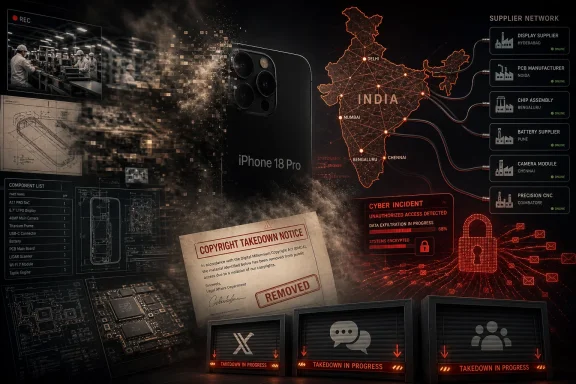
Apple and Tata Electronics are investigating a reported June 2026 cyberattack on Tata systems after hackers claimed to publish more than 200,000 files, totaling roughly 630GB, including confidential Apple manufacturing material tied to current and future iPhone production. The breach is not just another entry in the grim ledger of supplier compromises. It is a warning that Apple’s most important hardware secrets increasingly live outside Apple’s walls. For WindowsForum readers, the story matters because it is less about one unreleased iPhone than about the modern technology supply chain: distributed, opaque, and only as secure as its weakest trusted partner.
Apple has built one of the most disciplined secrecy cultures in consumer technology, but iPhones are not designed, validated, tooled, assembled, and shipped by secrecy alone. They move through a global manufacturing web that includes assemblers, component makers, semiconductor partners, logistics vendors, quality-control teams, and regional compliance operations. Every one of those links needs documents, credentials, drawings, manufacturing standards, and system access.
That is what makes the reported Tata Electronics breach so uncomfortable. The leaked material is said to include manufacturing specifications, quality inspection standards for iPhone circuit board components, internal correspondence, system logs, and copies of employee passports. If accurate, this is not the kind of leak that merely spoils a keynote slide six months early. It is a window into how Apple’s hardware machine actually operates.
The distinction matters. Rumors about the iPhone 18 Pro Max, the A20 chip, or Apple’s next modem are familiar fare in the Apple-watching ecosystem. A supply-chain breach is different because it may expose process knowledge rather than consumer-facing features. A photograph of a chassis tells the market what a phone might look like; a factory document can tell competitors, counterfeiters, attackers, and regulators how that phone is made.
Tata has reportedly said its operations were unaffected after identifying a cybersecurity incident, and that is a meaningful statement in the narrow sense. Factories continuing to run is better than a shutdown. But security teams know the harder question is not whether the line kept moving on Monday morning. The harder question is what quietly left the building before anyone realized the door was open.
Reuters reporting appears to substantiate the broader breach claim: a large archive allegedly published by the World Leaks group, with Apple-related manufacturing files among the material. Other reports have gone further, asserting that documents tied to the iPhone 18 Pro lineup, A20 Pro processor, and second-generation Apple modem were exposed. Those more specific claims should be treated as reported, not proven, unless independently confirmed by Apple, Tata, or a researcher with verifiable access to the dataset.
That does not make the claims irrelevant. Apple’s development cycle means that a 2026 breach could plausibly contain documents for devices still a generation or two away from release. The iPhone 18 family would be deep enough in planning, validation, or supplier coordination that parts of its manufacturing and component documentation could exist across partner systems. Future iPhones do not materialize in September; they are industrial projects with long paper trails.
Still, the danger of the “iPhone 18 Pro Max reveal” framing is that it turns a security incident into a gadget leak. If the only question is whether Apple’s next flagship has a particular modem or board design, the public conversation becomes entertainment. The more serious question is whether Apple’s supplier ecosystem can keep proprietary manufacturing data, identity documents, and operational logs from being packaged into a searchable archive for criminals.
This is why the timing stings. Apple has spent years reducing concentration risk in its supply chain, and India is a key part of that plan. Tata is important because Apple needs credible local manufacturing partners with scale, political alignment, and operational discipline. A major breach at such a partner does not necessarily derail that strategy, but it complicates the story Apple wants to tell.
There is an irony here that IT leaders will recognize immediately. Diversification reduces one kind of risk while creating another. Moving production across more sites, firms, regions, and regulatory environments can make Apple less vulnerable to a single country’s disruptions. It can also expand the number of systems, people, and third parties that hold sensitive data.
That trade-off is not unique to Apple. Windows device makers, enterprise OEMs, semiconductor firms, cloud providers, and defense contractors all live inside similar partner networks. The difference is that Apple’s brand is unusually tied to control. When an Apple supplier leaks, it cuts against the company’s cultivated image of end-to-end command.
A quality inspection standard for iPhone circuit board components, for example, may sound dry compared with a leaked render. But to a counterfeiter, repair gray-market operator, hostile intelligence service, or competing manufacturer, that kind of document can be unusually useful. It can show what Apple checks, how it checks it, and where suppliers must meet thresholds. It can also reveal the internal language and document patterns that make future phishing and social engineering more believable.
System logs are another underrated category. Logs can contain hostnames, usernames, timestamps, application traces, network paths, and evidence of how systems are segmented. Even if no source code or crown-jewel schematic is present, operational telemetry can help attackers reconstruct an environment. In a mature intrusion, logs are not just forensic exhaust; they are maps.
Employee passport copies raise a different risk. That is not trade-secret exposure; it is human exposure. Identity documents can be abused for fraud, impersonation, visa scams, targeted phishing, and pressure campaigns against employees or contractors. The human cost of a supply-chain breach is often treated as secondary, but for the affected workers it can be the most immediate and lasting consequence.
But silence has limits. Apple sells trust as part of the product. The company has spent years positioning itself as the privacy-and-security adult in the room, often with good reason. When a manufacturing partner tied to Apple allegedly has hundreds of gigabytes of sensitive material posted online, customers and enterprise buyers will reasonably want to know whether the exposure affects product integrity, employee privacy, or future device security.
The likely answer is nuanced. A leak of manufacturing documents does not automatically mean iPhones are compromised. It does not imply that attackers can sign firmware, modify Apple silicon, bypass Secure Enclave protections, or intercept iMessage traffic. But it may increase the amount of knowledge available to adversaries who already study Apple’s ecosystem intensely.
That is the part vendors often struggle to communicate. Breaches do not need to produce an immediate exploit to matter. They can raise the baseline capability of adversaries. They can make future attacks cheaper, more targeted, and more convincing.
Apple’s modem program is even more strategically sensitive. The company has spent years trying to reduce dependence on third-party cellular modems, with mixed visible progress and a long trail of industry speculation. A second-generation Apple modem would matter not simply because of speed tests, but because baseband design affects power efficiency, radio behavior, integration, privacy architecture, and Apple’s control over the total platform.
Still, a leaked file name is not the same thing as a validated engineering disclosure. Supply-chain archives often contain stale documents, planning artifacts, test fixtures, supplier correspondence, outdated revisions, and mislabeled folders. A document that references “A20” or “C2” may be important, or it may be adjacent to something important. Without independent technical review, certainty would be theater.
The responsible conclusion is therefore uncomfortable but clear: the reports are plausible enough to take seriously and unverified enough to resist overclaiming. That is the zone where many modern security stories live. By the time absolute certainty arrives, the defensive window has often already narrowed.
For victims, the publication stage changes the incident. Before publication, containment and negotiation can focus on limiting exposure. After publication, the problem becomes diffusion. Files can be mirrored, indexed, downloaded, repackaged, and resold. Even if the original leak site disappears, the data may continue circulating.
That is why “operations were unaffected” can be true and still incomplete. Operational continuity is one metric. Data control is another. Once proprietary documents are distributed outside the organization, the incident can continue producing consequences long after the production line looks normal.
IT administrators understand this from ransomware cases across every industry. The disaster recovery plan can bring systems back. It cannot make stolen passports unstolen. It cannot ensure that a supplier schematic does not become training material for the next attacker.
Windows administrators already deal with this reality through driver signing, firmware updates, OEM utilities, BIOS management tools, vendor portals, cloud management connectors, and third-party endpoint agents. A compromise upstream can create downstream exposure even when the enterprise’s own network is clean. Supply-chain security is not an abstract boardroom phrase; it is the background condition of modern IT.
The Apple angle makes the issue more visible because Apple is famous for vertical integration. If even Apple must manage the messy security implications of distributed manufacturing, then less-integrated ecosystems face the problem at even greater scale. PC supply chains include a wider range of OEMs, ODMs, component vendors, BIOS suppliers, peripheral makers, and regional distributors.
That does not mean Windows hardware is inherently less secure. It means trust is more complicated than a logo on the lid. Enterprises should be asking vendors not only about device security features, but about how manufacturing partners handle confidential data, employee identity documents, and internal system access.
A major supplier breach does not negate that progress. Every manufacturing region has suffered cyber incidents, and China-based suppliers have hardly been immune to security problems. But the breach adds pressure on India’s electronics sector to show that scale will be matched by mature cybersecurity governance.
Manufacturing security is difficult because factories are hybrid environments. They combine corporate IT, industrial systems, engineering workstations, supplier portals, file shares, identity systems, and operational technology. The data is sensitive, but the environments are often optimized for uptime, throughput, and partner access. That combination is fertile ground for attackers.
For India, the reputational risk is not that one company had an incident. The reputational risk is that global customers may ask whether fast-growing manufacturing capacity is being accompanied by equally fast maturation in security controls, incident reporting, and third-party assurance. Apple will not abandon India over a single breach, but it will almost certainly sharpen its expectations.
That means partner access must be treated as production access, not administrative convenience. Sensitive documents should be compartmentalized, watermarked, monitored, and time-limited. Access should be based on current operational need, not a broad assumption that a supplier’s staff may require entire repositories indefinitely.
The reported Tata response — restricting internal access to sensitive systems and bringing in outside forensic help — is exactly the kind of step companies take after a major incident. The harder and more valuable work happens before the breach: reducing who can see what, detecting unusual bulk access, and making it difficult for one compromised account or endpoint to become a warehouse-scale data loss.
Apple, to its credit, is one of the few companies with the leverage to demand this from suppliers. If Apple decides that certain manufacturing data must live in more controlled systems, that decision can ripple through the industry. The same dynamic has played out before with labor standards, environmental reporting, and component traceability. Security may be next.
But consumers should not confuse leaked development artifacts with final products. Apple tests multiple configurations, revises components, changes suppliers, and cancels plans. A schematic from one stage of development may not describe what ships. A modem reference may reflect an experiment, a region-specific variant, or an internal validation path.
For security-minded readers, the more useful habit is to ask what category of data was exposed and who could exploit it. If leaked files include manufacturing standards, then counterfeit and quality-evasion risks rise. If they include employee passports, identity risk rises. If they include system logs, future intrusion risk may rise. If they include unreleased chip or modem documentation, competitive and strategic risks rise.
That framework is less exciting than declaring the iPhone 18 Pro Max “revealed,” but it is more accurate. Breaches are messy. Treating them as rumor dumps misses the point.
 Apple’s Secrecy Machine Has a Supply-Chain Problem
Apple has built one of the most disciplined secrecy cultures in consumer technology, but iPhones are not designed, validated, tooled, assembled, and shipped by secrecy alone. They move through a global manufacturing web that includes assemblers, component makers, semiconductor partners, logistics vendors, quality-control teams, and regional compliance operations. Every one of those links needs documents, credentials, drawings, manufacturing standards, and system access.That is what makes the reported Tata Electronics breach so uncomfortable. The leaked material is said to include manufacturing specifications, quality inspection standards for iPhone circuit board components, internal correspondence, system logs, and copies of employee passports. If accurate, this is not the kind of leak that merely spoils a keynote slide six months early. It is a window into how Apple’s hardware machine actually operates.
The distinction matters. Rumors about the iPhone 18 Pro Max, the A20 chip, or Apple’s next modem are familiar fare in the Apple-watching ecosystem. A supply-chain breach is different because it may expose process knowledge rather than consumer-facing features. A photograph of a chassis tells the market what a phone might look like; a factory document can tell competitors, counterfeiters, attackers, and regulators how that phone is made.
Tata has reportedly said its operations were unaffected after identifying a cybersecurity incident, and that is a meaningful statement in the narrow sense. Factories continuing to run is better than a shutdown. But security teams know the harder question is not whether the line kept moving on Monday morning. The harder question is what quietly left the building before anyone realized the door was open.
The iPhone 18 Pro Max Hook Is Real, but It Is Not the Whole Story
The headline-friendly version of this incident is obvious: iPhone 18 Pro Max, A20 Pro, C2 modem, leaked schematics. That framing has already traveled quickly because it connects a cyberattack to Apple’s future product roadmap. But the most responsible reading is more cautious.Reuters reporting appears to substantiate the broader breach claim: a large archive allegedly published by the World Leaks group, with Apple-related manufacturing files among the material. Other reports have gone further, asserting that documents tied to the iPhone 18 Pro lineup, A20 Pro processor, and second-generation Apple modem were exposed. Those more specific claims should be treated as reported, not proven, unless independently confirmed by Apple, Tata, or a researcher with verifiable access to the dataset.
That does not make the claims irrelevant. Apple’s development cycle means that a 2026 breach could plausibly contain documents for devices still a generation or two away from release. The iPhone 18 family would be deep enough in planning, validation, or supplier coordination that parts of its manufacturing and component documentation could exist across partner systems. Future iPhones do not materialize in September; they are industrial projects with long paper trails.
Still, the danger of the “iPhone 18 Pro Max reveal” framing is that it turns a security incident into a gadget leak. If the only question is whether Apple’s next flagship has a particular modem or board design, the public conversation becomes entertainment. The more serious question is whether Apple’s supplier ecosystem can keep proprietary manufacturing data, identity documents, and operational logs from being packaged into a searchable archive for criminals.
Tata’s Rise Makes the Breach Strategically Awkward
Tata Electronics is not a marginal subcontractor. It has become central to Apple’s India strategy, particularly as Apple diversifies production away from China and expands Indian iPhone manufacturing capacity. That shift is driven by tariffs, geopolitics, supply-chain resilience, and the Indian government’s push to position the country as a major electronics manufacturing hub.This is why the timing stings. Apple has spent years reducing concentration risk in its supply chain, and India is a key part of that plan. Tata is important because Apple needs credible local manufacturing partners with scale, political alignment, and operational discipline. A major breach at such a partner does not necessarily derail that strategy, but it complicates the story Apple wants to tell.
There is an irony here that IT leaders will recognize immediately. Diversification reduces one kind of risk while creating another. Moving production across more sites, firms, regions, and regulatory environments can make Apple less vulnerable to a single country’s disruptions. It can also expand the number of systems, people, and third parties that hold sensitive data.
That trade-off is not unique to Apple. Windows device makers, enterprise OEMs, semiconductor firms, cloud providers, and defense contractors all live inside similar partner networks. The difference is that Apple’s brand is unusually tied to control. When an Apple supplier leaks, it cuts against the company’s cultivated image of end-to-end command.
Manufacturing Data Is More Valuable Than a Spec Sheet
Consumer tech leaks tend to focus on features: screen sizes, camera layouts, chips, colors, batteries, modems. Attackers often care about something more durable. Manufacturing data can reveal tolerances, test procedures, part mappings, supplier names, internal file structures, and the rhythm of production itself.A quality inspection standard for iPhone circuit board components, for example, may sound dry compared with a leaked render. But to a counterfeiter, repair gray-market operator, hostile intelligence service, or competing manufacturer, that kind of document can be unusually useful. It can show what Apple checks, how it checks it, and where suppliers must meet thresholds. It can also reveal the internal language and document patterns that make future phishing and social engineering more believable.
System logs are another underrated category. Logs can contain hostnames, usernames, timestamps, application traces, network paths, and evidence of how systems are segmented. Even if no source code or crown-jewel schematic is present, operational telemetry can help attackers reconstruct an environment. In a mature intrusion, logs are not just forensic exhaust; they are maps.
Employee passport copies raise a different risk. That is not trade-secret exposure; it is human exposure. Identity documents can be abused for fraud, impersonation, visa scams, targeted phishing, and pressure campaigns against employees or contractors. The human cost of a supply-chain breach is often treated as secondary, but for the affected workers it can be the most immediate and lasting consequence.
Apple’s Silence Is Predictable, but Not Very Satisfying
Apple reportedly has not issued a public comment on the incident. That is unsurprising. The company rarely validates leaks, and commenting on stolen files can create legal, operational, and reputational complications. Silence also avoids giving attackers the public confirmation they often seek.But silence has limits. Apple sells trust as part of the product. The company has spent years positioning itself as the privacy-and-security adult in the room, often with good reason. When a manufacturing partner tied to Apple allegedly has hundreds of gigabytes of sensitive material posted online, customers and enterprise buyers will reasonably want to know whether the exposure affects product integrity, employee privacy, or future device security.
The likely answer is nuanced. A leak of manufacturing documents does not automatically mean iPhones are compromised. It does not imply that attackers can sign firmware, modify Apple silicon, bypass Secure Enclave protections, or intercept iMessage traffic. But it may increase the amount of knowledge available to adversaries who already study Apple’s ecosystem intensely.
That is the part vendors often struggle to communicate. Breaches do not need to produce an immediate exploit to matter. They can raise the baseline capability of adversaries. They can make future attacks cheaper, more targeted, and more convincing.
The A20 and C2 Claims Sit in the Fog Between Leak Culture and Industrial Espionage
The most explosive claims concern future Apple silicon: the A20 Pro processor and Apple’s next-generation C2 modem. If genuine, such documents would be valuable because Apple’s chip roadmap is one of the company’s deepest strategic assets. The A-series chips define iPhone performance, battery behavior, machine-learning capability, thermal design, and increasingly the device’s relationship to cloud services.Apple’s modem program is even more strategically sensitive. The company has spent years trying to reduce dependence on third-party cellular modems, with mixed visible progress and a long trail of industry speculation. A second-generation Apple modem would matter not simply because of speed tests, but because baseband design affects power efficiency, radio behavior, integration, privacy architecture, and Apple’s control over the total platform.
Still, a leaked file name is not the same thing as a validated engineering disclosure. Supply-chain archives often contain stale documents, planning artifacts, test fixtures, supplier correspondence, outdated revisions, and mislabeled folders. A document that references “A20” or “C2” may be important, or it may be adjacent to something important. Without independent technical review, certainty would be theater.
The responsible conclusion is therefore uncomfortable but clear: the reports are plausible enough to take seriously and unverified enough to resist overclaiming. That is the zone where many modern security stories live. By the time absolute certainty arrives, the defensive window has often already narrowed.
The Dark Web Is a Distribution Channel, Not a Vault
The reported publication of more than 200,000 files on a dark-web leak site follows a familiar extortion pattern. Criminal groups steal data, demand payment, and publish samples or full archives when negotiations fail or when publicity becomes useful. The leak site is both a pressure tactic and a marketing tool.For victims, the publication stage changes the incident. Before publication, containment and negotiation can focus on limiting exposure. After publication, the problem becomes diffusion. Files can be mirrored, indexed, downloaded, repackaged, and resold. Even if the original leak site disappears, the data may continue circulating.
That is why “operations were unaffected” can be true and still incomplete. Operational continuity is one metric. Data control is another. Once proprietary documents are distributed outside the organization, the incident can continue producing consequences long after the production line looks normal.
IT administrators understand this from ransomware cases across every industry. The disaster recovery plan can bring systems back. It cannot make stolen passports unstolen. It cannot ensure that a supplier schematic does not become training material for the next attacker.
This Is a Windows Story Because Enterprises Live in the Same Supply Chain
At first glance, an Apple-Tata leak may seem outside the usual WindowsForum lane. It is not. The lesson applies directly to Windows shops, managed device fleets, endpoint security teams, and enterprise procurement. Most organizations trust hardware and software supply chains they cannot fully inspect.Windows administrators already deal with this reality through driver signing, firmware updates, OEM utilities, BIOS management tools, vendor portals, cloud management connectors, and third-party endpoint agents. A compromise upstream can create downstream exposure even when the enterprise’s own network is clean. Supply-chain security is not an abstract boardroom phrase; it is the background condition of modern IT.
The Apple angle makes the issue more visible because Apple is famous for vertical integration. If even Apple must manage the messy security implications of distributed manufacturing, then less-integrated ecosystems face the problem at even greater scale. PC supply chains include a wider range of OEMs, ODMs, component vendors, BIOS suppliers, peripheral makers, and regional distributors.
That does not mean Windows hardware is inherently less secure. It means trust is more complicated than a logo on the lid. Enterprises should be asking vendors not only about device security features, but about how manufacturing partners handle confidential data, employee identity documents, and internal system access.
The Breach Tests India’s Electronics Ambitions
India’s emergence as a major electronics manufacturing hub is one of the most important shifts in global hardware production. Apple’s expansion there has symbolic and practical weight. It signals that high-volume, high-complexity consumer electronics manufacturing can move beyond its historical concentration in China.A major supplier breach does not negate that progress. Every manufacturing region has suffered cyber incidents, and China-based suppliers have hardly been immune to security problems. But the breach adds pressure on India’s electronics sector to show that scale will be matched by mature cybersecurity governance.
Manufacturing security is difficult because factories are hybrid environments. They combine corporate IT, industrial systems, engineering workstations, supplier portals, file shares, identity systems, and operational technology. The data is sensitive, but the environments are often optimized for uptime, throughput, and partner access. That combination is fertile ground for attackers.
For India, the reputational risk is not that one company had an incident. The reputational risk is that global customers may ask whether fast-growing manufacturing capacity is being accompanied by equally fast maturation in security controls, incident reporting, and third-party assurance. Apple will not abandon India over a single breach, but it will almost certainly sharpen its expectations.
The Next Security Boundary Is the Partner Login
The classic security perimeter has been dying for decades, but supply-chain incidents keep proving the point in concrete terms. The relevant boundary is no longer just the corporate firewall. It is the identity relationship between a company and everyone permitted to handle its data.That means partner access must be treated as production access, not administrative convenience. Sensitive documents should be compartmentalized, watermarked, monitored, and time-limited. Access should be based on current operational need, not a broad assumption that a supplier’s staff may require entire repositories indefinitely.
The reported Tata response — restricting internal access to sensitive systems and bringing in outside forensic help — is exactly the kind of step companies take after a major incident. The harder and more valuable work happens before the breach: reducing who can see what, detecting unusual bulk access, and making it difficult for one compromised account or endpoint to become a warehouse-scale data loss.
Apple, to its credit, is one of the few companies with the leverage to demand this from suppliers. If Apple decides that certain manufacturing data must live in more controlled systems, that decision can ripple through the industry. The same dynamic has played out before with labor standards, environmental reporting, and component traceability. Security may be next.
Leak Readers Should Separate Product Curiosity from Security Reality
There is nothing wrong with curiosity about future iPhones. Apple’s hardware roadmap shapes the broader mobile industry, influences semiconductor competition, and affects what competitors in the Windows and Android worlds decide to build. The A20 and C2 rumors are therefore genuinely interesting.But consumers should not confuse leaked development artifacts with final products. Apple tests multiple configurations, revises components, changes suppliers, and cancels plans. A schematic from one stage of development may not describe what ships. A modem reference may reflect an experiment, a region-specific variant, or an internal validation path.
For security-minded readers, the more useful habit is to ask what category of data was exposed and who could exploit it. If leaked files include manufacturing standards, then counterfeit and quality-evasion risks rise. If they include employee passports, identity risk rises. If they include system logs, future intrusion risk may rise. If they include unreleased chip or modem documentation, competitive and strategic risks rise.
That framework is less exciting than declaring the iPhone 18 Pro Max “revealed,” but it is more accurate. Breaches are messy. Treating them as rumor dumps misses the point.
The Useful Lessons Are Buried Under the iPhone 18 Noise
The concrete takeaways from this incident are not limited to Apple watchers. They apply to any organization that depends on outside partners to build, support, secure, or operate critical systems.- The reported breach involved Tata Electronics, a major Apple manufacturing partner in India, and hackers claimed to publish more than 200,000 files totaling about 630GB.
- The strongest public reporting supports the presence of confidential Apple manufacturing material, while more specific iPhone 18 Pro, A20 Pro, and C2 modem claims remain less independently established.
- A manufacturing document leak can matter even if no customer device is directly compromised, because process details can aid counterfeiting, social engineering, and future intrusions.
- Employee identity documents in a corporate leak create personal risk that cannot be solved merely by restoring systems or keeping factories online.
- Apple’s growing dependence on India-based manufacturing makes supplier cybersecurity a strategic issue, not just an IT cleanup problem.
- Enterprises should read this as another reminder that third-party access, vendor portals, manufacturing systems, and shared documentation repositories deserve the same scrutiny as internal production networks.
References
- Primary source: RS Web Solutions
Published: 2026-06-27T23:50:12.166904
iPhone 18 Pro Max Reveal: Apple and Tata Design, A20 Chip Insights
Discover the groundbreaking iPhone 18 Pro Max details as Apple teams up with Tata on design insights and unveils powerful A20 chip features.www.rswebsols.com - Related coverage: techradar.com
Tata Electronics confirm data breach, with hackers claiming 200,000 Apple, Tesla files stolen | TechRadar
World Leaks shared a large database allegedly stolen from Tata Electronicswww.techradar.com - Related coverage: thedailystar.net
Tata Electronics hack claims to leak Apple, Tesla data: report
A ransomware attack on Tata Electronics has reportedly led to the leak of confidential manufacturing documents belonging to Apple and Tesla.www.thedailystar.net - Related coverage: macobserver.com
Apple Supplier Tata Faces Cyberattack After 630GB Data Leak Claim
Tata Electronics confirmed a cyberattack after hackers claimed to leak Apple and Tesla documents, while investigators review the incident.www.macobserver.com - Related coverage: 9to5mac.com
Apple working with supplier Tata after sensitive files leak online - 9to5Mac
Reuters says Apple and Tata Electronics are responding to a massive data breach that exposed sensitive files earlier this month.9to5mac.com - Related coverage: phonearena.com
Apple's C2 modem leak reveals the iPhone 18 Pro's plan to end dead zones forever - PhoneArena
Forget simple SOS. The C2 modem might give the iPhone 18 Pro full satellite 5G.www.phonearena.com
- Related coverage: investing.com
India’s Tata Electronics hit by cyber breach claiming to expose Apple, Tesla trade secrets By Reuters
India’s Tata Electronics hit by cyber breach claiming to expose Apple, Tesla trade secretswww.investing.com - Related coverage: news24online.com
Tata in trouble? Apple iPhone 18 Pro key details, A20 Pro data, C2 modem files and more allegedly stolen from India plant
A cyberattack on Tata Electronics reportedly exposed confidential Apple files, including iPhone 18 Pro logic board schematics, A20 Pro chip documents and C2 modem details, according to AppleInsider.news24online.com