

CISA on July 2, 2026, published an industrial control systems advisory for CubeSpace’s CW0057 Reaction Wheel, warning that firmware before version 5.0.20 can accept malicious replacement firmware because it does not cryptographically verify update authenticity. The affected device is not a Windows endpoint, a cloud service, or a networked appliance in the usual enterprise sense. It is a small-satellite actuator, and that is precisely why the advisory matters: the firmware-security assumptions now familiar to PC and server administrators are moving into orbital infrastructure.
The vulnerability, tracked as CVE-2026-13743, is rated medium under CVSS 3.1 and low under CVSS 4.0, largely because exploitation requires physical access and is not remotely reachable. But the interesting part is not the score. The interesting part is the gap between “the firmware image is intact” and “the firmware image is trusted,” a distinction Windows admins learned the hard way years ago and spacecraft vendors are now being forced to encode into their own boot chains.
The CubeSpace CW0057 is a reaction wheel, a precision electromechanical device used by CubeSats and SmallSats to control attitude without expending propellant. Reaction wheels are not glamorous in the way cameras, radios, or propulsion systems are, but they are mission-defining hardware. If a spacecraft cannot point, it cannot image, communicate efficiently, manage thermal exposure, or hold the geometry its mission requires.
That makes firmware control unusually sensitive. A malicious or incorrect firmware image on a reaction wheel does not have to “own” an operating system to cause trouble. It can distort torque behavior, degrade pointing precision, interfere with attitude-control loops, or drive operators into a recovery workflow at the worst possible moment.
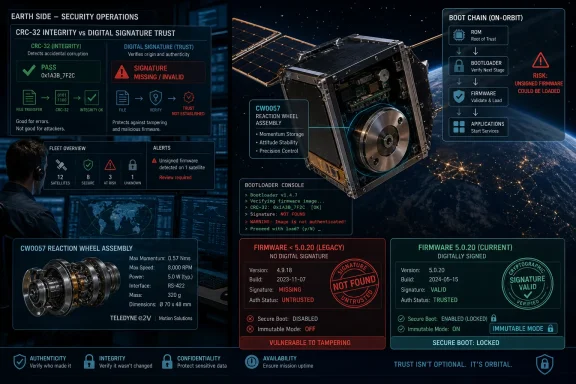
CISA’s advisory says the affected CubeSpace firmware used CRC-32 to authenticate firmware updates. That language is important because CRC-32 is an integrity check, not a signature scheme. It can help detect accidental corruption, but it does not prove that CubeSpace authored the image or that the image was approved by the spacecraft operator.
This is the kind of bug that sounds mundane until it lands in a device class where mistakes are expensive, physical access windows are rare, and trust decisions may be made long before launch. Firmware authenticity is not a theoretical nicety in space systems. It is part of the chain of custody.
CRC-32 has been around for decades because it is fast, simple, and useful for catching transmission or storage errors. It is not designed to resist an adversary. A malicious actor who can build an image can also account for a checksum; the check confirms that the bits arrived as expected, not that the bits came from a trusted party.
That distinction is familiar to anyone who has followed the evolution of Windows boot security. Secure Boot, signed drivers, measured boot, TPM-backed attestation, and Windows Defender Application Control all exist because modern systems cannot merely ask whether code is well-formed. They must ask whether code is authorized to run.
The CW0057 case is not a Windows vulnerability, but it belongs to the same family of security failures. A platform treats integrity as identity. A checksum answers one question, while a digital signature answers another. When hardware can be updated in the field, confusing those two questions creates a firmware supply-chain opening.
Still, physical access is not irrelevant in aerospace. Devices pass through manufacturing, integration, testing, shipping, storage, launch preparation, and sometimes third-party labs before they ever become unreachable in orbit. The pre-launch environment is full of legitimate hands, legitimate tools, and legitimate pressure to make hardware work on schedule.
For an attacker, physical access may mean a malicious insider, compromised supply-chain step, untrusted test fixture, or unsupervised access during integration. For a defender, it means the security boundary has to extend backward into procurement and handling. By the time a spacecraft is in orbit, the opportunity to inspect, reflash, or physically isolate hardware has mostly disappeared.
That is why the CVSS number can understate the operational anxiety. Physical access makes exploitation harder, but it also shifts the attack window into a phase where organizations may be least disciplined about cyber controls because the system is “just hardware on a bench.” Space systems increasingly need the same secure build-room assumptions that mature IT organizations apply to privileged infrastructure.
But recoverability is not security. It limits the blast radius after detection; it does not prevent unauthorized code from running in the first place. In a lab, recovery may be a manageable nuisance. In a spacecraft integration campaign, it can become a schedule risk. In an already-launched spacecraft, the usefulness of physical recovery depends on whether the vulnerable pathway is even accessible.
The advisory also notes that firmware version 5.0.20 introduces cryptographically verified secure boot, but that the protection is not enabled by default. This is the most consequential sentence in the whole advisory. A security feature that exists but is not activated is a control, not a guarantee.
That design may reflect legitimate deployment constraints. Space hardware has long life cycles, conservative change management, and mission-specific configurations. Vendors may be reluctant to force a boot policy that could lock out certain workflows or disrupt existing customers. But optional security creates an administrative burden: someone has to know the feature exists, understand the modes, choose the right one, and enable it before the system is exposed to risk.
Windows administrators will recognize the pattern. Turning on a security feature is often the beginning of the work, not the end. Secure Boot can be disabled in firmware settings. BitLocker is only as useful as its recovery-key process. Driver signing policies fail when exceptions multiply. Application control works only if organizations know what they intend to allow.
The CW0057 case follows the same operational logic. A mission team that updates to 5.0.20 but leaves cryptographic secure boot disabled has reduced nothing meaningful about the original weakness. A team that enables a weaker mode may improve posture but still preserve update pathways that need strict governance. A team that enables fully immutable mode gets the stronger guarantee, but it also commits itself to a more rigid lifecycle.
That is the trade-off secure systems always make explicit. Flexibility is useful during development, integration, and troubleshooting. Immutability is useful when the device must resist tampering. The mistake is pretending those goals are the same.
CubeSpace is headquartered in South Africa and sells components into an international market of CubeSat and SmallSat missions. The CW0057 sits in a category of compact, high-heritage reaction wheels designed for modular spacecraft architectures. Those traits are exactly what make the smallsat ecosystem powerful: standardized components, repeatable interfaces, shorter development cycles, and a larger supplier base.
They are also what make firmware trust more important. Reusable commercial components can propagate the same design assumption across many missions. A weak update mechanism in one device may not threaten every spacecraft the same way, but it can create a recurring integration risk wherever that device appears.
This mirrors the industrial control system world that CISA has been warning about for years. A vulnerability in a niche controller, encoder, robot, gateway, or actuator may look narrow on paper. But the installed base often crosses sectors, countries, and operational contexts. The device is small; the dependency graph is not.
But the generic guidance is still a useful reminder that component vulnerabilities do not live alone. The vulnerable device is part of a ground-test environment, engineering workstation workflow, configuration-management process, and operational chain. A malicious firmware image has to come from somewhere, be introduced by someone, and survive some process failure.
The practical work for integrators is therefore not limited to the reaction wheel. They should ask how firmware is obtained, hashed, stored, approved, applied, logged, and verified. They should ask whether engineering laptops used for hardware flashing are treated as privileged systems or as disposable lab tools. They should ask whether the person applying a firmware image can prove which image was applied.
This is where WindowsForum readers should see the bridge to their own world. The same endpoint hygiene that protects a domain admin workstation may protect a spacecraft test bench. The same inventory discipline that tracks BIOS versions across a fleet may matter for flight hardware. The same suspicion of unsigned code applies whether the target is a laptop driver or an actuator controller.
The tension is in the default. Security professionals have spent two decades learning that opt-in protections protect the users who are already attentive. The users who most need the control may never enable it, may enable it late, or may misunderstand what level of protection they selected.
There are reasons vendors hesitate to make secure boot mandatory. Mandatory signature enforcement can complicate field service, break custom workflows, or strand users who depend on older tooling. In aerospace, those concerns are amplified by mission assurance culture, where a known process with a known weakness may be viewed as less risky than a new process with uncertain integration consequences.
But attackers benefit from that caution. If a device’s strongest protection is optional, then the real-world security baseline is not the existence of the feature. It is the percentage of deployed units where customers turned it on correctly.
Windows has become increasingly assertive about hardware-backed security because the old perimeter model failed. Secure Boot, virtualization-based security, kernel-mode code integrity, TPM attestation, and signed update channels are all attempts to ensure that the machine starts from a trusted state before user-space defenses ever get a vote. Those ideas are spreading because every device is becoming a computer with a specialized job.
A reaction wheel is a motor, bearings, electronics, firmware, and interfaces. A router is packet silicon plus firmware. A printer is a document-processing computer with rollers. A camera is an image sensor attached to an embedded system. The security question is no longer whether a thing looks like a PC. The question is whether code running on the thing can alter the trustworthiness of the mission.
For IT pros, this is the lesson hiding inside the space-hardware story. Asset inventories that stop at “server,” “workstation,” and “network switch” are obsolete. The modern environment contains controllers, sensors, embedded Linux boxes, UEFI stacks, baseboard management controllers, programmable peripherals, and specialty devices whose firmware may be the most privileged code in the room.
For deployed or soon-to-launch hardware, the immediate question is firmware state. Operators need to determine whether any CW0057 units are running firmware before 5.0.20, whether 5.0.20 can be applied safely within the mission schedule, and whether signed boot can be enabled without disrupting required operations. The phrase “fully immutable mode” deserves special attention because it suggests a one-way or tightly constrained security posture that may require planning before activation.
For hardware still in development or integration, the better question is process state. Who can touch the device? Who can attach flashing tools? Which firmware images are approved? Are test images segregated from flight images? Are update attempts logged? Is there a second-person review before firmware is installed on flight hardware?
For procurement teams, the lesson is even broader. Secure boot should not be an afterthought discovered in a CISA advisory. It should be a requirement in component evaluation, along with documentation about key management, update signing, rollback protections, recovery modes, and default enforcement.
A medium vulnerability on a bench device may be easy to fix. A low vulnerability in a flight-critical component may require review boards, regression testing, mission assurance signoff, and vendor coordination. The calendar risk can dwarf the exploit risk.
That does not mean every operator should rush into a firmware change. CISA correctly reminds organizations to perform impact analysis and risk assessment before deploying defensive measures. In aerospace and industrial systems, a rushed patch can be its own incident.
It does mean the decision should be explicit. Leaving pre-5.0.20 firmware in place because the issue is “only physical” is different from accepting the risk after documenting access controls, recovery procedures, mission phase, and compensating measures. Mature security is not the absence of risk. It is the refusal to inherit risk accidentally.
The vulnerability, tracked as CVE-2026-13743, is rated medium under CVSS 3.1 and low under CVSS 4.0, largely because exploitation requires physical access and is not remotely reachable. But the interesting part is not the score. The interesting part is the gap between “the firmware image is intact” and “the firmware image is trusted,” a distinction Windows admins learned the hard way years ago and spacecraft vendors are now being forced to encode into their own boot chains.
 A Spacecraft Component Gets a Very Earthbound Firmware Lesson
The CubeSpace CW0057 is a reaction wheel, a precision electromechanical device used by CubeSats and SmallSats to control attitude without expending propellant. Reaction wheels are not glamorous in the way cameras, radios, or propulsion systems are, but they are mission-defining hardware. If a spacecraft cannot point, it cannot image, communicate efficiently, manage thermal exposure, or hold the geometry its mission requires.That makes firmware control unusually sensitive. A malicious or incorrect firmware image on a reaction wheel does not have to “own” an operating system to cause trouble. It can distort torque behavior, degrade pointing precision, interfere with attitude-control loops, or drive operators into a recovery workflow at the worst possible moment.
CISA’s advisory says the affected CubeSpace firmware used CRC-32 to authenticate firmware updates. That language is important because CRC-32 is an integrity check, not a signature scheme. It can help detect accidental corruption, but it does not prove that CubeSpace authored the image or that the image was approved by the spacecraft operator.
This is the kind of bug that sounds mundane until it lands in a device class where mistakes are expensive, physical access windows are rare, and trust decisions may be made long before launch. Firmware authenticity is not a theoretical nicety in space systems. It is part of the chain of custody.
CRC-32 Was Never a Security Boundary
The advisory’s core technical point is simple: firmware versions before 5.0.20 do not properly verify a cryptographic signature. An attacker with physical access to the device could upload arbitrary malicious firmware without authentication. In CWE terms, this is improper verification of cryptographic signature, but the practical translation is even blunter: the device could be convinced to run code whose origin it had not proved.CRC-32 has been around for decades because it is fast, simple, and useful for catching transmission or storage errors. It is not designed to resist an adversary. A malicious actor who can build an image can also account for a checksum; the check confirms that the bits arrived as expected, not that the bits came from a trusted party.
That distinction is familiar to anyone who has followed the evolution of Windows boot security. Secure Boot, signed drivers, measured boot, TPM-backed attestation, and Windows Defender Application Control all exist because modern systems cannot merely ask whether code is well-formed. They must ask whether code is authorized to run.
The CW0057 case is not a Windows vulnerability, but it belongs to the same family of security failures. A platform treats integrity as identity. A checksum answers one question, while a digital signature answers another. When hardware can be updated in the field, confusing those two questions creates a firmware supply-chain opening.
The Physical-Access Caveat Lowers the Odds, Not the Stakes
CubeSpace’s mitigation statement is clear that exploitation requires direct physical access and cannot be performed remotely. That sharply limits the realistic attack surface. This is not a wormable satellite component flaw, not an internet-exposed control panel, and not a remote code execution vulnerability hiding behind an open port.Still, physical access is not irrelevant in aerospace. Devices pass through manufacturing, integration, testing, shipping, storage, launch preparation, and sometimes third-party labs before they ever become unreachable in orbit. The pre-launch environment is full of legitimate hands, legitimate tools, and legitimate pressure to make hardware work on schedule.
For an attacker, physical access may mean a malicious insider, compromised supply-chain step, untrusted test fixture, or unsupervised access during integration. For a defender, it means the security boundary has to extend backward into procurement and handling. By the time a spacecraft is in orbit, the opportunity to inspect, reflash, or physically isolate hardware has mostly disappeared.
That is why the CVSS number can understate the operational anxiety. Physical access makes exploitation harder, but it also shifts the attack window into a phase where organizations may be least disciplined about cyber controls because the system is “just hardware on a bench.” Space systems increasingly need the same secure build-room assumptions that mature IT organizations apply to privileged infrastructure.
Recovery Is Reassuring, but It Is Not the Same as Prevention
CubeSpace says an affected unit cannot be permanently disabled by this method because the bootloader operates independently of the application firmware and can reload known-good CubeSpace-supplied images. That is a meaningful mitigation. A recoverable firmware compromise is materially different from a device that can be bricked permanently.But recoverability is not security. It limits the blast radius after detection; it does not prevent unauthorized code from running in the first place. In a lab, recovery may be a manageable nuisance. In a spacecraft integration campaign, it can become a schedule risk. In an already-launched spacecraft, the usefulness of physical recovery depends on whether the vulnerable pathway is even accessible.
The advisory also notes that firmware version 5.0.20 introduces cryptographically verified secure boot, but that the protection is not enabled by default. This is the most consequential sentence in the whole advisory. A security feature that exists but is not activated is a control, not a guarantee.
That design may reflect legitimate deployment constraints. Space hardware has long life cycles, conservative change management, and mission-specific configurations. Vendors may be reluctant to force a boot policy that could lock out certain workflows or disrupt existing customers. But optional security creates an administrative burden: someone has to know the feature exists, understand the modes, choose the right one, and enable it before the system is exposed to risk.
Secure Boot Becomes a Configuration Problem
The firmware 5.0.20 fix is not just “install the update.” CISA’s advisory says users must activate signed-boot functionality, especially the fully immutable mode, to achieve full security. That makes this less like a normal patch and more like a platform-hardening project.Windows administrators will recognize the pattern. Turning on a security feature is often the beginning of the work, not the end. Secure Boot can be disabled in firmware settings. BitLocker is only as useful as its recovery-key process. Driver signing policies fail when exceptions multiply. Application control works only if organizations know what they intend to allow.
The CW0057 case follows the same operational logic. A mission team that updates to 5.0.20 but leaves cryptographic secure boot disabled has reduced nothing meaningful about the original weakness. A team that enables a weaker mode may improve posture but still preserve update pathways that need strict governance. A team that enables fully immutable mode gets the stronger guarantee, but it also commits itself to a more rigid lifecycle.
That is the trade-off secure systems always make explicit. Flexibility is useful during development, integration, and troubleshooting. Immutability is useful when the device must resist tampering. The mistake is pretending those goals are the same.
SmallSat Hardware Is Growing Up Under a Security Spotlight
The broader significance is that small-satellite hardware is moving from bespoke engineering culture toward critical infrastructure culture. CISA classifies the advisory under the communications sector and lists worldwide deployment. That framing matters because satellites are no longer exotic national assets operated by a handful of agencies. They are commercial infrastructure, research infrastructure, and in many cases communications infrastructure.CubeSpace is headquartered in South Africa and sells components into an international market of CubeSat and SmallSat missions. The CW0057 sits in a category of compact, high-heritage reaction wheels designed for modular spacecraft architectures. Those traits are exactly what make the smallsat ecosystem powerful: standardized components, repeatable interfaces, shorter development cycles, and a larger supplier base.
They are also what make firmware trust more important. Reusable commercial components can propagate the same design assumption across many missions. A weak update mechanism in one device may not threaten every spacecraft the same way, but it can create a recurring integration risk wherever that device appears.
This mirrors the industrial control system world that CISA has been warning about for years. A vulnerability in a niche controller, encoder, robot, gateway, or actuator may look narrow on paper. But the installed base often crosses sectors, countries, and operational contexts. The device is small; the dependency graph is not.
The Advisory Is Also a Message to Integrators
CISA’s recommended practices include the usual control-system guidance: minimize exposure, isolate systems, use firewalls, secure remote access, keep VPNs updated, perform impact analysis, and watch for social engineering. Some of that reads oddly when applied to a reaction wheel that is not remotely exploitable. Nobody should pretend a firewall fixes a physically accessible firmware loader.But the generic guidance is still a useful reminder that component vulnerabilities do not live alone. The vulnerable device is part of a ground-test environment, engineering workstation workflow, configuration-management process, and operational chain. A malicious firmware image has to come from somewhere, be introduced by someone, and survive some process failure.
The practical work for integrators is therefore not limited to the reaction wheel. They should ask how firmware is obtained, hashed, stored, approved, applied, logged, and verified. They should ask whether engineering laptops used for hardware flashing are treated as privileged systems or as disposable lab tools. They should ask whether the person applying a firmware image can prove which image was applied.
This is where WindowsForum readers should see the bridge to their own world. The same endpoint hygiene that protects a domain admin workstation may protect a spacecraft test bench. The same inventory discipline that tracks BIOS versions across a fleet may matter for flight hardware. The same suspicion of unsigned code applies whether the target is a laptop driver or an actuator controller.
Vendor Transparency Helps, but Defaults Decide Outcomes
CubeSpace’s acknowledgement is comparatively straightforward. The company concedes the finding, explains the CRC-32 limitation, emphasizes the physical-access requirement, notes the independent bootloader recovery path, and points customers to optional secure boot in firmware 5.0.20. That is better than vague advisory language that hides the mechanism behind marketing reassurance.The tension is in the default. Security professionals have spent two decades learning that opt-in protections protect the users who are already attentive. The users who most need the control may never enable it, may enable it late, or may misunderstand what level of protection they selected.
There are reasons vendors hesitate to make secure boot mandatory. Mandatory signature enforcement can complicate field service, break custom workflows, or strand users who depend on older tooling. In aerospace, those concerns are amplified by mission assurance culture, where a known process with a known weakness may be viewed as less risky than a new process with uncertain integration consequences.
But attackers benefit from that caution. If a device’s strongest protection is optional, then the real-world security baseline is not the existence of the feature. It is the percentage of deployed units where customers turned it on correctly.
The Windows Analogy Is Not Forced
At first glance, a South African smallsat reaction wheel seems far outside the Windows ecosystem. Yet the advisory lands squarely in a conversation Windows admins know well: firmware is software, software must be authenticated, and platform trust cannot be patched in after compromise without operational pain.Windows has become increasingly assertive about hardware-backed security because the old perimeter model failed. Secure Boot, virtualization-based security, kernel-mode code integrity, TPM attestation, and signed update channels are all attempts to ensure that the machine starts from a trusted state before user-space defenses ever get a vote. Those ideas are spreading because every device is becoming a computer with a specialized job.
A reaction wheel is a motor, bearings, electronics, firmware, and interfaces. A router is packet silicon plus firmware. A printer is a document-processing computer with rollers. A camera is an image sensor attached to an embedded system. The security question is no longer whether a thing looks like a PC. The question is whether code running on the thing can alter the trustworthiness of the mission.
For IT pros, this is the lesson hiding inside the space-hardware story. Asset inventories that stop at “server,” “workstation,” and “network switch” are obsolete. The modern environment contains controllers, sensors, embedded Linux boxes, UEFI stacks, baseboard management controllers, programmable peripherals, and specialty devices whose firmware may be the most privileged code in the room.
The Real Risk Lives Before Launch
The advisory says there is no known public exploitation targeting this vulnerability and that it is not remotely exploitable. That should prevent panic. It should not prevent action.For deployed or soon-to-launch hardware, the immediate question is firmware state. Operators need to determine whether any CW0057 units are running firmware before 5.0.20, whether 5.0.20 can be applied safely within the mission schedule, and whether signed boot can be enabled without disrupting required operations. The phrase “fully immutable mode” deserves special attention because it suggests a one-way or tightly constrained security posture that may require planning before activation.
For hardware still in development or integration, the better question is process state. Who can touch the device? Who can attach flashing tools? Which firmware images are approved? Are test images segregated from flight images? Are update attempts logged? Is there a second-person review before firmware is installed on flight hardware?
For procurement teams, the lesson is even broader. Secure boot should not be an afterthought discovered in a CISA advisory. It should be a requirement in component evaluation, along with documentation about key management, update signing, rollback protections, recovery modes, and default enforcement.
The Concrete Shape of the Fix Matters More Than the Score
This advisory is a useful example of why vulnerability severity is not the same as remediation priority. CVSS 3.1 gives the issue a 6.1 medium rating, while CVSS 4.0 gives it a 3.3 low rating. Both scores reflect the physical attack vector and absence of remote exploitability. Neither score captures the awkwardness of making boot-policy changes in a spacecraft program.A medium vulnerability on a bench device may be easy to fix. A low vulnerability in a flight-critical component may require review boards, regression testing, mission assurance signoff, and vendor coordination. The calendar risk can dwarf the exploit risk.
That does not mean every operator should rush into a firmware change. CISA correctly reminds organizations to perform impact analysis and risk assessment before deploying defensive measures. In aerospace and industrial systems, a rushed patch can be its own incident.
It does mean the decision should be explicit. Leaving pre-5.0.20 firmware in place because the issue is “only physical” is different from accepting the risk after documenting access controls, recovery procedures, mission phase, and compensating measures. Mature security is not the absence of risk. It is the refusal to inherit risk accidentally.
The Orbiting Firmware Lesson for Earthbound Administrators
The CW0057 advisory is narrow, but it usefully compresses a larger firmware-security argument into one device and one update path. It is a reminder that code authenticity is now a baseline requirement for specialized hardware, not a premium enterprise feature.- Firmware before version 5.0.20 on the CubeSpace CW0057 Reaction Wheel is affected by a signature-verification weakness that can allow arbitrary firmware installation with physical access.
- The vulnerability is not remotely exploitable, and CubeSpace says affected units remain recoverable through an independent bootloader.
- CRC-32 can confirm that a firmware image was not accidentally corrupted, but it cannot prove that the image came from an authorized source.
- Firmware version 5.0.20 introduces cryptographically verified secure boot, but customers must enable signed boot themselves to get the intended protection.
- The strongest posture appears to depend on enabling fully immutable mode, which should be planned and tested rather than treated as a routine toggle.
- The operational risk is most relevant during manufacturing, integration, testing, shipping, and other pre-launch handling phases where physical access is plausible.
References
- Primary source: CISA
Published: 2026-07-02T12:00:00+00:00
CubeSpace CW0057 Reaction Wheel | CISA
www.cisa.gov
- Related coverage: dawndusk.space
- Related coverage: satcatalog.com
Gen2: CubeWheel CW0057 - Reaction Wheel | SatCatalog
CubeSpace (CS) offers a wide range of robust reaction wheels perfect for CubeSats and SmallSats. Our CubeWheel range is designed for precision ease of and...www.satcatalog.com - Related coverage: cubespace.co.za
- Related coverage: assurantcyber.com
Rockwell Automation CompactLogix 5370 - ASSURANT™
Rockwell Automation CompactLogix 5370 All CISA Advisories, CISA, January 22, 2026 View CSAF Summary Successful exploitation of this vulnerability could allow an attacker to cause a denial-of-service condition. The following versions of Rockwell Automation CompactLogix 5370 are affected... www.assurantcyber.com
- Related coverage: cisco.com
