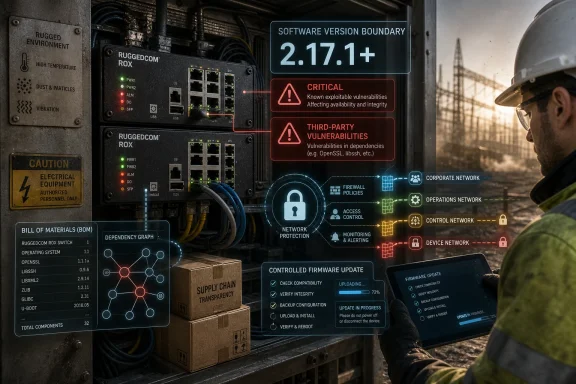
Siemens and CISA disclosed on May 12 and May 14, 2026, that Siemens RUGGEDCOM ROX devices running versions before 2.17.1 contain dozens of third-party software vulnerabilities, including flaws rated as critical, and Siemens is telling operators worldwide to update affected industrial networking equipment. The advisory is not a flashy zero-day story; it is a supply-chain maintenance story with teeth. For utilities, transportation operators, factories, and anyone else running hardened network gear in unforgiving environments, the message is blunt: old embedded software is now an operational risk, not just a compliance nuisance.
RUGGEDCOM is the kind of product line most ordinary Windows users will never touch and many IT administrators will never see, but it sits in places where failure is expensive. These devices are built for substations, traffic cabinets, industrial plants, and other harsh environments where ordinary enterprise switches are not the right tool. That is precisely why this advisory matters: the gear is deployed where replacement cycles are long, change windows are scarce, and downtime can quickly become a business or public-service problem.
The affected ROX products include the MX5000, MX5000RE, RX1400, RX1500, RX1501, RX1510, RX1511, RX1512, RX1524, RX1536, and RX5000 families when running versions before 2.17.1. Siemens says the fix is to update to version 2.17.1 or later. CISA’s republication places the issue squarely in the Critical Manufacturing sector, with worldwide deployment and Siemens’ headquarters in Germany.
The vulnerability list is long enough to look almost absurd at first glance. It includes older CVEs from 2019 and 2020 alongside issues assigned in 2025, spanning uncontrolled recursion, integer underflow, heap and stack buffer overflows, out-of-bounds reads and writes, use-after-free, weak hashing, path traversal, expired pointer dereference, and other memory-safety and input-validation failures. The vendor CVSS v3 score reaches 9.8, which puts the advisory into the category that usually makes asset owners stop treating firmware updates as optional housekeeping.
But the important detail is not simply the score. The important detail is that these are third-party vulnerabilities bundled into industrial firmware. Siemens did not describe this as one bespoke RUGGEDCOM design flaw; it described a pileup of inherited software risk inside a platform that customers bought for reliability.
The clean operational line is version 2.17.1. If an affected RUGGEDCOM ROX device is below that version, Siemens says it is exposed to the listed third-party vulnerabilities. If it is at 2.17.1 or later, Siemens’ stated remediation path has been applied. That is the sentence asset owners should turn into a discovery query, a maintenance ticket, and eventually a change record.
The affected product spread also matters. This is not a single obscure model in a forgotten corner of the catalog. The advisory covers a broad ROX II family footprint across multiple RX and MX devices. That implies the underlying vulnerable components are part of a common software base rather than a one-off packaging mistake.
For WindowsForum readers, the closest analogy is not Patch Tuesday on a desktop fleet. It is closer to discovering that a shared driver, library, or appliance firmware stack quietly underpins a dozen systems you thought of as separate assets. The difference is that industrial networking hardware often sits outside the cleanest parts of an IT asset inventory, especially when it is owned by operations teams rather than corporate IT.
A switch can remain physically sound for a decade while the libraries compiled into its firmware accumulate years of public vulnerability history. That is what makes this kind of advisory so awkward. The device can be doing its day job perfectly while becoming progressively harder to defend from a cybersecurity standpoint.
This is not unique to Siemens. Every industrial vendor that ships Linux-based appliances, web management interfaces, VPN components, packet parsers, compression libraries, or cryptographic code inherits the same lifecycle problem. The product may have a 15-year operational expectation, but its software dependencies may need attention every month.
That tension is now the defining problem in operational technology security. Asset owners want stability; attackers exploit stagnation. Vendors want predictable support models; vulnerability disclosure turns inherited components into emergency work. Regulators and insurers increasingly expect patch discipline; operators know that patching industrial networks is never as simple as approving a reboot prompt.
That amplification changes the practical life of the advisory. A Siemens customer might miss a ProductCERT bulletin buried in a vendor portal workflow. A CISA ICS advisory is more likely to be ingested by vulnerability management platforms, government watchers, managed security providers, and risk teams that track critical infrastructure exposure.
It also creates a useful forcing function inside organizations. Operations engineers may be more willing to schedule an upgrade when security teams can point to a CISA advisory rather than a generic vendor release note. Conversely, security teams have to respect that CISA’s recommended practices are intentionally broad: reduce exposure, isolate control networks, use secure remote access, and perform impact analysis before defensive changes.
That last point is not boilerplate. In industrial environments, “just patch it” can be dangerous advice if it ignores process availability, redundancy, safety constraints, and vendor support requirements. The right response is urgent, but it is not reckless.
Customers buy an appliance, not a dependency graph. If a buffer overflow in an embedded component can compromise the box, the box is the thing that needs to be managed, patched, isolated, and monitored. Attackers do not care whether the vulnerable line of code originated inside Siemens, an open-source project, or another upstream supplier.
The more useful interpretation is that industrial firmware is now a supply-chain artifact. It contains layered software from multiple origins, and the security of the finished product depends on how quickly vendors can track, validate, integrate, and ship fixes for components they did not originally write. That makes SBOM discipline, reproducible build practices, and support transparency more than procurement buzzwords.
For administrators, the practical takeaway is to stop treating embedded firmware as a black box that only matters when hardware breaks. It is software. It has dependencies. It has a patch cadence. It has known-bad versions. It belongs in vulnerability management, even if the device lives in an OT rack rather than a server room.
But CISA’s defensive guidance is clear because the pattern is clear: minimize network exposure for control system devices, keep them off the public internet, isolate control system networks from business networks, and keep VPNs and remote access components current. That is a familiar message because it remains one of the most reliable ways to prevent vulnerabilities from becoming incidents.
In practice, the riskiest ROX deployment is not necessarily the oldest one. It is the one with unclear ownership, internet-reachable management, flat network access from corporate IT, stale credentials, or remote access glued on during a past emergency and never revisited. A fully patched device in a poorly segmented environment is still a problem; an unpatched device in a well-segmented environment is still an exposure. The combination of both failures is where advisories become incident reports.
Administrators should therefore resist the urge to treat version 2.17.1 as the entire fix. Updating is the vendor’s remediation, but exposure management is the organization’s responsibility. The patch closes known software flaws; architecture determines how much opportunity an attacker had in the first place.
That is why Windows shops should read industrial advisories even when the affected product is not a Microsoft platform. The security boundary between enterprise and operations has been eroding for years. Plants need remote support; substations need telemetry; field devices need centralized monitoring; vendors need maintenance access. Every integration creates identity, logging, routing, and access-control questions that Windows-centric teams are often asked to answer.
The worst organizational pattern is the one where OT owns the device, IT owns the identity system, networking owns the firewall, security owns the scanner, and nobody owns the complete risk. Advisories like this punish fragmented responsibility. They require a single view of asset version, network path, compensating controls, maintenance feasibility, and business impact.
For WindowsForum’s sysadmin audience, the action item is not to become an expert in every industrial switch. It is to know whether your environment has them, who owns them, whether your Windows infrastructure can reach them, and whether your remote access architecture quietly makes them more exposed than the OT team believes.
That does not make patching optional. It means patching has to be governed like an operational change rather than treated as an isolated security task. The advisory itself says organizations should perform proper impact analysis and risk assessment before deploying defensive measures. That language can be abused as an excuse to delay forever, but it is also a necessary warning against cowboy remediation.
A serious response starts with inventory. Which RUGGEDCOM ROX devices are present? Which exact models? Which firmware versions? Which networks can reach their management interfaces? Which services are enabled? Which business or industrial processes depend on them? Which devices can be updated immediately, and which need a scheduled outage?
From there, organizations should divide the fleet into risk tiers. Internet exposure or broad corporate reachability should raise urgency. Devices in safety-adjacent or availability-critical roles may require more testing but should not be allowed to disappear into an indefinite exception list. If compensating controls are used, they should be documented as temporary controls with owners and expiration dates.
This is how technical debt appears in infrastructure: not as one dramatic failure, but as a stack of old assumptions that eventually becomes too heavy to ignore. Each third-party component may have had its own disclosure, fix, and upstream release history. The appliance vendor then has to determine whether the component is present, whether the vulnerable code path is reachable, whether the fix affects device behavior, and how to package the result into a supported firmware release.
For asset owners, the lesson is uncomfortable but simple. Waiting for the one perfect maintenance window can turn routine patching into a major security event. The longer industrial firmware sits below current release levels, the more likely the next update will include a broad mix of security fixes, behavior changes, and operational uncertainty.
The better model is boring and scheduled. Firmware should have a lifecycle calendar. Critical devices should have tested update procedures before an urgent advisory appears. Backups, rollback paths, and vendor contacts should be known in advance. The time to learn how a ROX update behaves is not during an incident-response call.
That guidance is reasonable. It is also the minimum expected shape of an industrial security advisory in 2026. The harder question is whether organizations can prove they have followed it.
Proof means more than a policy document. It means asset records showing firmware versions. It means firewall rules that match architecture diagrams. It means remote access logs that can be audited. It means vulnerability exceptions tied to actual compensating controls. It means change records showing when version 2.17.1 or later was deployed, and where it was deferred.
This is where many organizations still struggle. OT environments often contain devices that are known by location, function, or tribal memory rather than by clean CMDB entries. A security team may know a vendor name but not firmware versions. A plant team may know a cabinet but not the CVE implications. Bridging that gap is now core infrastructure work.
That reliability is a double-edged sword. A device that rarely fails rarely attracts attention. If it forwards traffic, survives harsh conditions, and avoids nuisance alarms, it becomes part of the scenery. Security advisories turn that invisibility into risk.
The cure is not panic scanning of production networks. Industrial discovery has to be careful, especially around legacy protocols and fragile environments. But passive monitoring, configuration reviews, vendor management records, maintenance logs, and controlled queries can usually build a better picture without treating the plant like a corporate LAN.
The ownership question matters as much as the technical one. Someone has to be accountable for turning Siemens’ version boundary into a local answer: which devices are below 2.17.1, when will they be updated, and what controls protect them until then?
Industrial security will not be won by pretending rugged devices are timeless or by forcing OT teams into reckless patch cycles built for office laptops. It will be won by treating firmware as living software, by making network exposure a first-class risk measure, and by building maintenance habits before advisories with 9.8 scores arrive. Siemens has drawn the line at ROX 2.17.1; the next move belongs to the operators who have to prove their most reliable equipment is also being reliably maintained.
Source: CISA Siemens Ruggedcom Rox | CISA
 Siemens’ Rugged Switches Just Became a Software Bill of Materials Problem
RUGGEDCOM is the kind of product line most ordinary Windows users will never touch and many IT administrators will never see, but it sits in places where failure is expensive. These devices are built for substations, traffic cabinets, industrial plants, and other harsh environments where ordinary enterprise switches are not the right tool. That is precisely why this advisory matters: the gear is deployed where replacement cycles are long, change windows are scarce, and downtime can quickly become a business or public-service problem.The affected ROX products include the MX5000, MX5000RE, RX1400, RX1500, RX1501, RX1510, RX1511, RX1512, RX1524, RX1536, and RX5000 families when running versions before 2.17.1. Siemens says the fix is to update to version 2.17.1 or later. CISA’s republication places the issue squarely in the Critical Manufacturing sector, with worldwide deployment and Siemens’ headquarters in Germany.
The vulnerability list is long enough to look almost absurd at first glance. It includes older CVEs from 2019 and 2020 alongside issues assigned in 2025, spanning uncontrolled recursion, integer underflow, heap and stack buffer overflows, out-of-bounds reads and writes, use-after-free, weak hashing, path traversal, expired pointer dereference, and other memory-safety and input-validation failures. The vendor CVSS v3 score reaches 9.8, which puts the advisory into the category that usually makes asset owners stop treating firmware updates as optional housekeeping.
But the important detail is not simply the score. The important detail is that these are third-party vulnerabilities bundled into industrial firmware. Siemens did not describe this as one bespoke RUGGEDCOM design flaw; it described a pileup of inherited software risk inside a platform that customers bought for reliability.
The Critical Number Is 2.17.1, Not the CVE Count
Security advisories invite a kind of CVE numerology. Thirty-plus identifiers look worse than three, and a 9.8 rating looks worse than an 8.8. That is true as far as it goes, but it is not the most useful way to read this advisory.The clean operational line is version 2.17.1. If an affected RUGGEDCOM ROX device is below that version, Siemens says it is exposed to the listed third-party vulnerabilities. If it is at 2.17.1 or later, Siemens’ stated remediation path has been applied. That is the sentence asset owners should turn into a discovery query, a maintenance ticket, and eventually a change record.
The affected product spread also matters. This is not a single obscure model in a forgotten corner of the catalog. The advisory covers a broad ROX II family footprint across multiple RX and MX devices. That implies the underlying vulnerable components are part of a common software base rather than a one-off packaging mistake.
For WindowsForum readers, the closest analogy is not Patch Tuesday on a desktop fleet. It is closer to discovering that a shared driver, library, or appliance firmware stack quietly underpins a dozen systems you thought of as separate assets. The difference is that industrial networking hardware often sits outside the cleanest parts of an IT asset inventory, especially when it is owned by operations teams rather than corporate IT.
The Advisory Is Also a Reminder That “Rugged” Does Not Mean Immutable
Industrial equipment has always sold itself on endurance. RUGGEDCOM hardware, like other industrial gear, is built to tolerate heat, vibration, electrical noise, and long service lives. The uncomfortable modern twist is that the network stack inside that rugged chassis ages on a very different timeline from the metal around it.A switch can remain physically sound for a decade while the libraries compiled into its firmware accumulate years of public vulnerability history. That is what makes this kind of advisory so awkward. The device can be doing its day job perfectly while becoming progressively harder to defend from a cybersecurity standpoint.
This is not unique to Siemens. Every industrial vendor that ships Linux-based appliances, web management interfaces, VPN components, packet parsers, compression libraries, or cryptographic code inherits the same lifecycle problem. The product may have a 15-year operational expectation, but its software dependencies may need attention every month.
That tension is now the defining problem in operational technology security. Asset owners want stability; attackers exploit stagnation. Vendors want predictable support models; vulnerability disclosure turns inherited components into emergency work. Regulators and insurers increasingly expect patch discipline; operators know that patching industrial networks is never as simple as approving a reboot prompt.
CISA’s Republication Turns a Vendor Fix Into a Public Risk Signal
Siemens ProductCERT reported the vulnerabilities, and CISA republished the advisory as part of its industrial control systems program. That distinction matters because CISA explicitly notes that the advisory is a verbatim republication of Siemens’ CSAF advisory and is provided for visibility. In other words, CISA is not rewriting the technical finding; it is amplifying it to the industrial security community.That amplification changes the practical life of the advisory. A Siemens customer might miss a ProductCERT bulletin buried in a vendor portal workflow. A CISA ICS advisory is more likely to be ingested by vulnerability management platforms, government watchers, managed security providers, and risk teams that track critical infrastructure exposure.
It also creates a useful forcing function inside organizations. Operations engineers may be more willing to schedule an upgrade when security teams can point to a CISA advisory rather than a generic vendor release note. Conversely, security teams have to respect that CISA’s recommended practices are intentionally broad: reduce exposure, isolate control networks, use secure remote access, and perform impact analysis before defensive changes.
That last point is not boilerplate. In industrial environments, “just patch it” can be dangerous advice if it ignores process availability, redundancy, safety constraints, and vendor support requirements. The right response is urgent, but it is not reckless.
The Third-Party Label Should Not Make Anyone Relax
There is a subtle trap in the phrase third-party vulnerabilities. It can sound like exculpation, as if the vendor is saying the dangerous code came from somewhere else. That may be technically true, but it is operationally irrelevant to the owner of a vulnerable device.Customers buy an appliance, not a dependency graph. If a buffer overflow in an embedded component can compromise the box, the box is the thing that needs to be managed, patched, isolated, and monitored. Attackers do not care whether the vulnerable line of code originated inside Siemens, an open-source project, or another upstream supplier.
The more useful interpretation is that industrial firmware is now a supply-chain artifact. It contains layered software from multiple origins, and the security of the finished product depends on how quickly vendors can track, validate, integrate, and ship fixes for components they did not originally write. That makes SBOM discipline, reproducible build practices, and support transparency more than procurement buzzwords.
For administrators, the practical takeaway is to stop treating embedded firmware as a black box that only matters when hardware breaks. It is software. It has dependencies. It has a patch cadence. It has known-bad versions. It belongs in vulnerability management, even if the device lives in an OT rack rather than a server room.
Remote Exposure Is the Difference Between Bad and Urgent
The advisory text does not turn every listed CVE into a guaranteed remote compromise path against every deployment. That distinction matters. Industrial devices are often deployed behind segmentation layers, firewalls, management jump hosts, or private operational networks. Some vulnerabilities may require specific services, protocol paths, configuration states, or attacker positions.But CISA’s defensive guidance is clear because the pattern is clear: minimize network exposure for control system devices, keep them off the public internet, isolate control system networks from business networks, and keep VPNs and remote access components current. That is a familiar message because it remains one of the most reliable ways to prevent vulnerabilities from becoming incidents.
In practice, the riskiest ROX deployment is not necessarily the oldest one. It is the one with unclear ownership, internet-reachable management, flat network access from corporate IT, stale credentials, or remote access glued on during a past emergency and never revisited. A fully patched device in a poorly segmented environment is still a problem; an unpatched device in a well-segmented environment is still an exposure. The combination of both failures is where advisories become incident reports.
Administrators should therefore resist the urge to treat version 2.17.1 as the entire fix. Updating is the vendor’s remediation, but exposure management is the organization’s responsibility. The patch closes known software flaws; architecture determines how much opportunity an attacker had in the first place.
The Windows Angle Is the Boundary Between IT and OT
This advisory is not about Windows endpoints, but it lands directly in the territory Windows administrators increasingly occupy. Active Directory, jump servers, remote desktop gateways, VPN concentrators, SIEM agents, backup systems, and patch-management workflows often form the connective tissue between corporate IT and OT environments. A compromised industrial network device may not run Windows, but the path to it may pass through Windows-managed infrastructure.That is why Windows shops should read industrial advisories even when the affected product is not a Microsoft platform. The security boundary between enterprise and operations has been eroding for years. Plants need remote support; substations need telemetry; field devices need centralized monitoring; vendors need maintenance access. Every integration creates identity, logging, routing, and access-control questions that Windows-centric teams are often asked to answer.
The worst organizational pattern is the one where OT owns the device, IT owns the identity system, networking owns the firewall, security owns the scanner, and nobody owns the complete risk. Advisories like this punish fragmented responsibility. They require a single view of asset version, network path, compensating controls, maintenance feasibility, and business impact.
For WindowsForum’s sysadmin audience, the action item is not to become an expert in every industrial switch. It is to know whether your environment has them, who owns them, whether your Windows infrastructure can reach them, and whether your remote access architecture quietly makes them more exposed than the OT team believes.
Patching Industrial Gear Is a Governance Test, Not a Download Task
In a conventional IT environment, a critical update can often move from advisory to deployment through a fairly mature pipeline: test group, phased rollout, monitoring, rollback plan. Industrial gear is different. Firmware updates may require vendor procedures, maintenance windows tied to physical operations, redundant path validation, configuration backups, and local personnel who understand the process impact.That does not make patching optional. It means patching has to be governed like an operational change rather than treated as an isolated security task. The advisory itself says organizations should perform proper impact analysis and risk assessment before deploying defensive measures. That language can be abused as an excuse to delay forever, but it is also a necessary warning against cowboy remediation.
A serious response starts with inventory. Which RUGGEDCOM ROX devices are present? Which exact models? Which firmware versions? Which networks can reach their management interfaces? Which services are enabled? Which business or industrial processes depend on them? Which devices can be updated immediately, and which need a scheduled outage?
From there, organizations should divide the fleet into risk tiers. Internet exposure or broad corporate reachability should raise urgency. Devices in safety-adjacent or availability-critical roles may require more testing but should not be allowed to disappear into an indefinite exception list. If compensating controls are used, they should be documented as temporary controls with owners and expiration dates.
The CVE Spread Shows the Cost of Long Maintenance Tails
One striking feature of the advisory is its date range. The listed vulnerabilities include identifiers from 2019, 2020, 2022, 2023, 2024, and 2025. That does not automatically mean Siemens ignored all of them for years; embedded product integration, applicability analysis, and advisory timing are more complicated than public CVE dates suggest. But for customers, the visible effect is a large cumulative update boundary.This is how technical debt appears in infrastructure: not as one dramatic failure, but as a stack of old assumptions that eventually becomes too heavy to ignore. Each third-party component may have had its own disclosure, fix, and upstream release history. The appliance vendor then has to determine whether the component is present, whether the vulnerable code path is reachable, whether the fix affects device behavior, and how to package the result into a supported firmware release.
For asset owners, the lesson is uncomfortable but simple. Waiting for the one perfect maintenance window can turn routine patching into a major security event. The longer industrial firmware sits below current release levels, the more likely the next update will include a broad mix of security fixes, behavior changes, and operational uncertainty.
The better model is boring and scheduled. Firmware should have a lifecycle calendar. Critical devices should have tested update procedures before an urgent advisory appears. Backups, rollback paths, and vendor contacts should be known in advance. The time to learn how a ROX update behaves is not during an incident-response call.
Siemens’ Guidance Is Sensible, But Customers Need Evidence
Siemens recommends updating to the latest version and protecting network access with appropriate mechanisms. It also points customers toward its industrial security operational guidelines and product manuals. CISA echoes the standard ICS defense-in-depth posture: reduce exposure, isolate control networks, secure remote access, assess impact, and report suspected malicious activity.That guidance is reasonable. It is also the minimum expected shape of an industrial security advisory in 2026. The harder question is whether organizations can prove they have followed it.
Proof means more than a policy document. It means asset records showing firmware versions. It means firewall rules that match architecture diagrams. It means remote access logs that can be audited. It means vulnerability exceptions tied to actual compensating controls. It means change records showing when version 2.17.1 or later was deployed, and where it was deferred.
This is where many organizations still struggle. OT environments often contain devices that are known by location, function, or tribal memory rather than by clean CMDB entries. A security team may know a vendor name but not firmware versions. A plant team may know a cabinet but not the CVE implications. Bridging that gap is now core infrastructure work.
The Real Risk Is the Device Nobody Thought to Ask About
The most dangerous asset in this advisory is not necessarily the most critical switch. It may be the forgotten one: a remote site device installed years ago, reachable through a vendor VPN, absent from the central inventory, and running firmware that nobody has reviewed since commissioning. Industrial networks are full of such ghosts because the hardware is designed to keep working.That reliability is a double-edged sword. A device that rarely fails rarely attracts attention. If it forwards traffic, survives harsh conditions, and avoids nuisance alarms, it becomes part of the scenery. Security advisories turn that invisibility into risk.
The cure is not panic scanning of production networks. Industrial discovery has to be careful, especially around legacy protocols and fragile environments. But passive monitoring, configuration reviews, vendor management records, maintenance logs, and controlled queries can usually build a better picture without treating the plant like a corporate LAN.
The ownership question matters as much as the technical one. Someone has to be accountable for turning Siemens’ version boundary into a local answer: which devices are below 2.17.1, when will they be updated, and what controls protect them until then?
A Short Field Guide for ROX Owners Before the Next Maintenance Window
This advisory’s lesson is concrete enough to turn into action, but only if organizations resist making it either too abstract or too theatrical. It is not enough to say “critical CVEs exist,” and it is not useful to treat every industrial update as an emergency outage. The work is to put the affected devices into a controlled remediation path.- Organizations should identify all Siemens RUGGEDCOM ROX MX5000, MX5000RE, RX1400, RX1500, RX1501, RX1510, RX1511, RX1512, RX1524, RX1536, and RX5000 devices and record their current firmware versions.
- Any affected device running a ROX version before 2.17.1 should be treated as within the scope of Siemens’ remediation guidance.
- Update planning should include configuration backups, vendor documentation review, maintenance-window approval, and a rollback plan appropriate to the site.
- Network teams should verify that management interfaces are not internet-accessible and are isolated from business networks except through controlled administrative paths.
- Remote access into environments containing these devices should be reviewed for current VPN versions, strong authentication, least-privilege access, and useful logging.
- Deferred updates should be tracked as explicit risk exceptions with named owners, compensating controls, and target remediation dates.
Industrial security will not be won by pretending rugged devices are timeless or by forcing OT teams into reckless patch cycles built for office laptops. It will be won by treating firmware as living software, by making network exposure a first-class risk measure, and by building maintenance habits before advisories with 9.8 scores arrive. Siemens has drawn the line at ROX 2.17.1; the next move belongs to the operators who have to prove their most reliable equipment is also being reliably maintained.
Source: CISA Siemens Ruggedcom Rox | CISA