

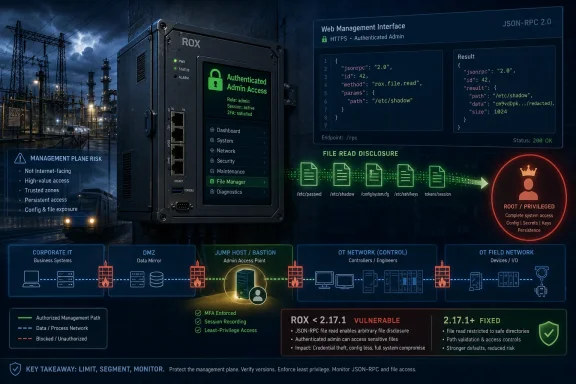
Siemens and CISA disclosed on May 12 and May 14, 2026, respectively, that Ruggedcom ROX devices before version 2.17.1 contain CVE-2025-40948, an authenticated remote file-read vulnerability in the web server’s JSON-RPC interface affecting multiple MX5000, RX1400, RX1500, RX1510, RX1524, RX1536, and RX5000 models. The flaw is not a Hollywood-grade unauthenticated worm, but in industrial networks that is the wrong yardstick. A bug that lets a logged-in remote user read arbitrary operating-system files with root privileges is a quiet breach of trust in the management plane. For power, transport, and factory environments, that is often where the real leverage lives.
The advisory gives CVE-2025-40948 a CVSS 3.1 base score of 6.8, which lands it in “medium” territory. That number is technically defensible: exploitation requires network access, low attack complexity, no user interaction, and high privileges. It does not provide integrity or availability impact on paper.
But CVSS has always struggled with operational technology because the asset’s importance is not fully captured by the exploit primitive. A file disclosure issue on a consumer gadget is annoying. A file disclosure issue on a ruggedized switch or router in a substation, rail cabinet, industrial plant, or traffic-control deployment can expose configuration material, secrets, certificates, routing information, or operational clues that make the next step easier.
Siemens describes the issue as improper input validation in the web server’s JSON-RPC interface. The relevant weakness classification is CWE-88, improper neutralization of argument delimiters in a command, commonly described as argument injection. The result, according to Siemens, is that an authenticated remote attacker may read arbitrary files from the underlying operating system’s filesystem with root privileges.
That phrase should stop administrators from treating the advisory as routine housekeeping. The vulnerability does not merely expose a narrow application file or a harmless diagnostics page. It crosses a boundary from authenticated management access into the device’s root-level filesystem view.
That physical durability can create a dangerous mental shortcut. Engineers and operators may think of these boxes as infrastructure, closer to relays and cabinets than to Linux-bearing network appliances with web interfaces, authentication layers, libraries, command parsers, and firmware release trains. CVE-2025-40948 is a reminder that industrial networking equipment has inherited the same software attack surface as the rest of enterprise IT.
The affected list is broad across the ROX II family: MX5000, MX5000RE, RX1400, RX1500, RX1501, RX1510, RX1511, RX1512, RX1524, RX1536, and RX5000 models are affected when running versions earlier than 2.17.1. Siemens has released version 2.17.1 or later as the fix.
That version detail matters because industrial patching is usually slower than office IT patching. Firmware upgrades in OT environments may require outage windows, vendor coordination, site access, regression testing, and formal change-control approval. A “just update” recommendation can be technically correct and operationally incomplete.
In real OT and industrial-edge networks, management credentials are often more complicated than policy documents admit. Shared accounts, dormant vendor logins, reused passwords, long-lived administrator roles, and emergency access practices can all turn “authenticated attacker” into a smaller obstacle than it appears. Even when organizations have improved identity practices, field devices may lag behind centralized authentication standards.
The vulnerability’s practical risk therefore depends less on the CVSS label and more on who can reach the web management interface. If the interface is exposed to a broad engineering workstation subnet, a jump host used by multiple contractors, or a remote-access path that has accumulated exceptions over years, the “authenticated” requirement becomes less reassuring.
This is why Siemens and CISA both emphasize network protection, segmentation, and limiting exposure. Those recommendations can sound generic because every industrial advisory says them. In this case, they are directly tied to the vulnerability mechanics: if the JSON-RPC interface cannot be reached by unnecessary users or systems, the exploit path narrows sharply.
On a network device, filesystem access can reveal the architecture of the target. Depending on implementation and file permissions, an attacker may look for configuration files, logs, credential stores, certificates, private keys, account data, interface settings, routing context, or evidence of how the device is integrated into the wider environment. Even when sensitive files are not directly readable or credentials are hashed, the information gathered can support lateral movement and future attacks.
That is why the root-privilege aspect is significant. Siemens’ wording indicates the file read occurs with elevated operating-system privileges, not merely with the permissions of a constrained web application user. In industrial security, information disclosure can be a bridge from “I have an account” to “I understand the site.”
For defenders, this changes the incident-response question. The right question is not only whether the device is patched. It is whether logs, configurations, or credentials accessible through the device should now be treated as potentially exposed if an untrusted or compromised authenticated account had access.
Argument injection is the kind of bug that often appears where software translates structured user input into lower-level commands. If delimiters are not handled properly, attacker-controlled input can change how a command is interpreted. The advisory does not publish exploit details, and it should not be read as a recipe, but the weakness classification gives defenders enough context to understand why input validation around the management interface is central.
This is also where WindowsForum readers should pay attention even if they do not run Siemens gear. The management plane has become the soft underbelly of many otherwise hardened environments. Whether the product is a firewall, VPN concentrator, storage appliance, hypervisor host, or industrial router, the web admin layer increasingly carries the highest privilege and the least tolerance for bugs.
The lesson is not that JSON-RPC is uniquely unsafe. The lesson is that administrative APIs are part of the attack surface, not an internal convenience. Once a management interface can execute privileged actions, parse structured input, and sit on a network reachable by humans and automation, it deserves the same scrutiny as any internet-facing service.
That amplification is useful because industrial security work is partly a visibility problem. Many organizations do not have a single authoritative inventory of all embedded devices, firmware versions, remote access paths, and management services across their operational estate. A CISA advisory can trigger conversations that a vendor bulletin alone might not.
The vulnerability was reported by researchers from Palo Alto Networks’ OT Threat Research Lab, according to the Siemens advisory. That kind of coordinated disclosure is the healthier version of OT security research: find the bug, work through the vendor, publish a fix, and give operators a concrete version target. The awkward part is what comes next, because disclosure does not patch field equipment.
For defenders, the presence of a CISA ICS advisory should be treated as a workflow trigger rather than a panic signal. It should start an asset search, version check, exposure review, and patch-planning process. If those steps cannot be completed quickly, the advisory has revealed a governance problem as much as a product problem.
The operational reality is less tidy. Many industrial organizations do not discover vulnerable devices by reading model names in an advisory and immediately matching them to a perfect inventory. They discover them by asking site teams, checking network management platforms, querying configuration backups, examining procurement records, and sometimes physically validating cabinets.
The advisory also has a worldwide deployment footprint and maps to critical manufacturing in CISA’s sector taxonomy. That does not mean every affected device sits in a critical manufacturing plant, nor does it mean every deployment is high risk. It does mean the product class belongs to environments where downtime, safety margins, and maintenance windows are not casual matters.
The best response is therefore staged but not slow. Identify every affected device. Determine whether its web management interface is reachable from user networks, vendor remote access, jump hosts, or monitoring systems. Then decide whether the patch can be applied immediately or whether compensating controls must be tightened until the maintenance window arrives.
For CVE-2025-40948, they are more than boilerplate. The vulnerability is remotely reachable through the management plane, but it requires authentication. That makes access control, route filtering, and administrative reachability central to risk reduction. If only a hardened engineering workstation can reach the ROX web interface, and only named administrators can authenticate, the blast radius is different from a flat network where broad groups can browse device GUIs.
Still, segmentation is not a fix. It reduces likelihood; it does not remove the vulnerable code. If an attacker compromises the right admin workstation or steals a valid high-privilege credential, the flaw remains available until the firmware is updated.
This is the uncomfortable balance in OT patch management. Patching may require planning, but postponing indefinitely turns temporary compensating controls into permanent exposure. The right answer is not to choose segmentation over updates. The right answer is to use segmentation to survive the time it takes to update responsibly.
Windows systems often sit adjacent to industrial networks. Engineering workstations, historian servers, jump boxes, remote access gateways, patch repositories, SIEM collectors, and vendor laptops frequently run Windows. If those systems can reach industrial device management interfaces, Windows identity and endpoint security become part of the OT attack path.
That means a vulnerability like CVE-2025-40948 is not only a Siemens maintenance item. It is also an Active Directory hygiene problem, a privileged access problem, a network segmentation problem, and a monitoring problem. If a domain account or local administrator credential gives a user access to the web management plane, the Windows side of the house is implicated.
The practical coordination point is simple: IT and OT teams should compare notes before the emergency. Windows administrators need to know which jump hosts and management workstations can reach Siemens devices. OT administrators need to know which identities, endpoint protections, and logging controls govern those Windows systems. Neither side can fully assess this vulnerability alone.
The harder part is deciding whether exposure has already occurred. Because the vulnerability involves file disclosure rather than overt system disruption, successful exploitation may not leave the kind of obvious evidence administrators hope for. Device logs, web server access records, authentication logs, remote-access logs, and jump-host telemetry may become important, but the advisory does not provide a public exploit signature.
That does not mean incident response should spiral into speculation. Teams should start with access history. Review which accounts had high-privilege access to affected devices, which source systems connected to management interfaces, and whether any unexpected authentication events appear around the relevant period. If suspicious activity appears, broaden the investigation to configuration exposure and credential rotation.
The most conservative posture is to treat sensitive files and secrets available to the device as potentially exposed if there is evidence an untrusted authenticated party accessed the interface. That may mean rotating local passwords, reviewing certificates or keys, and validating device configuration integrity after patching. Not every organization will need a full credential reset, but no organization should assume “medium” means “ignore.”
The danger is that process becomes paralysis. Industrial teams sometimes postpone firmware updates because the change process is painful, while enterprise teams sometimes underestimate how much validation is required before touching production OT gear. CVE-2025-40948 sits in the middle: serious enough to demand action, constrained enough to allow disciplined planning.
The best organizations will not treat this as a one-off bug. They will use it to check whether their ROX inventory is current, whether firmware versions are tracked, whether management interfaces are reachable only from approved paths, whether privileged accounts are individualized, and whether logs from industrial management systems are retained long enough to matter.
That is the difference between vulnerability management and advisory consumption. Advisory consumption is reading the bulletin and forwarding it to someone else. Vulnerability management is proving where the affected assets are, what version they run, who can reach them, how fast they can be fixed, and what controls exist if they cannot.
Source: CISA Siemens Ruggedcom Rox | CISA
 The Medium Score Hides a Management-Plane Problem
The advisory gives CVE-2025-40948 a CVSS 3.1 base score of 6.8, which lands it in “medium” territory. That number is technically defensible: exploitation requires network access, low attack complexity, no user interaction, and high privileges. It does not provide integrity or availability impact on paper.But CVSS has always struggled with operational technology because the asset’s importance is not fully captured by the exploit primitive. A file disclosure issue on a consumer gadget is annoying. A file disclosure issue on a ruggedized switch or router in a substation, rail cabinet, industrial plant, or traffic-control deployment can expose configuration material, secrets, certificates, routing information, or operational clues that make the next step easier.
Siemens describes the issue as improper input validation in the web server’s JSON-RPC interface. The relevant weakness classification is CWE-88, improper neutralization of argument delimiters in a command, commonly described as argument injection. The result, according to Siemens, is that an authenticated remote attacker may read arbitrary files from the underlying operating system’s filesystem with root privileges.
That phrase should stop administrators from treating the advisory as routine housekeeping. The vulnerability does not merely expose a narrow application file or a harmless diagnostics page. It crosses a boundary from authenticated management access into the device’s root-level filesystem view.
Rugged Devices Still Run Software, and Software Still Fails
RUGGEDCOM gear exists because industrial sites are hostile places for ordinary IT equipment. These systems are built for electrical noise, temperature extremes, vibration, and long service lives. The word “rugged” in the product name is not marketing fluff; the devices are designed for physically demanding environments where replacing network hardware is rarely as simple as swapping a top-of-rack switch in a data center.That physical durability can create a dangerous mental shortcut. Engineers and operators may think of these boxes as infrastructure, closer to relays and cabinets than to Linux-bearing network appliances with web interfaces, authentication layers, libraries, command parsers, and firmware release trains. CVE-2025-40948 is a reminder that industrial networking equipment has inherited the same software attack surface as the rest of enterprise IT.
The affected list is broad across the ROX II family: MX5000, MX5000RE, RX1400, RX1500, RX1501, RX1510, RX1511, RX1512, RX1524, RX1536, and RX5000 models are affected when running versions earlier than 2.17.1. Siemens has released version 2.17.1 or later as the fix.
That version detail matters because industrial patching is usually slower than office IT patching. Firmware upgrades in OT environments may require outage windows, vendor coordination, site access, regression testing, and formal change-control approval. A “just update” recommendation can be technically correct and operationally incomplete.
Authentication Is a Barrier, Not a Comfort Blanket
The most obvious reason this advisory will be under-prioritized is the high-privilege requirement. CVSS says the attacker needs significant privileges before the exploit becomes useful. In a clean, well-segmented, least-privilege environment, that is a meaningful constraint.In real OT and industrial-edge networks, management credentials are often more complicated than policy documents admit. Shared accounts, dormant vendor logins, reused passwords, long-lived administrator roles, and emergency access practices can all turn “authenticated attacker” into a smaller obstacle than it appears. Even when organizations have improved identity practices, field devices may lag behind centralized authentication standards.
The vulnerability’s practical risk therefore depends less on the CVSS label and more on who can reach the web management interface. If the interface is exposed to a broad engineering workstation subnet, a jump host used by multiple contractors, or a remote-access path that has accumulated exceptions over years, the “authenticated” requirement becomes less reassuring.
This is why Siemens and CISA both emphasize network protection, segmentation, and limiting exposure. Those recommendations can sound generic because every industrial advisory says them. In this case, they are directly tied to the vulnerability mechanics: if the JSON-RPC interface cannot be reached by unnecessary users or systems, the exploit path narrows sharply.
File Reads Are Reconnaissance with a Badge
Arbitrary file read vulnerabilities rarely make as much noise as remote code execution. They do not crash systems, spawn ransomware banners, or immediately seize the plant floor. Their danger is more patient.On a network device, filesystem access can reveal the architecture of the target. Depending on implementation and file permissions, an attacker may look for configuration files, logs, credential stores, certificates, private keys, account data, interface settings, routing context, or evidence of how the device is integrated into the wider environment. Even when sensitive files are not directly readable or credentials are hashed, the information gathered can support lateral movement and future attacks.
That is why the root-privilege aspect is significant. Siemens’ wording indicates the file read occurs with elevated operating-system privileges, not merely with the permissions of a constrained web application user. In industrial security, information disclosure can be a bridge from “I have an account” to “I understand the site.”
For defenders, this changes the incident-response question. The right question is not only whether the device is patched. It is whether logs, configurations, or credentials accessible through the device should now be treated as potentially exposed if an untrusted or compromised authenticated account had access.
The JSON-RPC Layer Becomes the Weak Link
The flaw sits in the web server’s JSON-RPC interface, a detail that fits a broader pattern in network appliance security. Modern device management has moved away from serial consoles and proprietary tools toward browser-accessible interfaces and structured APIs. That shift improves usability and automation, but it also concentrates risk in web handlers, input validation, and command-wrapper logic.Argument injection is the kind of bug that often appears where software translates structured user input into lower-level commands. If delimiters are not handled properly, attacker-controlled input can change how a command is interpreted. The advisory does not publish exploit details, and it should not be read as a recipe, but the weakness classification gives defenders enough context to understand why input validation around the management interface is central.
This is also where WindowsForum readers should pay attention even if they do not run Siemens gear. The management plane has become the soft underbelly of many otherwise hardened environments. Whether the product is a firewall, VPN concentrator, storage appliance, hypervisor host, or industrial router, the web admin layer increasingly carries the highest privilege and the least tolerance for bugs.
The lesson is not that JSON-RPC is uniquely unsafe. The lesson is that administrative APIs are part of the attack surface, not an internal convenience. Once a management interface can execute privileged actions, parse structured input, and sit on a network reachable by humans and automation, it deserves the same scrutiny as any internet-facing service.
CISA’s Republication Turns a Vendor Advisory into an Operational Signal
The CISA advisory is a republication of Siemens ProductCERT SSA-973901 under the Common Security Advisory Framework process. That distinction matters. CISA is not claiming new exploitation, new technical analysis, or independent editorial ownership of the finding. It is amplifying the vendor advisory so asset owners who monitor federal ICS channels see it.That amplification is useful because industrial security work is partly a visibility problem. Many organizations do not have a single authoritative inventory of all embedded devices, firmware versions, remote access paths, and management services across their operational estate. A CISA advisory can trigger conversations that a vendor bulletin alone might not.
The vulnerability was reported by researchers from Palo Alto Networks’ OT Threat Research Lab, according to the Siemens advisory. That kind of coordinated disclosure is the healthier version of OT security research: find the bug, work through the vendor, publish a fix, and give operators a concrete version target. The awkward part is what comes next, because disclosure does not patch field equipment.
For defenders, the presence of a CISA ICS advisory should be treated as a workflow trigger rather than a panic signal. It should start an asset search, version check, exposure review, and patch-planning process. If those steps cannot be completed quickly, the advisory has revealed a governance problem as much as a product problem.
The Affected Product List Is a Map for Asset Owners
The affected models span multiple ROX devices used in industrial networking roles. Siemens names the RUGGEDCOM ROX MX5000 and MX5000RE, RX1400, RX1500, RX1501, RX1510, RX1511, RX1512, RX1524, RX1536, and RX5000 when running versions earlier than 2.17.1. The remediation is straightforward in wording: update to version 2.17.1 or later.The operational reality is less tidy. Many industrial organizations do not discover vulnerable devices by reading model names in an advisory and immediately matching them to a perfect inventory. They discover them by asking site teams, checking network management platforms, querying configuration backups, examining procurement records, and sometimes physically validating cabinets.
The advisory also has a worldwide deployment footprint and maps to critical manufacturing in CISA’s sector taxonomy. That does not mean every affected device sits in a critical manufacturing plant, nor does it mean every deployment is high risk. It does mean the product class belongs to environments where downtime, safety margins, and maintenance windows are not casual matters.
The best response is therefore staged but not slow. Identify every affected device. Determine whether its web management interface is reachable from user networks, vendor remote access, jump hosts, or monitoring systems. Then decide whether the patch can be applied immediately or whether compensating controls must be tightened until the maintenance window arrives.
Segmentation Is Not a Substitute for Patching, but It Buys Time
CISA’s recommended practices are familiar: minimize network exposure for control system devices, keep them off the public internet, place control networks and remote devices behind firewalls, isolate them from business networks, and use secure remote-access methods such as VPNs while remembering that VPNs themselves require maintenance. These lines appear so often that they risk becoming background noise.For CVE-2025-40948, they are more than boilerplate. The vulnerability is remotely reachable through the management plane, but it requires authentication. That makes access control, route filtering, and administrative reachability central to risk reduction. If only a hardened engineering workstation can reach the ROX web interface, and only named administrators can authenticate, the blast radius is different from a flat network where broad groups can browse device GUIs.
Still, segmentation is not a fix. It reduces likelihood; it does not remove the vulnerable code. If an attacker compromises the right admin workstation or steals a valid high-privilege credential, the flaw remains available until the firmware is updated.
This is the uncomfortable balance in OT patch management. Patching may require planning, but postponing indefinitely turns temporary compensating controls into permanent exposure. The right answer is not to choose segmentation over updates. The right answer is to use segmentation to survive the time it takes to update responsibly.
Windows Shops Should Care Because OT No Longer Lives Somewhere Else
At first glance, a Siemens industrial-router advisory may seem distant from the Windows administrator’s daily world. Most WindowsForum readers are more likely to manage Active Directory, Windows Server, Intune, Defender, Hyper-V, Azure Arc, or desktop fleets than a RUGGEDCOM RX1536 in a remote cabinet. But the separation between IT and OT is thinner than it used to be.Windows systems often sit adjacent to industrial networks. Engineering workstations, historian servers, jump boxes, remote access gateways, patch repositories, SIEM collectors, and vendor laptops frequently run Windows. If those systems can reach industrial device management interfaces, Windows identity and endpoint security become part of the OT attack path.
That means a vulnerability like CVE-2025-40948 is not only a Siemens maintenance item. It is also an Active Directory hygiene problem, a privileged access problem, a network segmentation problem, and a monitoring problem. If a domain account or local administrator credential gives a user access to the web management plane, the Windows side of the house is implicated.
The practical coordination point is simple: IT and OT teams should compare notes before the emergency. Windows administrators need to know which jump hosts and management workstations can reach Siemens devices. OT administrators need to know which identities, endpoint protections, and logging controls govern those Windows systems. Neither side can fully assess this vulnerability alone.
The Patch Is Clear; the Evidence Trail Is Harder
Siemens has provided a clean remediation target: ROX version 2.17.1 or later. That clarity is welcome. Many advisories leave operators juggling partial mitigations, “no fix planned” language, or complex product matrices. Here, the affected threshold is easy to state.The harder part is deciding whether exposure has already occurred. Because the vulnerability involves file disclosure rather than overt system disruption, successful exploitation may not leave the kind of obvious evidence administrators hope for. Device logs, web server access records, authentication logs, remote-access logs, and jump-host telemetry may become important, but the advisory does not provide a public exploit signature.
That does not mean incident response should spiral into speculation. Teams should start with access history. Review which accounts had high-privilege access to affected devices, which source systems connected to management interfaces, and whether any unexpected authentication events appear around the relevant period. If suspicious activity appears, broaden the investigation to configuration exposure and credential rotation.
The most conservative posture is to treat sensitive files and secrets available to the device as potentially exposed if there is evidence an untrusted authenticated party accessed the interface. That may mean rotating local passwords, reviewing certificates or keys, and validating device configuration integrity after patching. Not every organization will need a full credential reset, but no organization should assume “medium” means “ignore.”
The Advisory’s Small Print Points to a Bigger Industrial Security Cycle
This disclosure arrives in a familiar rhythm for industrial networking: vendor advisory, CISA republication, firmware target, segmentation guidance, and a reminder to perform impact analysis before defensive changes. That rhythm is bureaucratic, but it exists for a reason. In OT, a poorly tested fix can create its own availability problem.The danger is that process becomes paralysis. Industrial teams sometimes postpone firmware updates because the change process is painful, while enterprise teams sometimes underestimate how much validation is required before touching production OT gear. CVE-2025-40948 sits in the middle: serious enough to demand action, constrained enough to allow disciplined planning.
The best organizations will not treat this as a one-off bug. They will use it to check whether their ROX inventory is current, whether firmware versions are tracked, whether management interfaces are reachable only from approved paths, whether privileged accounts are individualized, and whether logs from industrial management systems are retained long enough to matter.
That is the difference between vulnerability management and advisory consumption. Advisory consumption is reading the bulletin and forwarding it to someone else. Vulnerability management is proving where the affected assets are, what version they run, who can reach them, how fast they can be fixed, and what controls exist if they cannot.
The ROX 2.17.1 Line Administrators Should Draw Now
The concrete message for operators is not complicated, but it is easy to dilute. Siemens has drawn the fixed line at ROX 2.17.1, and organizations running affected models below that version should treat the update as the destination, not merely one option among many. Until then, management access should be narrowed and watched.- Organizations should identify all RUGGEDCOM ROX MX5000, MX5000RE, RX1400, RX1500-series, RX1524, RX1536, and RX5000 devices and verify whether they are running version 2.17.1 or later.
- Administrators should restrict web management access to approved engineering workstations, jump hosts, or management networks rather than broad user or business subnets.
- Teams should review privileged accounts on affected devices because the exploit requires high privileges but may become practical if credentials are shared, stale, or poorly governed.
- Security staff should examine recent management-plane access logs for unusual authentication sources or unexpected administrative activity before and after patching.
- Asset owners should treat segmentation as a temporary risk reducer and not as a permanent replacement for applying Siemens’ fixed release.
- IT and OT teams should coordinate because Windows-based jump hosts, engineering stations, and identity systems may be the route by which an attacker reaches the vulnerable interface.
Source: CISA Siemens Ruggedcom Rox | CISA
