

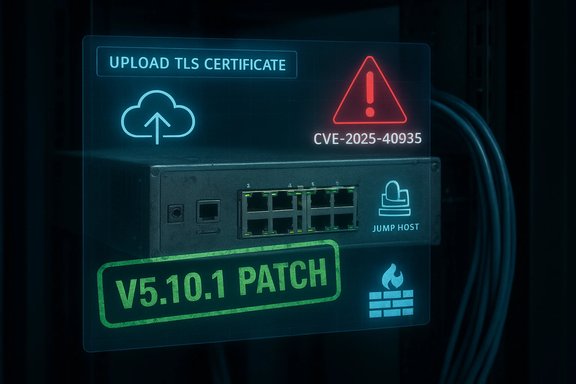
Siemens has confirmed a temporary denial‑of‑service vulnerability in a broad family of RUGGEDCOM ROS devices that can be triggered by malformed input during the TLS certificate upload procedure of the device web service; operators should treat CVE‑2025‑40935 as a patch‑now advisory and update affected units to V5.10.1 (or later) while applying immediate network compensations where patching is not yet possible.
RUGGEDCOM ROS is a hardened embedded operating system used across Siemens’ RUGGEDCOM line of industrial switches, serial‑to‑Ethernet gateways, and ruggedized routers. These devices are commonly found at the network edge in critical‑infrastructure environments — substations, traffic cabinets, rail and industrial sites — where reliability and predictable uptime are primary design goals. The newly disclosed vulnerability, tracked as CVE‑2025‑40935, stems from improper input validation during the TLS certificate upload path of the web administration service and can lead to a crash and automatic reboot of the device under certain authenticated conditions. Siemens published ProductCERT advisory SSA‑763474 on December 9, 2025, listing the RUGGEDCOM ROS V5.X family as affected and marking the vulnerability with a CVSS v3.1 score of 4.3 and a CVSS v4.0 score of 5.3; Siemens’ advisory and multiple independent trackers consistently note that all versions prior to V5.10.1 are vulnerable.
Source: CISA Siemens RUGGEDCOM ROS | CISA
 Background
RUGGEDCOM ROS is a hardened embedded operating system used across Siemens’ RUGGEDCOM line of industrial switches, serial‑to‑Ethernet gateways, and ruggedized routers. These devices are commonly found at the network edge in critical‑infrastructure environments — substations, traffic cabinets, rail and industrial sites — where reliability and predictable uptime are primary design goals. The newly disclosed vulnerability, tracked as CVE‑2025‑40935, stems from improper input validation during the TLS certificate upload path of the web administration service and can lead to a crash and automatic reboot of the device under certain authenticated conditions. Siemens published ProductCERT advisory SSA‑763474 on December 9, 2025, listing the RUGGEDCOM ROS V5.X family as affected and marking the vulnerability with a CVSS v3.1 score of 4.3 and a CVSS v4.0 score of 5.3; Siemens’ advisory and multiple independent trackers consistently note that all versions prior to V5.10.1 are vulnerable. What is CVE‑2025‑40935?
The technical fault (high level)
- Root cause: improper input validation in the TLS certificate upload routine of the device’s web service (CWE‑20).
- Trigger: an authenticated remote actor uploads specially crafted certificate data that the device’s web upload handler fails to validate properly.
- Result: the device process handling the upload can crash, causing the device to reboot and suffer a temporary denial of service (loss of network forwarding/management availability until reboot completes).
- Affected attack model: network‑accessible administrative interface with low attack complexity but privilege‑required (an authenticated actor).
Exact scope — product SKUs
Siemens lists a long set of ROS‑based SKUs in the advisory; the public product lists and CVE aggregators identify the following representative models as affected when running versions prior to V5.10.1:- RUGGEDCOM RMC8388, RS416Pv2, RS416v2
- RUGGEDCOM RS900 (32M), RS900G (32M)
- RUGGEDCOM RSG2100 (32M), RSG2100P (32M)
- RUGGEDCOM RSG2288, RSG2300, RSG2300P, RSG2488
- RUGGEDCOM RSG907R, RSG908C, RSG909R, RSG910C, RSG920P
- RUGGEDCOM RSL910, RST2228, RST2228P, RST916C, RST916P
Timeline and disclosure
- CVE assigned and Siemens ProductCERT advisory published: December 9, 2025.
- Public CVE and vulnerability aggregators mirrored the advisory within days; NVD has an entry that is awaiting NVD enrichment but references the vendor data.
- Commercial OT security vendors (e.g., Tenable) have added detection plugins and guidance to their OT scanners indicating the issue and pointing to the Siemens advisory for remediation.
Risk analysis — who should be concerned and why
Sectors and operational impact
These devices are heavily deployed in critical manufacturing, energy distribution, transport infrastructure, and remote field installations worldwide. Even a temporary DoS on an edge switch or serial concentrator can:- Disrupt telemetry and remote control channels to field devices.
- Break management connectivity (preventing remote diagnostics, configuration, or failover actions).
- Force manual interventions and costly site visits — particularly in hardened physical environments like substations or rail cabinets.
Exploitability and prerequisites
- Privileges required: authenticated access to the web administration interface (the attack is not unauthenticated).
- Remote reachability: the attacker must be able to reach the device’s web service over the network. That could be from within an internal engineering subnet, a poorly segmented corporate network, or via exposed remote‑maintenance tunnels.
- Complexity: low — the flaw is input validation, which typically requires little sophistication once the upload vector is known.
- Likely attacker scenarios:
- Malicious internal actor or contractor with legitimate credentials.
- Attacker who has phished or stolen administrative credentials from a user workstation that has access to the device.
- Post‑compromise lateral movement from a breached host inside the OT/engineering network.
Vendor response and remediation
Siemens’ ProductCERT advisory (SSA‑763474) identifies the vulnerability and notes that affected devices are those running RUGGEDCOM ROS V5.X versions earlier than V5.10.1. The vendor’s remediation directive is to update affected units to V5.10.1 or later where an update is available. In addition, Siemens reiterates long‑standing operational guidelines: protect network access to devices, apply Siemens’ industrial security configurations, and restrict management interface exposure. Third‑party security vendors and CVE trackers echo the vendor’s remediation threshold and urge operators to test and deploy the V5.10.1 update or otherwise apply compensating controls where immediate update is impractical. Commercial OT security tooling vendors have begun deploying sensors/rules to detect attempts to access the TLS certificate upload endpoint and to flag devices on vulnerable firmware.Practical remediation playbook (what to do, step‑by‑step)
- Inventory and identify
- Immediately identify every RUGGEDCOM device in your estate and confirm the SKU and exact ROS firmware version. Match against Siemens’ SSA‑763474 per‑SKU list.
- Prioritise exposed or high‑impact devices
- Prioritize devices that are:
- Internet‑facing or reachable via remote maintenance tunnels.
- On networks that interconnect OT and corporate IT.
- Directly tied to safety‑critical or time‑sensitive operations.
- Plan and test the firmware update
- Obtain V5.10.1 (or later) from Siemens support channels.
- Test the update in a lab or pilot before wide deployment to validate that feature sets and custom configs behave as expected.
- Apply the update in maintenance windows
- Schedule and apply the update, ensuring rollback images and validated backups are available.
- Compensating controls where patching is delayed
- Restrict access to the web administration interface to a minimal set of management host IPs.
- Place RUGGEDCOM management interfaces behind jump hosts or an OT‑dedicated management VPN that enforces MFA and endpoint posture checks.
- Block or filter HTTP/HTTPS management traffic at the OT firewall; allow only explicitly trusted admin hosts.
- Disable the web GUI if it is not required for operational tasks.
- Harden credentials and sessions
- Enforce strong, unique administrative passwords and rotate credentials.
- Use dedicated administrative workstations (jump hosts) and minimize browsing while logged into management consoles.
- Detection and monitoring
- Monitor for unexpected reboots, crashes, or certificate‑upload activity in device logs.
- Deploy IDS/OT‑aware rules to detect anomalous web admin uploads and unusual session behavior.
- Incident response readiness
- Prepare a runbook for device recovery, including validated procedures for manual reconfiguration if automatic updates produce regressions.
- Record and preserve device logs and packet captures if suspicious activity is observed.
Detection and hunting guidance
- Watch for short, repeated process crashes and unscheduled reboots on RUGGEDCOM devices — the advisory explicitly notes a crash/reboot behavior.
- Alert on certificate upload POSTs to the web admin endpoint coming from unexpected source IPs or accounts.
- Hunt for sessions with administrative privileges being used outside of approved maintenance windows or from geographically improbable locations.
- Correlate device‑side logs with jump host session logs to detect lateral moves or credential misuse.
- If possible, capture and analyze TLS certificate upload payloads (securely) to confirm whether malformed uploads are present and to build an IDS signature for similar attempts.
Strengths in the vendor response — and remaining gaps
Notable strengths
- Siemens issued a clear, SKU‑mapped ProductCERT advisory (SSA‑763474) with a firmware threshold and CVE assignment, which helps operators triage quickly.
- The vulnerability has been mirrored in public CVE registries and commercial OT security vendors’ feeds, improving situational awareness across the industry.
Potential gaps and residual risks
- The advisory requires authenticated access to exploit the flaw, which places emphasis on credential protection; however, credential theft or reuse often remains the weakest link in OT environments.
- Some operators run legacy or highly customized firmware where a vendor update may be delayed or require extended testing — in those cases compensating network controls must be enforced rigorously.
- NVD’s entry shows “awaiting analysis,” and public exploit artifacts were not reported at time of publication; this means operators must not over‑ or under‑react and instead follow a measured mitigation plan. Flagging the lack of public exploit‑code is critical: absence of public PoC does not mean the flaw is not exploitable in the wild.
Operational recommendations for Windows and enterprise IT teams
RUGGEDCOM vulnerabilities are an OT problem, but they intersect with enterprise Windows administration in several important ways:- Engineering and admin workstations are often Windows machines. Use hardened, isolated jump hosts (Windows or Linux) for device management that enforce endpoint protection and browsing restrictions.
- Integrate RUGGEDCOM asset data into enterprise vulnerability management dashboards so Windows/IT teams and OT teams share a single source of truth for remediation timelines.
- Enforce least‑privilege and MFA on accounts that can reach industrial devices.
- Use enterprise syslog/SIEM to centralize OT device logs; correlate admin session events and unusual Windows host activity that might indicate credential theft or lateral movement.
For SOCs and managed service providers (playbook)
- Immediately notify affected customers and provide a validated remediation path (V5.10.1 test image and rollback instructions).
- Run targeted scans to identify ROS V5.X devices and report a prioritized patch schedule.
- Offer managed jump host or VPN hardening as a temporary service for customers who cannot patch immediately.
- Provide detection rules (SIEM/IDS signatures) that alert on certificate upload anomalies and unscheduled device reboots.
Verification, cross‑checks, and what remains unverified
The core vendor claims — affected product list, the nature of the flaw (TLS certificate upload input validation), CVE‑2025‑40935, and the remediation threshold (V5.10.1) — have been verified against Siemens ProductCERT advisory SSA‑763474 and mirrored in independent CVE aggregators and OT security vendor advisories. These are the principal, load‑bearing facts of this story. Unverified or unverifiable claims to call out:- There is no public proof‑of‑concept (PoC) widely acknowledged in vendor advisories as of publication; therefore any claims about published exploit code should be treated as unverified unless reproduced and attributed. Operators should treat the vulnerability as exploitable in the presence of valid credentials and network reachability, but should not assume a wide‑scale exploitation campaign without corroborating telemetry.
Long term hardening — reduce the blast radius of future web/UI flaws
- Consistently segment management networks from control and business networks and limit access through hardened jump hosts.
- Enforce multi‑factor authentication for all administrative accounts that manage OT devices.
- Adopt a patch management lifecycle that includes automated inventory, lab testing, and predictable maintenance windows.
- Use configuration baselines that disable unnecessary services (web GUI, HTTP) on devices where possible.
- Deploy centralized certificate management and integrity monitoring for device OS and web components to detect anomalous uploads or file changes.
Conclusion
CVE‑2025‑40935 is a medium‑scored but operationally meaningful vulnerability in the RUGGEDCOM ROS V5.X family: it enables an authenticated attacker to trigger a device crash and reboot via malformed TLS certificate uploads to the web service. Siemens’ fix threshold — V5.10.1 or later — is the definitive remediation; operators must inventory affected devices, prioritize exposures, test and deploy vendor firmware updates, and apply strict network compensations until patching is complete. Cross‑domain coordination between OT engineers and Windows/IT teams is essential to secure administrative paths and prevent credential misuse from turning a manageable web UI flaw into an operational outage. Immediate checklist recap- Inventory: confirm SKUs and ROS firmware versions.
- Patch: schedule and test updates to V5.10.1 or later.
- Segment: restrict web admin access to trusted jump hosts and management subnets.
- Harden: enforce unique admin credentials, MFA, and limited session lifetimes.
- Detect: enable monitoring for certificate upload anomalies and unexpected reboots.
Source: CISA Siemens RUGGEDCOM ROS | CISA
