
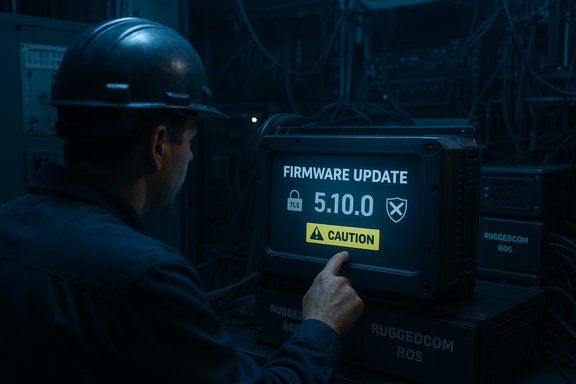
Siemens has confirmed multiple serious vulnerabilities in its RUGGEDCOM ROS family that affect a wide range of industrial switches, routers and serial‑to‑Ethernet gateways, and it is urging operators to update to the newly released ROS 5.10.0 where available and apply strict network mitigations where fixes are not yet available. These flaws — tracked across several CVE identifiers and impacting TLS handling, cipher selection, TLS handshake robustness, and interface access controls — carry mid‑to‑high CVSS ratings and expose industrial networks to man‑in‑the‑middle, denial‑of‑service, and unauthorized‑access risks until corrected. Siemens published consolidated guidance under ProductCERT advisory SSA‑083019 and notified customers to treat ROS V4.X devices as currently unpatched while ROS V5.X devices should be moved to V5.10.0 or later when possible.
Siemens’ RUGGEDCOM portfolio is widely used in harsh and safety‑critical industrial environments — electric utilities, critical manufacturing and transportation — where devices frequently operate for years without change and network segmentation can be variable. The recently disclosed set of ROS vulnerabilities was coordinated and published by Siemens ProductCERT (SSA‑083019), with CVE assignments covering weaknesses in cryptographic choices, TLS handshake robustness, and interface configuration enforcement. External databases and national CVE feeds have cataloged the same CVE identifiers and summary scores, confirming vendor disclosures. Why this matters: RUGGEDCOM devices often sit in the OT management plane or at network edges where they bridge control networks and field equipment. Failures in TLS confidentiality/integrity or in management interface enforcement can be leveraged to observe, tamper with, or persist inside OT communications — consequences that can cascade into operational loss well beyond a single device. CISA has historically republished Siemens advisories for visibility but now directs operators to Siemens ProductCERT for ongoing status updates; operators must therefore follow ProductCERT closely for fix availability and timing.
Source: CISA Siemens RUGGEDCOM ROS Devices | CISA
 Background / Overview
Siemens’ RUGGEDCOM portfolio is widely used in harsh and safety‑critical industrial environments — electric utilities, critical manufacturing and transportation — where devices frequently operate for years without change and network segmentation can be variable. The recently disclosed set of ROS vulnerabilities was coordinated and published by Siemens ProductCERT (SSA‑083019), with CVE assignments covering weaknesses in cryptographic choices, TLS handshake robustness, and interface configuration enforcement. External databases and national CVE feeds have cataloged the same CVE identifiers and summary scores, confirming vendor disclosures. Why this matters: RUGGEDCOM devices often sit in the OT management plane or at network edges where they bridge control networks and field equipment. Failures in TLS confidentiality/integrity or in management interface enforcement can be leveraged to observe, tamper with, or persist inside OT communications — consequences that can cascade into operational loss well beyond a single device. CISA has historically republished Siemens advisories for visibility but now directs operators to Siemens ProductCERT for ongoing status updates; operators must therefore follow ProductCERT closely for fix availability and timing. Executive summary: key technical findings
- Affected families: A broad swath of RUGGEDCOM ROS devices across V4.X and V5.X device lines are in scope; for ROS V5.X Siemens recommends updating to V5.10.0 or later where fixes are available, while ROS V4.X devices remain without vendor patches in many cases.
- Primary vulnerability classes identified:
- Use of a Broken or Risky Cryptographic Algorithm (TLS cipher suites using CBC mode, vulnerable to timing attacks).
- Improper Handling of Exceptional Conditions (malformed TLS handshakes that can crash the webserver / cause DoS).
- Protection Mechanism Failure (interface access control changes not enforced until reboot).
- Representative CVE identifiers and scoring (vendor‑published):
- CVE‑2023‑52236 — legacy TLS/handshake handling (vendor CVSSs published; multiple scoring frameworks applied).
- CVE‑2025‑41222 — TLS handshake malformed message handling leading to potential DoS (vendor CVSS: v3.1 = 5.3; v4 = 6.9).
- CVE‑2025‑41223 — risky cryptographic algorithm (CBC‑mode cipher TLS_ECDHE_ECDSA_WITH_AES_128_CBC_SHA256) with timing‑attack exposure.
- CVE‑2025‑41224 — protection mechanism failure in “NC” (non‑management / non‑control) interface enforcement prior to reboot (vendor CVSS v3.1 = 8.8; v4 = 7.7).
Affected products and versions — what to inventory first
Siemens published exhaustive SKU‑level listings inside SSA‑083019. The short practical checklist for operators is:- Identify all RUGGEDCOM ROS devices (i800/i801/i802/i803 families, RS/RS‑series switches, RS900/RS910/RS920/RS930 families, RSG/RSG2xxx series, RMC and RST model variants, etc. and record exact ROS major/minor versions and memory footprint labels (32M builds vs others).
- Treat any ROS V4.X device as in scope and likely unpatched in many cases, and prioritize updates only if vendor fixes exist for the specific SKU.
- For ROS V5.X devices: cross‑reference the installed V5 release against the ProductCERT matrix and schedule updates to V5.10.0 or later where Siemens lists a remediation. For many V5.X SKUs, V5.10.0 is the vendor‑supplied fix target.
The technical risks explained
TLS cipher suite weakness: CBC mode timing risk (CVE‑2025‑41223)
The affected ROS builds expose the cipher suite TLS_ECDHE_ECDSA_WITH_AES_128_CBC_SHA256. CBC mode ciphers are known to be susceptible to timing and padding oracle style attacks in certain implementations and operational contexts. In OT environments where the session boundary and traffic patterns are predictable, an attacker capable of network‑level interception (or able to execute a man‑in‑the‑middle position) may be able to reduce confidentiality and integrity guarantees or exploit side‑channels to infer plaintext. Siemens’ advisory recommends migrating clients and servers to GCM ciphers where possible and restricting legacy CBC ciphers. Why this is serious: devices in substations or plant networks often exchange control plane data or credentials over TLS sessions; if an attacker can reduce TLS security they can eavesdrop on sensitive management traffic, inject commands, or harvest authentication tokens for later abuse.Malformed TLS handshake handling & DoS (CVE‑2025‑41222 / CVE‑2023‑52236)
Certain ROS webservers do not correctly validate or handle malformed TLS handshake messages. Crafted handshakes can cause the web process to crash or hang, producing a denial‑of‑service that persists until the service or device recovers. The vendor scored these issues in the mid range, but the operational impact in a live OT plant — where remote management visibility and patch pipelines are slow — can be outsized. Operational impact: Denial of the management/web interface may prevent remote diagnostics, firmware pushes, or secure remote assistance — all high‑value goals for defenders that adversaries may seek to disrupt during an attack.Interface access enforcement not applied until reboot (CVE‑2025‑41224)
Some ROS V5.X "NC" variants contain a logic error where changing an interface from management to non‑management does not enforce the revised access restrictions until the next reboot, even when the configuration change is saved. This allows an authenticated user (or an attacker who has obtained credentials) to maintain SSH or management access through an interface that should have been demoted and blocked. Siemens assigned a high severity score to this issue and recommends urgent version checks and fixes where available. Why this is exploitable in practice: credential compromise or lateral movement attacks inside the same broadcast domain can be converted into persistent device access if administrative state transitions are not enforced atomically.Mitigations and remediation: what Siemens and CISA recommend
Siemens’ ProductCERT published prescriptive mitigations and a clear upgrade path for many affected SKUs (update to ROS V5.10.0 or later where available). For products where a fix is not yet available, Siemens provided countermeasures; CISA reiterated industry best practices in its older republished advisories and continues to point operators to vendor ProductCERT pages for follow‑on action. Key operational mitigations are:- Update to ROS V5.10.0 or later on SKUs where Siemens lists a corrective release. Prioritize devices that:
- Are internet‑facing or reachable from less‑trusted networks.
- Provide management plane functions (web/SSH) used for bulk operations.
- Restrict management ports (TCP 80, 443, 22) to trusted IP addresses/subnets via firewall or ACL rules. Blocking or tightly controlling administrative access dramatically reduces attack surface.
- Deactivate the webserver and/or SSH service if not required on a given device and if the product supports such configuration changes. This is an acceptable interim control for high‑risk devices that cannot be patched immediately.
- Configure the web client/server to use GCM ciphers; explicitly disable CBC‑based TLS cipher suites where client and server interoperability permit. Consult the ROS configuration manual for supported cipher lists.
- Protect device network access with defense‑in‑depth: isolate OT management VLANs, place jump hosts/bastion systems in an intermediary zone, and never expose RUGGEDCOM management directly to the internet. Use VPNs and MFA for remote access, but remember VPNs must be kept patched and are only as secure as endpoint devices.
- Inventory: enumerate affected devices and current ROS versions.
- Isolate: ensure management access is limited to a trusted management network or jump hosts.
- Mitigate: restrict ports 80/443/22 at network edge and disable web/SSH if safe to do so.
- Patch: apply V5.10.0 or later per Siemens mapping where a fix is published.
- Verify: after patching, validate that the CVE conditions are resolved and that cipher suites no longer expose CBC modes.
- Monitor: add IDS/IPS rules to detect anomalous TLS handshakes, repeated handshake failures, or scanning against management ports.
Critical analysis: strengths and shortcomings of the response
What Siemens did well
- Comprehensive SKU mapping: SSA‑083019 provides a detailed SKU/version matrix that enables operators to determine exactly whether a given device is fixed or needs compensating controls.
- Patch releases for many V5.X SKUs: The vendor has consolidated fixes into a single target release (V5.10.0) for many affected lines, simplifying patch planning where device support exists.
- Practical interim mitigations: Siemens published sensible, actionable mitigations (disable services, restrict ports, configure cipher suites), which help reduce risk before device updates can be scheduled.
Shortcomings and operational risks
- Large number of SKUs with no immediate fix: A significant portion of the ROS V4.X fleet and several V5.X variants do not yet have vendor fixes, forcing operators into long‑term compensating controls or hardware replacement cycles. This increases operational burden and long‑tail exposure.
- Dependency on correct inventory and rigorous change control: The remediation matrix is only useful if operators can accurately identify installed SKUs and firmware builds — a known challenge in many OT networks where asset hygiene lags.
- Residual cryptographic exposure: For devices that cannot be patched quickly, reliance on disabling services or restricting access may be the only option; however, these mitigations do not fully remove the risk of lateral movement or insider threats.
- CISA’s changed role increases operator burden: Since CISA no longer provides rolling updates for Siemens advisories beyond initial republication, asset owners must track ProductCERT directly. That shift centralizes responsibility on operators and may slow cross‑agency coordination or awareness in some sectors.
Operational guidance for Windows‑centric IT teams managing hybrid IT/OT environments
Even if primary responsibility for ROS devices sits with OT teams, Windows IT administrators will likely encounter these devices in the following ways: Active Directory‑integrated management endpoints, Windows jump hosts used for OT access, and centralized monitoring platforms running on Windows servers. Recommended cross‑domain controls for Windows teams:- Harden jump hosts: ensure Windows bastion systems that access management VLANs run with minimal software, are fully patched, use endpoint protection, and require MFA for access.
- Apply strict firewall rules on Windows hosts that bridge IT and OT zones; only allow management protocols to/from known, authorized hosts.
- Monitor Windows logs for unusual device management activity (unexpected SSH clients, TLS handshake anomalies from OT ranges) and forward to SIEM for correlation with network telemetry.
- Coordinate patch cycles with OT owners: Windows teams often schedule maintenance windows that include network‑adjacent devices; use those windows to coordinate safe ROS updates or configuration pushes.
Detection and monitoring recommendations
Given the vulnerability classes involved, focus monitoring on:- TLS anomalies: unusual handshake errors, repeated incomplete handshakes, and shifts in negotiated cipher suites away from GCM.
- Management port scanning and lateral movement indicators: spikes to TCP 80/443/22 from non‑management subnets.
- Slowloris‑style behavior: many partially open HTTP connections from single or clustered sources; track HTTP connection duration and per‑client connection counts.
- Auditing configuration changes: watch for management to non‑management interface changes and verify that reboots are performed where required to apply access enforcement.
Caveats and items requiring verification
- The vendor CVSS scores, exact CVE vectors and the full SKU mapping were taken from Siemens ProductCERT advisory SSA‑083019 and corroborated with NVD/CVE aggregator entries; operators should always confirm the exact SKU and micro‑build from the device’s own firmware metadata before concluding that an installed unit is remediated. If the device label does not match the advisory mapping exactly, treat the unit as vulnerable until verified.
- Public exploit status is fluid. At the time of the vendor advisory publication no widespread public exploits were confirmed, but that status can change rapidly. Treat “no known public exploitation” as a temporary condition and maintain active monitoring and patching cadence.
- Some mitigation steps (disabling webserver/SSH) may not be operationally feasible in all environments; always perform an impact assessment in consultation with OT engineering before applying changes that could affect safety or availability.
Long‑term risk reduction: strategy beyond immediate patching
- Maintain an authoritative asset inventory that includes SKU, firmware revision and production date; reconcile bi‑annually.
- Adopt a hardened OT baseline configuration that excludes legacy CBC ciphers and enforces secure cipher suites across management planes.
- Institute a secure update pipeline for OT devices: staged testing, rollback plans and rollback images, with rehearsed change windows.
- Use microsegmentation and least‑privilege ACLs to reduce lateral movement and make single‑device compromises less likely to escalate.
- Develop joint IT/OT incident response playbooks and run cross‑domain tabletop exercises focused on device compromise and recovery.
Conclusion
The RUGGEDCOM ROS advisory is a textbook example of modern OT risk: legacy cryptography, fragile handshake handling, and management‑plane logic errors combine to create both immediate and persistent attack surfaces. Siemens ProductCERT has published a comprehensive advisory (SSA‑083019) and released V5.10.0 for many affected SKUs; operators must prioritize inventory, isolate management access, apply network mitigations and schedule the vendor updates where available. Where fixes are not yet provided, strict network controls and service deactivation are the practical interim defenses. Because CISA now directs Siemens users to ProductCERT for continuous updates, asset owners must accept primary responsibility for tracking patch status and applying mitigations without relying on ongoing third‑party republication. Follow the vendor remediation map, implement the mitigations listed above, and maintain vigilant monitoring — these actions materially reduce the window of opportunity for attackers in critical industrial environments.Source: CISA Siemens RUGGEDCOM ROS Devices | CISA
